GE Transport


For at least the past decade the two main issues that have occupied residents’ minds has been (over)development and traffic management (including parking). Each successive council plan has noted this. The planning scheme since time immemorial has promised to introduce parking precinct plans. Such plans have never materialised.

Over the past year council has, without consultation, created havoc in local streets by changing existing parking restrictions. First there was Phillip Street in East Bentleigh (see: https://gleneira.wordpress.com/2016/06/08/councils-parking-management/). Next came the streets around the town hall and the Caulfield Hospital – again without consultation. Council’s response back in June last year was that the new restrictions will be ‘reviewed’. Item 9.7 constituted this ‘review’. The ‘recommendation’ based on the so called ‘surveys’ was that there was ample parking available so nothing much needed to be done except to work with the hospital and to close their pedestrian gates so people won’t be able to get through and therefore not park in these side streets.

The ‘debate’ that ensued on Item 9.7 is fascinating for several reasons –

  • Silver with his statement that ‘it’s a numbers game’ confirms what we all already know. Decisions are not made in council chambers, but behind the scenes at assemblies. If it were any different, his motion to delay further would not have occurred.
  • Since practically every single councillor who spoke confirmed that there was a major problem with parking and safety, then how can these councillors accept the officer report which concluded that there is now a reasonable on-street parking supply that balances the diverse parking needs of the community
  • If it is a ‘numbers game’ then it is incumbent, according to the councillor code of conduct, for councillors to be accountable for their decisions in the council chamber. Davey and Taylor failed to utter a word to justify their vote and Athanasopoulos’ comments were largely irrelevant to the issue!
  • If councillors weren’t happy with the fact of no consultation, then why wasn’t there any resolution to either update the archaic 2002 ‘policy’, or rescind the appropriate delegation, or simply move a resolution which mandated public consultation? Apologies in our view only go so far unless there is action to implement the change desired!

Residents attended in force on Tuesday night. Their anger and frustration was palpable. Here is some of what they said.

RESIDENT #1 – named all the streets that are affected by parking changes around the Caulfield Hospital site and ‘your responsibility is to us, not the public hospital’.  Whilst applauding the government’s investment in health care it shouldn’t be at the expense of the local community. He also accused council of not adhering to its own policy on carbon reduction by increasing traffic, and pollution in the area. Claimed that it made no sense to have restricted parking on main roads like Hawthorn and Kooyong but all day parking in narrow side streets! Asked ‘who thinks like that?’.

RESIDENT #2 – said that staff parking at the hospital is $2.50 but she can’t get out of her driveway and didn’t realise that the hospital could take over her land. Stated that no other hospital such as Cabrini or the Epworth does this.  Reiterated that council’s major responsibility should be to its residents and not to the hospital. Complained about merely getting a letter with no consultation, telling them that this would be done without warning. Wondered if council had any idea how many people lived in these streets, how many cars they had, how many kids, etc.

At this point Delahunty apologised for the lack of consultation but also said that it wasn’t a decision made by councillors!

RESIDENT #3 – started by saying ‘I am mystified’ on what ‘grounds’ the decisions on parking were made. Said that as soon as one side of Sylverly Grove was made all day parking  the street is jammed with traffic. ‘It amazes me. Doesn’t this council have traffic engineers?’ Wondered about council’s transparency. The website contains all the appropriate ‘touchy feely’ words about consultation he just wanted to know ‘on what grounds, the basis, of the decision to change parking restrictions’. Ended by saying ‘I haven’t seen them and I would be amazed if they exist’.

There was also a question as to whether council could provide any parking fine figures for those cars parked in the 2 hour spots. Delahunty responded with ‘probably not’ without notice and she ‘acknowledged’ that ‘monitoring needs to step up’.

Another resident queried the methodology used in the officer’s report since about a dozen streets were listed and the number of vacant spots were noted on an hourly basis. Therefore, did the surveyors have 20 people walking the streets every hour and counting? Council were asked to also include an explanation of methodology in all their reports. Delahunty admitted she had no idea as to methodology. Torres responded by saying that there are ‘staff on the streets’ who do the counts. One resident chimed in and said that he had never seen anyone counting in the street at 7am

There was then a motion to have Item 9.7 dealt with at this point in time instead of later. Passed unanimously.

Silver moved motion to accept recommendations plus that a ‘further report’ be presented in April and that the community plan include as a ‘priority’ traffic management. Sztrajt seconded.

SILVER: started off by saying that he would ‘prefer to stand up and say’ return 2 hour parking ‘right now’ but ‘unfortunately this is a numbers game’ but the main problem is the ‘gate’ at the hospital. His proposal is that ‘we’re not changing right now’ but to tell the hospital to close the pedestrian gates. Said that ‘people should not feel marginalised’ ‘simply because they are not happy with changes to parking restrictions’. Claimed he saw the problems in Sylverly and the bottlenecks created and ‘risks’ that happen on turning into intersections. ‘Ideally we would be changing the restrictions back now’ but ‘it’s best not to take a street by street approach’. The report and motion offers a ‘consistent, thorough approach’  and ‘puts the ball squarely in the hospital’s court’ and once the gate is ‘closed’ will this ‘settle things down’. ‘Ideally I would like to restore them (conditions) now’ but ‘it is a numbers game unfortunately’ and he assures residents that if this doesn’t work then they he will favour restoration. ‘I would like to be announcing a different motion but it is a numbers game’.

SZTRAJT: started by saying that the community ‘has spoken’ on this and he doesn’t think ‘that there are councillors here who want’ the situation to ‘continue’. Claimed that the ‘reality’ is that the hospital charging its staff for parking has ‘ultimately created the circumstance’. So ‘if we are going to offer free parking right outside the hospital’ via the 2 hour parking spots, but this won’t be the ‘ultimate’ fix. The ‘ideal fix’ is to have hospital staff ‘parking at the hospital’ and for residents to be able to park for longer than 2 hours. The ‘way to do that’ is to ‘close’ the gate so ‘council needs to implore the hospital’ to do so. If this happens then the hospital could even get more money in because more staff would be parking there. The hard part is that ‘council needs to have a view beyond’  one street. So the motion is ‘let’s look at the immediate solution of closing the gate’ and then have traffic management investigate the impact ‘in the entire area’. Solving parking in ‘one street is going to move to next street’. Closing the gate is ‘going to make residents happy’ and help solve ‘what is a growing issue for residents’.

ESAKOFF: was against the motion because she thought ‘this needs immediate action’. Thought that the ‘reversal’ of restrictions was ‘very unfair’. Said she said she’s driven down all the streets and ‘found them very heavily parked’ and ‘generally speaking they were all appalling’.  There was also the worry that driving through these streets there was the ‘fear that you wouldn’t get out the end of them in one piece’. ‘They were atrocious’. Thought that what should happen is to ask the hospital to close the gate but also ‘not wait til April’ and ‘see if this fixed the problem’ in all these streets affected by the hospital. Said that people are ‘inherently lazy’ so once the gate is closed the problem should ‘sort itself out’. Stated that ‘parking is required’ for every development application that comes to council and ‘wasn’t sure’ if hospitals were exempt from this requirement. Torres responded that they ‘don’t need’ planning approval on this. ‘We cannot impose a parking scheme on the hospital’.

MAGEE: said he will ‘support the motion but I don’t like it at all’. Believes that ‘every councillor’ gets at least 3 or 4 parking enquiries from residents. The same issues occur around schools and railway stations. ‘To be constantly tweaking and changing’ for this area, then that area’ isn’t effective. Said that council has done ‘traffic studies before’ but things ‘change so quickly’. The hospital ‘knows very well the issues’ and the problems with parking. No-one likes their streets having strange cars parked there but ‘to simply keep reacting’ and changing things, when ‘really what is needed is a holistic approach’ that goes forward into ‘the next decade, the next 2 decades’ on parking and traffic. Council needs to ‘fix’ these issues but ‘it has to be science based’ and looking at ‘who’s coming in, who’s leaving’ and the ‘demographics for the future’. He would ‘hate to push the traffic out of these five streets into the next five streets’ and then ‘in 6 months time doing exactly the same thing again’.

ATHANASOPOULOS: said the first thing he asked was ‘was there consultation done?’ and that he is ‘really a firm believer’ that as ‘this collective group’ ‘we go out to the community first’ before making any decision. He ‘believes’ that ‘our council is also supportive of that outcome’.

HYAMS: said that as a council they have residents who want to be able to park in their streets and ‘exit their driveways’ and on the ‘other hand’ the ‘streets are public assets’ so the ‘question is getting the mix right’. Said that ‘we have a policy’ that prior to any imposition of parking restrictions ‘we always consult with the residents’ and ‘we’ve learnt that we also need to extend this policy for when we change parking restrictions’. Claimed that ‘we didn’t cause this problem, the hospital caused this problem’ by starting to charge fees. (at this point residents called out ‘you are talking rubbish’. Another resident said ‘I am disappointed at the standard of this local government’). The surveys found that ‘the streets were underparked – on the whole’. He acknowledged the frustration in ‘driving around’ all streets ‘looking for a parking spot near a facility’ and the streets happen to be empty but they are all 2 hour parking. Thought that ‘this motion at the moment strikes the right balance’.

SILVER: said he understood that residents ‘aren’t happy with this decision’ and admitted that ‘there should be consultation in the first place’. Thought that the mayor’s apology was ‘very appropriate’. Continued that council ‘would take the steps to ensure there is less traffic in the streets’ but ‘restoring the restrictions’ is not the way to go. Residents ‘should have been consulted. We are consulting now, belatedly, we are going through the process’. ‘we are going to get less traffic either way’ – that is closing the gate or greater monitoring.

MOTION PUT AND CARRIED.

VOTING IN FAVOUR – SILVER, SZTRAJT, HYAMS, MAGEE, ATHANASOPOULOS, DELAHUNTY, DAVEY

VOTING AGAINST – ESAKOFF
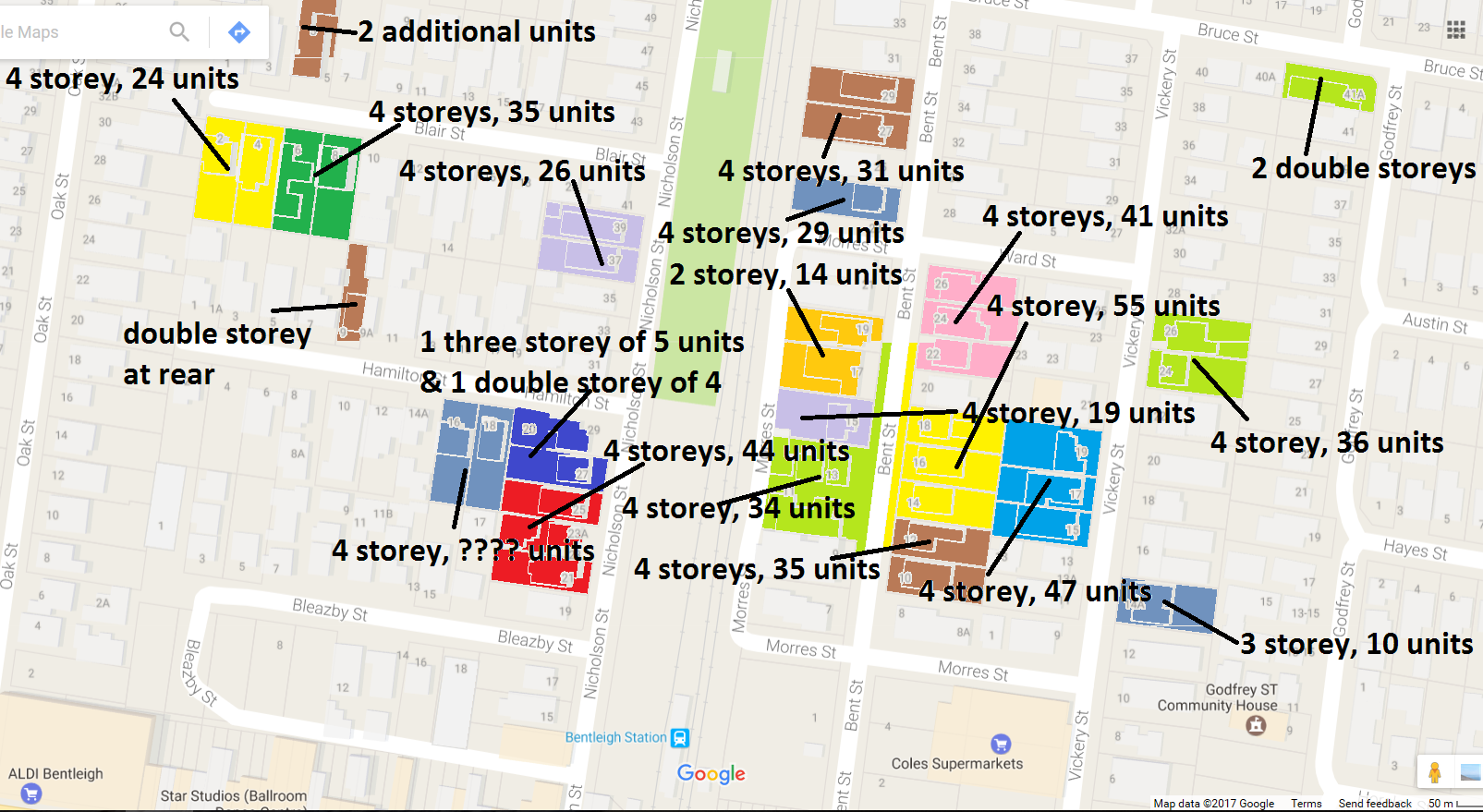
No need for words. The image says it all – 500 apartments crammed into another handful of streets! And this is without the 7,8, and 9 storey developments waiting in the wings along Centre Road itself. We should also point out that in the majority of these developments, permits were granted by Hyams, Esakoff, Magee and Delahunty who also decided that the community was not worth consulting when they introduced the zones in secret and by stealth!

bentleigh2CLICK TO ENLARGE

Featured below is what has been happening in McKinnon over the past 12 months. We have included several applications that council refused on the assumption that the developer will head to VCAT and instead of demanding 32 units for example, he will ask for 30 units. Given the current planning scheme, history tells us that a second bite at the cherry will be successful.

Please note:

  • The map DOES NOT INCLUDE ALL PERMITS GRANTED SINCE THE ZONES WERE INTRODUCED – ie multi-development in Penang for example, or the current amendment for the corner of Wheatley and McKinnon Road. Nor have we included all of the countless 2 double storey developments in these side streets. We have only concentrated on the past 12 month decision making by council and/or VCAT.
  • We estimate that during this time well over 300 new units will be on the cards – some already built, or in the process of being built. According to the planning scheme, Glen Eira requires only 600 net new dwellings per year to meet population growth. Thus a handful of streets in McKinnon alone have achieved 50% of the stated target for the entire Glen Eira municipality!

Residents should start asking the following questions and demanding concrete and honest answers from their councillors:

  1. What drainage upgrades have occurred in this area since the zones came in?
  2. When will council complete its structure planning for McKinnon and the other neighbourhood centres? Are residents expected to wait 10 to 15 years for this to occur according to the published schedule?
  3. Why is the current consultation on the ‘shopping strips’ emphasising the commercial strips, instead of first informing and then asking direct questions on development, traffic, open space, etc? What role did the consultation committee have in ‘devising’ this current consultation?
  4. How many one bedroom apartments have been built in Glen Eira over the past 3.5 years and how many 3 and 4 bedroom apartments?
  5. How many car parking waivers have been granted to all of the developments shown in the map below – and throughout all of Glen Eira itself?
  6. Why is council steadfastly refusing to review the zones themselves – especially since development is occurring far more in local residential streets zoned General Residential and Residential Growth rather than those areas zoned commercial and mixed use?

mckinnonCLICK TO ENLARGE

Apologies for this very long post. What occurred last Tuesday night on this item makes us wonder:

  • Has anything really changed in council?
  • How much are councillors really told/informed about?
  • When will the truth replace fiction? – ie Magee’s comments on ‘what sits next door’
  • Consistency remains elusive given the scores of times that councillors have lopped off several storeys in an application because it was good politics to ignore the ‘expert planners’ on council. Now suddenly it is vital that ‘expert’ recommendations are adhered to.
  • We ask residents to read and judge for themselves whether the level of debate has been elevated or whether this is nothing more than a continuation of the status quo?

Davey moved motion to accept recommendations ‘as printed’. Seconded by Athanasopoulos.

DAVEY: said the ‘report speaks for itself’ and that council has been ‘provided with expert’ advice and that 8 storeys is better than 13.

ATHANASOPOULOS: said he had spoken with residents about the issue. Made the points that ‘six storeys has already been approved in the area’ and this is a ‘stand alone site’ and  council will ‘fight’ so that it ‘won’t become a precedent’. Government wants ‘a landmark’. Council sought expert advice to present to the panel and they’ve got that and ‘the findings give us the tools’ and help council to ‘define our position’. This ‘wipes off 4 storeys from the initial plans’ and council is asking for ‘mandatory height’ which currently isn’t proposed. Said he could be ‘populist’ and ‘oppose the advice which we’ sought. ‘It would be much easier for me to say ‘no’, I think we should go for 6 storeys’ but they’ve ‘made a decision as a council that we want some evidence’. Council has asked for this ‘evidence’ but there will also be ‘other evidence’ that will be presented at the hearing. Said that the traffic evidence could ‘suggest that even 8 storeys is too high’. Said that if they ‘bundle’ all the reports together then if the panel chooses ‘not to go with something’ that could ‘undo all the work’ done. Council needs ‘evidence based defences when we come into these situations’ rather than being ‘wishy washy’ and saying ‘we feel this and so forth’.

ESAKOFF: started off by making several points. (1) this is a ‘neighbourhood centre’ and in council’s heirarchy of centres this is set down for less development in comparison to the 3 major activity centres of Bentleigh, Elsternwick, Carnegie. (2) this ‘sits at lowest’ centre for development (3) schools nearby, childcare, so there are ‘associated parking and traffic ‘ issues. (4) area ‘is a flood zone’ (5) heritage overlays are there and also Neighbourhood Residential zones. The consultants suggest 8 storeys as ‘maximum’ and is based on the desire for this ‘to be a landmark building’. Said that ‘community views in the main are not supportive’ of this and ‘I doubt they would be supportive of any development’ of 8 storeys. Thought that the ‘sticking point’ was the government’s wish that this be a ‘landmark building’. Asked ‘what makes a building a landmark’? Didn’t think that a landmark building ‘needs to be 2 storeys higher’ than its surrounds. Landmarks are building of ‘some special design feature’ and not just height. Said that heritage and neighbourhood status of the centre ‘should be respected’ and traffic shouldn’t be raised to levels that match ‘arterial roads’. ‘Community views should be respected’. Said her ‘preference is not to exceed’ what’s already approved – ie 6 storeys but could ‘succumb’ to a well planned 7 storeys.

SZTRAJT: Thought the whole issue was a ‘circus’. This was a state government project and they are making the decisions so ‘that is already absurd’. Went on to say that the government isn’t ‘building a park’ and they are ‘calling this landmark’ in order to ‘give them the possibility of creating a cash cow’ and to ‘recoup’ their costs for the grade separation. They are therefore ‘using the word landmark to convince us that a residential tower’ is ‘something special in a shopping area’. His concern was that council had to ‘put its stamp of approval on something’ and that ‘the minute we say 8 storeys is acceptable in Ormond’ it will be the  benchmark because this is the ‘first of many towers’ that the state government will be looking to build and ‘I can’t believe the state government is going to show restraint on the first project’ so for the other project ‘not being able to exceed the limits’ they’ve done in Ormond. ‘Therefore, they are not going to listen to this advice’ and will want to ‘build this as high as they possibly can’. They will build their 13 and in a couple of years there will be ‘an application from next door’ where the developer will say that even council supports 8 storeys. ‘We are setting ourselves up’. Said ‘I am disgusted by this report in the first place’ and council has to make sure that ‘if the state government is going to steam roll us, we are not giving permission’ for even 8 storeys. ‘To put anything higher than 6’ is he believes ‘irresponsible’.

SILVER: began by stating that the reason why this tower is proposed in Ormond is because ‘it is a Liberal electorate’ and Bentleigh and McKinnon aren’t. If this was proposed for these latter suburbs then he could ‘assure’ us that the sitting member ‘would be quite worried’. Supported the motion and does ‘prefer the evidence based approach’ although he isn’t completely happy with the proposal. Thought it was ‘damage control’. State government is in control and ‘they want to make a bit of money out of this site’. In cases like this it is worth being ‘objective and look at the surrounding area’ and ask ‘what is reasonable?’ Said that ‘unfortunately, we don’t have those controls anymore’ since it is a government controlled development. Said that the Panel ‘will look for the best evidence, the most persuasive’. Claimed that councillors had a ‘choice whether we put an emotive argument’ which people might be ‘happy’ about, but which is ‘unlikely to give us much credibility’. That would lead to 13 storeys and ‘I don’t want to see that’ nor does he particularly ‘want to see 8’ but ‘it’s better than 13’. Didn’t think ‘this should be happening’ and for the next state election to ‘give the state government hell over this’. Council needs to ‘put its best foot forward’ and to ensure that they have the ‘best option going forward’.

MAGEE: asked the mover and seconder whether they would accept the addition to the motion that council releases the Hansen report. Both agreed. Began by saying that there’s a ‘little place’ called the ‘real world’ and in this place the government has ‘every right’ to do some ‘value capture’ to recoup some of the money it has spent on the grade separation and this money eventually goes to ‘you and me’ as the tax and ‘ratepayers’. Said that council is ‘considering something that we asked for’ (ie consultant’s report). Council ‘decided’ that ‘we didn’t want to go to the Minister and say I think 5, I think 6’. He will ask how did you come to 6 storeys and we will say because next door is 6 storeys. Said that ‘regardless of what sits next door, VCAT cannot use this as a precedent’. With the amendment ‘we can prove how we came to that’ because ‘8 storeys doesn’t throw a shadow’ onto the south side and that the setbacks on the west are ‘sympathetic’ to heritage. ‘We brought in the experts’ and the Minister will listen to them because of all the criteria which ‘we mightn’t understand’ but the panel will. ‘This isn’t about 9 councillors saying I think, I like, I want’ because they are going to front a committee who understands how all this works. Can’t have the ‘expert’ saying 8 and council saying ‘7 or 6’ and council ‘not supporting the officer recommendation’. Said he doesn’t want 8, but he certainly doesn’t want 13 and can’t have a situation where ‘all the experts are saying this, but councillors are saying that’. ‘That defeats the purpose, no matter how much we don’t like it’. They’ve asked for an ‘evidence based approach’ and he thinks it is ‘incumbent on us to actually use that’.

TAYLOR: land is ‘precious’ and house prices are escalating and there’s a ‘housing shortage’. ‘On the other hand’, council has to ‘bear in mind where’ this development will go. All of this ‘has to be considered’ and perhaps a ‘little harsh’ to say that it’s ‘only a money grab’. ‘We did decide that we would defer to experts’ and ‘we are not experts’ in planning and if they are ignored then ‘why pay for experts in the first place?’ Experts give council ‘the best possible chance to get the best possible outcome’. On height and if councillors said only 6, then the panel would ask well, do you want 6 here, and here, over the whole site. But with this proposal there would be ‘bulk at the front’ only and a ‘greater probability’ of getting 3 and 4 storeys at the back. Worried that ‘if we trim that front they will say okay we’re going to have to get it somewhere’ so residents ‘will appreciate that they have a 3 level rather than a six level’ next to them.

SZTRAJT: wanted to ‘clarify something that was said before’ – hamely that if an application goes in for 8 storeys ‘next door’ and ‘we reject it’ whether this means that ‘VCAT can’t approve it’?

TORRES: said the site is under a ‘new set of rules’ which is a ‘building envelope’ and ‘you can build within that height without any resistance from local government’.

SZTRAJT: asked that ‘if a new developer’ and not government puts in an application for ‘8 storeys next door’, council rejects it and the developer goes to VCAT, can ‘VCAT not allow’ that development?

TORRES: asked if this was a ‘scenario on nearby land that is privately owned’. Was told ‘yes’. Said that it ‘would depend on the planning controls on that land’. If ‘it is in a Commercial 1 zone, there is no height control’ and the usual ‘decision making process could include VCAT overriding council decision’.  Said that according to the notion of ‘precedent’, that in planning there is the thinking that ‘each application is assessed on its merits and that tends to move away from the precedent notion’. This is because ‘every site is different’ even if they’ve got the ‘same zones’. ‘It can’t be said that just because there is 8 storeys near by that 8 storeys can just go’ into a neighbouring site.

HYAMS: agreed with Sztrajt and Esakoff ‘except for their conclusions’. SAid that ‘under normal circumstances’ he would never ‘say’ anything that could be seen as ‘supporting 8 storeys’ in Ormond.  Acknowledged that it’s a ‘lower order centre’ and 13 storeys is ‘way out of character’ for the area – ‘but these aren’t normal circumstances’. Government which ‘has power over all of us’ has set the circumstances and the urban design expert ‘has taken into account those circumstances’. Said he’s interested ‘in the best outcome for the community’ and this can only be achieved ‘if we make our expert evidence as strong as possible’. It is ‘possible’ that the government will simply put its 13 storeys up, but council’s best chance is to ‘go along with what our expert has said’. Doesn’t think that ‘just because an expert says something we automatically have to go along with it’. Councillors are the ‘decision makers’ and they have to ‘take that evidence, assess it’. But it’s also ‘important’ that ‘we do achieve the best result by assessing that evidence’.  On the question of ‘precedent’ he thought if it is 13 storeys then this ‘does change the way VCAT’ and applicants will ‘look at it’, and that’s one reason why council is ‘trying to keep it as low as possible’ by ‘throwing our weight behind the expert evidence’.

SZTRAJT: said they’ve been talking about ‘evidence based’ study but ‘we have one piece of evidence’ but ‘I understand that council may also have requested additional’ advice that ‘would include elements like the’ narrow streets alongside the project and ‘issues like the number of cars going’ down these streets. Wanted to know that if council is taking the ‘evidence based approach’ that they are not simply taking ‘one piece of evidence’ but ‘all three that have been requested by council’.

TORRES: said that council’s submission will ‘consist of 3’ expert evidence on traffic, urban design, and retail impact.

SZTRAJT: repeated that he wanted clarity that the evidence based approach is based on ‘all three’ documents and ‘not just one’.

TORRES: ‘yes’. SAid the council rep will ‘orchestrate’ at the panel the ‘strong presentation’ to ‘strongly support our submission’. All are on different topics, but will form part of the submission.

SZTRAJT: asked if ‘one piece of evidence’ is saying 8 storeys  and for example the traffic evidence says that the ‘bulk’ of the building ‘will create’ cars ‘in excess of what the streets can handle’ puts council in a position where they might have to ‘request less than 8 storeys’.

TORRES: said that traffic report ‘will not provide advice on urban design’ but ‘would likely come up with potential suggestions about road widths’ and so on.

ATHANASOPOULOS: asked why Torres had said to councillors that ‘evidence based’ would have ‘a bit more weight behind it’ when council would be arguing their case?

TORRES: said that ‘one word’ missing from all the discussion thus far is ‘independent’. The urban design report ‘has not been guided by officers’. SAid the report is based on ‘urban design principles’. Based on  council’s experience this kind of advice before panels and VCAT has ‘the strongest impact’.

DELAHUNTY: said council is in a very ‘unique’ position. Government on one side and community on the other, and so council had to do what it could to ‘collect the best evidence’. Said they’ve told the government that 13 storeys is ‘ridiculous’. Council has ‘done all that’ so they can’t come back and say ‘we want 5’ with ‘nothing backing that up’. ‘Our reputation is at stake in this process’ and the residents will benefit if ‘that reputation is intact’. ‘This process allows us to enhance our reputation’. They’ve also told government that it is a ‘mistake that they are the planning authority’ and it should be council. ‘Therefore, it is important that we do so with a straight bat’. SAid that the ‘solar access’ points made in the consultant’s report ‘are crucial’ whereas the ‘arbitrary 13 storeys said don’t worry’. Since both sides of the street should be in sunlight therefore the setbacks become important and ‘should be at this amount’. Everyone shouldn’t ‘just talk about height’. ‘Height can disappear if interaction is right’. Council is proposing that the building ‘better integrates’ into the village. There needs to be major ‘scaleback at the back’ to better integrate with heritage. Said that council is like an ordinary community member here and that the best way for them to go is ‘to use this evidence based approach’.

DAVEY: asked for details of when the panel would take place.

TORRES: said he wasn’t ‘up to speed’ on the panel hearing dates.

DAVEY: quoted Esakoff about getting ‘maximum building height’ so ‘hopefully they go less’. Said that Athanasopoulos cited ‘quite rightly’ that these sites have ‘specific controls’. What she found ‘quite disappointing’ plus recognising ‘the irony’ in her saying this as the Green ‘endorsed candidate’, the only party to formally endorse candidates, were Silver’s comments. It is disappointing that ‘we are bringing pure speculation’ about ‘the rationale’ behind the proposal. SAid the government ‘has every right’ to try and recoup its money. What’s disappointing is the speculation that this is ‘being done because of the sitting member in this seat’ (ie Liberal).


MOTION PUT AND PASSED. VOTING AGAINST – SZTRAJT AND ESAKOFF

Council has released the various documents it will be presenting at the upcoming panel hearing for the Ormond Tower project. The files are available at: http://www.gleneira.vic.gov.au/Council/News-and-media/Latest-news/Copy-of-Ormond-Station-proposal

We wish to note the following:

  • The only councillors to vote against the ‘official’ council position of a mandatory 8 storey height limit were Esakoff and Sztrajt. All others in our view adopted the spurious position of 8 storeys is better than 13 storeys. Hardly a convincing argument!
  • The fact that the so called ‘evidence’ was released only AFTER the decision was made cannot be seen as transparent and accountable government. It reinforces our view that like so many other contentious issues in Glen Eira, first make the decision and then massage the ‘evidence’ to support that decision!
  • ‘Evidence based’ is the latest jargon to infiltrate into polit-speak. Our understanding of ‘evidence-based’ is that it stems from medicine in the first place and involves data that is ‘scientific’, ‘objective’ and quantified through such processes as randomised clinical trials held over years and years. Individual ‘clinical expertise’ does come into it, but that ‘expertise’ is accorded the lowest rung on the hierarchy of ‘evidence’ and is measured against the overwhelming findings of the various data sets.
  • We find no such ‘evidence’ in the Hansen report for starters. The term ‘opinion’ is used at least 11 times in the document, whilst ‘in my view’ occurs countless more times. Basically, this is nothing more than the ‘opinion’ of one individual – albeit the opinion of someone with great experience.
  • We challenge anyone to find one single scrap of ‘evidence’ in the Hansen report that would justify the recommendation for an 8 storey building. There is absolutely nothing in this report that would indicate why 8 storeys is preferable to say 7, 6 or even 10 storeys!
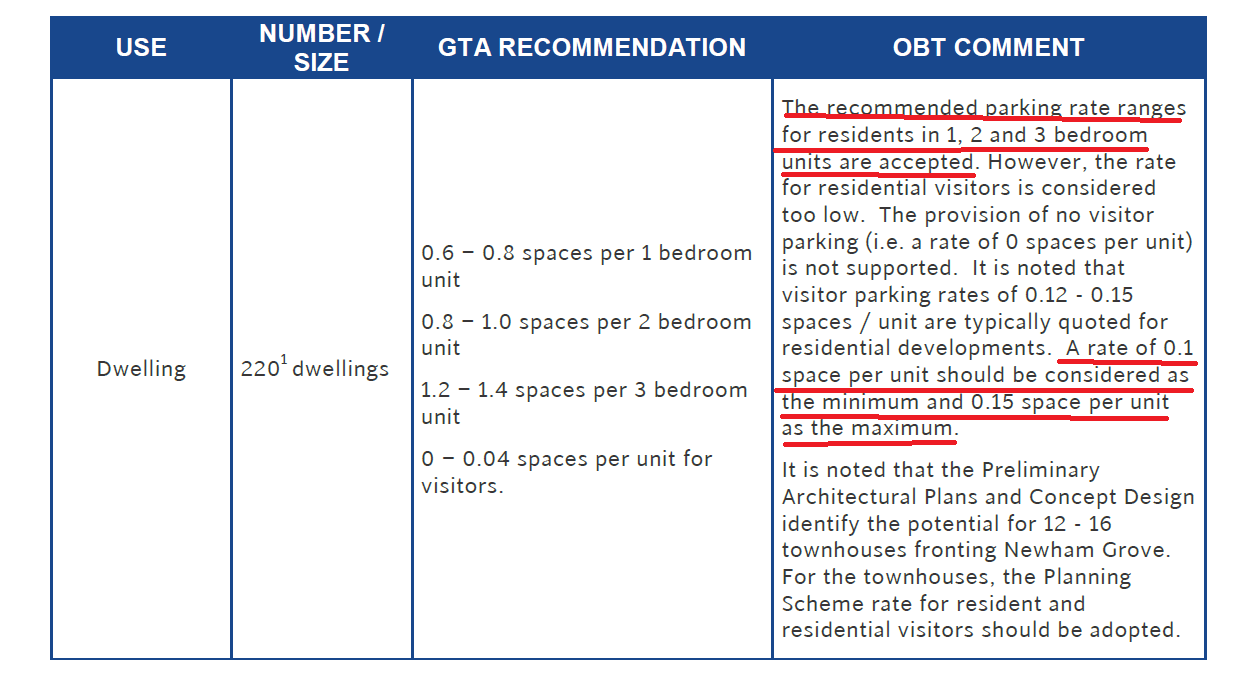
  • The traffic report is equally dubious. And why there is support for a reduction in resident and visitor parking is simply beyond us given that it does not accord with council’s own planning scheme! (see image below).

parking

  • The economic retail report is interesting for several reasons. It announces huge impacts on neighbouring commercial shopping strips if the project proceeds. Mention is made of Bentleigh and others. Yet when it came to the Virginia Estate proposed amendment, the initial officer’s report fobbed off the economic impact by stating that under the zoning of Commercial, the intent was to develop more ‘activity’ and ‘employment’ in these centres.

Thus we have to wonder – did each an every councillor bother to read these ‘expert’ reports? Did they ask some decent questions? When were they briefed on the reports? Or were they simply told by officers ‘this is what we think’ and you should abide by this? Finally, how much did all these ‘experts’ cost ratepayers?

We will report on the actual ‘debate’ in the coming days.

PS: Last night’s meeting was largely all about planning and ‘consultation’. It is a continuing shame how incompetent planning is in Glen Eira when we find (finally) an admission that Council with its proposed interim height amendments (ie Amendment C147) was nothing more than a knee-jerk reaction and a pretense that it was ‘listening’ to the community. It is no wonder that Minister Wynne has refused to gazette these amendments.

We draw readers’ attention to the following paragraph from a VCAT decision where the member granted the applicant a permit for an 8 storey building in Rosstown Road, Carnegie. It shows clearly how – (1) residents have been conned – again, and (2) the quality of council’s planning department, plus (3) why must such information be discovered from third parties and not directly from council itself? Here is what the member stated in his judgement –

Fourthly, I choose to give limited weight to Amendment C147 to the Glen Eira Planning Scheme which seeks to apply a Design and Development Overlay to the review site, which will apply a discretionary height limit of six storeys. The proposed height limit is discretionary, so it does not preclude the consideration of a well designed eight storey building on the review site. Further, in response to my specific question, I have been informed by Council that there is no strategic work that underpins or informs the proposed height limit of six storeys. If such strategic work did exist, and had been adopted by Council, it may have provided me with some understanding or basis on which to further consider whether a reduction of height is appropriate for the review site. In the absence of any such strategic work, I am left with what appears to be an abstract proposed discretionary height limit, which I can only presume is based on the aforementioned development at 2 Morton Avenue, and which is not a seriously entertained planning proposal.

Source: http://www.austlii.edu.au/au/cases/vic/VCAT/2017/158.html

++++++++++

Here’s a summary of how the voting went at tonight’s council meeting – plus a few ‘highlights’.

Ormond Road Eight Storeys – Council will be supporting 8 storey mandatory height limits

Virginia Estate & Victorian Planning Authority – Council will forge ahead with the ‘partnership’ and hold ‘community consultation’ earlier.

Cr Silver distinguished himself by stating that he does not support social housing in Camden Ward.

Council will not be seeking to amend its local law on meeting procedures until at least 2018/19 when the current sunset clause for the law kicks in. Remarkable we say, given that emasculating the public question component of the local law was done so easily and on the whim of Lipshutz, Hyams and Esakoff in particular.

Caulfield Racecourse Trustees have signed the resignation paper but there is a hold up since the question of leases is yet to be finalised. We wait with bated breath!

The details of the above will be forthcoming in the next few days.

From feedback received thus far it appears that resident concerns over the ‘partnership’ between Council, developer and the Victorian Planning Authority, are either not being understood by some councillors, or these concerns are seen as unnecessarily ‘alarmist’.

When the largest ever development is about to occur in Glen Eira, we maintain that community input, from the very start is essential – and not when a draft structure plan has already been devised and to all intents and purposes, probably set in concrete. Any ‘visioning’ must include residents from the start and their involvement must be ongoing throughout the entire project.

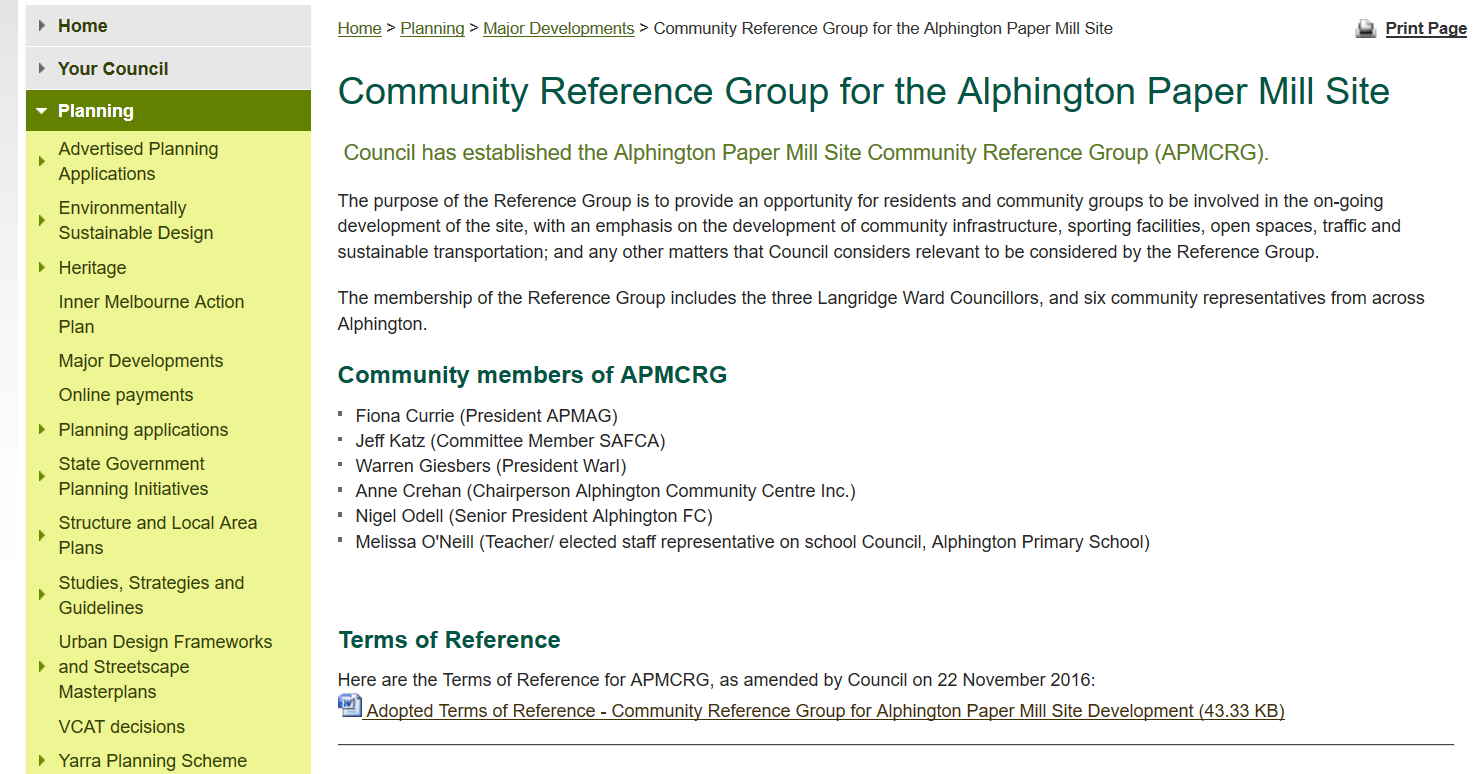
In the current agenda papers, one officer report notes the large development at the old Amcor site. Yarra City Council is one model that should be employed for the Virginia Estate development. Yarra had no problem in establishing a ‘reference’ committee right from the start that included 6 community reps. Yarra had no problem in holding regular meetings where residents through their representatives could bring up issues. This is not rocket science. It is the basis of an inclusive council that sees its residents as partners. If the current mantra of council is to be believed then the establishment of such a group is essential!

Here’s the Yarra Council blurb for this committee –

yarra

We’ve also uploaded HERE, the relevant Terms of Reference for the committee.

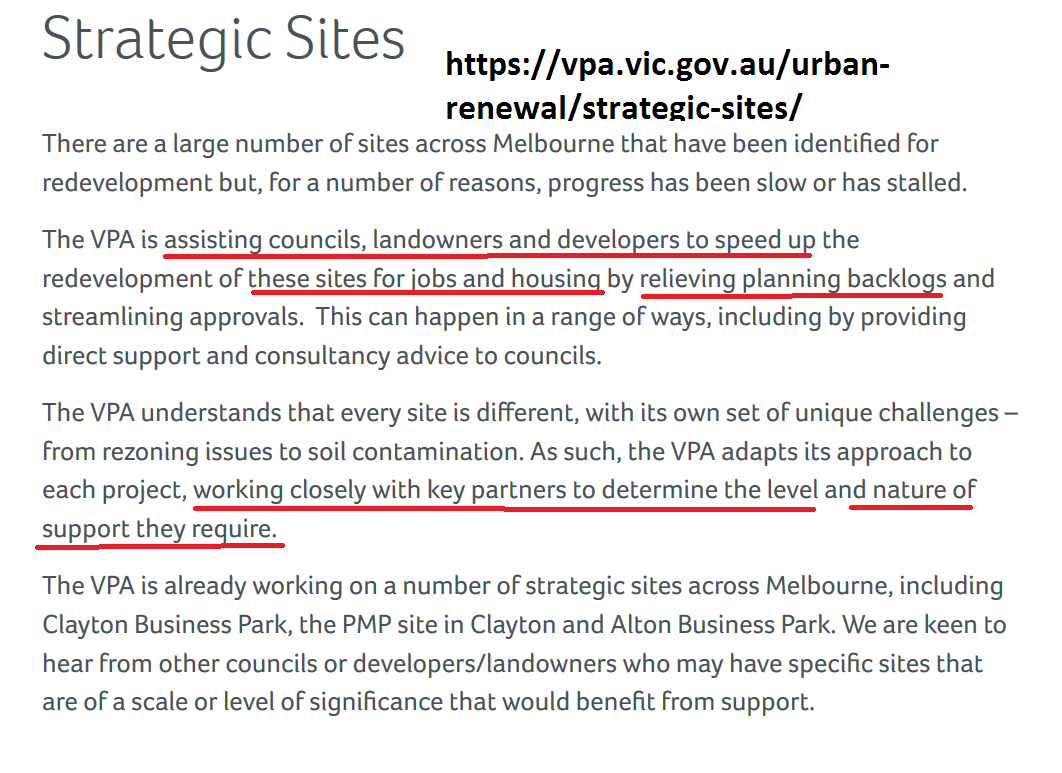
The plans for the development of Virginia Estate have taken a new turn with the proposed ‘partnership’ between council and the Victorian Planning Authority (VPA). This government body is primarily charged with the responsibility of overseeing ‘urban renewal’, especially in growth areas. They are also involved with large development sites within the metropolitan area such as the Monash/Clayton precinct and now East Village. Here is what their brief states –

redsites

All of the above would indicate that government, developer and council are keen to push through rezoning and amendments that will set the ball rolling for Virginia Estate. There is no doubt that at the latest stated figure of 24 hectares, Virginia Estate will be developed, and a very large component will feature residential accommodation. What concerns us is the role that the community will play in this development. The letter from the VPA, included in the agenda, outlines a brief timetable schedule. Please note carefully the following:

  • The time frame for the ‘delivery’ of a draft structure plan for the site is basically 3 months. Yet, the officer report keeps insisting that this will be part of council’s review of its ‘activity centre strategy’ – not due to be completed until 2018 at the earliest. Thus, what porkies are we being fed?
  • Why aren’t the community involved right from the start instead of having the draft structure plan thrust down their throat and then asked to comment? We all know what this means and how little is changed once the ‘draft’ of anything is completed.
  • Why does the officer report emphasise ‘business’ and ‘residential’ barely rates a mention?

We’ve uploaded the proposed schedule. Clearly discussions between government, developer and council have been ongoing for some time given this timeframe. We’ve also uploaded the full agenda item (HERE) so readers can see for themselves the lack of real detail provided.

vpa

In conclusion, VPA does have a role here and council is undoubtedly better off financially if much of the cost comes out of government and developer coffers. What we are concerned about is the level of genuine consultation with the community and whether development gets the go ahead well and truly before infrastructure, transport, etc. is completed.

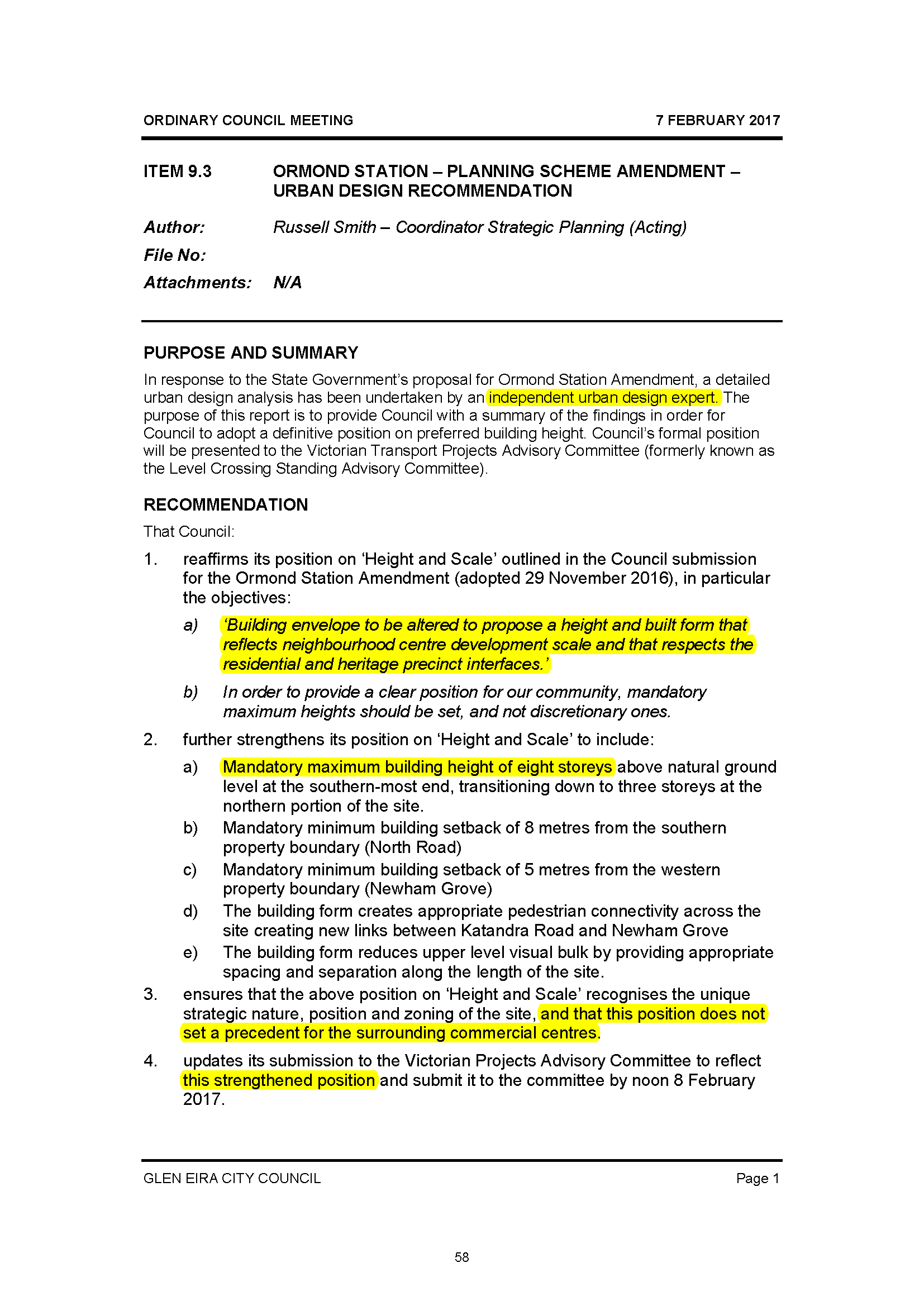
There are 3 agenda items down for decision this coming Tuesday which should set alarm bells ringing for residents. In this first post we concentrate on Item 9.3 – Council’s ‘position’ on the Ormond Railway development site.

What is absolutely staggering about this report and its recommendation is that councillors ENDORSE A MANDATORY HEIGHT LIMIT OF 8 STOREYS!

This is staggering for the simple reason that it exceeds the proposed heights of 7 storeys in Carnegie and 5 storeys in Bentleigh that were nominated in the proposed Amendments for these activity centres. Thus we now have the ludicrous situation where a so called ‘neighbourhood centre’ with less shopping areas and surrounded by residential development is okay for 8 storeys and Carnegie and Bentleigh are deemed suitable for lesser height. Unbelievable shonky planning !

What makes matters even worse is that this recommendation by the ‘experts’ is not even in the public domain. Hence we have the situation where residents are denied access to the rationale which would support a recommendation of 8 storeys. So much for transparency and accountability!

Further, we are told in the officer report  that: In order to form the strongest position possible, City Futures (ie Council) have sought an evidence-based approach to inform Council’s position for a preferred maximum building height. And what is this ‘evidence based’ data on? According to the report it consists of the following –

  • Status of centre
  • Precedents
  • Typology
  • Street wall ratio
  • Solar Access
  • Key View lines
  • Transition
  • Connectivity

We posit that none of the above is ‘evidence’ for an 8 storey apartment block. It might as well be 10 or 12 storeys! Nothing here would suggest that the following important issues have been considered – open space, infrastructure, parking/traffic, development in the area, retail business study, etc. etc. If this is the basis upon which such major decisions are being made, then God help us!

Even worse, is that once again there has not been a single round of ‘consultation’ between residents and council on how high anything should be in the municipality! The rhetoric is all about ‘consultation’. Pity that words never seem to match actions and decisions!

pages-from-02-07-2017-agenda

untitled

« Previous PageNext Page »