Labor to review Coalition residential zones overhaul

Date:November 6, 2014 – 6:51AM

Planning Minister Matthew Guy’s revamp of Melbourne’s residential zones could be overturned if Labor wins this month’s state election, with the opposition promising a major review of the new rules.

Mr Guy warned the review would be the first step in Labor tearing up the new zones in a bid to “bring back Melbourne 2030“, the controversial planning doctrine rolled out by the Bracks governments from 2002.

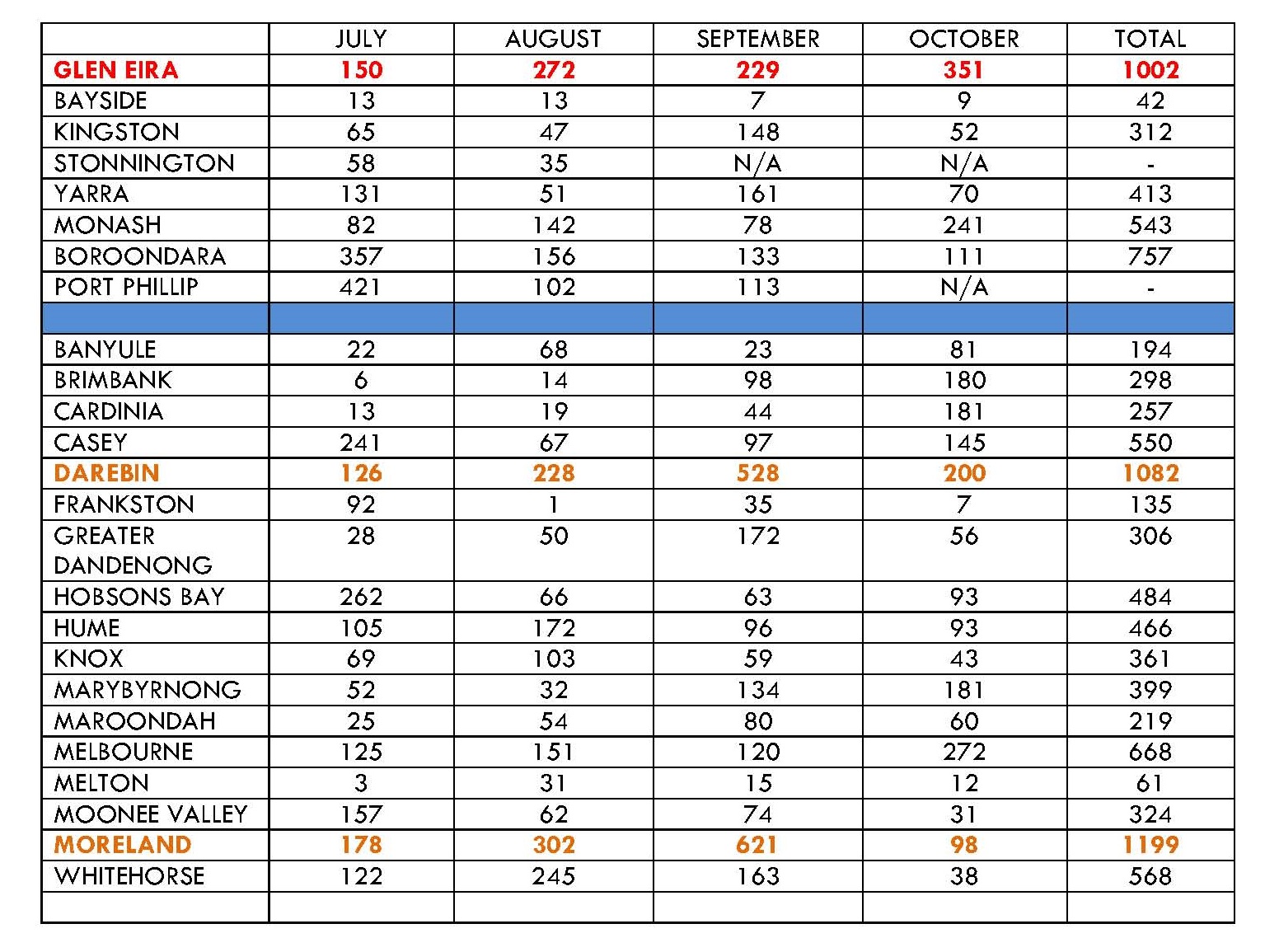
Mr Guy has approved new planning zones for 22 of Melbourne’s 31 councils.

The new zones divide suburbs into streets deemed “no-go”, where nothing over two levels can be built, “slow-go” where up to three levels is permitted, and “go-go” areas where up to four levels is allowed.

Councils have put forward their plans for where high-density development should be banned – but those in the city’s leafiest suburbs have had greater success in convincing Mr Guy to sign off on their proposals.

Glen Eira Council covers suburbs including Elsternwick, Bentleigh, Caulfield and Ormond. It has had 80 per cent of its municipality placed in the “no-go” zone where only two-level development was allowed.

Darebin Council, by comparison, asked for 36 per cent of its suburbs to be placed in this “no-go” zone – but last week learned it had got only 10 per cent.

Labor will on Thursday pledge to review what it says is the “botched” process of rolling out the new zones across Victoria.

Labor’s planning spokesman Brian Tee said Darebin showed decisions on the new zones had been heavily politicised.

The new zones had, he said, “distorted growth and planning by forcing intensive high-rise development in some areas, while locking up leafy Liberal suburbs”.

He said Labor’s review of the planning zones would include an examination of the consultation process and the role of Mr Guy and his office in it, and how the new zones had looked at the housing needs of the state.

But Mr Guy said Labor’s “review” would see the zones already rolled out, which had protected suburbs like never before, thrown away.

“Labor wrecked our suburbs when last in government, and by ‘reviewing’ the Neighbourhood Residential Zone, they’ll do it all over again under Daniel Andrews,” he said.

Labor’s pledge to review the zones came as a Greens candidate for the inner Melbourne seat of Northcote said the new planning rules had treated suburbs in Melbourne’s less conservative suburbs differently to those in Liberal electorates.

Trent McCarthy, who is also a Darebin councillor, said Mr Guy had played a “cruel joke” on residents by rejecting the controls proposed by Darebin Council. It had left many neighbourhoods exposed to “over-development”, he said.

Planners though were circumspect about Labor’s pledge to review the zones.

A group of high-profile planners have opposed the new zones because they restrict development and force medium and high-density housing into smaller pockets of Melbourne.

One outspoken planner, Colleen Peterson from Ration Consulting, said there was “every chance Labor’s proposal will make it worse not better”.

“This isn’t the great salvation – it’s going to play more into the common public perception that residential development is a bad thing,” Ms Peterson said.

She said planning a city should be “just like collecting taxes and building roads – governments have to make decisions for the greater good. It’s not a popularity contest”.

Swinging voters could knock Denis Napthine out in Melbourne’s planning zones

Date
November 6, 2014 – 7:06AM
Concerns: Danita Tucker in Jasper Road, McKinnon, where residents are dismayed by developers' plans to build three-storey apartment blocks. Concerns: Danita Tucker in Jasper Road, McKinnon, where residents are dismayed by developers’ plans to build three-storey apartment blocks. Photo: Penny Stephens

She doesn’t look scary, but there are few people the Napthine government should fear more than someone like Danita Tucker. “I’m a swinging voter,” says the mother of two who lives with her family in a quiet Bentleigh street.

It’s a marginal electorate, held by the Liberal Party by just 0.9 per cent, and one that helped deliver government to Ted Baillieu in 2010.

Bentleigh is among a clutch of seats that could help hand power back to Labor this month.

If the electorate does switch to Labor, the new government will have planning – the perennial debate in Melbourne’s suburbs – to thank for it.

Like the seats of Mordialloc, Carrum and Frankston, Bentleigh is one four marginals strung along the Frankston train line. The suburbs within these seats are not normally known for their political combat.

But, thanks to changes Planning Minister Matthew Guy started putting through last July – and still far from complete – there is an increased focus on urban development.

The new residential zones Guy has begun ushering in have been planned by consecutive governments over the past decade, and have now been introduced to 22 of Melbourne’s 31 council areas. The rollout has been messy, confusing, and has sparked anxiety for many residents.

But the three new zones were an attempt to drastically simplify the planning system and provide certainty – so residents know exactly what’s allowed in their street.

Glen Eira, the council covering Tucker’s area, was the first cab off the rank in Guy’s rezoning of residential areas into three zones: “no-go”, “slow-go” and “go-go”.

The “no-go” zones are called Neighbourhood Residential Zones. They restrict housing development in areas deemed urban preservation zones, and limit development to just two storeys.

Glen Eira had a remarkable 80 per cent of the council’s areas deemed worth preserving.

It compares with just 11 per cent on the other side of the city, in Darebin Council in the city’s north that covers areas including Northcote, Thornbury Preston and Reservoir.

The “slow-go” zones were applied to areas like Tucker’s, where “moderate housing growth” would be allowed, with buildings up to three levels.

In the seat of Bentleigh, the zoning has caused an outcry. Suddenly, residents in the streets surrounding the train line have found themselves pitted against developers wanting to build three-storey apartment blocks.

The new  rules theoretically changed little from existing land zoning. In reality, they removed any uncertainty about what a developer would get, either from the council or the state planning tribunal.

Newly formed resident groups say the changes are now having significant a impact. In a fortnight, Save Our Suburbs will hold a specially convened forum in Bentleigh on the zones.

Residents are concerned because, in the year since the new rules came into the area, several single-level, post-war cottages that have long defined the character of suburbs such as Bentleigh have been bought by developers.

They are to be replaced by townhouses and apartment blocks to house some of the 1.6 million extra dwellings the government’s Plan Melbourne strategy says will be needed by 2050.

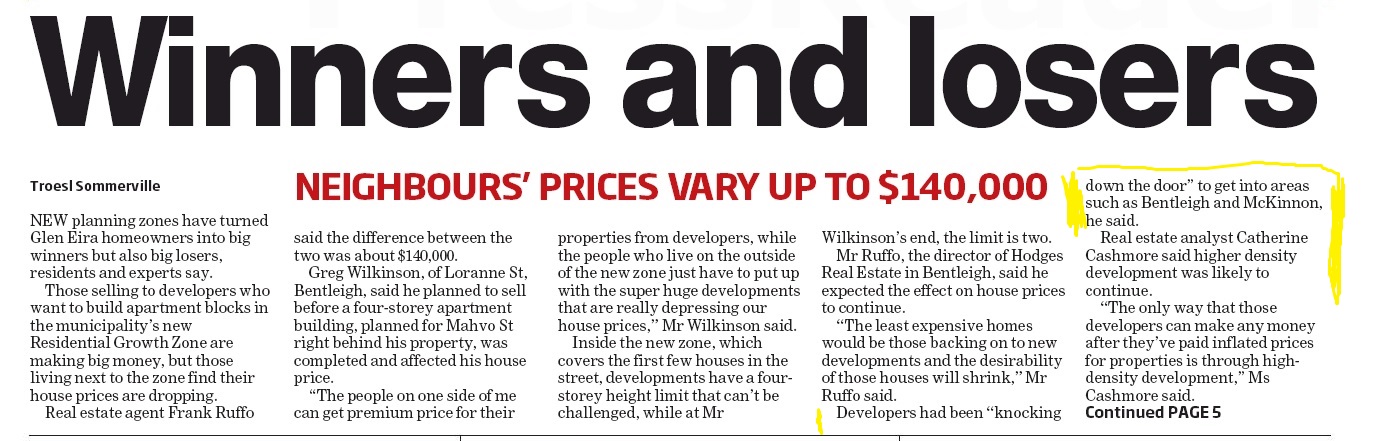
“Developers weren’t really interested in this area until they saw there was a set height limit,” says Tucker, who is watching in amazement as her neighbours houses sell for medium-density housing. Every day flyers come through Tucker’s letterbox from real estate agents.

She says there is “an annoyance at our local member because she has not been looking after the needs of her local community”. The zones, Tucker says, were “just imposed upon us without any engagement”.

That local member, the Liberal Party’s Elizabeth Miller, supported the zones for Bentleigh.

She argues the changes have meant councils are now truly the planning authority for their area, deciding where development is appropriate.

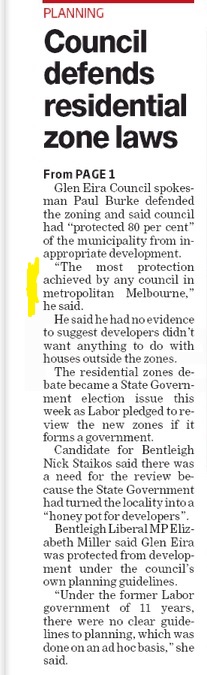
“Glen Eira Council has identified 80 per cent of the municipality is now protected from development under the council’s own planning guidelines,” she says. “Under the former Labor government of 11 years, there were no clear guidelines to planning, which was done on an ad hoc basis.”

Labor’s candidate for the area is Nick Staikos. He says the zoning changes have turned Bentleigh “into a honey pot for developers”.

Staikos is doing a lot of door-knocking and jokes that the zones have had an upside for him in the development rush: “I’m finding there’s a developer or a real estate agent who’s been here just before me – residents are relieved I’m a politician.”

Glen Eira is among a lucky few councils – Bayside and Boroondara are the others – that were major beneficiaries of the zoning changes, with Guy locking up all but 20 per cent of each of the well-to-do councils’ suburbs from developers wanting to build anything above two levels.

While other councils like Darebin, Moonee Valley, Darebin and others were less fortunate, Guy boasted last week on ABC Radio he had introduced the toughest zoning laws in the country.

“Around 80 per cent plus [is] in the most restrictive zone in Australian residential zoning history, the government’s new neighbourhood residential zone.”

Guy wasn’t so keen to talk about the small pockets in places such as Bentleigh, Moorabbin, Highett and Cheltenham now facing what is known as the “go-go” zoning – the Residential Growth Zone.

These are areas where residential streets near train lines and busy shopping strips have been, or are to be, rezoned to allow developments of at least four storeys. There aren’t many in the marginal Bentleigh electorate affected by this.

But across the rail line from Bentleigh is the far safer seat of Sandringham, held by Murray Thompson – son of a former premier Lindsay – by a margin of 15.6 per cent.

It is in the council area of Bayside. There, while the richest suburbs like Brighton and Sandringham have largely received the highest level of protection from “over-development” available in Australia, the less wealthy have been put into this pro-development category.

A drive around the streets affected by these proposed new zones in Cheltenham, Moorabbin, Highett and near the long-promised new Southland railway station shows why many residents are anxious.

Typical is Highett’s Major Street, a quiet dead-end so narrow the rubbish truck can’t turn around and has to reverse out each week. It has a few new two-storey townhouses, but most of its 20 houses are single level.

On one side of the street – the side to be rezoned for up to four-level development – every house bar one has a sign Melbourne has seen before: “We Will Oppose Inappropriate Development.”

Gary McCulloch bought in Major Street two years ago “because it was a very quiet, family-oriented street that was organically regenerating”, and now fears he will soon have an apartment tower looming over him.

McCulloch doesn’t know who to blame for the zoning that could soon be finalised on his street: Bayside Council or the minister. They blame each other.

But he’s sure of one thing: “None of this is based on sound planning principles, and it is a result of political interference from the state government – there are no votes for them here or in Cheltenham. They wouldn’t dare upset their blue-blood constituents in Brighton.”

Bayside mayor Laurie Evans says the council was forced to choose the high-growth zones after Guy’s chief of staff demanded the council select areas along the Frankston railway line.

Guy argues the zones have provided people with certainty, protecting large areas of Melbourne from inappropriate high-rise development.

He says Labor had never accepted responsibility for some of the problems created by the “anything-goes Melbourne 2030 policy”. He argues its push to consolidate Melbourne into its existing boundaries fuelled inappropriate overdevelopment.

Labor, for its part, on Thursday revealed that if it was elected it would complete a major review of the zoning changes.

“Communities right across Victoria are complaining that they were not consulted,” Opposition planning spokesman Brian Tee says.

“Outcomes have been forced on them with many residents believing the changes to what can be built in certain areas is political – some suburbs have been protected and development has been pushed elsewhere.”

Perhaps most surprisingly in the debate around the zones in the bayside areas is that, while residents are unhappy, developers are equally dissatisfied. A group of them, represented by high-profile planning barrister Nick Tweedie, SC, last month told a planning department committee considering the new high-growth zones that they would have preferred them to be in more affluent bayside areas.

James Larmour-Reid is president of Victoria’s Planning Institute, which backs the new residential zones as a means of managing growth and change across Melbourne. Larmour-Reid says the new zones, after a decade of debate, have provided a method of implementing “go-go”, “slow-go” and “no-go” areas in council housing strategies.

But he says that missing from the plan to push forward with the residential zones was “an overarching metropolitan housing strategy”. It was also unfortunate that the government’s Plan Melbourne strategy had been released only after the new residential zones had started to be rolled out.

Larmour-Reid says it is  “too early to make a call on whether or how the new zones are shaping development proposals in particular locations” because the housing market is constantly evolving.

Questioned over suburbs such as Bentleigh seeing a surge of applications for medium-density development, he says these sorts of projects were always possible under the old zones.

And, he says, medium-density development might just be something Melbourne has to start getting used to.

“Apartments are now being constructed at greater distances from the CBD in places like Mitcham, Glen Waverley and Preston.”


PS – and the Labor Party Media Release –

LABOR WILL TAKE THE POLITICS OUT OF PLANNING

 An Andrews Labor Government will review the botched planning zones imposed on councils and allow communities to have their say.

The Napthine Government has distorted growth and planning by forcing intensive high-rise development in some areas, while locking up leafy Liberal suburbs. Under Labor’s plan, new planning zones will be reviewed with a full report tabled in Parliament. The review will examine:

• The Napthine Government’s consultation process •
  • The role of Planning Minister Matthew Guy and his office in that process
  • • Departmental advice on zone application and what weight is given to heritage, local character and the housing needs of the state
  • • The impact of the zone changes on our suburbs
  • • Alternative ways to meet our housing needs
  • • How the zones can better fit within the framework outlined in Plan Melbourne Quotes attributable to Mr Tee “The Liberals can’t say they support growth and development in Melbourne if they target suburbs based on their politics.” “Under the Liberals, local councils are getting trampled over, the community doesn’t have a say and some of our oldest and most vibrant neighbourhoods are facing the wrecking ball.” “Labor will take the politics out of planning. We’ll meet the housing needs of our future but we’ll take communities and councils with us.”
  • Key Facts
  • • Plan Melbourne, the Napthine Government’s vision for Melbourne to 2050, outlined the need for 1.6 million houses to keep pace with population growth.
  • • The Napthine Government’s new zones were released before Plan Melbourne was released.

Untitled

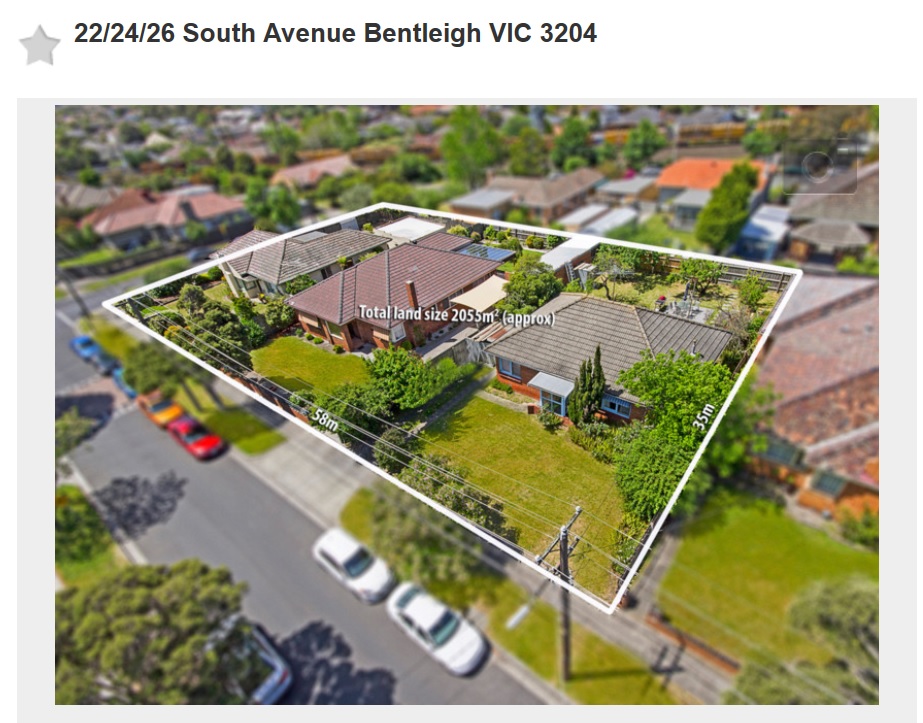
Land is over 2000 square metres and zoned GRZ

Listed below are some of the latest planning applications yet to be decided. We draw readers’ attention to the following:

  • The number of requested car parking waivers
  • The lack of detail provided in council’s register (ie ‘multi-unit development’). The legislation requires that council publish what the proposal states. It is entirely inadequate that a phrase such as ‘multi unit development’ meets this requirement. If this is all that was submitted, then it should never have been accepted. If the application is far more detailed, then council needs to publish the details in full.

BENTLEIGH

14-18 Bent Street – Construction of a four (4) storey building comprising of 55 units (above basement car parking)

477 South Road – The construction of a four (4) storey building comprising of five (5) dwellings and a shop and reduction of the car parking requirements for the shop use and visitor car parking

85 Robert Street – Construction of a three (3) storey building (above basement level) comprising of ten (10) dwellings and a reduction of the associated visitor parking requirements

CARNEGIE

14-16 Elliott Avenue – Construction of a four storey building comprising twenty-one (21) dwellings (above basement car parking) and a reduction in the associated visitor car parking requirements

5 Tranmere Avenue – The construction of a four (4) storey building comprising of twelve (12) dwellings

ORMOND

2 Ormond Road – Construction of a three (3) storey building above basement car park comprising of 15 dwellings

2 Ulupna Road – The construction of a three (3) storey building comprising of sixteen (16) dwellings with basement car parking

CAULFIELD NORTH

90 Hawthorn Road – Construction of a three (3) storey building (above basement level) comprising of twenty-six (26) units and alteration of access to a road in a Road Zone, Category 1 on land affected by the Special Building Overlay

97-93 Hawthorn Road – Construction of a five storey building comprising of a shop and up to eighteen (18) dwellings; reduction of car parking requirements associated with the shop and a waiver of loading bay requirements

1A Orrong Crescent – Construction of a four (4) storey building comprising three (3) shops and eighteen (18) dwellings above basement car parking; reduction in car parking requirements and waiver of the loading bay requirement

BENTLEIGH EAST

817-819 Centre Road – Construction of 26 apartments, associated reduction in carparking and alteration of access to a road in a Road Zone Category 1

908 Centre Road – Multi unit development

2 Malane Street – Construction of a three (3) storey residential building comprising eleven (11) dwellings

CAULFIELD

307 Hawthorn Road – Construction of multiple dwellings on a lot, alteration of access to a road in a Road Zone Category 1 and a reduction in the visitors parking requirements of the Glen Eira Planning Scheme


In return for 2046 dwellings (at this stage) which will comprise the Caulfield Village, our great negotiators exacted the paltry sums of 4 and 5 percent as the open space contributions. We estimate that this will provide a return of around $5 to $6 million by the time the money starts rolling in. Similar, long term ‘negotiations’ have taken place over the Moonee Valley Racing Club’s development plans.

Matthew Guy recently gazetted the amendments necessary – declaring the area the equivalent of a Priority Development Zone and, also similar to Caulfield, the creation of an Incorporated Plan approach. An Advisory Committee had been set up to consider the proposals and public hearings were held over ten days. Guy admittedly over-rode many of the committee’s recommendations regarding height and density. However, the following conditions were exacted from the racing club and outstrip by light years what our wonderful negotiating team achieved. We cite directly from the council minutes and remind readers that when queried about the open space within the Caulfield Village development there was no answer forthcoming from our planners and negotiators.

In the end, the Moonee Valley Racing Club were forced to cough up some substantial concessions since council and community worked together. In Glen Eira, residents have to wonder who the negotiating team really worked for? According to the figures below, the Moonee Valley Council can look forward to about $12 million in levies, and countless other millions worth in public facilities. Not so in Glen Eira!

This will allow for the provision of cash and land contributions up to the value of $6,000 per dwelling.

The contributions are to comprise the following:

  • A public open space contribution in the form of a single park equivalent to 5,000 square metres, and additional open spaces up to 2,000 square metres.
  • A financial contribution equivalent to the construction of 2 full sized AFL/Cricket playing fields, including lights and car parking.
  • A financial contribution equivalent to the construction of a 500 square metre sporting pavilion.
  • Delivery/upgrade on-site or off-site for physical and community infrastructure,having regard to the demand generated by the anticipated additional populationwithin the precinct, including:
  • Contribution towards or provision of public art on the site.
  • Financial contributions equivalent to 30% of the construction cost of a Multi-Purpose Community Facility on-site (based on a 500 square metre facility)

Source: http://mvcc.vic.gov.au/~/media/Files/Governance/Council%20meetings/2014/28%20October%20Ord%202014/Agenda%20%20Ordinary%20Council%20Meeting%20to%20be%20held%2028%20October%202014.pdf

We’ve received a series of photographs that illustrate the carnage caused by development and the failure of this council to enforce its own regulations – much less fine contractors or even order a halt to construction because permit conditions aren’t being adhered to or everyday road rules are ignored. There is absolutely no excuse why residents living near these constructions should have their safety, and lives impacted to such an extent. Developers are not outside the law – but it might appear to some that in Glen Eira they are free to do what they like, when they like, and how they like!

photo13

photo2

photo6 and 7

photo10

photo11


photo5


Last council meeting the agenda was jam packed with application after application – all of them highly contentious and controversial – ie Belsize Avenue, Penang St., Mavho St., Lorranne St., Tucker Road, etc. We commented at the time that this is the typical council strategy. Cram all important decisions onto the one agenda so that debate and decision making is reduced to a measly 5 or 10 minutes each, as well as getting the resulting ‘pain’ from outraged residents over in the one fell swoop!

The agenda for next Wednesday night’s council meeting confirms this deliberate manipulation. There’s nothing that equals last meeting’s controversy. Item after item is so inconsequential that we have to laugh at the obvious ‘light weight’ nature of this agenda compared to what was dished up three weeks ago. There are no planning applications that occur in residential zones; there are no reports that couldn’t have appeared at last meeting given that councillors had requested them as far back as the 23rd September and the 12th August. For a council that claims to get councillor requests back at the next meeting this makes a mockery of such claims. Manipulation of the agenda is the name of the game!

There are however a couple of interesting applications for increases in both height and number of dwellings. These are all in areas zoned Commercial and hence there are no height limits. We’ve done a comparison of two of these in order to illustrate how inconsistent and nonsensical the officers’ reports are. Readers should remember that basically, these constitute a single development. Council in its benevolence at the time of decision making granted them 13 public car parking spots in return for an exeloo toilet! The buildings will ultimately be seen as basically fronting Centre Road, so why one should be allowed to be 5 storeys and the other only 4 given that both abut residential areas is anyone’s guess.

669_Page_1CONCLUSIONS

  • Given that these buildings are literally side by side, then allowing car parking waivers on one and simultaneously arguing that trucks can park on the same street taken up by cars from the other development is quite farcical
  • Since both are on Centre Road, why should one report single out the opposite side of Centre Road and argue that 4 storeys will dominate, but that 5 storeys won’t? Further the mention of Tucker Road buildings are at least 850 metres away – see screen dump below.
  • Finally we don’t believe that asking for accuracy and some decent officer reports is demanding too much – especially not when ratepayers are footing the bill for such efforts!

tuckerPS: THIS MUST SURELY TAKE THE CAKE!

UntitledAND THE BLURB STATES:

Vacant Land with Plans and Permits approved

Planning Permit Now Issued.
13.72m X 13.31m = 182.60m2 approx.
Elevated from the street with entrance from rear laneway.
Possible site for a 2-3 bedroom unit.
Use your imagination to create your new home in this great location.
Minutes to transport, shops, parklands and good schools.
Call for more details.

2011522262

quinnsblurb

Our apologies for this long post. However, we believe it lays to rest any misapprehensions about the new zones and the damage they are wreaking throughout Glen Eira.

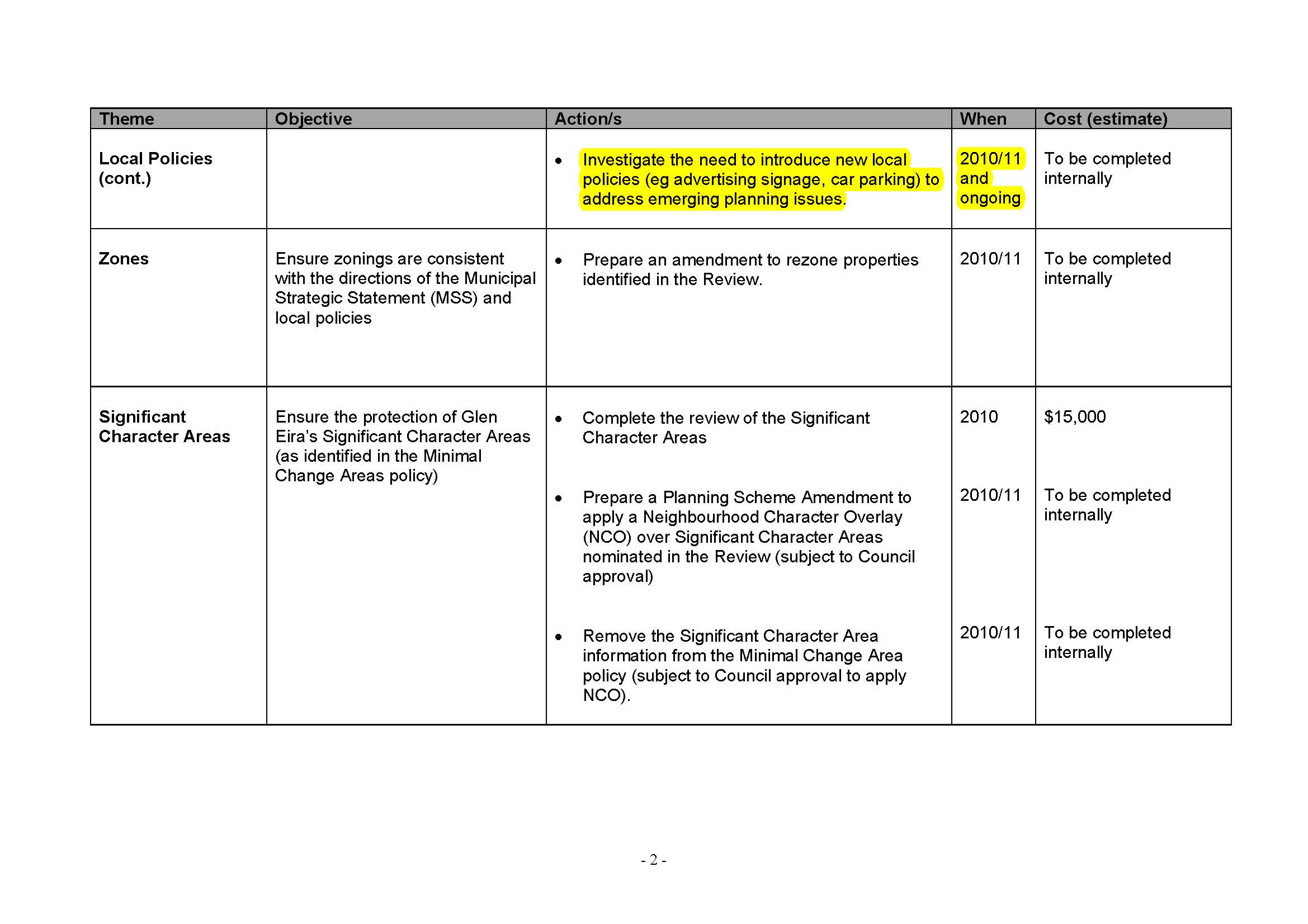
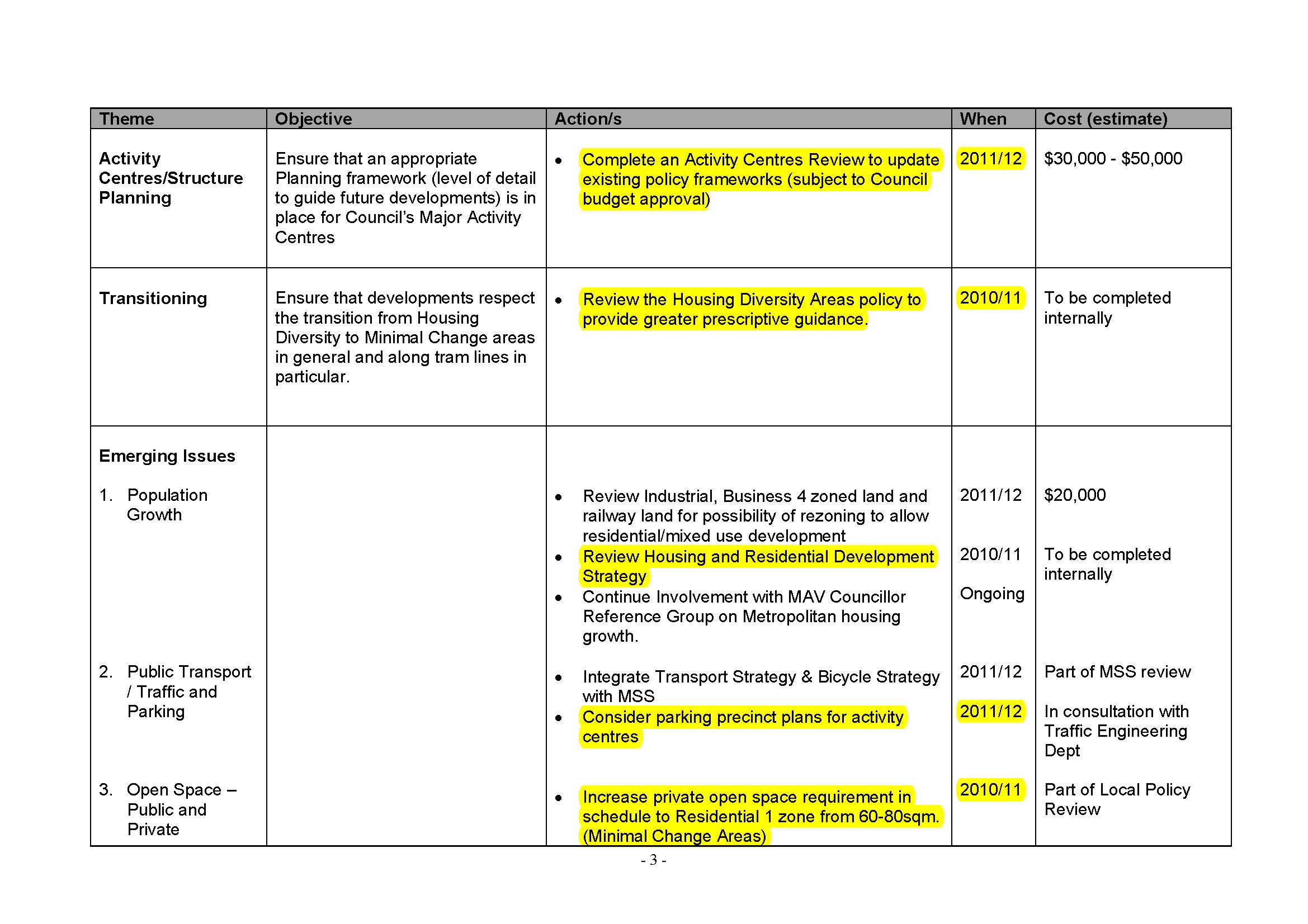
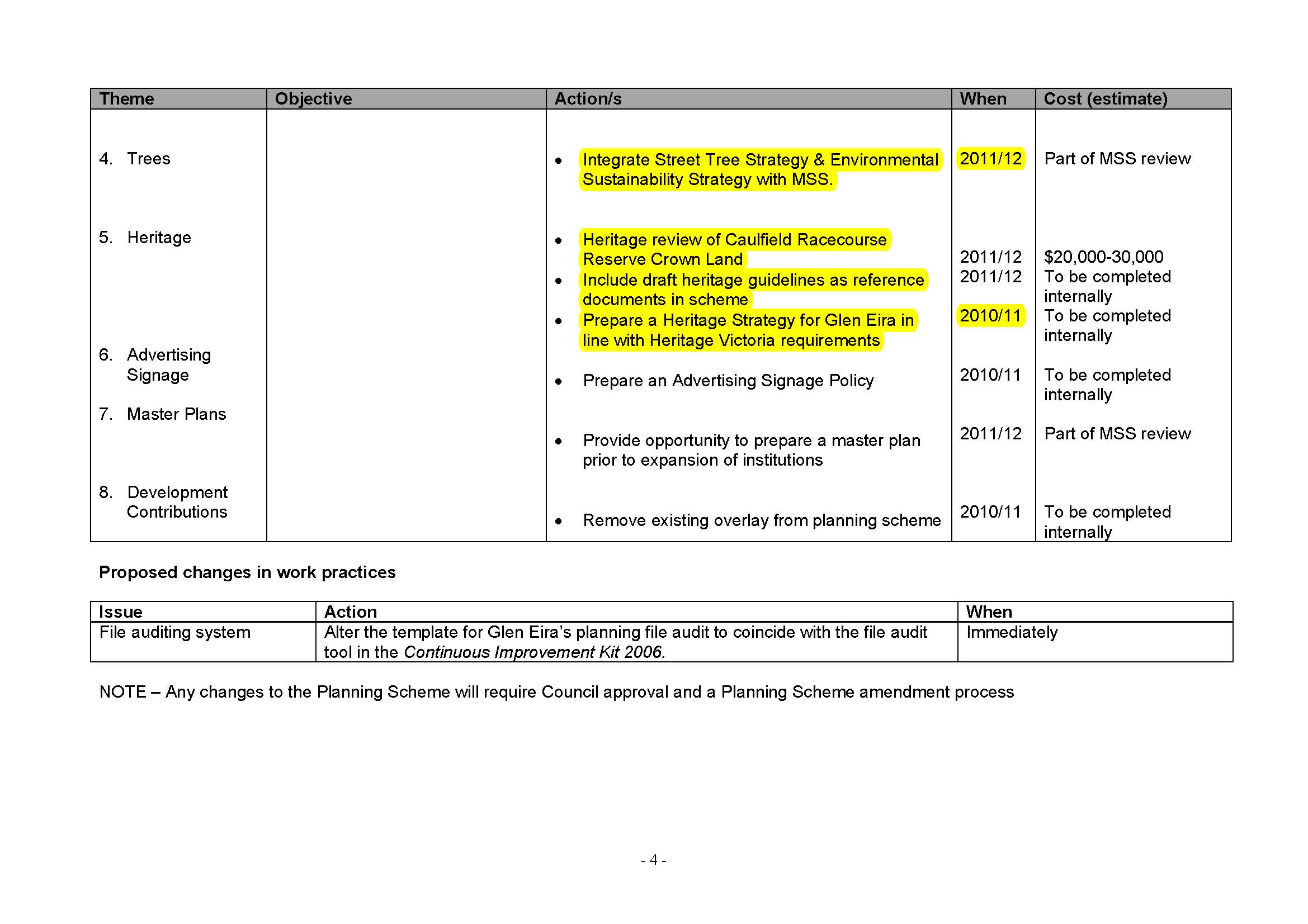
We highlight one single case that has dragged on for over 12 years – that of 17 Rosella Street, Murrumbeena which is now zoned GRZ2 but which directly abuts the so called ‘minimal change area’. It is also a large site of approximately 1200 square metres. The property, we believe, was originally a government sale in 2002. Since then, there has been application after application for a variety of developments. Here’s a brief history:

2003 – application for 3 double storeys and one single storey. Application withdrawn eventually.

2003/4 – application for 2 double storeys and one single storey. Permit granted (3/2/2004)

2005 – application for 5 double storeys. Permit granted 6/9/2005

2005 – amended application – permit granted 7/4/2006

2006 – ‘voluntary amendments’ – Permit granted 22/8/2006

2007 – application for amendment to increase units from 5 to 9. Refused permit – 21/6/2007

2010 – application for 2 storey and 12 dwellings. Officers recommended approval. Councillors unanimously refused permit – 40 objections. VCAT hearing – which incidentally is not recorded in the planning register!

2013 – application for 3 storey and 7 dwellings. Permit refused – 15/4/2014

2014 – application for 7 double storeys. Decision pending.

In 2010, when that particular application went to council, the officers report included the following gems:


A Planning Permit was issued by Council in May 2005 for the subject site and authorised the construction of five (5) double storey dwellings and basement carparking. This permit has not been acted upon and has expired.

The proposed development is considered to be consistent with and respectful to the existing and envisaged character of this neighbourhood. At a height of two storeys, the proposal is considered to be compatible with the existing building stock inRosella Street and nearby streets which includes single and double storey dwellings and a range of multi unit development. Its setbacks and appearance (materials and roof form) are also appropriate in the existing streetscape on this 1177 square metre site.

The development will have a maximum height of 6.6 metres. This is comparable with other building heights in the neighbourhood and will provide a reasonable transition with adjacent single storey development.

The site abuts seven properties within the Minimal Change Area to the south and west. The development provides setbacks of at least 4 metres from the western boundary and over 14 metres from the southern boundary at both ground and first floor. This is considered an appropriate design response to these sensitive interfaces. The rear setback in particular could be described as a generous outcome for a housing diversity area and will allow planting of canopy trees and protection of the Melbourne Water main drain asset.

Crs Esakoff/Pilling

That Council:

Issues a Notice of Refusal to Grant a Planning Permit for the construction of a two storey building comprising twelve dwellings and basement carparking, in a Special Building Overlay Area for Application No. GE/PP-22781/2010 in accordance with the following grounds:

  1. The proposal does not satisfy the intent and objectives of Council’sHousing Diversity Areas policy (Clause 22.07-3.1). It will have anadverse visual impact on the adjoining residential properties to thewest, which are located in a minimal change area.
  1. The proposal is not site responsive in terms of minimising adversevisual bulk impacts on the adjoining residential properties to thewest.

The MOTION was put and CARRIED unanimously.

The ensuing VCAT hearing which also refused the application, had the following comments to make:

  • The review site is within the Hughesdale residential neighbourhood centre. Its western boundary is the boundary between the residential neighbourhood centre and an area of minimal change. Council and residents opined the site is a transition site and development should respond to guidelines for minimal change areas as well as those for residential neighbourhood centres.
  • Planning policies for the residential neighbourhood centres such as Hughesdale anticipate an intensification of dwellings and built form in a manner that:
  • is a lower scale and density than development in commercial and mixed use areas of neighbourhood centres
  • is appropriate to that of the neighbourhood centre
  • is sited and designed so that it does not dominate the streetscape
  • responds positively to its interfaces with existing residential development in minimal change areas.
  • The submissions, photos tendered at the hearing and my inspection suggest to me the neighbourhood character of this area comprises:
  • predominantly interwar single storey dwellings, with very low site coverage, generous front setbacks, side setbacks and some canopy trees in rear yards. Nearly all dwellings have hipped roofs, articulated built form and a mix of materials and colours
  • some varied larger built form such as 1960’s style ‘barrack’ flats, articulated townhouses and dual occupancies in both tandem and side by side arrangements
  • few developments with basements and ramps to the public realm
  • breaks and gaps in the built form when it extends deep into the site.
  • Mr Bowden, Mr Shumack and Ms Ramsay opined the proposed development would be inconsistent with the character of the neighbourhood, even allowing for some level of change and intensification. Mr Bowden submitted broad planning policy objectives need to be tempered by the site’s inclusion in a residential neighbourhood centre and its proximity to a minimal change area. He thought the site to be suitable for some intensification but not to the intensity or built form proposed. He thought the proposed level of intensification to be better located within a higher order commercial neighbourhood centre or village. (Source: http://www.austlii.edu.au/cgi-bin/sinodisp/au/cases/vic/VCAT/2011/352.html?stem=0&synonyms=0&query=17%20and%20rosella


CONCLUSIONS

  • Under the new GRZ zones there IS NO TRANSITION BUFFER
  • 3 years ago, it was considered that 12 units and 2 storeys (of 6.5 metres in height) was ‘too intense’ development. Now 3 storeys (and 10.5 metres) is deemed suitable by council
  • There is no differentiation in council’s GRZ AND RGZ zones between commercial and ‘neighbourhood centres’ that are hundreds of metres away from any shop, any railway station, or any transport route.
  • This application typifies everything that’s wrong with planning per se, but especially the disaster that is planning in Glen Eira.

PS: this is the real estate agent’s blurb that accompanied the 6 Larman St, East Bentleigh advertising –

Play with the Possibilities (general residential zone)

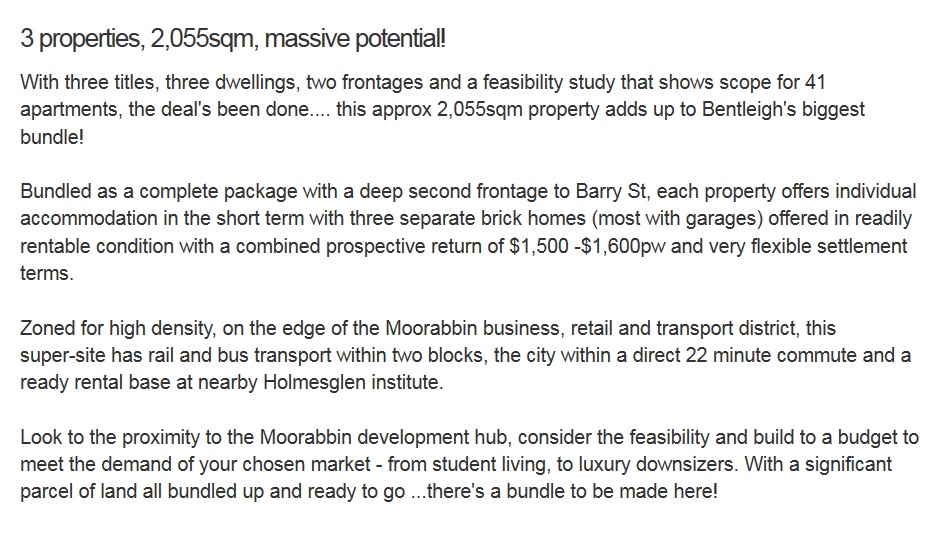
Fit the family, invite the in-laws, develop the dream! With a charming three bedroom, two bathroom brick home, around 643sqm of land and flexible General Residential Zoning, this versatile property in the Gardeners Reserve/Moorabbin Hospital precinct has so many possibilities to play with!

Offering three living areas, two quality kitchens, two-car garaging and scope to configure as two dwellings, this immaculately presented home offers excellent family accommodation for today, exceptional rental potential for tomorrow and all the extras you could need (including gas and woodfire heating, air-con’r, polished boards and robes) as a basis for renovation and extension in the future.

Alternatively, see the future rewards in this super-central site and explore the multi-level, multi-home potential offered by flexible zoning (subject to Council Approval). Close to the Glen Eira Sports and Aquatic Centre, medical facilities and Centre Rd shopping and transport, this prime site is ready to get into the game!

Council is clinging desperately to its myth that the new zones are a ‘neutral translation’ of the past. According to their version of history, nothing is different. Well, much is different we say. The number of permits granted since the zones came in have skyrocketed and it’s not due to developers trying to get their ambit applications in before the gazetting of the amendment so that the ‘old’ rules would apply. Nothing is the same under the new zones. The staggering increase of four storey applications for quiet residential streets is a new phenomenon – thanks to the zones. The number of amended permits seeking higher and greater numbers of dwellings is also ‘new’. The current trend of selling multiple blocks of land in order to build bigger and denser apartment blocks is also new. The number of residents getting out of Glen Eira because their streets are becoming the slums of the future is also new. Everything has changed and in our view, to the detriment of thousands upon thousands of residents.

It’s therefore interesting to see in today’s Leader this little ‘clarification’ –

UntitledWe have to ask:

  • What pressure was put on The Leader to insert this token ‘correction’?
  • Isn’t it news that the old system ‘permitted buildings of up to five storeys’ when we are repeatedly told that there were no height limits in the past?
  • Will Council’s reach ever extend to silence real estate agents when they disclose the truth?