We are committed to facilitating genuine debate within Glen Eira. Your views on planning, environment, open space, CEO and councillor performance matter.
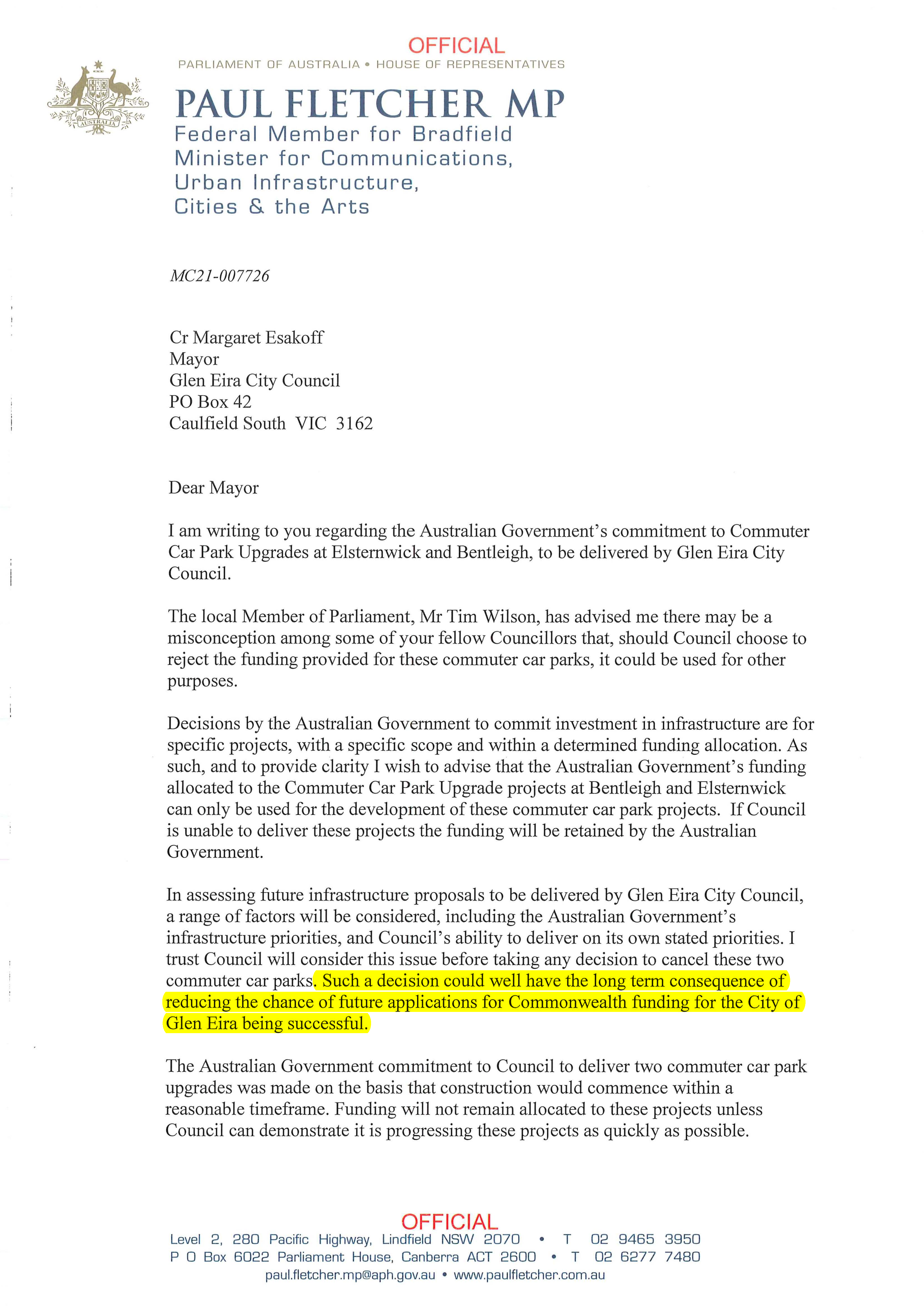
The Age has today published a letter from the Commomwealth Minister for Infrastructure in relation to the multi-level car park funding. It is presented below:
Whatever one may think of the entire car park issue, there have been plenty of ‘wrongs’ committed along the way by council and government. Consider the following:
The first real inkling that residents had of council’s possible intention to built high rise car parks came with the structure planning for Bentleigh & Carnegie. At no stage were residents provided with the opportunity to say ‘yeeah’ or ‘naay’ SPECIFICALLY to these structures. An earlier background report for Bentleigh even suggested that two such car parks be erected and that council owned land could be sold off.
Now that there has been plenty of adverse criticism for the funding, a ‘consultation’ is finally taking place. But like most Glen Eira consultations, it is far from acceptable. (See: https://gleneira.blog/2021/10/13/multi-storey-carparks/
If council are so fantastic in their strategic planning, then why didn’t they get the proposed locations right the first time around? Why were residents told that a 6 and 5 storey construction was required, to now have these heights reduced – without of course informing us as to the new proposed heights!
As for the Minister’s letter, thinly veiled threats are far from acceptable. Nor do we really know whether council was ‘tapped on the shoulder’ (as claimed) for these grants, or whether there was a formal submission. Perhaps if such a document exists, it could be placed in the public domain?
In our view none of this would have happened if a logical and clear process was followed. Namely:
First the decision is made AFTER community consultation that such multi-level carparks are required.
Consultation provides all the necessary detail – ie costings, design, etc.
Government grants and the rationale for decisions are made public
So we are now really and truly in the proverbial! If for example the community is in favour of only one of these car parks, will council receive half the money, or none? Will council react to this clear intimidation, or meekly cave in? If this letter was sent in September, when were councillors informed as to its receipt? Or did they only find out today?
And when will politics finally keep its grubby little hands out of local affairs? Labor and the Greens are keen to use the ‘tainted’ nomenclature to earn some brownie points against Morrison’s gov , whilst the Libs are also not averse to screaming ‘community benefit’.
It will be very interesting to see which way this council jumps – assuming of course that residents will be informed of everything leading up to the final decision!
Readers may remember the recent application for a 9 storey development at 217 Nepean Highway, Gardenvale. This was supported by officers, but rejected by councillors. The ensuing VCAT appeal by the applicant was refused. We now have the second attempt. This time for a six storey development and 18 apartments. The plans are not yet available.
Gardenvale presents a fascinating insight into the council agenda. According to the CURRENT planning scheme, Gardenvale is deemed a LOCAL centre. With the arrival of the City Plan, it has been upgraded to a Neighbourhood Centre and earmarked for “substantial’ development. The current Planning Scheme Rewrite seeks to enshrine this new designation. City Plan proposes that commercially zoned sites be set at the preferred height of 5 storeys. This application, whilst lower than its predecessor, is already seeking something higher. It will undoubtedly be recommended for a permit by officers, given that they were in favour of 9 storeys.
Yet, we cannot find one single word anywhere which justifies the re-classification of Gardenvale as a Neighbourhood Centre from a Local Centre. Nor can we find any logic behind the failure to treat each activity centre as an individual entity with its own height nominations. Time and again we are told that locations should be assessed on their unique characteristics, but what we have are strategic plans which treat all neighbourhood centres as mirror images of each other ie 5 storeys for anything zoned as Commercial regardless of their residential surrounds or various transport options.
More concerning is the failure of council to safeguard all of our neighbourhood and local centres. Will all of these be candidates for structure plans, or will residents have to be satisfied with meaningless built form frameworks that are nothing more than ‘guidelines’? And what is the time frame for any other work? Another 5 years of nothing, 10 years?
This current application will probably be determined well and truly before anything is finalised in terms of the current planning scheme rewrite, and the adoption of the city plan. It will set a precedent and that means it will be too late to halt other, and probably higher applications.
Finally, we present below, the VCAT decision which rejected the original 9 storey application. The comments relating to the wisdom of designating Gardenvale as a neighbourhood centre instead of its current local centre status are worth reading. The comments are still very relevant. How does council answer these judgements? Where is the justification and the strategic work that should underpin such changes? It is non-existent, we assert!
· The provisions relating to the scope for Patterson and Gardenvale local centres to have more intense development are however quite limited in scope because the policy encourages only gradual changes in building heights between existing buildings and new developments. Where building heights are above the prevailing height of existing development, policy encourages the building design to reduce the visibility of the additional storey(s) by either;
Incorporating the additional storey(s) into roof space (attic style).
Limiting the additional storey(s) to an envelope that is significantly less than the floor immediately below and is significantly set back from the front and rear of the site to limit visibility from the street in front or the properties to the rear.
· I was referred to the Council’s City Plan[8] which was adopted by the Council in February 2020. By virtue of having been adopted by the Council, this is a document to which I may have regard as appropriate[9], but it is not part of the planning scheme. City Plan includes the review site in a Substantial Change Area 3 in which development up to 5 storeys is contemplated. Structure plans for activity centres are to be prepared.
· With respect to the applicant submission that the proposal should be assessed on the basis that Gardenvale is akin to a neighbourhood centre or even an urban village, the submission ignores the fact that Council has had ample opportunity to change the local centre designation for Gardenvale but has not done so. I must apply the planning scheme’s provision as they exist, and it would be inappropriate to accord a different status to that which appears in the planning scheme.
· I have also commented previously that Gardenvale is a small, confined centre surrounded by Commercial 2 zoned land that extends north and south along Nepean Highway and by residential areas predominantly zoned Neighbourhood Residential. I am not persuaded that Gardenvale is anything other than a local centre with very limited capacity to expand beyond that designation. This application must therefore be assessed having regard to the policy settings established for this local centre.
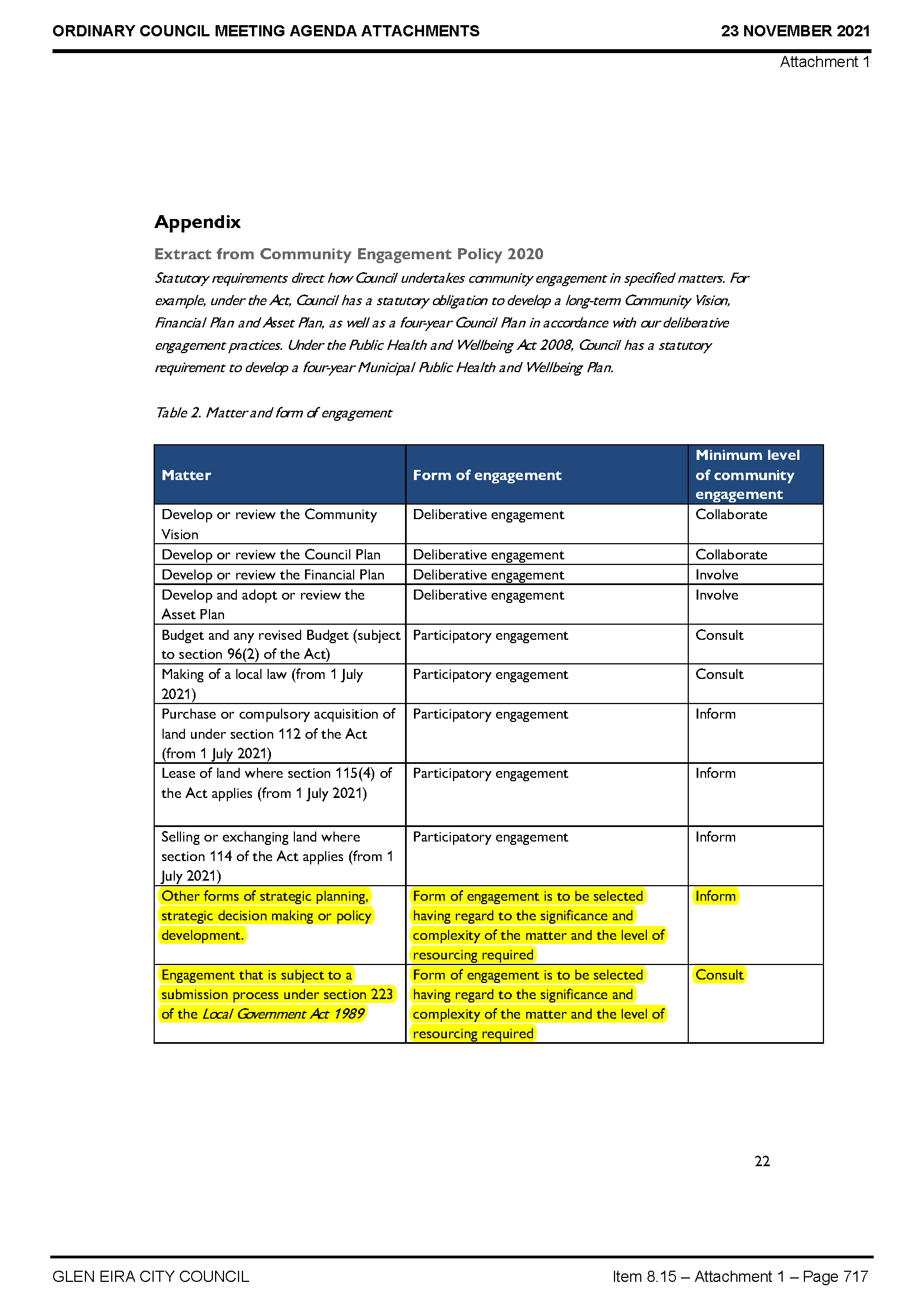
There can be no excuse for what is proposed for council’s Community Engagement Strategy. The vote on Tuesday night will seek to endorse a strategy that has been rejected by a council resolution on the 23rd February 2021. This resolution still stands!
Council’s presentation for this item is deliberately false, inaccurate, and devious. First off, we are told that the attachment represents the endorsed Community Engagement Policy from 2020. Here is the (false) presented version . Please note the highlighted sections at the bottom of the table.
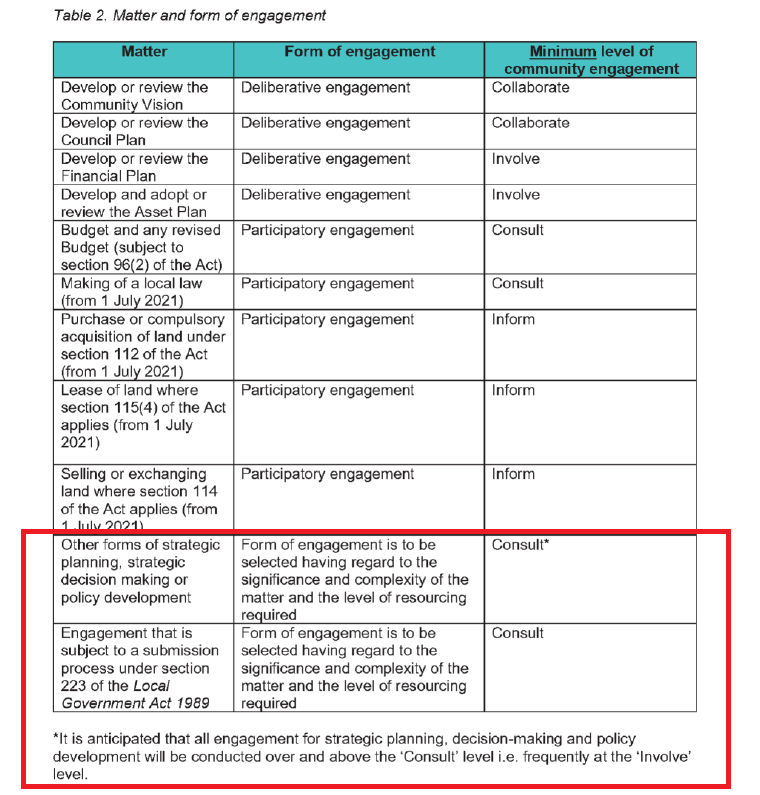
On the 15th December 2020 the draft contained the following. Again, please note the highlighted sections and compare with what is now suggested as the 2020 policy.
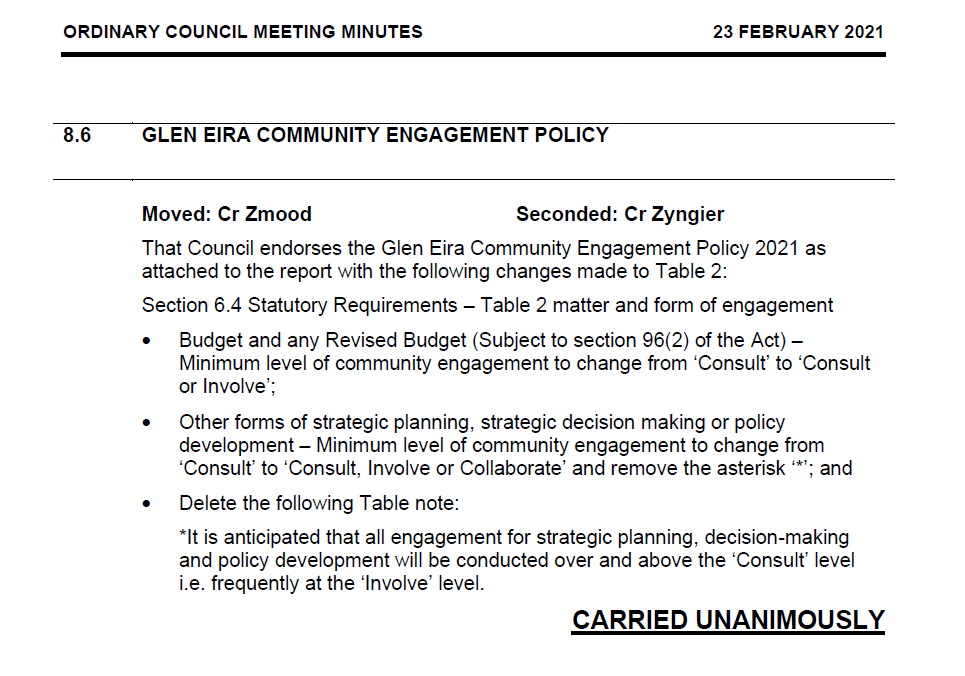
Following public consultation, councillors voted on the 23rd February 2021 as follows:
COMMENTS
It is simply staggering that council should attempt to present such false information and in doing so, over-ride a clear councillor resolution. Secondly, if this is passed then it achieves a reduction in community input to the most important aspects of council’s operation – ie strategic planning and policy development. As we’ve stated in earlier posts, Glen Eira compared to other councils is determined to limit resident participation as much as possible. ‘Inform’ and ‘Consult’ are the lowest rung of the engagement ladder according to these councils and the IAPP principles. (see: https://gleneira.blog/2021/01/07/consultation-2-2/. But what is even more damning is our allegation that this is deliberate and an attempt to bypass and ignore a councillor resolution as well as limiting community participation. It is unconscionable!!!!
Council’s agenda is out and once again we despair at the predetermined outcomes that this administration enforces upon its residents. Included in the agenda are the Built Form Frameworks (BFFs) for Caulfield South, Caulfield North and Bentleigh East, as well as the Community Engagement Strategy.
Readers should note the following:
The Community Engagement Strategy promises that residents will be provided with feedback on how their views influenced the final council proposal/decision. In relation to the BFF’s this is entirely missing. So much for the ‘engagement strategy’ and its empty promises.
The report on the community consultation for the BFFs failed to include the actual comments. What we basically get are ‘summaries’. Given the importance of these strategic plans, and how many residents will be impacted, surely a comprehensive and detailed analysis of all responses is warranted? Of course, readers might like to think back to the actual questions that were asked as part of this ‘consultation’ and how sub-standard they were! (See: https://gleneira.blog/2021/05/12/is-this-fair-dinkum-consultation/ for our ‘review’ of the consultation)
The BFFs remain unchanged from the previous versions as far as we can tell. Interestingly, the accompanying draft Design & Development Overlay, is only for Caulfield South. Why? No explanation is given as to why Bentleigh East and Caulfield North are ignored. Is council simply testing the water at this stage? What is the expected time frame for the DDO’s for the remaining two centres?
Most importantly, any planning for activity centres has as its major objective to ensure that there is capacity to meet the forecast population growth. Not one single statistic on population and dwelling growth is provided in any of these frameworks!!!! Hence, we cannot find any strategic justification as to why 6 storeys is appropriate, compared to 10 storeys or even 15 storeys if this is the logic behind these plans! In our view, the link between projected population growth and dwellings required has not been established. That is the role of a Housing Strategy. But of course, council is rushing everything through PRIOR to the creation of a Housing Strategy!!!!!
Even more damning is the fact that Council is still relying heavily on its City Plan. We remind readers that this document argues that 5 storeys is the optimum discretionary level for commercially zoned sites in these centres. Yet we are confronted with BFFs that totally ignore this and recommend higher levels. What’s the point of having a policy that is continually ignored?
There is much, much more that could be said in regards to these BFFs and the Engagement Strategy. We will provide a more detailed analysis in the next few days.
Some ex-councillors and even some current councillors appear incapable of admitting that this council can ever get anything wrong. So we have to be constantly beware of misleading and deliberate obfuscation of the facts. Surely it is time for a simple apology and the admission that ‘we stuffed up’. But no! Apologists continue to flood social media with their propaganda and refusal to show any contrition.
We thought that it is therefore time that readers had a clear idea of the history of planning in Glen Eira and to lay blame where it crucially belongs. Yes, the State Government has had a major role, but this cannot excuse the failures of our council – especially when their actions and results are compared to what other councils have achieved.
Please read the following carefully:
In 2004, Amendment C25 was introduced which created the minimal change/housing diversity split up of the municipality
The Planning Panel report that assessed this amendment used the term ‘interim’ in regards to the amendment 24 times, plus sentiments such as – The boundaries of the neighbourhood centres identified in the amendment are considered by the panel as interim at best. The Panel also urged council as a case of urgency to undertake structure planning which Council promised to do. This was never done – no review, no structure planning, no parking precinct plans, etc. So 17 years later, we still do not have any permanent structure plans in place, no parking precinct plans, and certainly no review of the activity centre boundaries.
The then Planning Minister Guy announced the new zones on 5/8/2013. These were gazetted (ie legally approved) on 23/8/2013.
Councillors claim that ‘consultation’ occurred with the 2010 Planning Scheme Review and the zones were a ‘neutral’ translation and what people had told council they wanted. Neighbourhood Character Overlays were introduced via Amendment C87 in 2012 – BUT THEY ONLY COVERED APPROXIMATELY 600 SITES OUT OF 53,000 sites in Glen Eira. Secondly, the 2010 Planning Scheme Review report does NOT EVEN MENTION ‘mandatory heights’ which Hyams for example claims residents expressed a wish for. Nor has there ever been any discussion, much less consultation, on what residents consider an appropriate height for various sectors of the municipality.
Prior to the zones there was a ‘preferred’ height limit set of 9 metres in residential areas. With the zones, council had the option of less than 10.5 metres for General Residential Zone and less than 13.5 metres for Residential Growth zone. Council imposed the maximum.
Other councils (Bayside, Stonnington, Monash, etc) had up to 13 GRZ zones where they had differing height limits for each of the 13 or so GRZ zones. In Glen Eira there were only 3 GRZ (and one created especially for Wilks St development) each of 10.5 metres. Thus, a ‘one size fits all’ approach and lack of real strategic work to look at the municipality and work out what’s best for each specific area. Needless to say, these other councils determined their zoning on the basis of their respective Housing Strategies. Glen Eira still does not have one.
This means that people woke up on the 23rd August and could legally have a 13.5m building next to them, when on the 22nd the chances of this happening were practically zilch. NO warning, no consultation, and apparently no intention of reviewing the zones themselves. And even with the introduction of the zones, the Glen Eira planning scheme still made it possible for large sites to contain more than 2 dwellings in the NRZ. This remains until this day and well before Wynne’s removal of the 2 dwelling limit.
As to the efficacy of these new zones, we have had plenty of recent officer reports that state the ‘radial’ application of the zones (ie drawing a circle on a map) was ‘inappropriate’ at best, and wrong at worst, resulting in countless streets with at least 3 different zones.
In 2015 there was a state wide ‘review’ of the residential zones and committees were set up to make recommendations to the government. In its report on the Glen Eira introduction of the zones, the committee concluded:
The zones were implemented in Glen Eira without public consultation, and without an independent review process. The Reasons for Decision to Exercise Power of Intervention deemed that further consultation through the formal statutory process unnecessary, stating: Consultation has been conducted during the development of the Housing and Residential Development Strategy and in relation to Amendment C25. The Committee notes the Council’s Housing and Residential Strategy was adopted in 2002, 11 years before the gazettal of Amendment C110. The Committee questions the currency of the policy itself as well as the currency of the community consultation in relation to this policy. (page 176 of Advisory committee Report: Managing Residential Development Advisory Committee Residential Zone Review).
Amendment C25 back in 2004 introduced a 25% permeability requirement for NRZ only. This had nothing to do with the introduction of the zones in 2013. Furthermore, permeability, setbacks, have never been MANDATORY as one ex-councillor would like us to believe. The only thing that became ‘mandatory’ were the heights.
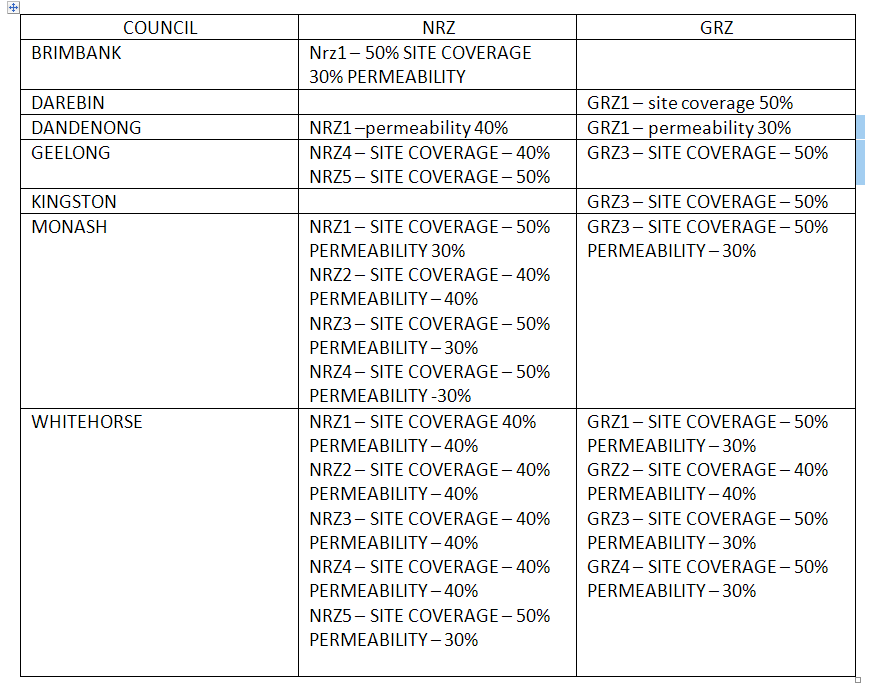
As an example of what countless other council currently have in their planning schemes we provide the following table. Glen Eira still maintains it 25% for the NRZ zone, and 20% for its GRZ and RGZ zoning. Readers should also remember that with the proposed amendment C184 for Carnegie, council was quite happy with a new RGZ zone that applied a 5% permeability rating and a 90% site coverage!!!!
Finally, all we seem to be getting with the current ‘consultation’ on the Planning Scheme rewrite is more of the same – empty promises that council will continue with its ‘further strategic work’. Here is what is promised according to the proposed draft amendment. Given this council’s history of doing bugger all if it can, we urge all residents to take these promises with a gigantic grain of salt! With the rate of development that has occurred in Glen Eira and is still occurring, we cannot have another set of empty promises that, at best, could take another decade or more to introduce if there is the will, or at worst, will never see the light of day.
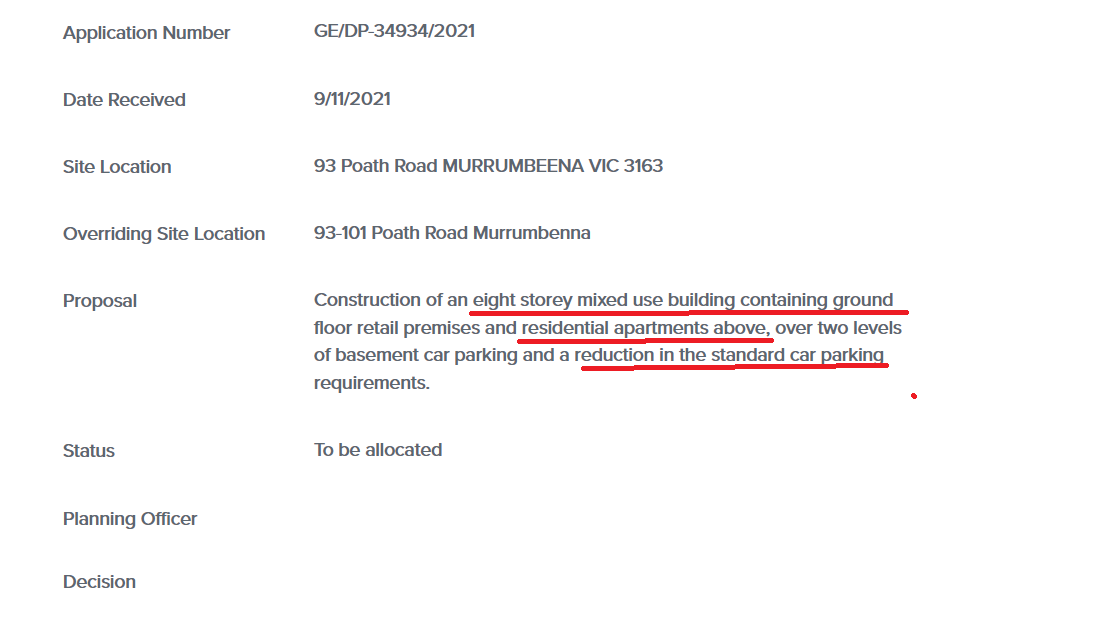
Under council’s zoning and continued lack of action regarding the majority of our neighbourhood centres, these areas are challenging Bentleigh, Carnegie and even Elsternwick, for the ‘prize’ of high rise apartments. Murrumbeena continues to cop such applications. The most recent is below:
If this application is successful, it will feature an 8 storey building alongside a street zoned for 3 storeys and which still contains many dwellings of single and double storey. The longer council delays in implementing some decent controls for all of our neighbourhood centres, they are clear targets for over-development.
Recent council responses to a variety of public questions have made it clear that permanent planning controls for Bentleigh and Carnegie are expected (probably) in 2024. Elsternwick will be following these amendments – hence we could well be looking at 2025 and perhaps even 2026 for this area. That leaves Glen Huntly which will come after all of these. Is anyone prepared to hazard a guess as to when this Major Activity Centre will be finalised? How about 2026-2028?
Since the Glen Huntly amendment is years down the track, one might well ask why there was the rush to get the draft structure plan ratified now, instead of working all out on the Bentleigh, Elsternwick and Carnegie ones? Please remember that unless something is in the planning scheme, via a gazetted (approved) amendment, it has no power to influence council and VCAT decisions.
Even more important than all of the above, is that these structure plans and their respective amendments are being rushed through prior to the creation and finalisation of a Housing Strategy – the work which is meant to be the foundation for all planning and zoning in the municipality. Whilst other council have had housing strategies for well over a decade (and are continually reviewing them), all Glen Eira has is a document that dates back to 2002 and is based on data from 1999!
We’ve also got the additional problem of the Built Form Frameworks for Caulfield North & South and Bentleigh East – all well and truly ‘cemented’ before the housing strategy even sees the light of day. Council maintains that all of its previous work remains ‘relevant’. Not so! Documents created in 2017 are now well and truly outdated as well as being created pre-COVID.
Adding to the mess that is emblematic of council’s planning processes, on the 11th November, we will also have ‘consultation’ on the Planning Scheme rewrite, and the draft amendment for the Open Space levy contribution rate. Again, all before, the development and ratification of a housing strategy. Assessments of neighbourhood character are supposed to be included in such ‘rewrites’. Has, or will, this be done or will we again have areas lumped together without any real municipal wide investigation of current zonings and their schedules. In the age of a ‘climate emergency’ will we still have zones and schedules that only require 20% permeability in GRZ and RGZ zonings when some other councils have up to 40% for these zones? And the most crucial question of all is – given the rate of development in Glen Eira over the past decade, do we still need so many areas zoned for multi-unit development and/or high density development?
In December 2015, Wynne refused council’s request for another time extension on reviewing their planning scheme. They were also ordered to undertake structure planning. By the time we get any permanent controls into our municipality, it will be at least 8 to 9 years since this time. We find it staggering that any strategic planning should take this length of time. Council can keep blaming the State Government all it likes, but other councils have managed to implement their planning scheme rewrites, their structure plans, their increased open space levies, without the ‘problems’ that council claims. Of course, one could be cynical and argue that the longer it takes to introduce anything, then more and more development can take place. Or being kind, we might simply argue, that what we have is the most incompetent, and out of touch, planning department in the state. The tragedy is that millions have literally been wasted and we are still reliant on policies that provide no real protection or community benefit when it comes to planning.
If anyone had any doubts about council’s internal political divide, the election of mayor and deputy mayor fully illustrates how the Labor versus Lib chasm is well and truly operational in Glen Eira.
Magee has been elected by a vote of 5 to 4 as Mayor. Labor together with the support of the Greens voted for Magee, whilst the Libs with the support of the nominal ‘independents’ voted for Cade. The votes in favour of Magee were: Magee, Athanasopolous, Zhang, Zyngier and Pilling. The four voting for Cade were: Parasol, Szmood, Esakoff, Cade.
Sadly, what this means is that we have a Labor Mayor and Deputy Mayor in charge for the next year. Whether or not this means that Glen Eira will continue to back to the hilt the incumbent Labor State government remains to be seen. Sadly, taking state politics out of local government seems a forlorn hope. As we’ve stated numerous times before, local government and its councillors, owes it top priority to its residents and not to some political agenda dictated by political parties.
There are several agenda items for the upcoming Wednesday night council meeting which deserve residents’ close attention. The major focus for two of the items is on heritage, whilst the third item contains comments that apply to planning in general throughout Glen Eira.
What each of these items has in common can be summarised as follows:
A history of neglect and dereliction of duty by council on heritage for well over 15 years. Given that we have had, and still have certain councillors with extended time on council, the blame for such inaction must fall upon them.
Scant concern for existing heritage overlays and the resolve to initiate controls via planning scheme amendments to ensure greater protection for these sites and precincts.
In Glen Eira, development potential usurps heritage protection. In fact, this applies equally to the State Government and VCAT.
With the third agenda item (ie submission on the Gov’s Land Use Frameworks) we have the explicit and unequivocal admission that the introduction of the residential zones in 2013 were abysmally implemented. Even worse, is the admission that what council is now proposing is in fact contrary to what the approved structure plans for Bentleigh, Carnegie and Elsternwick propose.
We will go through the above and elaborate in order.
HERITAGE AMENDMENT C214glen
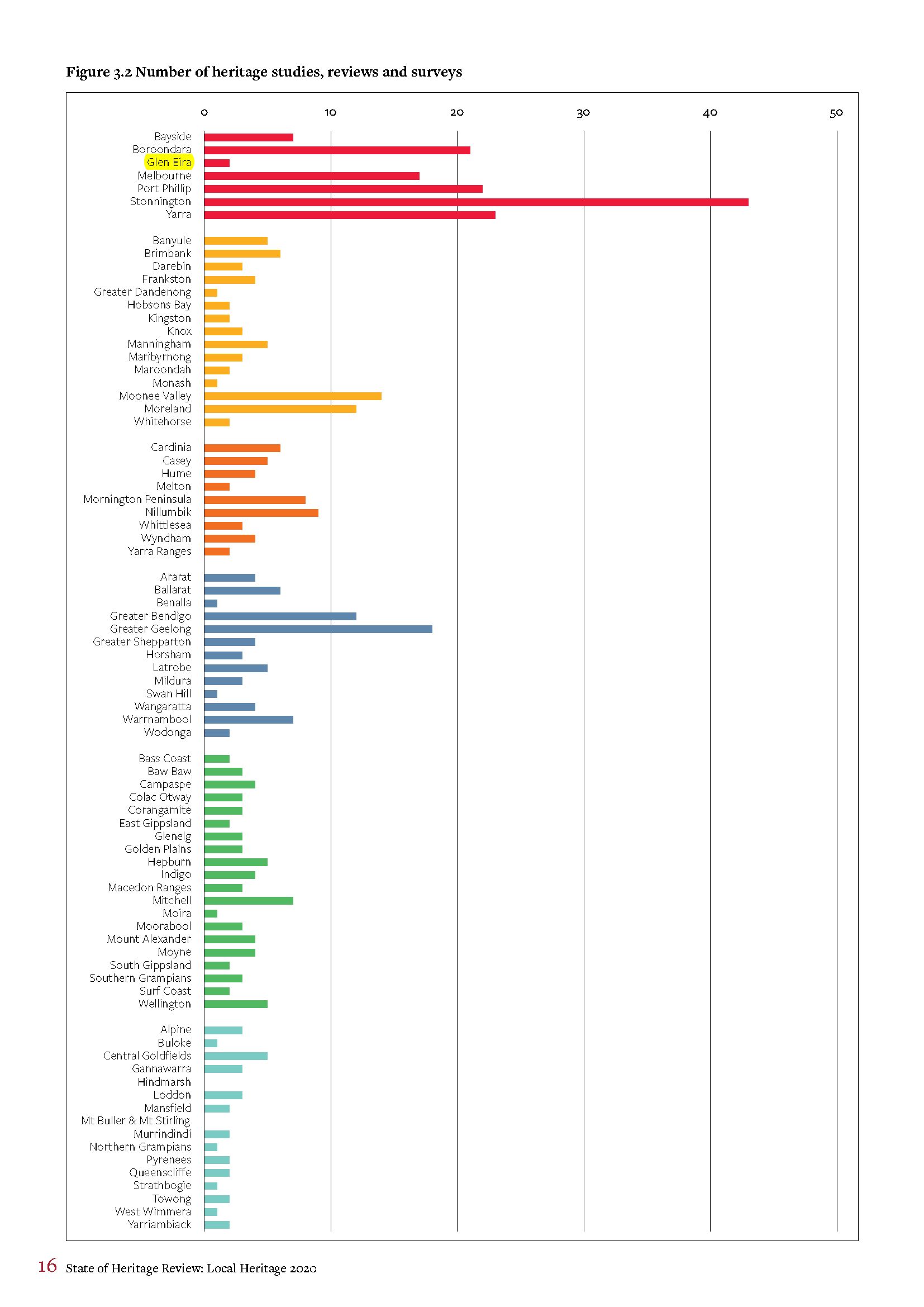
Included in the Panel Report for this proposed amendment, we find data collated by the Heritage Council’s review for all municipalities in the state. These are produced below. Please note:
How badly Glen Eira compares with other inner metropolitan councils
How little has been achieved over the years on heritage, despite the fact that in the 2016 Planning Scheme Review, residents were promised a complete review of the ENTIRE municipality. This has now morphed into individual precincts and suburbs. The promise of 2016 has not been done, which leaves hundreds of properties at the mercy of developers.
The Panel Report, and the officer’s report makes it absolutely clear that the issue of whether or not a site is suitable for heritage protection has nothing whatsoever to do with:
Objections
Financial costs
State of building, or
Potential development
This therefore raises innumerable questions as to why council did not utter a single word when the Minister refused to incorporate several heritage precincts in Elsternwick that were evaluated by Heritage experts as being worthy of inclusion into the proposed heritage overlays. The published excuse was that there was no current ‘development pressure’. Council has also used this ‘excuse’ when considering applying for interim heritage overlays. The above Planning Panel report invalidates these excuses and also brings into question why the Minister, in refusing to include these heritage precincts, has in fact acted against his own Planning Practice Notes!
NEERIM ROAD, MURRUMBEENA APPLICATION
This is an application for 7 storeys, and 88 student apartments, and on a site which has recently gained a heritage overlay. There were 115 objections. Previously the site was earmarked for a 9 storey building, which was refused by council. At the subsequent VCAT hearing, the developer reduced the application to 7 storeys. VCAT also refused the granting of a permit, largely on heritage grounds and insufficient setbacks. This latest application argues that the previous VCAT directions have now been attended to via the new plans.
Whilst this latest application receives the nod for a permit, we find the reasons for this view to once again show how pro development this planning department is. The report completely ignores to mention the following:
Less than half of the proposed dwellings are more than 20 square metres! Some are in the range of 16, 17, and 18 square metres in size. Readers might remember the furore created by the City of Melbourne’s report that student apartments should have a minimum size of at least 50 square metres in order to be truly ‘liveable’. The Minister had his chance to implement minimum size guidelines with his ‘Better Apartments’ guidelines, but failed to do so. Glen Eira’s submission to this endeavour stated: While setting minimum apartment sizes is encouraged in principle, this should be considered against the impact it may have on construction costs and consequently, housing affordability. If a correlation genuinely exists between the two, setting an apartment standard may not be ideal.
Whilst both City Futures and Heritage stated that the height was still a concern, the report concluded: While Council’s Heritage Advisor does not consider that the proposal has gone far enough to address the specific heritage elements in this centre, it is considered on balance that the proposal has suitably addressed the requirements of the Heritage Overlay, has moderated the bulk and form to a sufficient degree which was a key issue in the VCAT decision for the 2019 Student Housing Proposal and provides for the retention and restoration of the façade of the original building.
It is clear that when it comes to heritage, this council prefers development. We have already seen the granting of a permit for 12 storeys of student accommodation in Derby Road, Caulfield East on a heritage site, and the demolition of several other heritage properties throughout Glen Eira.
If and when this latest application goes to VCAT, we are not optimistic as to the final decision. Why? Because the arguments presented at the previous VCAT hearing remain. Of course, these comments made by the member were not included in the council officer’s report. We quote from this earlier decision:
Unfortunately, there is no structure plan for this activity centre to assist us in considering the built form outcomes for this site. Council has adopted a new City Plan (February 2020). The plan sets out a 4-storey preferred height for those parts of the activity centre to be included within the Heritage Overlay and a 5-storey height for land facing Melbourne Street. The City Plan shows four levels for the front part of 430 Neerim Road and five levels to the rear. The Tribunal in 348-354 Hawthorn Road Pty Ltd Ltd v Glen Eira CC [2020] VCAT 1211 accepted that the City Plan may be the council’s current broad thinking about activity centres in general, but we give it no weight as a tool to assess building height, relative to the urban design tests of the planning scheme as set by both the State and local policy frameworks. While we agree with these comments, we consider that there is an expectation of development within this activity centre of up to five storeys, noting that there are developments of this scale already present in the activity centre
The council submission acknowledges that the local policies do not prescribe particular heights or densities for the neighbourhood centre and that density, mass and scale of residential development needs to be assessed according to the location, physical size, scale and character of the neighbourhood centre.
there is nothing in the planning scheme to indicate that a uniform height is sought for buildings in this centre, or any other neighbourhood centre.
COUNCIL SUBMISSION TO GOV – LAND USE FRAMEWORKS
Whilst this submission is a vast improvement on previous council efforts, given that there are overt criticisms made of the policy, plus the call for more specific explanation and verified data, the overall response includes several paragraphs that should be noted by residents. The following is in response to the State Gov’s proposal that neighbourhood activity centres be required to accommodate medium to high density development along a range of 800 metres.
Direction 5 – Prioritise housing growth in areas with access to jobs, services andgood public transport
This Direction refers to opportunities for new medium and higher density housing to beconsidered within an 800 metre walkable catchment of activity centres. This is notsupported. Many of Glen Eira activity centres are linear and relate better to a 400 metrewalkable distance at the most. A radial measurement is not appropriate and opportunitiesfor new housing should be considered at the local level, through structure plans, where thecommunity is involved.
What we have here is the complete disavowel of the residential zones that were introduced in 2013. They were ‘radial’ in countless residential streets. All council did was draw a circle on a map with a radius of 400m. Most of our activity centres and their respective zoning still has not altered, meaning that countless residential streets currently have at least 2 and often 3 different zones. 8 years later we are being told that this is ‘inappropriate’.
Worse still is the admission that a 400 metre ‘walkable distance’ is the best option. If so, then why do our current interim structure plans work on the principle of 800m? Does this mean that the structure plans for Bentleigh, Elsternwick and Carnegie will be consigned to the dustbin of history – as they should? How much money has this cost thus far and to what effect?
All of the above illustrates fully what an absolute mess planning is in Glen Eira. Heritage is ‘expendable’ when it competes with development; structure planning for all of our neighbourhood centres remains in the ‘never-never’ and contrition from the likes of Hyams, Magee, Athanasopolous, Delahunty, Lipshutz, and Esakoff, and Pilling, for allowing such incompetence for years and years, is not forthcoming. Our hope is that with a new crop of councillors, perhaps residents can finally achieve the sort of council that does act in the best interests of its community.
Council has produced a survey seeking community input on its proposed multi-storey car parks in Bentleigh & Elsternwick. Whilst this latest effort is a vast improvement on recent surveys, there remain a few glaring problems. (see: https://www.haveyoursaygleneira.com.au/glen-eira-multideck-car-parks)
There is now much background information on the entire process and council receiving a promise of $20M under the Commonwealth Government’s Urban Congestion Fund. The claim is that the car parks will therefore be fully funded by this grant. Readers will remember some councillors’ recent media comments regarding the ‘tainted’ nature of this funding given the alleged political rorts that accompanied the handing out of the grants. That aside, residents are now invited to proffer their views on whether or not these car parks should proceed.
In order to fully understand the issues, the problems, and the potential benefits, council has this time included a lengthy blurb as a ‘starter’. Unless residents bother to read the accompanying reports in full, we have to conclude that they will not have a clear idea of all the information required in order to come up with some reasoned decision.
For example, what residents are not told up front is that the consultant’s report noted:
For every 3 extra car parking spots created, there will only be one more use of public transport. We are told that for the Elsternwick site (a)ll 78 car parking spaces at the site would be retained. It is estimated that an increase of 82-122 spaces can be achieved, for a total of 160-200 car parking spaces at this site. With 82 extra car spots, this would then lead to an increase of 27 public transport trips. With 122 spots, there would be 41 extra trips. Applying the same formula to Bentleigh, would create either 52 or 69 trips. Hardly earth shattering for the expenditure of $20M!
Nor do the various blurbs mention the consultant’s findings that increased local road congestion is also a possibility, especially for Elsternwick.
THE SURVEY
Since the survey’s objective is to determine whether or not residents are in favour of proceeding with the building of these car parks, one would have thought that this aspect would have and should have been the focus. Council admits that its related ‘congestion busting’ ambitions are dependent on further and different grants from government and hence some way down the track. The $20M is ear marked for ‘commuter’ transport primarily and council’s own terminology repeatedly refers to ‘commuters’. Given this emphases, then surely some questions relating to current public transport and car use was essential.
What’s wrong with some simple questions along the lines of:
Do you drive to work outside of Glen Eira?
Do you drive to work in Glen Eira?
How many times a week do you use public transport (pre-covid)
Post-covid, will this frequency increase?
Do you find car parking is sufficient in Elsternwick/Bentleigh?
Where do you work?
Do you drive to shop in Bentleigh/Elsternwick?
If you drive to shop do you think you would use these multi-storey car parks? Why?
Do you think you would use these multi-storey car parks at night?
What would make you feel confident about using these car parks at night?
As a trader, how many of your staff (including you) drive to work?
How many staff use public transport?
Would you be prepared to pay for car parking?
There are undoubtedly plenty more questions along these lines which would provide a clear picture of residents’ needs and their views. Instead we get the following as part of the survey which concentrates on ‘congestion reduction initiatives’ – many of which council has absolutely no control over!
What other types of congestion reducing initiatives should Council seek further federal government funding for under the Urban Congestion Fund? Select all that apply.
On-call shuttle buses to take commuters to train stations
Repair of footpaths
Optimise traffic-light management
Use CCTV to monitor road conditions
Enforcement of existing road traffic laws
Improve perceptions of buses
Extend residents’ parking zones
Charge for workplace parking
Improve cycling infrastructure (e.g. protected cycleways, safe cycling zones around schools, etc.)
Improve bus services
Develop and refine park-and-ride
Existing rail network
Light rail
Strategic Road Network resilience
None of the above
Other (please specify)
Even more ridiculous in the above list is the inclusion of jargon that we guess is totally nonsensical to the majority of residents – unless they happen to be traffic engineers. What on earth are we to make of: Strategic Road Network resilience? Or even Existing rail network? Nor does council inform us that road repairs have very little to do with ‘walkability’ or increased public transport use!
Council has also not provided any information as to what might happen if, for example, Elsternwick responses are in favour of the multi-storey car park and Bentleigh respondents are opposed. Does all the funding fall away, or will the government simply halve the grant and allow one to proceed? Surely this possibility would have already been discussed with the funders?
We are guilty of continually criticising this council’s consultation methodology and in particular their sub-standard surveys. Our solution(s) to these problems are simple:
All surveys MUST undergo a comprehensive ‘test run’ with councillors, community engagement committee members, and residents before they are put into the public domain.
Background information that is succinct, accurate and provides all the relevant data must accompany all surveys.
Those responsible for the creation of surveys be named and accessible to the public for continued feedback on their performance.
Reports on surveys be consistent in detailing all responses, number of respondents and publishing all comments. This does not happen with Community Voice!
Until we have such protocols, then residents have every right to be critical of council’s consultations and the adopted methodologies and purported outcomes.



 Glen Eira Debates