Finally, ‘victory’ appears to be on the horizon for the local community with the release of the committee’s report on the Trustees and Caulfield Racecourse issues. We’ve uploaded the full document HERE

In short, the recommendations are:

  • All trustees to resign. If they refuse the government will introduce legislation which revokes the Crown Grant
  • The department to be interim ‘manager’
  • Preference is for a “separately legislated trust with specific accountabilities and functions” rather than a Committee of Management.
  • Training to go within 5 years of renewal of leases

“What effective controls do the Glen Eira City Council have in place to ensure that the personal information of those asking Public Questions is protected and not disclosed or published in the Ordinary Council Meeting Minutes.”

The Mayor read Council’s response. He said:

“The process for submitting public questions to Council is managed in accordance with the Glen Eira City Council Local Law 2009 together with Guidelines for Public Question Time adopted by Council. Local Law 232 requires that questions bear the questioner’s name, address, date and telephone number.

Public questions submitted to a public forum such as a Council meeting are public in their nature, however, Council has generally followed a practice that only the questioner’s name will be recorded in minutes of Council meetings.

Council’s practice is to include in Council minutes the first initial and surname of the person asking the question together with the actual question. Due to a change in Council personnel Council did not follow the usual practice in its most recent minutes for the public questions on 19 Jul, 2016. However, these minutes have now been revised to delete the full address details of the questioner to comply with past practice.

The Local Government Act 1989 requires the minutes of Council meetings to contain details of the proceedings and resolutions made. Council is of the view that the Privacy and Data Protection Act 2014 does not preclude the publication of the questioner’s name and address in the Council minutes.”

COMMENT

  • Information Privacy Principle (IPP) No.2 states – An organisation must not use or disclose personal information about an individual for a purpose (the secondary purpose) other than the primary purpose of collection…… The individual has consented to the use or disclosure ….
  • Disclosing the names, addresses, and emails of those who submitted public questions is NOT THE PRIMARY purpose of the collection of such information. Council’s ‘guidelines’ clearly state that details such as name, address, date and phone nos. are required for ‘verification’. That, and that alone, is the primary purpose.
  • Is it really too much to ask (given that this is not the first time this has occurred) that instead of bluff and bluster, council simply proffers a heartfelt and genuine apology?

pill0003

The trend of councillors lopping off a storey or two plus some apartments and then having the developer go to VCAT and winning has continued. The latest example concerns  600-604 North Road, Ormond. The application was for 6 storeys and 57 1 and 2 bedroom units, plus visitor car parking waivers. Officers recommended 5 storeys and councillors decided that 4 storeys was ‘acceptable’. VCAT allowed the 6 storeys and 57 units plus reduction in car parking waivers. Councillors just never seem to learn! They have failed miserably every single time where this ‘populism’ has occurred. Instead of addressing the real culprit (the Planning Scheme) councillors have been contact to continue with this pointless tactic. Of course, it allows them to use VCAT as the total villain.

Adding insult to injury in this case is the substandard performance of council at VCAT itself and the fact that of the 20 or so conditions imposed, the VCAT member overturned most of them. Here is some of what he stated:

VISITOR CAR PARKING

Whilst I understand the concerns of the residents, the evidence is that there is sufficient capacity in on-street car parking areas to accommodate the demands generated by visitors who are unable to secure a car space in the basement. I was not provided with any evidence or data to contradict that of Ms Dunstan (for developer), and also note the absence of an objection from the Council’s Traffic Engineers.

CROSSOVER WIDTH

The Council seeks to have the vehicle crossover to be 6.0 metres in width and in line with a 6.0 metre wide accessway to the basement car parking area, measured between a 300mm wide kerb on each side. This requirement was included upon the recommendation of the Council’s Traffic Engineers, and the Council’s submission did not include an explanation of why the proposed 5.5 metre width is unsatisfactory. ….. Ms Dunstan’s evidence is that the proposed 5.5 metre width is sufficient to allow for the simultaneous two-way traffic flow, and exceeds the 5.0 metre dimensions specified in Clause 52.06 for a passing bay. I accept this evidence and was not provided with any justification for the required 6.0 metre width. …..No justification for the required reduction in the width of the crossover was provided. I will delete Condition No. 1 d).

HEIGHT

As observed in the case of Rosenwald v Glen Eira CC – There is nothing in the Planning Scheme to indicate that a uniform height is sought for buildings within this centre. Indeed, as noted during the course of the hearing, the land within the activity centre is not affected by any overlays that regulate built form outcomes, such as a Design and Development Overlay or Heritage Overlay. Activity centres are commonly characterised by a varied skyline or building profile. Heights vary, and it is not unusual to find that one building is taller than the others. It may well be that this building will be the tallest in the activity centre. If this were to eventuate, we do not consider it to be an unacceptable planning outcome as, ultimately, it is likely that the disparity in the height with other buildings would be confined to something in the order of two storeys. We consider this to represent an acceptable graduation in height within this context. These observations equally apply here….The absence of a height control for the commercial area is an indicator that notably taller buildings than in the residential streets can be contemplated in these locations. I consider that a five-storey height as recommended by the Council’s officers would be reflective of this distinction. The question then becomes whether the additional (top) level should be approved. I have determined that it should be, based on its recessive siting and appearance.

Source: http://www.austlii.edu.au/au/cases/vic/VCAT/2016/1316.html

CONCLUSION

Merely a set of questions –

  • When will councillors learn that until the planning scheme is changed (and quickly) their grandstanding is useless?
  • When will officers and/or consultants front up to VCAT with a fully documented case of sound evidence, rather than continually relying on developer ‘statistics’. Unless this is done, it is simply a waste of ratepayers’ money to defend cases that don’t have a hope in hell of succeeding.
  • When will council stop imposing farcical conditions that are doomed to failure because they simply do not accord with council’s own planning scheme? Does this mean that officers don’t even know what their planning scheme contains? That conditions are imposed willy-nilly?
  • Why has it taken the Minister’s intervention for council to even contemplate changes to its planning scheme, when the past four years of this council alone, illustrate the futility of lopping off a storey when the developer decides to go to VCAT. Or has this been the plan all along?

PS: THE ANSWERS!

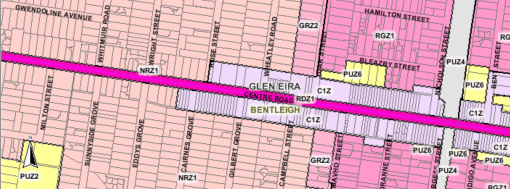
The top photo is Mimosa Road, Carnegie. The second shot is Bent St, Bentleigh. What both have in common is that the houses on the left are zoned Residential Growth Zone (ie 4 storeys); both middle ones are zoned General Residential Zone (ie 3 storeys) and the ones on the right are zoned Neighbourhood Residential Zone (ie 2 storeys). This is council’s version of a ‘transition zone’ and given that neither the RGZ or the GRZ1 have any decent setback requirements apart from the ‘optional’ ResCode, buildings at the back and the sides will be towered over – as many already are. This represents planning insanity and/or incompetence. Even developers for the current State Government Review of the zones recommended that streets do not have multiple zonings. In Glen Eira, countless streets have 2 or 3 zones within a 200 metre stretch. As one commentator pointed out, this is what happen when you sit at your desk and simply draw a circle on a map instead of undertaking a comprehensive analysis of your streets, your suburbs, your ‘neighbourhood character’, and the available infrastructure.

Prior to the introduction of the abysmal zones, all residentially zoned land was declared as R1Z with a preferred height limit of 9 metres. The zones changed all that with Council’s lazy and incompetent, ‘one size fits all’ approach. Areas zoned GRZ could now go to 10.5 metres and land zoned RGZ suddenly became 13.5 metres in height. Hyams in particular continues the myth that this represents a ‘neutral’ translation of previous conditions, whilst others such as Magee, Pilling, and Lipshutz have all stated how the zones are basically ‘superb’, or ‘positive’ or ‘very, very good’ and what a wonderful planning department we have.

We invite readers to comment on just how ‘good’ these new zones really are. The screen dumps below are parts of two separate streets in Glen Eira. The houses depicted are not mansions, but well kept period homes. Guess what they are zoned? We will reveal all shortly.

guess

guess2

Here is how Pilling summed up:

PILLING: thanked residents for the ‘most successful consultation’ in Glen Eira and that the review ‘largely reflects’ what the community wanted. Said that the issues are more than structure planning but include infrastructure, parking, etc. ‘It’s a wide range of issues’ but ‘the only practical way’ since it is an ‘ambitious’ document is to ‘allow time to get it right’. Endorsed Lipshutz’s comments regarding the Lobo comments and stated that the latter’s comments were ‘totally inaccurate’ and that he wants to remind Lobo that ‘he did vote to bring the new zones in as well as every other councillor who was here at the time’.

Thought that the action plan was ‘practical’ given the ‘biggest population growth in melbourne’s history’ and ‘we are trying to manage that’. ‘Looking back’ they may have done something ‘different in the past’ but ‘certainly times have changed’ and ‘we are responding to that’. ‘We are trying to address the concerns of the community’. So they are taking on board community concerns and talking with the planning department as to ‘what is achievable’. Repeated that the document is ‘ambitious’ but after ‘tonight will leave us in a better position to plan for our future growth’. Thought the ‘zones have been a very positive step’, Neighbourhood character is also ‘very important’. Council has ‘2 storey 8 metres over 78%’ of the municipality and this has ‘certainly helped’ to preserve neighbourhood character. ‘But can we do more? Yes’ by ‘identifying areas we can improve on’. ‘So it is a continual update’ and he regards it as ‘one of the most important documents’ since he’s ‘been on council’.

MOTION PUT AND CARRIED. MAGEE VOTED AGAINST. ALL OTHERS VOTED FOR.

COMMENT

  • Once again we have confirmation of the illegal processes this council undertakes. No formal resolution was ever tabled or voted on by councillors to introduce, or to even send off a ‘request’ to the Minister on the zones. Thus any ‘vote’ taken was taken in assemblies – a definite ‘no-no’ according to the Local Government Act.
  • On another governance issue – Pilling moved the motion on the interim heights. Since he is ‘chairperson’ of the meeting, he should have stepped down and the deputy mayor taken his place. Plenty of other councils stipulate this in their Local Law meeting procedures. The fact that Glen Eira doesn’t is another example of shonky process and poor governance. Since it is the chair who determines points of order, eligibility of questions, etc., it is inappropriate for that same individual to be moving any motion. But that’s Glen Eira – anything that favours the ruling clique goes!
  • Sounds as if the flavour of the month is the word ‘ambitious’. Perhaps Pilling could inform residents how ‘ambitious’ it is to set a time frame of up to 20 years to implement structure plans for all activity centres and 3 to 4 years for parking precinct plans that have been on the books for the past 10 years?

CONCLUSION

Pilling’s record as a councillor is frankly appalling. Elected on Green credentials he very quickly disowned that party and to all intents and purposes became a Liberal. Nothing wrong with changing allegiances, but not when people voted for him believing he is a Green. Since the party also funded his campaign has that money been returned? We also have it on good authority that some Pilling reps came cap in hand to the Greens seeking Pilling’s re-entry to the Greens and begging for another round of campaign funding! Given his 2 time mayoralty, we would have thought that $190,000+ should buy plenty of election posters and pamphlets! We can only hope that the Greens have learnt their lesson and formally excommunicated their Quisling.

Residents should also remember Pilling’s role in the most contentious issues of recent times and how his vote helped scuttle community aspirations. We refer to:

  • Caulfield Village C60 & Development plans
  • Caulfield Village Cinema
  • Frogmore heritage status
  • Turning more and more of Bailey Reserve into a car park
  • In 2011 Pilling was in favour of a Notice of Motion. In 2016 he voted for public question restrictions that limited transparency and community participation.
  • Casting vote in line with Lipshutz, Hyams, etc. on numerous developments
  • Gagging councillors repeatedly

Here is part of Pilling’s record in voting for permits, many of which he moved or seconded –

1056-1060 DANDENONG ROAD, 8 storeys, 97 units

127-131 Gardenvale Road – 12 units

483-493 GLEN HUNTLY ROAD, ELSTERNWICK – 8 storey, 57 units

687-689 GLEN HUNTLY ROAD, CAULFIELD – 28 units

451-453 SOUTH ROAD BENTLEIGH – 5 storey, 12 units

149-153 NEERIM ROAD & 4 HINTON ROAD, GLEN HUNTLY – 17 double storeys

2 MORTON AVENUE, CARNEGIE – 6 storeys, 40 units

15-19 Gordon Street ELSTERNWICK – 8 storeys, 55 units

730A CENTRE ROAD BENTLEIGH EAST – 5 storeys, 29 units

33-35 Jersey Parade, Carnegie – 4 storey, 28 units

115-125 Poath Road Murrumbeena – 4 storey, 33 units

67-73 Poath Road MURRUMBEENA – 6 and 7 storey, 39 units

144 Hawthorn Road CAULFIELD NORTH – 6 storeys, 40 dwellings

2-4 Penang Street MCKINNON – 3 storey, 23 units (permit was refused by councillors, but Pilling & Sounness voted against refusal)

15-17 Belsize Avenue & 316-320 Neerim Road CARNEGIE – 4 storey, 52 units

22-26 Bent Street BENTLEIGH – 4 storeys, 41 units

29-33 Loranne Street BENTLEIGH – 4 storeys, 42 units

168 Hotham Street ELSTERNWICK – Lipshutz & Pilling wanted 5 storeys and 78 dwellings

339-341 Neerim Road & 19-21 Belsize Avenue CARNEGIE – 4 storeys, 35 units

64-66 Bent Street MCKINNON – 3 and 4 storey, 31 units (again Pilling & Sounness moved to accept)

1240-1248 Glen Huntly Road CARNEGIE – 6 storeys, 117 units (Pilling/Delahunty motion)

DELAHUNTY: stated that Magee has got a ‘special place in my heart’ because ‘in one sentence’ you can find yourself disagreeing with him and then when he gets to the end you go ‘yeah’. Didn’t know whether she could ‘endorse’ all of Magee’s comments especially on structure planning and ‘proper strategic conversations’.  Said that the review is an important strategic document that should help residents ‘shape’ the community. Said that some councillors think that ‘we should be doing what other councils are doing’ like ‘going down the path of structure planning’. So ‘perhaps if these had been done some time ago’ then ‘we would have had the discussion about’ the strategic vision and maybe the same issues with VCAT but ‘with more influence and the greater ability to more strategically manage the outcomes’.  This is ‘what structure planning does’ even though it might ‘still have ambiguities in it when it comes to appeal rights’ that ‘sort of conversation with the public is very important to have’.  

Gave an example of a planning application for East St. Kilda where it is a very ‘small block’ surrounded by 5 and 6 storey buildings ‘all around it’. But at the ‘other end of the municipality’ the same planning rules exist – such as in Bentleigh and when an application comes in ‘you are standing in a quarter acre vegie patch’. ‘It just feels like such a different part of the world’. So in order to ‘properly’ define these neighbourhoods and ‘how they should grow’ and ‘how we manage the rate of change is an incredibly important piece of work’ and ‘it should have been done by council a long time ago’Said that she isn’t ‘having a go’ at others but that ‘we thought we had the right policies in place’ but ‘you always need to check whether you’re doing things in the best manner’. Thought that ‘we were a little left behind’ in this. Said that the Minister ‘is right to point out that we have some inconsistencies’ compared to other councils and that ‘it is right for us to come up with this work plan’. Thought it was proper to set aside ‘time’ and money in order ‘to have this conversation with residents to develop structure plans’

COMMENT

Some slack can admittedly be granted to Delahunty given that she has inherited the decisions of previous councils and was elected in 2012. However, her above comments also deserve some major criticism.

  • Is Delahunty hedging her bets? – ie on the one hand admitting council’s slackness in not achieving anything for years and years, but then on the other hand, excusing this inaction by claiming they thought they had got the policies ‘right’. All one needs to consider is the constant complaints about VCAT and it is obvious that the so called policies were not ‘right’.
  • Delahunty has publicly stated that she ‘lost the argument’ on community consultation on the new zones and that she is glad she lost the argument! In other words, this is condoning the decision to exclude the public. Now we get the motherhood statements of how important it is to have community consultation. Sounds a little like Magee we suggest – inconsistent and opportunistic.
  • Delahunty voted for this draft review, yet there is barely a word about the time lag of the work plan, nor any of the other recommendations. As for ‘setting aside money’ that won’t be until the next budget so more delay. Surely if someone votes for something the least that residents should expect is an insight into the rationale of why, or why not, the recommendations are acceptable?
  • Delahunty has also not been averse to voting for plenty of developments. Here is a list of her voting patterns. Many of these motions to grant permits were moved or seconded by Delahunty –

15-19 VICKERY STREET, BENTLEIGH – 4 storey, 47 units

670-672 CENTRE ROAD & 51 BROWNS ROAD BENTLEIGH EAST – 67 units

10 & 12 Bent Street BENTLEIGH – 35 units

9 & 9A Truganini Road, Carnegie – 20 units

23 Bent Street BENTLEIGH – 34 units

30-32 Ames Avenue CARNEGIE – 12 double storeys

1100 Dandenong Road CARNEGIE – 22 units

337-343 Balaclava Road CAULFIELD NORTH – 33 units

247-251 Neerim Road CARNEGIE – 48 units

143-147 Neerim Road GLEN HUNTLY – 32 units

817-819 Centre Road BENTLEIGH EAST – 26 units

629-631 Glen Huntly Road CAULFIELD – 15 units

1240-1248 Glen Huntly Road CARNEGIE – 6 storeys, 117 units

14-18 Bent Street BENTLEIGH – 55 units

339-341 Neerim Road & 19-21 Belsize Avenue CARNEGIE – 35 units

14-16 Elliott Avenue CARNEGIE – 21 units

495-501 Glen Huntly Road ELSTERNWICK – 7 storeys, 32 units

670-672 Centre Road BENTLEIGH EAST – 5 storeys, 50 units

168 Hotham Street ELSTERNWICK – 4 storeys, 67 units

29-33 Loranne Street BENTLEIGH – 42 units

22-26 Bent Street BENTLEIGH – 41 units

15-17 Belsize Avenue & 316-320 Neerim Road CARNEGIE – 52 units

150 Tucker Road BENTLEIGH – increase of dwellings form 13 to 20

401-407 Neerim Road Carnegie – 5 storey, 57 units

67-73 Poath Road MURRUMBEENA – 6 storeys, 30 units


ESAKOFF: stated that others had already brought up what she had wanted to address. Said that structure planning was the ‘first one’ she wanted to talk about. Said that she didn’t ‘know whether they are a good thing or they’re not’. Went on to say that ‘we’ve been advised in the past that unless you go for more they’re not likely to be approved’ and ‘time will tell whether this is in fact the truth or not’. Said she’s ‘been thinking back 13, 14 years before our zones were in place’ and ‘attending meetings that were held to do with the zones’ and in the discussions ‘people were shock, horror’ about 3 storeys ‘in an activity centre’. This ‘had not been seen before’.  15 years down the track and ‘we would probably be very glad that they had a minimum of 5’. ‘Perhaps if we had gone for structure plans that long ago we might have got 5’. ‘We might have been shocked at the thought that it’s five’ but ‘today it’s looking pretty good’. Said that ‘no one can see ahead’ and wished that ‘sometimes we could’. ‘We don’t know what’s around the corner in the years to come and what we will consider acceptable or not’.

Stated that the ‘topics of conversation’ at the forums ‘were pretty consistent’ and people noted structure plans, transition zones. Acknowledged that ‘transition has been an issue since I’ve been on council’ and that she’s ‘always wanted transition to be wider than one block’ and ‘that’s what people want too’. Hoped this could be achieved so it’s a ‘slower transition from one block to another’.

She hoped that ‘we can address’ neighbourhood character since ‘there’s a fair bit of damage done’ so difficult to ‘say in some areas what neighbourhood character is any more’. Hoped that with Neighbourhood Character Overlays this could ‘cover those areas still intact’.

On traffic and parking she thought this could ‘extend further’ than just the borders of the activity centres into residential areas where people are saying they can’t park in their streets anymore. Growing population will impact on this but council ‘has done a lot by way of parking around activity centres’ via refusing parking permits for new developments.

Heritage ‘can do with a review’. ‘No doubt, it’s been a while’. ‘Loss of trees on development sites was also an issue. ‘We have put in place some sorts of barriers to stop moonscaping’ but ‘that doesn’t always work – it doesn’t deter developers overly’.  So ‘whatever’ council decided to do ‘it has to be something that is passed’. ‘If it’s something that is going to stop development altogether it will be stopped in its tracks’ because the State Government ‘is for development’.

Went on about infrastructure and ‘improvements’ and thought this was ‘fair enough and we will see what we can do there’. Open space is also an issue and ‘that’s why we are trying to secure open space in and around activity centres’. However ratecapping ‘has put a little bit of a dampener on that’.

ESD is another issue that ‘we have addressed somewhat and will address further’. Underground parking is another issue and she ‘guesses’ this is about canopy tree coverage on development sites. But ‘underground parking allows for lower heights I believe’ since trying to ‘park at grade you are increasing your height because’ it’s got ‘nothing to do with the reduction of the number of dwellings’.


COMMENT

  • God help us!!!!!! Here is a 13 year serving councillor admitting she hasn’t got the foggiest about structure planning! Has she ever asked? What has she been told? Has she ever bothered to read other council’s planning schemes and their numerous structure plans? And what does this say about the ‘advice’ that councillors have been fed from the likes of Newton and Akehurst over the past 13 years? And more importantly, what does it say about the will of councillors and to what extent they have been complicit in a planning agenda that has finally been called out by the Minister as being totally out of kilter with best practice?
  • ‘No one can see ahead’. Surely that is the objective of a good planning scheme – to prepare a vision for a municipality that can stand the test of time. Exactly what is the overall ‘strategic vision’ of Glen Eira, except to create countless opportunities for developers to ruin suburb after suburb?
  • At least Esakoff acknowledges that ‘neighbourhood character’ is now hard to define in many areas. Perhaps if council had preferred character statements years ago, instead of waffly useless phrases like ‘emerging character’ in its planning scheme, many areas would still be ‘intact’? More importantly, is this an admission that all council is intending to do is include a few more streets under Neighbourhood Character Overlays? What is most disappointing about Esakoff’s statements is that residents are provided with literally no idea as to what anything means, nor what council plans to do. Detail is non-existent!
  • Esakoff’s and the other councillors short-sightedness is evidenced by her statements on underground car parking. The issue is far more important than whether or not a few canopy trees can be planted. The issue of underground parking could be calamitous in terms of its impact on the water table and the cumulative impact on constant digging. London research has shown that the more basement car parking allowed in one area, the greater the risk of sink holes – aka Monash last year!
  • Epiphanies keep coming for councillors when less than a year ago, Esakoff was quite happy with the provisions to stop moonscaping and no necessity for a tree register –  ‘the owner of that property should have every right to do what they like’. She has always ‘been on the side of personal rights’ and she doesn’t want people to be told ‘what they can and can’t have’ in terms of trees in their gardens. That’s their ‘domain’ and it’s ‘called private open space – private’. ‘To be personal and to accuse people of inconsistency I think is a disgrace’. Said that people can argue for protecting street trees and planting more trees, but on people’s own property they should decide. Went on to ‘red tape and the costs’ is ‘another layer that the community is over’. Said that the ‘community’ doesn’t ‘want any more red tape’ or costs in choosing ‘what to do with their own private space’. (24/3/2015)
  • and there are good protections currently existing via what council already has to deal with Mentioned ResCode and how this ‘removes the advantage that developers gain’. Permits also come with conditions that trees can’t be removed but this also has a ‘down side’ because years later there’s the request for a change in condition so these trees which are now ‘causing damage’ can be removed. There have to be avenues of appeal with the tree register because that would make it ‘fair’ and to remove ‘those rights of appeal would not be a fair process’. Said that ‘my position remains unchanged’ and that she is against ‘tree control in Glen Eira’. (16/10/2013)
  • Existing mechanisms include town planning, so that if there is a significant tree then town planning conditions are ‘put in place to protect them’. There are also ‘large penalties’ for ‘breach of those conditions’. Other safeguards are landscape plans, 4 metre setbacks and open space requirements which means that more trees can be planted. ‘There are enough hoops to jump through’ without adding to them. (14/10/2013)

LOBO:  was happy that Magee ‘to some extent’ agreed that ‘Glen Eira has to progress’. Stated that ‘all this hooha could have been avoided’ if Akehurst hadn’t taken ‘a shortcut’ and ‘asked us to take the zones’ to the government. ‘We accepted his recommendation and that was a rude awakening of our residents’. Result is that ‘we’ve now come back to the drawing board’ and they ‘could have come back early’ and ‘not have to wait for the Minister to tell us what to do’. He believes that ‘openness, transparency and accountability are the cornerstones of democractic system, free and fairness are the pre-requisites’.

LIPSHUTZ: thought that Akehurst ‘presided over a planning department that was second to none’. Said that council was ‘faced with a situation where we had policies that were not being looked at’ by VCAT. The Government then changed things and said ‘rather than having policies we are going to have zones’ and ‘that meant that VCAT had to adhere to the law’. Therefore ‘to criticise Mr Akehurst – I reject that completely’. Said that all councils are in a similar situation and Glen Eira ‘was the first council and we got the best deal possible, in fact the best deal than any other council’  because ‘we were the first’. He ‘rejects’ and thinks it is ‘dishonourable’ what was said about Akehurst.

Admitted that ‘I have never been a great fan of structure plans’. ‘They are very blunt instruments’. Thought the ‘aims’ of structure plans for activity centres was ‘a good thing I guess’ and that ‘they are long term arrangements’. But ‘things do change’. However, ‘I don’t see any alternative but to go ahead and do it’ because the ‘Minister has come along and said to us that that’s what they really want’. ‘We don’t have mandatory height limits’ and they are ‘finding’ that in Bentleigh and Carnegie 7, 8, or 9 storeys are going up ‘which are simply inappropriate and we can do nothing about it’ because all VCAT does is ‘we have to look at your policies’ but ‘don’t have to follow them’. They also ‘rely on their own precedent’ when they previously grant a 6 storey nearby and ‘ignoring what council and residents want’. So if council is to get a height limit and ‘we have to go through the structure plan process then that is what we are going to do’. ‘I don’t like it. I don’t think it is a very good way of going ahead’ but ‘we have no alternative’ to doing what the minister wants. The ‘real issue’ is that ‘rather than doing structure plans’, ‘rather than doing these half-baked planning review – I’m not saying this one is’, the government ‘needs to look at planning overall’.  They have to recognise ‘that we as residents know best what we want for our cities’ and that ‘we as councillors, representatives of our residents, have more say’ than the government.

COMMENT

  • Quite amazing that since we’ve published the Minister’s letter, there is (belatedly) the admission that council has been ORDERED by the Minister to do some work following years of doing bugger all and handing the municipality over to developers.
  • For a lawyer, and supposedly an intelligent individual, Lipshutz’s logic is woeful. But that’s what happens when you try to defend the indefensible and to save your own neck! First off: structure plans are not set in concrete. Like any other planning mechanisms they can be changed via amendments. All that is required is for the planning department to do some fair dinkum analysis, provide a feasible argument for a change, and produce the amendment. Obviously beyond this council’s will or capacity! Secondly, the claim that ‘we can do nothing about’ what’s been happening with heights is a blatant lie! During the past 13 years Council has had ample opportunity to introduce height limits; to introduce Urban Design Frameworks; to introduce Structure Plans; to introduce Design and Development Overlays. VCAT has been 100% correct in stating time and again that none of these tools exist in the planning scheme and therefore developers are within their rights to apply for what they want. It has nothing on earth to do with VCAT changing its interpretations and everything to do with Council’s refusal to implement any amendment which will impede developers and provide more stringent safeguards to the community. That is the bottom line and these councillors have all been complicit in allowing this state of affairs to continue unabated.
  • Being ‘first’ means nothing when other councils did their homework and achieved far better results for their communities through well prepared zones that were not ‘one size fits all’ – plus schedules that provided greater protections. And we do not need to remind residents that NO OTHER COUNCIL IN THE STATE, proceeded in the secret manner that Glen Eira did with councillors (undoubtedly Lipshutz, Hyams, Esakoff, Pilling, Delahunty and probably Sounness) deciding (illegally) behind closed doors that residents were not worthy of having a say!
  • As with our previous post on Hyams, Lipshutz can accept a large part of the responsibility for the erosion of resident rights and the appalling governance and internal divisions that have characterised this council for well over a decade. If he does stand again, and there is a very strong rumour that he won’t, then like the others, we urge residents to vote this ‘bastard’ out!

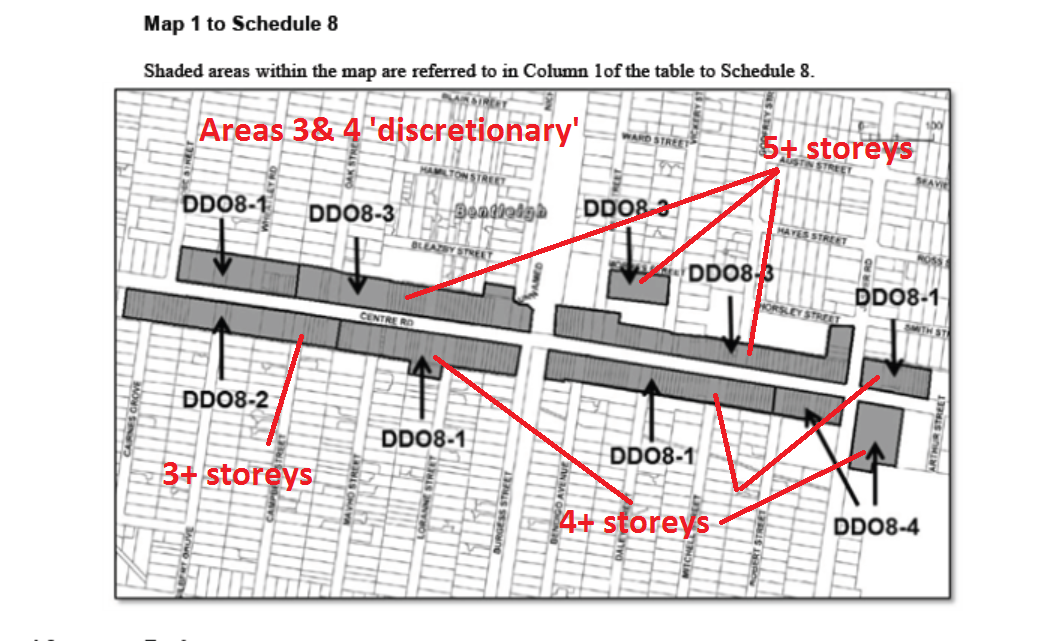
HYAMS: started off with ‘there is rapid growth all over Melbourne’ and other councils have had this for a long time and it is now hitting Glen Eira. The question is ‘are we equipped to protect our neighbourhoods?’ It ‘would appear not’ ‘given VCAT’s changing interpretation’. Claimed that policies were ‘previously sufficient, now not so much’. Council does ‘need to do something about it’ and the report does this. Said that at the last review ‘people were a lot less ambitious about what they wanted from us’ such as height limits, which council has now got. People also wanted ‘transition zones’ which is also achieved and ‘better protection of neighbourhood character’ and that’s been gained via the Neighbourhood Character Overlays. ‘So we basically carried out what was wanted in the previous review’ and ‘this is far more ambitious’ and ‘most of what residents have asked us for is represented in this plan’.

Admitted that some councillors, like Magee, ‘want the zones reviewed’. He believes that ‘it would be nice to do that’ but ‘it could be a double-edged sword’ and end up with things a lot worse.  The ‘more important point’ is that the Government is ‘in the process of reviewing’ the zones ‘so there is no point in us doing it’ because they would say like they did with Moreland that the latter’s proposed Better Apartment Guide wasn’t going to be ‘taken on’ because ‘we’re doing a Better Apartment Guide of our own’. So if council ‘was to do all the work on a review of our zones’ plus all the necessary strategic justification to go along with this, the government could then say why ‘are you wasting your time’ since we (the government) are already doing the review. ‘With a bit of luck’ the government review will achieve a ‘better outcome’.

With the zones, ‘nothing can be built now that couldn’t be built before’ but other things can’t be ‘built now because of the mandatory height limits’. The apartment boom did coincide with the introduction of the zones, especially in Bentleigh, and this isn’t ‘because of the zones’ since other areas like Carnegie ‘were copping’ growth ‘before the zones’. ‘There would be those who continue to misrepresent our zones for political purposes’.

Council ‘isn’t proposing to change the zones’ but to ‘strengthen the protection within each of the zones’ and this is the ‘neighbourhood character work’.  This, together with the structure plans, is the most important aspect of the workplan. This is important for the activity centes and the commercial zones and ‘whilst our policies haven’t changed but the interpretation of them has’ so both the government and VCAT are ‘now looking for something more explicit’ in place to give the protection ‘that we’ve achieved, or hoped to achieve in the past’.

On structure plans council had been told that unless you have ‘mandatory height limits in structure plans’ it is ‘hard to get mandatory height limits in shopping strips’ and these were interpreted as a minimum ‘height limit’ so developers went for higher. So now VCAT is ‘saying we don’t have height limits specified’ so we ‘now do need height limits even if they are not mandatory’.

Council is concentrating on Carnegie and Bentleigh because these are the areas that ‘residents said are the most important’ and ‘appreciates’ Pilling adding the clause about the interim height limits to the motion.  Said that there was a ‘gap identified in our heritage policy’ so this is the ‘first thing we will do’.

‘Unfortunately’ ‘everything we are planning to do does take time’. Council ‘would like to get’ these things ‘through quickly but the fact is that ‘we need planning scheme amendments’, and ‘you need to have done the research to present the government with truth’ etc and this could take up to 18 months. Claimed that the ‘government will never allow us to put at risk development’ and that’s what ‘all this is about’, ‘unless we make a very strong case based on the truth’.

On Magee’s thinking of what council should do, these are ‘encapsulated’ in the work plan and ‘we can’t really do them in a way except like this’. Admitted that it’s not something ‘that everyone would like’ but it’s putting one step forward and council wants to achieve 3 structure plans in 4 years. Saw this ‘as the best way forward’ and council would do ‘everything we can to expedite’ this and that involved ‘making budgetary decision next year’.

COMMENT

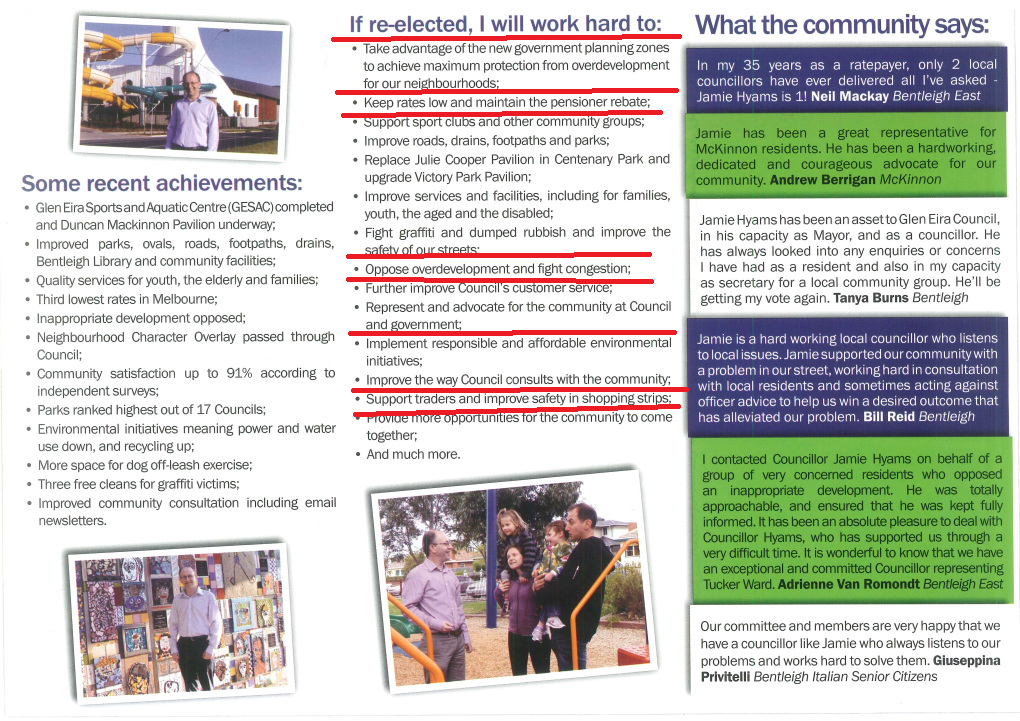
Like a dog with a bone, Hyams continues to stick to the glib, unsubstantiated claims that are designed to camouflage the incompetence of this council and his role as a ten year councillor.

We reiterate what we have previously stated –

  • VCAT has not changed its position. Glen Eira planning policies have always been deficient in terms of protecting our suburbs, especially housing diversity precincts. See the following post for VCAT decisions that precede the introduction of the zones: https://gleneira.wordpress.com/2016/07/22/lipshutz-versus-hyams/
  • Hyams like Magee, contradicts the report which states that council has reviewed the zones. Either the report is a work of fiction or both Magee and Hyams have either not read it, or ‘truth’ is not a priority component of their grandstanding.
  • Glen Eira has transition ‘buffers’ not ‘transition zones’ that would stand up to any real scrutiny. Zoning one property as GRZ2 hardly constitutes a ‘transition zone’. Further, Hyams claims of neighbourhood character protection is minimalist covering less than 2.5% of properties – and that’s if one can believe council’s figures!
  • How much longer will council use the excuse for doing nothing because the state government is looking at the issue or it should be the role of state legislation rather than local policies? That hasn’t stopped Moreland and other sympathetic councils from pursuing a Better Design Guideline for their municipalities. Nor has it stopped other councils from introducing Environmental and Water Sustainable policies years ago. Glen Eira’s persistent refusal to do anything is unforgiveable and residents are paying the price.
  • Council in its report admits that structure planning may necessitate the hiring of outside consultants and that this will be expensive. Yet, Hyams reveals that no money has been set aside in the current budget and it won’t be until next year’s budget. Thus, either we get a half baked structure plan devised by the current crop of Council’s planning ‘professionals’, or further delay is written into the workplan until funding is available.
  • Hyams continually hangs his hat on ‘mandatory height limits’ as the be all and end all. We remind readers of his contradictions when pre-zone he stated: that a problem was that if you set height limits then ‘people will build up to that height and you can’t stop them’ but if you don’t have height limits and let each application be ‘judged on its merits’ then you could get ‘better outcomes’. (from our post of 6/2/2013 – ie on application for Glen Huntly Road – 6 storeys and 45 dwellings which got a permit from council.)

Then post zones we get this diametrically opposed statement –

‘The new zones are limiting development’ because of the height limits and that ‘anyone who tells you otherwise doesn’t know what they are talking about’ or ‘is deliberately seeking to mislead you’.(25/9/2014)

  • Hyams’ record on voting in favour of major developments is akin to Magee’s. We won’t repeat by providing a list.
  • Finally, residents need to consider how much this individual has contributed to the poor governance within this council and how much this has subsequently cost ratepayers. We refer of course to the foul mouthed abuse of residents and Lobo and the bonanza this has created for lawyers. We also remind readers that it is primarily he and Lipshutz who have been the force behind: no notice of motion; no tree register; changing public question formats; and countless machinations over the continued reappointment of Newton. Nor does the community’s view appear to matter. When over 1000 people requested a Heritage protection overlay for Frogmore, it was Hyams, Lipshutz, and Pilling who denied residents the right to provide their evidence before a planning panel. It was also this unholy alliance which granted the MRC rights to their development via a fabricated ‘special committee’ arrangement. Countless questions of ‘conflict of interest’ also appear to have been ignored by these individuals. Thus, in our view, Hyams is definitely one of those ‘bastards’ who must be voted out!