Some background on this suburb is necessary. Glen Huntly is the second smallest suburb in the municipality coming in at 0.89 square km. Only Gardenvale is smaller at 0.25 sq km.

The planning history of Glen Huntly and how council has handled this area is abysmal. According to the State Government this is designated as a Major Activity Centre. Council regards it as a ‘neighbourhood centre’. Thus, when applications have gone into VCAT, the judgements have always been that State legislation over-rides council views and thus the developer has been granted his permits for far more intense development. What makes this situation even worse is that the State Government granted Council $45,000 to undertake the necessary work to produce a structure plan. Council returned that money and refused to implement any structure planning or anything else that could mitigate the ongoing development in Glen Huntly. So Glen Huntly is now stuck in the ‘never-never land’ of being technically a Major Activity Centre, with no Urban Design Frameworks, no parking precinct plans and no real vision as to the future of this suburb and its shopping strip. Retailers have time and again lobbied for improvements – to little avail. But development continues unimpeded – thanks to the zones.

What is even more questionable is the way the zones have been applied. The breakdown is:

31% of this suburb is zoned as GRZ1 and GRZ2 – ie available for 3 storey development

5.39% of the suburb is zoned Commercial 1 – no height limits

0.72% is zoned – Mixed Use Development (MUZ) – no height limits

Add in the Road Zone Category which also welcomes 3 storeys along major roads and close to half of Glen Huntly is ripe for the picking and far greater development. Glen Huntly does admittedly already have large numbers of units. These are products of the 50’s and onwards and will be demolished and new ones built of far greater density and even height.

Yes, there is plenty of public transport, and an incredibly busy rail crossing. But without proper planning that actually addresses the social, environmental and economic aspects of growth, Glen Huntly will continue along the path of unsustainable development.

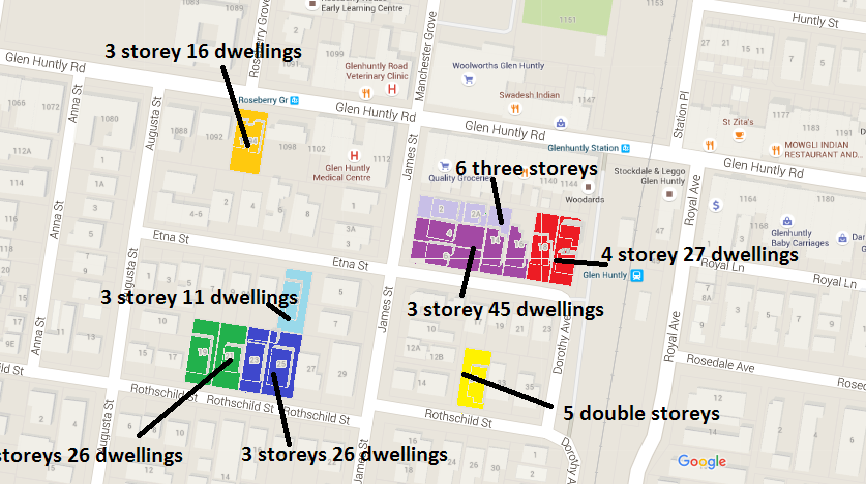
One perfect example of this in just one small area, is shown below. These are applications that have been decided since the zones and most have been granted permits. Those ‘refused’ by council will undoubtedly end up at VCAT.

gh

PS: here is an example of the point we made above – http://www.conquestea.com.au/news/2014/5/8-glen-huntly-block-sold-on-48pc-yield

UntitledCLICK TO ENLARGE

Why on earth does council even bother to put in submissions to state government reviews when they are invariably of such poor quality? Most are a few pages of self congratulation with a total lack of analysis, detail, and real contribution to the debate. And lest we forget, without endorsement via a council resolution and made public only ‘after the fact’. Frankly, council ought to be highly embarrassed in comparison to what other councils are capable of producing.

The latest effort concerns the State Government’s Plan Melbourne Refresh – a very, very important document that will have a major impact on strategic planning for Melbourne for the next 30 years. There is much in this document that should concern residents:

  • The ‘suggestion’ that middle ring suburbs should contain a 70/30 split of future housing growth
  • Notions of a 20 minute neighbourhood centre
  • Environmental sustainability
  • Changes to planning legislation, and much, much more.

So what is Glen Eira’s response to all these vital issues? Readers should note what our council, unlike countless others, fails to even mention –development contribution levies, tree protection on private and public land. We’ve uploaded the full submission HERE. Below are a few extracts and then a comparison with the views of other councils.

This is a very, very long post, but we urge readers to carefully consider the views presented below.

ON HOUSING AND THE 70/30 SPLIT

The Glen Eira Council view – It is proposed to accommodate the majority of new housing in Melbourne’s established areas, rather than in the growth areas. Glen Eira adequately accommodates population growth through its longstanding housing policies and suite of residential zones. These serve to co-locate higher densities of housing with public transport. A balance has been achieved in maintaining low scale residential areas and channelling housing into locations that can best support change. We have obtained government approval for maximum heights over all residentially zoned land where there were no limits before. Any move through Plan Melbourne 2016 to dilute the protection that Glen Eira has over its residentially zoned land will not be supported.

COMMENT

There is much in the above paragraph that needs to be challenged. For example:

  • How many residents would concur with council’s interpretation of ‘adequately accommodates population growth’ when all the complaints are about traffic mayhem, lack of public open space, lack of well designed buildings, and lack of infrastructure support.
  • What exactly does ‘higher density’ mean when neighbourhood centres such as McKinnon, Ormond, Murrumbeena, and East Bentleigh have the highest proportion of GRZ in their suburbs. Further, if public transport is the ‘key’ to locating ‘higher density’ then East Bentleigh certainly does not fit into this category.
  • What exactly does ‘locations that can best support change’ mean when council has not lifted a finger to introduce any parking precinct plans, urban design frameworks, etc. And how can certain ‘locations’ ‘support change’ when there is absolutely no preferred character statements in the planning scheme for any of the housing diversity areas?
  • Another major furphy is the claim that ‘maximum heights’ are the be all and end all of good strategic planning. And of course there is also the blatant unfounded mantra that ‘all residentially zoned’ land in Glen Eira is now better off. No mention of course of Mixed Use Zones which give a lie to the claim that all residentially zoned land now has height limits.

Thankfully other councils have taken the trouble to analyse and provide some data to support their assertions. They also oppose the introduction of the 70/30 split but at least their arguments have far greater validity, or raise concerns that are never mentioned by Glen Eira – ie neighbourhood character, heritage, employment, etc. Some examples:

BOROONDARA – Council is particularly concerned with the point around ‘low suburban density’ and “to encourage high urban densities and foster more diversity and choice in the housing sector, in closer proximity to public transport and jobs.” Many areas in Boroondara which adjoin public transport corridors consist of high quality residential streets which should be protected from intensive development, particularly apartment buildings. This includes some areas in the vicinity of train stations.

, accommodating the majority of new dwellings in established areas within walking distance of the public transport network can lead to a loss of trees and canopy cover in those areas. Therefore, any regulatory framework needs to take account of the local context and competing objectives and allow a level of discretion in managing these requirements. Further, Council questions the notion of protecting environmental and liveability assets on the urban fringe at the expense of another area’s environmental assets. This includes protecting valued tree canopy cover that reduces urban heat island effect and other valued aspects of Boroondara’s liveability.

The proposed housing target ignores the expectations which Boroondara has around the quality of new development. Importantly though, it makes broad based assumptions around the capacity of existing infrastructure in established areas such as Boroondara to support such intensification. In many instances, local development and social infrastructure already operates at or above capacity. Further, increasing development within these areas will only exacerbate the situation. Established area councils therefore require better infrastructure funding mechanisms to meet  increasing demand and renewal of infrastructure assets.

Council also refutes the claim being made in the Discussion Paper that Melbourne’s middle ring suburbs are accommodating a steadily increasing share of Melbourne’s housing growth – from 25% of building approvals in 2002 to 40% in 2014. This is on the basis of Footnote 6 in the Discussion Paper which states “This is an indicative measure of change in middle suburbs as building approvals include knock down and rebuild developments and therefore not necessarily net additional dwellings.

While knock down rebuilds distort the data, overall, new supply has increased in middle suburbs.” In other words, the Discussion Paper cannot readily point to any data which suggests that new dwelling supply in the middle suburbs has increased to a level which can justify a 70/30 target or sub-regional or municipal wide housing targets more generally. Further, the Discussion Paper notes that Melbourne 2030 aspired to a (roughly) 70/30 housing target, but (at best) Melbourne is being planned on the basis of 61% of new dwellings being located in established areas to 2051 under Victoria in Future 2015……Council does not believe the MAC or the Minister for Planning has strategically justified the imposition of a 70/30 housing target.


MONASH

The issues with existing infrastructure and service levels within the established suburbs of Melbourne is significant and is the major impediment to achieving the 70/30 split and ensuring the Melbourne continues to be a liveable and functional city. If the strategy is to encourage increased density within established suburbs (including parts of Monash), the need to upgrade and provide additional physical and community infrastructure needs to be given a much higher priority and be more clearly acknowledged and planned for in Plan Melbourne.

The Refresh paper identifies ‘low suburban density’ as a problem that needs to be addressed. However, it does not explain why this is a problem. In stating that this ‘problem’ will be overcome, it does not explain whether it still proposes to enable the retention of existing elements of suburban development that many within the community value – such as key elements of the existing neighbourhood character – and how the aspiration to increase the density rather than continue to expand the urban growth boundary will work with the ‘green our city’ elements of the Plan Melbourne strategy.

The Refresh Paper criticises the current aspiration in Plan Melbourne for 50% of metropolitan Melbourne being within the Neighbourhood Residential Zone because ‘applying a zone according to a percentage is an unconventional approach’., however it appears to be taking a similar approach to setting a 70/30 split for new development. Further justification should be provided to support this proposed split, which, if achieved, will lead to a significant change throughout suburban Melbourne. It is not appropriate, for instance to completely remove from any decisions around housing scale, consideration of the character of the area (built or natural / landscape character.

WHITEHORSE

Transport infrastructure has the potential to shape the built form and land use activities of our city. Many investment decisions are made based on the proximity to transport infrastructure regardless of whether it is included in a metropolitan or local planning strategy. However, simply being adjacent to a bus route should not automatically mean that development intensity can be increased. For example, the bus service may be infrequent, or there may be a sensitive environmental or neighbourhood character area nearby that warrants protection. One option is to rank bus or transport routes by frequency and quality before allowing more intensive development across the board. Council notes that it considered this sort of information when it introduced the new residential zones suite into its planning scheme, with this information balanced against environmental and neighbourhood character considerations.

Council would also like to emphasise the importance of integrating planning and building systems and a recommendation along these lines could be included in Plan Melbourne 2016 here. For example, single dwellings on a lot over 300 square metres in most instances do not require planning permission, which often results in a dwelling which is out of character with the surrounding neighbourhood. By being in the building system, Council cannot control the built form outcome on these sites. More consideration to neighbourhood character in the building system, or alternatively, consideration of single dwellings in the planning system, is needed.

MORELAND

Council does not consider increased density should occur at the expense of adversely affecting valued urban character by excessive building height, allowing sub-standard accommodation (as is occurring with some apartment developments) and on the assumption that there is adequate infrastructure in established areas to accommodate increased growth in established areas.

COMMENT

What stands out clearly from the above quotes is that Glen Eira continues with its myth about the new zones being in the ‘right locations’. Every other council comments on the fact that being close to a transport node is not necessarily the best or sole criterion for increased density – especially not if it means the destruction of heritage, neighbourhood character, and environment. But in Glen Eira we have heritage overlays smack in the middle of Residential Growth Zones because they are allegedly ‘close’ to railway stations; we have street after street of beautiful Californian bungalows and Edwardian cottages gone – ie Bent St., Bentleigh and Elliott St., Carnegie, plus countless others. And of course we have moonscaping that is allowed to go on unabated. And even with this unprecedented growth in Glen Eira, there is no attempt to re-introduce development contributions levies or a decent open space levy.
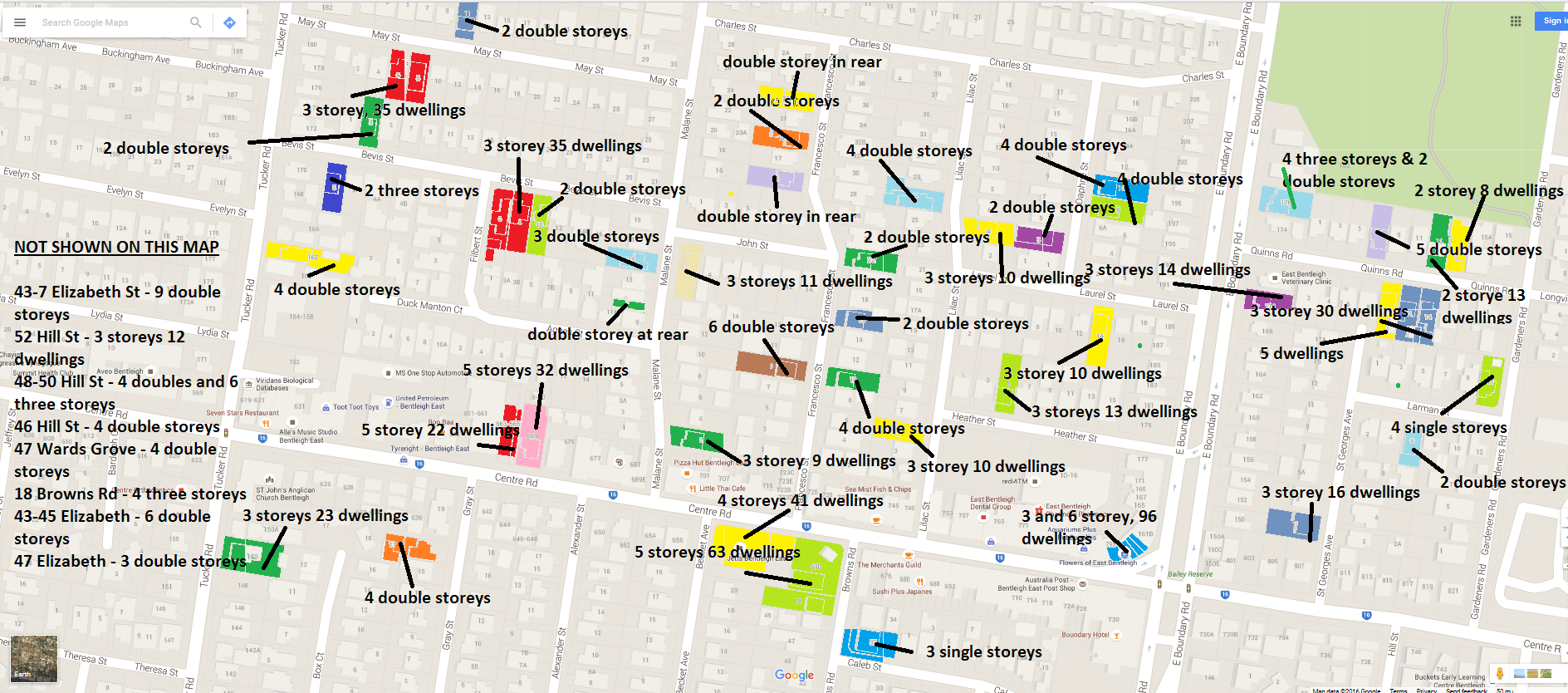
Our final post for 2015 is very apposite. It sums up:

  • The disaster that is the zones
  • The failure of council to undertake any measures to ameliorate the damage
  • The continued and unabated destruction of huge swathes of Glen Eira
  • The creation of a ‘second class citizenry’ that does not deserve open space, landscaping and on site parking
  • How out of date the current planning scheme is since it states that Glen Eira can meet its housing requirements with an average of 600 new dwellings PER YEAR!
  • The utter failure to provide quality strategic planning, and
  •  Councillors who have failed in their duty to insist on open and transparent government

What we present below are the applications that have come in from October to the end of December 2015. That is two months worth! All have yet to be decided but we anticipate that 95% at least will eventually be granted a permit. Please remember that this is only the ‘snap shot’ of one suburb! Thus in two months one small suburb of 3.8 square km is to contain the entire new housing that was mapped out in the planning scheme for an entire municipality!

Here are the applications in no particular order –

PS: we have ignored the scores and scores of applications for 2 double storeys which would bring the total up far more.

285-287 Neerim Road CARNEGIE VIC 3163 – 6 storey, 61 dwellings,

315-317 Neerim Road CARNEGIE VIC 3163 – 7 storey 26 dwellings

363R Neerim Road CARNEGIE VIC 3163 – 3 storey, 4 dwellings

14-22 Woorayl Street CARNEGIE VIC 3163 – 12 storey, 134 dwellings, amended plans put in

116-118 Grange Road CARNEGIE VIC 3163 – 31 dwellings

1 Beena Avenue CARNEGIE VIC 3163 – 5 three storey attached dwellings

10-12 Anzac Street CARNEGIE VIC 3163 – 6 double storeys

1240-1248 Glen Huntly Road CARNEGIE VIC 3163 – 6 storeys, 117 dwellings

30-32 Ames Avenue CARNEGIE VIC 3163 – 3 storey 28 dwellings

26 Ames Avenue CARNEGIE VIC 3163 – 4 double storeys

8-12 Elliott Avenue CARNEGIE VIC 3163 – 4 storeys 41 dwellings

1 Tranmere Avenue CARNEGIE VIC 3163 – 4 storey, 15 dwellings

5 Tranmere Avenue CARNEGIE VIC 3163 – 4 dwellings of three storeys each

22-28 Jersey Parade CARNEGIE VIC 3163 – 4 storey, 39 dwellings

TOTAL – 515 DWELLINGS!

The deadline for submissions to the Local Government Act Review has now passed. Glen Eira has placed its effort on its website – after the fact of course and in direct contrast to other councils who sought a formal council endorsement (via resolution) on their submissions.

Councils generally have tended to advocate for the status quo, thereby maintaining their ‘independence’ and powers to do as they like. But as per usual, very few of these other councils are as conservative and anti change as Glen Eira. Here are some quotes from Glen Eira’s submission –

On mandatory versus normative legislation – We feel that the legislation should as a general principle provide consequences for noncompliance. But in this case, where it’s a matter of more general principles, there needs to be a reliance on common sense elements – much as it currently is.

On elections and set questions for candidates – We don’t agree with the suggestion that all candidates should answer standard questions, this should be left to the discretion of each candidate. If they don’t adequately communicate with voters they will not be successful.

On banning developer donations – We don’t agree that donations should be banned, nor that certain categories of donors should be banned. Banning categories of donors could unduly favour certain types of candidates over others. Conflict of interest provisions, which would prevent councillors from voting on anything that benefits major donors, should be sufficient to cover this.

Roles of councillors and Mayor – Clarifying the role of the Mayor is a good idea but we don’t agree that this should mirror either the NSW or QLD model  – AND

We don’t believe councillors should be full time. This would dilute the pool of those able to stand. Tiering for payments is unfair. Everyone should get the same pay – it’s the same amount of work regardless of the population of the Council.

The Mayor should have a casting vote to resolve deadlocks. It should be up to Councils to determine the extent of public participation in decision-making, not legislated, beyond what is currently contained in s223.

Local laws including meeting procedure should be left to each council to determine. Indexing fines is a good idea.

On reporting and ‘efficiency’ – We oppose the suggestion to require the publication of comparative data for all services – this would be a large impost on resources that should be directed to delivering services

On conflict of interest – Where councillors have a conflict, they should be entitled to be present for the debate, but not to vote. Often, as in the case of conflicting duties, the councillor excluded may have valuable insight into the subject at hand.

By way of contrast, here are some extracts from other councils –

BAYSIDE – The discussion paper raises the practice of councils appointment of special committees to undertake a number of non-statutory, operational roles for example managing sporting pavilion hire art gallery etc. It is suggested that this model should be explored further to enable community involvement in the management of local facilities.

STONNINGTON – There should be a uniform state-wide compulsory Code of Conduct for Councillors. There should be a uniform state-wide compulsory Code of Conduct for officers.

MELBOURNE – Regardless of role, it is essential that the governance requirements of the MAV are updated to reflect current public sector best practice and to tackle some current challenges. The MAV should be subject to the same openness and transparency requirements (including freedom of information) as other public bodies established under legislation. Areas that could be covered in a new Act include:

  • employment of senior officers
  • disclosure of senior officer remuneration in its annual reports
  • management and disclosure of conflicts of interest

BOROONDARA – to address the insufficiency of comparable information about candidates. The answers to these questions be made available to voters in the form of a candidate information template in the postal ballot packs provided by the VEC and this information be made available on the VEC website. While candidates would have the right to withhold answers to some or all of the prescribed questions, all their answers (including ‘no response’) would be made available to voters.

YARRA – The current minimum standards for public exhibition and submissions to Council Planning and budgeting processes act as a barrier to the development of more meaningful consultation methodologies. By effectively reducing the time available for other forms of consultation and participatory decision-making, the exhibition process is an inhibitor rather than facilitator of community engagement

seasons-greetings2

2015 has definitely been a very mixed bag. Here is our summation –

The Positives

  • The resignation of Andrew Newton and another senior bureaucrat.
  • The fallout from the residential zones is now obvious to all and councillors are feeling the pressure
  • A far more enlightened and knowledgeable electorate on planning
  • 2016 is an election year.
  • Rate capping imposed

The Negatives

  • Further evidence in recent days of a dysfunctional and divided council
  • Major travesties of justice and continued ignoring of community – Frogmore, the MRC and C60 developments, Caulfield Park conservatory, destruction of street after street as a result of the new zones
  • Ratepayer funds spent on disseminating lies and propaganda as damage control – ie the 11 cents flyer
  • Voting cliques
  • No tree register
  • No amendments to curb overdevelopment & no review of planning scheme
  • No consistency in councillors’ arguments
  • Deplorable governance continues
  • Sub standard officer reports
  • Pavilions that continue to come in well over budget – Duncan MacKinnon for one.

We have undoubtedly ignored plenty of other events/issues that could have been included in the above. Please feel free to add your own.

Finally, thank you to all our readers and contributors and thank you again to our council for it is they who provide the multitude of fodder for our analyses. We are pretty optimistic about the future and the potential for major change and improvement. As the following says – it has started but still a long way to go before we get a fully transparent and accountable council. That in the end will depend on voters and candidates who do give a damn about residents.

2016

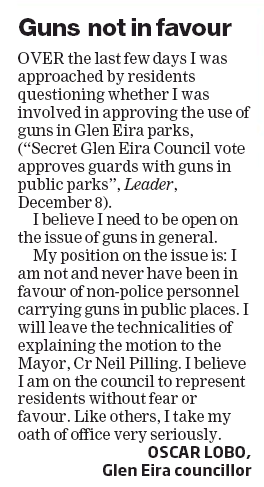
Approval sought to arm private security guards on Glen Eira Council property

December 22, 2015 12:00am

Cheryl Balfour

Glen Eira Council received a request to allow armed guards on its property. A CONFIDENTIAL report has confirmed a private security company sought approval from Glen Eira Council for guards to carry guns in public places, just two months ago.

The council has dodged questions on the issue since Caulfield Glen Eira Leader first revealed on December 7 that the issue went before a confidential council meeting on October 20.

The issue has caused friction at the council, with Cr Oscar Lobo accused of “anti-semitism” for comments he made during a council debate about public security. Cr Oscar Lobo’s comments during a council debate have incensed some in the community.

Leader has since obtained the confidential ‘Change to Council’s Risk Profile’ report tabled at the November 27 Audit Committee meeting. The report says: “On October 6, 2015 a non-government security group wrote to council seeking authority for some of its members to carry concealed firearms at events held on council property”.

Councillors Mary Delahunty and Thomas Sounness confirmed a letter from the Community Security Group seeking consent for security measures for Jewish events going forward was circulated among councillors on October 6.

The risk profile report states, “council officers would not give permission for an event under these circumstances but would suggest alternative venues for consideration”.

It says council management advised that if the council proposed to authorise the request, all security personnel must be licenced and have Australian citizenship or Australian residency. Firearms management should comply with legislation and evidence of public liability insurance of $20m must be provided, according to the report.

The document says that after the October 20 special council meeting, the security group “advised Council that it held public liability insurance of $20m on the following basis: “use of guns — covered”.

Minutes show a majority of councillors voted to close the October 20 meeting to the public and that “matters affecting the security of council property” were discussed.

Sources have confirmed to Leader off the record that councillors voted to allow armed guards on council property, including parks.

Mayor Neil Pilling again refused to comment and directed Leader to a council statement that “there is no authorisation by Glen Eira Council for the carrying of firearms for any current or future event anywhere in Glen Eira”.

The statement does not mention past events.

Victoria Police spokesman Acting Superintendent Richard Koo said police authorised individuals to provide armed guard services. “Provided a private security guard holds the appropriate sub-activity of armed guard on their licence there is no legislative restriction on where the activity can be carried out so long as the individual is abiding by the conditions stipulated on their licence and legislation.”

Police confirmed armed security guards could protect property and cash in transit only.

Government spokesman Kosta Pandos said it was “a matter for the council, however any decisions such as this must comply with the law”. “I can say that the government wants to see less guns on our streets and not more.”

Caulfield State Liberal MP David Southwick said the matter was between police and the council.

Source: http://www.heraldsun.com.au/leader/inner-south/approval-sought-to-arm-private-security-guards-on-glen-eira-council-property/news-story/bb16a685455c17183177444c2a3e0405#load-story-comments

letter


Here are some questions to ponder –

  • Why is so much in Glen Eira ‘secret’? – when other councils see no need for such limitations?
  • Why do councillors continually allow such ‘perversions’ to continue unabated?
  • Why does Glen Eira continually resort to bluff, bluster and frankly intimidation when it is dealing with residents?
  • Why does this council’s culture display such arrogance and disdain for its residents?

Here are some prime examples of very recent times.

  • The online planning register has suddenly been updated to include this load of deliberate, intimidating hogwash.

Availability of planning documents
The planning applications and associated plans and documents available on this website are provided solely for the purpose of the planning process as set out in the Planning and Environment Act 1987. The information must not be used for any other purpose. By entering this website you acknowledge and agree that you will only use information accessible here for the purpose of the planning process under that Act and any use or distribution of this information beyond that purpose is strictly prohibited.

Not only is there nothing in the Planning and Environment Act to substantiate these bogus ‘threats’, but the Government Spear program itself includes far more than the pathetic council register – ie name of applicant. Further, Planning Alerts is a free service that publishes applications for wider distribution.

  • Last Tuesday night’s council meeting included this public question –

“Will Council publish its submissions on Plan Melbourne Refresh and the Local Government Act Review? I also ask why council does not seek a formal resolution endorsing all submissions made to Government reviews or inquiries?” and the ‘answer’ was –

“When finalised, the submissions will be posted on Council’s website. Resolutions are sought as required.”

There is plenty amiss here. Firstly, residents will not have any idea of council’s position on these important issues until AFTER THE FACT. There is no open public discussion in chamber; no formal council resolution endorsing the submission written by officers, and hence another example of decision making behind closed doors – and we are of course assuming that councillors even get to read the draft submission! Yet, as always, such practices are allowed to continue unchallenged by councillors. No comments are required as to the ‘tone’ of the response and the arrogance implicit in it!

In stark contrast, we’ve done a very quick search of other councils who did seek formal resolutions and discussions on their submissions. Here is the list we’ve found after only a 5 minute search. All speak volumes of the culture of Glen Eira!

Plan Melbourne Refresh

Banyule

Boroondara

Brimbank

Darebin

Hobsons Bay

Maribyrnong

Melbourne

Moonee Valley

Moreland

Mornington Peninsula

Nillumbik

Stonnington

Whitehorse

Yarra

Yarra Ranges


Local Government Act Review

Bayside

Boroondara

Brimbank

Frankston

Monash

Moreland

Nillumbik

Northern Grampians

Port Phillip

Surf Coast

Yarra

Instead of the usual practice of merely ‘noting’ and accepting the records of assembly, Magee moved an alternate motion and was seconded by Delahunty. Hyams, Lipshutz and Esakoff declared a conflict of interest and left the chamber. The motion reads –

That the record of the above assemblies be received and noted and that council writes to the Department of Environment, Land, Water and Planning and asks if the code of conduct adopted at the most recent meeting of the Caulfield Racecourse Reserve Trust meets the compliance standards outlined in the Auditor General’s recommendations. Specifically recommendation 2 which deals with the governance framework and the need for contemporary and public reporting. And recommendation 7 which challenges the Trust to address their community engagement obligations.

MAGEE: said that the Auditor General in September 2014 released ‘an absolute scathing’ report on the trustees and the department. ‘It showed that the community were ignored’ and that ‘the land was almost totally utilised for racing’. On 21st November before the election Lisa Neville wrote to Magee (and he quoted) that Labor supports the Auditor General recommendations and that they would ‘implement the recommendations’ if elected. The records of assembly show that Delahunty asked the councillor trustees to ‘report on the latest’ trustee meeting. They said that a ‘new code of governance was voted in’ which set down that ‘no trustee is allowed to speak outside the trust’ and nor can they ‘say what is happening inside the trust meetings’. The Auditor General was ‘scathing on this’ and his recommendations were ‘that this was not to continue’. Magee then quoted Greg Sword from September 2014 where ‘the trust welcomes the Auditor General’s report’. He then said that what is ‘disturbing’ about the code is that it ‘gags, silences’ and stops trustees from ‘saying what happens on a $2 billion community asset’. This asset ‘has seen over 400 children’ from Glen Eira ‘having nowhere to play sport’. ‘What’s most upsetting’ is that the code of conduct was ‘written by the Victorian Government Solicitor’. Didn’t think that Neville was even ‘aware of this’. Said he’s ‘drafted a letter’ and will be telling her that the Government Solicitor has drafted this code in ‘total contradiction’ to the Auditor General’s report. Went on to say that the ‘last time’ the trust even produced minutes was in February 2014 – 7 months before the report and since then ‘they have met once’. So ’14 months’ after the report the ‘trustees decide to have a meeting’. And the ‘first thing they do’ is pass this code of governance ‘gagging all trustees’. So ‘you, I don’t know what’s happening with a $2 billion asset’. Said his letter will be asking that they ‘dismiss’ this ‘anti-social, dysfunctional, secretive organisationwhich has ‘no place in contemporary Australia’ and a ‘framework of governance’. ‘There is no standards within this board of trustees’ that recognises the community’s use. Said the trustees had this ‘little consultation about the new plan’. ‘No one has seen the plan’ or heard of it. So when the trustees are talking to the community about what they want, ‘one-third of the trustees have actually produced their own plan’ and this was ‘to lock everybody out’ and from what they’ve heard ‘night racing’ is part of the proposed plan. Said that the trustees at the first opportunity have chosen to ‘reverse, go backwards’ and they are ‘now back in the 1800 hundreds where we should be seen but not heard’. They see the racecourse ‘as theirs’ and the activities on this land as ‘making money for them’ – their Tabaret makes $12 million ‘off crown land and very little of that finds its way back to the community’. Ajax footy club ‘train and play outside Glen Eira because there’s no space’. Games are ‘cancelled’ because of no space. ‘I can’t handle that. I can’t take that. I can’t allow that to continue’. He will continue to write ‘letter after letter’ and when they say ‘they will do something’ ‘nothing has been done’. Quoted Andrews on the Auditor General’s report welcoming the recommendations and said that it was not ‘worth the paper it was written on’. (Melodramatically) tore the sheets of paper in half!

DELAHUNTY: said it was hard to follow Magee because he speaks with ‘such passion’. Said they don’t know what’s going on. Also that there is a ‘theme’ running through the first two items on the agenda tonight – ‘an open and transparent body should be the only body’ that is acceptable. Said this arose because of her question to the councillor trustees asking for an update from the trustee meeting and ‘they provided it as best as they could’. Said that the motion is relevant to ‘us’ because it seeks to know how ‘constraining and blocking and gagging code of conduct’ meets any of the Auditor General’s recommendations. And ‘how you are going to adopt a governance framework that is consistent with contemporary standards’. Said that they thought they ‘had some tractions’ with the Auditor General’s report and whilst hundreds are being turned away from sporting activities ‘is heartbreaking and we won’t rest’ until this is resolved.

OKOTEL: endorsed Magee and said that a year ago ‘we were all pleased and optimistic’ about the report and they had hoped that ‘some real action’ would be taken. Now when ‘not one single recommendation’ has been implemented ‘it is devastating’ for ‘those sporting clubs’. Thanked Magee for the motion and ‘encouraged’ him to ‘continue advocate on this issue’.

LOBO: can ‘go on an on playing the broken record’ but nothing will change unless they lose the backing of the Minister and unless ‘we all go to VCAT’. ‘Don’t waste our time. Fight for the residential codes rather’ than this ‘which will not come to you’.

PILLING: also ‘endorsed’ the ‘long’ issue and both sides of politics are involved. ‘We need more sports ovals’ and for the MRC ‘to consider the community far more’. Things can be done but just needs ‘the political will from the State Government’.

MAGEE: the Government Solicitor also gave ‘advice’ that the trustees ‘should adopt the committee of management guidelines’ . These ‘guidelines state very clearly that all meetings should be open publically’ and that ‘minutes should be made public’. He also ‘recommended that 6 of the trustees have conflicts of interest’ and shouldn’t vote on ‘matters’ dealing with the MRC. ‘those 6 trustees agreed that they would disagree’ and ‘they voted that down’. ‘They have said that they will vote on anything that relates to them’. Spoke about leases and how the MRC writes the leases and then ‘sublets’ to members of the trust. ‘If this is not an absolute travesty of justice’ he is tired of writing to politicians and ‘everyone says ‘ugggh’ ‘not touching that!’ Finished by ‘surmising’ that the councillor reps on the trustees were ‘very disappointed’ by the code of governance and that ‘they cannot tell us, they cannot communicate with us’. ‘this is not their fault’. Nothing will change until ‘this group united (15 trustees) will stand up for residents’.

MOTION PUT AND PASSED UNANIMOUSLY.

COMMENTS

  • We do not disagree with any of Magee’s criticisms of the trustees as stated above. However, we do find it terribly ironic and hypocritical that not 5 minutes previous, Magee, Pilling and Okotel were part of the successful gagging and silencing of Delahunty’s motion. Their votes helped cement the ‘secrecy’ and dysfunctional council that we now have. We suggest that all of the criticisms levelled at the MRC and the trustees would appear to apply equally to the vast majority of Glen Eira City councillors and council’s total disregard for good governance and open, transparent government!
  • If our trustees are so ‘desperately disappointed’ then why don’t they resign? Given that their presence is totally ineffectual, then surely a mass resignation will achieve far more in terms of publicity and condemnation of the trustees?

NEWS FLASH: Peter Waite announced his resignation to staff yesterday.

Once again under ‘Urgent Business’ Hyams and Pilling moved the following motion (our emphases in bold)

Crs Hyams/Pilling

That Council release, distribute to the Leader newspaper and place on Council’s website the following statement:

‘At its Special meeting of October 20, Council considered a motion in the confidential part of the meeting that related to the provision of security services on Council property. Council stands by its decision to consider that item confidentially, as we give priority to public safety, and believe it is potentially detrimental to public safety if details of security measures and any limitations on those are revealed to those who may wish to disrupt or attack an event – operational matters related to security are not generally put into the public domain, nor should they be.

However, Council wishes to make clear the following points:

o As stated in a statement dated December 11, there is no authorisation by Glen Eira Council for the carrying of firearms for any current or future event anywhere in Glen Eira;

o Council is aware of no specific threat beyond the heightened alert;

o At recent major events on Council parks where extra private security has been provided, such security has been provided in coordination with the police, and the police have been informed of the security measures to be taken; and

o Council’s role in such events is to decide whether to accept a booking for a Council venue and, if so, on what conditions’.

Note: when a seconder was called for the above it took an unprecedented amount of time for a councillor to put up his hand. Pilling, rather sheepishly, eventually did.

HYAMS: he thought that ‘the motion speaks for itself’ so didn’t have anything to say ‘at this stage’.

Pilling also didn’t have anything to say and called for speakers against.

DELAHUNTY: said that there is ‘denigration’ of the ‘processes which brought us to this point’. Agreed that a meeting took place on the 20th October but the meeting was ‘constituted’ to consider the ‘security of council property’ and said that ‘at no point was that raised’ so that the statement is therefore ‘incorrect’ and ‘brings into question whether or not the original meeting’ was legal and according to the Local Government Act. The Act ‘compels us to consider only those items that are advertised to the public and no other’. Said that Hyams is ‘now telling us that we didn’t get to the business that was advertised to the public’. She’s against the motion because it ‘asks me’ to ‘ratify a decision that I didn’t endorse in the first place’. Said that she doesn’t believe it accords with the guidelines of the Local Government Act and doesn’t agree that ‘operational matters relating to security’ shouldn’t ‘generally’ be in the ‘public domain’. Didn’t agree that this could be ‘detrimental to public safety’. Gave examples of grand final day at the MCG where ‘police issues statements’ about their arrangements to ensure ‘security at those events’. Claimed that ‘this all aids us in feeling safe’. Said that council ‘isn’t experts on this – they are experts on this’ (ie police). Thought there was ‘good intent’ about the motion but it ‘underlines’ support for what went before and that when ‘we allow those discussions’ to happen ‘behind closed doors it doesn’t have the level of debate’ that the public expects. Said again that she is not having a go at the ‘intent’ but can’t agree with the part of the motion which refers to the meeting of October 20th because ‘we told the public we were doing something else’ and that is contradictory to ‘the Act’.

SOUNNESS: said that he is aware of what ‘needs to be said’ and ‘how I can say it’. Said he has got a ‘lot of concern’ about how ‘my country, Australia’ can be a safe place for everyone. For him there needs to be ‘clear markers’ as to who has the responsibility for ensuring it is a safe place. Said ‘I find it uncomfortable that Council can be in a position behind closed doors’ about something that he doesn’t think is ‘core business’. Other ‘sectors’ do this ‘far better’. Admitted he was ‘beating around the bush’ but wanted to say that the way that councils should go about security is of being ‘more accepting and calming fears’. Repeated that this was again ‘beating around the bush’ but didn’t feel that he could ‘say anymore’.

MAGEE: said this was about discussion in camera and that in ‘my time as a councillor we’ve always taken such decisions’ very seriously. Claimed that these decisions were based on ‘merit’ and ‘information’ and councillors make the decision as ‘individuals, moms and dads’. When they make decision to move in camera and sometimes after going into confidential mode they wonder ‘why we even bothered’ so ‘until we get there’ they find that the ‘information can’t be’ revealed before ‘we go in camera’ and ‘sometimes’ when they are in camera they think it ‘shouldn’t have been in camera’. ‘But at the point where you are asked’ is the important decision and he prefers to decide on ‘the side of caution’ and how he ‘believes my community wants me to act’. And if he doesn’t think it should be in camera then ‘I will make my voice known within that forum’. Didn’t want people to think that ‘moving into in camera’ was just something council did to be ‘blasé’ or ‘just being secretive’. Repeated that moving into confidential meetings is ‘very serious’ and that councillors do it with ‘the utmost respect for people’.

LIPSHUTZ: said we ‘live in the real world’ and there is a ‘world wide threat against Australia’ and against ‘Western civilisation’ and the ‘impact on all of us’. So no matter how ‘we deplore’ this and ‘feel uncomfortable’ about it ‘I feel more comfortable to know that our government’ and others are ‘doing something to protect us’. Said it was the ‘height of naivety’ to expect authorities to disclose what they are doing. Some might disclose that ‘yes we have police there’ but ‘do you think that’s the only’ security they have? Claimed to have ‘connections with a number of security agencies’ and ‘you don’t go and tell the public every operational matter’ because ‘if you are a terrorist here is what we are going to do’. You don’t do this. You give the public ‘some comfort’ but what is not revealed is the ‘second layer’ – the ‘other security measures’. If you do tell everything then ‘you are almost guaranteed that there will be a tragedy’. Council has the ‘same role as government, the same role as State Government’ so ‘if there is a situation where we believe’ there is a ‘threat, wherever it may be’ you then ‘have another layer’. Last week council had Carols in the Park and there were police there but also ‘private security guards’ and that was because ‘council took the view that we needed it’. Said he wanted a ‘safe place’ and didn’t think it was ‘acceptable to have armed guards outside Jewish schools’, or synagogues and that his grandchildren ‘have to hide behind fences’ because of the ‘fear of threats to the Jewish community’. So ‘when council faces an issue where there may be a threat’ and ‘we’ve been told by our Prime Minister’ that ‘we can expect’ a tragedy. ‘We don’t know where, we don’t know when’. Thus ‘we have heightened security’ and ‘don’t go around and tell the public this is what we’re going to do’. Councillors are ‘responsible’; they ‘do deal with the police’ and ‘liaise with them and get their advice’ but ‘ultimately we make a decision as a council’ what happens in our parks and ‘we then determine the conditions’. There was ‘no actual threat that we were told about’ but ‘there is a general threat to every institution’ in the country. Because of this they have been ‘responsible as councillors and to do otherwise would be negligence’.

Delahunty then wanted to move an amendment that part of Hyams’ motion be deleted.

Points of order from Hyams in that ‘you completely wipe the motion and instead put something else’. Delahunty agreed – ‘quite right’. Pilling said that he ‘has to hear’ what is proposed before he can over-rule. Delahunty then read out her motion and the important part was that ‘council release the minutes of that meeting’ (October 20th) and that ‘those minutes cease to be confidential’. Hyams didn’t accept the proposed amendment. Pilling agreed that ‘this is so far removed’ from the original motion.

MOTION PUT – VOTING IN FAVOUR – HYAMS, LIPSHUTZ, ESAKOFF, MAGEE, PILLING, OKOTEL.

VOTING AGAINST – DELAHUNTY, SOUNNESS, LOBO

Under ‘Urgent Business’ Delahunty tried to move the motion in its own right. Lobo seconded.

Crs Delahunty/Lobo

That an item relating to the Minutes of the Special Council Meeting commencing at 7.59PM on 20 October 2015 dealing with security cease to be Confidential and be released to the public be dealt with as Urgent Business.


This attempt was voted down. Readers should note that since this was not accepted as ‘Urgent Business’ there was no opportunity to even debate the motion. And of course, since Glen Eira does not have Notice of Motion, again the issue will not be debated in open chamber.

Delahunty asked for a division on the voting but under the Local Law there is no facility to impose this requirement on Urgent Business. Here however is how the vote went-

AGAINST – LIPSHUTZ, HYAMS, ESAKOFF, OKOTEL, MAGEE, PILLING.

Voting to treat the matter as Urgent Business – Delahunty, Lobo, Sounness.