Congratulations to those residents who objected, and put in the necessary time and resources to the 6-8 Bevis Street, Bentleigh East development application. VCAT confirmed council’s rejection of the application and no permit was granted. The member’s judgement however, where he summarised the verdicts of many other VCAT decisions, laid bare the mess that is the current planning scheme and how the zones have been (mis)applied by council.

In the end, the application was refused primarily because the developer was far too greedy and NOT because of the constraints that exist in the planning scheme. The ‘faults’ of the application were:

  • Unacceptable daylight to many habitable rooms due to snorkel windows.
  • Small habitable rooms, particularly bedrooms that would have dimensions less than three metres.
  • Living rooms with dimensions less than three metres, and meals areas located in corridors.
  • Balconies that are less than eight square metres as required by standard B28 of clause 55.05.
  • The secluded private open space of several dwellings, including the larger three bedroom dwellings would face south and have poor solar access.
  • The floor levels of some dwellings on the south side would be different to natural ground level, requiring steps that would reduce the open space areas, and the steps are not shown on the plans.
  • The dwelling entry should face Bevis Street as that is the address of the land, and the entry facing Filbert Street would cause confusion.
  • The extent of screening to habitable rooms would diminish their amenity.

What concerns us is the ‘lessons’ that must be taken from these decisions and remedied with a completely revamped planning scheme AND a total review of the zones. Unless the shortcomings,outlined below, are effectively addressed, then developers will still be successful in 99% of cases.

Here are the gaping holes as enunciated by the VCAT member and which have been a constant refrain for years and years –

The purposes of the GRZ are also to implement adopted neighbourhood character guidelines and to ensure that development respects the existing or preferred neighbourhood character.

The scheme provides limited guidance as to the height, scale and massing of development within the HDA’s.

Clause 22.07 does not specify a neighbourhood character for the HDAs in general or for particular HDAs, unlike clause 22.08 that includes a description of the character of each of the sixteen neighbourhoods that comprise the areas nominated for minimal change.

A range of dwelling types can be accommodated in the housing diversity areas, including apartment buildings.

With regard to the policies in clause 22.07 that encourage a transition in density and scale between the commercial core and a boundary with the NRZ, the Tribunal has found:

  • The height limit in the GRZ1 of 10.5 metres or three storeys is itself a transition between the taller heights that are generally allowed within the commercial areas and the two storey height limit that is applicable in the Neighbourhood Residential Zone.
  • The schedule to the zone does not vary the standard of clause 55 to require transition in height, built form or intensity. Schedule 2 to the GRZ that is applied at the interface of the GRZ and the NRZ only varies the setback to the rear boundary and does not reduce the allowable height in the NRZ.
  • Hence the need for transition within the housing diversity area is limited.
  • Proximity to a minimal change area (NRZ) does not diminish the strong policy support for more dwellings in the housing diversity areas. A street can provide an effective transition between three storey built form in the GRZ and two storey built form in the NRZ on the other side of the street.

The generality of the policy that encourages transition makes it of limited value to decision makers when considering specific development proposals.

I accept the level of public transport service is less than is available near Bentleigh and other train stations. Whilst limited, it is available and it is probably a better service than found in many fringe suburbs. The distance from Bentleigh train station is not a reason to constrain development in a nominated housing diversity area. If that had been an important consideration, in my view, the area would not have been identified in the scheme as an area where change is to be expected. It has been so nominated in the scheme and change should be expected in this area.

  • It was said that an apartment building is unsuitable in a local residential street. I am satisfied that an apartment building can be an appropriate housing form in Bevis Street and Filbert Street in a housing diversity area. I come to this finding for the following reasons.
  • Firstly there is no distinction in the GRZ, clause 55 or in clause 74 (Definitions) between a duplex, a townhouse or an apartment building. All are defined as dwellings. The scheme distinguishes other forms of accommodation (residential building, residential village, boarding house and others) but has deliberately decided not to distinguish between other types of dwellings. Clause 55 guides the development of a range of buildings up to four storeys in height, without distinguishing amongst housing types. Hence all dwellings must be considered to be appropriate within the GRZ.

Secondly, State and local policy strongly encourage the provision of a diversity of dwellings. Clause 21.04 and clause 22.07 use the terms “multi-unit housing” and residential development. Both terms are broad and refer to more than one dwelling on a lot. They do not limit or define the housing types that can implement the housing objective.

Clause 22.07 encourages a range of housing types comprising of a mix of single dwellings, two dwelling developments and other forms of multi-unit development. This clearly contemplates that a wide range of dwelling types can be appropriate in a housing diversity area

  • They (objectors) say the numeric density of this development is consistent with, or greater than apartment buildings being developed in Centre Road. Hence its appropriate location is on a main road, within or immediately adjacent to the commercial centre, rather than being in a local residential street.
  • I think that the reference to density in clause 22.07 has to be read in conjunction with the height, scale and mass of the building. The discretion that I have to exercise under the zone and the decision guidelines is in relation to the built form, not the number of dwellings. It is the height, setbacks, design, site coverage, ground level open space, landscaping and permeability of a proposed building(s) in its setting that determines whether it comprises an acceptable development. Density or the number and size of dwellings is an outcome or derivative of these design matters; that is, how large can a building envelope be? I do not consider density to be a decisive criteria in its own right, or more important than built form. Furthermore the scheme does not provide any guidance whether a particular dwelling density is acceptable while another density may be unacceptable. It does not distinguish any correlation between density and distance from a commercial zone or main road.

A further proposition that was put by the respondents that Glen Eira is meeting and exceeding its housing growth targets. This proposition is based on a letter from the Chief Executive Officer of the Council to Ms Wilson dated 17 October 2016. The letter advises that in the financial year 2015-2016, the City experienced a net increase of approximately 1900 dwellings. The respondents say this recent growth largely meets the City’s target in clause 21.04 of 6000 dwellings. Consequently they say there is no need to efficiently develop sites in the housing diversity areas.

While the information regarding the number of recent dwelling approvals is interesting, I give it little weight in this review. It does not assist the discretion I must exercise. I must apply the scheme as I find it. In my view there is no direction in the scheme that allow me to refuse a development proposal in a housing diversity area because a certain number of dwellings have been approved or constructed elsewhere in the municipality.

Source: http://www.austlii.edu.au/au/cases/vic/VCAT/2017/153.html

Finally, just to add more salt to the wounds, VCAT granted a permit for a 7 storey building in Centre Road, Bentleigh – on the corner of the ruined Mavho Street. Councillors as per norm, lopped off a couple of storeys and a number of dwellings and granted a permit for 5 storeys and 19 apartments. The developer naturally went to VCAT and got his permit for 7 storeys. Once again, there are plenty of take home messages in the member’s decision –

  • the scheme provides no specific directions regarding the appropriate height of development in an urban village generally or Bentleigh in particular. There is no further guidance regarding preferred heights within precinct 2, even though it is a long ribbon strip with varying interfaces. There is remarkably little policy guidance in this matter beyond very general policy support for the urban villages to do the heavy lifting in meeting Glen Eira’s housing aspirations. This generally means that taller mixed use buildings at higher densities than in other parts of the municipality are to be developed in these centres. Taller buildings can be contemplated in Bentleigh, but as noted in Kai Mou Pty v Glen Eira CC, beyond these general propositions, policy does not greatly assist us in forming a view about the acceptability of a particular proposal[5]. In that matter, the Tribunal undertook a contextual assessment.
  • Mr O’Leary advised that the Council has requested the Minister for Planning to prepare, adopt and approve Amendment C147 in accordance with section 20(4) of the Planning and Environment Act 1987. This amendment would impose a Design and Development Overlay in the Urban villages. It include a maximum mandatory height limit of 4 storeys. Mr O’Leary advised the DELWP has requested further information.
  • The Tribunal has found that no weight should be given to Amendment C147 because there is no certainty that the minister will agree to the council’s request or what form the amendment may ultimately take[6]. Consequently, its final form is highly uncertain at this time. I adopt this approach and give it no weight in this review.

Source: http://www.austlii.edu.au/au/cases/vic/VCAT/2017/136.html

And the final insult to injury, is that once again a developer has taken council to VCAT due to the failure to determine an application for 8 storeys in Centre Road within the 60 day time limit.  This is now the third example in recent times!!!!!!

Unless the zones and the schedules are rewritten completely, we do not see much changing for the countless suburban streets caught up in the mess of Glen Eira’s planning. Concentrating exclusively on ‘shopping strips’ will do nothing to alleviate the over-development occurring in the kms zoned GRZ!
Council has released the various documents it will be presenting at the upcoming panel hearing for the Ormond Tower project. The files are available at: http://www.gleneira.vic.gov.au/Council/News-and-media/Latest-news/Copy-of-Ormond-Station-proposal

We wish to note the following:

  • The only councillors to vote against the ‘official’ council position of a mandatory 8 storey height limit were Esakoff and Sztrajt. All others in our view adopted the spurious position of 8 storeys is better than 13 storeys. Hardly a convincing argument!
  • The fact that the so called ‘evidence’ was released only AFTER the decision was made cannot be seen as transparent and accountable government. It reinforces our view that like so many other contentious issues in Glen Eira, first make the decision and then massage the ‘evidence’ to support that decision!
  • ‘Evidence based’ is the latest jargon to infiltrate into polit-speak. Our understanding of ‘evidence-based’ is that it stems from medicine in the first place and involves data that is ‘scientific’, ‘objective’ and quantified through such processes as randomised clinical trials held over years and years. Individual ‘clinical expertise’ does come into it, but that ‘expertise’ is accorded the lowest rung on the hierarchy of ‘evidence’ and is measured against the overwhelming findings of the various data sets.
  • We find no such ‘evidence’ in the Hansen report for starters. The term ‘opinion’ is used at least 11 times in the document, whilst ‘in my view’ occurs countless more times. Basically, this is nothing more than the ‘opinion’ of one individual – albeit the opinion of someone with great experience.
  • We challenge anyone to find one single scrap of ‘evidence’ in the Hansen report that would justify the recommendation for an 8 storey building. There is absolutely nothing in this report that would indicate why 8 storeys is preferable to say 7, 6 or even 10 storeys!
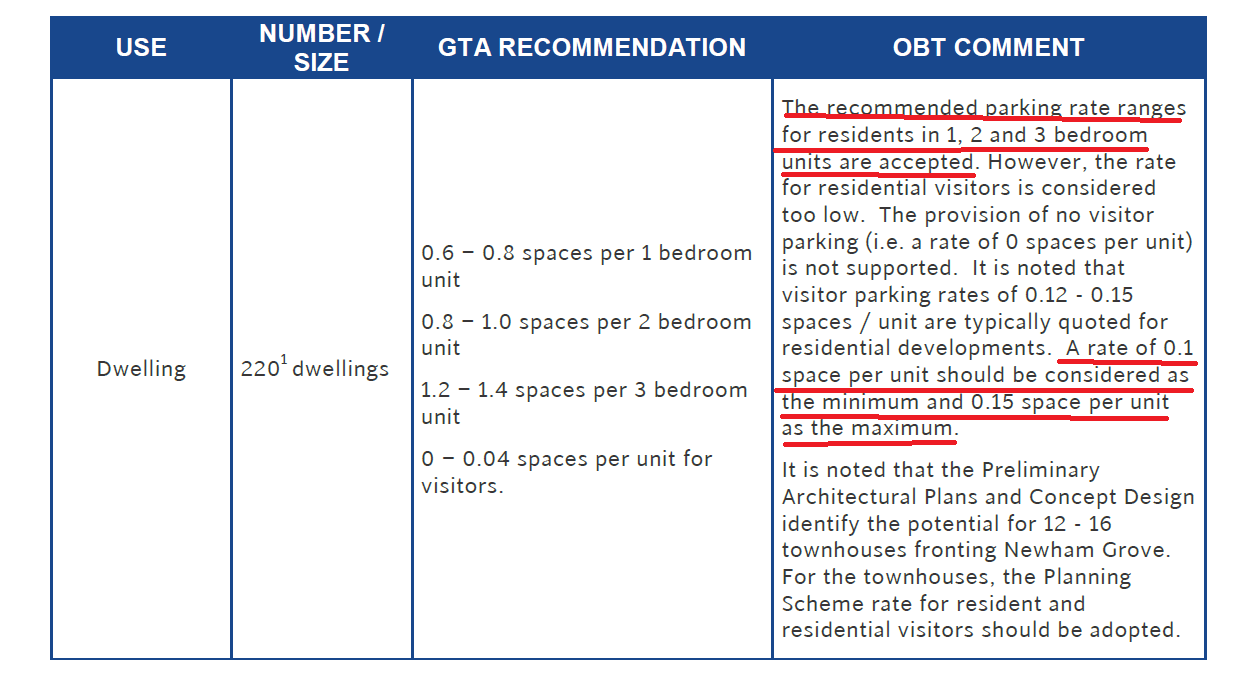
  • The traffic report is equally dubious. And why there is support for a reduction in resident and visitor parking is simply beyond us given that it does not accord with council’s own planning scheme! (see image below).

parking

  • The economic retail report is interesting for several reasons. It announces huge impacts on neighbouring commercial shopping strips if the project proceeds. Mention is made of Bentleigh and others. Yet when it came to the Virginia Estate proposed amendment, the initial officer’s report fobbed off the economic impact by stating that under the zoning of Commercial, the intent was to develop more ‘activity’ and ‘employment’ in these centres.

Thus we have to wonder – did each an every councillor bother to read these ‘expert’ reports? Did they ask some decent questions? When were they briefed on the reports? Or were they simply told by officers ‘this is what we think’ and you should abide by this? Finally, how much did all these ‘experts’ cost ratepayers?

We will report on the actual ‘debate’ in the coming days.

Hyams moved an amendment to accept the recommendations plus, to ‘include meaningful engagement’ with the community to be part of and ‘not following’ the draft structure plan. Taylor seconded.

HYAMS: began by saying that even though the recommendations as ‘set out in the report’ are ‘intended to be pretty thorough’ it recommends community consultation ‘on the master plan’ or structure plan ‘afterwards’. ‘My view’ is that ‘residents’ should have a say in the drafting of the structure plan. Said that ‘this would have happened anyway’ because that was what ‘council intended to do’ and ‘it’s better to have that clarified in the report‘. Called this a ‘great opportunity’ for Glen Eira because it is a ‘massive site’ and they intend to use this as an ’employment hub’ with retail plus residential. That’s ‘what we’re allowed’ by the planning scheme. Hyams went over past history – the first amendment which rezoned part to Commercial and the second application for amendment which proposed many residential premises and a ‘supermarket’ and council thought this wasn’t ‘appropriate’ for the site because ‘it didn’t do what we wanted it to’ as an ’employment hub’ and also ‘competed too much’ with other retail in the area. ‘So what we’re looking for here is something along the first lines’ (ie employment hub) but it’s a ‘huge site’ with many ‘possibilities, so it will be very complicated’ and that’s why the VPA is being brought in ‘to assist us’. Said that ‘all final decisions’ will ‘rest with council’. ‘We will direct the consultation, we will still make the decision’ but the VPA ‘will be using their greater expertise’ in ‘producing the best outcome for Glen Eira’. Apart from the consultation ‘which will be going on throughout’ the applicant can still put in their amendment planning scheme application. This will go through the ‘normal processes’ of submissions, panel if required, and ministerial approval. Summed up by saying that right through the process ‘there will be a great opportunity’ for people to ‘have input all the way through’. ‘Noted’ that the ‘current landowner has been a lot more consultative’ and ‘friendly’.

TAYLOR: began by saying that it is ‘absolutely a given’ that there is ‘full and transparent consultation’. Wanted to ‘reassure’ those people who had rung her and that it ‘doesn’t hurt to spell out’ the ‘continuous involvement’ of the community. ‘We genuinely want you to have a say’. ‘We are all members of this community’ and everyone has ‘something to offer here’.

ATHANOSOPOULOS: said that ‘everyone agreed’ that they need to ‘establish some key partnerships’ and this is ‘just an example of us doing that’. Said that if they are going ‘to deliver’ a ‘great’ development then they need to ‘consider the residents’, ‘housing responsibilities’, ‘educational responsibilities’ and overall ‘responsibilities for the whole of Glen Eira’. Said the developer’s ‘initial process’ was ‘railroaded through’ and they’ve realised they haven’t done a ‘good job and come back to us’ and ‘engaged with the community’ plus traders and others. Thought it was important that council establish partnerships ‘especially with resources being limited’. Vital that council be the ‘leader’ on this. Said that the ‘community has been screaming out’ about the site and this is the ‘first opportunity’ ‘for us to actually go ahead with this’. Said the most important point is that he has put forward a ‘recommendation’ based on a resident’s comment to ‘establish’ some form of community group ‘that does feed us, the council information as this project goes on’.  The makeup of the group is ‘unknown, maybe a couple of residents’, ‘community leaders’, etc.  This will ‘bounce ideas’ and ‘get a feel for what the community wants’.Said it was a good ‘opportunity for us to establish something like this’.

DELAHUNTY: asked the CEO to ‘explain’ what the VPA was.

MCKENZIE: said this is a recent extension of the Metropolitan Planning Authority and has a ‘role in providing guidance’ for major developments especially in new suburbs and ‘in creating jobs’. Council has ‘already committed to’ a huge program of strategic work and by forging this ‘partnership’ this ‘enables us to carry on this program of work in parallel’ with the other projects on structure planning. This ‘doesn’t derail’ the existing program but allows them to ‘carry on’ and to ‘deliver a cost saving to council’ and to ‘draw on specialist expertise’ – particularly on retail development and development contributions. ‘Council would retain the decision making role’ and ‘lead and take ownership’ of the ‘community engagement element of the project’.

MAGEE: said this has ‘come a long, long way’ and now there is a ‘far better approach’ than what happened in 2013. In 2013 one of the recommendations was to rezone all the site to Commercial and without community consultation. Said that council learnt of this via the department and the local minister and local member of the time supported this. The proposed structure planning now ‘is certainly the right way to go’ and ‘the approach now (by the developer) is totally different’. They have held a ‘number of community consultation meetings’, ‘poorly attended, but that’s our fault, not theirs’. Said that the ‘Minister likes the VPA’. ‘They are ‘experts in doing structure plans’. Thought that an application would come in this year for a ‘planning scheme amendment’ which could be ‘simple’ and asking for the ‘whole site’ to be Commercial 1. With Commercial you can ‘put residential, commercial and mixed uses in’. The VPA will ‘assist council in putting together a structure plan’ and at ‘all stages will talk with our community’. The community has to ‘understand’ what is going to happen on the biggest site where ‘we all live’. ‘This is a huge site and it has huge implications’ so even though ‘I welcome the new approach I’m still wary of what happened in 2013’. ‘Once this decision is made it will never be reversed’. He hopes that as councillors ‘we will drive past something that we are proud of’. ‘Concerned that we cannot get this wrong’. Welcomed the VPA involvement and community consultation but ‘don’t come at the end and say you don’t like what’s been written’. ‘Don’t say you didn’t get an opportunity’ to have a say.

DELAHUNTY: said she ‘welcomed this’ and it ‘allows us to get on’ with the program of planning and ‘adds to the resources of the council’. Last effort had mistakes by applicant and ‘this allows us to better formulate community engagement’ and the suggested reference group is ‘an interface between council and the community, not between the community and the applicant’ and ‘does add to our ability to take different views’. ‘This is worth being done properly’ and is exactly what council should be doing in ‘bringing in extra resources’.

MOTION PUT AND CARRIED UNANIMOUSLY

PS: Last night’s meeting was largely all about planning and ‘consultation’. It is a continuing shame how incompetent planning is in Glen Eira when we find (finally) an admission that Council with its proposed interim height amendments (ie Amendment C147) was nothing more than a knee-jerk reaction and a pretense that it was ‘listening’ to the community. It is no wonder that Minister Wynne has refused to gazette these amendments.

We draw readers’ attention to the following paragraph from a VCAT decision where the member granted the applicant a permit for an 8 storey building in Rosstown Road, Carnegie. It shows clearly how – (1) residents have been conned – again, and (2) the quality of council’s planning department, plus (3) why must such information be discovered from third parties and not directly from council itself? Here is what the member stated in his judgement –

Fourthly, I choose to give limited weight to Amendment C147 to the Glen Eira Planning Scheme which seeks to apply a Design and Development Overlay to the review site, which will apply a discretionary height limit of six storeys. The proposed height limit is discretionary, so it does not preclude the consideration of a well designed eight storey building on the review site. Further, in response to my specific question, I have been informed by Council that there is no strategic work that underpins or informs the proposed height limit of six storeys. If such strategic work did exist, and had been adopted by Council, it may have provided me with some understanding or basis on which to further consider whether a reduction of height is appropriate for the review site. In the absence of any such strategic work, I am left with what appears to be an abstract proposed discretionary height limit, which I can only presume is based on the aforementioned development at 2 Morton Avenue, and which is not a seriously entertained planning proposal.

Source: http://www.austlii.edu.au/au/cases/vic/VCAT/2017/158.html

++++++++++

Here’s a summary of how the voting went at tonight’s council meeting – plus a few ‘highlights’.

Ormond Road Eight Storeys – Council will be supporting 8 storey mandatory height limits

Virginia Estate & Victorian Planning Authority – Council will forge ahead with the ‘partnership’ and hold ‘community consultation’ earlier.

Cr Silver distinguished himself by stating that he does not support social housing in Camden Ward.

Council will not be seeking to amend its local law on meeting procedures until at least 2018/19 when the current sunset clause for the law kicks in. Remarkable we say, given that emasculating the public question component of the local law was done so easily and on the whim of Lipshutz, Hyams and Esakoff in particular.

Caulfield Racecourse Trustees have signed the resignation paper but there is a hold up since the question of leases is yet to be finalised. We wait with bated breath!

The details of the above will be forthcoming in the next few days.

From feedback received thus far it appears that resident concerns over the ‘partnership’ between Council, developer and the Victorian Planning Authority, are either not being understood by some councillors, or these concerns are seen as unnecessarily ‘alarmist’.

When the largest ever development is about to occur in Glen Eira, we maintain that community input, from the very start is essential – and not when a draft structure plan has already been devised and to all intents and purposes, probably set in concrete. Any ‘visioning’ must include residents from the start and their involvement must be ongoing throughout the entire project.

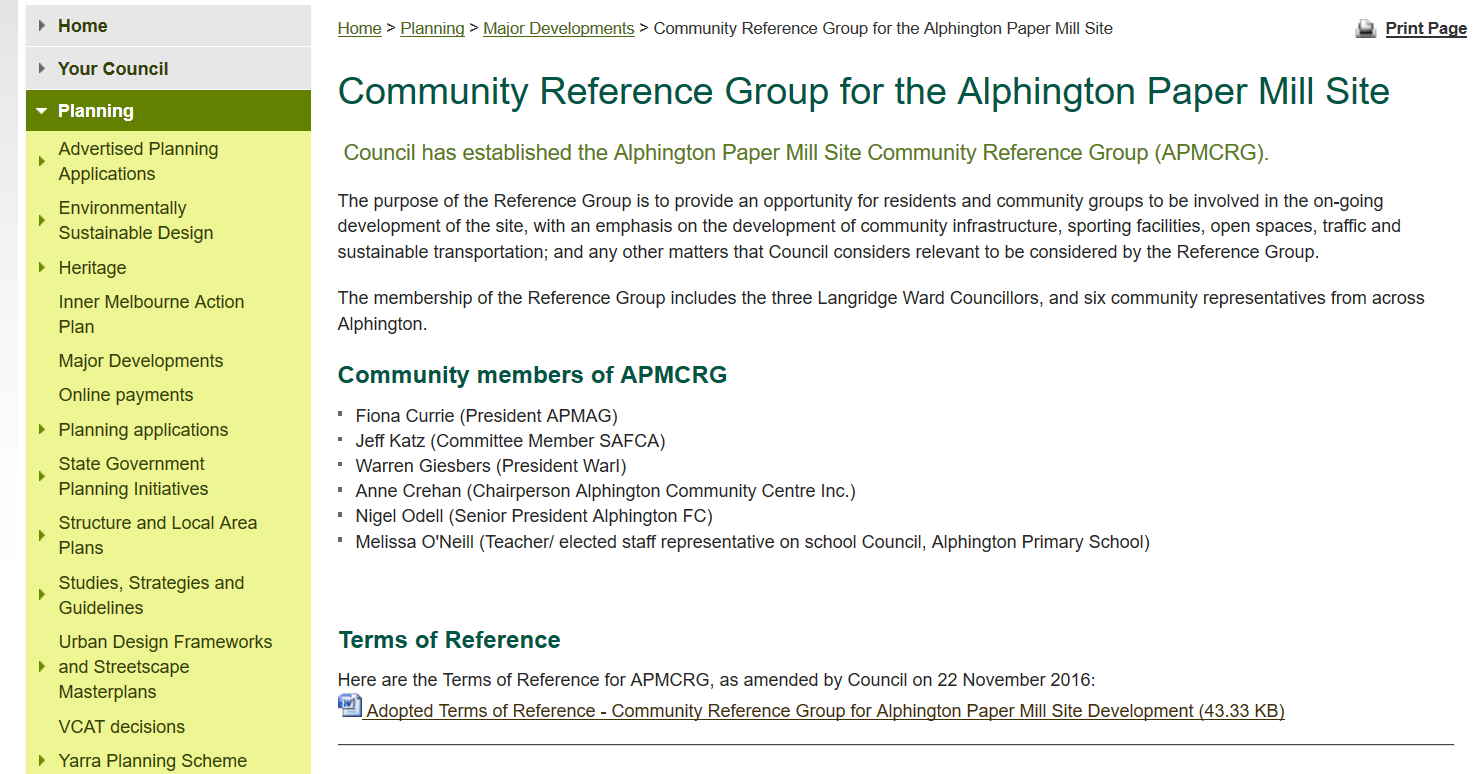
In the current agenda papers, one officer report notes the large development at the old Amcor site. Yarra City Council is one model that should be employed for the Virginia Estate development. Yarra had no problem in establishing a ‘reference’ committee right from the start that included 6 community reps. Yarra had no problem in holding regular meetings where residents through their representatives could bring up issues. This is not rocket science. It is the basis of an inclusive council that sees its residents as partners. If the current mantra of council is to be believed then the establishment of such a group is essential!

Here’s the Yarra Council blurb for this committee –

yarra

We’ve also uploaded HERE, the relevant Terms of Reference for the committee.

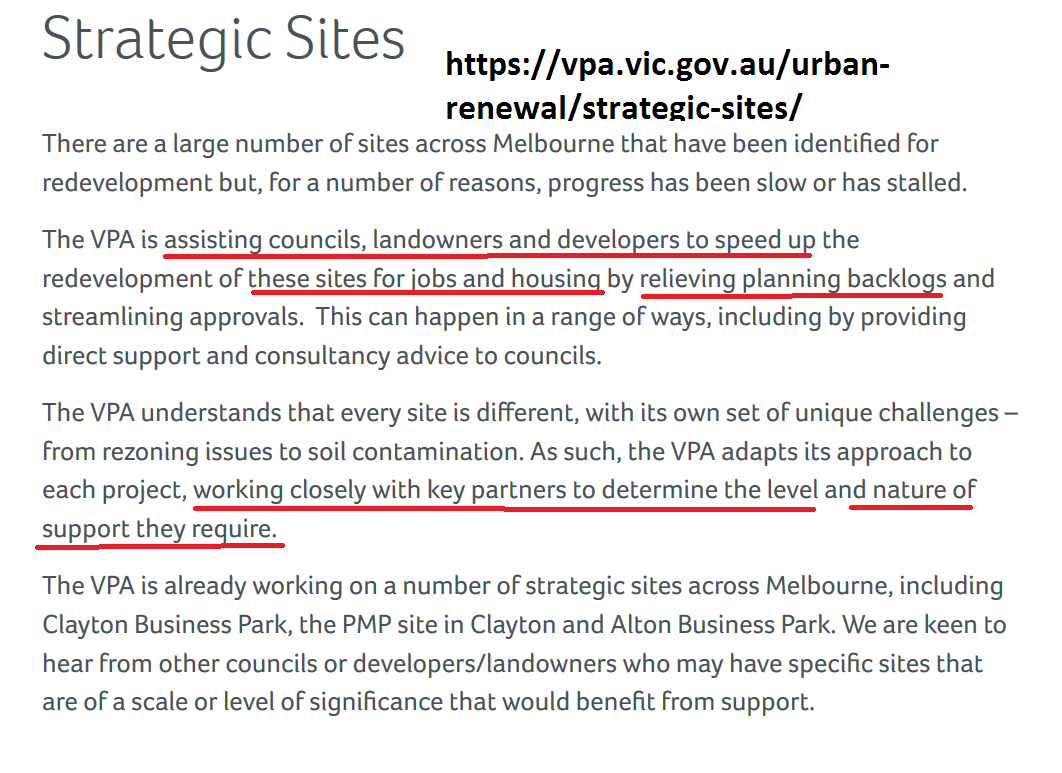
The plans for the development of Virginia Estate have taken a new turn with the proposed ‘partnership’ between council and the Victorian Planning Authority (VPA). This government body is primarily charged with the responsibility of overseeing ‘urban renewal’, especially in growth areas. They are also involved with large development sites within the metropolitan area such as the Monash/Clayton precinct and now East Village. Here is what their brief states –

redsites

All of the above would indicate that government, developer and council are keen to push through rezoning and amendments that will set the ball rolling for Virginia Estate. There is no doubt that at the latest stated figure of 24 hectares, Virginia Estate will be developed, and a very large component will feature residential accommodation. What concerns us is the role that the community will play in this development. The letter from the VPA, included in the agenda, outlines a brief timetable schedule. Please note carefully the following:

  • The time frame for the ‘delivery’ of a draft structure plan for the site is basically 3 months. Yet, the officer report keeps insisting that this will be part of council’s review of its ‘activity centre strategy’ – not due to be completed until 2018 at the earliest. Thus, what porkies are we being fed?
  • Why aren’t the community involved right from the start instead of having the draft structure plan thrust down their throat and then asked to comment? We all know what this means and how little is changed once the ‘draft’ of anything is completed.
  • Why does the officer report emphasise ‘business’ and ‘residential’ barely rates a mention?

We’ve uploaded the proposed schedule. Clearly discussions between government, developer and council have been ongoing for some time given this timeframe. We’ve also uploaded the full agenda item (HERE) so readers can see for themselves the lack of real detail provided.

vpa

In conclusion, VPA does have a role here and council is undoubtedly better off financially if much of the cost comes out of government and developer coffers. What we are concerned about is the level of genuine consultation with the community and whether development gets the go ahead well and truly before infrastructure, transport, etc. is completed.

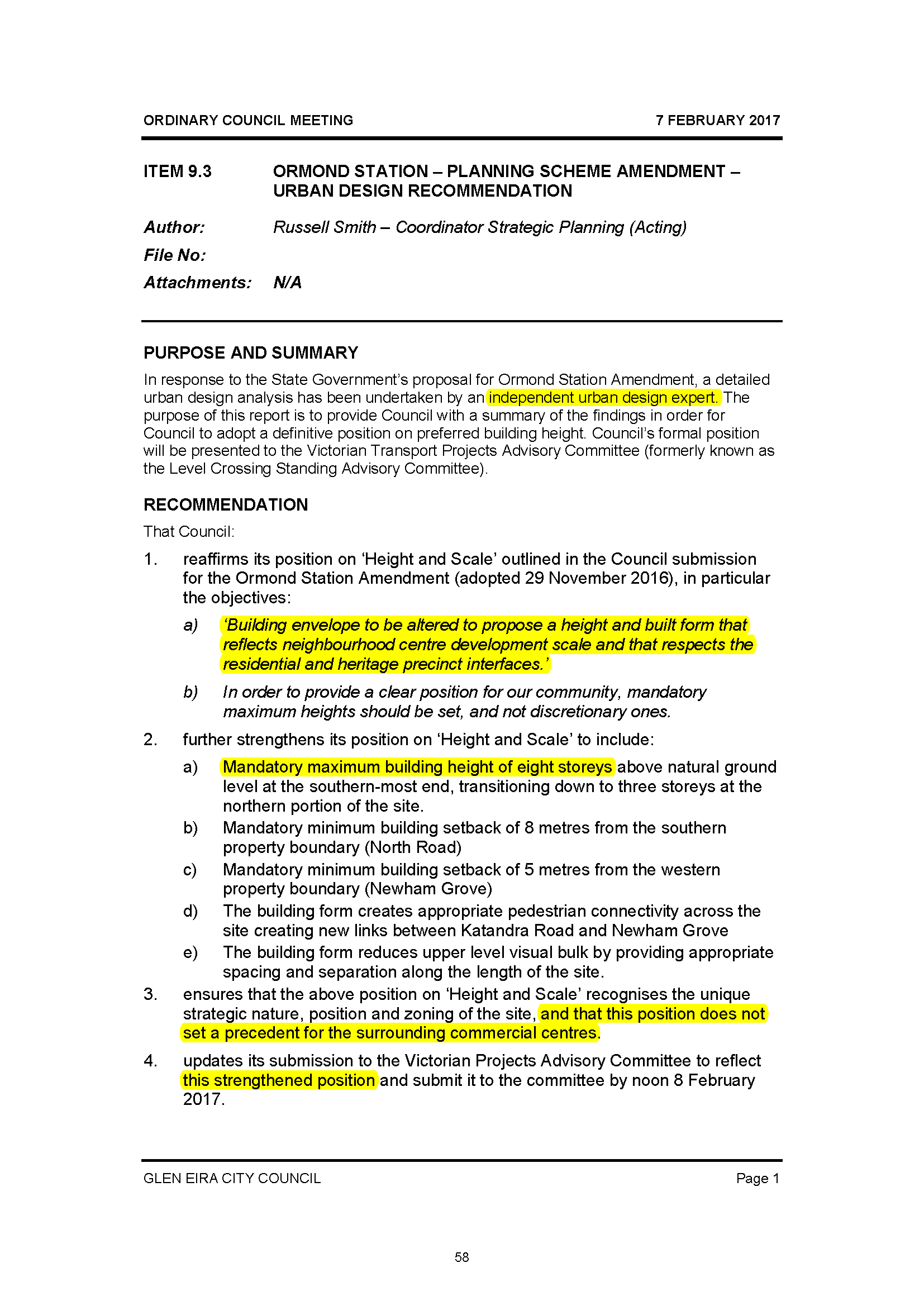
There are 3 agenda items down for decision this coming Tuesday which should set alarm bells ringing for residents. In this first post we concentrate on Item 9.3 – Council’s ‘position’ on the Ormond Railway development site.

What is absolutely staggering about this report and its recommendation is that councillors ENDORSE A MANDATORY HEIGHT LIMIT OF 8 STOREYS!

This is staggering for the simple reason that it exceeds the proposed heights of 7 storeys in Carnegie and 5 storeys in Bentleigh that were nominated in the proposed Amendments for these activity centres. Thus we now have the ludicrous situation where a so called ‘neighbourhood centre’ with less shopping areas and surrounded by residential development is okay for 8 storeys and Carnegie and Bentleigh are deemed suitable for lesser height. Unbelievable shonky planning !

What makes matters even worse is that this recommendation by the ‘experts’ is not even in the public domain. Hence we have the situation where residents are denied access to the rationale which would support a recommendation of 8 storeys. So much for transparency and accountability!

Further, we are told in the officer report  that: In order to form the strongest position possible, City Futures (ie Council) have sought an evidence-based approach to inform Council’s position for a preferred maximum building height. And what is this ‘evidence based’ data on? According to the report it consists of the following –

  • Status of centre
  • Precedents
  • Typology
  • Street wall ratio
  • Solar Access
  • Key View lines
  • Transition
  • Connectivity

We posit that none of the above is ‘evidence’ for an 8 storey apartment block. It might as well be 10 or 12 storeys! Nothing here would suggest that the following important issues have been considered – open space, infrastructure, parking/traffic, development in the area, retail business study, etc. etc. If this is the basis upon which such major decisions are being made, then God help us!

Even worse, is that once again there has not been a single round of ‘consultation’ between residents and council on how high anything should be in the municipality! The rhetoric is all about ‘consultation’. Pity that words never seem to match actions and decisions!

pages-from-02-07-2017-agenda

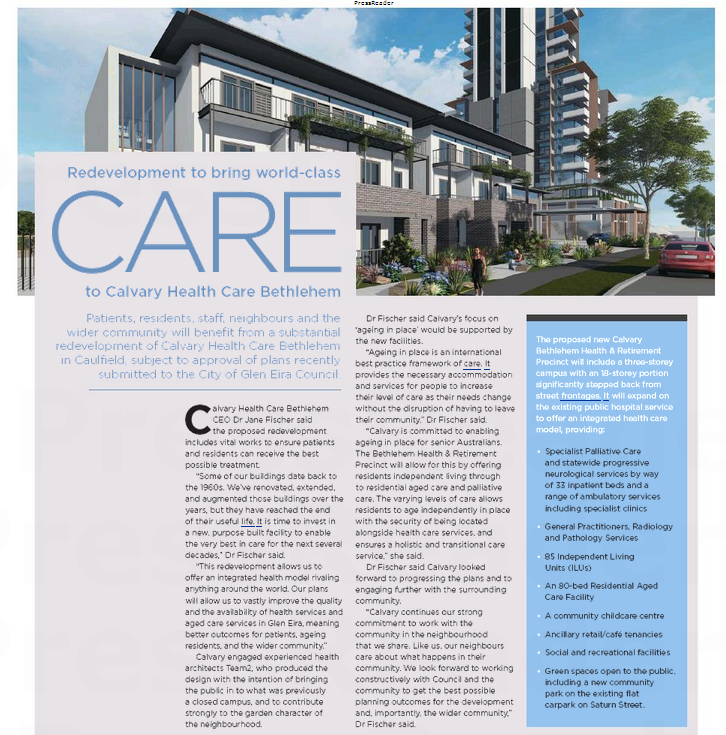
The following image was published in today’s Caulfield Leader. For the other side of the story representing residents’ point of view, please see: http://www.heraldsun.com.au/leader/inner-south/caulfield-south-residents-up-in-arms-over-calvary-health-care-bethlehems-plans-for-19storey-agedcare-and-hospital-complex/news-story/602039735243cae64e7ac19c2ae315e9

ch

PS: Adding insult to injury, a new application for 18 storeys has come in for 9-13 Derby Road, Caulfield East. The proposal is for 158 student units, plus shops and underground parking – and of course adjacent to a Heritage Overlay. This comes on top of the 127 student units in Dudley Street, which remains zoned as Neighbourhood Residential. Such examples are the consequences of negligent planning by council for the past 15 years! However 18 storeys will fit in perfectly with the MRC development of at least 22 storeys near by. Monash, as far as we know, is still planning for around 1200 student accommodation places at Caulfield.

The Australian Bureau of Statistics has released its building approval figures for the current financial year – ie from July 1st to November 30th. The table below mainly highlights the results for the metropolitan area, plus all those municipalities which exceed the number occurring in Glen Eira. Readers should note that:

  • The size of the municipalities which have experienced a greater building boom and the impact this would have on overall density
  • The number of houses compared to units in most of these municipalities
  • Also worth considering is that Moreland has 576 hectares of open space; Moonee Valley has 528 hectares and poor old Glen Eira 172.9 hectares according to the 2014 Open Space Strategy!

Conclusion? Glen Eira continues to be a developers’ paradise and at this rate will become the most dense municipality in the state (outside of Melbourne) and available open space per head of population will continue to shrink.

The complete Excel data sheet is uploaded HERE

housing-approvals2

untitled