Councillor Performance


Item 9.1 – Centre Road, Bentleigh East. 3 storey, 24 dwellings.

Lobo moved motion with the amendment that some of the windows on upper floors have ‘glazing’ and ‘panels to 1.7 metres’ in height. Seconded by Delahunty.

LOBO: said he was ‘generally against development’ but here ‘a lot has been tried on behalf of residents’ like increased setbacks. But because of ResCode they ‘can’t do much’ other than what the report recommends. So all they ‘could do was this amendment of transparency’. Stated that he ‘understands it is a dilemma for Australians’ with overlooking into backyards which is a ‘way of life for an Aussie’ when they have a ‘barbecue and a beer in their hands’ and for the Greek community who ‘dance Zorba the Greek’.   He had been contacted by ‘half a dozen people’ who ‘didn’t like what they are seeing’ and who feared that the area will be ‘dominated by high rise buildings’. Didn’t want to go over the issue of the zones but said that residents had told him that ‘they have been treated with contempt’. They pay their rates and are facing ‘a ghetto’ and problems like parking, lack of privacy and ‘peeping toms’. Said he ‘reluctantly’ has to vote in favour because ‘I have no other choice’. Changing the application ‘would push this to VCAT’ which would then be a ‘case of David and Goliath’. Said that VCAT’s ‘wings have to be cut’ by the government.

DELAHUNTY: said that they were trying to ‘strike a balance’ as to ‘what is allowable under the zones’ and what is ‘fair’. She chaired the planning conference and thanked residents for their ‘detailed and comprehensive’ submissions. Traffic was the major themes and this has ‘been increasing in recent times’ and is possibly ‘exacerbated by the paid parking’ at the hospital. Said she asked for traffic management to undertake a review of the area. This is ‘ongoing’ and ‘will stretch to some of the other roads’ in the area. Said that ‘we’re not really sure’ whether there is a ‘rat-run’ occuring so they ‘will be looking at that’. On the application said that it ‘unusual’ for council to be ‘endorsing’ something ‘of this size down that end’ because of the lack of public transport there but the conditions imposed ‘go some way to help the amenity’ of residents. Stated that she was ‘disappointed’ at the planning conference when the developer ‘chose to attack the residents for not selling their houses’. Hoped that residents would ‘find that this building sits well’.

PILLING: supports the amendment and thought that ‘this goes some way’ to address residents concerns about overlooking. Thought that ‘generally’ this was a ‘good application’ since it’s on a ‘main road’ and in a General Residential Zone for 3 storeys. It does ‘tick many of the boxes’ even though he takes Delahunty’s point about lack of transport. He ‘took issue’ with Lobo’s comment about council treating residents ‘with contempt’ because they treat developers and residents ‘in a fair way’. They’ve listened here to residents concerns and the changes show that they’ve taken this seriously.

LIPSHUTZ: when he first ‘read this’ he wanted two storeys but then thought ‘what’s going to happen in terms of VCAT’. ‘We can play the populist card’ and ‘knock this down to 2’ as residents want us to do ‘but at the end of the day it goes to VCAT’ and they give the developer what he wants. Thus, ‘the best we can do is tinker and try to find a balance’. ‘Shared’ Pilling’s view about Lobo’s comments on ‘contempt’. Said that ‘we’re all residents’ and ‘each one of us is concerned about planning’ and that they ‘try to do the best we can within the confines of the law’. Despite what they ‘want to do’, ResCode makes them do things ‘we might not want to do’. Said that Lobo’s amendment has ‘tried to alleviate some of the issues’ such as parking and overlooking. Not the ‘best’ that residents wanted but the ‘best balance’ that council could get’.

ESAKOFF: would have liked greater setbacks on ‘rear’ and ‘where it adjoins residential properties’. Said that her ‘understanding’ is that residents were ‘happier’ to ‘leave it like that’ once the conditions of the amendment were put in ‘rather than push the boundaries’ and end up at VCAT. Said that ‘I probably would have pushed those boundaries’ more but she ‘understands’. The saiving grace is that some of the residential properties are north so won’t have overshadowing to a great extent.

OKOTEL: thought that 3 storeys ‘was appropriate’ since near the hospital and a permit already exists for three storeys ‘to the west’. Appreciated the increased setbacks to the front and the concern about parking and thought it was ‘important that we ensure there is adequate parking’. Said one resident was worried about balconies overlooking her garden and they did ‘explore options’ as to whether ‘balconies could be removed’ but that couldn’t be done because of the need to supply private open space to the building apartments. As to increasing setbacks even more planning officers ‘advised’ that this would mean the ‘deletion’ of more apartments and that this would be ‘overstepping the mark’. Thought that this strikes the ‘appropriate balance’ and hoped that ‘neighbours could be comfortable’ with the result.

HYAMS: visited the area on Saturday and therefore ‘totally understands’ residents’ concerns. ‘we’ve done everything we can under ResCode’ about overlooking. They’ve also done all they can in ‘requiring’ the number of parking spots. Said they are looking into parking but with the no parking permit conditions put on the permit this means that there is ‘restricted parking in the area’ so people who will live in the building will only have ‘cars as they have parking spots’ or they will have to park ‘further away’. Said it ‘probably is the right place’ for this dwelling even though it’s near ‘shops, and bus routes’. In the past he’s spoken about ‘neighbourhood character’ but in this instance neighbourhood character is ‘more varied’ so demanding pitched roofs wouldn’t be a ‘valid objection’. Ultimately this is ‘the right balance’.

LOBO: said that ‘the word contempt has not come out from me’ – it’s what the residents think – and ‘since we represent the residents we have to hear the key words’. Said that like Martin Luther King he ‘had a dream’ about Glen Eira becoming Calcutta. He still thinks ‘this is going to be a Calcutta’. In china there are 64 vacant apartments and he was told that they build them ‘just to give jobs to people’. wondered whether ‘the same thing is happening here’. ‘Appreciates’ that government is trying to ‘accommodate people’ but ‘why don’t they accommodate people in their homes?’ One resident who has lived in the area for 30 years was ‘instrumental’ in raising over $200,000 for the hospital and is ‘now feeling that the job that she has done is just nothing’. ‘we have to put up a fight’ regardless of political parties.

Pilling raised a point of order here about ‘relevance’. Magee said that ‘I understand the relevance’ so ‘I will over-rule your point of order’.

LOBO: ‘we need to have guts as councillors’ or ‘not stand for election next time’ and promise ‘the world’ that they will ‘fight inappropriate development’. He wanted ‘reluctantly’ the item passed.

MOTION PUT and CARRIED UNANIMOUSLY


Much has been made of ‘neighbourhood character’ at recent council meetings when considering planning applications. Neighbourhood character is defined by the State Government as:

Neighbourhood character is essentially the combination of the public and private realms. Every property, public place or piece of infrastructure makes a contribution, whether great or small. It is the cumulative impact of all these contributions that establishes neighbourhood character.

We draw readers’ attention to some further statements from this document that highlight the shortcomings within Glen Eira –

The character of all areas is to be respected (even areas that planners or designers might not think to be attractive). If, for a broader range of considerations, a change in the character of an area is sought, then this must be achieved by setting out a preferred future character statement in the planning scheme

Describing the character of an area will also depend on the extent of neighbourhood character analysis already undertaken by the relevant council and the particular characteristics of the neighbourhood in question

Source: http://www.dtpli.vic.gov.au/__data/assets/pdf_file/0006/231648/Understanding_Neighbourhood_Character.pdf

Why this is so relevant to Glen Eira is that there is no preferred character statements for any area designated as housing diversity. This has been made clear in numerous VCAT decisions and has played a major role in the member’s final conclusions. For example – A recent VCAT decision on 10-12 Cromwell Street, North Caulfield contained the following comments in the decision to grant a permit for 8 townhouses –

There is no local planning policy that addresses neighbourhood character within the  housing diversity  areas. While regard must be given to the existing character of these areas, any assessment needs to balance this against the change that is anticipated in these areas.

Thus we have the ludicrous situation where on the one hand change is forecast and expected, but the nature of that change (ie preferred neighbourhood character) is never defined, illustrated, or circumscribed. With no future vision clearly laid out, then most developments are possible – especially if council has already granted a permit for a large development in the street. Change without statements on preferred neighbourhood character are Glen Eira Council’s further presents to developers.

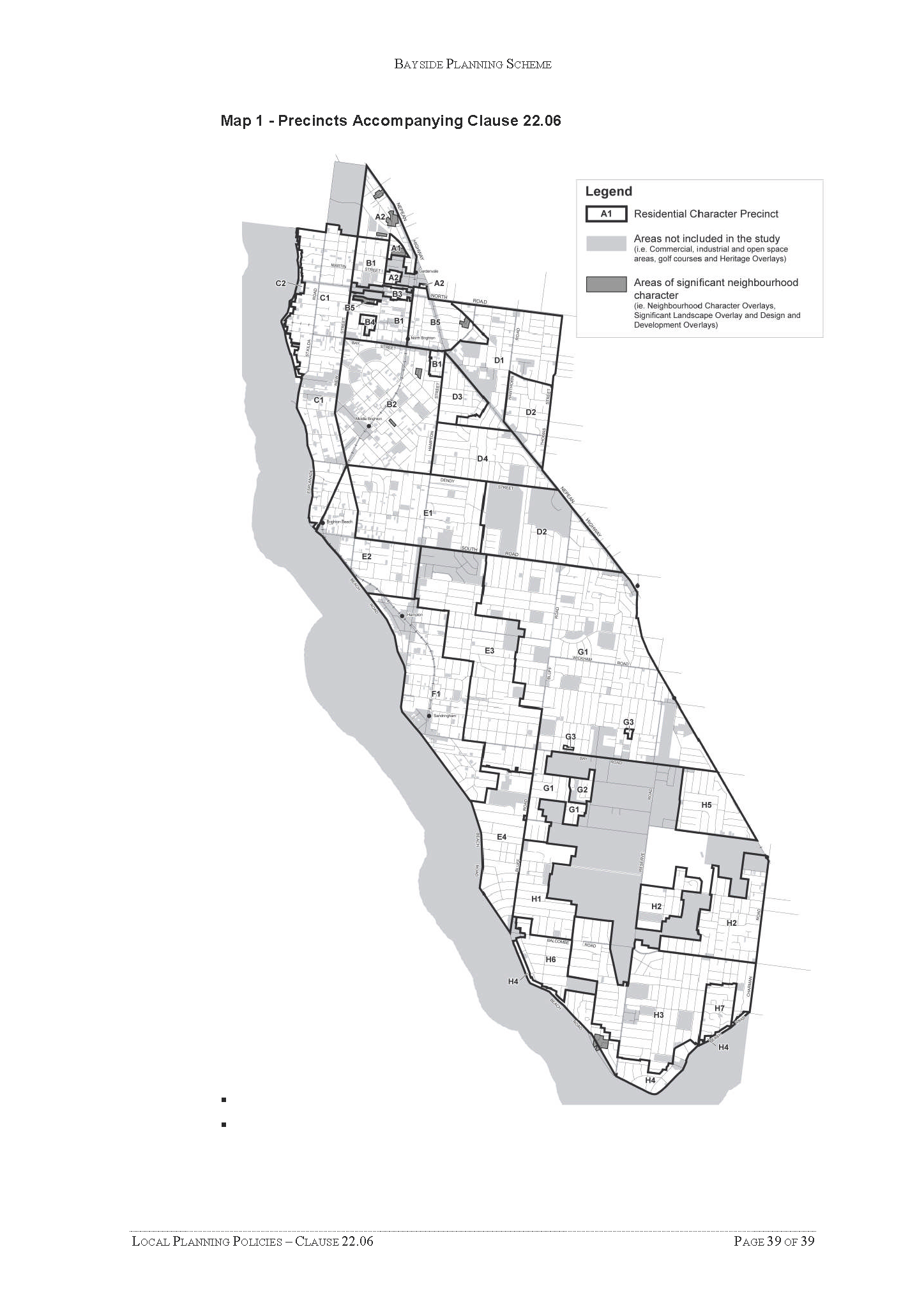
Not all councils take this approach. Whitehorse, Stonnington, Bayside, and plenty of others, have as part of their planning schemes specific ‘preferred neighbourhood character’ statements for all of their residential areas – including the equivalent of Residential Growth Zones, and General Residential Zones. They also have structure plans, development overlays, etc – all of those ‘planning tools’ which Glen Eira has steadfastly refused to consider and implement.

The result is that councillors can talk until the cows come home about neighbourhood character. But unless the planning scheme includes some direct and explicit mention of these tools, then developers will continue to have a field day in our municipality.

PS: Below is an example from Bayside. Please note that every square inch of land designated as ‘residential’ has been allocated a ‘preferred neighbourhood character’ statement regardless of whether or not that site is in the so called ‘housing diversity’ areas.

Pages from 22_lpp06_bays

Wednesday night’s agenda items feature more planning applications that deserve to be highlighted. Officer reports recommend

  • The demolition of two houses within a Heritage Overlay in Ormond and the construction of attached 2 two storey modern buildings across two sites. The report itself is unsurprisingly short on detail and short on justification.
  • Permits for another 56 dwellings for two applications – both in Neighbourhood Centres and not activity centres. Once again notification is minimal, but objections high. For the Heritage demolition only 8 properties were notified and 38 objections received.
  • Not one statistic to support such statements as: Traffic generated by the development would not have a major impact on the operation and function of Neerim Road and the surrounding road network.
  • Demanding increased setbacks for second and third level storeys that are outside council’s own planning scheme. An open invitation we believe for VCAT to reject such conditions. If council wanted increased setbacks then that should have been included within the new zones schedules. It wasn’t!
  • Of the 56 proposed new dwellings NOT ONE is a three bedroom apartment. So much for demanding ‘diversity’ in building!
  • A new childcare policy that’s to go to a planning panel but with important deletions from the current policy as pointed out by objectors – Disagree with deleting the objective to “ensure adequate provision for onsite car parking and drop off areas”. Disagree with deleting of car parking clause relating to provision of clear sight lines when entering and exiting.
  • Hyams and Esakoff still editing the minutes from Records of Assembly with such comments as – “unnecessary detail” and “amend wording”.

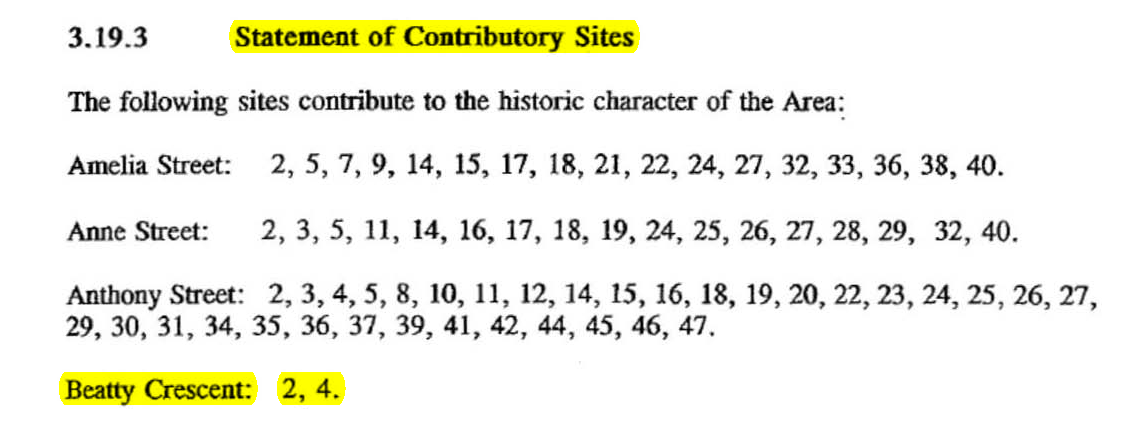
 PS: In the officer’s report for the demolition of 4 Beatty Cresc., Ormond there is this statement: Council’s Heritage Advisor has identified that the existing dwelling is not contributory to the Ormond Precinct Environs.

Once again accuracy does not appear to be a high priority in Glen Eira. The 1996 Heritage Plan, Volume 2, states clearly that this site IS CONTRIBUTORY to the overall Heritage area. Below is a screen dump of the relevant information.

beatty

ve

At last week’s council meeting a permit was granted for a six storey and 117 units in Glen Huntly Road Carnegie – just past Grange Road. The area is now zoned Commercial (thanks to amendment C80) and is bordered by areas zoned General Residential Zone 1 (ie 3 storeys).

We have lamented time and time again the inconsistency and lack of accountability in Council’s planning offer reports. We revisit this issue via a comparison with a decision from September last year and the ensuing VCAT decision. What makes this inconsistency ten times worse is the questions that such a practice raises –

  • Is Carnegie the sacrificial lamb as opposed to North Caulfield (apart from the MRC windfall of the Caulfield Village?)
  • Is Glen Eira Council deliberately facilitating the creation of a ‘second class citizenry’, or are unknown vested interests involved that could explain such inconsistent and unjustified decision making?

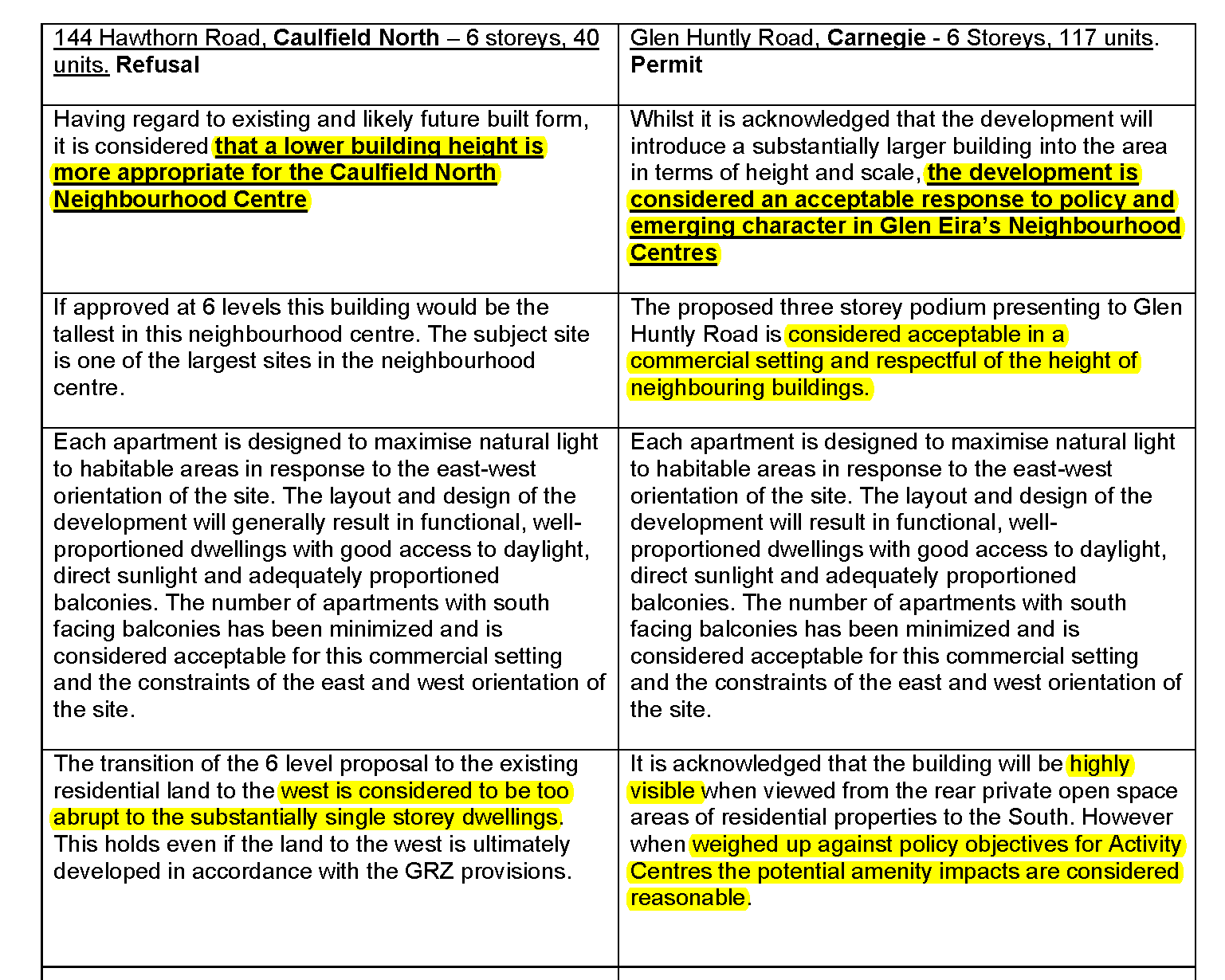
In September last year an application was refused by officers and councillors for a 6 storey development in Hawthorn Road. It was also zoned Commercial and surrounded by GRZ1 areas. The application was for 40 units. Below is a table featuring the officer comments from both reports. Please note that neither site is in an Activity Centre and both are on tramlines – Hawthorn Road being close to two tramlines.The only difference is that the Glen Huntly Road application is approximately 600 metres from  a railway station.

Please note carefully:

  • How the Caulfield North Neighbourhood Centre is treated in comparison to ‘Glen Eira’s Neighbourhood Centres’ from the Glen Huntly Road application.
  • Cut and paste (verbatim) – and not for the first time!

144 Hawthorn Roa1

The Hawthorn Road application has ended up at VCAT and the member granted a permit. Whilst we do not support all of the member’s comments, we repeat some of what he said from an earlier post and ask readers to consider how well Council does its work. For example, in the original officer’s report there was this statement – There are no off-street public car parks in the Caulfield North Neighbourhood Centre. This centre is a known ‘hot spot’ in terms of infringements issued for overstaying time restricted parking. This demonstrates a car parking shortfall which extends into evening times. Off course no statistics, no traffic analysis, etc. Thus, at the VCAT hearing the only ‘evidence’ supplied came, of course, from the developer!

Here are some select quotes from this VCAT decision –

The review site forms part of the Caulfield Park Neighbourhood Activity Centre, which falls within the category ‘Neighbourhood Centres – Commercial’. It is in a location where increased residential densities are anticipated, and facilitated, by policy.

while building heights for the Neighbourhood Centres have not been specified in the Planning Scheme, it follows from the above that the height of anticipated development lies within the range established for the residential area and that of the Urban Villages/Phoenix Precinct. The proposed six storey height sits comfortably within these expected outcomes;

It would not be appropriate, in our view, to simply respond to the existing context by limiting development to not more than four storeys, which would equate to the tallest existing structure in the centre, located on the south-western corner of Hawthorn and Balaclava Roads. This would not sufficiently respond to the policy seeking to intensify residential densities in this location. Rather, it would reflect an outcome that would have been anticipated under the former planning regime which pre-dated the strategic work that underpinned the Council’s current housing policies. A height greater than four storeys must reasonably be contemplated for this site given its size and the strategic importance of its location.

There is nothing in the Planning Scheme to indicate that a uniform height is sought for buildings within this centre. Indeed, as noted during the course of the hearing, the land within the activity centre is not affected by any overlays that regulate built form outcomes, such as a Design and Development Overlay or Heritage Overlay. Activity centres are commonly characterised by a varied skyline or building profile. Heights vary, and it is not unusual to find that one building is taller than the others. It may well be that this building will be the tallest in the activity centre. If this were to eventuate, we do not consider it to be an unacceptable planning outcome as, ultimately, it is likely that the disparity in the height with other buildings would be confined to something in the order of two storeys. We consider this to represent an acceptable graduation in height within this context.

Having regard to the scale and form of existing development, there is no question that, at six storeys, the proposal will have a level of prominence within the centre. This is both from within the immediate streetscape and from further afield, in more distant locations along Hawthorn Road, for example. We do not find this to be a reason to refuse a permit. The policies anticipate the emergence of larger built forms within the centre. It is to be expected that these structures will have a degree of visibility within their context. This is particularly so given that this development is ‘the first cab off the rank’ within a low-rise environment.

The Applicant’s evidence confirmed that the shortfall in the car parking provision can be accommodated by the surrounding on-street parking within a distance of some 350 metres of the review site. The empirical basis of this evidence was not challenged. Rather, the Council submitted that, in determining whether to approve the reduced parking provision, consideration should not be given solely to the existing capacity within the adjoining and nearby streets, but also to the demand that is likely to be placed on this resource in the future as the activity centre consolidates and is further developed

We have made our finding based on the empirical data contained within the Applicant’s evidence. The surveys of on-street parking availability clearly demonstrate that there is adequate capacity to accommodate both the two shop car spaces and three visitor spaces. During the daytime, the available car spaces are subject to a range of time restrictions which make them suitable for the short-term nature of parking associated with customers and residential visitors. At evening times and during parts of the weekend, restrictions cease operating. These periods coincide with the times when the peak demand for visitor parking is generally expected to occur. For these reasons we conclude that the proposed reduction in the car parking requirement is acceptable in this instance and not a basis to refuse a permit.

We acknowledge the Council’s concerns regarding the impacts associated with a series of incremental approvals that reduce parking requirements for new developments. We also recognise that this centre lacks an off-street public car park. Parking provision in the activity centre is a broader strategic planning issue that should be approached on a centre-wide basis. If warranted, such an exercise may lead to the introduction of a Parking Overlay, for example, that would assist the Council in achieving its objectives in respect of satisfying the car parking requirements of the centre over the longer term.

We conclude that if residents are to have any confidence in the planning decisions arrived at by this council then, in our view, there must be fundamental change. Officer reports quite frankly are sub-standard, lacking detail, and justification. Since councillors are reliant on such reports for their decision making, it follows, that the ‘quality’ of many of these decisions are uninformed and suspect.

At last week’s council meeting there was plenty of implied criticism of how strategic planning in Glen Eira was arguably negligent and inept and had not achieved what was possible in protecting residential amenity. The most damning comments came from Sounness in relation to the Glen Huntly Road application (Item 9.2).

SOUNNESS: ‘I recognise the building is kind of ugly’ and ‘if we wanted to have a particular form for built form outcome’ then council would be saying ‘this is the character we want’ but ‘Glen Eira hasn’t gone down that particular path’ (apart from Neighbourhood Character Overlays). This means that ‘not having said what we want’ this application then becomes what is ‘acceptable‘. Believed that a ‘refusal’ would ‘be hard to substantiate’ given the zoning and potential future development of the area. Said he would ‘love to see good tools’ but ‘we don’t seem to have them’.

The ‘tools’ that Sounness is referring to, and which other councils have worked on and included in their planning scheme – some, a decade ago – include such things as:

  • Structure Plans – especially for Activity Centres
  • Design and Development Overlays
  • Urban Design policies
  • Parking Precinct Plans

It should also be noted that councils which have had Structure Plans in place for eons have also had interim height limits for commercial buildings. Many, such as Bayside, now want these ‘interim’ height limits on a permanent basis and as part of their overall strategic planning for Activity Centres. In Glen Eira, because of the failure to implement any structure plans, or to even seek height limits on commercial properties, the sky is literally the limit. Now there are applications for 12 and even 16 storeys. But do the planning department and councillors really care?

As for Design and Development Overlays, Glen Eira has 5 in its planning scheme. Are they there to protect against ‘inappropriate development’? Definitely NOT. Two of these 5 are designed to permit (and we quote) higher density and higher scale development. The remaining three concern themselves with the height of fences in specific areas.

Here’s how many of these overlays other neighbouring councils have in their planning schemes. All vary in their intent and the ‘limits’ on development. Most however take a proactive approach in attempting to describe what they want, and to list what kind of development should be excluded. Not in Glen Eira though! Here are the tallies –

Bayside – 12

Boroondara – 31

Kingston – 24

Manningham – 12

Monash – 11

Moonee Valley – 12

Moreland – 23

Port Phillip – 21

Stonnington – 13

Whitehorse – 8

Yarra – 13

Glen Eira of course has its Neighbourhood Character Overlays. The ‘problem’ with this is that all of these together basically cover a bare 1500 properties and a few score number of streets throughout Glen Eira. It is no use therefore complaining, as Hyams and others have, about the lack of pitched roof applications, especially in housing diversity areas, when no attempt has been made, as Sounness says, to introduce the ‘tools’ that would help achieve such an outcome.

Sounness’ comments are warranted. Okotel’s previous claims about having to ‘watch’ the number of applications in Neerim Road and the car parking situation is also warranted. But what then? Apart from stating the obvious, what has council done in the past ten years to even come close to addressing such issues?

Ultimately the hand wringing of Lobo, Sounness, Okotel, and Hyams with his pitched roof pitch, does not excuse the inaction of this current crop of councillors, and those before them. When the problem is so obvious, and when countless streets are being destroyed, it is incumbent on councillors to ensure that all means are introduced to protect the local amenity, and neighbourhood character. It does not mean wringing one’s hands and saying ‘we do not have the tools’! The tools are available – if wanted. They have been available for years! Yet under this administration and its compliant councillor group, none of these tools have ever been openly discussed, much less implemented. In our view this represents a clear failure of planning prowess or, the deliberate decision to place as few obstacles in front of developers as legally possible. Either way, it is the community who pays the ultimate cost.

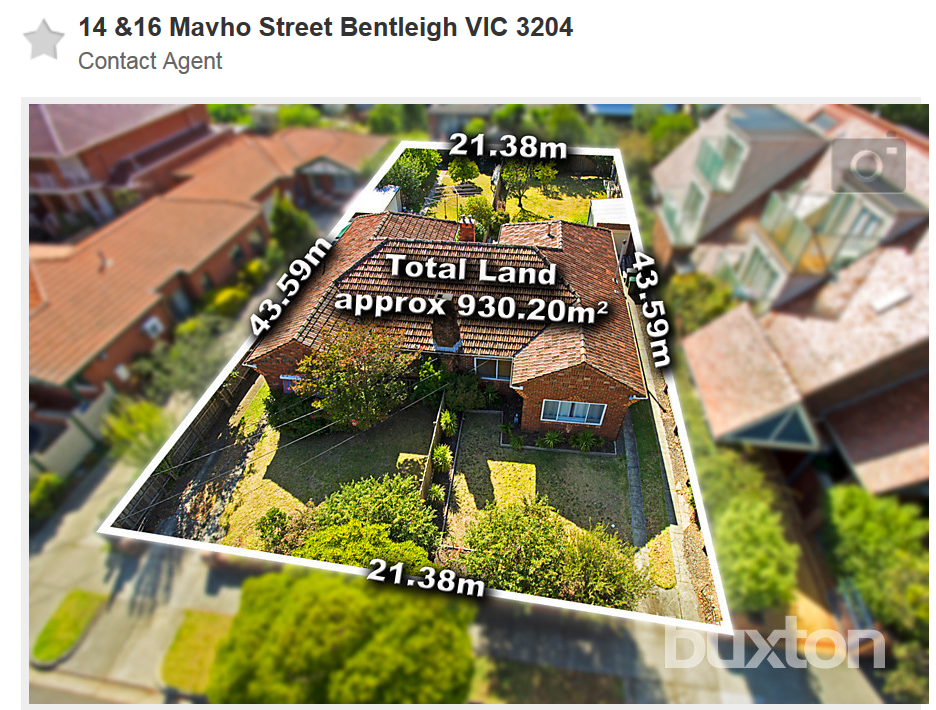
A trend is definitely occurring within Glen Eira where properties zoned Neighbourhood Residential, are selling up and getting out as quickly as they can. The latest example comes from Mavho Street, Bentleigh where some properties are zoned Residential Growth, some General Residential and others Neighbourhood Residential. Below is a screen dump of two adjoining properties located in the Neighbourhood Residential zone. We can only assume that the owners have seen what is happening to their street and their neighbourhood and decided that they want out.

What will also be vital in the months to come is what happens on such relatively large sites. Whilst the Planning Scheme still contains the criterion that larger than surrounding blocks will be adjudicated against the General Residential Zone ‘standards’ instead of the Neighbourhood Residential zone ones, it will be most interesting to see how this plays out if the purchaser decides to aim for a 3 storey and 20+ unit development.

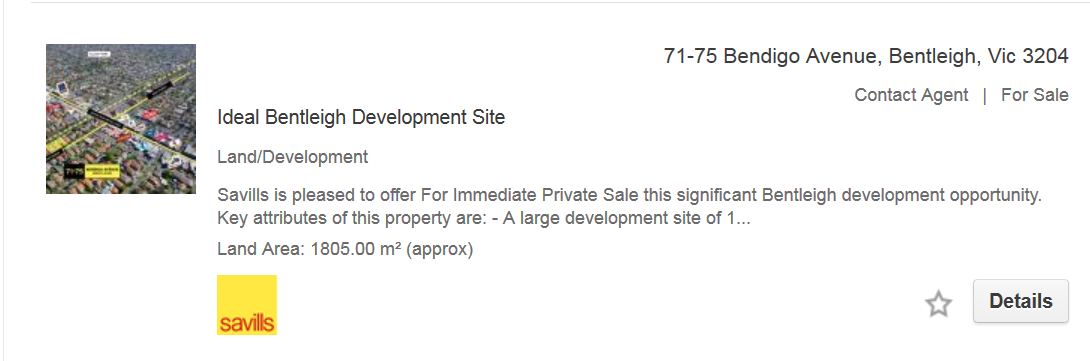
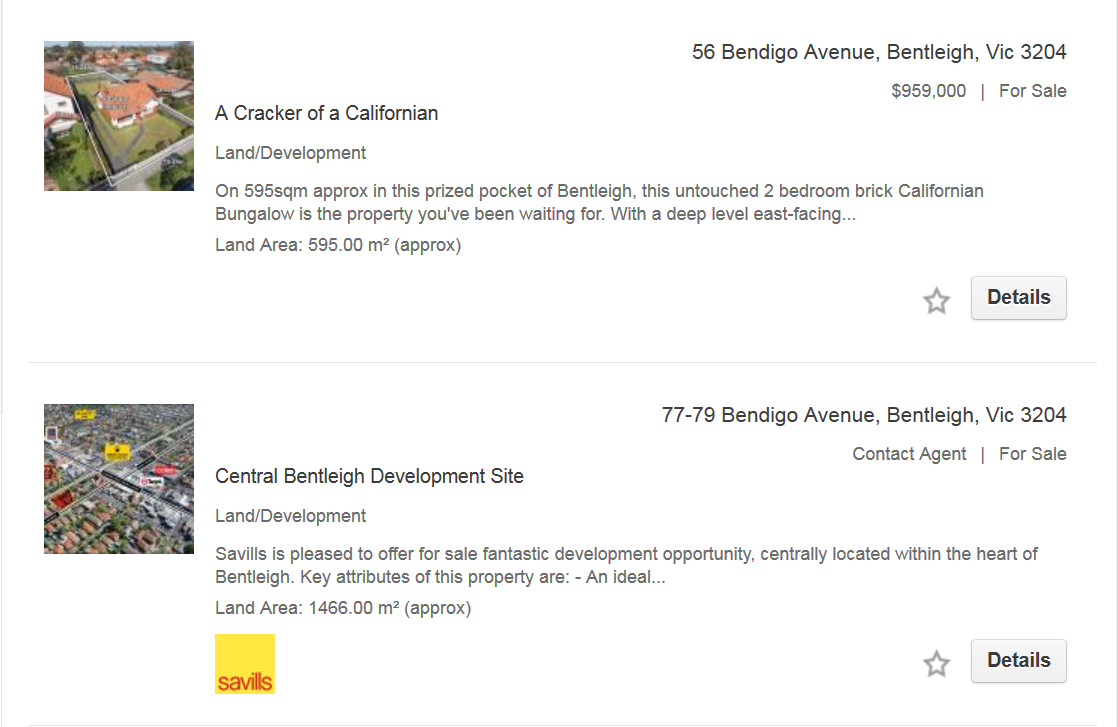
mavhoMavho Street is already gone. Now it is the turn of Bendigo Avenue as these recent advertisements show. Two triple blocks zoned Residential Growth are on the market and the single property is zoned General Residential Zone 2. An ‘invitation’ for 4 and 3 storey developments in an area with a Heritage Overlay and a SBO (Melbourne Water overlay).

bendigo1bendigo2


ve

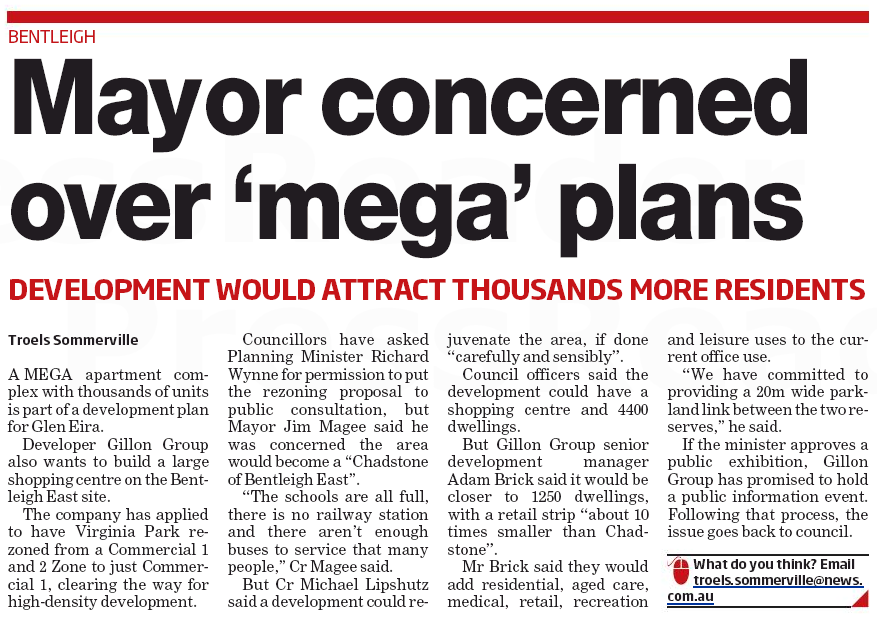
When big money is involved (for both developers and council) then transparency and truth are the inevitable victims. We revisit the Virginia Estate proposal since the claims by the developer, council officers and councillors appear to be at odds and are strikingly reminiscent of what occurred with the Caulfield Village enterprise. Here’s why:

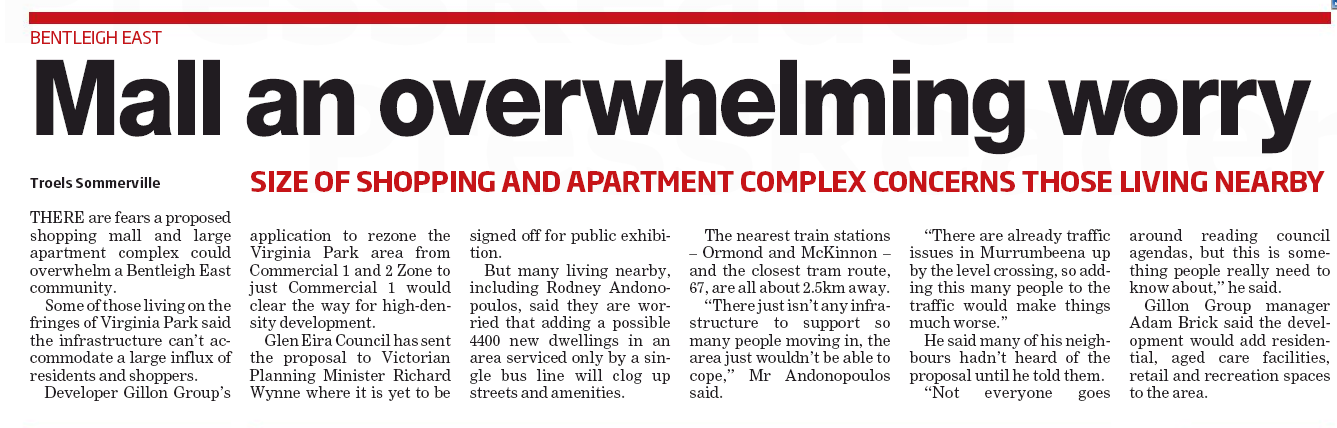
  • Gillon cites 1250 new dwellings in this week’s Leader articles. In the officer’s report the figure of 4,400 was stated. Magee even claimed 5000 new dwellings.
  • Caulfield Village started off with a proposed figure of 1100 dwellings. At this stage it has ballooned out to over 2000 – on a site that is half the size of Virginia Estate. We anticipate further increases once the remaining development plans are submitted.
  • How council can cite 4,400 new dwellings and Gillon only 1250 needs explanation – especially when the existing amendment (or equivalent of the Caulfield Village Incorporated Plan) grants permission for towers ranging from 4 to 10 storeys.
  • Council quotes directly from the ‘Retail Impact Statement’. Hence detailed documentation by Gillon does exist. It would also have existed when they approached the department and the Minister. Undoubtedly private discussions between Gillon and Council have been going on for some time. Requests for changes to setbacks and other conditions of the current amendment are not agreed to without some clear indication of why this is needed. Setback reductions can only mean more land for more development. Council’s reasons for agreeing to this are top secret as revealed in the non-answer to this public question –

“In 2011 Council resolved that the schedule for Amendment C75 maintain the 8 metre setback to East Boundary Road. The officer report now states: “The DPO will be amended to require that any land development within 6 metres of the East Boundary Road must be to Council’s satisfaction”. Why and on what basis has it been recommended to renege on a previous council resolution and the terms of the gazetted Schedule 2?”

The Mayor read Council’s response. He said:

“The request to change the existing DPO is a new amendment process and is totally separate to Amendment C75. The proposed changes to the existing DPO will be required to go through a full

public exhibition and independent panel process. At the conclusion of the amendment process, Council can decide to either support or reject this amendment.”

And as with the Caulfield Village fiasco, residents are the last to know what is really going on. Yes, a ‘public information event’ might be held. But how much veracity residents can rely on from both council and the developer is the real question! Finally, as has already been noted – when each and every councillor basically spoke against the requested amendment, why on earth did they vote to exhibit rather than reject! Given Andrew Newton’s email to the Minister’s Office, the writing is on the wall that the proposed Amendment will be pushed through – aka Caulfield Village!

Crs Lipshutz/Okotel

That Council resolve not to proceed with item 7i in the Community Action Plan for 2014-15.

Motion carried. Division Called. Voting for: Lipshutz, Okotel, Esakoff, Magee, Lobo. VOTING AGAINST: Delahunty, Pilling, Sounness, Hyams

SOME BACKGROUND: On a previous vote on this issue, Lobo voted for the creation of a tree register. At this meeting there were a few aghast faces when Lobo didn’t immediately put up his hand to vote in favour of the Lipshutz motion. After some concerted stares from across the chamber, he raised his hand. Anyone still believe that ‘decisions’ aren’t pre-arranged behind closed doors?

We also point out that it was Lobo who was featured prominently in his election material alongside Simon Crean. The later comments in the ‘debate’ are referring to this.

LIPSHUTZ: a ‘vexed issue’ which has ‘come back to council over and over again’. It’s been to the Local Laws committee which looked at this ‘extensively’. Claimed there is ‘no right or wrong’ but is a ‘philosophical argument’. Some say that’s it’s ‘very important to have a tree register’ and others say that they should be able to do ‘what I wish on my land’. Reiterated that ‘there is no right or wrong’ but an issue of ‘the right approach’. In his view, if ‘I buy a piece of land’ then ‘I should be able to do with it as I wish’. If he wanted to remove his trees and ‘concrete’ then ‘it’s my prerogative to do so’. When he bought his land over 20 years ago, there were trees and he kept some of them ‘but over the last 20 years or more those trees are gone’ and now he has ‘bigger and better trees’. ‘That’s my right to do that’. ‘Acknowledged’ that ‘not every tree’ is going to be classified as a significant tree, ‘but ultimately it comes down to property rights’ and ‘therefore I am seeking to abandon that part of the community plan’.

COMMENT: Note the last sentence. The motion says nothing about ABANDONING the options for introducing a tree register. In fact, the motion speaks only to 2014/15! Yet, the intent and the overall impact will be that once gone from the community plan, there is no requirement for the Local Laws committee to ever revisit the issue, and hence no need to consider the issue as part of any Local Law Amendment. Further, if by chance the Local Law does come up for some amendments this year, then it will not be touched in all likelihood for another ten years until the sunset clause expires. The Tree Register issue will be dead, forgotten, and effectively killed off. We might also add that for the past 3 to 4 years the Local Laws Committee has been under the obligation to create the ‘framework’ according to the standing resolution. Their task was simply to carry out a council resolution. This they did not do! Nor has there been any report as to why this committee found so many alleged problems with creating the required wording – especially when countless other councils have ready made models to emulate.

OKOTEL: repeated that it’s a ‘vexed’ issue and that it’s been before council ‘many, many times’ and that it has also been looked at by the Local Laws Committee ‘many, many times’. People ‘do have different views’ but the committee has had ‘great difficulty in dealing with’ the issue if there was a ‘law in place’. The committee has ‘looked at different wording’, but they couldn’t ‘come up with anything that people are entirely satisfied with’. Council does have a ‘number of tree protection measures already in place’ and ‘these are adequate to protect our important trees’. On public land there is policy to ‘protect trees in our parks’ and on private land there are ‘laws against moonscaping’ and there are ‘often’ conditions in permits that council has said have trees that are significant. Said that having a new register would be ‘unduly onerous and invasive’ . There would be costs in ‘hiring the consultants’ and they would have to ‘survey the entire municipality’ then ‘maintaining and updating the register’ and ultimately ‘prosecuting the individuals’. All of these ‘costs would be of little benefit’ since only the ‘best of the best trees’ would be on the register. There wouldn’t be a ‘large number of trees’ so ‘going to the extent of having consultants identify the area’ for those few trees and prosecuting those individuals who happen to ‘prune’ their tree is ‘going that step too far’. She was ‘certain’ that when people buy a property with a nice tree they keep that tree. Thought it would be far better to ‘spend that money on planting new trees’. ‘Greening’ the streets by planting new trees is important and planting 400 new street trees is good but ‘we can do better’. Shopping strips ‘require greening’ so more can be planted there. Thought that Council could be ‘spending money in a way that would have far greater benefit’. Agreed with Lipshutz that when people ‘have a garden’ it should be their ‘right to tend their garden’ as they wish. Nobody should expect that if they ‘cut down a branch’ they would be ‘facing a $10,000 fine’ and if they ‘cut down the tree they could be facing a $50,000 fine’.

PILLING: thought it ironic that immediately after an item on powerlines and trees, and council’s emphases on saving trees, they should now be considering this particular item on the tree register. Said that council ‘does a lot of things for the community benefit’ and that saving trees, ‘even on private property has worth for the community’. Said that Okotel was ‘probably right’ in that ‘most owners’ would keep their trees but property developers are different. Other councils protect their trees but in Glen Eira ‘we don’t have very much protection at all’. Wanted this to ‘go forward’ and thought that it ‘eventually’ would either be by this council or the next. Thought that the ‘philosophical argument’ wasn’t as ‘good for the community’.

DELAHUNTY: ‘accepted’ that there are ‘philosophical arguments both for’ and against but thought that the application of these philosophical arguments was ‘mind boggling to me’ and there’s the inconsistency of the application of such arguments ‘from one item to the next’. Quoted Okotel from the last item when she said – “The loss of trees is a great shame for Glen Eira’. ‘Guessed’ it was about ‘where they were planted’ so all boils down to the ‘individual property rights kind of argument’. But then councillors who argue that they can do anything they want on their land will ‘then go on to quote all the provisions we have around the planning scheme’ and that this ‘protects trees’. Then asked ‘whether that should be changed as well?’ ‘You can’t have this inconsistent application’ about trees on private land. Either trees are important and ‘community asset’ no matter ‘where they are’ they should be protected or ‘you don’t’ think they are important. Said that ‘this lauding of planting more street trees’ is equally ‘mind boggling’ in the ‘inconsistent application of this as well’. It’s community money used to plant but the same councillor ‘who moved a motion to get those same street trees removed’ so this is a ‘bad use of money’. Plenty of arguments around for protection of existing trees – ‘population growth’. Why protect them right now ‘no matter where they are planted’ because ‘they are a community asset’.

Lipshutz might have done the ‘right thing’ by planting ‘new beautiful trees’ at his place but that ‘doesn’t give them any protection from the next owner’. Yet he ‘sees them now as adding back to the community’. ‘It doesn’t mean that they will be there forever’. Said that councillors need to ‘think about our values’ on this. Admitted that she is a ‘screaming leftie’ and because of this believes in ‘the community’s values over the individual’s values’ and she’s a member of the Labar party ‘because their values match mine’. Their values ‘state’ that ‘community’s have rights, organisations have rights’ ‘over an individual’. Said that some people might be ‘shocked’ to think that they ‘voted’ for some of these councillors who ‘purport to uphold these values’ and on their election promotions blurbs had ‘labor giants’ photographed with them. ‘Simon Crean was an absolute giant of the Labor party’.

PILLING: interrupted with a ‘point of order’. Delahunty asked ‘what is the point of order’. Pilling answered that he thought it ‘was off topic’.

DELAHUNTY: ‘on the basis of relevance’ she thought that ‘values’ were relevant to every decision council makes.

MAGEE: said he ‘understood’ the point of order and where ‘Delahunty is going’ but asked her to ‘please come back to Item 9.11’.

DELAHUNTY: repeated that council values are implicit in every decision and that it ‘should come as no surprise to the community’ especially since those ‘values are heralded on our election material’. Thus, trees are a ‘community asset’ wherever they’re found; community ‘has rights over the individual’. This is what she ‘believes’ and that’s why she ‘belongs to a party that also believes that’.

Went on to say that the issue was in the ‘much heralded’ community plan – the ‘overarching government document’. ‘Therefore a tree protection list must be forwarded’. Said it was ‘absolutely outrageous that we would'( interrupted by Magee at this point about the need for an extension of time. Delahunty said ‘I am done’.

SOUNNESS: ‘having respect’ for the environment is a ‘matter of principle’ and council spoke very ‘convincingly on Section 18c’ about racial discrimination and they took a ‘principled decision there’. If the environment isn’t protected then ‘some things degrade’. ‘Feared’ that ‘Glen Eira may go down the path of the Sahara desert’.

MAGEE – asked Sounness ‘are we talking about Item 9.11?’ The ‘tree register’.

SOUNNESS: Said he sees trees that are in the backs of properties and he enjoys seeing them and he’d like others who see such trees to be ‘comforted and supported’ and ‘encouraged to retain those trees’. Unless Council has a register then there ‘will be some’ who dismiss the importance of trees as ‘insignificant’ and ‘everyone stops caring about such things’. Whilst flowering gums and other shrubs might be attractive, they ‘don’t have the grace of some of the older’ trees. Wants to protect those trees and those properties who have such trees to be supported for ‘their retention’. This is above the individual’s rights for the ‘greater community benefit’.

LOBO: said ‘I am not supposed to talk on this, but I will’. Answered Delahunty by saying ‘I am here to represent the residents not a political party’. (Esakoff saying ‘hear, hear’ at this!) Lobo said that political parties can be either right or wrong and that they aren’t always right and if wrong ‘I do tell even the biggest person that you are wrong in the Labor party’.

ESAKOFF: ‘well said Councillor Lobo’. Said that councillors are there to represent the community and ‘not any political party’ and the community values ‘what they own’. Hopefully they ‘will value any significant trees they may have on their property’. ‘If you’ve bought a property that has a lovely tree you will cherish that tree’ and it will be removed if it becomes ‘old’ or ‘dangerous’ but she ‘couldn’t see that happening’. For developers and moonscaping ‘there are laws in place’. Doesn’t agree with many of the comments already made and that councillors are there ‘for the community and people do have rights’. ‘The community should not be able to over-ride’ the individual’s wishes ‘in their own home’. If the tree is in the front then people could see it, but if the tree is ‘in the backyard who is going to see it apart from perhaps a neighbour?’ and ‘not the community’. Thus ‘the owner of that property should have every right to do what they like’. She has always ‘been on the side of personal rights’ and she doesn’t want people to be told ‘what they can and can’t have’ in terms of trees in their gardens. That’s their ‘domain’ and it’s ‘called private open space – private’. ‘To be personal and to accuse people of inconsistency I think is a disgrace’. Said that people can argue for protecting street trees and planting more trees, but on people’s own property they should decide. Went on to ‘red tape and the costs’ is ‘another layer that the community is over’. Said that the ‘community’ doesn’t ‘want any more red tape’ or costs in choosing ‘what to do with their own private space’.

HYAMS: said he understands that ‘this is a philosophical discussion’ about the ‘rights of the individual which are very important’ and the ‘rights of the community’ to enjoy the ‘amenity’. Thought that Pilling, Sounness and Delahunty have ‘missed the main point’ in that the motion is about ‘asking the community if they want a significant tree register’. If the motion is voted in then it becomes part of the Local Law and that ‘goes out to quite a comprehensive community consultation’. Said that those who support the motion are arguing that ‘we support’ the community ‘so much that we don’t want to know what they think about this’. He does ‘want to know’ what people think and he won’t support one if the community says it doesn’t want one. Stated that ‘trees to contribute to the community’ and even from backyards ‘if they are tall enough’. There are ‘thousands of houses’ that have got Heritage listing. So if council thinks that it’s important to preserve ‘neighbourhood amenity’ with the heritage listings, and councilors at every meeting ‘limit’ what people can do through imposing ‘greater setbacks’ on their applications, then this is ‘all about contributing to the neighbourhood amenity’. A tree register ‘isn’t terribly different to that’. Admitted to be ’embarrassed’ because the issue keeps returning. Said that a ‘great’ amount of work had been done by the Local Laws committee. Stated that the planning scheme maybe does ‘take care of some areas’ it ‘doesn’t take care of all’ the possibilities. So, ‘let’s hear what the community has to say about this and then make our decision’.

MAGEE: supports the motion because when he moved into his house in 1988 it was ‘ornamental trees and fruit trees’. He pulled them out and ‘put in native trees’. Now he’s got an ‘oasis of native birds’. He also planted an ‘inappropriate tree’ which ‘grew very, very quickly’ and had to be taken out because of impact on neighbours. He’s planted every tree and if in a ‘couple of years time’ he wants to change his garden then should be able to. ‘This isn’t about cutting down trees but giving people their individual rights to decide’ on their own property. Said he would hate to see a ‘situation’ where a tree was ‘causing me harm’ but his neighbours ‘opposed that’ and ‘council supported them rather than me’.

LIPSHUTZ: although he rarely agrees with Lobo, he does on this occasion in that ‘we’re all here to represent the community and not political parties’ and ‘Cr Delahunty represents the Labor Party’.

DELAHUNTY: ‘point of order Mr Mayor. That’s not what I said’.

MAGEE: confirmed this wasn’t ‘what she said’.

LIPSHUTZ: withdrew comment. Said that on Heritage ‘how many times has it come back to council because we don’t necessarily agree with the Heritage advisor?’ This is like ‘someone coming along and saying that tree is significant’. Then someone will appeal that decision and then it will be ‘red tape and a bureaucratic issue’. Whether something is a significant tree ‘is in the eyes of the beholder’. As an analogy said that clients going to court are told ‘to settle because it is in your control’. When the judge decides ‘you’re gambling’ as to the decision. ‘This is exactly the same thing here’. People ‘gamble on somebody saying this is not a significant tree’. Stated that those claiming that a tree is significant won’t be the owner of the tree but a neighbour. ‘It’s a matter of property rights’. Agreed that ‘trees do add a great deal to the community’. Hyams has spoken about asking the community but that’s a ‘very cute argument because we all know that when you’ consult with people that ‘the vast majority’ ‘don’t give their view’ and it’s only those people ‘who have a strong view about the issue’. those who give their view are the voters and it’s those people who ‘will in fact say yes or no’. Going to community consultation means that ‘you will get’ the views of ‘activists and who have strong views’ and the ‘vast silent majority don’t care’. And ‘they don’t care’ because they are ‘satisfied’ about the ‘way council operates’.

MOTION PUT and MAGEE HAD TO ASK TWICE FOR ‘ALL THOSE IN FAVOUR’ GIVEN LOBO’S TARDINESS IN PUTTING UP HIS HAND.


barbecue

view from barbecue area

« Previous PageNext Page »