Councillor Performance


Page two of council’s damage control exercise (ie the Apartment Boom letter) purportedly sets out all of the fabulous things that council is doing for its residents. It is a pity that careful phrasing and half truths dominate instead of real facts. We ask readers to consider each point. The Council statements are in italics.

  1. Council is managing the boom within the limited powers given to us by state authorities.

One might quibble as to the definition of ‘limited powers’. Whilst it is true that there is much in all planning schemes set by the government, it is also true that close to a third of all planning schemes are handed over to councils to determine – they simply must support their proposals with sound empirical evidence. Councils are free to introduce structure plans, heritage overlays, design and development overlays, infrastructure levies on developers, open space levies, parking overlays, preferred character statements, up to date housing strategies for each precinct, and of course, the schedules to all the zones, and to determine where the zones go. We note that Glen Eira (contrary to other councils) has never had anything approaching real structure planning; it has 6 piddling design and development overlays – 3 of which regulate fence heights in a handful of streets and another two facilitate higher development in 2 specific areas. The Municipal Strategic Statement dates from 1999 and now belongs in a museum! Promises made centuries ago have never materialised. For 8 years council was content to extract a pittance for open space levies, knowing full well that the municipality was highly lacking in open space. Council also never bothered to ‘renew’ its lapsed development contributions levy so that now residents are subsidising developers completely for drainage. There is thus plenty that is within the power of council to initiate and deliver. They have simply refused to do the basics that every other council has done and which the State Government expects – ie structure planning and decent strategic planning.

  1. We obtained government approval for maximum height limits over all residentially zoned land where there were no limits before.

The veracity of this statement depends on how one defines ‘residentially zoned land’. According to the planning scheme the Mixed Use zone (MUZ) is also labelled as ‘residentially zoned land’. Hence Council has not imposed maximum height limits on all residentially zoned land as they would like residents to believe. One could go even further and argue that today Commercial zones are de facto residential zoned land – especially when developers can build one or two shops and then put 100 units on top of this! It is also worth noting that Boroondara has managed to achieve a three storey height limit for its Neighbourhood Centres including the commercially zoned shopping strips and other councils are following this lead. In Glen Eira, no such thing exists, and even worse, all Local Centres are now zoned Commercial and the vast majority directly abut Neighbourhood Residential Zones.

As to the ‘no limits before’ statement – again a misrepresentation. There were limits, albeit, ‘preferred’ height limits of 9 metres. So what does council do with the zones? Accept and impose the absolute maximum of 10.5 and 13.5 metres and no height limits whatsoever for the Mixed Use Zone. A ‘one size fits all’ approach across the board. Sloppy planning indeed when seen in light of other councils and the number of GRZ and RGZ zones each applied and the height variations within each of the schedules. This of course required some hard work and a close analysis of the municipality – something entirely alien to this council.

Height limits by themselves do not of course make for good planning and protection of residential amenity. Especially not when there are no urban design frameworks to accompany the height limits and no real provision for open space, permeability, no tree protection, and no preferred character statements for Housing Diversity areas. We remind readers that other councils for both their GRZ and RGZ zones have managed to achieve far greater protections in terms of open space and permeability than Glen Eira. Some councils (ie Yarra) have even managed to have the Residential Growth Zones removed entirely and Bayside is also awaiting approval for this to happen in their municipality.

At the time of introducing the zones, Council had the choice. Schedules were there to be fine tuned. There was no fine-tuning. Simply a total cave in. Our question always remains the same – if other councils could get a better deal for their residents then why couldn’t Glen Eira? How hard did Newton, Akehurst and Hyams really try? Or were they so caught up with the self promotion of being the first council that all thought of getting the best deal went out the window?

  1. There is nothing under the new zones that could not be built before

A nice little slogan! The point is that PRIOR to the zones, developments were far more constrained and those applications which did get through (particularly in Carnegie) were also the result of a poor and ill-defined planning scheme. The loopholes that exist now, existed then. The difference however is that cometh the new zones, developers, investors, and real estate agents were given the clear signal that they could now build to their hearts content and instead of a 9 metre preferred limit, they could now literally go for 13.5 metres in RGZ and 10.5 metres in GRZ. That’s why we are now seeing amended application after application seeking the limit. One perfect example is 20 Wheeler St., Ormond. On the 21st May 2013 an application went in for 2 double storeys. On the 12th December 2013 an amended permit went in for changes to windows. Then on the 21st February 2014, a new application came in for 8 double storey dwellings. Council refused this application so we now get another application (15/10/2015) for seven dwellings on land that is roughly 760 square metres and zoned GRZ1 and this includes a combination of three and two storey buildings. Needless to say there is no minimum lot size for subdivision in Glen Eira, whilst Bayside is aiming for a minimum of 800 square metres and other councils have a range from 350 square metres per lot – ie Manningham

There’s also this beauty for 249 Neerim Road, Carnegie. In September 2011 an application went in for three storeys and 11 dwellings. It got a permit. Then in June 2015 another permit was issued for 4 storeys and 48 dwellings! Of course Council would like us to believe that this has nothing whatsoever to do with the zones

Even VCAT prior to the zones would pay close attention to the ‘preferred’ height limits. From a decision in 2011 on George St., Caulfield North –

The Council and Mr Durrell asked for the building to be lowered to 9 metres to meet Standard B7 (and consequently Standard B17 with respect to the western elevation) and to provide a better transition from the larger and higher form on the north side of George Street. ….. I consider lowering the building is a necessary together with other modifications as referred to in these reasons. I appreciate the scale of development opposite the site but am also mindful that land differs from the review site. The review site is small, has different building relationships, and has different visibility in the streetscapes and from adjacent confined lots. Further, it is influential to my conclusion that the change will assist to bring the development into compliance with Standard B17 with respect to the impact on No. 3 George Street

Compare the above (and council’s attitude) to what we now have. A VCAT decision from September 2015 –

There is no Design and Development Overlay or other overlay, or indeed a policy, to indicate the preferred heights for new multi-dwelling developments in the residential area. What guidance is available is obtained from Schedule 1 to the General Residential Zone, which specifies a maximum height of 10.5 metres for a building on this land. This height can comfortably accommodate three-storeys of residential development. Accordingly, the Council, through its Planning Scheme, has made a conscious decision to allow for three-storey development on this site. Indeed, the Council advised that it has no ‘in-principle’ objection to a three-storey building on the review site

Bent Street Bentleigh is another example of amended permits seeking an additional storey increase and more apartments to permits that had already been granted. Again, the VCAT member’s comments on what the zones really mean –

….there has been a change in planning circumstances, notably the zoning of the land has changed from Residential 1 Zone to the current General Residential Zone Schedule 1, which contemplates more intensive development where height of building can be 10.5 metres and up to 11.5 metres on a slope plus promotion of site consolidation, compared to the maximum height of 9 metres recommended in Clause 55 for the Residential 1 Zone.

The situation is even worse for some developments zoned Mixed Use and/or Commercial. Centre Road is the perfect example with applications going in for increased heights and increased numbers of dwellings. Because they can – they will! Which of course raises the question as to why Council did not at the time of introducing the zones include a height limit on MUZ? Thus, we return to the ad hoc planning that has characterised Glen Eira for well over a decade. Two recent amendments have imposed 3 storey height limit on MUZ sites. Why couldn’t this be applied to all such zoning back in 2013? Or is the truth finally dawning on council about the unmitigated disaster they have ushered in through their indecent, secretive haste and lousy planning?

  1. We refuse to give on-street residential parking permits to new nulti-unit developments

Wonderful! Except that all these cars now go into surrounding residential streets that have no parking precinct plans attached to them and no real analysis of what these neighbouring streets can cope with. Nor does the absence of a residential parking permit mean that all those cars which are parked illegally will be fined. Laws are one thing – enforcement another!

More in the days ahead!

The following reports come from 2 agenda items – (1) comments on the VCAT decisions, and (2) the Bent St application. We have decided for this first item to highlight some of the comments made by Magee. The reasons should be obvious!

MAGEE: said he spent the day at VCAT with residents of Claire St., McKinnon and that the judgement shows that VCAT ‘does have the capacity’ to look at the Glen Eira Planning Scheme and listen to what the residents of Glen Eira ‘have said they want in the area’. The Planning Scheme has ‘been put together over many years with vast community consultation’ (sniggers and jeers from the gallery). Said he represents the 140,000 people and not the few who claim to do so. Continued that the planning scheme was voted on by all councillors. It then ‘went to the Minister’ who approved it. After doing ‘so much work, we know what our residents wanted’ and ‘that’s what our planning scheme actually says’. With the new zones, Claire Street has height limits and the developer got it wrong by wanting to ‘build almost fence to fence’. ‘He had scant disregard for our planning scheme’. The VCAT member ‘applied our planning scheme’ – he applied ‘what we as a council’ and what ‘we as residents have said is appropriate to Glen Eira’. Every council has a scheme but that sits on what councillors and ‘residents think is appropriate’ for that municipality. The member ‘applied our planning scheme’ and ‘when he did, this building did not fit’. And when he applied the rules that ‘residents put to us that they wanted, it did not fit’. Said that unfortunately not all VCAT members are as ‘educated’ as this member and not all of them ‘do their homework’ nor ‘appreciate the level of detail we have in our planning scheme’.

Said that 97% of the municipality has got height limits and 3% commercial with no height limits. Putting height limits on commercial areas has to be done through an overlay, and then community consultation, ‘permission from the minister’, and ‘through a long and detailed process’. ‘If council decides at some point in the future’ to do this, then he would ‘welcome that’ but to do ‘that we would need legal opinion, planning opinion’ and the Minister’s approval. There are some other things that might be done with the commercial zones but he is ‘very, very happy that’ the zones ‘cover 97% of our municipality’. This ‘in conjunction with our planning scheme’ is what ‘makes it work’. When VCAT doesn’t apply the planning scheme ‘that’s when it goes wrong’ but for Claire St., they did apply it.

COMMENT

  • 97% of the municipality DOES NOT HAVE HEIGHT LIMITS!
  • Mixed Use Zones (apart from 2 specific sites) DO NOT HAVE HEIGHT LIMITS. No mention of course about this little fact
  • Once you remove parkland, VicRoad land, Special Utility zones, etc from the total acreage then the percentage of land zoned commercial and mixed use is far greater than the 3% this council would like residents to believe is the truth. Also given council’s penchant for transforming sites zoned C2 (ie no residential dwellings) into C1 (allowable residential dwellings such as Virginia Estate amendment) then the percentage skyrockets even further. Then add on all the amendments which have already and are still waiting to be rezoned from ‘industrial’ land into Mixed Use or Commercial and the figures literally go much higher.
  • Magee is obviously under the illusion that if you repeat something often enough people will believe you – ie ‘vast community consultation’. Perhaps he and the other councillors should ask residents whether they believe the planning scheme does in fact represent resident views?

BENT STREET APPLICATION

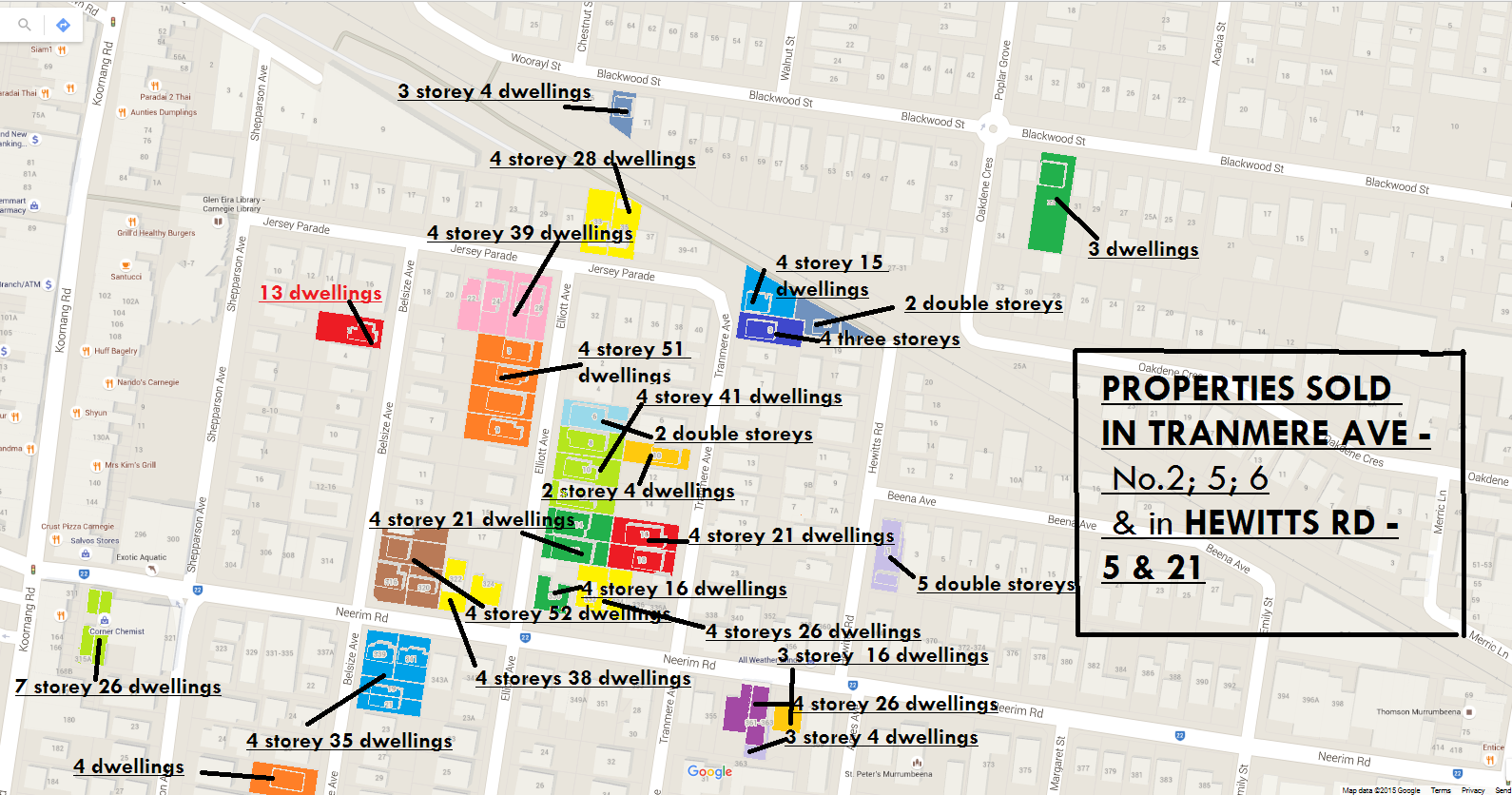
Before we report on the actual ‘debate’ readers need to take a look at what the zones have meant for this street and the surrounds. It is our estimate that since the zones were introduced the area has had 378 new dwellings permitted. This rivals Neerim Road’s 548 new dwellings. (click to enlarge the image)

bent street latest

Here is what councillors said. It took roughly 7 minutes!

Proposal 4 storey, 20 dwellings. Hyams moved motion to accept plus introducing some conditions for the street trees. Seconded by Sounness.

HYAMS: said he chaired the planning conference and that objectors’ ‘concerns’ have been ‘addressed by the officer recommendations’. This is the ‘right place for a 4 storey development’ ie next to supermarket and station and ‘sufficient’ parking. Went through some of the conditions such as increased setbacks for basement car parking to allow for landscaping. Basically read out the other conditions from the officer’s report. Thought that all of this meant a ‘reasonable compromise’.

SOUNNESS: said he is supporting the application in order to be ‘consistent with the planning scheme’ designed for the area. ‘Being part of the Bentleigh Urban Village it does have criteria’ and meets those criteria. There has also been a lot of 4 storeys surrounding this development and others higher in surrounding area given by VCAT.

LOBO: said that in 2011 ‘I predicted that Glen Eira will be like Calcutta’ and he ‘got told off’ for saying that. ‘Well the writing is on the wall’.

DELAHUNTY: said she remembers Lobo’s comments and is an ‘indication’ of what is happening in Bentleigh and ‘especially around this area’. Bent Street ‘have taken more than their fair share’. However she wanted to draw people’s attention to ‘housing affordability’ and the high cost of renting. A report came out showing that some families spend up to 50% of their income on rent. So they need more development and then the rental will drop because more development ‘will push the prices down’ for ‘people to be able to live around infrastructure’. Thought that Lobo’s values would also support the idea that people should be able to afford to live where there are good health services and ‘good infrastructure options’ and ‘Bentleigh certainly has’ those things. She ‘understands that it is a balancing act’ so will support the motion.

MOTION PUT AND CARRIED. Lobo only councillor to vote against.


We urge all residents to read the following carefully. It illustrates completely how resident wishes are completely ignored and distorted. It reveals the complete failure of strategic planning in Glen Eira and the unwillingness to remedy this situation. When hundreds of residents demand a review of the total planning scheme, when they demand a review of the entire zones, the argument becomes distorted into maybe, possibly, perhaps years down the track, we might consider something for the commercial zones. This is not councillors representing their constituents. It is councillors representing developers above the community!

Item 9.8 The Minister’s Letter

Hyams moved the motion to accept the report plus adding two more clauses – (1) that officers prepare a report on vcat decisions which show “contradictions on similar applications’, and (2) that ‘officers ascertain’ from the Minister what he allegedly stated to residents regarding structure planning. Seconded by Magee.

HYAMS: said the minister’s letter was ‘disappointing’ although council couldn’t expect him to suddently change everything. He had hoped that he might have said that this could be the start of a ‘process’ where VCAT would have to ‘take account of our planning scheme’. Went on to say that council’s policies have to be approved by the minister and that before they even get to the minister council goes through an ‘exhaustive process’ and the housing diversity/minimal change ‘went through about 2 years of exhaustive consultation’ and the zones were a ‘direct translation’ of this earlier 2004 policy. They also did a ‘lengthy consultation on the whole planning scheme’ and people said ‘they wanted transition zones’ and height limits and more character overlays which ‘became neighbourhood character overlays’. Claimed that a ‘lot of work goes into these’ and it’s a ‘shame’ that VCAT doesn’t pay them more attention. Said the Minister said we should look at zones and overlays because they are more ‘stringent’. Some parts of the zones are mandatory but others remain ‘discretionary’. Problem now is that VCAT is inconsistent and that two members can look at identical applications and give different decisions. That’s why he has moved the second part of the motion and with these examples ‘perhaps this will’ bring more ‘pressure on the government’ to act. The third part of his motion is because some residents in Bentleigh who ‘have taken it upon themselves’ and who are ‘quite eager about changing our planning scheme’. They met the Minister and he ‘apparently gave them an undertaking’ that ‘we were to put in some strategic plans or structure plans’ and that he would be ‘quite ameniable’. ‘That would be nice if it was true’. He wasn’t sure and gave an example of Moreland who asked for ‘ten storey limits’ in their commercial centres and the Minister responded with 13 storey discretionary height limits. So even if there is the possibility of ‘improving the amenity of our commercial zones’ then ‘we’re obliged’ to find out exactly.

MAGEE: claimed that 97% of Glen Eira has ‘a mandatory height limit’ and 3% could ‘possibly’ have council ‘put in some overlays’. Said that ‘regardless of what we are told by some of our residents’ structure plans ‘are nothing more than a plan’. ‘It’s not a law’ but only a ‘look at an area in the future’ that says ‘how it should look like and how do we get there’ and cater for transport, etc. ‘It doesn’t actually say that we have to apply any of that’ and VCAT doesn’t have to do anything either. Claimed that if council wanted VCAT to do anything then ‘it would have to be in the form of an overlay’. Overlays need a panel assessment and they could end up saying that ‘Carnegie is quite suitable for 13 storeys’ and Bentleigh ‘quite suitable for 6’. Council would then ‘have to argue against that’, then the Minister would ‘have information’ saying the opposite. S0 ‘there is a risk in asking for something’ that ‘you don’t get what you want’. Said he was ‘open minded’ about what the Minister said to residents. He and Hyams had met with residents and when they heard what Wynne had said they were both ‘enthusiastic’ because these were different to ‘the comments’ heard ‘in the past’. Previously they ‘had heard’ that commercial zoning was ‘the responsibility of the State Government’. Council only assesses according to the planning scheme. Repeated that if council got mandatory height limits in commercial zones or activity centres then ‘it would have to be in the form of an overlay’. Council will write to the minister to ‘clarify’ what he said. If he is ‘going to be supportive’ of overlays then ‘I would be very willing’ to support ‘going along that line’. But ‘before that’, there has to be a motion, and before that ‘there would have to be information coming back to an assembly of councillors’ so councillors know ‘what is proposed’ and that would need ‘legal advice’, ‘strategic planning’ advice, and they would ‘have to assess that at an assembly of council’ and ‘if there was support to see that go further’. First off, council ‘needs the minister to clarify his comments’ because ‘this process could take anything from one to two years’ and cost over $100,000. He doesn’t want to do this if the minister ‘says no – that’s not what I said’. Need to clarify what he said but overall supportive of an ‘overlay’ around commercial zones.

LIPSHUTZ: said that ‘before we go ahead’ he wants things ‘in concrete’ that it will be accepted and ‘not simply some political speech’. Also have got to be careful about ‘what we wish for’ since might ‘get something we don’t wish for’. Before they start anything they need to get ‘proper advice as to what we actually want’. Earlier Delahunty had spoken about affordability of housing and so ‘maybe we actually want’ some areas to be ‘growth zones where we have higher density’ rather than putting overlays on ‘carte blanche’ and this may ‘not be what we want’. Said it is easy as ‘some residents have said’ to put on overlays of no more than 5 storeys ‘over this whole area – but is that what we want?’ Said that what ‘we have to do’ is have ‘measurable’ facts about ‘areas that aren’t covered’ and ask ‘what is the strategic vision’ and once they’ve got it, then they will ‘go to the minister’. Repeated that ‘sometimes the cure is worse than the disease’ and here ‘it may well be’.

DELAHUNTY: supports Hyams’ motion. Thought that Lipshutz was ‘quite right’ that there is a ‘requirement for high density’ in some areas. Third part of the motion asks for ‘clarification’ from the minister and that ‘this would be a change in direction’ and leads to the question of ‘whether we should go down that road of structure plans’. She likes structure plans because it allows ‘residents to have a say’ on areas in contrast to what is happening now such as ‘piece meal’ planning in ‘making decisions application by application’. But even though she likes the ‘process’ it ‘doesn’t necessarily result in better outcomes’.

OKOTEL: said that council has been ‘frustrated’ by VCAT decisions ‘many times’ as illustrated by the Claire St decision where policy was applied and in McKinnon road was ignored. The inconsistency ‘makes it difficult’ for council because they have to think how VCAT ‘might approach’ the decision and council has to try and be consistent ‘in our decision making’. Also ‘frustrating for residents’ because a lot depends on which VCAT member is making the decision. Claimed that the ‘only way’ to get consistency from VCAT is via the State Government. The minister’s response to council’s letter was ‘disheartening’ in that it said that VCAT could continue and completely ‘disregard our planning laws’, despite ‘the extensive work we’ve put in in developing those policies’. Hyams’ second part of the motion is ‘looking’ for evidence to ‘highlight that inconsistency’ in VCAT decision making. Regarding the third part of the motion, she is ‘eager’ to see the minsiter’s response.

HYAMS: the commercial areas are the only parts in Glen Eira that don’t ‘have a zoning’ and ‘everything is discretionary’. So he is looking to ‘get greater certainty’.

MOTION PUT AND PASSED UNANIMOUSLY

A quick note on tonight’s council meeting. Much, much, more to follow!

  1. Frogmore application for Jewish Care Aged Care Facility – refusal passed unanimously with both Esakoff and Delahunty declaring conflicts of interest
  2. Truganini Road application – permit
  3. Bent St – permit with conditions about protecting street trees
  4. North Road 6 storey application – Esakoff moved motion to lop off two storeys and reduce number of dwellings. Motion passed.
  5. Minister’s letter – officers to prepare another report on inconsistencies with VCAT decisions and follow up on resident claims regarding Wynne being amenable to structure plans and zones. This was suddenly a discussion only about COMMERCIAL ZONES!
  6. Lobo gagged from asking questions by Magee, Pilling, Lipshutz
  7. Magee taking on the mantle of chief council promoter!

Level of consistent and cogent argument remains appalling. Political expediency the winner!

Tonight’s Planning Conference on the 9 storey application in Centre Road Bentleigh had a huge turnout of very disgruntled and angry residents. Well over 100 residents and thus far over 150 objections. 6 councillors showed up – Lipshutz (who chaired the meeting), Hyams, Magee, Pilling, Delahunty and Lobo.

It was announced that at 4pm this afternoon the applicant had notified council of his referral to VCAT as a result of council’s failure to reach a decision within the 60 day timeframe. Quite remarkable given that the application was submitted on the 30th June, 2015 – five months ago! Several residents took council to task on this issue, asking why council is incapable of determining something within the legislated timeline.

What makes this even more outrageous is the fact that it only took one month for a decision on a 16 storey application to be rejected by the manager for an application in Egan Street, Carnegie. For this application (and we quote)  (t)he reasons for the refusal relate to planning policy; impact on the public realm, height and scale of the building; traffic impacts, internal amenity; and equitable development rights with the adjoining sites. This is identical to all the objections raised by residents at tonight’s meeting. Hence, why does one application only take 32 days to determine and another application fails to be determined in 5 months? Why is one application refused under delegation by the Manager, and this application is permitted to go on and on and on? Or is this another instance perhaps of the Alma Club fiasco where council also failed to deliver a decision in 60 days and at ‘mediation’ caved in entirely so the developer got his way?

The most promising aspect of tonight was:

  • How well versed residents were in planning law and how little the professional planners seemed to know, or couldn’t answer
  • How residents are no longer prepared to sit and merely accept council’s waffle
  • How residents are now loudly and clearly demanding that councillors introduce planning scheme amendments – although Lipshutz denied that this was an option and the planners pleaded ignorance, thereby contradicting what Magee and other councillors have allegedly told individual residents.
  • How residents are now demanding that council do what it is supposed to do – ie. insist on accurate and valid traffic reports from the developer; that height in basement car parking be measured accurately so that cars over a certain height can enter; that Heritage of nearby streets be protected.
  • How community expertise is prepared to challenge council ‘expertise’ – ie architects, air conditioning professionals, and ordinary residents who have had enough of council’s pro-development agendas and seeing their neighbourhoods destroyed.

Of course, tonight was merely going through the motions. The developer did not front, and Lipshutz performed his usual trick of twice threatening to close the meeting. In fact, he closed the meeting with people still wanting to ask questions. Ultimately, tonight’s meeting was another clear message to councillors – shape up or ship out like Newton and Akehurst have.

REVIEW THE PLANNING SCHEME NOW AND WITH FULL COMMUNITY CONSULTATION OR YOU WILL BE EX-COUNCILLORS IN 12 MONTHS!

We beg your indulgence for this extremely long post, but we believe it is important that residents get the full and true picture of what has happened in Glen Eira, and what is still occurring as a result of Council’s inept and atrocious planning.

Item 9.8 of the current agenda features Minister Wynne’s response to Council’s letter requesting that the Planning & Environment Act, 1987 be amended to ensure that VCAT implements, rather than ‘considers’ local planning policies. Sounds good and fits in nicely with Council’s current campaign of scapegoating VCAT for all the ills faced by residents through rampant overdevelopment of the municipality. Sadly, this Rocky Camera report is another illustration of the ‘sins of omissions’ and therefore should be seen as entirely and deliberately misleading.

The Minister’s Response

It is no accident that the Camera report does NOT cite two paragraphs of the Minister’s letter. Why? Because if we were to read between the lines, Wynne is basically giving this council a glorious kick up the backside for its failures to do what it was meant to do! Here is what Wynne wrote:

A local planning policy is a guide to decision making in relation to a specific discretion in a zone or an overlay. It helps the responsible authority and VCAT to understand how a particular discretion is likely to be exercised. It is not seen as a mandatory requirement, nor do I consider that it should be mandatory as each proposal should be assessed on its merit against relevant State and local policy objectives. Nevertheless, a local planning policy that is well written, clear and unambiguous can reduce challenges at VCAT and make the whole decision process more transparent.

I appreciate the Council’s concern but I am not satisfied that legislative change is appropriate in this instance as other mechanisms such as zone and overlay provision can be used to achieve Council’s objective if strategically justified.

It is our view that what the Minister is in effect saying to Council is– get your act together through the existing mechanisms of zones and overlays and ‘well written, clear’ statements. All of which of course must be based on CURRENT, fully documented and reasoned ‘strategic justification’. Something that Council has never done. Its planning scheme is a mish-mash of contradictions, archaic data, and woefully expressed concepts. Nothing can be ‘strategically justified’ if the data that council relies upon, even if it wanted to do something, dates back to 1996, and is based on an Amendment (C25) that was seen by the Planning Panel to be “interim”. The easy option taken by council has been to do nothing and cosy up to Matthew Guy to rubber stamp more inept planning.

VCAT and Council Policy

We have reported numerous times on VCAT decisions and WHY council’s decision making is often overturned. In 99% of cases it has nothing whatsoever to do with whether policy is mandatory or not, and everything to do with what is missing from the planning scheme – ie Urban Design Frameworks, Structure Planning, Design and Development Overlays, Parking Precinct Plans, Tree Protection, Water Sensitive/Environmental Sustainability policies and most importantly – Preferred Character Statements for housing diversity. For an expose of Council’s inadequacies we refer readers to a recent post where we cited member statements that reveal fully how hopeless Glen Eira is – https://gleneira.wordpress.com/2015/10/07/statistics-glen-eira-style/

Statement after statement by VCAT members tells council that:

  • Either its imposed conditions aren’t supported by the planning scheme
  • Either there is no urban design framework to guide decision makers in what is ‘acceptable’
  • Either the imposed conditions are contradictory and so forth.

The errors, the poor performances, and the failure to have a decent planning scheme means that most developments (especially in housing diversity) get through. Again, this has nothing to do with whether policy is ‘mandatory’. Councils MUST HAVE POLICIES TO BEGIN WITH. What has Glen Eira got apart from the zones that arbitrarily carved up the municipality over a decade ago.

Mandatory Policies

Plenty of other councils have taken Wynne’s message to heart and introduced Design & Development Overlays that legally ARE MANDATORY. Manningham, Mornington Peninsula, and plenty of others have succeeded in having their various overlays gazetted as mandatory. Boroondara for example has ensured that NO development zoned Commercial in its Neighbourhood Centres can exceed 3 storeys. Unlike the countless instances of sheer waffle found throughout the Glen Eira Planning Scheme (ie “encourage”, “advocate”, “discourage”, “ensure”) these other councils use the explicit and legally binding language of “MUST”. Here’s part of the various Manningham Design and Development Overlays  –

For Doncaster Road area – Planting within the building setback area must include a row of avenue trees.

For Activity Centres – Development must: Include only one vehicular crossover, wherever possible, to maximise availability of on street parking and to minimise disruption to pedestrian movement. Where possible, retain existing crossovers to avoid the removal of street tree(s). Driveways must be setback a minimum of 1.5m from any street tree, except in cases where a larger tree requires an increased setback.

For Warrandyte & Tempelstowe areas – – Each lot must not be developed with more than one dwelling. A permit cannot be granted to vary this requirement.

BOROONDARA

For its Willesmere area – Buildings and works must be constructed in accordance with the following requirements:

􀂃 The density for a multi-dwelling development must not exceed 25 dwellings per hectare.

􀂃 A minimum of 60 percent of all dwellings within Areas B and C shown on Map 1 to this Schedule must be detached houses or dual occupancy.

􀂃 All low voltage electricity supply mains and all telephone lines must be located underground unless otherwise agreed by the responsible authority.

􀂃 On detached house lots, at least 50 percent of the area between the dwelling and road boundary must be free of paving to allow for lawns and other planting. On the balance of the site, there must be sufficient area free of buildings, paving, pools and tennis courts to enable a garden environment to be created.

We could of course go on and on, citing all the MANDATORY PROVISIONS that other councils have been able to achieve (some, years ago – ie the above Boroondara overlay dates back to 2006) and which Glen Eira Council has nothing to compare except for about 1500 dwellings included in Neighbourhood Character overlays. This alone, should be indictment enough for residents to start asking why this council has been so negligent?

Now to the zones themselves. Even here, Glen Eira has done nothing except change the dates from 2004 (ie C25 gazetted) to 2013 (C110). Again, other councils put Glen Eira to shame in terms of the number of schedules to their various zones, and the increasing numbers of amendments they have put through post the introduction of the zones to provide further protections. We’ve tabulated the evidence below –

cw

Please note that GRZ3 is a ‘belated’ addition to accommodate the rezoning of several sites – the Alma Club in particular. Basically, there are a paltry 2 General Residential Zones in Glen Eira. Also Yarra Council has had its RGZ removed entirely, and Bayside is awaiting the approval of its removal.

The Rocky Report

The Rocky Camera report continues the Glen Eira tradition of publishing misleading and deceptive information. We are supposedly given 4 cases where ‘VCAT has ruled contrary to Council’s planning policies’. Not true! We will examine a few of these in turn.

495 Glen Huntly Road, Elsternwick – In the first place, this application was for a 7 storey building, shops, and 44 dwellings. The officer’s report of 25th November, 2014 recommended a five storey building and 32 dwellings. The site is zoned MUZ (no height limit). Councillors accepted this recommendation and the vote was 7 to 2 with only Esakoff and Lobo opposing the motion. Thus it was NOT VCAT, but council itself which approved this application – minus the reduction in dwellings and 2 storeys. Further, given that there is no record of this on the VCAT website, we must assume that at the hearing, Council again caved in to the developer and either accepted his amended plan entirely so that no full hearing proceeded!

Numerous ludicrous statements are contained in the officer’s recommendations for this development. For example: It is recommended that changes to the building form in terms of height are required to respond to the preferred character for this location. How on earth can there be reference to ‘preferred character’, when there is no preferred character statement in existence?!!!!! And no urban design framework which includes height limits for such sites!!!! Readers may also wish to revisit the so called ‘debate’ that took place in chamber for this application – https://gleneira.wordpress.com/2014/11/26/are-councillors-really-representing-you/

322-326 Neerim Road, Carnegie – application was for 4 storeys, 38 dwellings. Here is part of what the member says. Ultimately, the application is supported to the hilt by council’s policies!!

In submissions, the Council says it took account of the site’s location in the Carnegie Urban Village where planning policies encourage substantial change. It acknowledged that the character of the north side of Neerim Road is rapidly changing as three and four-storey apartment buildings replace single attached and brick pair housing. In this context, it says that only some aspects of the development were unacceptable. These aspects are:

  • the inadequate space for landscaping; and
  • its setbacks from the frontages and the side and rear boundary;
  • a reasonable transition to the lower scale residential development to the north.
  • This implies that a four-storey building is an acceptable response to the site’s context if its scale and mass is proportionate to the site and its surrounds. Conversely, it implies the existing single-storey development to the north and west does not reflect the built form directions sought by planning policy for this area.
  • I find this is the case. I accept the Applicant’s submission that local policy at clause 22.05 specifically targets the delivery of higher density residential development within the municipality’s Urban Villages. Policy at clause 22.05 identifies the site as part of Precinct 8, which encourages ‘a mix of density and housing types’ to ‘accommodate different household types, especially the elderly’.
  • This policy direction justifies the application of the Residential Growth Zone to the site and surrounds. This Zone’s purpose is consistent with policy for Precinct 8 and its provisions envisage buildings up to 13.5 metres in height. Its decision guidelines anticipate site consolidation and larger buildings. .
  • The proposed building responds to the policy direction and the zone controls. It adopts a four-storey form and provides a form of housing that differs from the detached housing that dominates the municipality. The building contains one and two- bedroom dwellings serviced by a lift. These dwellings would suit elderly people seeking to downsize while remaining in the area in which they live. The building also takes advantage of the opportunities created through site consolidation and proposes a larger building.
  • It is substantially larger than the dwellings along Elliot Avenue. Yet the same policy direction and zone controls apply to these properties. I find this gives more weight to these properties’s development potential than it does to their existing low-scale form.
  • As such, I find the building responds to the site’s context.

And here are the real killer comments – .there is little in local policy of the Glen Eira Planning Scheme that directs any specific built form outcome for this site, or any of precinct 8 in the Urban Villages Policy at Clause 22.05. This leaves Clause 55 of the planning scheme to form the basis of decision making about built form, along with the provisions of the Residential Growth Zone and State policy at clause 15.01 and 16.

[6] There was also no dispute from Council that the Carnegie Urban Village policy (at clause 22.05 of the planning scheme) advocates for a substantial increase in housing density and a new built form that is different in character to much of the existing housing stock of the area. (my emphasis)

I agree with these comments. The policies at clause 22.05 anticipate a change in character without setting direction on what that character should be.

COUNCIL CANNOT HAVE IT BOTH WAYS! IT CANNOT ARGUE THAT VCAT IGNORES COUNCIL POLICY, WHEN POLICY IS NON-EXISTENT, ARBITRARY, OR CONTRADICTORY! Thus the statement that (e)ach (of these cases) are examples of VCAT not applying local policy is total bunkum.

Several other Camera statements need to be challenged. We’re told –

In 2000 Council refused a planning permit application for a residential development in Norwood Road, Caulfield North. Council refused the application primarily on noncompliance with its housing policies. VCAT overturned Council’s refusal. Council subsequently challenged VCAT’s decision at the Supreme Court on grounds that VCAT had not considered Council policy. The Supreme Court found that “to consider is not necessary to adopt or follow”.

Yes, it is true that Council (stupidly!) went to the Supreme Court, and probably spent a fortune on lawyers defending a case that should never have gone to court. Appeals to the Supreme Court against VCAT decisions can only be made on points of law – ie did VCAT err? The Justice of the Supreme Court found that there was no error in interpreting the law. In fact, Council simply had a planning scheme which did not make sense. We’ve gone back to the records of the time and here is what happened.

The VCAT decision was Gory v Glen Eira and council’s refusal to grant a permit was made under delegation by the Manager of the time. At the time, and it took over 4 years to change, Council had a policy which it labelled ‘incremental change’. This terminology and the policy itself was severely criticised by VCAT members on numerous occasions. Here are parts of the Gory decision and also another case – Anderson v Glen Eira (30th April 2000). We cite verbatim from the VCAT records –

This involves converting the rear split level apartment into two separate self contained dwellings. Each apartment is to have living, service areas and two bedrooms. All the additions and alterations are to be contained within the existing building envelope. The proposal involves a building in a courtyard at the lower level to increase the floor area of the ground level apartment. This is slightly compensated by the removal of the north-west corner of the building in order to provide ground level private open space. The upper floor is to have private open space consisting of two balconies totalling 11 sq. metres of inside area but both are narrower than the 1.6m depth parameter of the Good Design Guide. The ground floor open space is approximately 25 sq. metres. A new single driveway is proposed at the south-west corner of the frontage to an open car space within the frontage area now containing some dense vegetation.

The City of  Glen Eira  has a particular policy in relation to incremental change and this area is of one of those specified as an incremental change area. A number of tribunals including this one have commented on this incremental change policy in recent times and those comments have generally been negative ones. However, the City of  Glen Eira  keeps rolling the same policy out at any application for review of residential development. It insists that incremental change does not only mean an increase but a decrease in the number of dwellings per site for locations where higher densities already exist. Incremental change does not mean no change.

The Council’s grounds of refusal included reference to its Municipal Strategic Statement’s objectives. This proposes that, apart from key areas which are set aside for increased densities around shopping centres, transport nodes and the like, its residential areas should remain unchanged although some incremental growth will be provided for medium density housing. In the context of this policy one wonders what incremental growth is. The Oxford Dictionary defines incremental as “where something variable increases by a small amount”. This I believe could only be considered to be normal growth. The MSS also indicates that incremental does not mean no change and I agree with this. The problem here is that the responsible authority seems to consider it does mean no change. That is the perception I have gained from a number of recent submissions made to me. Incremental means normal. Normal growth should include some medium density housing and one would hardly consider the occasional house behind an existing house or a dual occupancy to meet the true meaning of multi unit development, which is why they were separately defined as “Dual Occupancy”. (Anderson versus Glen Eira) (30th April 2000)

The Municipal Strategic Statement of the time had this doozy in it –

 Incremental  change could vary from location to location within the municipality. It could mean, for example, a dual occupancy on a conventional site in a location predominantly characterised by detached housing. It could also mean several dwellings on a site where the site is significantly larger than conventional sized lots in a given location. The level of development would be limited to the extent that change could be said to be  incremental  . Conversely,  incremental  change could mean no increase or in fact a decrease in the number of dwellings per site for locations in which higher densities of development are not encouraged but already exist.

It’s no wonder then that in another judgement (Bedrega v  Glen Eira  CC [2001] VCAT 2400 (3 September 2001) – the member said –

Council’s view is that a dual occupancy development on the subject land would be  incremental  change, but 3 dwellings as proposed would not be. In fact the Council issued in September 2000 a planning permit for a dual occupancy development on the land. But what is ”  incremental  change”? This Tribunal has previously expressed its difficulties in interpreting the term and the policy as it is expressed in Clause 21.04, most notably in Brichon Developments Pty Ltd v  Glen Eira  City Council (2000/086932; 8 VPR 10), a case dealing with a situation similar to the one before me in that the proposed development was for three dwellings, but the Council refused to grant a permit on grounds including that the degree of change represented by the proposal would not accord with the  incremental  change policy. In the Brichon case Mr Read analysed in detail the  incremental  change policy and made a number of trenchant criticisms of it, perhaps best illustrated by the following statement:

“Another difficulty that I have had interpreting the “  incremental  “change policy is that it is almost impossible to convert it into any meaningful or objective measures (e.g. an  incremental  change in what: the height of the dwellings, the amount of open space, building bulk, driveway crossings, neighbourhood character?). The question of what degree of change is  incremental  is almost impossible to explain and the possibility of getting two independent people to agree on what or what is not an acceptable increment seems remote.”

Thus when judgement after judgement goes against council because of its nonsense and poorly worded policy of “incremental change”, council decides to spend a fortune and go to the Supreme Court. How much did this cost ratepayers, and for what?

The final Camera transgression comes with this –

Council’s local planning policies are “well written, clear and unambiguous”. If implemented, they can “reduce the challenges at VCAT and make the whole decision process more transparent”.

Perhaps Camera did not notice that Wynne is NOT TALKING ABOUT GLEN EIRA. He is stating the principle that all policies should be ‘clear and unambiguous’ – then they might have some hope of getting up. In Glen Eira a miracle needs to happen. It may have started with the departure of Newton and Akehurst, and hopefully all of these 9 councillors!


Poor Rocky Camera! Forced to follow to his masters’ political agenda and in the process produce one of the most farcical officer reports in living memory. For this Frogmore application, Rocky has literally had to perform planning hari-kari in order to come within cooee of justifying why he recommends a refusal for the Jewish Care Aged Care Facility in Carnegie. The devious shenanigans that obviously go on behind closed doors are highly visible when this report is compared to others in the agenda. But more of that later.

First some questions:

  • Will Esakoff and Delahunty declare a conflict of interest – or have Eskaff’s ‘close relatives’ found a suitable place in the meantime? Will Magee grace us with his appearance this time?
  • Will Lipshutz, Hyams and Pilling be consistent and vote for a permit, given their arguments for abandoning the option of going to a Planning Panel and thereby allowing the destruction of what should have been a Heritage Building? Or as astute political beasts will they vote for refusal knowing that this will end up at VCAT, and a permit will be granted – giving council more ammunition in its spurious argument that VCAT is the sole villain for everything!
  • Why the ‘refusal’ anyway? – especially when there are no solid grounds for refusal in our view? Frogmore evoked plenty of community opposition, and plenty of negative publicity. Adding salt to the wounds, 88 trees were chainsawed prior to a permit decision. Is Council trying to curry favour with disenchanted residents? Adding to its pathetic arguments about VCAT?
  • When other applications on this agenda receive permits with countless conditions attached, then why couldn’t this Frogmore site also have conditions applied rather than straight out refusal? Mind, we are not arguing for the travesty that has occurred here. We are simply comparing officer reports across a range of applications and noting how biased, inconsistent, and inept they are. What appears to happen is that decisions to grant or not grant permits are made first, and then officer reports cobbled together in the attempt to justify these predetermined decisions. Frogmore is the perfect example!

As for the actual Camera report, please read the following carefully and compare what this application states against others prepared by the same individual and which were granted permits – ie a North Road complex wanted 7 storeys and 67 dwellings. Recommendation was 5 storeys and 45 dwellings. Another was for Truganini Road – 4 storeys and 20 dwellings. Permit recommended. The last one is quite remarkable – another in Bent Street, Bentleigh for 4 storeys and 35 dwellings and heaps of tenuous and suspect conditions. But no such luck for Frogmore! Italicised comments come directly from the reports.

It is considered that the site does not satisfy the policy location objectives. The surrounding streets are not considered particularly busy roads which could potentially justify the location. (Frogmore)

COMMENT: The Planning Scheme states – on some pre-existing large sites, aged persons housing may be appropriate in Minimal Change Areas. The site is huge – roughly 8000 square metres.

Furthermore, the Minimal Change Area Policy seeks to discourage the siting of two storey dwellings or buildings at the rear of sites and adjoining neighbouring secluded private open spaces. This policy objective acknowledges that a significant characteristic of Glen Eira’s Minimal Change areas is of open rear yards free from the visual bulk impacts of double storey buildings. (Frogmore)

COMMENT: The planning scheme again disregards the 2 dwelling limit in neighbourhood residential zone for large allotments! Further, if council was so concerned about double storeys in rear yards, then it would have had to reject countless applications. It has not!

The upper-floor faces several neighbouring back yards (along the north, south and west sides) with setbacks ranging from 4 to 6 metres. This is not considered appropriate given the significant length of the building and its potential visual bulk impact on adjoining properties (Frogmore)

COMMENT: Again, the schedule to the neighbourhood residential zone only requires 4 metres for side and rear setbacks! Not a word about ‘length’ of building or setbacks for upper storeys.

The southern portion of the site that fronts Wahgoo Road is proposed to be utilised for services with a substation, waste rooms and meter boxes. This area would be accessed by a separate crossover. This is considered a poor neighbourhood character outcome that detracts from the streetscape appearance of the development and unreasonably compromises the health of the retained trees on-site and adjacent street trees. (Frogmore)

COMMENT: according to the plans, the building will be 9 and 10 metres from the street!

The development will cast a shadow over adjoining properties. However, overshadowing complies with the guidelines. (Frogmore)

COMMENT: Compare this with the less pejorative language used for the North Road permit application Overshadowing of adjoining properties is considered acceptable and in accordance with accepted ResCode overshadowing Standards.

Four Flax Leaf Paperbark street trees are located across the Wahgoo Road property frontage. The application seeks to remove all four street trees. Council’s Parks Services Department does not support the removal of these street trees as they all display good health, form and structure. All street trees are also consistent with the streetscape. (Frogmore)

COMMENT: Then we get this comment regarding trees in North Road – Due to the development impacts on the street trees, the 4x Desert Ash street trees located on Carlyon Street are recommended for removal

The application proposed the removal of 88 trees from within the subject site. Some of these trees include native vegetation. It is noted that these trees have already been removed from the land. At the time of writing, an investigation is being conducted on whether this breached the planning scheme. Council’s Landscape Assessment Officer has advised that the health of the 4 trees to be retained on-site will be compromised by the siting and design of the proposed development. This is considered a poor outcome that cannot be supported.

AND THEN THERE’S RESCODE

The Frogmore application is said to fail on two Rescode guidelines – its site coverage and permeability. 52% for site coverage instead of 50% and permeability of 23% instead of 25%. How many ResCode provisions are not met in the following – YET THEY STILL GET A PERMIT! We quote:

Truganini Road – The third floor side setbacks of 7.0m do not fully accord with ResCode and are approximately 0.3m less than the prescribed setback but are considered to be satisfactory because the amenity of the existing dwellings at 7 and 11 Truganini Road would not be significantly reduced.

Bent St does not meet ResCode requirements in terms of:

  • Street setbacks plus east, south and western setbacks
  • Landscaping – condition to reduce size of basement car parking
  • Site coverage
  • Storage space size in basement
  • Lack of sunlight in bathrooms

Permeability –The site coverage exceeds the 60% State Government requirement. The development also fails to achieve the 20% permeability requirement. It is considered that the recommended setbacks will successfully address these areas of noncompliance. (Bent St)

Conclusion? Council is hedging its bets again, relying on VCAT to do its dirty work. It should also be noted that there is not one word in this officer report about ‘community benefit’ of an aged care person’s facility, when this was the main thrust of the argument to allow the destruction of Frogmore House! Tuesday night should make for fascinating viewing!


CLICK ON IMAGE TO ENLARGE

mckinnon

Adding insult to injury, the final decision on Penang Street has now been brought down. The earlier VCAT order required the developer to submit amended plans for his three storey and 24 units proposal. This has now been done. The result is a reduction of two units (site in above image should now be read as 22 dwellings).

What is very disturbing in this final judgement is the position taken by council and Melbourne Water on potential flooding risks. We quote from the judgement –

The Potential for Overland Flow

  1. In light of the residents’ submissions about water flowing through this site in 2011, we expressed concern in our Interim Order as to whether the basement may be impacted by flooding and whether the ground floor apartments and associated paved courtyards may be subject to overland flow from the south. So, our Interim Order required the amended plans to be considered by Melbourne Water and the Council’s drainage engineering section.
  2. The Council’s Infrastructure Assets Manager has approved a flood level report that states there is no flood level or flood velocity applicable to this site. The report also states that the site “is not subject to flooding from the local Council drainage system based on flood level that has a probability of occurrence of 1% in any one year.”
  3. Council’s Engineering Assets Department and Melbourne Water both advise that flooding is expected in the Penang Street road reserve directly adjacent to this site. The Council states the basement ramp should be designed to avoid flooding. Melbourne Water advises the road reserve flood level is 30.56m AHD (Australian Height Datum) and the northeast corner of the site has a surveyed surface level of 30.46m AHD, so the basement is vulnerable to flooding. Melbourne Water has requested a permit condition that the entry/exit driveway to the basement car park must incorporate a flood proof apex of a minimum of 30.86m AHD, i.e. 300mm above the applicable flood level. The amended plans incorporate this apex. Melbourne Water also points out that finished floor levels of the ground floor of the building are higher than its minimum requirement of 300mm above the applicable flood level.
  4. None of the other parties have made any further submissions about this.
  5. Whilst we are cognisant of the residents’ submissions and photographs tendered about the overland flow, the view of the Council is that this site is not affected by a probable 1% in any one year occurrence of flooding from the local Council drainage system; and the view of Melbourne Water is the northeast corner of the site is below the applicable flood level for the Penang Street road reserve. The amended design addresses the potential for flooding of the basement in a manner that is acceptable to Melbourne Water. For these reasons, we are now satisfied that the implications associated with the potential for overland flow have been fully considered by the relevant authorities. In absence of any further submissions or evidence regarding the flooding potential of this site, we must give weight to the views of the relevant authorities. As such, there is insufficient reason to refuse this proposal on the basis of this issue.

Source: http://www.austlii.edu.au/au/cases/vic/VCAT/2015/1772.html

lettersmagee


Ed Booth’s appeal for ‘actions not words’ is lost on Magee and his fellow non-representatives of the community. Instead there is the usual spin, mistruths, and pure bunkum. Perhaps if neighbourhood character was so important to Magee and this council, we may have had ‘preferred neighbourhood character’ statements in the planning scheme for housing diversity. They don’t exist, which results in the following images for Vickery Street, Bentleigh. A four storey monster containing 47 dog boxes is set to replace Californian bungalows. Yes indeed, Council really cares about neighbourhood character, and how street after street is being destroyed!

IMG_20151117_195228330

IMG_20151117_195356648

Whilst not as bad (yet) as Carnegie, East Bentleigh isn’t too far behind in terms of over development and transforming the suburb completely. Readers need to bear in mind several important facts –

  • East Bentleigh is not a Major Activity Centre – it is designated as a Neighbourhood Centre
  • It is not within cooee of adequate public transport
  • Virginia Estate redevelopment is probably just around the corner adding thousands of new dwellings
  • East Bentleigh, despite the fact that it is NOT a major activity centre, has one of the highest land masses zoned as ‘commercial’ – meaning no height limits, and no other protections for the neighbourhood such as Design & Development Overlays, Parking Precinct Plans, Structure Plans, Urban Design Frameworks, etc.
  • It also has the largest area zoned RDZ – meaning 3 storeys

Below are two images that should be viewed in conjunction and that attempt to capture some of what is happening since the secret introduction of the zones without any community consultation. We have not included all that is occurring – ie applications galore for other streets such as Browns Road, Elizabeth St, and of course East Boundary Road itself and the streets coming off this road to the East. Like all planning in Glen Eira, everything has been handed over to the market and the market (and therefore Council) does not care one iota for residential amenity. That philosophy represents negligence of the highest order.

CLICK TO ENLARGE IMAGE

east bentleigh

and the continuation to the North

EB

« Previous PageNext Page »