GE Consultation/Communication


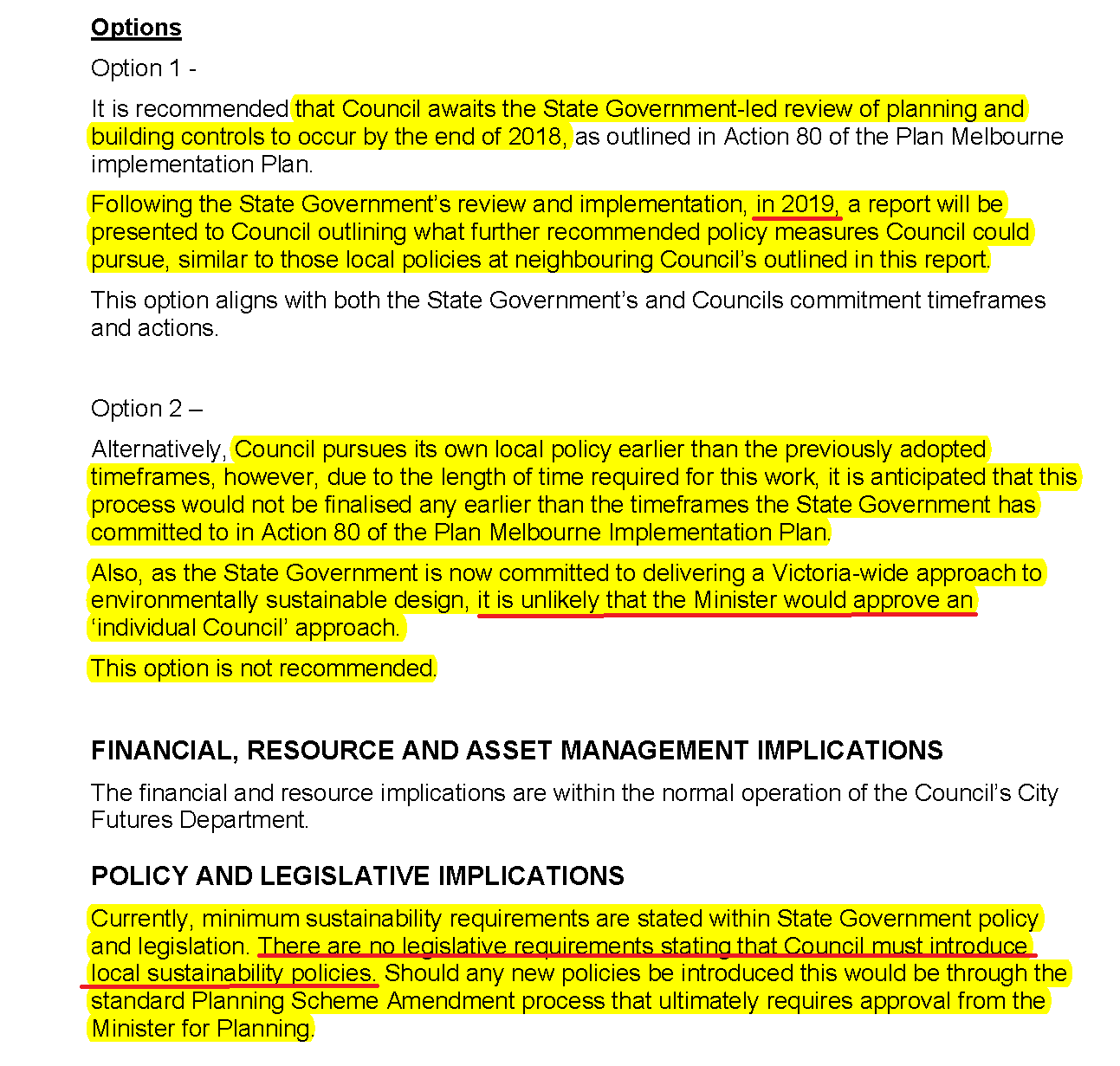
Item 9.8 of the current agenda features council’s approach to Environmental Sustainability. That is, let’s not do anything and wait another two to three years for the State Government to introduce legislation. This ‘recommendation’ is despite all resident feedback on the need to increase open space in developments; to increase permeability and to introduce some decent amendments that will address the lack of any decent environmental measures in the current planning scheme.

We must also point out the complete lack of ‘objectivity’ in the officer’s report. Six metropolitan councils have been successful in introducing their own Environmental Sustainability Design amendments. Admittedly, these expire at the end of December 2017 as noted in the report. What is not noted is:

  • Are these councils seeking to extend their sunset clause?
  • What benefits have already been derived by having policy in place for nearly 3 years?
  • What damage will continue to occur in Glen Eira over the next 3 years whilst this council sits on its hands?
  • What of Water Sensitive Urban Design policies that these councils have with NO expiry date?

Every time that there is the possibility of introducing some new measure to protect the environment, or residential amenity, this council resorts to its old tricks – let’s wait for a couple of years because it is a state responsibility and not ours! Imagine how many more trees will go and how much more concrete will be poured whilst this council does nothing!!!!!!!

Here are the ‘unbiased’ officer recommendations –


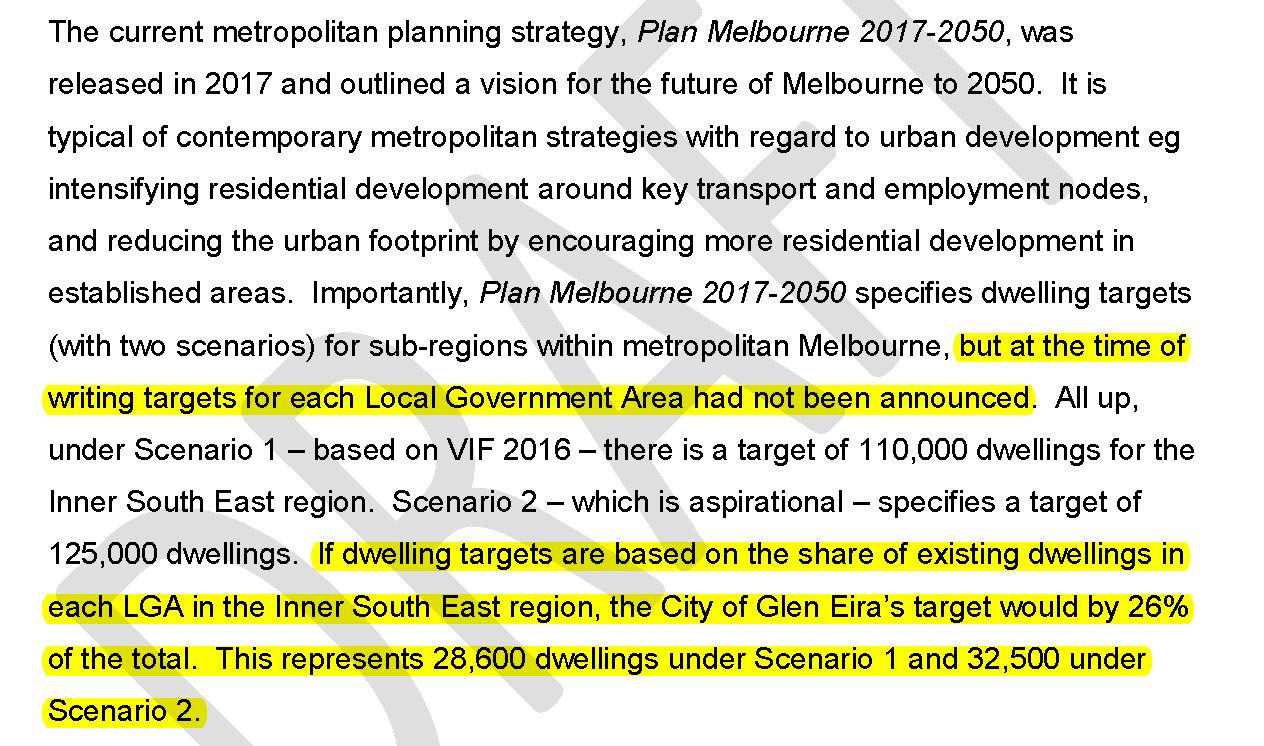
The above image comes from page 93 of council’s commissioned Housing Report. We highlight this paragraph because it illustrates completely how statistics can be used to distort situations, especially when only half of the story is presented.

Both Plan Melbourne and Victoria in Future 2016 are cited, leading to two possible scenarios required  to meet Glen Eira’s population growth – either 28,600 net new dwellings, or 32,500 required dwellings. Thirty two thousand certainly sounds a lot, and is intended to. What readers need to remember is that these figures are projections for the next thirty-three (33) years up to 2050 or 2051. Thus if we are indeed in need of another 32,500 new dwellings, then all Glen Eira has to average is 970 net new dwellings per year! And for the past 5 years this pro-development council has averaged 2000+ per annum – OVER DOUBLE WHAT IS ‘REQUIRED’!!!!!

Why couldn’t the document state this simple fact? Why do residents have to perform some basic arithmetic in order to come up with a scenario that is far more ‘realistic’ and accurate? When put into perspective isn’t the issue that Glen Eira doesn’t need to:

  • Expand its activity centre borders as we suspect will happen
  • Maintain a growth that is double and triple what is required
  • Maintain a growth that increases density per square km that is totally unsustainable
  • Make Glen Eira the development ‘capitol’ of the Southern Region?

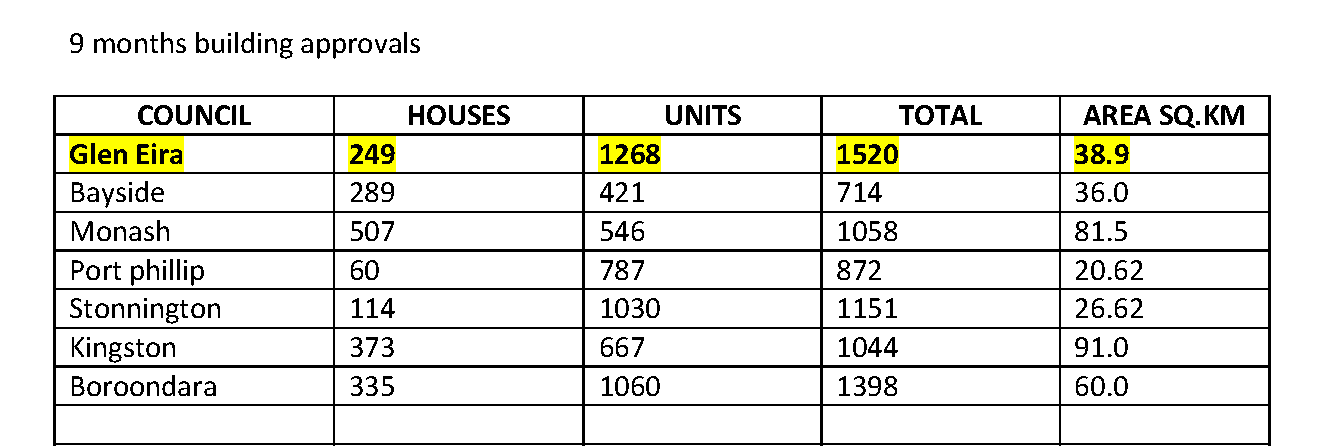
To illustrate all of the above here are the ABS building approval figures up to the end of March 2017 – that is, 9 months of building approvals. At this rate the year’s total will be approximately another 2000 new dwellings.

Residents need to understand that council’s mantra is and has always been to welcome development irrespective of its cost to residential amenity, sustainability, and overall density. Residents also need to demand answers as to why this council isn’t screaming blue murder as a result of Wynne’s recent amendments and why no genuine attempt is being made to rein in development?

Finally, it is also worth pointing out that the very figures presented by Plan Melbourne are highly questionable. Victoria in Future 2016 only shows projections up to the year 2031. Yet Plan Melbourne sites this source as projecting to 2051. There’s also the question as to how Glen Eira is supposed to represent 26% of the required new dwellings when there are only 4 municipalities included in the Inner Southern Region – Glen Eira, Stonnington, Bayside and Boroondara? Surely that’s 25%? Plenty of other stats in all of these documents can and should be called into question.

Thanks to the Stonnington agenda, we now know that the state government’s promise to facilitate social housing is a step closer. We’ve uploaded Stonnington’s submission, plus provided extracts from their officer’s report. Whether or not this will be another example of government policy railroaded through on the back of poorly drafted legislation and with little thought given to the countless loopholes that can be exploited, remains to be seen.

Here are the officer report extracts –

Proposed Planning Reforms

Council was notified on 22 May 2017 that the Minister for Planning is seeking feedback on proposed reforms to the Victoria Planning Provisions to provide permit exemptions or streamline permit application processes for specified accommodation land uses.

Comments on the proposed reforms are due by Friday, 16 June 2017. Due to the short consultation timeframe and the timing of Council report cycles, this provides Council a short time frame to review the reforms and prepare a submission for Council endorsement.

Facilitation of public housing

The Government argues that there is a pressing need to increase the supply of social housing in Victoria. The reforms are intended to help support government policy to replace ageing public housing stock and develop new public housing.

The reforms seek to streamline the planning permit process for the development of no more than 10 dwellings on a lot by, or on behalf of, a public authority such as the Department of Health and Human Services (DHHS). It exempts assessment under Clause 55 (ResCode) and car parking requirements if specified requirements are met. In addition, it exempts an application from public notice and review requirement

Rooming house

The term “shared housing” is proposed to be replaced by the term “rooming house” (a newly defined land use term under Clause 74 of the Planning Scheme) which clarifies that other land uses such as a backpackers accommodation, boarding houses and hostels cannot benefit from the provision. The provision proposes to provide a permit exemption for use and development of land for a rooming house where specified requirements are met supporting the development of ‘domestic scale’ rooming houses under the proposed draft provisions.

The requirements propose limits of 12 persons, 8 bedrooms and a gross floor area of 300 square metres. It proposes to exempt applications by public authorities from public notice and review requirements.

Council is not confident that the draft controls will result in a high level accommodation that is respectful of its neighbourhood character, context or surrounding amenity.

The draft controls propose to provide a reduced assessment threshold to a proportion of Public Housing, Community Care Accommodation and Rooming Houses. This raises concern in relation to whether adequate levels of internal amenity, managing off -site amenity impacts and how successful integration of development within its neighbourhood context will be achieved.

The lower assessment threshold may lead to an increase in such developments, creating a loop hole for the development of sub -standard accommodation if the buildings are retro fitted into private apartment buildings in the future.

It is also considered that the Clauses as drafted will pose challenges in the extent of public notice and review exemptions. The lack of notice and review means that where otherwise affected parties would be able to make submissions, there will not be an opportunity to do so.

The proposed exemption from notice and review may result in a disconnected community and potentially increased compliance expectations on Council

Stonnington’s submission uploaded HERE
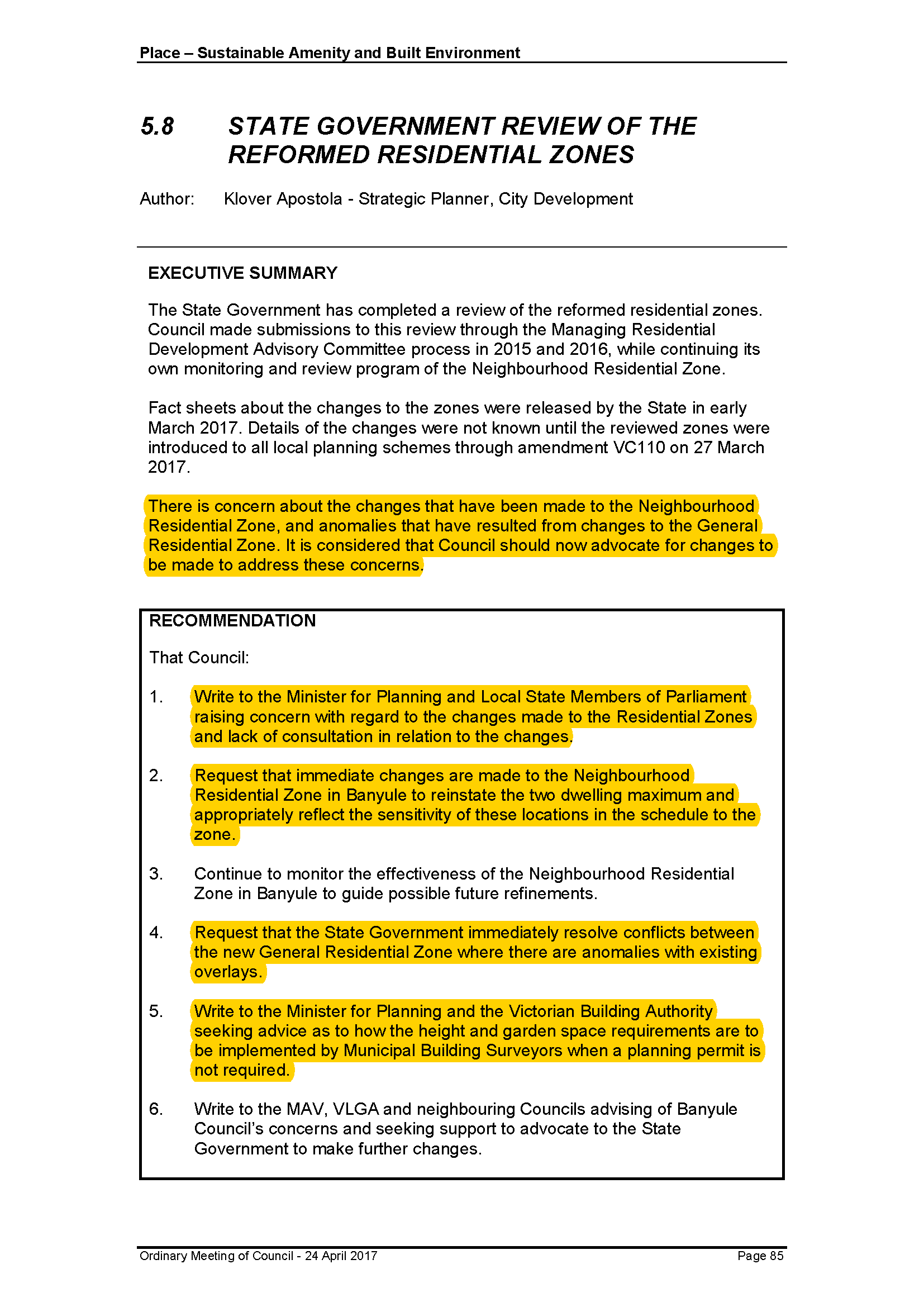
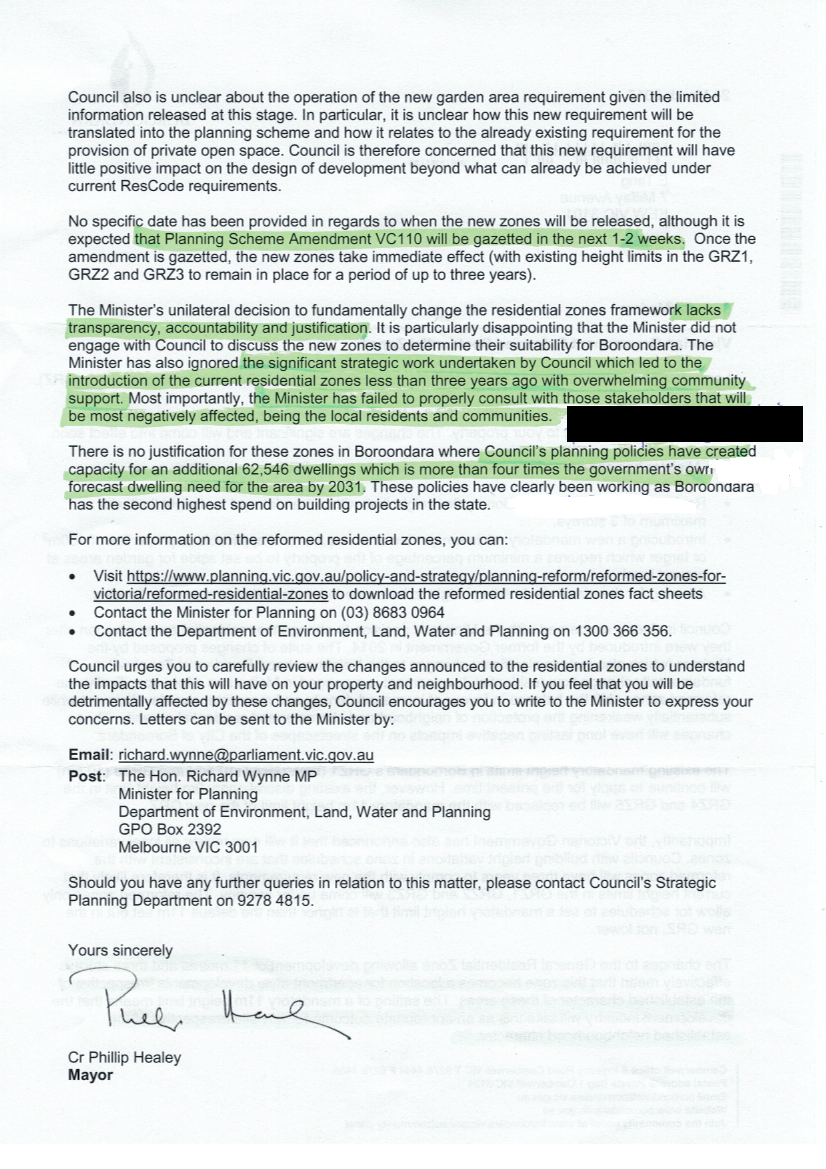
In March 2017, Wynne gazetted Amendment VC110 which is the latest version of the residential zones and the one trumpeted to ‘save our backyards’. Practically every other council has at least put up on its website information about this amendment. Many have included an officer’s report in their agenda papers and some like Banyule and Boroondara (see images below) have voiced strong concerns/objections to the amendment. Glen Eira on the other hand has maintained a stony silence! Not a public peep has come out from any councillor and certainly not from any administrative quarters via a media release, a web page announcement. Nothing but silence! Why? Is this another foray into keeping the public ignorant? Or is it more to do with not wanting to ‘antagonise’ Wynne and the Labor party so that brokered secret deals can go through? How much is politics at play here rather than transparent planning? Why, when after years and years of patting itself on the back for achieving such ‘largesse’ from Matthew Guy (ie mandatory heights, 2 dwellings per nrz) is council now silent when these very ‘achievements’ are about to go down the drain?

And if we are correct, then the rot has already started for the Neighbourhood Residential Zones. An application is in for 76 Bignell Road, Bentleigh East. This is a site in the NRZ of 580 Sqm and was sold in September 2016 for $1m. The application is for 3 attached double storeys! And all is ‘legal’ since March 2017 thanks to Wynne. We therefore urge all residents in both the NRZ and GRZ zones to be on the look out for this new threat to our neighbourhoods – one that council is hoping will slip through unnoticed no doubt! Wynne’s amendment we suggest sits well with council’s long history of a pro-development agenda. Like VCAT it will eventually become the convenient scapegoat for over a decade of appalling strategic planning and gang after gang of complicit councillors.

We will report on the potential impacts of Wynne’s amendment in posts to come. In the meantime, here are some screen dumps from a recent Banyule council meeting and the letter that Boroondara sent out to its residents –

We have received several emails asking us to elaborate on our statement that council will be enlarging the activity centres and thus paving the way for more intense development throughout Glen Eira. This post explains our reasoning.

According to the planning scheme the ‘housing diversity’ areas include all those sites zoned as General Residential Zone, Residential Growth Zone, Commercial and Mixed Use. NO NEIGHBOURHOOD RESIDENTIAL ZONING (NRZ) IS INCLUDED IN HOUSING DIVERSITY. These come under the umbrella of ‘minimal change’ – ie the NRZ zones.The image below makes this clear

Thus we have the current situation where each and every ‘activity centre’ is zoned as either RGZ, GRZ, C1Z OR MUZ. Where these sites meet ‘minimal change’ (ie NRZ) then that determines the border of the respective activity centre.

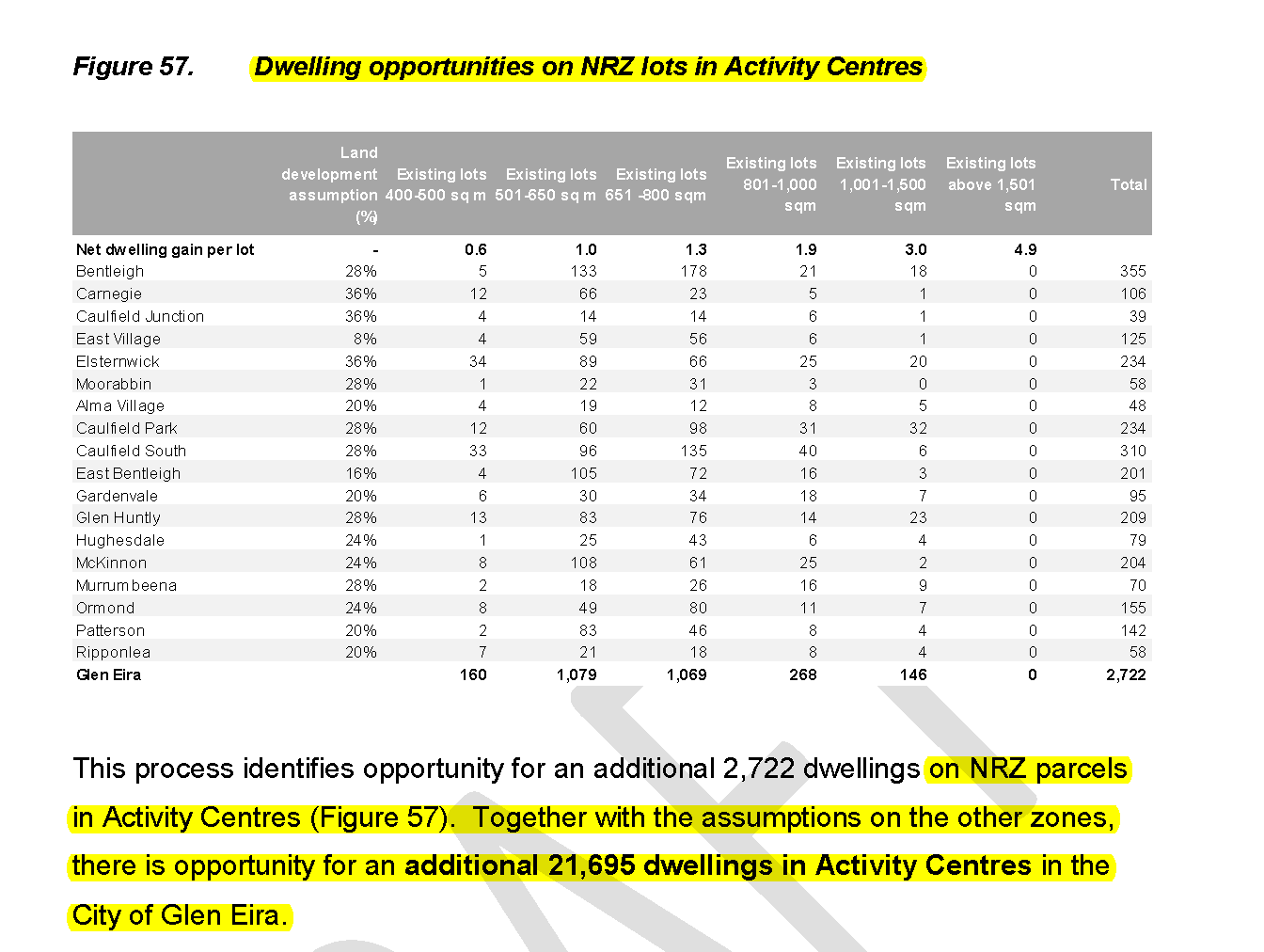
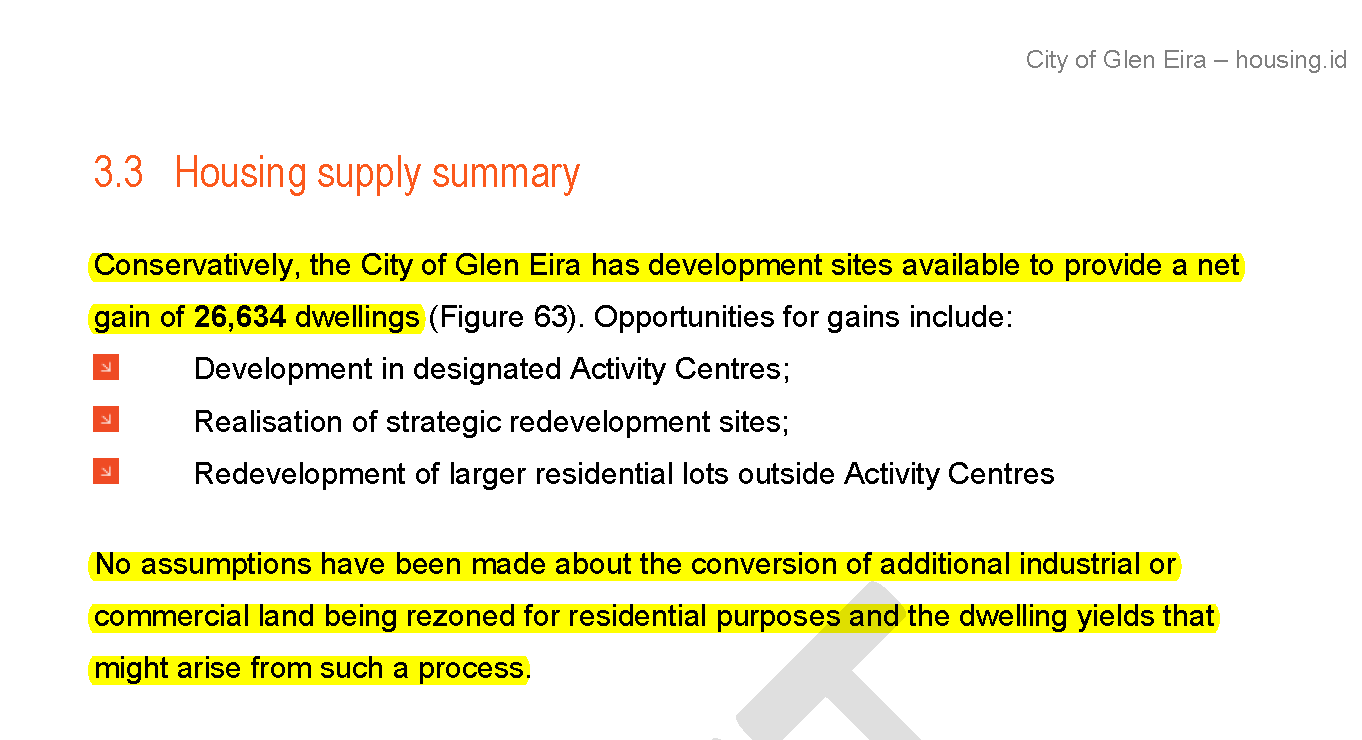
If we are to believe what is written in council’s commissioned housing report, then all this is about to change. Here are a couple of screen dumps from this document which refer to NRZ sites WITHIN ACTIVITY CENTRES! As we’ve stated – there are no NRZ sites in any activity centre. The fact that this ‘research’ is done on this basis can only mean one thing in our view – council will be extending the borders to most activity centres. And once extended we would bet that the classification of these sites will not be NRZ any longer!

Isn’t it about time that council came clean on what it is really doing? How much longer will residents be kept in the dark? And how about council answering the most basic questions concerning:

  • definite time lines
  • what is ‘capacity’ and why do we even contemplate the need for another 20,000+ dwellings?
  • how sustainable is any of this?
  • what is council doing about parking and traffic management?
  • what is council doing right now about amending the schedules to the zones?
  • why can other councils keep working on amendment after amendment and council has done bugger all, except to rezone land for more development?

There can be no doubt that council is gearing up for:

  • Facilitating increased major development throughout Glen Eira
  • Expanding the borders of activity centres

Residents need to question why given:

  • That Glen Eira is already the third most densely populated municipality in the state – only behind Melbourne and Port Phillip – both of which are special cases anyway.
  • That no estimates of infrastructure costs, traffic management costs, etc. have been included in any forecasts
  • No realistic estimates of what Wynne’s new legislation will mean for accelerated development in both Neighbourhood Residential Zones and the General Residential zones. The housing paper we believe fails to adequately account for these changes and their potential for much more development.
  • No realistic estimates of what demands will be placed on open space and how much meeting the most minimalist standards will cost
  • No consultation with residents as to whether or not they are accepting that various activity centres should be able to have a dwelling ratio of over 200 dwellings per hectare! A hectare is 10,000 square metres. If we assume that the average housing block is 500 square metres, this means that 20 houses will be replaced by over 200 in countless residential streets.

Featured below is the more detailed prognosis for our suburbs from council’s commissioned report –

Carnegie – Assumed 36% of developable land in the centre for future residential development of at least 200 dwellings per hectare.

Caulfield Junction (inc. Caulfield Village) – …. it is assumed that 36% of developable land in the centre for future residential development of at least 200 dwellings per hectare.

Elsternwick – development. Assumed 36% of developable land in the centre for future residential development of at least 150 dwellings per hectare.

Bentleigh – Assumed 28% of developable land in the centre for future residential development of at least 150 dwellings per hectare.

Moorabbin – Assumed 28% of developable land in and around the centre for future residential development of at least 150 dwellings per hectare

Murrumbeena – Assumed 28% of developable land in and around the centre for future residential development of at least 150 dwellings per hectare

Caulfield South – Assumed 28% of developable land in and around the centre for future residential development of at least 100 dwellings per hectare.

Glen Huntly – Assumed 28% of developable land in and around the centre for future residential development of at least 100 dwellings per hectare.

Caulfield Park – Assumed 28% of developable land in and around the centre for future residential development of at least 100 dwellings per hectare.

Hughesdale – Assumed 24% of developable land in and around the centre for future residential development of at least 100 dwellings per hectare.

McKinnon –  Assumed 24% of developable land in and around the centre for future residential development of at least 100 dwellings per hectare.

Ormond – Assumed 24% of developable land in and around the centre for future residential development of at least 100 dwellings per hectare.

Ripponlea – Assumed 20% of developable land in and around the centre for future residential development of at least 75 dwellings per hectare.

Gardenvale –  Assumed 20% of developable land in and around the centre for future residential development of at least 75 dwellings per hectare.

Alma Village – Assumed 20% of developable land in and around the centre for future residential development of at least 75 dwellings per hectare.

Patterson –  Assumed 20% of developable land in and around the centre for future residential development of at least 75 dwellings per hectare.

East Bentleigh –  Assumed 16% of developable land in and around the centre for future residential development of at least 75 dwellings per hectare.

We urge all residents to read the Housing commissioned paper and to digest its message. (UPLOADED HERE). Query the assumptions! Query the figures and finally query the (secret) agenda! We will be doing this in future posts.

There was a very, very good turnout at tonight’s forum. We estimate approximately 85-90 residents. Also in attendance was Mr Steve Dunn acting CEO of the VPA (Victorian Planning Authority) and some of his colleagues.

The evening was again facilitated by Ms Nathan. Following her introduction which assured residents that nothing was ‘set in concrete’ and that everything was on the table, Aiden Mullen from council presented the results of the previous survey and council’s plans for further community input. This was followed by Mr Dunn’s presentation where he outlined the role of the Victorian Planning Authority and also provided overheads of the work they have done thus far – eg. several projects in Bundoora (3000 dwellings on a 104 hectare site and another one (Polaris) which has 1100 dwellings on 12 hectares). Interestingly all the slides of development presented by both Mr Mullen and Mr Dunn did not show any buildings of higher than 4 or 5 storeys for the latter and 3 storeys by council!

The audience was then asked to discuss at their tables the ‘vision statement’ and to answer the following questions:

VISION STATEMENTEast Village will be a thriving, mixed use precinct with a focus on employment, innovation, education and housing affordability

THE QUESTIONSDo you agree with the vision? How would you change it? What would the table’s vision be? (10 minutes).

What are the tables 3 priorities to include in the structure plan in order to achieve this vision? And how?

RESPONSES

Each table then reported back to the entire audience on their discussions. We summarise the major points below:

  • Problem with language – people did not know what ‘innovation’ referred to – far too vague.
  • More clarity required about the term ‘affordable housing’ and this should be changed to ‘diversity of housing’
  • Questions about what ‘village’ means and is this a ‘village’
  • Traffic and car parking are major problems
  • Desire for low rise townhouses. Some tables nominated a maximum height limit of 3 storeys and others up to 6 storeys.
  • Diverse views on the need for another school and whether this should be part of McKinnon High or another new school entirely.
  • Open space that wasn’t covered over in concrete
  • A new supermarket required but also not a threat to other existing businesses in the area.
  • No waiving of car parking spots
  • Environmental sustainability across the entire centre including flood mitigation

COMMENTS

How useful an evening like this has been remains to be seen of course. It will largely depend on how many of the above comments find their way into the final structure plan. In other words to what extent is government, council and the developer listening to the locals? Will we have maximum height limits of 3, 4, or 5 storeys? Will we have open space that is more than a ‘village square’ surrounded by high rise? Will we have 2, 3, or 4000 apartments and only a handful will be categorised as ‘affordable/social housing’? Will the traffic mayhem of North and East Boundary Roads be fixed by appropriate infrastructure? Will an entire new school really happen and how big will it be? Will retail offer fair dinkum employment opportunities or are we going to get employment as slave labour (ie kids) working for McDonalds and supermarket check out staff? What carrots will be dangled in front of major companies to come to Virginia Estate and will this cost ratepayers anything? What is the appropriate percentage mix of retail, to housing, to industry/offices – 50/50? 70/30? Who decides – the market, council, state government?

There are literally a myriad of unanswered questions and in our view a vision statement as presented above does not clarify anything. The questions that go with the vision statement are also far from ‘objective’. They are there to simply endorse the ‘vision’ rather than to really elicit knowledgeable commentary from residents.

PS: not one councillor was in attendance that we saw!

PPS: it has now been months since talk of establishing a ‘community reference group’ to work with council on the East Village project. Thus far – silence! Will this group eventuate and if so will it be when all the planks have already been set in stone?

Council is wonderful in producing stats that sound scary and ostensibly support their case. More often than not, these stats tell only half the story. For example this paragraph from the Activity Centre Strategy  –

State Government statistics indicate that over the last five years (2011–2016), Glen Eira has experienced significant change with a population increase of 11,233 and 4,300 new dwellings constructed (page 147)

Or this effort –

Recent statistics released by State Government (Victoria in Future 2016) indicate that Glen Eira’s population is likely to increase by a further 15 per cent over the next 15 years, resulting in the need for an additional 9,000 dwellings.(page 159 and repeated in the glossy section at page 22).

So exactly what do these figures mean? 9000 new dwellings sounds like a hell of a lot and is meant to – but this is over a projected 15 year period. Hence all Glen Eira requires to meet its population growth according to these figures is a measly 600 net new dwellings per year! Hardly enough to justify the strategy and its ambition to hand over more and more land to developers.

Nor do these figures take into account what has been happening in Glen Eira for the past 5 to 6 years. Australian Bureau of Statistics data on building approvals provides a window into the rampant development that has already occurred. Building approvals are development applications that have already received their permits and have been given the green light to begin construction. Here are the ABS figures for new dwellings –

2011/12 – 912

2012/13 – 957

2013/14 – 1,231

2014/15 – 1,786

2015/16 – 1,680

2016/17 – 1520 (end of March 2017)

TOTAL – 8086

This figure of 8086 new dwellings DOES NOT INCLUDE:

  • The 1200+ new dwellings for Caulfield Village which have already been granted their ‘permits’ via the approved Incorporated Plan and various Development Plans
  • Another, 2000, 3000, 4000(?) potential apartments for Virginia Estate.
  • Nor does this figure of 8086 include all the permits which have been granted but are yet to be taken up and construction started (and hence are still awaiting their building permits)
  • Set down for decision Tuesday night, we get the recommendation for another 87 new dwellings! The meeting before, 18 new dwellings plus refusal for 169 which will end up at VCAT and in all likelihood get at least half of this number. These would not have been added to building or planning permit state registers as yet. Thus, in two council meetings we have just under another 200 net new dwellings in Glen Eira. Go back a couple of more council meetings and the picture is the same.

So what is the take home message for residents?

  • At the current rate of development, Glen Eira will be able to cater for projected population growth NOT IN 2031 BUT BY 2021!
  • 600 net new dwellings is the required ‘quota’ per year according to all recent projections. Glen Eira is averaging close to triple this amount per year.
  • Given the above, WHY IS THIS STRATEGY DETERMINED TO INCREASE DEVELOPMENT AND WHY THE SECRECY ON HOW RESIDENTIAL AMENITY IS TO BE PROTECTED?

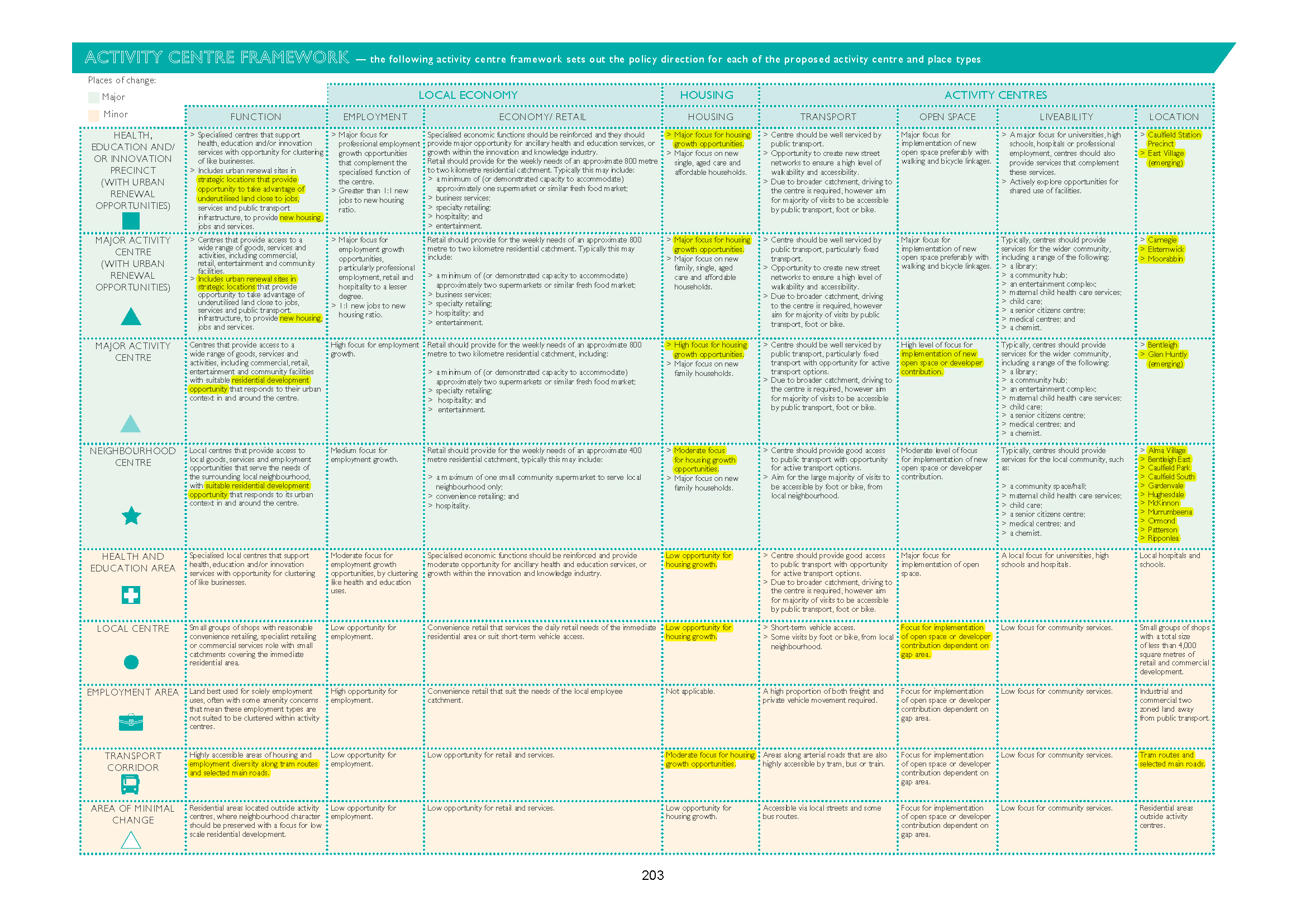
By way of summary, here is what the strategy wants to happen in order to facilitate further development. This may sound innocuous and to be merely repeating the current mantra of housing diversity versus minimal change and thus directing development to ‘appropriate’ spots. It is the extent of expansion, the vague references to ‘strategic sites’ plus ‘arterial roads’ and the upgrading of local centres to neighbourhood centres, or neighbourhood centres to major activity centres that is the concern.

CLICK TO ENLARGE – Couldn’t council have produced a far more legible document that could be read clearly without the need for a magnifying glass?

Council has finally released its draft Activity Centre Strategy. We are left speechless at both the quality and the deliberate camouflage of council’s intentions. Not only is the document a vapid, repetitious , and totally uninformative vision of the future but it lacks everything that an Activity Centre Strategy should include. For example:

  • No detail on proposed height limits
  • No detail on proposed building form
  • No detail on proposed open space requirements
  • No definition as to what ‘urban renewal’ really means
  • Plenty of promises that largely repeat the promises made in 2003/4 but without any timelines
  • Statistics that are wrong, wrong, wrong!

Worse still is the tone! Lack of detail is one thing, but when a strategic document of this importance includes the following rubbish it is totally unacceptable. We quote directly from the strategy and invite ‘interpretations’ as to the true meaning of any of these sentences –

As our local centres become more affected by globalised and mobilised markets, it becomes more and more important to create community rich experiences within these centres that cannot be bought online

Explore opportunities to facilitate local flexible working opportunities such as co-working spaces or expanded library areas.

Strategically locate future parcel pick-up stations and other digital transactions facilities within activity centres that encourage community interaction

Strengthen the heart of the community

Foster ‘bottom-up’ change through a focus on place-making.

Ensure key community needs are provided in each centre (such as banks, post office, grocers, butchers and bakers). (Please remember that council has no control over banks, post offices, nor private retail!!!)

Housing capacity and building scale can be separated from activity centre hierarchy by clearly identifying housing typologies that can accommodate growth in strategic locations that respond to their immediate context and neighbourhood character, and also reduce impacts on amenity.

We also have succinct vision statements for each centre that belong to the world of Forrest Gump or the Wizard of Oz, rather than a local government strategic document. Here is the ‘summary’

We acknowledge that Plan Melbourne has foisted some conditions onto council – ie Caulfield Junction as a Major Activity Centre, plus Moorabbin, etc. However, this does not excuse the production of a document that is full of meaningless waffle and motherhood statements, plus similar promises to what has been made and not been acted upon in the past 15 years! It is surely time that council comes clean and informs its residents in a straight forward and honest manner exactly what it proposes! We would also welcome a submission period of longer than the 3 weeks indicated.

Finally, by way of contrast, we have to again bemoan the fact why  other councils can do things so much better and with so much more clarity, and dare way say, honesty! Here are a couple of Activity Centre Strategies from other councils. Please compare and contrast!

STONNINGTON – UPLOADED HERE

MORELAND – UPLOADED HERE

Finally some potential action on flooding and the Elster Creek catchment area! But what is so disappointing is that residents have to find out about this initiative not from their own council, but from the agenda items of Port Phillip! Given that the first meeting occurred in March, that surely provided enough time for some Glen Eira Council comment, or even a media release. Instead there has been silence.

This will also have major significance for Glen Eira which is ‘home’ to about 70% of the Elster Creek catchment – and that includes the upcoming Virginia Estate development. How much this will all cost the individual councils remains to be seen. But wouldn’t it make a great change for once if residents were informed as to what was happening and the likely costs – instead of being always kept in the dark like mushrooms!

We’ve uploaded the full Port Phillip officer report HERE

« Previous PageNext Page »