GE Consultation/Communication


Hyams moved an amendment to accept the recommendations plus, to ‘include meaningful engagement’ with the community to be part of and ‘not following’ the draft structure plan. Taylor seconded.

HYAMS: began by saying that even though the recommendations as ‘set out in the report’ are ‘intended to be pretty thorough’ it recommends community consultation ‘on the master plan’ or structure plan ‘afterwards’. ‘My view’ is that ‘residents’ should have a say in the drafting of the structure plan. Said that ‘this would have happened anyway’ because that was what ‘council intended to do’ and ‘it’s better to have that clarified in the report‘. Called this a ‘great opportunity’ for Glen Eira because it is a ‘massive site’ and they intend to use this as an ’employment hub’ with retail plus residential. That’s ‘what we’re allowed’ by the planning scheme. Hyams went over past history – the first amendment which rezoned part to Commercial and the second application for amendment which proposed many residential premises and a ‘supermarket’ and council thought this wasn’t ‘appropriate’ for the site because ‘it didn’t do what we wanted it to’ as an ’employment hub’ and also ‘competed too much’ with other retail in the area. ‘So what we’re looking for here is something along the first lines’ (ie employment hub) but it’s a ‘huge site’ with many ‘possibilities, so it will be very complicated’ and that’s why the VPA is being brought in ‘to assist us’. Said that ‘all final decisions’ will ‘rest with council’. ‘We will direct the consultation, we will still make the decision’ but the VPA ‘will be using their greater expertise’ in ‘producing the best outcome for Glen Eira’. Apart from the consultation ‘which will be going on throughout’ the applicant can still put in their amendment planning scheme application. This will go through the ‘normal processes’ of submissions, panel if required, and ministerial approval. Summed up by saying that right through the process ‘there will be a great opportunity’ for people to ‘have input all the way through’. ‘Noted’ that the ‘current landowner has been a lot more consultative’ and ‘friendly’.

TAYLOR: began by saying that it is ‘absolutely a given’ that there is ‘full and transparent consultation’. Wanted to ‘reassure’ those people who had rung her and that it ‘doesn’t hurt to spell out’ the ‘continuous involvement’ of the community. ‘We genuinely want you to have a say’. ‘We are all members of this community’ and everyone has ‘something to offer here’.

ATHANOSOPOULOS: said that ‘everyone agreed’ that they need to ‘establish some key partnerships’ and this is ‘just an example of us doing that’. Said that if they are going ‘to deliver’ a ‘great’ development then they need to ‘consider the residents’, ‘housing responsibilities’, ‘educational responsibilities’ and overall ‘responsibilities for the whole of Glen Eira’. Said the developer’s ‘initial process’ was ‘railroaded through’ and they’ve realised they haven’t done a ‘good job and come back to us’ and ‘engaged with the community’ plus traders and others. Thought it was important that council establish partnerships ‘especially with resources being limited’. Vital that council be the ‘leader’ on this. Said that the ‘community has been screaming out’ about the site and this is the ‘first opportunity’ ‘for us to actually go ahead with this’. Said the most important point is that he has put forward a ‘recommendation’ based on a resident’s comment to ‘establish’ some form of community group ‘that does feed us, the council information as this project goes on’.  The makeup of the group is ‘unknown, maybe a couple of residents’, ‘community leaders’, etc.  This will ‘bounce ideas’ and ‘get a feel for what the community wants’.Said it was a good ‘opportunity for us to establish something like this’.

DELAHUNTY: asked the CEO to ‘explain’ what the VPA was.

MCKENZIE: said this is a recent extension of the Metropolitan Planning Authority and has a ‘role in providing guidance’ for major developments especially in new suburbs and ‘in creating jobs’. Council has ‘already committed to’ a huge program of strategic work and by forging this ‘partnership’ this ‘enables us to carry on this program of work in parallel’ with the other projects on structure planning. This ‘doesn’t derail’ the existing program but allows them to ‘carry on’ and to ‘deliver a cost saving to council’ and to ‘draw on specialist expertise’ – particularly on retail development and development contributions. ‘Council would retain the decision making role’ and ‘lead and take ownership’ of the ‘community engagement element of the project’.

MAGEE: said this has ‘come a long, long way’ and now there is a ‘far better approach’ than what happened in 2013. In 2013 one of the recommendations was to rezone all the site to Commercial and without community consultation. Said that council learnt of this via the department and the local minister and local member of the time supported this. The proposed structure planning now ‘is certainly the right way to go’ and ‘the approach now (by the developer) is totally different’. They have held a ‘number of community consultation meetings’, ‘poorly attended, but that’s our fault, not theirs’. Said that the ‘Minister likes the VPA’. ‘They are ‘experts in doing structure plans’. Thought that an application would come in this year for a ‘planning scheme amendment’ which could be ‘simple’ and asking for the ‘whole site’ to be Commercial 1. With Commercial you can ‘put residential, commercial and mixed uses in’. The VPA will ‘assist council in putting together a structure plan’ and at ‘all stages will talk with our community’. The community has to ‘understand’ what is going to happen on the biggest site where ‘we all live’. ‘This is a huge site and it has huge implications’ so even though ‘I welcome the new approach I’m still wary of what happened in 2013’. ‘Once this decision is made it will never be reversed’. He hopes that as councillors ‘we will drive past something that we are proud of’. ‘Concerned that we cannot get this wrong’. Welcomed the VPA involvement and community consultation but ‘don’t come at the end and say you don’t like what’s been written’. ‘Don’t say you didn’t get an opportunity’ to have a say.

DELAHUNTY: said she ‘welcomed this’ and it ‘allows us to get on’ with the program of planning and ‘adds to the resources of the council’. Last effort had mistakes by applicant and ‘this allows us to better formulate community engagement’ and the suggested reference group is ‘an interface between council and the community, not between the community and the applicant’ and ‘does add to our ability to take different views’. ‘This is worth being done properly’ and is exactly what council should be doing in ‘bringing in extra resources’.

MOTION PUT AND CARRIED UNANIMOUSLY
PS: Last night’s meeting was largely all about planning and ‘consultation’. It is a continuing shame how incompetent planning is in Glen Eira when we find (finally) an admission that Council with its proposed interim height amendments (ie Amendment C147) was nothing more than a knee-jerk reaction and a pretense that it was ‘listening’ to the community. It is no wonder that Minister Wynne has refused to gazette these amendments.

We draw readers’ attention to the following paragraph from a VCAT decision where the member granted the applicant a permit for an 8 storey building in Rosstown Road, Carnegie. It shows clearly how – (1) residents have been conned – again, and (2) the quality of council’s planning department, plus (3) why must such information be discovered from third parties and not directly from council itself? Here is what the member stated in his judgement –

Fourthly, I choose to give limited weight to Amendment C147 to the Glen Eira Planning Scheme which seeks to apply a Design and Development Overlay to the review site, which will apply a discretionary height limit of six storeys. The proposed height limit is discretionary, so it does not preclude the consideration of a well designed eight storey building on the review site. Further, in response to my specific question, I have been informed by Council that there is no strategic work that underpins or informs the proposed height limit of six storeys. If such strategic work did exist, and had been adopted by Council, it may have provided me with some understanding or basis on which to further consider whether a reduction of height is appropriate for the review site. In the absence of any such strategic work, I am left with what appears to be an abstract proposed discretionary height limit, which I can only presume is based on the aforementioned development at 2 Morton Avenue, and which is not a seriously entertained planning proposal.

Source: http://www.austlii.edu.au/au/cases/vic/VCAT/2017/158.html

++++++++++

Here’s a summary of how the voting went at tonight’s council meeting – plus a few ‘highlights’.

Ormond Road Eight Storeys – Council will be supporting 8 storey mandatory height limits

Virginia Estate & Victorian Planning Authority – Council will forge ahead with the ‘partnership’ and hold ‘community consultation’ earlier.

Cr Silver distinguished himself by stating that he does not support social housing in Camden Ward.

Council will not be seeking to amend its local law on meeting procedures until at least 2018/19 when the current sunset clause for the law kicks in. Remarkable we say, given that emasculating the public question component of the local law was done so easily and on the whim of Lipshutz, Hyams and Esakoff in particular.

Caulfield Racecourse Trustees have signed the resignation paper but there is a hold up since the question of leases is yet to be finalised. We wait with bated breath!

The details of the above will be forthcoming in the next few days.

From feedback received thus far it appears that resident concerns over the ‘partnership’ between Council, developer and the Victorian Planning Authority, are either not being understood by some councillors, or these concerns are seen as unnecessarily ‘alarmist’.

When the largest ever development is about to occur in Glen Eira, we maintain that community input, from the very start is essential – and not when a draft structure plan has already been devised and to all intents and purposes, probably set in concrete. Any ‘visioning’ must include residents from the start and their involvement must be ongoing throughout the entire project.

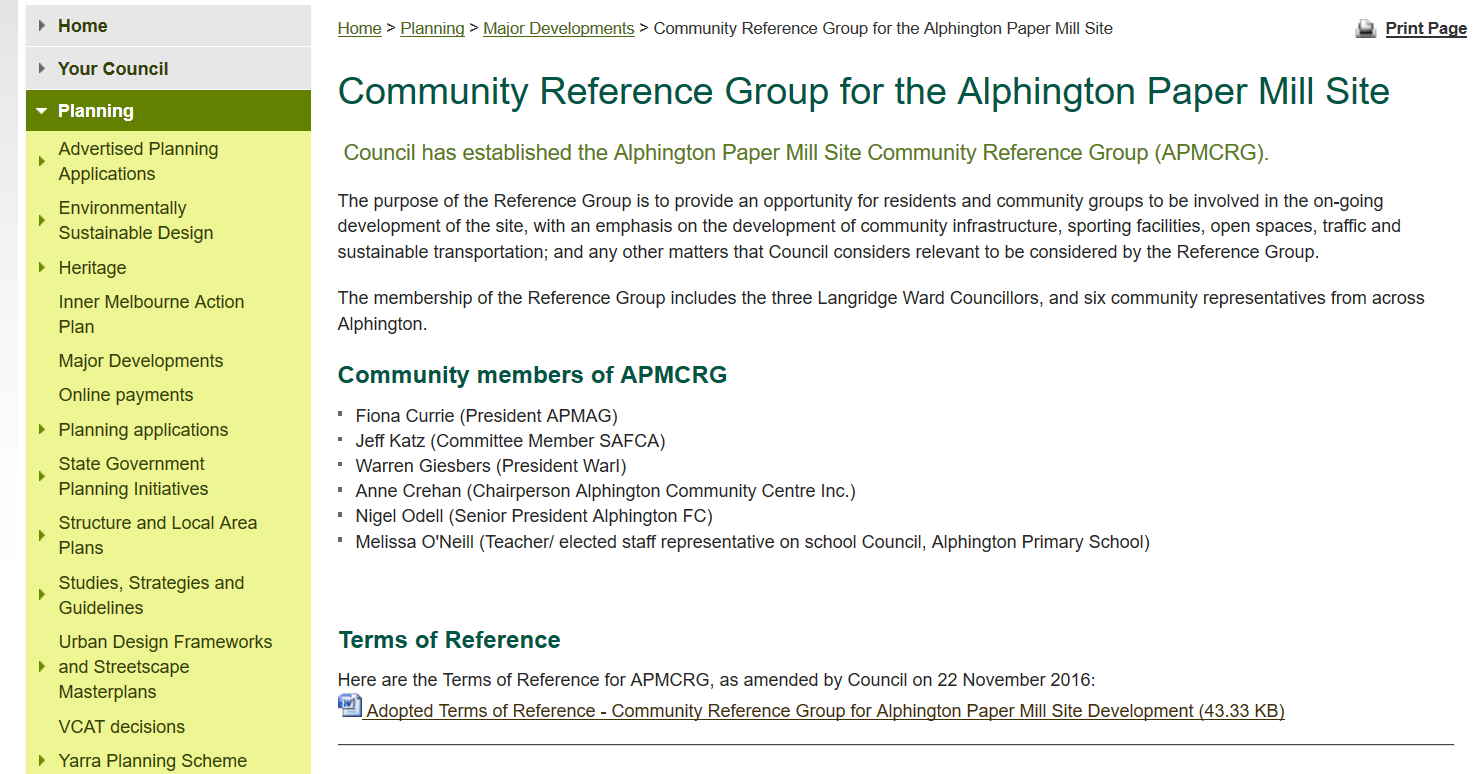
In the current agenda papers, one officer report notes the large development at the old Amcor site. Yarra City Council is one model that should be employed for the Virginia Estate development. Yarra had no problem in establishing a ‘reference’ committee right from the start that included 6 community reps. Yarra had no problem in holding regular meetings where residents through their representatives could bring up issues. This is not rocket science. It is the basis of an inclusive council that sees its residents as partners. If the current mantra of council is to be believed then the establishment of such a group is essential!

Here’s the Yarra Council blurb for this committee –

yarra

We’ve also uploaded HERE, the relevant Terms of Reference for the committee.

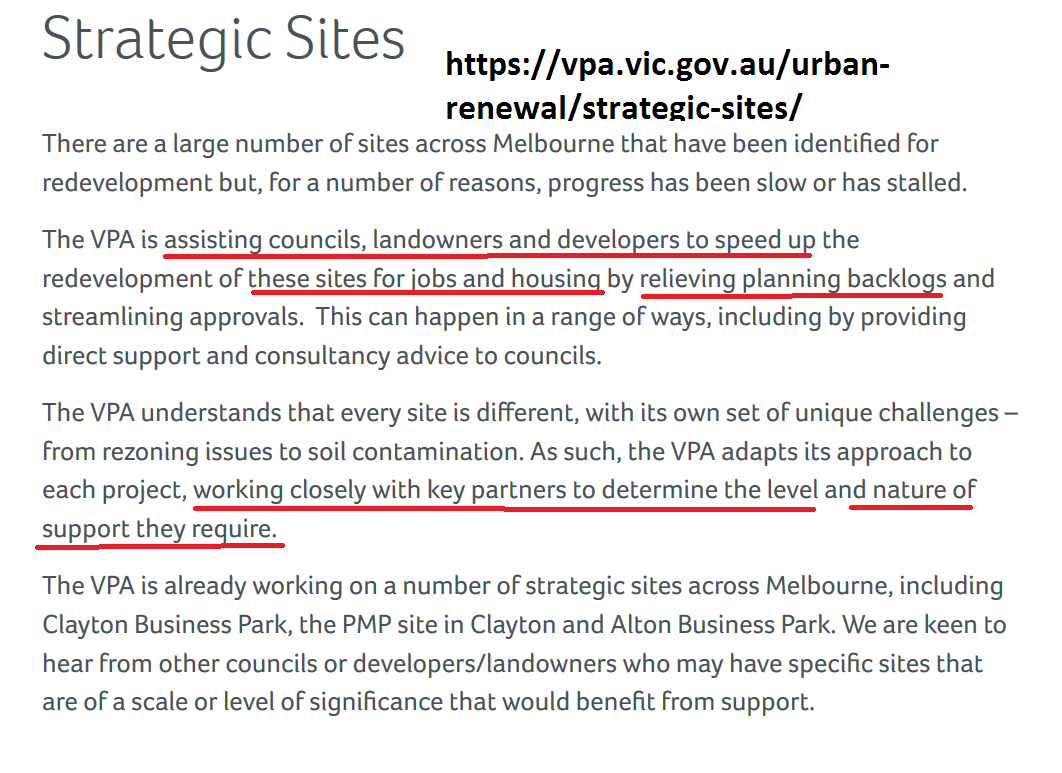
The plans for the development of Virginia Estate have taken a new turn with the proposed ‘partnership’ between council and the Victorian Planning Authority (VPA). This government body is primarily charged with the responsibility of overseeing ‘urban renewal’, especially in growth areas. They are also involved with large development sites within the metropolitan area such as the Monash/Clayton precinct and now East Village. Here is what their brief states –

redsites

All of the above would indicate that government, developer and council are keen to push through rezoning and amendments that will set the ball rolling for Virginia Estate. There is no doubt that at the latest stated figure of 24 hectares, Virginia Estate will be developed, and a very large component will feature residential accommodation. What concerns us is the role that the community will play in this development. The letter from the VPA, included in the agenda, outlines a brief timetable schedule. Please note carefully the following:

  • The time frame for the ‘delivery’ of a draft structure plan for the site is basically 3 months. Yet, the officer report keeps insisting that this will be part of council’s review of its ‘activity centre strategy’ – not due to be completed until 2018 at the earliest. Thus, what porkies are we being fed?
  • Why aren’t the community involved right from the start instead of having the draft structure plan thrust down their throat and then asked to comment? We all know what this means and how little is changed once the ‘draft’ of anything is completed.
  • Why does the officer report emphasise ‘business’ and ‘residential’ barely rates a mention?

We’ve uploaded the proposed schedule. Clearly discussions between government, developer and council have been ongoing for some time given this timeframe. We’ve also uploaded the full agenda item (HERE) so readers can see for themselves the lack of real detail provided.

vpa

In conclusion, VPA does have a role here and council is undoubtedly better off financially if much of the cost comes out of government and developer coffers. What we are concerned about is the level of genuine consultation with the community and whether development gets the go ahead well and truly before infrastructure, transport, etc. is completed.

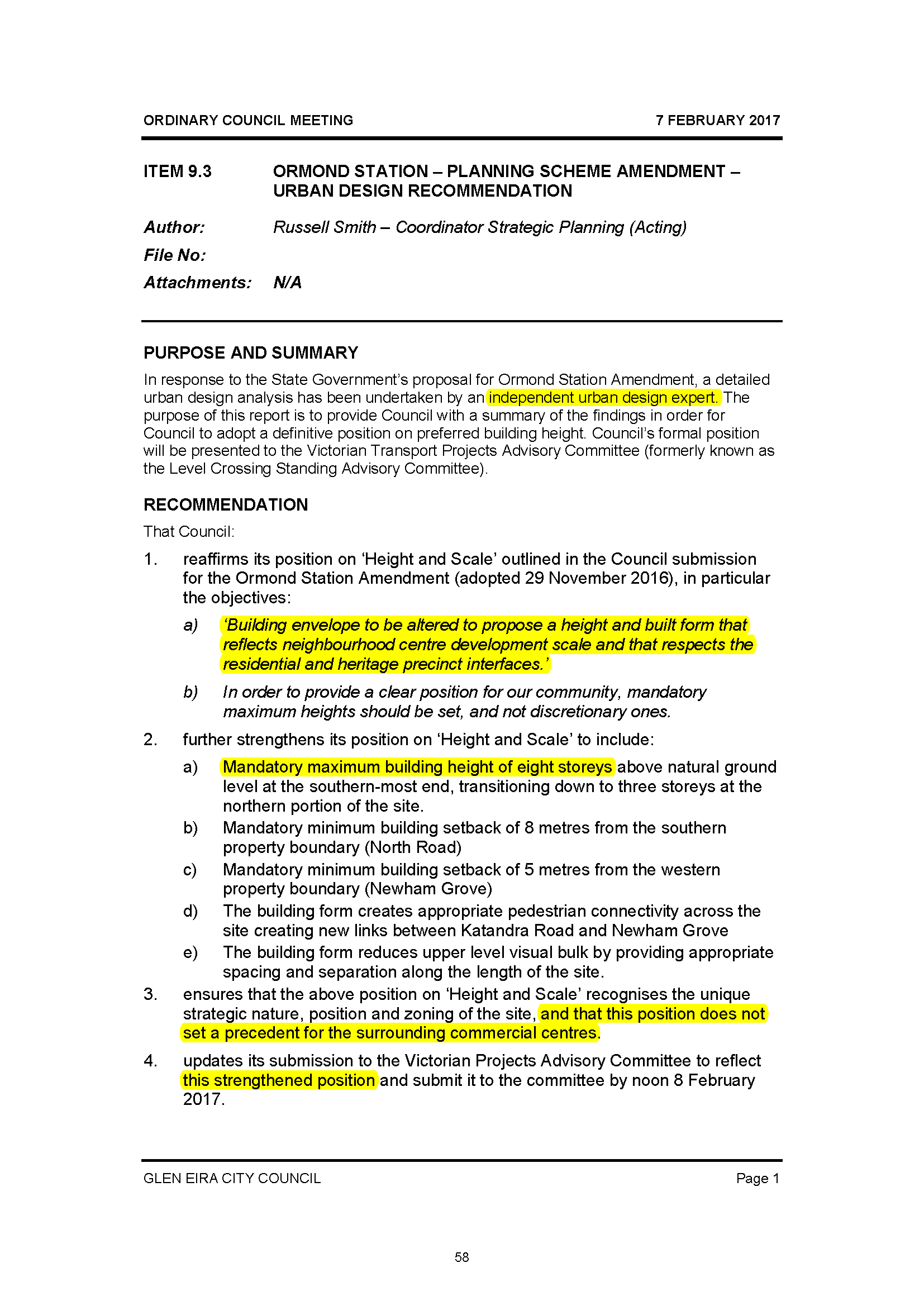
There are 3 agenda items down for decision this coming Tuesday which should set alarm bells ringing for residents. In this first post we concentrate on Item 9.3 – Council’s ‘position’ on the Ormond Railway development site.

What is absolutely staggering about this report and its recommendation is that councillors ENDORSE A MANDATORY HEIGHT LIMIT OF 8 STOREYS!

This is staggering for the simple reason that it exceeds the proposed heights of 7 storeys in Carnegie and 5 storeys in Bentleigh that were nominated in the proposed Amendments for these activity centres. Thus we now have the ludicrous situation where a so called ‘neighbourhood centre’ with less shopping areas and surrounded by residential development is okay for 8 storeys and Carnegie and Bentleigh are deemed suitable for lesser height. Unbelievable shonky planning !

What makes matters even worse is that this recommendation by the ‘experts’ is not even in the public domain. Hence we have the situation where residents are denied access to the rationale which would support a recommendation of 8 storeys. So much for transparency and accountability!

Further, we are told in the officer report  that: In order to form the strongest position possible, City Futures (ie Council) have sought an evidence-based approach to inform Council’s position for a preferred maximum building height. And what is this ‘evidence based’ data on? According to the report it consists of the following –

  • Status of centre
  • Precedents
  • Typology
  • Street wall ratio
  • Solar Access
  • Key View lines
  • Transition
  • Connectivity

We posit that none of the above is ‘evidence’ for an 8 storey apartment block. It might as well be 10 or 12 storeys! Nothing here would suggest that the following important issues have been considered – open space, infrastructure, parking/traffic, development in the area, retail business study, etc. etc. If this is the basis upon which such major decisions are being made, then God help us!

Even worse, is that once again there has not been a single round of ‘consultation’ between residents and council on how high anything should be in the municipality! The rhetoric is all about ‘consultation’. Pity that words never seem to match actions and decisions!

pages-from-02-07-2017-agenda

Figures detailing the number of net new dwellings granted permits for the second quarter of the 2016/17 financial year has just been published. Glen Eira continues to quadruple what is stated as required with a yearly average of 2000+ net new dwellings. We remind readers that the 11,000 dwellings required to meet population growth by 2031 will be reached at the latest in 2020 at this rate!

Unfortunately the complete data for Port Phillip, Bayside and Stonnington is not available.  Even if the data were available we remind readers that both Port Phillip and Stonnington are ‘special cases’ in that the former is a major tourist centre and hence it has several ‘capital city’zonings. Stonnington, according to the State of Play Reports has over 10% of its municipality zoned as commercial and development is concentrated in these areas. Glen Eira has a bare 3% of its land zoned as Commercial. In Glen Eira development occurring in the commercial areas is minimal, compared to the damage done in local residential streets zoned as GRZ and RGZ and yes, even NRZ.

Based on these figures alone, there is no reason why the zones cannot be reviewed and the extent of GRZ and RGZ areas reduced. If council is serious about implementing structure plans that take account of resident views, then the borders of the so called ‘activity centres’ and their respective zoning must be the foundation of any such review.

Here is the data and please keep in mind the question of ‘density’ when municipalities such as Monash, Kingston, Manningham, etc are double and triple the size of Glen Eira. What impact does 2000+ new dwellings per annum have on density, infrastructure, open space, traffic and transport on a municipality that is only 38.9sqk in comparison to these other councils?

untitled

PS: Some developer Xmas presents –

23 Koornang Road CARNEGIE – Construction of a fifteen (15) storey building comprising ground floor retail and eighty-six (86) dwellings above basement car parking, reduction in car parking and bicycle requirements and waiver of loading bay requirements

277-279 Centre Road BENTLEIGH -Construction of a nine (9) storey building comprising ground floor retail and seventy-two (72) dwellings above basement car parking on land adjacent to a Road Zone Category 1, Use of the land for accomodation (dwellings) and reduction of statutory car parking requirements

348-352 Centre Road BENTLEIGH -Construction of an eight storey building comprising ground floor retail and thirty (30) dwellings above basement car parking on land adjacent to a road zone category 1 and affected by the special building overlay, use of the land for accomodation (dwellings), reduction of statutory car parking requirements and waiver of loading bay requirements

+++++++++++

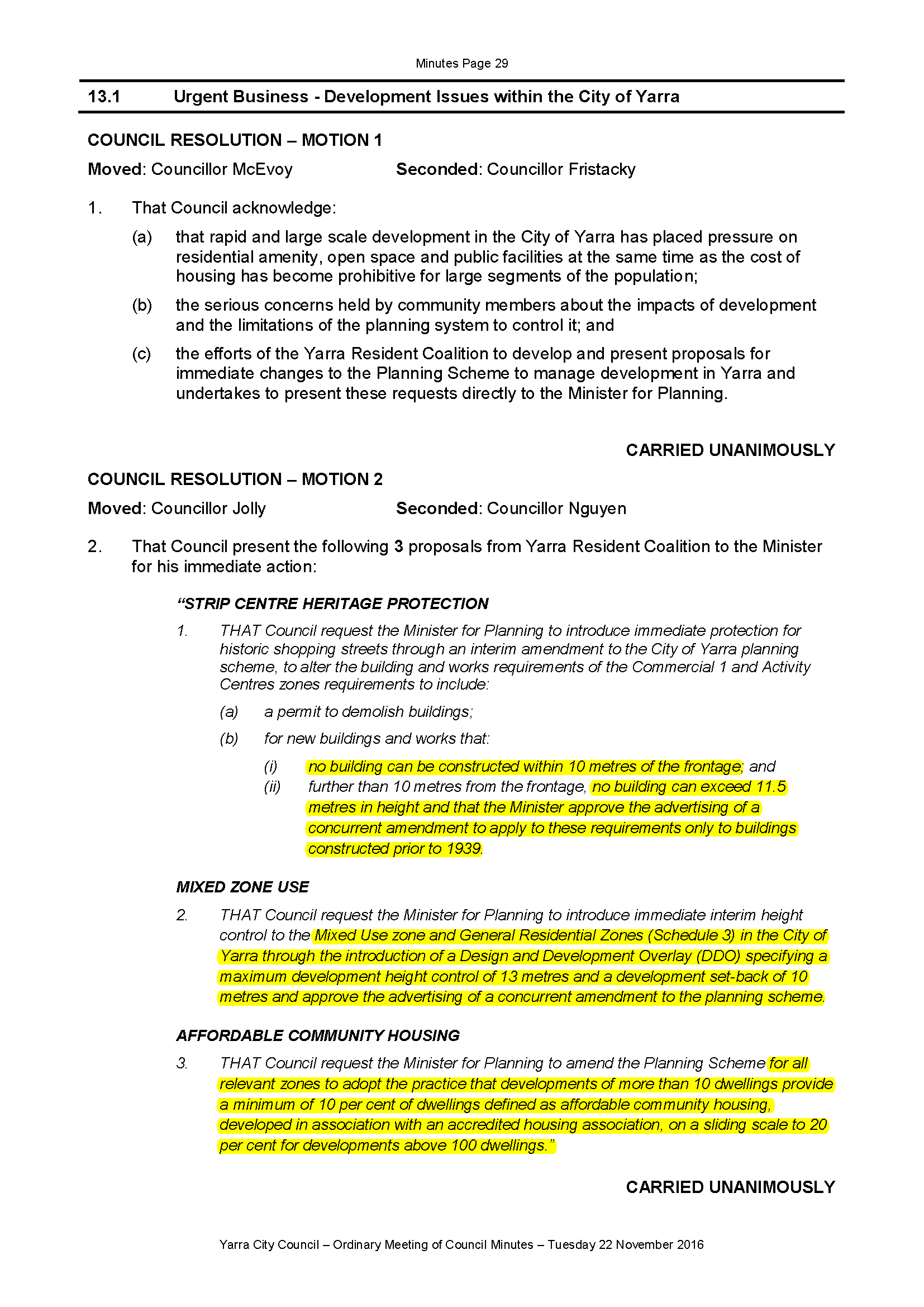
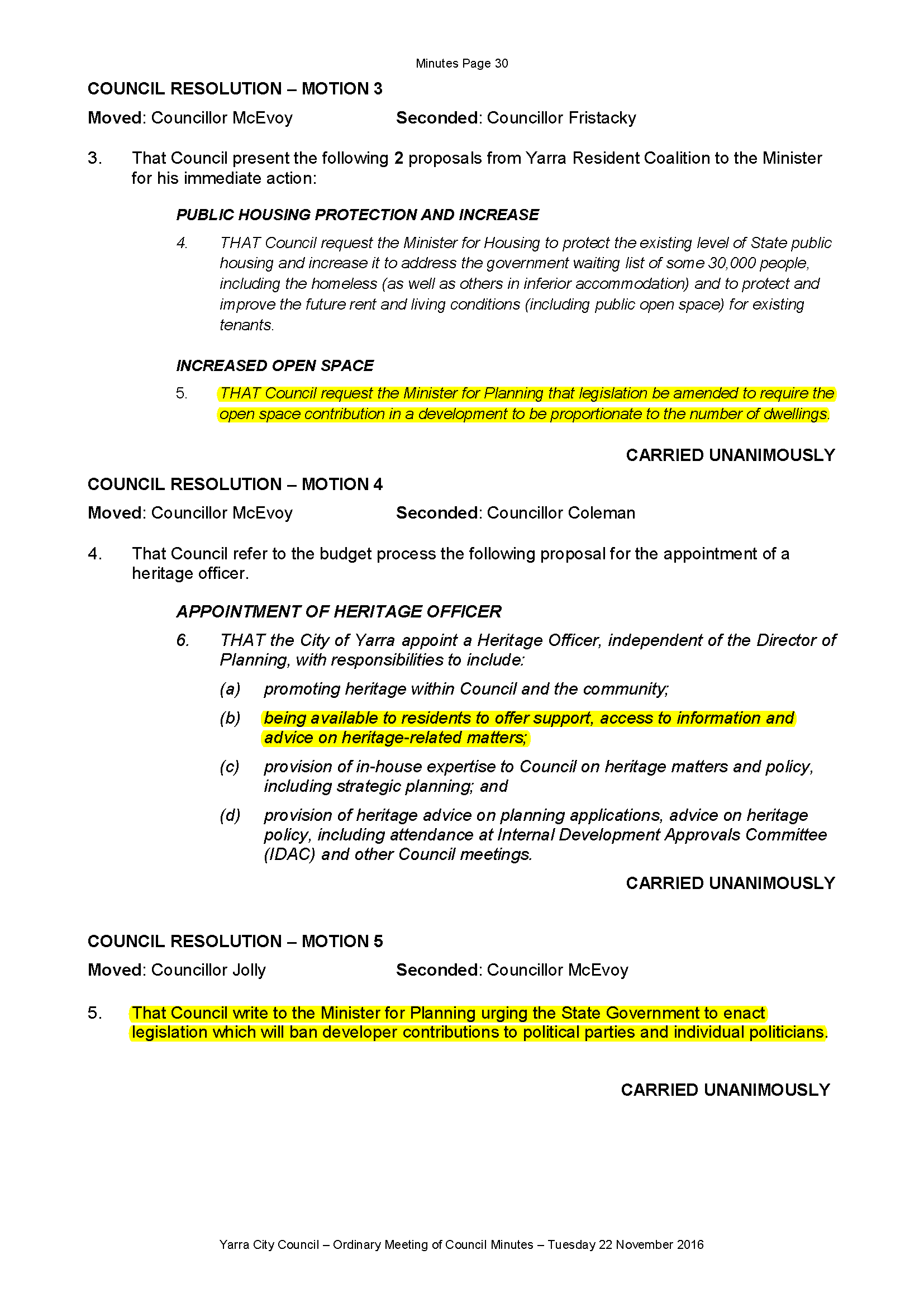
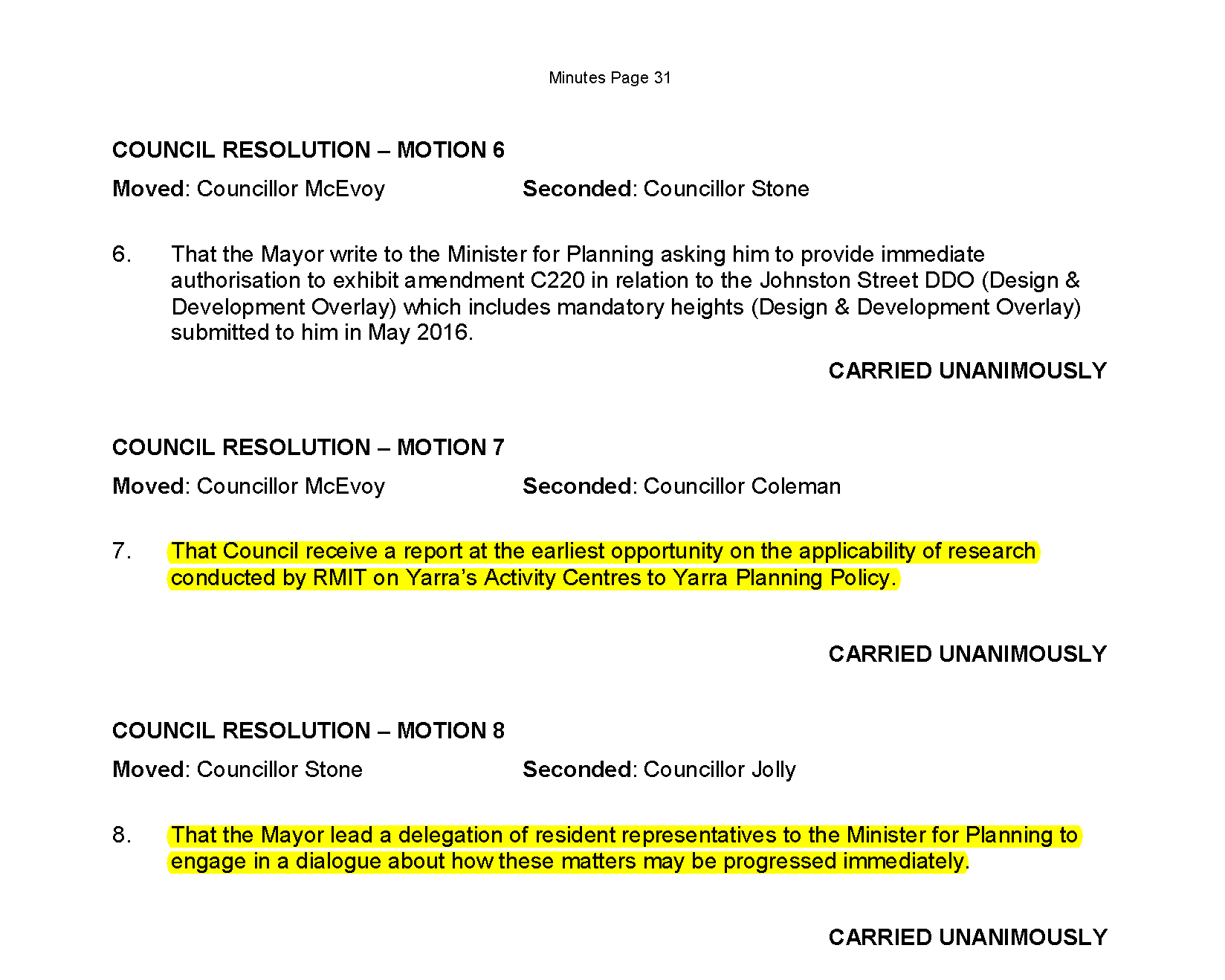
The following resolutions come from Yarra City Council’s meeting minutes of November, 2016. They illustrate perfectly what people power can achieve together with a newly elected crop of councillors who are committed to listening and acting on residents’ behalf. Whilst the proposed amendments are only the start and still have to be rubber stamped by the Minister, they are light years ahead of what Glen Eira is doing. For example: would Glen Eira even dream of organising a meeting between residents and the Minister? Would Glen Eira ever demand 3 storey maximum heights in its neighbourhood centres?

pages-from-revised-public-minutes-22-november-2016_page_1pages-from-revised-public-minutes-22-november-2016_page_2pages-from-revised-public-minutes-22-november-2016_page_3

There is much in the current agenda for Tuesday night’s council meeting that residents need to be aware of and to actively lobby the new council on. Whilst there are clearly some major improvements in terms of community consultation, and a more ‘up front’ approach to letting residents know what is on the drawing board, vigilance by residents is still required. Plus of course the demand that council is explicit and precise in all its communications with residents.

This last point is crucial, especially as it applies to Item 9.7 of the agenda – ie ‘city strategy’ and the work council is proposing to undertake in the next 18 months on planning. The item basically promises 3 things:

  • To update the 2005 Activity Centres Strategy
  • To complete structure plans for Bentleigh, Carnegie and Elsternwick, and
  • To continue and expand the ‘engagement’ practices currently initiated for the shopping strips

Whilst this all sounds wonderful, there are some real concerns as exemplified by this sentence – The revised Activity Centre Strategy will inform Building and Development (or Urban Design) Guidelines which will guide the design of future developments within all commercial areas.

And

Community feedback will be sought on built form controls across all commercial areas with a more detailed focus on Urban Villages.

We remind readers that an ‘activity centre’ is much, much more than the ‘commercial’ areas. It also incorporates the surrounding residential areas that are currently zoned either Residential Growth Zone, and/or General Residential Zone (ie 4 and 3 storeys respectively).

Then there is also this nebulous sentence  – This work will manage development in key sensitive areas whilst also aiming to strategically unlock some key sites close to train stations for redevelopment. Exactly what does this mean? Which sites are in the firing line?

Until council is prepared to commit to a full and comprehensive review of its residential zones, then no amount of structure planning, or urban design frameworks alone will ameliorate the damage that is currently continuing to occur in our local residential streets. The real questions that residents should be demanding answers to are:

  • If the major shopping strips can provide enough housing to cater for the population growth, then does Glen Eira really need 40+% of Ormond, for example, zoned as General Residential Zone?
  • Why do so many streets have 3 distinct zonings when the recommendations from the Minister’s Standing Committee on the new zones recommended against this practice?
  • Why have so many heritage areas been included as part of growth zones and others haven’t? What is the logic and the consistency behind the new zones and does this stand up to scrutiny?

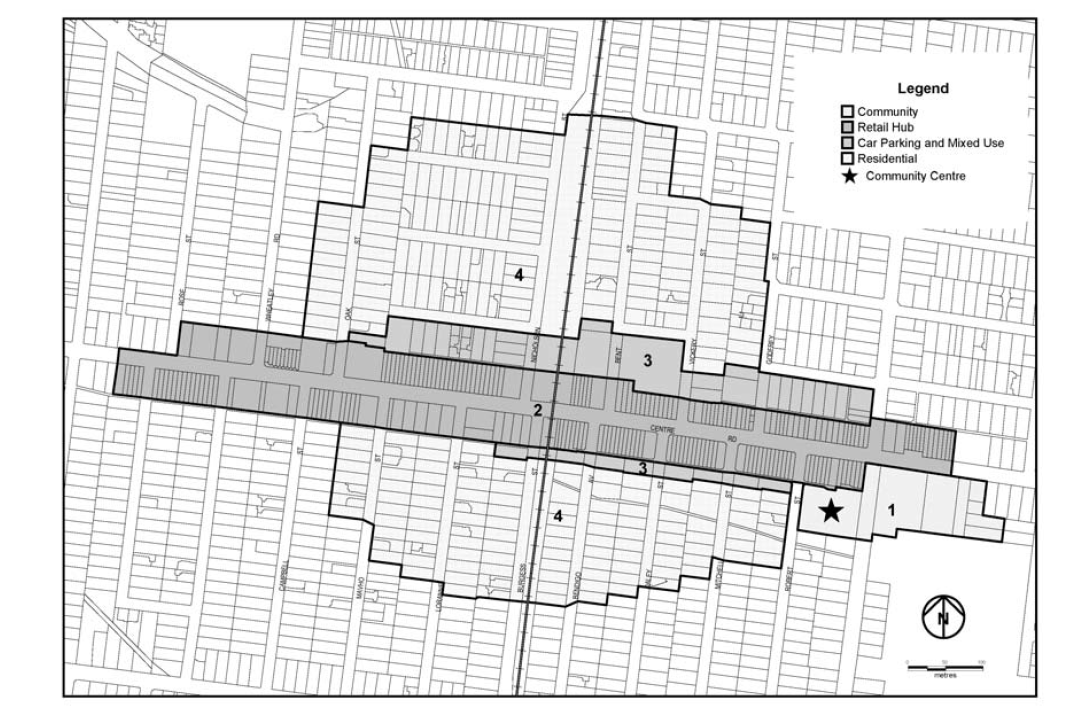
The following screen dump from the current planning scheme will show why we are concerned about the potential direction of planning in Glen Eira if the intention is to only concentrate on the commercial areas and totally ignore the surrounding residential streets that are part of all activity centres. The shaded areas largely represent the commercial and mixed use zonings in Bentleigh. The darker single lines represent the ‘circumferance’ of the Bentleigh activity centre. Most of the activity centre is comprised of nearby streets and therefore housing.  To ignore these countless streets which are zoned GRZ and RGZ and to only concentrate on the commercial zoning as the draft Amendments C147/8 do is to wash one’s hands of protecting neighbourhoods and undertaking planning of the highest order. In the meantime of course, officer recommendations are to grant permits for another 61 units over 3 locations of 3 and 4 storey heights!

untitled

Development will happen at Virginia Park. That is inevitable. What matters is:

  • How much development is ‘necessary’ or even ‘appropriate’ for this site? 1000, 2000, 4000 or 5000 apartments?
  • What will this development look like?
  • What short and long term benefits will accrue to the community as a result?

The answers to these questions are currently unknown. What is known, is that housing brings in the money for developers and that rezoning of the land is the first step in the process. Once rezoned it is the fine print of the so called Development Plan that will reveal much of what the future might look like. Thus it becomes even more imperative that Council insists that the eventual Master Plan is more than a glossy salesman’s promotion – which it currently is!

At this stage we can only go on the published documentation and there is much to be concerned with here given the absence of specific detail and the plethora of motherhood statements.

We address some of the core issues below.

How many apartments are planned?

The developers neatly side-step this concern with this catch all statement – Final densities and dwelling numbers cannot be determined at this point as they are dependent on a number of factors such as potential heights, scale and uses on which feedback is sought as part of this consultation phase.

The intended message is that resident input will have a decided effect on the outcomes – such as ‘dwelling numbers’. That remains to be seen of course, but we are indeed skeptical. Heights for close to half of the site are already set by the existing Schedule to Amendment C75 gazetted in 2011. Plus, when it was envisaged that a 12.5 hectare site could accommodate up to 4000 apartments, it is extremely difficult to believe that a site double this size will not attempt to accommodate more!

The final number of apartments will also be determined by how many are single bedroom, double bedroom or how many are 3 bedroom apartments suitable for families. When the issue of ‘housing diversity’ is reduced to the following, as the documentation repeatedly emphasises, then this is potentially another cause for concern – ie Feedback from earlier consultation on the development of a 20 year masterplan for the precinct asked for consideration of smaller dwelling options, affordable housing and aged care and retirement options.

Housing diversity is much, much more than ‘smaller dwelling options’ or even the inclusion of aged care and affordable housing. The ‘offer’ of ‘up to 5% of total dwellings’ as ‘affordable housing’ palls when we consider the Yarra Council’s Schedule to the Alphington Paper Mill development  (16.5 hectares – 2500 units) and the imposition of an ‘unconditional’ 5% affordable housing component.  

It is therefore imperative that Councillors insist on unequivocal terms and definitions, once the final Master Plan is submitted.

Population Growth In Glen Eira

The various published documents emphasise how Glen Eira’s population is projected to grow by 2031 and the number of apartments that are required to meet this housing need. We’re told that population will increase by a third and that another 7,474 new dwellings are therefore essential – and that is throughout all of Glen Eira, not just East Bentleigh!

What the Gillon conglomerate does not tell residents is:

  • That there are already another 1500+ apartments in the pipeline due to the Caulfield Village development and these will all be completed by 2031.
  • According to Planning Permit Victorian figures for the first quarter of 2016/17 another 448 net new dwellings have been granted permits.
  • According to the ABS data on building permits for the current financial year, we can add another 420
  • On the cards is also major development projects at Rippon Lea, Ormond rail station and probably McKinnon and Bentleigh stations as well. Ormond is purported to house another 200 apartments. No information has been released for McKinnon and Bentleigh, but we can’t imagine that these stations will be left untouched. Then of course there is the recent sale of the Daily Planet and 2 surrounding properties where the developer promised ‘bay views’ to his prospective buyers.

Thus we have the situation where we already know for certain that out of the ‘required’ 7474 new dwellings, Glen Eira already has at least 2600 accounted for. This of course does not take into account the flurry of applications already in for the RGZ and GRZ areas of the municipality and those applications which will still come in. Even discounting all these latter scenarios, all Glen Eira has to achieve is another 4800 new dwellings over the next 15 years to meet its unofficial ‘quota’. Thus, there is absolutely no need for Gillon to use the excuse of a housing shortfall in order to condone the potential  (over)development at Virginia Estate. And certainly not the questionable and debated target of 4000+ that was in the first attempt at rezoning.

And all of the above ignores the major problems of traffic, parking, infrastructure, commercial viability of Centre Road shopping strip, residential amenity of neighbours, open space, walkability, transport options, blah, blah, blah. Each and every one of these concerns must be addressed – and not by motherhood statements, or vague promises. The onus is on council to do its own research and to insist that every single ‘I’ is dotted and every single ‘t’ is crossed and that clear, rational justification is provided to residents for the subsequent decision making.

This is the first of our posts on the draft Master Plan for the development of the Virginia Estate. For this post we have simply picked out some ‘howlers’ that have made their way into the draft. A far deeper analysis will follow in the coming days.

Whilst we acknowledge that legally the developers have only to abide by the constraints of the Amendment passed in 2011 (ie C75) which constitutes the equivalent of an Incorporated Plan designed to set out some broad parameters rather than detail, the Gillon group could have, and should have, done a lot more with this draft to allay resident fears.

In a 24 page document we find:

  • Unfounded claims and statistics
  • A watering down of previous commitments on open space
  • A reliance on developer protocols on ESD, and
  • Half of the document is nothing more than a regurgitation of past documents and actions/events

UNFOUNDED CLAIMS AND STATISTICS

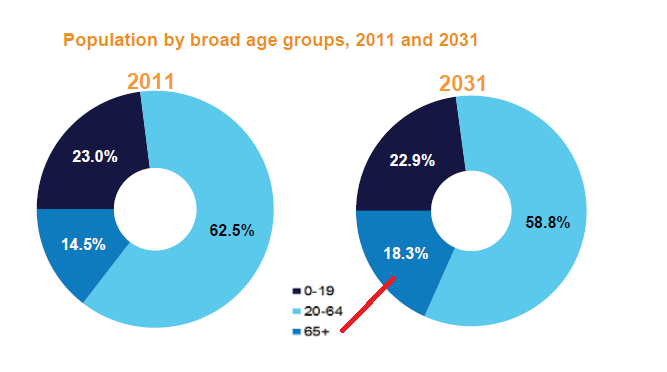
Several of the published documents make a big deal of our ageing population and the need for increased aged care. We take no issue with this. What we do object to is the deliberate obfuscation of the facts. Lumping together Glen Eira, Stonnington, Bayside, Monash and Kingston into an analysis of population without taking into account what aged care developments are happening in these other municipalities, or even acknowledging that Glen Eira residents could find themselves retiring to these other municipalities is, at best disingenuous and at worst deliberately misleading. Page 21 summarises the argument for Glen Eira alone with – “Those aged 65 years and over will make up 21.2% of the total population.”

The Victoria in Future – 2016 prognostications for Glen Eira differ markedly from this claim as evidenced below –

age-pop

OPEN SPACE

Originally, the developers were required (and we assume willing) to pay a 5.7% open space levy in cash – according to the minutes of March 17th, 2015. However, since the site has now doubled in size from 12.5 hectares to over 24 hectares, this does represent a huge increase in cash payments. Thus we get a new proposition of 3% cash and 3% in ‘land contribution’.

At a rough estimate, a 3% land contribution should be about a hectare of land. More than enough for wide open spaces within the estate. That is clearly not the aim of the developers. Going on their previous publications we fear that any land contribution will simply consist of concrete pathways and linkages between buildings and the nearby, already existing parks.  We do not envisage a grand open space area of over 1 hectares. Their proposed contribution in all likelihood will be cobbled together bits and pieces sitting between high density towers.

ESD – ENVIRONMENTALLY SUSTAINABLE DESIGN

Much is made of the use of ESD and how this will set a ‘benchmark’ for future development. The only problem with the ‘standard’ suggested is that it is owned, devised and regulated by the development industry itself – ie The Urban Development Industry of Australia. The scheme does not cover individual house construction per se. Instead it is geared towards “residential land development” and the developer’s ‘reward’ for adhering to these ‘standards’ is a ‘leaf icon’ as certification. Further, the developer does not have to abide by all the criteria listed – only one will suffice to get ‘accreditation’. We’ve uploaded a research article which compares the various ESD schemes available (HERE). The proposed one in our view falls well short of the mark in comparison.

It is also amusing to read such nonsense as – The EnviroDevelopment rating exceeds the requirements set by the Glen Eira City Council and the State Government. Anything would ‘exceed’ what council has got given that nothing of substance exists in its planning scheme!

Watch this space for more!

« Previous PageNext Page »