Presented below are the comments made by Esakoff and Zyngier on the draft Bentleigh Structure Plan at the last council meeting. Unlike the majority of those who spoke in favour of the draft, at least in these comments the ‘problems’ are clearly identified instead of resorting to generalities and spin.
GE Council Meeting(s)
Archived Posts from this Category
July 15, 2023
Bentleigh: Esakoff & Zyngier
Posted by gleneira under Councillor Performance, GE Consultation/Communication, GE Council Meeting(s), GE Governance, GE Open Space, GE Planning, GE Service Performance, GE Transport[2] Comments
July 13, 2023
Bentleigh: Where Is The Transparency?
Posted by gleneira under Councillor Performance, GE Consultation/Communication, GE Council Meeting(s), GE Governance, GE Open Space, GE Planning, GE Service Performance, GE Transport[2] Comments
If one counts the number of times that various councillors used the phrase ‘better controls’ or ‘better managed growth’ or ‘better planning’ in terms of the draft Bentleigh Structure Plan, one should conclude that the draft is god’s gift to planning acumen and a truly wonderful improvement for residents. Nothing could be further from the truth.
We do currently have interim controls via a Design & Development Overlay in Bentleigh that will not expire until December 31st, 2024. Whilst Amendment C228 changed the DDO to only include the commercial and mixed use, it begs the question of why the current draft structure plan sees fit to include some residential rezonings in its borders. Surely this flies in the face of Amendment c228? Regardless of this anomaly, the existing DDO still represents a vast improvement on what is currently proposed. It stipulates:
- Mandatory height controls along all of Centre Road
- Lower heights in metres for equivalent number of storeys to what is now proposed
- Far greater setbacks than in the current draft for certain conditions
Here is what the existing DDO consists of:
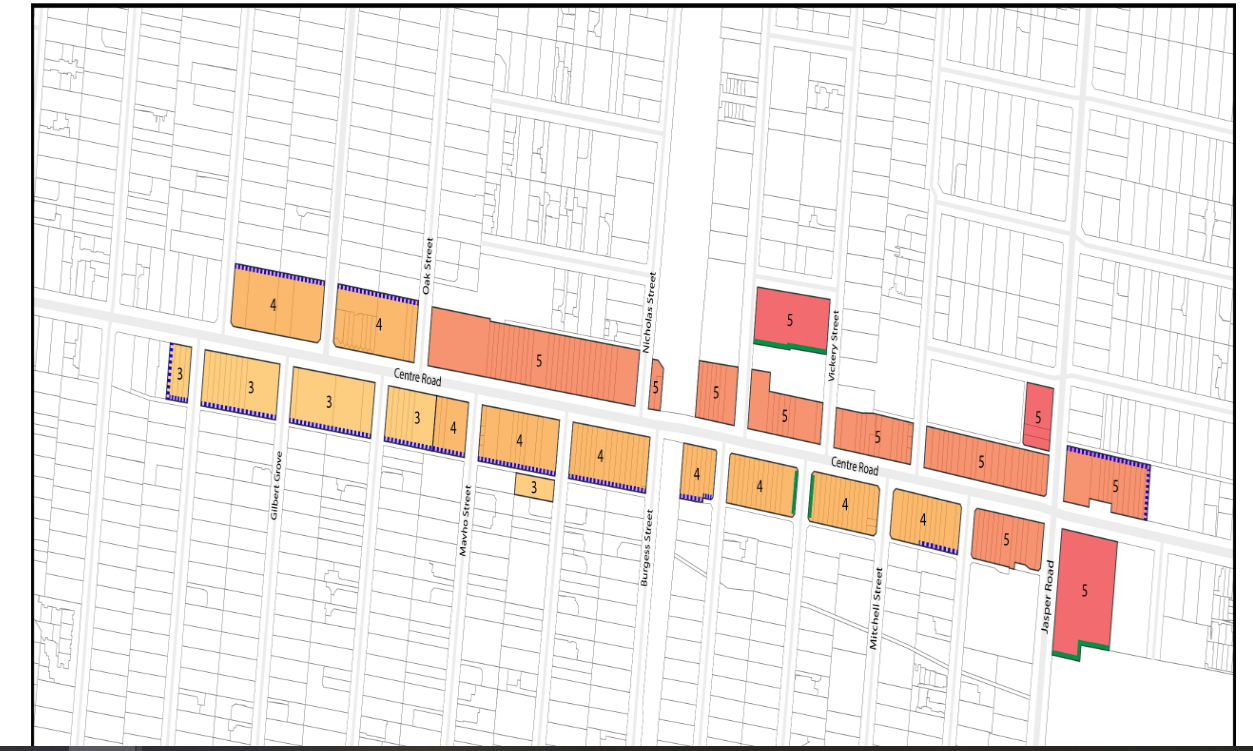
Readers will see: Nothing above 5 storeys. The current version is up to 8 storeys DISCRETIONARY
To therefore argue that the current draft structure plan will provide ‘better controls’ is beyond belief. Nor is it acceptable to argue that without rear setbacks for commercial sites that are not heritage listed that abutting heritage places will be better protected – as Athanasopolous would like us to believe.
So what has changed in the space of 15 months? Why is council so gung-ho on creating strategies that are far, far worse than what currently exist? What communication has taken place between officers and the department? Were councillors ever present at these meetings, or have they been privy to any of the communications? Why aren’t such communications made public or, at the very least, a report on what has taken place in such meetings?
Even if we accept that population will increase by approx 2000 over the next 15 years, how does this justify the proposed changes? And what guarantee is there that with increased apartments there will be more affordable housing? According to the latest census results, we already have 9+% of dwellings standing vacant across the municipality. Why? Are these properties that are already too expensive? Owned by foreign investors? Land banking until prices rise by developers?
No councillor at Tuesday night’s meeting had the courage to state the bleeding obvious! Zhang went on about how wonderful it was that streets currently zoned as RGZ (4 storeys) would now be reduced to 2 storeys because they are in a heritage overlay. She of course doesn’t mention how many four storey developments already exist in these streets, nor how many sites will be ‘upgraded’ to go from 2 storeys to 3 and 4 storey heights. When these are added up, they far exceed the number of properties that have had a reduction in height! What this also reveals is that the original introduction of the residential zones in 2013 was a disaster. No area under a heritage overlay should have been zoned for 4 storeys. And neither should all those properties that lie in the flood plain (SBO overlay) been zoned for three storeys or even included in the borders of the activity centre. . Of course, this was all ignored by the ‘guru’ of planning (Akehurst) and his complicit councillors!
The machinations and inconsistencies of this planning department continue unabated. There are numerous allusions to a ‘transport and assessment’ study and potential resulting actions. This document has not been made available and we doubt that even councillors have been provided with the opportunity to clap eyes on it. So once again, councillors are forced to make decisions without having all the information at their fingertips. The inconsistency is that for the Elsternwick structure plan, there was an accompanying traffic report. Why the difference? It simply is not good enough that residents will have all the requisite information only when the formal amendment is advertised. This approach entirely invalidates any attempt at genuine consultation. If other councils such as Port Phillip can publish all their documentation at the first stage of consultation, we see no reason why Glen Eira can’t – except of course to keep the plebs (and councillors?) as ignorant as possible until it is too late.
Much has to change in Glen Eira if this council is to live up to its stated charter of full ‘transparency’ and accountability.
PS: To put some historical perspective onto what’s been happening in Bentleigh, we’ve revisited an important VCAT decision (17th October, 2017) which granted a permit for a 7 storey development in Centre Road.
What’s fascinating about this decision, isn’t so much the outcome, but the arguments presented by the Council rep. The application was refused by council and thus ended up at VCAT. We quote verbatim what council had to say to support its refusal –
It was further put that guidelines relating to setbacks, height and amenity create further impetus to provide a more sensitive transition between the review site and the surrounding residential hinterland. Council put that Objective 5.1.2(a) of the Urban Design Guidelines seeks ‘To ensure the activity centre provides a graduated transition between different building scales and uses’. It was further put that it is Council’s view that the emphasis on the transitional role of buildings at the edge of an activity centre is greater in the Urban Design Guidelines.
· However, Council put to us that the proposed development is inappropriate at seven storeys because of the limitations imposed on the site due to the adjoining residential hinterland, the provisions of the DDO8 and the height and scale of development on the immediately abutting land.
· We make the observation that when assessed against broad strategic policies, the site is well located for redevelopment. However, Council put that the proposed development is in conflict with the vision of the DDO8 which establishes a preferred height of 5 storeys.
Council further submitted that the proposed development exceeds the maximum preferred height by 2 storeys and over 5 metres.
fails to perform a transitional function, which will necessarily cause a jarring impact at the edge of the Urban Village.
COMMENTS: So, in 2017 council was concerned about ‘transition’ – especially to the residential areas. With the draft Bentleigh Structure Plan this has gone out the window, where there is no problem with a potential 5 storey (and more if exceeding the preferred heights) of ‘transition’. How laughable! Furthermore, council’s preferred maximum height of 5 storeys has also gone out the winder by 2 storeys. That’s what ‘discretionary’ heights can produce!
Appropriate transitions remain relevant in all planning. In Glen Eira and with this draft, this no longer appears to be the case.
July 10, 2023
Cade & The Sudden ‘Conversion’?
Posted by gleneira under Councillor Performance, GE Council Meeting(s), GE Governance, GE Open Space, GE Planning, GE Service Performance, GE Transport, Miscellaneous[9] Comments
In August last year Cade voted against the Carnegie structure plan. She has also voted against the housing strategy but was absent for the determinative vote. On East Village she voted in favour of mandatory heights. So what has now changed? Why are we suddenly seeing a trend in Cade’s voting that largely supports the admin’s and planning department’s agenda of high rise and more and more development in our activity centres?
Cade’s voting patterns since being elected deputy mayor are very interesting. Together with Athanasopolous and Magee she voted AGAINST the refusal of a permit for an application in Grafton Street Elsternwick. Other interesting voting patterns include:
- Cade moved the motion for the Bentleigh Structure Plan
- She voted against reducing the height of one section in the Caulfield South Activity Centre
Admittedly she has voted against various permit applications (ie Bentleigh RSL in Huntley Road) but on all the recent major strategic planning strategies, she has been an ardent supporter – which contrasts strongly with her previous position(s) on these matters. So we have to ask: Could this possibly have anything to do with her election as deputy mayor and earning the princely sum of $59,659 PLUS 9.5% p.a for a grand total of just under $66,000? Or has she undergone some religious ‘conversion’? If so, then she needs to explain this.
Cade’s motion of support for the draft on Tuesday night, was staggering in its deception, the obvious pre-arranged Dorothy Dix questioning of Torres, and failure to disclose the full picture in so many instances – ie the sins of omission! Nor can it be seen as a genuine councillor contribution to the debate when much of Cade’s version of events mirrored precisely what appeared in the July edition of the Glen Eira News – basically, ‘don’t blame us, it’s all the government’s fault’! This has now become council’s escape clause for their repeated failures and refusal to (1) listen to the community and (2) adhere to sound strategic planning principles that actually enhance and preserve what residents see as vital aspects of residential amenity.
Here is what Cade stated. Please listen carefully.
“The Victorian government sets the agenda………”. True, but there is still plenty of scope within planning scheme for councils to create their own strategies. Approximately 25% of all planning schemes allow councils scope to introduce what they see as necessary for their communities. That’s why heaps of other councils have had structure plans for at least the past 15 years. That’s why other councils have implemented both ESD and WSUD (environment & water) in their planning schemes. Here in Glen Eira we are still waiting for a community infrastructure levy on developers, a car parking levy, or a WSUD policy – despite all being promised in 2016. In short, there is plenty that councils can do if they have the will. Whether or not a council’s proposed strategies will be approved by the Minister down the line is irrelevant at this early stage of structure planning. The focus should be on implementing sound strategic planning in line with community aspirations and which provides overall ‘community benefit’. There is no ‘community benefit’ in having potentially ten storey buildings overlooking single storey homes in a heritage overlay. Nor is there community benefit in flogging off council owned land for potential ‘mixed use’ development or for social housing. If council was really serious about social housing then it would not have endorsed a policy which seeks a meagre 5% of dwellings as social housing. It would have included a percentage of at least 10=20%! All of the above has nothing whatsoever to do with the government and everything to do with this administration and its lackey, pro-development councillors!
Cade’s question to Torres repeats past practice on the Carnegie/Bentleigh structure plans of several years ago. What happens if the draft isn’t passed Cade asks? Torres’ response once again resorts to straight out fear-mongering when he says: ‘If tonight’s recommendation did not get supported, our structure planning process for Bentleigh would not proceed’!!!!!!!!!! Why not? Why can’t improvements be made, or does council believe everything it sets out is perfect? There is nothing that stops a council from revisiting its drafts (as has happened previously) and ensuring that it is as sound and strategically justified as possible. Furthermore, the issue is not about abandoning the draft. Those councillors who voted against it simply wanted improvement and implied that this was not up to scratch. Given that council still has 18 months to get it right, the suggestion that everything will lapse or be abandoned is outrageous. Nor is it a valid argument to say that the community wants structure plans for ‘better controls’ and so council is providing structure plans. This of course ignores the central question as to whether the final plans do in fact offer ‘better controls’.
Torres then goes even further with the statement that if the motion fails, then the Minister could ‘quite possibly remove those (interim) controls’ from Bentleigh. Fear mongering at its best!!!!! And without a shred to evidence to support this claim. We know of no other instance in planning history where a minister has removed existing interim DDO’s in their entirety prior to the date nominated.
Cade then goes on to a supposed explanation as to why the draft hasn’t included the recommendations of the government’s Urban Design Guidelines. She says that the guidelines are a ‘background document’ and therefore aren’t in the planning scheme – so presumably council can ignore them is the implication. What is not stated is that STRUCTURE PLANS are also considered as background documents and are NOT IN PLANNING SCHEMES either!!!!!!! What does get into planning schemes are the amendments which introduce the Design & Development Overlays. In Glen Eira all of the most important strategic plans are ‘background documents’ –ie East Village structure plan; City PLan, Activity Centre plans; Urban Design Guidelines, etc.
Finally, Cade states that ‘I am not going to talk about building heights and setbacks’ or ‘parking’ because ‘I am sure my fellow councillors will address’ these issues. Really? How on earth can you move a motion to support a structure plan without even mentioning the most important aspects of it, and the most contentious? If you support something, then the onus should be on providing evidence as to why potentially 10 storey developments are appropriate, or why a 5 metre setback (discretionary) is okay when other councils have managed 6 metre setbacks in their major activity centres? But we guess it is easy to ignore the contentious issues and to simple promulgate more propaganda about everything being in the state’s control!
Cade’s conclusion is equally bizarre when she claims to want to hear from other councillors not only on what they like or dislike about the plan, but what they would ‘propose’ as an ‘alternative’. This is completely out of order since the possibility of an ‘alternative’ motion has already been rejected by Magee. Councillors are debating the motion as it stands and NOT what might be a feasible ‘alternative’.
Cade’s sudden ‘conversion’ is a concern. She is also doing the community a major disservice by simply regurgitating officer reports and presumably being complicit in staged Dorothy Dix questioning of officers only to provide them with the opportunity to further the set agenda. We remind her and our readers that stage managed debates are the antithesis of ‘robust’ discussion and serving the community with original thinking!
July 5, 2023
A Resident’s View On Bentleigh Structure Plan
Posted by gleneira under Councillor Performance, GE Consultation/Communication, GE Council Meeting(s), GE Governance, GE Open Space, GE Planning, GE Service Performance, GE Transport[5] Comments
The following audio is taken from last night’s council meeting where once again the council was split in voting 5 to 4 to send the draft structure plan out for consultation. There were many criticisms of the current draft, plus some fear mongering from certain councillors and the administration. The final vote was – AGAINST: Esakoff, Szmood, Zyngier, Pennicuik. Those who voted FOR were: Cade, Zhang, Athanasopolous, Magee and Parasol. We note that not for the first time, Parasol did not utter a word as to the reasoning behind his vote. He simply put up his hand.
Here is what one resident had to say about the draft and its unbelievable shortcomings:
We will comment more fully on what transpired in discussion on this item in the days ahead.
PS: In the above audio, Torres tried to negate the potential for a ten storey development by referring to the ‘setbacks’. What he doesn’t state is that rear setbacks for commercial dwellings backing on to heritage areas are NOT MANDATORY. They are DISCRETIONARY – and we all know how little control DISCRETIONARY provides!
June 30, 2023
Draft Bentleigh Structure Plan
Posted by gleneira under Councillor Performance, GE Consultation/Communication, GE Council Meeting(s), GE Governance, GE Open Space, GE Planning, GE Transport[5] Comments
The agenda for Tuesday night’s council meeting includes our first look at the draft Bentleigh Structure Plan. The recommendation is to put this document out for public consultation for a period of 6 weeks. We know little about the nature of this consultation, except that it will include: a range of in-person and online opportunities for the community to provide comments, feedback and ask questions. In other words, we anticipate another mock consultation that only achieves the ‘consult’ range rather than the ‘involve’ stage recommended in the IAPP2 ladder for public participation.
Far more depressing are the actual recommendations contained in this draft. A short summary follows:
- Discretionary heights of up to 8 storeys along Centre Road for non heritage buildings – which means developments could be even higher.
- Only heritage buildings to have a mandatory 5 storey height limit (17.8 Metres) along Centre road
- A discretionary 7 storey height directly abutting a two storey heritage overlay along Campbell and other streets
- The real possibility of a reduction in onsite care parking requirements
- No mandatory rear site setbacks for developments abutting residential/heritage
- Discretionary front setbacks for non heritage properties
- Potential sell-off of council owned land for mixed use development that might include social housing. Please remember that council’s policy as it stands only asks for a 5% component for large developments. Other councils have asked for as much as 20%!
- Winter solstice considerations only to be taken into account at a measurement of 3.9 metres from the site boundary in side/local streets. How many of these streets have footpaths that are a bare 2.5 metres in width?
Here’s a run down of the proposed heights. CLICK TO ENLARGE THE IMAGE
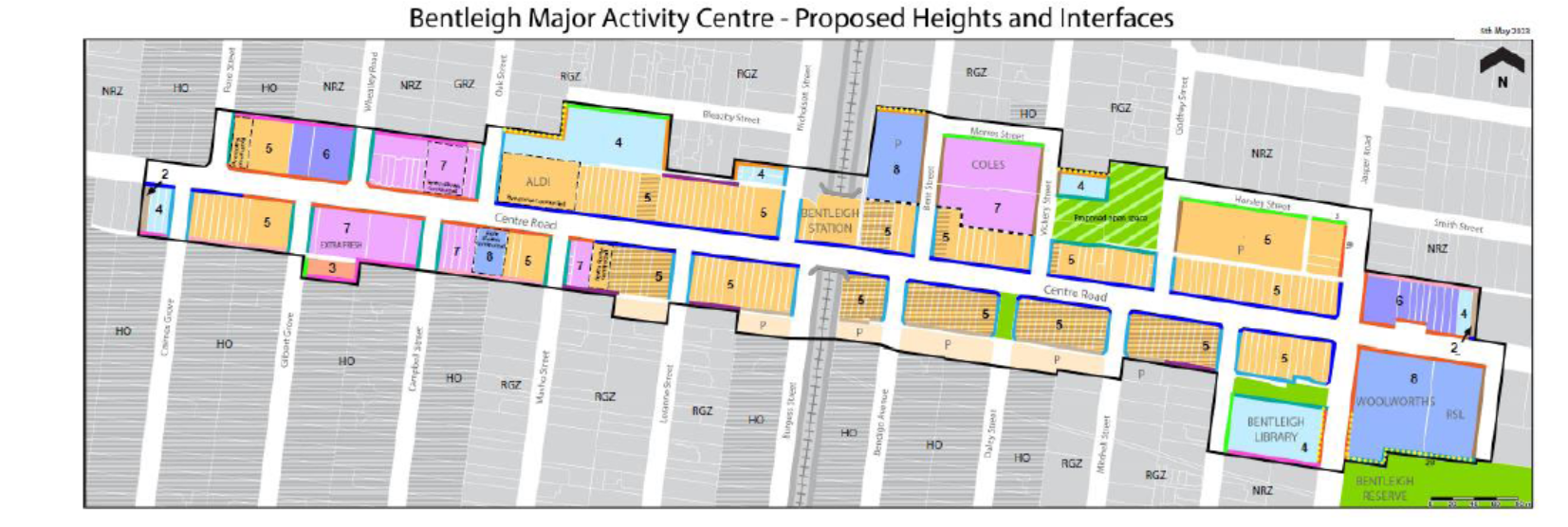
Readers should note the following:
- Only those hatched sites (ie with///////markings are heritage listed). Thus all other sites earmarked as 5 storeys could potentially be much higher.
- The number of residential properties that are currently in NRZ that will have a discretionary 7 or 8 storey building backing onto them – ie Wheatley Road, Campbell street, Smith Street, etc. Clearly a difference of 5 or 6 storeys does not matter to our council planners!
Finally, what’s not shown in the above map are the proposed future rezonings of the residential hinterland.
We urge all readers to carefully consider the published documents and to partake in the upcoming consultation.
April 8, 2023
Elsternwick: Community Feedback
Posted by gleneira under Councillor Performance, GE Consultation/Communication, GE Council Meeting(s), GE Governance, GE Open Space, GE Planning, GE Service Performance, GE Transport[7] Comments
Our apologies for this incredibly long post, but its importance we believe justifies the length since it goes to the heart of what constitutes full transparency and accountability and council’s unwillingness to be completely up front with its residents.
In keeping with its recent practice of refusing to publish the full feedback on its consultations, council has released its ‘summary’ on the draft Elsternwick Structure Plan. In the report we find little that would convince us that the presented analyses reveals an accurate and complete picture of what respondents wrote. So why is council insisting on mere ‘summaries’ rather than publishing the full data as it has done on numerous previous occasions. Why is council fighting tooth and nail to refuse FOI access on its bogus claims that requested documents are ‘voluminous’ and meeting the application would entail a severe imposition on council resources? The refusal to allow residents to come to their own conclusions as to the feedback can only lead to the perception that there is much to hide.
The summary report listed in the current agenda consists of 25 pages. Within these pages we find the following frequency of terminology used to report on the outcomes. Words such as ‘several’, ‘many’ and ‘some’ in relation to respondent answers are used without any clear indication of what was actually stated or the nuances and variations between respondent comments. The frequency in relation to respondent comments is:
Several – used 8 times
Many – used 21 times
Some – used 18 times
Another telling example of the inadequacy of the report comes from page 4 –
Many respondents supported protection of the centre’s heritage and were often concerned that increased built form would deteriorate the centre’s heritage value and village feel. Some participants considered the general lowering of permitted building heights to be the appropriate response.
What is the numerical difference between ‘many’ and ‘some’? Does the differentiation between the ‘many’ and ‘some’ indicate that the ‘many’ were not supportive of a decrease in height limits or that this was simply not mentioned? Did any of the responses really affirm or agree that Elsternwick has a ‘village feel’ or is this simply terminology assigned by the authors of the report? And how should ‘increased built form’ be interpreted anyway? Does it refer to the paltry set backs? The heights? Their discretionary nature instead of mandatory, or their overshadowing potential? Ultimately such statements are meaningless and certainly open to a multitude of interpretations. Without access to the actual comments, there is no way of telling and according credibility and value to the summary report.
We also have to take issue with the manner that the so called topics are presented and their accompanying tables purporting to reveal the ensuing ‘themes’. The survey questions focused on topics predetermined by council such as: vision and objectives; heritage; traffic; etc. Accompanying each topic, respondents had the choice of downloading what one can only assume to be information that would provide greater understanding of the topic. We repeat some of the comments we made in an earlier post (See: https://gleneira.blog/2022/11/04/elsternwick-another-shonky-consultation/) –
- The draft structure plan proposes to allow up to 6 storeys for heritage listed sites along Glen Huntly Road. Not once is this mentioned throughout the document that is supposed to provide respondents with information on this important aspect of the structure plan.
- Jargon predominates. What on earth does ‘rich materiality’ mean and how would respondents interpret this?
- Why aren’t we told that the heritage listed church is likely to be surrounded by 12 storey towers? And yet, given the above, we are still meant to believe that council takes great care to ensure the heritage fabric of Elsternwick is protected
As for the accompanying table on the vision and objective question we find this:
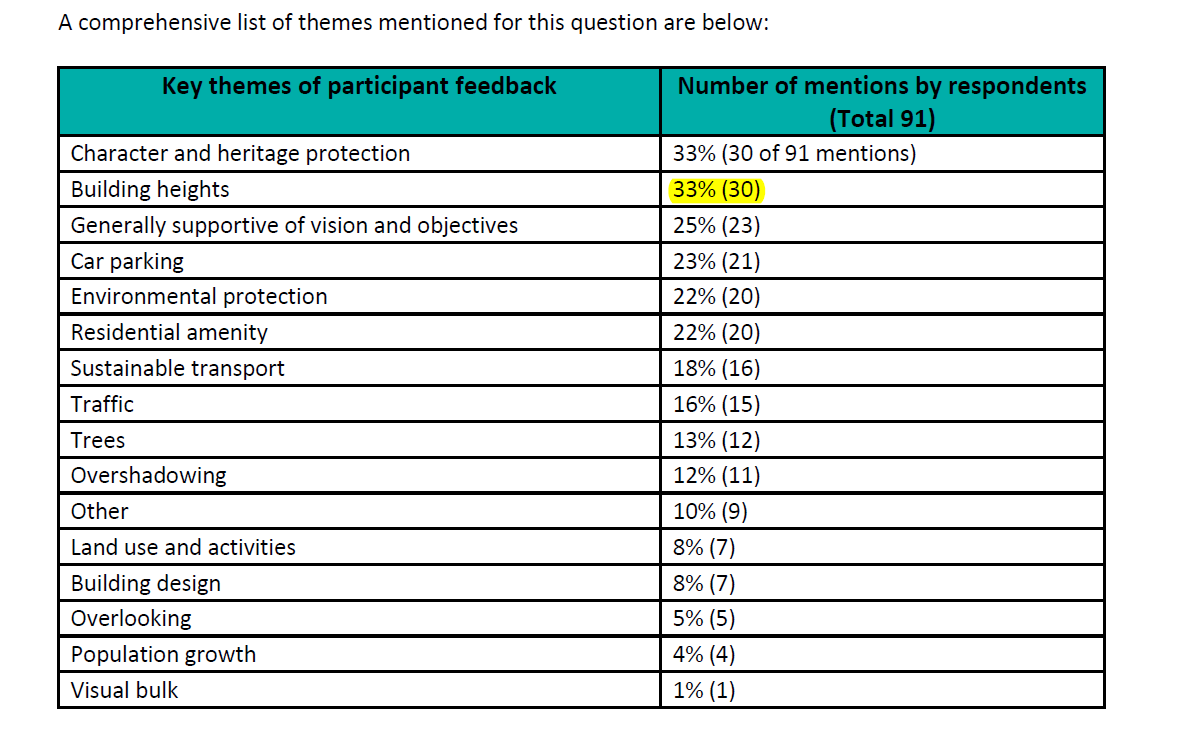
The above table reveals absolutely nothing about the views for or against – ie how many were opposed to the proposed building heights and how many were arguing for increased building heights or perhaps that the proposed heights were appropriate? Simply providing the number of times something was mentioned does nothing to convey what the community thought and how this was expressed in the feedback.
The value of any survey is 100% dependent on the quality of the questions asked. Are the questions open-ended and objective, or written with a specific end in mind? Are they free of ambiguity? Are they mere motherhood statements that would be hard to disagree with? Are respondents provided with enough specific detail to respond meaningfully, or do they have to plough through hundreds upon hundreds of pages in order to glean what is really proposed? How many respondents have actually bothered to do this if details are buried and does this potential lack of knowledge invalidate their answers? Council’s approach has always been to proffer questions that are nothing more than feel good statements, or rhetorical flourishes that no-one would or could disagree with. For example: the significance of heritage and the need for protection. Yes, residents would agree with the importance of protecting heritage, but does this then lead to the ‘support’ of what is proposed – especially when the mechanisms for achieving this aim are so vague and ill defined.
How many of these surveys are road tested prior to being inflicted on the community? Were there focus groups prior? Were their responses analysed? Did councillors have any say in the creation of these questions? What about the Community Consultation Committee? And who actually drafted the questions?
And how well has council advertised its surveys and their significance and ramifications? What follow up has council undertaken to analyse what could be considered as poor response rates? Did council really attempt to engender a huge response or the reverse – ie downplay the significance of the consultation? For the Elsternwick Structure Plan we are told that there were articles in the Glen Eira News informing residents of the consultation. The claim is that information was present in the November and December editions. The first screen dump is what appeared in the November issue followed by the December insert that came in on page 9.
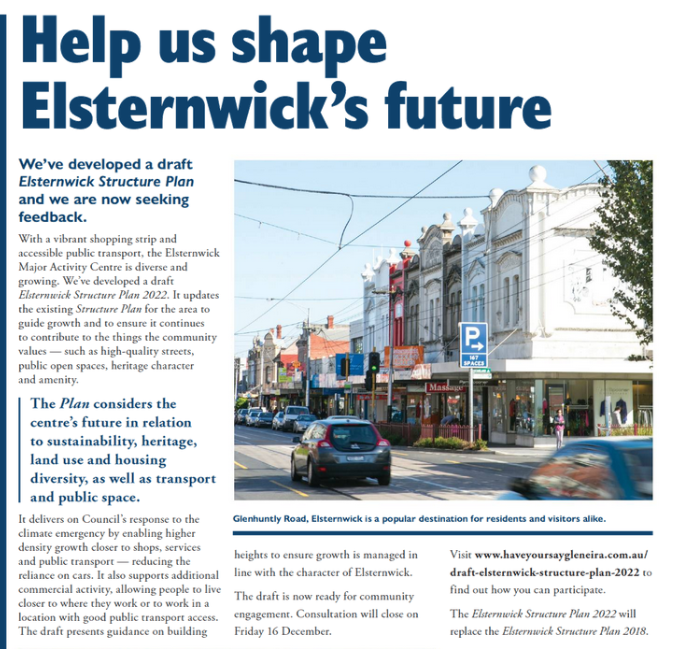
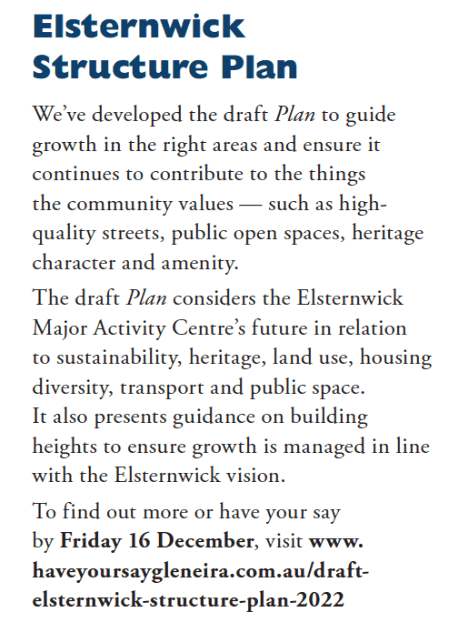
The above calls for participation leave a lot to be desired. Instead of ‘facts’ such as: proposed heights; rezoning of some properties; onsite car parking reductions and of course open space/environmental proposals, there is nothing in this first article that would provide residents with a clear vision of what the proposals entail. Nor does the December version elaborate on anything further. And is it sheer coincidence that the inserted photograph only features 2 storeys along Glen Huntly Road, instead of the monsters that are already in existence? Jargon, generalities, and platitudes epitomise the article instead of the transmission of real information. And when will council refrain from such nonsense as calling Elsternwick a ‘village’ when we already have 13 storey buildings going up!!!!
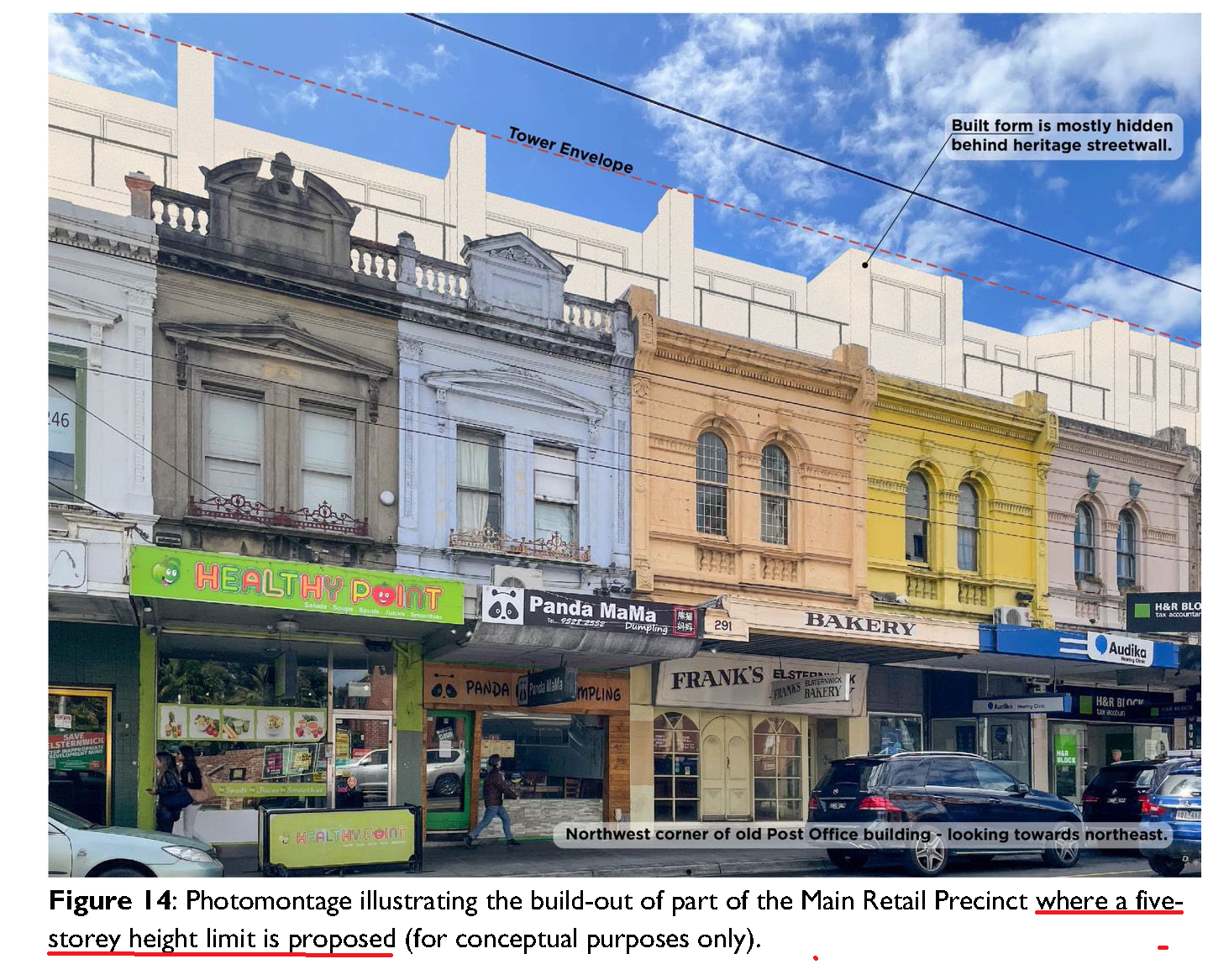
There are countless errors (falsehoods/deceptions?) in much of what council has presented in the accompanying ‘information’ sheets. For example the following image from the Buildings document showing the montage of what a 5 storey height might look like. Even if we accept the accuracy of this image (which we believe is highly suspect) it does not explain why council chose NOT TO DEPICT the opposite side of the street that has a 6 storey discretionary height limit as well as the neighbouring properties further up along this side of Glen Huntly Road that are also under heritage overlays.
Despite all this, council has been forced to reveal that on a ratio of close to 2:1 residents were opposed to most of what the draft structure plan envisioned. What happens now should be of utmost concern to all residents, especially in Elsternwick and Bentleigh. Will councillors insist that this draft goes back to the drawing board? Or will we merely have a minor tinkering around the edges and it is voted through? When something is so strongly opposed then the only solution should be that councillors listen and act in accordance with community sentiment!
March 2, 2023
Who Runs The Show?
Posted by gleneira under Councillor Performance, GE Council Meeting(s), GE Governance, GE Planning, GE Service Performance[10] Comments
At Tuesday night’s council meeting, residents gained further insight into the ills of Glen Eira Council. Please listen carefully to the following which occurred during item 8.3 on an application for a 4 storey development in a local centre.
Not for the first time are we informed that:
- Councillors are not provided with enough time to thoroughly digest and analyse information fundamental to their decision making. Hardly surprising when some agendas are well over 1000 pages!
- It’s also been made clear by some councillors that they have not been provided with important consultant documents prior to making major decisions. Or, if these documents are available, then they are provided at short notice. Hence we argue that this is anything but informed decision making.
- When it is the CEO who sets the agenda with mayoral ‘consultation’ and there is no genuine notice of motion option in Glen Eira, then we are on a hiding to nothing.
- The fact that councillors had to ask for all community consultation feedback on the housing strategy, rather than simply the ‘summary’, shows how little information is provided to them as a matter of course. And in response to a public question on Tuesday night, this practice of withholding the raw data is set to continue.
So what does all this mean? Put simply, we have a major problem in local government. Yes, some councillors have been found to be corrupt, and yes, some are bullies, or simply using local councils as stepping stones to far more lucrative careers in parliament. But what of bureaucrats? Who can pull them into line when every aspect of the Local Government Act practically empowers them to act with impunity? As managers and directors, all senior staff are beholden to the CEO for their (continued) contracts and ongoing employment. Councillors have no say in this and nor are they privy to their annual reviews or their Key Performance Indicators. That remains solely in the CEO’s domain. This breeds compliance and cow towing – especially when salaries are in the $230,000+ range.
Admittedly councillors have the right to sack CEO’s – but this can become a very expensive business and invite plenty of negative publicity and more investigations that could reveal other skeletons in the closet.
We have said on numerous occasions that councillors in general are regarded as a necessary evil at worst and as unnecessary appendages at best. Their ideal role is to merely rubber stamp whatever the administrators put before them. In theory, they are supposed to provide oversight; to analyse, question, and be provided with enough information so that their decision making is beyond question. Most importantly, they are meant to work in the interests of the community and to listen to resident views. This is impossible when they are denied access to timely information, or when they are so overloaded that it becomes impossible to do their jobs satisfactorily. We would love to know how many of these councillors even bother to read the hundreds upon hundreds of pages each week or simply rely on the reports from officers.
One article in yesterday’s Age has officers calling for more constraints to be placed on councillors. In turn, some councillors are seeing this as an attempt to further emasculate councillors and to ensure that all become nothing more than ‘lemmings’ following the lead of the bureaucracy. (See: https://www.theage.com.au/national/victoria/councillors-behaving-badly-calls-for-tougher-penalties-20230228-p5co4y.html ). Which ultimately leads to the question – do we need councillors and do we even need local government when real power is vested in officers and not our community representatives?
February 10, 2023
Carnegie Swimming Pool
Posted by gleneira under Councillor Performance, GE Council Meeting(s), GE Governance, GE Open Space, GE Service Performance[9] Comments
The following screen dump comes from the minutes of Wednesday’s council meeting. We are literally gobsmacked at the costings listed.

Several things need investigation:
- Why has the projected construction cost gone from a budget figure of $53M to $62M? Why weren’t figures provided earlier about total costs? Given that the final figure also excludes GST, ratepayers are therefore looking at a forecast cost of just under $84M!!!!!! What is the rationale for a 25+% increase overall? Will residents now have gold plated taps?!!!!!!!! Has the design changed? Even accepting the rise in construction costs, we find this increase unjustified, unexplained, and unacceptable. We are not aware of any public documentation to justify this increase.
- In terms of the published resolution (‘carried’) there are other questions that need to be answered. Why does ‘carried’ signify? Does this mean that some or at least one councillor was against publishing this resolution? Or does it mean that whoever voted against the resolution was also against the cost increase?
- The Local Government Act now stipulates that ALL resolutions include information as to who voted for or against. This has not been done here! Is this simply another example of the failure of council to be totally transparent and accountable? When we are talking the mega millions listed here, residents should be informed fully about what is going on and the rationale behind all such decisions
PPS: Council has put out the following Media Release.
Published on 10 February 2023
We have been successful in securing $15 million of funding through the Australian Government as part of our advocacy efforts and we will continue to advocate to the Victorian Government as the project continues.
Carnegie Memorial Swimming Pool underway
Construction is now underway on the new Carnegie Memorial Swimming Pool.
Council has awarded ADCO Group Pty Ltd the contract ($62 million) to deliver the project with a revised total project cost of $75 million.
The new year-round aquatic and leisure facility will be one of the most environmentally friendly and sustainable centres in the world. It will be designed and constructed to a Six Star Green Star rating with climate resilience, low energy operations and maximum water efficiency, and will include:
- indoor and outdoor pools;
- an outdoor diving pool;
- learn-to-swim programs, a therapeutic warmwater pool and numerous allied health services;
- a café, barbecue, and shaded seating areas;
- allied health treatment rooms;
- program rooms for classes such as yoga and Pilates; and
- retention of design references to the past such as the post-war style signage, the red brick and retaining the eastern hill.
Glen Eira Mayor Cr Jim Magee said we have been committed to delivering this much-needed facility to the Glen Eira community since 2019.
“We are excited to finally be moving ahead with this intergenerational project but there will be continued challenges that we face in relation to the increased cost of materials and labour that we will need to balance with all projects moving forward.”
To read more about the project, view the concept designs for the centre and to keep up-to-date with timelines and major milestones, please visit the Carnegie Memorial Swimming Pool redevelopment webpage.
FAQs
Why is the project starting now?
Due to a Victorian Heritage Register nomination from a member of the community and the subsequent review undertaken by Heritage Victoria, the project was delayed by 12 months.
Why is the project cost higher than the contract value?
The $62 million contract value is the value of the construction contract. Other costs go into delivering projects of this scale, such as a contingency budget, authority fees, consultant fees and capitalisation costs. The total project budget is $75 million.
COMMENT:
Sadly the above Media Release does nothing except repeat the notice in the minutes, plus adding plenty of more spin. Itfails to explain the reasons behind this decision, nor the lack of governance in providing residents with the complete information as to:
- The full voting record
- The exact nature of the various price increases and their justification
- Nor has any tender documentation for this project been placed in the public domain – as has been the case with various other expensive tenders. We do not know for example: how many applicants there were; how many of these applications were compliant; what were the selection criteria;
- Finally we repeat that even with major funding from government, residents will still be up for at least $70M. We will watch carefully to see which departments will have their budgets cut right back and which projects will be abandoned and/or delayed.
December 11, 2022
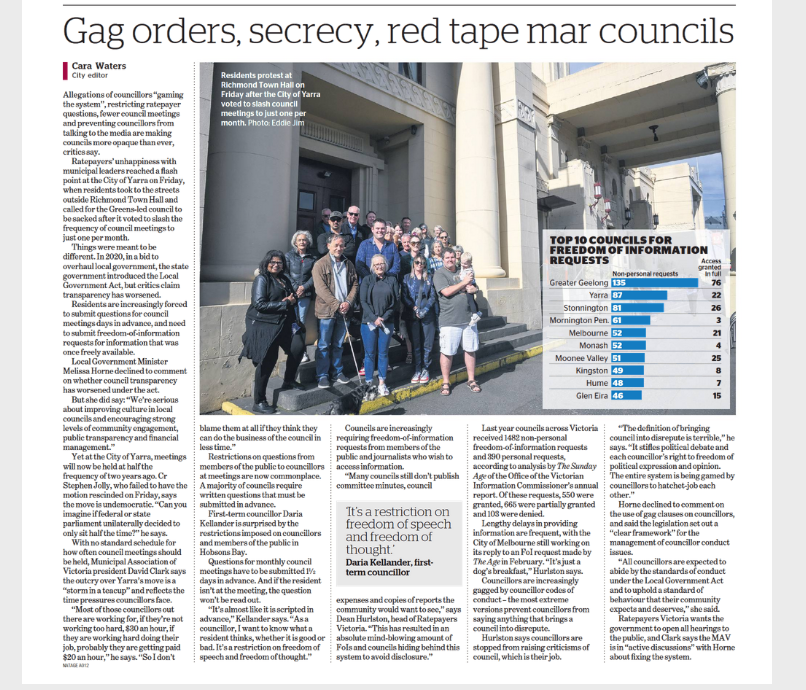
From ‘The Age’
Posted by gleneira under Councillor Performance, GE Consultation/Communication, GE Council Meeting(s), GE Governance1 Comment
CLICK TO ENLARGE
November 18, 2022
Inkerman Road – Safe Cycling Corridor
Posted by gleneira under Councillor Performance, GE Consultation/Communication, GE Council Meeting(s), GE Governance, GE Open Space, GE Planning, GE Service Performance, GE Transport[4] Comments
We continue to be appalled at the manner in which this council conducts its business and its total disregard for residents and their views. The latest example comes in the agenda for Tuesday night’s council meeting and involves the Inkerman Road ‘Safe cycling corridor’.
Some preliminary observations:
- The item consists of 510 pages out of a 1309 page agenda
- The agenda was published around 10am on Friday morning – literally 4 days before the council decision (and this includes a weekend) – hardly enough time to read, digest, analyse, and comment by residents. Some of the associated documents date from August 2022 whilst one is from April 2022. Why couldn’t these have been published earlier so that residents can get their heads around them? When were councillors themselves provided with access to these documents?
- From a very brief scan of the associated documents, nothing is definitive and recommendation after recommendation includes the need for further research once the project is given the go ahead – despite the plethora of caveat after caveat stating how difficult it is to provide real data and projections for increased cycling numbers, etc. Nor do we know how much all of these consultant reports cost!
What is the most staggering aspect of this item is the following recommendation:
That Council:
1. Adopts Option 2 (Attachment 3) as the preferred corridor design for the purpose of community consultation, once the following pre-conditions have been met:
a) Funding to deliver the project is confirmed through Council’s future budget allocation process.
b) The City of Port Phillip resolves to proceed to wider community engagement on its section of Inkerman Road / Street.
2. No further design work and/or community consultation is to commence until pre-condition a) and b) have been met.
3. Informs community and stakeholders of Council’s resolution.
COMMENT
- Why on earth would you commit council to an estimated expenditure of $14M+ before you undertake further (and hopefully genuine) community consultation on the actual options provided?
- If voted in, then what impact on other projects does the $14M have? What would be abandoned or delayed – especially if no state or federal funding was received?
WHAT WE ARE TOLD
- Option 2 is preferred even though it means that only 47% of current car parking will be retained. How many car parking spots will thus be lost?
- Currently the estimated average daily cycle numbers for the Glen Eira sections equals 163 cyclists. The claim is that the increase in cyclists would fall ‘somewhere’ between 84% – 207%. Hell of a range forecast upon which to spend $14+M!!!!!!! and we’re even told that estimating cycling demand is exceptionally difficult
- In terms of cycling instead of using the car the result is likely to be only about 6-8%!
Even if the number of cyclists along this stretch of road increased to 800 per day, that is still an expenditure of $17,500 per cyclist!!!! Nor is there any guarantee that this is money well spent in terms of overall safety – ie
The Independent Safety Review found that for both design Option 1 and 2, due to the bi-directional bicycle lane, there are expected risks for cyclists given the high number of intersecting driveway crossovers on the south side of Inkerman Road, largely applicable to westbound cyclists as departing vehicles may not expect a cyclist to arrive from this direction.
To address this the design includes the provision of bicycle line markings and surface treatments at the crossovers which serves to advise the presence of bicycle lanes. With the report concluding, “nonetheless, the prevailing issue is the unexpected arrival of a bicycle in the eastbound direction. As a primarily residential area, it is anticipated long-term residents will quickly adapt to the proposed design, and the risk associated with this item will reduce over time”.
On a wing and a prayer the above quote, rather than any assurance that in the early stages cyclists and motorists will be ‘safer’!!!!!
CONCLUSION
Glen Eira City Council is clearly addicted to grandiose projects that cost the earth and will look good on certain CVs. Whether or not the projects represent real value for money, or even achieve the desired outcomes is seemingly immaterial. All that matters is that agendas are rammed through and virtue signalling becomes the modus operandi for all council decisions.
Finally, we very much doubt that this important item is listed at the end of the obscenely long agenda by accident. What that means is that there will probably be very little time for ‘robust’ debate/discussion!!!!!
 Glen Eira Debates