GE Governance


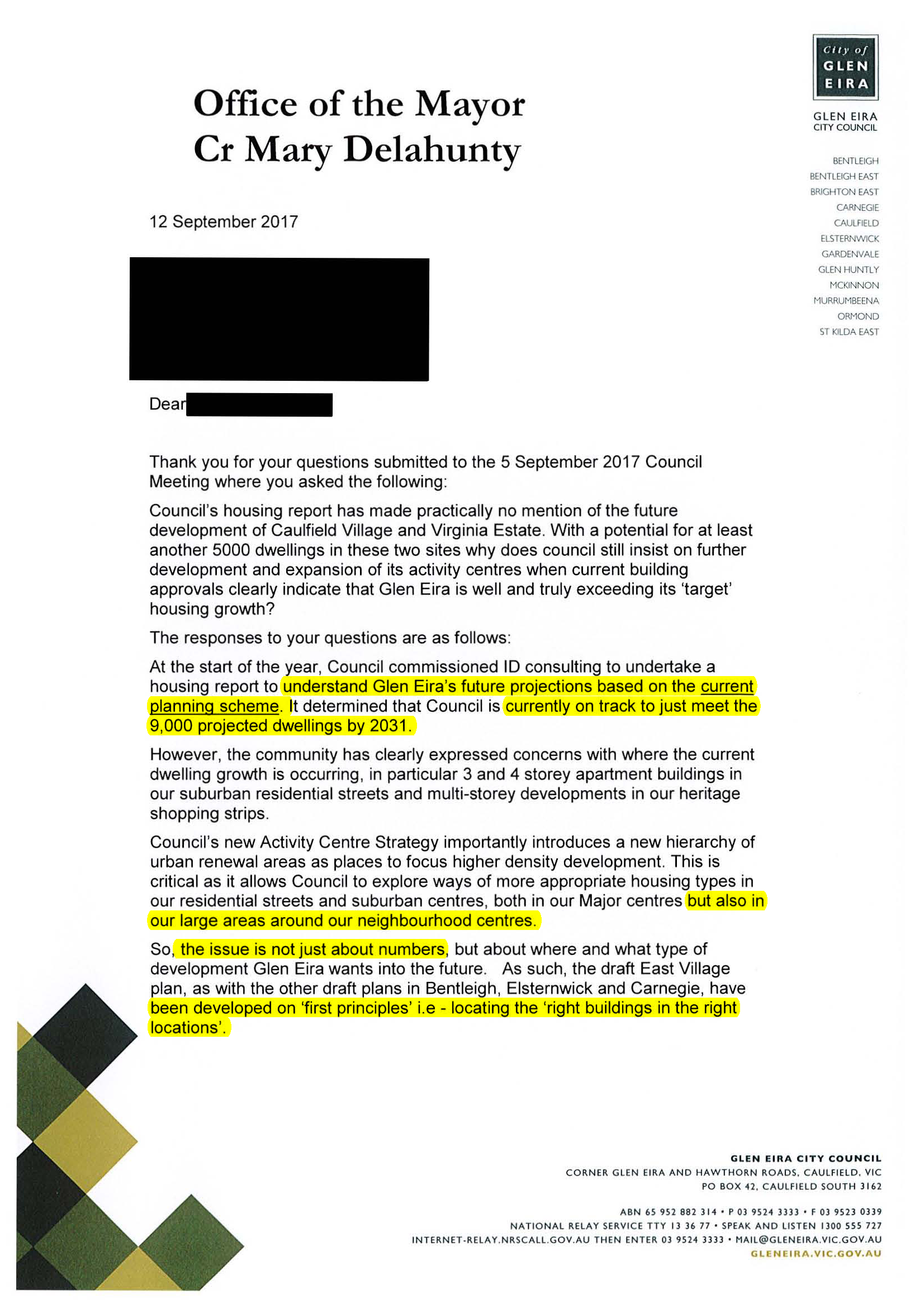
Council’s response to a public question asked at the last council meeting continues the tradition of – (a) not answering what was specifically asked; (b) revealing only half of the story, and (c) resorting to a plethora of meaningless motherhood statements.

We ask readers to especially focus on the highlighted sections in the following image. The question asked two specific things – why all of council’s documentation largely failed to take into account the development potential of Caulfield Village and Virginia Estate AND why council is proposing the expansion of our activity centres and hence more development when council is already well and truly surpassing its housing targets.

THE ‘ANSWER’

  • Council refers to the current planning scheme. Well the current planning scheme which is so out of date it is irrelevant states clearly that: there will be a need to plan for the additional 6,000 dwellings which are predicted for Glen Eira by 2021 as well as encouraging a more diverse housing stock (Department of Infrastructure, 1999, Victoria in Future).
    Not a word about 9000 or 2031!
  • Council then conflates the consultant’s Housing Study with Victoria in Future 2016. Far more damning however is the deliberate omission of some vital information. Here are the Victoria in Future projections where the 9000 additional dwellings is to be found in the time span from 2016 to 2031. Even these figures result in an average new dwellings per year of 642. Glen Eira’s average is practically triple this.
  • Nowhere in the housing study is the figure of 9000 mentioned. In fact, we’re told that in 2013 the available land promised 87 years of growth, but as of now this has been reduced to only 37 years. Are we therefore to conclude that development in Glen Eira has been so dramatic and drastic that in the space of 4 short years developers have gobbled up 50 years worth of previously available land? If so, then what does this say about our rate of development and the need for more development?
  • We might also ask what is the motive behind the use of the word ‘just’? Does this mean that according to council the projected housing growth is barely achieving what it must and this is the ‘excuse’ for facilitating more development? Where is the data to support such an outrageous claim?
  • Further the entire statement ignores what has been happening prior to 2016 and the amount of new dwellings that have already occurred in Glen Eira. Here are the figures for building approvals from 2011 to 2016 –
  • 2011/12 – 912
  • 2012/13 – 957
  • 2013/14 – 1,231
  • 2014/15 – 1,786
  • 2015/16 – 1,680
  • 2016/17 – 1991

That makes a grand total of 8557 in the space of 6 years. Victoria in Future 2016 projections are 13,000 from 2011 to 2031 – again reinforcing the fact that Glen Eira is capable of meeting its housing needs with an average of 650 dwellings per year. Even if this years Victoria in Future increases the number of projected dwellings needed, we maintain that Glen Eira remains well and truly ahead of the pack in the development game.

  • As for the 10 hectares of land now claimed to be ‘saved’ from 4 storey development it would be far more credible if council actually calculated how much land in the current RGZ areas was already chocka-block full of four storeys. Perhaps that would leave only 6 or 5 or 4 hectares that are now ‘saved’?
  • The most unbelievable statement is – the issue is not just about numbers. Surely it is the numbers that determine the required extent of new development? Surely it is the numbers that determine whether activity centre borders need to be doubled in size? Surely it is numbers that determine whether or not the municipality requires 12 storeys of mainly residential development in order to play its fair share in accommodating population growth? And the most important question – if structure planning is meant to apportion appropriate land use outcomes, then numbers are integral to decisions on where, how much, how high, and can the municipality cope with these numbers?
  • Please also note the failure to respond to the issue of Caulfield Village and Virginia Estate. With another potential 5000 dwellings to go up, then ‘first principles’ means nothing. Again, its back to numbers.

The really sad aspect of such a response is that councillors allowed this to go out in their name without a murmur. Do they really understand what is going on and have they heard the growing public resentment?

Whilst it is true that the past is the past and that we should be looking forward rather than back, history remains important – especially if that history is now being ‘revised’ and distorted with claims that are anything but truthful and has the potential to influence the present and future. This post seeks to correct these revisionist accounts by analysing the Hyams comments put up on the Bentleigh Action Group Facebook page. His comments are presented in italics.

….. when we consulted on the review of the planing scheme in 2010 -2011, we were told by the community that we should get mandatory height limits in residential zones, transition between zones and better protection for areas of significant neighbourhood character. We therefore changed our significant character areas to Neighbourhood Character Overlays, and added areas to those, and, as part of the zones that came in during 2013, achieved mandatory heights in all residential zones – the only Council to have this, and transition zones.

COMMENT

  • Mandatory height limits were NOT imposed on all residential zones. MUZ (Mixed Use Areas) which are included as ‘residential’ were totally ignored and remained so until the introduction of the recent interim height limits in Bentleigh & Carnegie. All other MUZ zones in Glen Eira do not have height limits.
  • There is not one single word in the 2010 Planning Scheme Review about mandatory heights for residential zones. Either this was not an overwhelming view in 2010, or the ensuing report was a total work of fiction. We’ve uploaded the report HERE and ask readers to carefully peruse this document. We challenge anyone to find a single word about height limits that does not relate to aged care only!
  • There has never been any ‘transition zones’ in Glen Eira. At best it can only be called a ‘buffer’. The only concession was the additional setbacks for the three storeys of GRZ2 when this bordered a Neighbourhood Residential zoning. – Even these setbacks and schedules pale into insignificance when compared to what other councils were able to achieve in their GRZ zoning. See: https://gleneira.wordpress.com/2015/09/22/some-more-comparisons/
  • The eventual Amendment C87 which introduced the Neighbourhood Character Overlays was totally inadequate. Many areas previously labelled as ‘significant’ became ‘non-significant’ . The total properties deemed ‘significant’ was just over a 1000 out of 50,000 plus homes. Further, nominations were made by officers alone. Both councillors and residents had no avenue upon which to include their nominations. The planning panel in fact stated that another amendment was required in order for residents to have other properties included. This took another few years and the additional numbers were less than earth shattering. It is also worth remembering that the Planning Panel report of December 2002, told council to introduce Neighbourhood Character Overlays. It took 10 years for council to get Amendment C87 underway!!!!!

We ahd (sic) intended to wait for the respective state governments to finish further reviewing their planning policies before we did our next review, so we knew what we were working with but, as you noted, the government required us to proceed with our Review.

COMMENT

  • The legislation requires local government to undertake reviews every 4 years. Council was required to undertake its next review in 2014. That would have provided them with a year’s ‘experience’ of the zones. Instead they requested and received extensions from Guy. Who applied for these extensions and whether they were done under delegated authority is the crucial question since there was no resolution permitting at least 3 consecutive requests for extensions. Readers should also note that the authority to request extensions is not delegated under the legislation. Thus, the questions remain – did councillors know that these requests had gone in? Were they supportive of these requests? If Wynne had not finally had a gut full of Glen Eira, and refused their latest request for a 2 year extension, would we still be sitting on our backsides and not have had a planning scheme review in 2016?

 It is notable that, as part of its review of the planning zones, the government has decreed that all General Residential Zones should now have mandatory height limits. We already had this, but many others had heights that were lower, but discretionary.

COMMENTS

  • Once again Hyams is not averse to telling a few porkies. If height limits are included in the schedule to a zone, then they are MANDATORY and not discretionary. There were plenty of other councils who used their schedules to good effect and achieved far greater benefit to their communities than Glen Eira did. Our council worked on the principle of ‘we’re perfect’ so don’t have to change a thing and we can rely on a housing strategy based on 1999 data. Thus it became a ‘one size fits all’. The schedules basically replicated what had been set up through Amendment C25 in 2004 (this amendment created the Housing Diversity/Minimal Change areas). By way of example here is what some other councils were able to achieve via the schedules to their zones –


Bayside – MUZ – 50% site coverage; GRZ’S – 50% SITE COVERAGE (Glen Eira 60% in GRZ and nothing for MUZ)

Boroondara – GRZ1 – 9 metres; GRZ2 – 10.5 metres; grz3 – 10.5 metres;

Greater Dandenong – permeability – 30% for GRZ1 and in NRZ – 40% permeability (Glen Eira – permeability 25% in NRZ and 20% in GRZ/RGZ)

Manninghem – RGZ1 – 11 METRES FOR PARTS OF MUNICIPALITY; GRZ1 – 9 METRES; PLUS FOR NRZ1 IN CERTAIN AREAS THERE IS THIS MANDATORY STIPULATION – The number of dwellings on a lot must not exceed 1

Stonnington – grz5 – 9 metres; grz6 – 11.5 metres; grz7 – 10.5 metres; grz8 – 12 metres;  grz10 – 9 metres; grz11 – 12 metres; grz 12 – 9 metres; grz14 – 9 metres

 Furthermore, the new mandated height is 11 metres, but we stay at 10.5 metres because that’s what we have in the schedule to the zone. It would therefore appear that we were ahead in this, rather than outdated.

COMMENT

Again, what is not stated is as important as what is stated. With the new legislation of VC110, councils have been given 3 years (from March 2017) to come into line – ie 9 metres in NRZ and 11 metres for GRZ. All councils will then revert to these heights regardless of whether or not their current height limits are lower. Even more important is the fact that council decided that what was previously a 9 metre discretionary height limit should overnight become a 10.5 or a 13.5 height limit across the board – all done in secret and without any consultation whatsoever. Other councils of course analysed their municipalities and produced various height limits to suit the specific areas. In other words, they actually did some decent planning. Glen Eira did none of this.

The committee advising the government in its review stated very clearly that the default zone should be the GRZ, not the NRZ as it is in Glen Eira, and that the NRZ should be used sparingly. This, if implemented, would have resulted in far more streets like Princes Street, not fewer, but fortunately, the government has not chosen to redraw the boundaries, despite the recommendation. It is also fortunate, therefore, that we had the zones implemented before the committee report.

COMMENT

The effect of implementing the zones before the committee report, and being the first council in the state to do so, gave developers a year’s head start to exploit the new height limits in both the GRZ and the RGZ. Developers now knew that they could build 4 and 3 storeys with impunity across large swathes of the municipality. Also worthy of comment is the fact that the Planning Panel report of 2004 stated unequivocally that council needed to address the borders for its neighbourhood centres and consider whether some suburbs like Murrumbeena and Ormond were in fact suitable candidates for designation as neighbourhood centres. Council has totally ignored this for the past 13 years. The panel also repeatedly stated that amendment C25 was viewed as ‘interim’ and that council must proceed with far more and immediate strategic planning to iron out all the anomalies. This never happened.

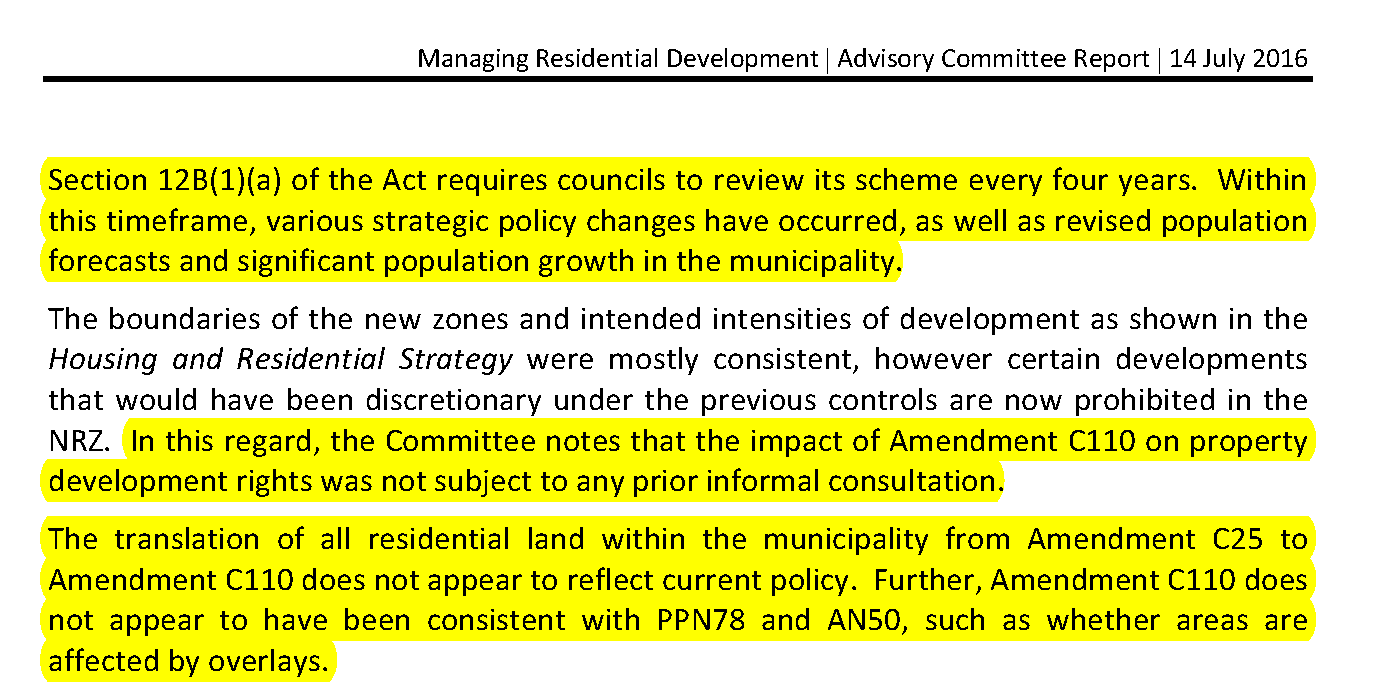
Even the later government  Advisory Committee report had this to say about the process that Glen Eira used to introduce the new zones in 2013 – especially the lack of strategic justification and lack of consultation.
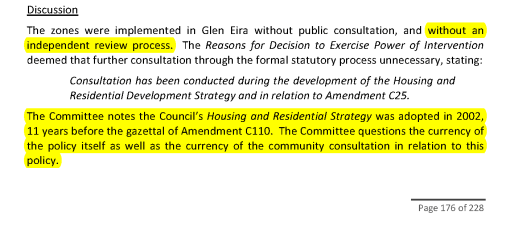
The State Government has not redrawn the boundaries as Hyams stated. This has been left up to individual councils. So what does our mob do? Borders have expanded, hundreds of currently zoned NRZ properties are now ‘suitable’ for 3 to 4 storey development and current 4 storeys may well become 12 storeys. Is the past about to repeat itself? Where is there one iota of strategic evidence for any of this current planning?

The past is thus crucial to an understanding of the present and the future. As a result of this past council now finds itself with a deluge of required work. For many areas it is far too late to ameliorate the damage already done. Structure planning is the start of a long overdue process. It is up to residents to decide whether the eventual outcomes from the current planning efforts are adequate and deliver what is expected. But structure planning is only the start. The most important aspect will be the ensuing amendments and their strategic justification, plus the accompanying schedules to the various zones.

Residents have made their views absolutely clear. Councillors had better be ready for an almighty fight if residents feel that the past is about to be repeated.
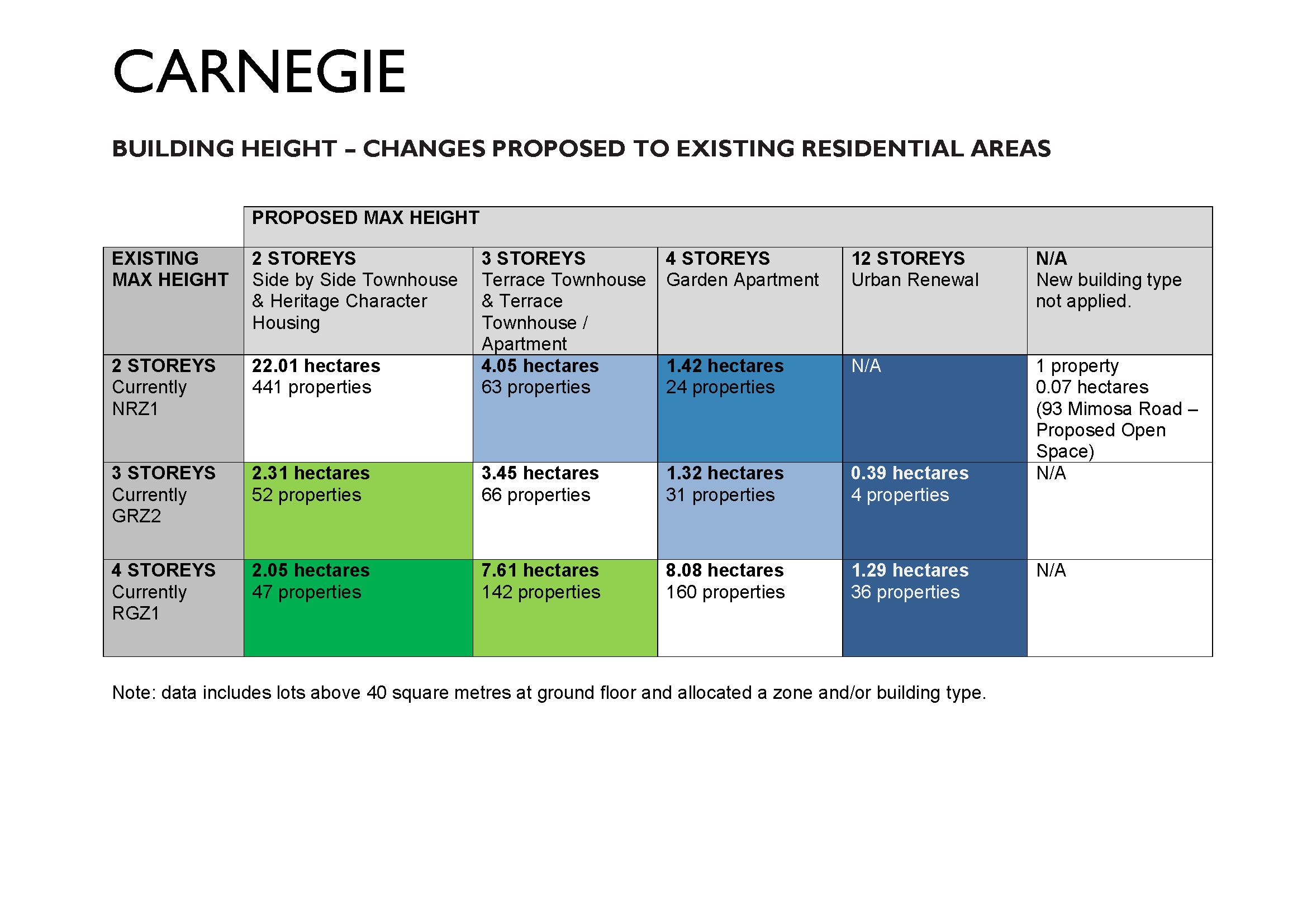
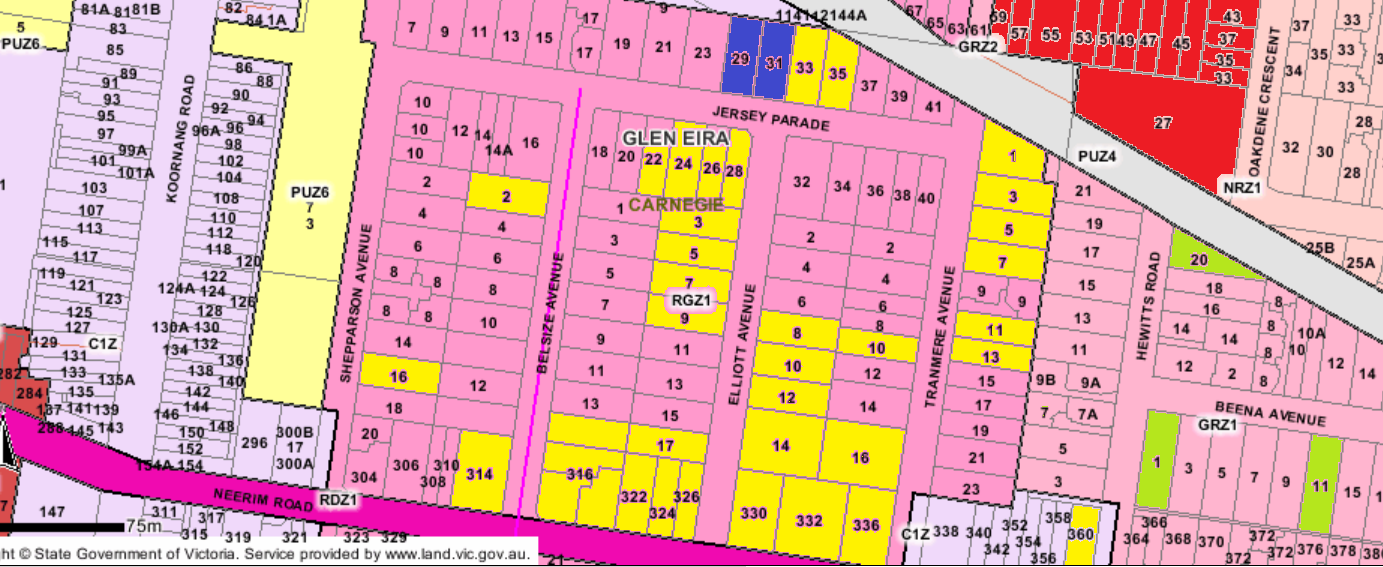
Here is council’s version of the relevant stats for Carnegie and the proposed structure plan – According to the above figure the residents of Carnegie are supposed to be better off in terms of the number of properties rezoned to a lower height. As with the Bentleigh figures, the reality is far different. One example is the rezoning of Elliott Avenue and Tranmere where seven properties on the east side of Elliott Avenue will go from 4 to 3 storeys, and both sides of Tranmere will also be reduced by one storey. Nominally, that should make it 21 properties that will have a reduction in height. Sadly, it is far too late for 14 of these properties which are already set for 4 storey development. (Please note – we are counting the consolidated lots as 2 properties).

This image tells the full story – post zones.

  • No 1 Tranmere has been to VCAT. Given developers’ past history, there is always the second bite at the cherry by simply reducing the number of proposed dwellings by a handful. It will be back again.
  • Nos. 3 -7 Tranmere are currently up for sale and will have their applications in well and truly before any amendments see the light of day from council! (See: – http://raywhitecarnegie.com.au/properties/residential-for-sale/vic/carnegie-3163/house/1709969 )
  • No.8 Tranmere sold in April 2016, No.6 Tranmere in 2015 & No. 11 Tranmere sold in November 2016. Whilst these properties could possibly remain as ‘owner-occupier’ we don’t like their chances of remaining so given what is happening around them and the potential to make some major profit.

Thus Tranmere & Elliott are GONE, GONE, GONE thanks to what happened in 2013 and no revamping of the zoning at this late point in time is going to alter this fact.

So that readers fully understand the above image here is the legend –

  • Yellow infill means that permits have been granted for 4 storey developments, or will soon have applications coming in for 4 storeys.
  • The dark blue in Jersey Parade is another application currently in for 4 storeys
  • The light green represents other applications and/or permits
  • The red indicates the upgrade from 4 storeys to a potential 12 storeys.

QUESTIONS

  • Given examples like this, how much faith should residents place in council’s figures?
  • What effect will rezoning have if nothing changes in the schedules to the zones and when will council get around to actually doing anything with the schedules?
  • The destruction of these streets has been known for years yet council has tried time after time to avoid undertaking a planning scheme review. This has only happened due to Wynne’s refusal to grant another extension and the order to undertake structure planning.
  • What is the strategic justification for any of these changes? Does it make sense to impose a 12 storey height limit on residents zoned for 4 storeys? We keep hearing the nonsense about ‘right buildings in the right place’ and maintaining a ‘balance’. The only ‘balance’ we can find is an open invitation for more development and the selling off of council land!

PS: we’ve received an email from a resident telling us that nos. 7-11 Belsize Avenue has been sold to a group of developers. Anyone want to take bets on what will happen to this land?

How much more public money is about to go down the drain because council refuses to accept the outcome of its first round of ‘consultation’ on the proposed redevelopment of Harleston Park? A million dollars was the original planned expenditure for this single park. We are now about to enter another phase of ‘consultation’ if the recommendations are voted through next Tuesday night.

We estimate that close to 90% of resident feedback was against the creation of a basketball area in the park. The vast majority of comments wanted to maintain the park’s passive atmosphere. So what does council do? Does it listen? It recommends a smaller ‘three point’ basketball court in a different spot. No dimensions are given and no comment is made on resident objections to the lurid blue originally suggested. Nor is there any evidence provided that a smaller court will create less noise or less conflict with passive areas.

This entire project raises innumerable  issues:

  • Why does every single park need to be a duplicate of each other – ie. some comments compared the proposals to what has been created in Booran Reserve. We also note that the Australian Standards do endorse that parks should differ and suit the local community. Glen Eira’s ‘interpretation’ of this comes via this paragraph – Public open spaces are a shared community asset. Living in proximity to parks does not afford residents greater rights over the use and development of these spaces than the wider community.
  • Why does council insist on spending a fortune on concrete plinths, so that again and again there is this ‘standardised’ look for all our open spaces?
  • Why can’t council publish concept plans that are legible and clear – which they certainly aren’t in the agenda papers?

We also challenge many of the comments included in the officer report. For example: Crime Prevention Through Environmental Design (CPTED) principles do not suggest lighting necessarily improves safety, and in some cases it may attract people to use the park later in the evening and night. This is not an intended outcome of the project and as such lighting has not been included – consistent with the status quo. 

If this is indeed the case then why has council spent millions upon lighting in so many of our parks – ie Princes Park, Allnutt Park to name just a few. More importantly, both the Victorian Police and Planning Vic recommend park lighting – ie Proper maintenance of landscaping, lighting treatment and other features can assist in the prevention of crime. (http://www.police.vic.gov.au/content.asp?document_id=10444)

AND

OBJECTIVE 4.3

To ensure lighting is carefully integrated to further enhance visibility and natural surveillance of parks and open spaces. (https://www.planning.vic.gov.au/__data/assets/pdf_file/0014/4631/Safer_Design_Guidelines.pdf)

The bottom line is that the community has been asked for its opinion and they have spoken. Council however is unwilling to accept the majority view based on this report. Possibly this will become another Caulfield Conservatory fiasco where 3 ‘consultations’ were undertaken.

Our position is: –

  • Allow diversity and uniqueness. Don’t clone each park into a pale imitation of each other
  • Give greater emphases to ‘passive’ and ‘green open space’
  • Stop spending a fortune for unnecessary works
  • Stop filling our parks with tons of concrete
  • Develop a playground policy that establishes expected work and budgets
  • And most important – listen to the community!

PS: We are in error. The site is zoned Commercial so technically ResCode does not apply. However, this still doesn’t obviate the need to assess applications against Section 58 of the Planning Scheme.

Another mammoth agenda (in paper weight) of mumbo-jumbo that would fit exceedingly well into any episode of Utopia. Until officer reports become truthful and provide detailed justifications for all recommendations, then good governance in Glen Eira is well and truly dead.  Here is our first example of what can literally only be called devious or incompetent – the rest to follow in the days ahead!

Planning Report

One application is for 4 storeys in Tucker Road, McKinnon. The Tangalakis recommendation is to grant a permit but for 3 storeys instead of the 4. What is totally unforgiveable in this report comes from page 73, where we find this paragraph –

Amenity impacts

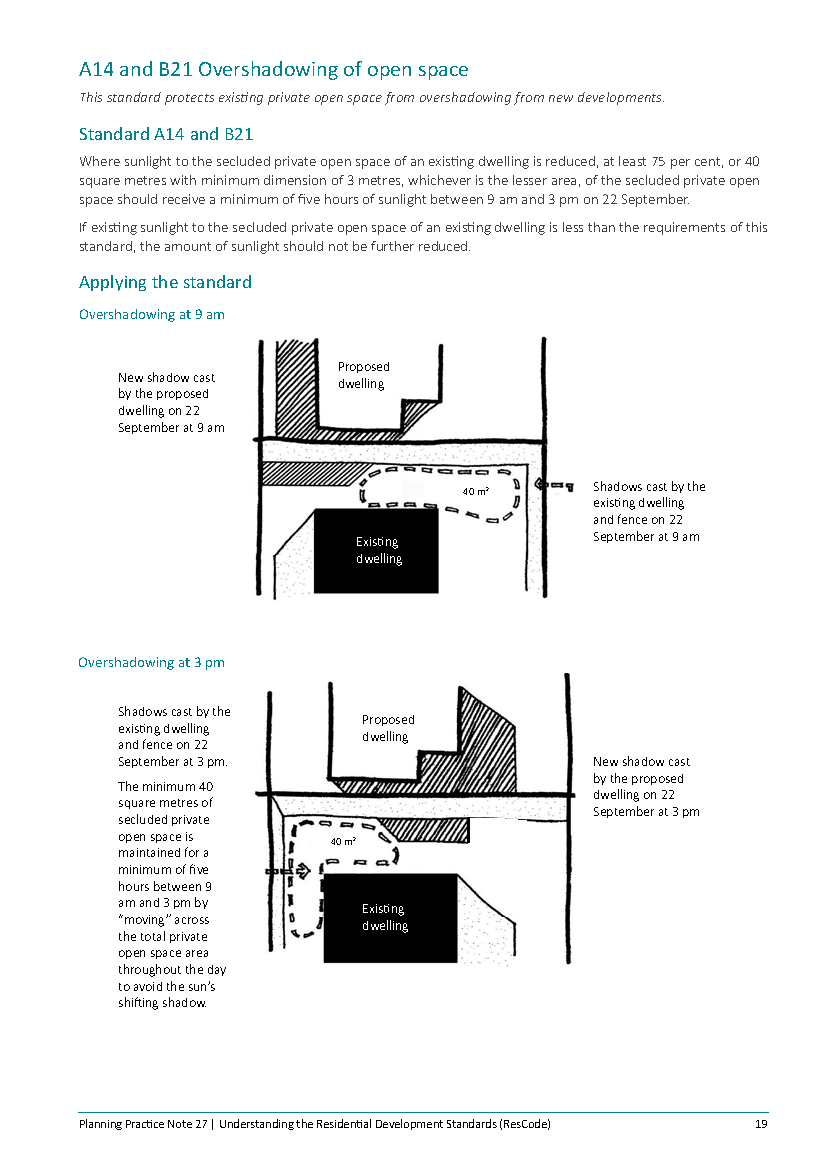
There will be overshadowing of the rear open space of the neighbouring property immediately to the south, however State Government requirements remain silent in relation to the overshadowing of neighbouring properties. They makes specific reference to overlooking impacts, but does not provide detailed requirements for overshadowing compliance

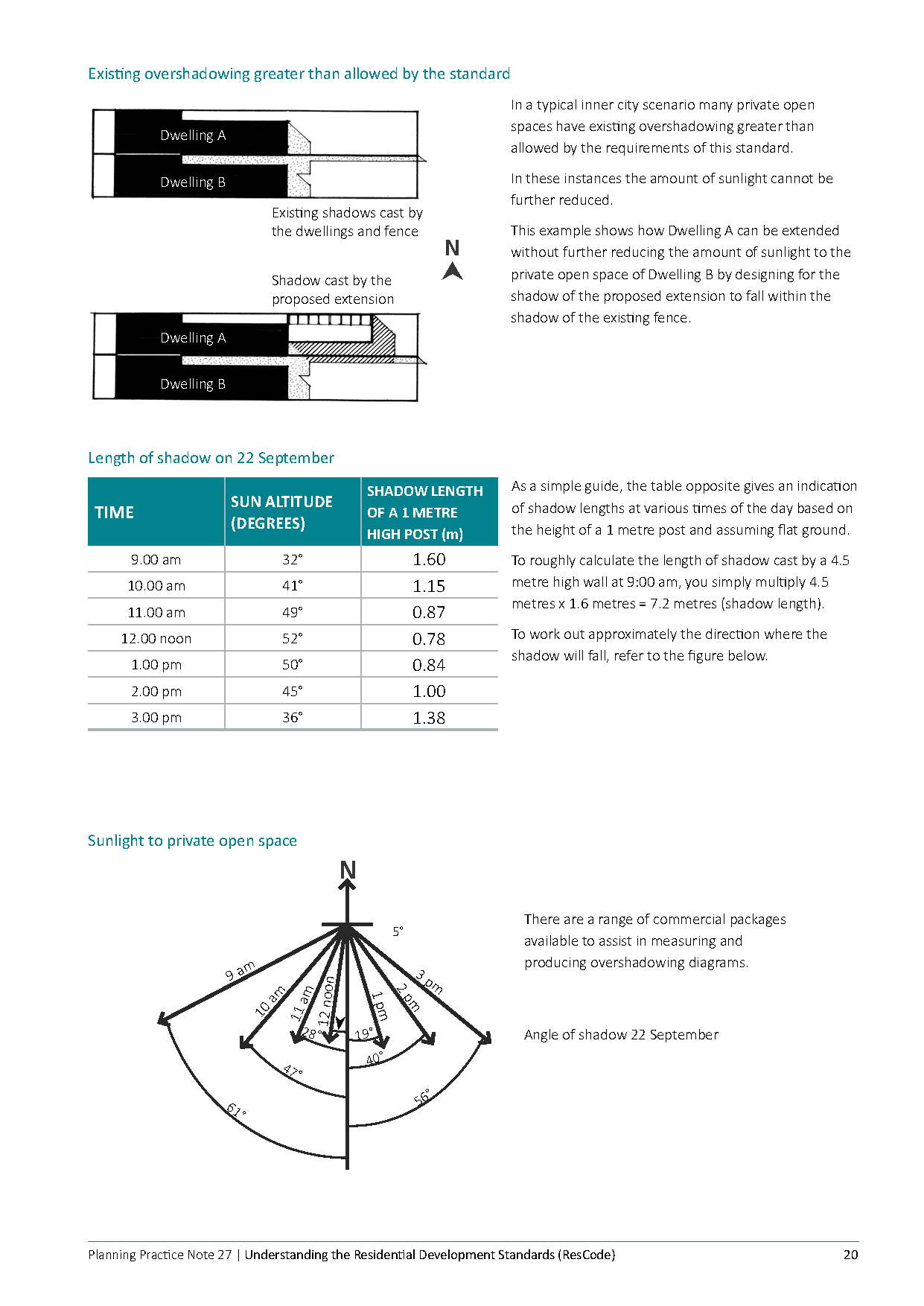
Apart from the shoddy grammar and lack of proof reading, this statement is blatantly untrue! ResCode via Planning Practice Note 27 does have very specific criteria for overshadowing as well as overlooking! (see below). Only two conclusions are therefore possible. Either the planner is entirely incompetent and does not know or understand the planning legislation, or this is a deliberate attempt to mislead. Either way, it is unacceptable.

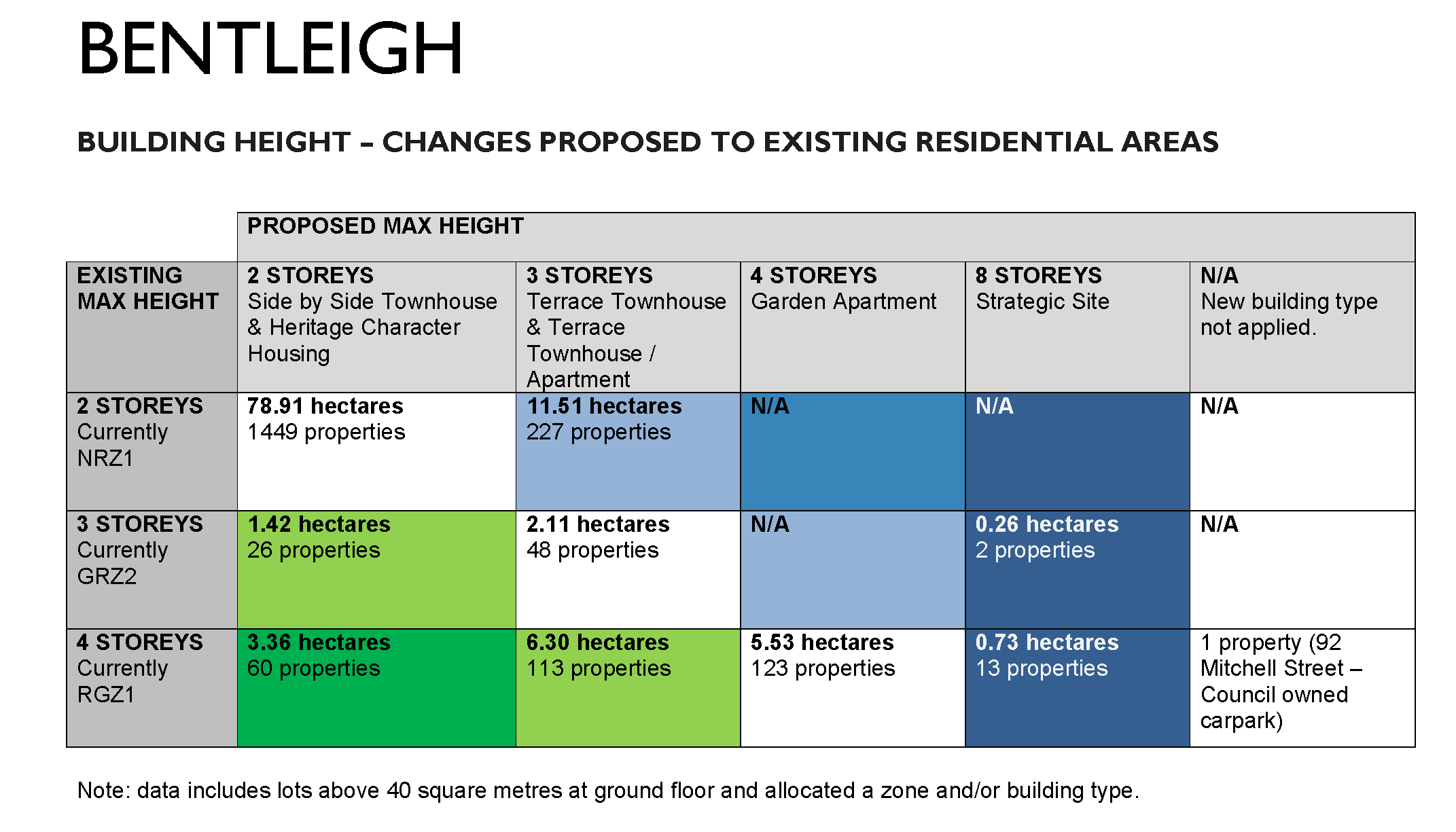
According to council’s own set of figures for Bentleigh (presented below) the proposed changes basically maintain the status quo. That is, there is not too much difference between those properties in line for increased height limits and those areas where height has been reduced.

Adding up all the figures from the table we find that:

  • 243 properties are earmarked for an increase in height, whilst
  • 199 properties are supposedly going to experience a decrease in height

Leaving aside the question of strategic justification for most of these changes, we still ponder whether these statistics really reveal the true stor(e)y (pun intended!). A positive is undoubtedly the rezoning of heritage areas – which implicitly acknowledges the incompetence of what occurred in August 2013. However, the most important issue is whether all of these changes are in fact far too late and what they can achieve? This will of course depend on the resulting amendments and the strength of the long awaited Heritage policy.

A couple of examples should illustrate what we mean regarding the value of some of the proposed changes and how these examples throw some doubt on the figures provided by council.

EXAMPLE 1:

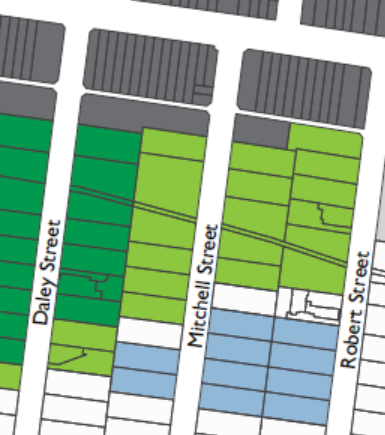
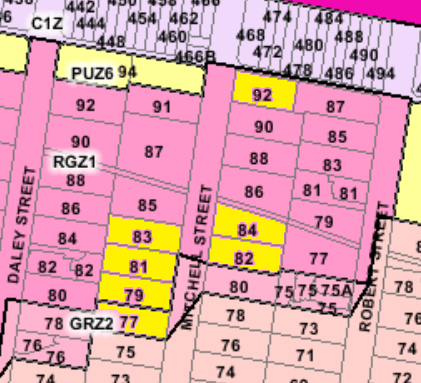
The intention is to rezone 11 properties in Mitchell Street from 4 to 3 storeys PLUS increase another 10 properties from 2 storeys to 3 storeys. But the sticking point is that Mitchell Street already has permits for 4 storey dwellings (nos. 79-83 and 82-84). Number 77 also has a permit for a 3 storey dwelling and no. 92 is probably geared for sale as a council car park. Hence of the 11 properties along this single stretch of road, 6 already are at 4 storeys and another one will go even higher. Thus council’s figure of 199 properties set for a height decrease certainly do not reveal the true storey since no account is taken of what already exists in these figures.

Further, what of the 6 properties going from 2 to 3 storeys in Mitchell Street?  Why are they being ‘upgraded’? What is the purpose, much less the strategic justification? If the intent is to draw a straight line that corresponds with the heritage overlays of Daley Street and Bendigo Avenue, then this hasn’t been achieved. We are still getting a zig-zag line of housing heights that make no sense and contradict council’s claims about trying to avert the radial configurations set in 2013.

EXAMPLE 2:

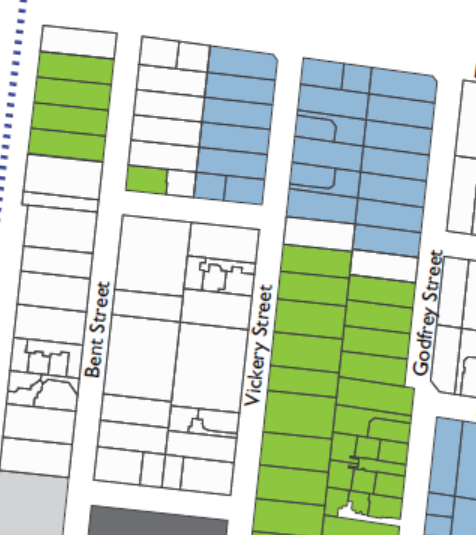
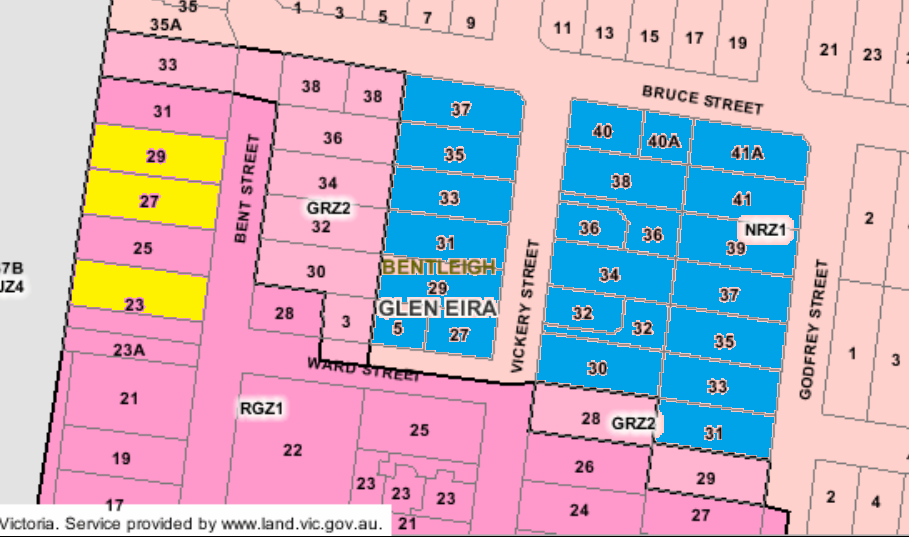
The same issues apply in Bent and Vickery Streets. Council proposes to rezone 25-31, plus 28 Bent Street to 3 storeys (ie 5 properties) and upgrade another 6 properties in Vickery to three storeys from the current 2 storey height limit.  No recognition is taken of the fact that permits for 4 storeys have already been granted to nos. 23,27-29 Bent Street for 4 storey developments. That makes it 2 out of the 5 sites that will be 4 storey. The blue markings in the image following are for the areas designated to now be 3 storeys, up from 2 storeys.

QUESTIONS

Residents really need to start questioning the efficacy, and strategic justification for some of these proposed changes. Is the solution to the current radial set up to simply increase height to the nearest bordering street? Does this really ameliorate the damage already caused or simply invite more damage to residential amenity? How much faith should ultimately be placed in the figures council presents – especially on the downgrading of heights in streets that are already chock-a-block full of 4 storeys. What consistency is to be found across all of these proposed changes? Why are some streets better off than others and why are upgrades along Centre Road so extensive? What does this augur for the eventual revealing of the plans for East Bentleigh? Will we now have entire activity centres blending into each other and stretching from Thomas Street to East Boundary Road? Remember that East Bentleigh is now also being ‘upgraded’ to a ‘larger’ neighbourhood centre – whatever that might mean!

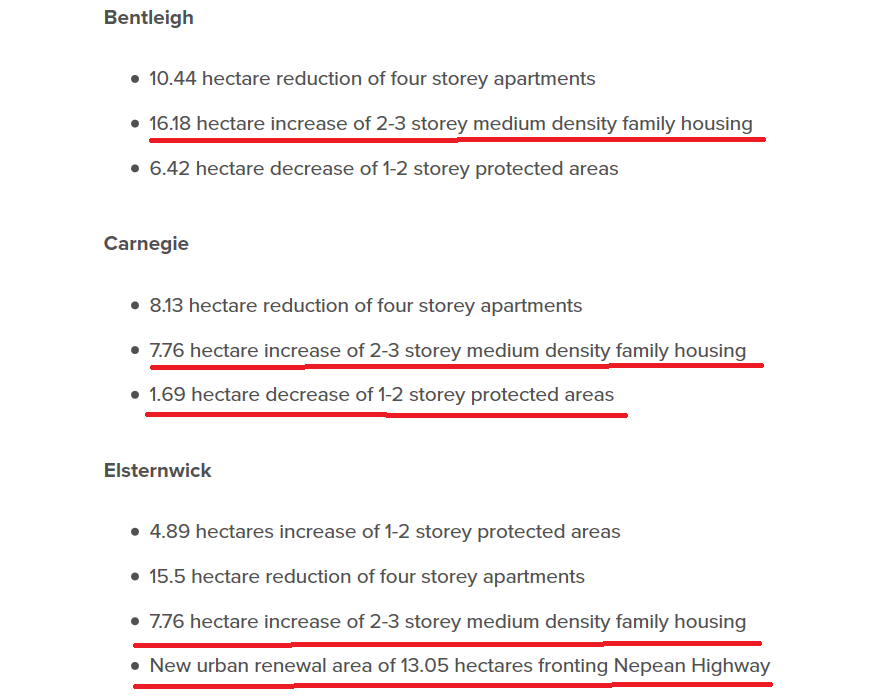
After some considerable pressure from residents, council has finally released its figures on the proposed zoning changes. We’ve uploaded the relevant document HERE.

The emphases remains on meeting government population growth – without of course any mention of current housing happening within Glen Eira. The enumeration of the hectares devoted to the various zones, both current and proposed, is also proffered without any explanation or clear definition – for example: do these figures include roads?

Council is clearly intent on maintaining the mantra that these changes are basically ‘neutral’ – that is, that the overall totals are ‘equitable’. We beg to differ! Once we’ve gone through all the details more carefully we will provide a commentary. In the meantime, here is council’s ‘summary’ –


Another great turnout by residents of approximately 100 people. Again butcher paper, facilitator and Aiden Mullen presenting the background, current status and promised future work. There was however about an hour of questions that interrupted Mullin’s presentation. We note once again that the magic words of 12 storey high potential developments were eventually admitted through gritted teeth!

Councillors in attendance: Delahunty, Silver, Sztrajt and Athanasopoulos

Here are a mere sample of the questions asked by residents and the ‘answers’

RESIDENT #1 – One resident asked for hands up from residents, developers, and state government agencies. The vast majority were residents

RESIDENT #2 – When Mullin put up the slide of the Vision for Elsternwick, which still included the word ‘village’, this resident interrupted and stated ‘I am quite frankly struggling to relate that vision plan to the concept plan’. Said that all council’s thinking and what’s presented in the concept plans ‘doesn’t seem’ to endorse the vision statement. Mullin answered that it’s about ‘maintaining that strong cultural and heritage feel’. Mullin then went on with the rest of the presentation – ie spoke about bike connections, and an ‘integrated rail precinct’ and parking ‘opporunities, particularly along Orrong Road’. Said that the ‘fundamental change’ would be ‘creating a new cultural precinct’ near the cinema and ABC studios. Plus the library ‘could be relocated’ to this new precinct. Also said that ‘council’s carparks could have a role in providing more office’ space and employment opportunities (aka flogging off council land to developers is our take on this).

RESIDENT 3 – another resident interrupted and wanted Mullin to explain what ‘community benefit’ means. Mullin responded by saying that Glen Eira is a ‘diverse community’ but developers only build one sort of dwelling – ie 1 or 2 bedroom or double storey attached in the NRZ. ‘The market’ doesn’t do ‘affordable housing, aged care’ and student accommodation and ‘medium density family type housing’. Said that on ‘counciul owned land we can have a lot more control on that’. Resident then wanted to know whether this land would be ‘given to the developer and they produce it’? Mullin responded that there’s a ‘whole range’ of ways this could be done. Resident then persisted with ‘selling council land’ and Mullin answered ‘that is one option’ but that nothing has been decided as yet. The objective is to ‘get something in’ that ‘meets community needs that isn’t being met at the moment’.

RESIDENT 4 – When Mullin outlined that the car park had an 11 storey permit next to it, another resident stated that ‘an 11 storey building doesn’t set a precedent for what is right in terms of development’. Went on to say that ‘someone who wrote these plans missed the church’ and a scout hall both ‘historic buildings’ but the plans have building heights of 8 storeys so ‘what is going to happen to that church’? Wanted Mullin to ‘please explain to me, how does that work out’? Mullin then said ‘I’m trying to get through the presentation and the resident repeated that he would like an answer. When Mullin again said that he wanted to continue with his presentation the resident stated that the evening was about residents asking questions and getting answers from those people who put the plans together. Mullin said that his aim was to ‘take you through to how we got to’ this stage and get your feedback. It’s up to residents to then decide if they ‘agree’. Mullin went on to say that people didn’t want apartment buildings in residential streets and council ‘really’ wanted to protect heritage and the neighbourhood character overlays and these are currently zoned for 4 storeys. Stated that a vcat decision for 8 storeys was given recently in a heritage overlay and vcat is saying that if you ‘lock everything down it has to go elsewhere’. Council was trying to ‘get a better mix’ in housing and in the commercial areas a better mix of employment opportunities like ‘office’.

RESIDENT 5 – said there was no single storeys being built and there was a strong need for this. Wanted to know why this wasn’t in the plans. Mullen said this is because people are trying to ‘protect back yards’ and that with council’s plans for the townhouses they are trying to ensure that ‘living is on groundfloor’.

Mullen went on to say that ‘you can’t lock down everything’ because if ‘won’t get approved by the Minister’. So council is protecting heritage but saying that along the railway line and Nepean Highway this can ‘accommodate’ ‘taller buildings’ which will have an ‘office’ and ‘allow for employment’. This area would be 6-8 storeys but if there was ‘community benefit’ this could be ‘additional car parking’, ’employment’, ‘diverse housing’. The strategic sites ‘can accommodate height behind the shops’.

RESIDENT 6: said that ‘our little court’ disappears from the concept plans but council has ‘rezoned that area’ to ‘be 6 storeys’. Wanted to know why previously it was 4 storeys and now capable of a potential 6 storeys. Repeated that ‘this is in a court and we’re not on Glen Huntly Road’. Mullin answered that he would be ‘happy to discuss’ the matter with the resident afterwards.

CONCLUSIONS?

Once again residents are presented with spin and more spin and no detail, no strategic justifications for anything, and no honest to goodness data. We remind readers that at the Bentleigh forum when asked how many properties were being rezoned to accommodate higher development, Mullen stated that the data would be provided. It is yet to make an appearance!!!!!

Nor have we had a single word to justify why 12 storeys is fair and reasonable. Why not 6 storeys, or 7 storeys, etc. On what basis is the figure of 12 storeys plucked from the air?

There is much, much more that could be said. We will simply reiterate our conviction that decisions are already set in concrete and that these forums have been nothing more than a public relations exercise designed to meet state recommendations for ‘community consultation’ when doing structure planning.

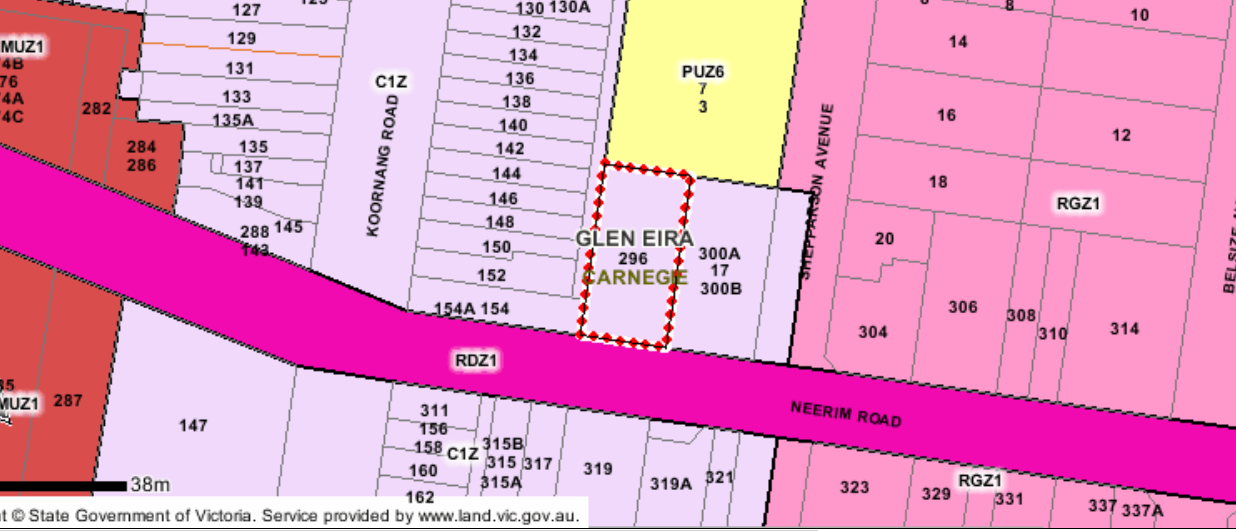
Council never fails to surprise when it comes to open space. The announcement that they have purchased a site in Neerim Road, Carnegie is, in our view, a mixed blessing indeed. Whilst we have consistently argued that it is Carnegie that requires a huge investment of funding for open space, we also query the motives behind this purchase.

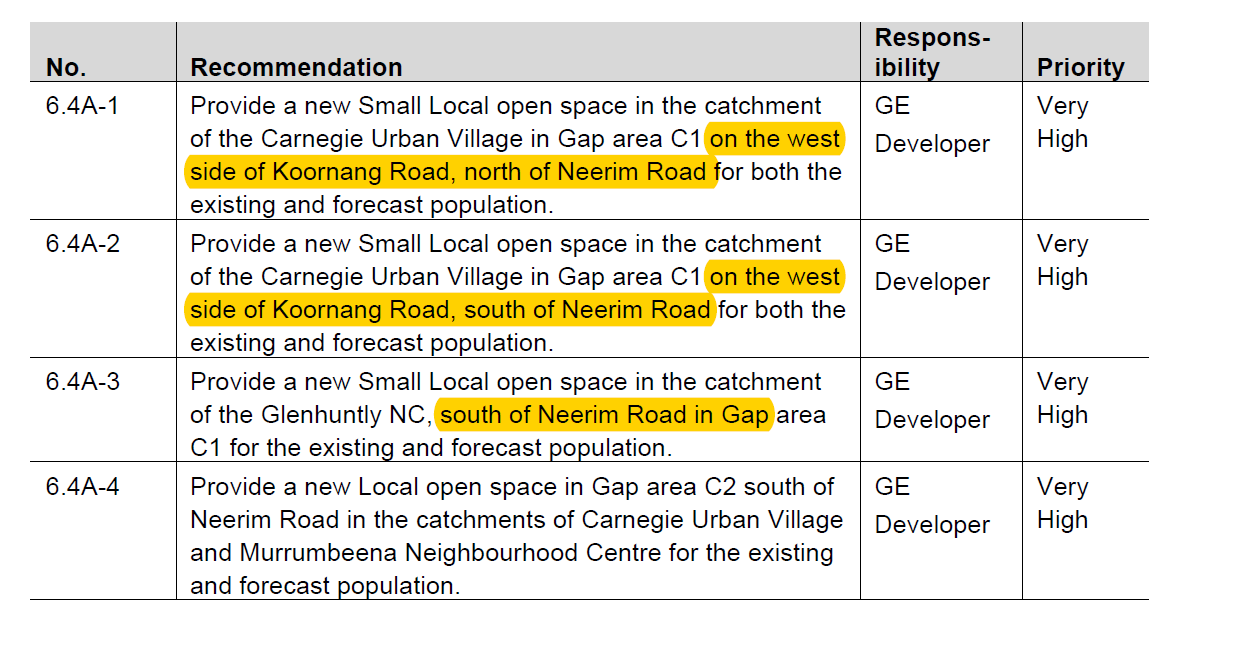
Residents have been repeatedly told that council’s rationale for all its open space endeavours is based on the 2014 Open Space Strategy. Well, unfortunately, this particular purchase is at odds with what the OSS recommends. The ‘expert’ recommendations were for the purchase of land on the WEST SIDE of Koornang Road. This property is on the east. See the two images below –

Points to consider:

  • Will this purchase become the $3.61 million reason to ram through the sell of council’s carpark and set the stage for 8 storey developments?
  • Neerim Road itself is hardly a ‘pedestrianised’ street. It is full of high density dwellings already. Thus access from Neerim Road itself would certainly be limited
  • Residents on the south side of Neerim are also ‘disadvantaged’ given that the OSS decries the creation of open space that necessitates the crossing of major roads.
  • The crucial question of course is what does all this say about council’s intention to first listen to the community and then to act on the community’s views. If this sizeable amount of money has already been signed off, then what prospect is there that if the community doesn’t agree with the sell off and ‘repurposing’ of council land, that residents will be listened to? Or is 600 square metres in the most noisy, and inaccessible position, plus being overshadowed by 8 storey dwellings, all that residents can hope for?
  • Finally we again question the consistency and value of any council ‘policy’ when it can function to justify any decision when council so pleases, and then be ignored – also at council’s whim and hidden agendas!

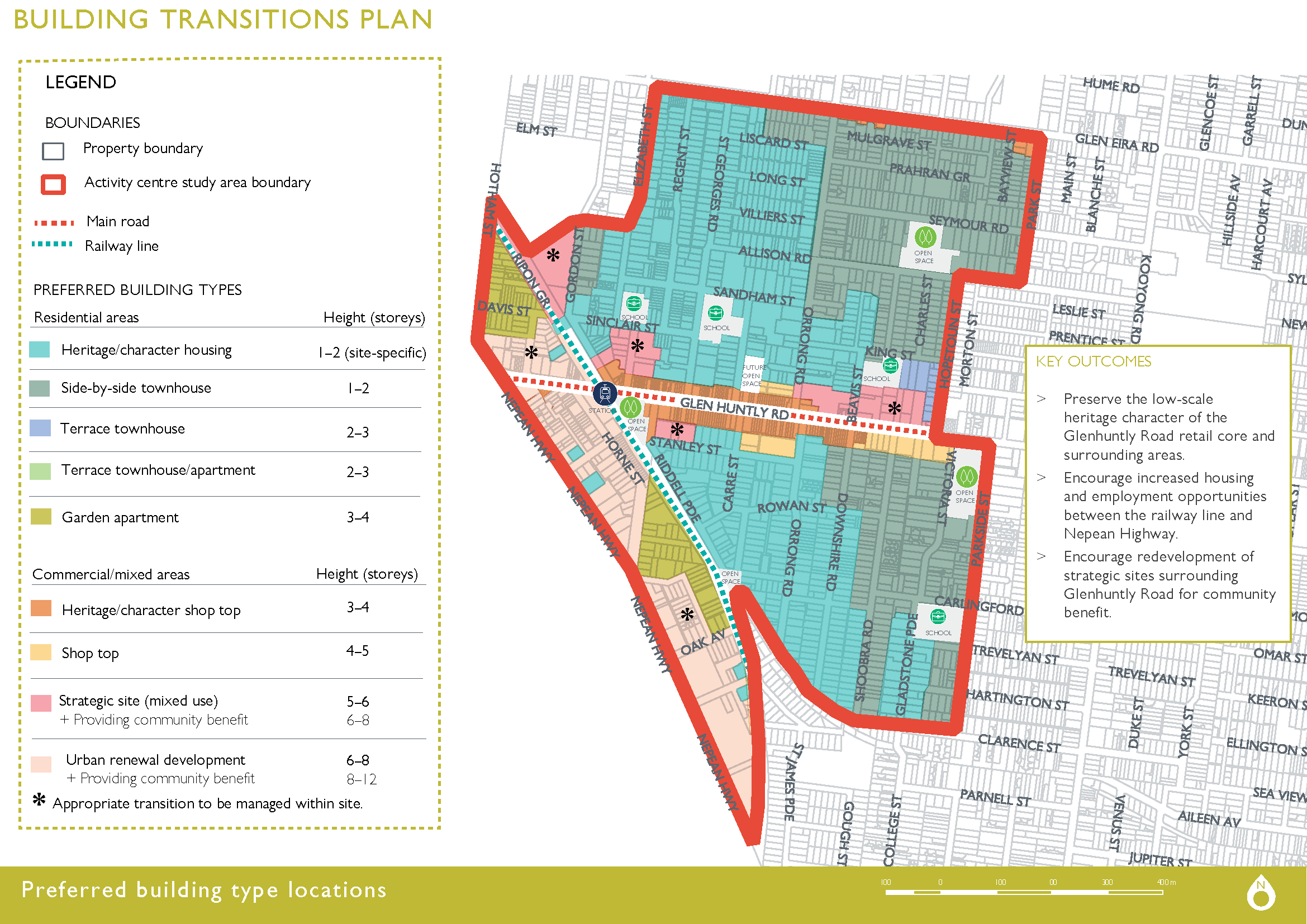
The Elsternwick draft concept plans are ‘interesting’ to say the least.  First off there is the admission how badly this council and its zones architects stuffed up in 2013. When an activity centre has so many areas covered by Heritage Overlays, Newton, Akehurst, Hyams, Delahunty, Magee and Esakoff, all saw fit to go ahead and allow these areas to be zoned as Residential Growth Zone (RGZ). Thankfully the current plans attempt to redress this incompetence. However, they do a lot more ‘damage’ elsewhere in another example of clearing the ground for major high rise development!

Here is a summary of what is proposed –

  • As with Carnegie, the central shopping strip will have 3-4 storey (orange) but some of this strip will allow 8 storeys directly behind Glen Huntly Road (ie Sinclair and Beavis Streets) which abut heritage areas. Thus like Carnegie, heritage areas will be overshadowed by anything up to 8 storeys.
  • Several heritage sites along Nepean Highway will be, as with Carnegie, directly overshadowed by 12 storeys
  • The ‘borders’ of the activity centre have, like Bentleigh, mushroomed out to practically double the size – now extending to Glen Eira Road.
  • Ripon Grove and Gordon Street will now also become 8 storeys (from the current 4 storeys) and once more they sit alongside Heritage areas.
  • The most startling changes will occur all along Horne Street to Nepean Highway. These sites can now become 12 storeys – again encircling previous NRZ zones that are now upgraded to 4 storeys.
  • The amount of land now given the go-ahead for 12 storeys is alarming!
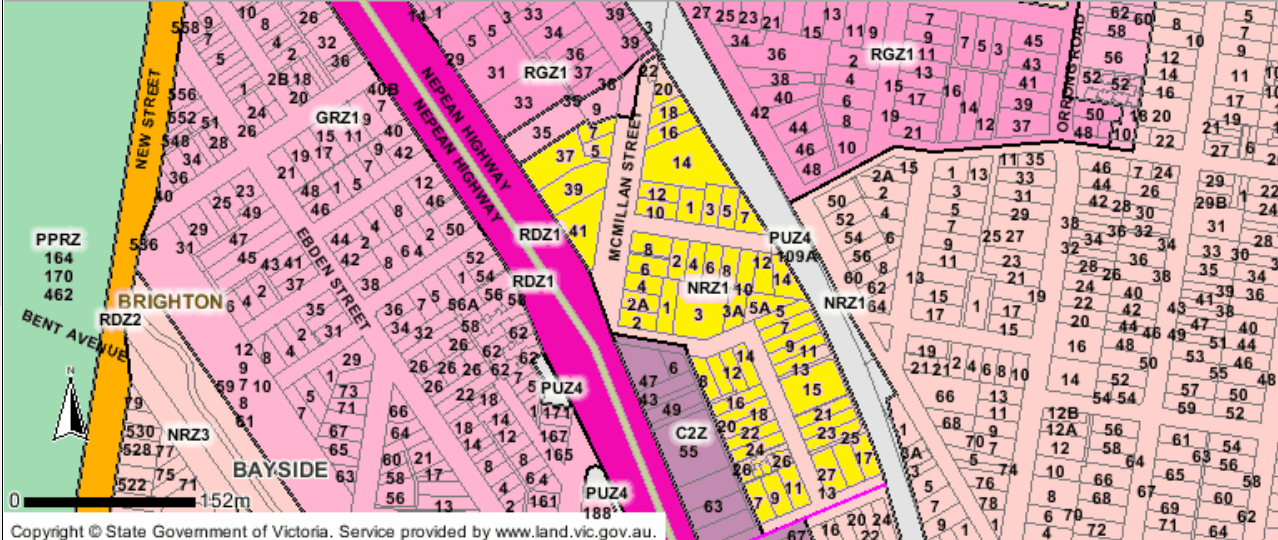
  • Possibly the most important change is the inevitable rezoning of those areas currently marked as C2Z to Commercial 1. This would allow residential and the height proposed is 12 storeys (ie along Nepean Highway).

The map below shows one example of what is envisaged. The yellow markings indicate some sites which are now being upgraded from 2 storeys to 4 storeys.

« Previous PageNext Page »