GE Open Space


The published draft budget contains some very interesting proposals. Below is a summary of the main ones that residents should pay attention to:

  • Proposed borrowings go from last year’s figure of $60M to the current goal of $65M and that still leaves the GESAC loan of just under $8m to be paid off.
  • The Carnegie Pool redevelopment has miraculously jumped from $51M last year to $53M this coming financial year
  • Pensioner rebates continue to decline. We are now down to the underwhelming subsidy of $23
  • The Elsternwick community Hub and park has now been further delayed to 2030 instead of the previous estimate of 2017.
  • $7M is proposed for the acquisition of open space. That is out of the current reserve sitting at about $25M. Hence whilst this proposed expenditure is a step in the right direction, we have to ask – is this enough given the long standing deficit of open space in Glen Eira? Also how much land will $7M actually buy?
  • The Murrumbeena Community Hub is fast tracked ahead of the Elsternwick Community Hub when the latter is in a major activity centre and has population forecasts that far exceed that of Murrumbeena.

There is also plenty missing in this year’s proposed budget. No clear and easily identified detail is provided on which projects have been abandoned or deferred and where the resulting allocated money has gone. For example: what is the status of the proposed multi-storey car parks in Bentleigh and Elsternwick? Have they been put on the back burner or simply gone into the dustbin of history?

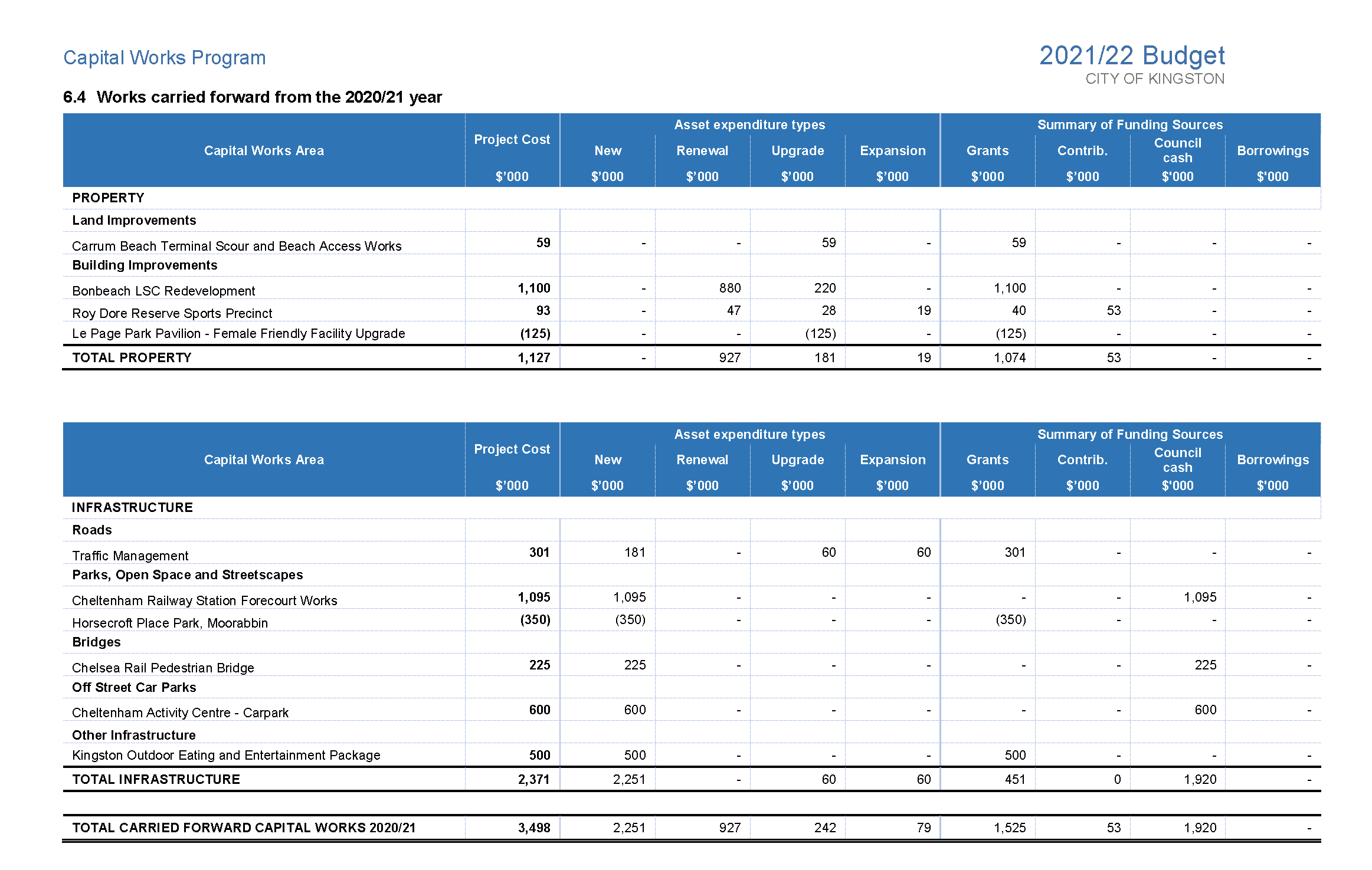
Other councils do not appear to have any problem in providing their residents with tables that are easy for any lay person to comprehend. Just one example comes from the current Kingston budget where carried forward works are depicted. Nothing like this is to be found in the Glen Eira budget papers.

The budget is also replete with jargon and statements that are misleading or totally uninformative. For example, on page 16 we find this paragraph:

The City is substantially developed and while it is experiencing an increase in property numbers, these mainly arise from higher density developments. The budget implications arise in Council having to cope with replacement of infrastructure such as drains which cannot cope with the higher density. These costs cannot be passed on to the developer and are paid for from rates. The rates received from new dwellings do not offset the significant infrastructure costs.

COMMENT: At the moment the costs ‘cannot be passed on to the developer’ because council does not have a CDP, or a community infrastructure levy. This income source was removed from the planning scheme years ago. The impression that the above creates is that it is not legally possible for councils to recoup some of the costs from developers and this is totally untrue. Also the 2016 planning scheme review highlighted council’s need for a CDP, So 5 years down the track we are still waiting for these amendments to surface! Developers can (and should) pay for infrastructure, but it all depends on a council that is willing to progress the necessary amendments to ensure this happens.

Next on page 16 we have two incredible sentences:

Continued investment of resources in the Council’s Transformation Program will enable further efficiencies and enhance customer outcomes.

When millions upon millions are spent each year on such programs and technology, surely residents deserve more than some glib pronouncements about ‘efficiencies’. What is the total required? What ‘efficiencies’ are achieved? And who are the ‘customers’ that will benefit and in what manner?  

Another sentence on this page also needs detail and explanation – Council declared a Climate Emergency on Tuesday 5 May 2020. Responding to this declaration through our work program will require a substantial increase in investment.

Again, we get no detail, no projections of required investment and no timelines.

We urge all readers to take the time to assess this budget and what is proposed. Do we really need these mega projects (and without any published business cases) that will put this council into hock for decades, and what services are not receiving the required funding. What are OUR PRIORITIES as opposed to those enumerated by bureaucrats?

Council’s Urban Forest Strategy made its first appearance in August 2020. On page 12 of the financial plan we find this commitment:

Urban Forest Strategy Implementation – $3.9M

This is supposed to be over a ten year time frame starting in 2021/2, so an average spend of $390,000 per annum. Whether or not such funding is sufficient begs the question of how much is required in order to ensure the goals of increasing our tree canopy.  Nor are residents provided with any indication for the coming years as to what exactly this money will be spent on. By way of contrast, the Moonee Valley budget has set aside $900,000 for the planting of trees this coming financial year! In the Glen Eira budget, trees do not even rate a mention! Instead we have the totally underwhelming allocation of $200,000 for the planting of ‘shrubs’ in already existing garden beds in our public parks!!!!! This is euphemistically labelled as ‘densification’!!!!!

Thus a year on, one could reasonably expect that if council was to live up to its promises for decisive action we would see this reflected in the draft budget and the financial plan. Nothing is further from the truth – sadly.

A quick report on last night’s council meeting:

  • Many of the submitted public questions merely ‘responded’ to rather than ‘answered’
  • By a vote of 5 to 4 committing $300,000 to $350,000 to proceed with the ‘design’ for the Inkerman Road bike path – in spite of the massive community opposition.
  • No attempt to change the public question format – current status accepted unanimously
  • The ‘revised’ Built Form Frameworks to go out for a 6 week ‘consultation’ period. Voted in unanimously with not a single word from any councillor as to why version 2 included some changes. The officer’s report for this latest version is still to make an appearance. We doubt it ever will.

We will comment in greater detail in the days ahead.

The agenda for next Tuesday night’s council meeting is now up on council’s website. Readers will remember that at the last council meeting the decision regarding the proposed Built Form Frameworks for Bentleigh East, Caulfield South and Caulfield North, was deferred. The argument was that councillors needed more time to discuss and that further detail was required. Residents therefore have every right to expect that what is now published fulfills these requirements. So what have we got? Nothing more than a repeat of what was in the last agenda.

Even if this is the result of a simple ‘technological’ error and that an updated version was somehow not included in the agenda papers, it does not excuse what has occurred. Doesn’t someone double check what goes out to the public? Don’t we have spell checks that are employed? Who is responsible? How diligently did they proof read the documents?

In the end, incompetence reigns supreme!

PS: Council has now uploaded the correct Built Form Frameworks. What they have NOT as yet done is to include the latest officer report. Surely residents should have timely access to the rationale behind whatever changes have been made.

Whilst council plods on with its long awaited structure plans, urban design frameworks and god knows what else it hasn’t achieved as yet, the most crucial element in both council’s and we presume the state’s planning is what COVID has produced in terms of migration slow down, oversupply of apartments, businesses closing, and rising house prices for detached dwellings. In short, the boom period for many individuals is well and truly over.

Given these factors, it becomes even more important that council’s strategic planning is fully cognisant of what lies ahead and what has been happening in the past 3 to 5 years. The oversupply of apartments is not something new – it was already evident in 2017. The rising costs of houses means that less and less can afford them, despite mortgage rates being at an all time low. Renters are also leaving in droves – often returning to stay with parents. And given the absence of overseas students, and migration figures to rival our lowest numbers since 1946, any strategic planning simply has to factor all this in.

We have had Victoria in Future 2019 predicting population growth that is now in tatters. The impact on housing supply and demand therefore must be reassessed and planned for accordingly.  Council continues to argue that things will return to ‘normal’. But when? In 3 years time, in five years, or never? Besides, structure plans are not meant to be created and then left hanging in the wind for decades. They are supposed to be ‘live’ documents that are continuously reviewed and reworked. So given all the above negatives, why is council still demanding 12 storey apartment complexes in Carnegie? Or even higher along Nepean Highway? Do we really need all this high rise when apartments are what is suffering the most?

All of the above makes it absolutely crucial that any Housing Strategy does not ignore these events. Simply looking at ‘capacity’ as we were told with the first version of the Built Form Frameworks for Bentleigh East, Caulfield North and Caulfield South, is in our view a meaningless exercise. Capacity does not equate with need. It simply says, ‘yes, a 20 storey building can go here’. It doesn’t answer the crucial question of whether or not we need 20 storey buildings to cater for population growth over the next 15 years. Nor does it tell us whether existing infrastructure can cope, nor how much it will cost to introduce the required infrastructure.

We have extracted two pages from a 2020 report from the National Housing Finance & Investment Company  which is worth a read. The full document is found at: https://www.nhfic.gov.au/media/1621/nhfic_state-of-the-nations-housing-report_accessible-updated.pdf

Please take a close look at their projections and the arguments upon which these are built.

CLICK TO ENLARGE

Source: https://www.theage.com.au/national/victoria/caulfield-racecourse-unveils-570m-sports-entertainment-precinct-plan-20210413-p57iu8.html

Whilst this is undoubtedly a step forward in the long drawn out ‘problem’ of the racecourse, much remains unknown and certainly contentious. Given the Melbourne Racing Club’s history of dealings with council, and overwhelming government support from both sides, answers to the following are essential:

  1. How much of this $570M will come out of ratepayers’ pockets?
  2. Will we have high rise and only a sprinkling of social housing along Neerim Road?
  3. If council is working with the MRC on a business plan, will this be made public?
  4. How many events will the MRC be permitted to hold each year – 100? 200? etc
  5. What will be the impact (noise, traffic, etc) on local residents?
  6. What are the parking arrangements? Will the second lake disappear?

For the second time, councillors through their voting have sent a clear message to officers,  that the latter’s work is clearly not up to community expectations or standards. Last night’s motion on the Urban Design Frameworks was deferred until next month – the rationale being that councillors needed additional time to discuss and to be provided with far more detail and justification. This resolution follows the abandonment of Amendment C184 on the Bentleigh & Carnegie structure plans.

What does this mean and what are the ramifications long term? We can only speculate, but it is becoming apparent that the planning department is being put under increasing pressure and that many of these new councillors will not automatically be rubber stamping whatever is put in front of them. That is all to the good for residents.

The only ‘negative’ from the debate on this issue was provided by Magee and his vote against deferment. His comments were insulting – ie claiming that as an old councillor he understood perfectly what the Urban Design Frameworks were all about and that there was heaps of ‘detail’. Given that this is the first time that UDF’s have been introduced in well over a decade, we can only wonder as to Magee’s ‘familiarity’ with this planning tool. Secondly, his comments came directly after Zyngier stated that he had received a letter from council and that he had difficulty in comprehending what was proposed. His argument was that when council decides to communicate with residents they need to ensure that the ‘message’ is clear, and in everyday language. This followed on from Zmood’s points that Urban Design Frameworks should not be seen in isolation but that they are the result of looking at the municipality as a whole – ie via a Housing Strategy and that data must constitute the first step.

Magee also covered himself in glory with his views on Heritage. Suddenly he has become the saviour of properties with a heritage overlay on them – or so he would like us to believe. Put simply, he stated there is ‘right’ and ‘wrong’. Could he then perhaps explain to residents if heritage is that important, why he seconded and voted in favour of the demolition of a contributory building and the erection of a 12 storey monstrosity on top of the heritage building next door in Derby Road, Caulfield East? For those interested we invite you to listen to his diametrically opposed comments below –

Item 8.1 last night –

AND

From November 2018 –

Consistency has never been Magee’s strong point on development and other issues. What residents must by now realise is that every ‘speech’ must be taken with a huge dollop of salt when Magee opens his mouth!

Council never fails to disappoint with its latest planning effort – the release of the Urban Design Frameworks/Guidelines for Caulfield Park, Caulfield South, and Bentleigh East.

Once again we have 3 documents short on detail, statistics, and images that are barely legible or comprehensible.

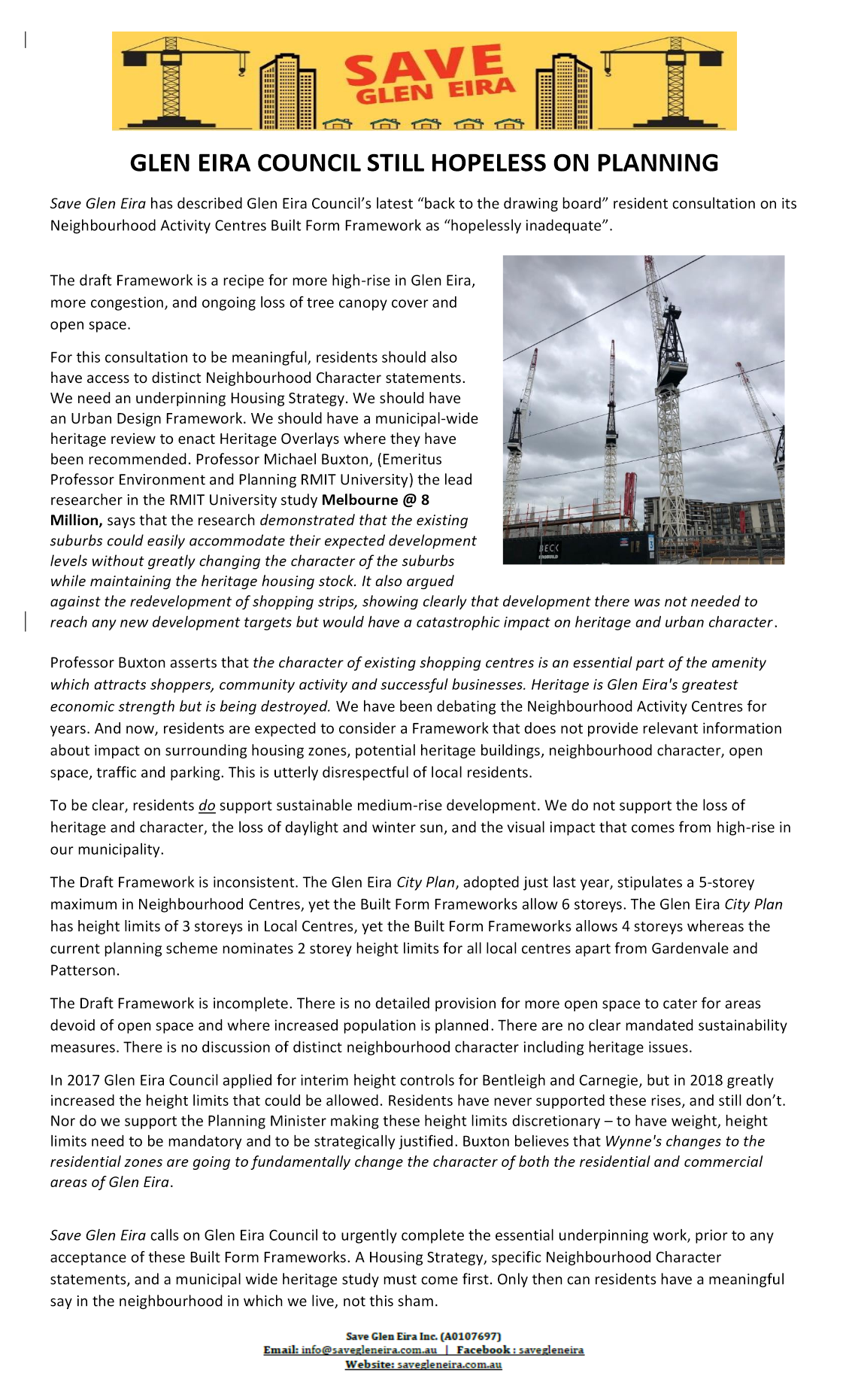
As per usual, we find adopted policies such as the City Plan being completely ignored when it comes to the latest recommendations. The City Plan specified a 5 storey height limit for its neighbourhood centres. The latest documents recommend a discretionary maximum height of 6 storeys for vast stretches within all of these centres. Why the inconsistency and how is this height increase justified when not one single piece of data is presented to account for this divergence?

Even more disappointing is the inclusion of currently designated ‘local centres’ into some of these frameworks and the recommendation that they can also reach for the skies.

We have already commented on the consistent failure of this council to conduct its consultations in an appropriate and meaningful manner. We ask:

  • Why is there no mention of this ‘consultation’ in the April edition of the Glen Eira News?
  • Why is there no Discussion Paper listing all the relevant concerns, and the potential pros and cons?
  • Why is there this insistence on a top-down approach to consultation instead of first asking residents what they want and then producing the draft documents?
  • Why is the consultation period a short 4 weeks, in contrast to some other councils that instituted an 8 week period?
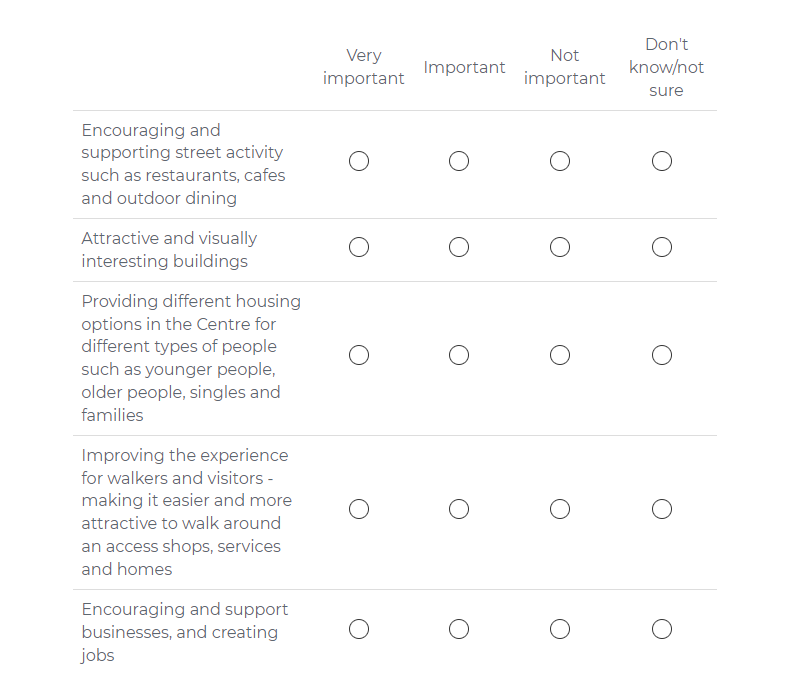
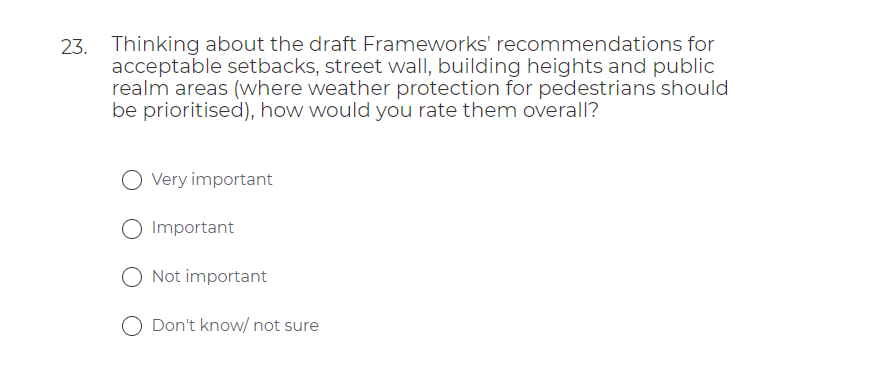
  • We have not as yet seen the ‘Have Your Say’ version of the consultation, but aren’t holding our breath that the questions will elicit too many decent responses.

For all those residents living in, or near, these neighbourhood centres, we invite you to peruse these maps so that you know what this council is planning for your area and its likely impact on your neighbourhood. Needless to say, there is barely a single word about how this council will deal with: open space, infrastructure, parking, traffic congestion, etc. In conclusion, another set of documents that do nothing to instill any confidence in this planning department and an administration that is not prepared to listen and genuinely consult with its residents.

We will comment in greater detail in the days ahead.

Amendment c155 (East Village) has now been gazetted. The result is another slap in the face for residents and highlights once again council’s pathetic ‘advocacy’. Readers will remember that the main areas of contention were:

  • Whether the number of proposed dwellings be a mandatory 3000, or whether they would be regarded as a ‘soft cap’ meaning that the developer can exceed this number
  • Whether the 8 storey height limit for the majority of dwellings be mandatory or discretionary
  • Whether there would be the removal (entirely) of third party objection rights

Each of the above has been decided in favour of the developer by the Department and/or the Minister. So, there will be more than 3000 dwellings and there will be buildings that are higher than 8 storeys and all without the possibility that residents can object to any development plan that comes in for the various sectors.

In what has too often become the typical council grandstanding, in July 2020 we had Hyams and Cade moving a motion that included accepting the Panel report but asking for mandatory heights and dwelling numbers, plus 3rd party objection rights. Too little too late we say and again, what a convenient scape goat to blame government now. Readers must remember that it was council who introduced a structure plan that allowed 8 storeys and 3000 dwellings. Why was this structure plan accepted in the first place after plenty of community opposition? Why was there the decision to send off to a panel, knowing full well that panels tend to support developers? Why didn’t council fight tooth and nail for the above 3 factors when the Comprehensive Development Plan was first mooted? Pretending that council cares after all of these processes have been gone through is not advocacy. It amounts to pulling the wool over residents’ eyes in our view! And adding further salt to the wounds is that this entire structure planning process cost ratepayers over $400,000!

In our view, the amendment should never have gone to a panel and should have been abandoned as happened with the Bentleigh & Carnegie structure plans. Yes, the developer would have gone to the Minister and he might have intervened. At the very least, council would have emerged with some integrity and the perception that it does indeed care about its neighbourhoods and residents.

For years now, council has been losing millions of dollars annually on its aged care provision. Ratepayers have therefore been subsidising this program. There is nothing wrong with this. Even if council is the only municipality to still provide aged care, that is no reason to get rid of the facilities or the various programs. And besides, ratepayers have been subsidising developers for eons now because this council does not have a development contributions levy, or a community infrastructure levy which countless other councils have.

Before any decision is made regarding the future of aged care in Glen Eira, we believe that there simply has to be a full, comprehensive and genuine consultation with the entire community. This is not a decision solely for bureaucrats or 9 elected councillors. The community has got every right to determine where and how their money is spent. If the majority of residents are opposed to council run facilities, then so be it. If the majority prefer that the $3m or so each year is spent elsewhere, then again, so be it. But if the majority still want council to continue to care for our frail and elderly, then that is a decision that must be respected. That is democracy!

As for the consultation itself, and before any decision is made, residents need to know the full facts, such as:

  • What is the full cost to council (including staff, upgrade of facilities, cleaning, etc?)
  • What is the likely current and future demand for beds based on demographics?
  • Are there waiting lists?
  • Are the current facilities in the right areas, given demographic change?
  • What areas are deficient in aged care?
  • How many jobs are currently associated with aged care? What is the future job projection(s)?
  • How many (if any) Spurway residents were moved against their will or their families wishes?
  • How many private facilities are currently in the municipality and where?
  • What is the entry and weekly costs for residents associated with each of these private facilities?
  • What are the potential financial impacts of the recommendations likely to be made by the Royal Commission?

Once all of these facts are presented in a clear and concise manner to residents, the consultation should be straight forward, and include such questions as:

  • Should Glen Eira City council continue to provide aged care facilities?
  • Do you believe that private aged care can provide a better service? Why?
  • Is anyone in your family likely to require aged care in the next 10 years?

The other ramifications if council does decide to close Spurway, and potentially the others in time, is what happens to the land, the buildings, the staff? Additional questions that residents must have a say on, would focus on these areas:

  • Are you in favour of council land being sold off for private development?
  • How would you like the Spurway 2500 square metres of land used in the future?
  • Would you support the Spurway facilities being turned into social housing? Open Space?

Until this council learns to be upfront and honest with its ratepayers, we will continue to have the turmoil of 2019. In camera decisions are the antithesis of open, transparent government on issues such as this and what happened previously.

« Previous PageNext Page »