GE Planning


The Phoenix Precinct has been moribund for years. Now it is officially dead with council’s proposed Amendment C109 in Tuesday night’s agenda. What was envisaged as a ‘grand plan’ that would look at an entire area (Caulfield Racecourse & Monash, plus surrounding areas and plan appropriately) has been hacked to pieces. The C60 was just the beginning of the dismantling. Now there is the Monash proposal (nothing definite of course!) and Council once again rolling over and complying with all developer requests – this time our old friend Urbis rather than Equiset.

The Amendment proposes to remove the Priority Development Zone and vest control in Council – which would have happened anyway with the demise of Priority Development Zones under the new planning laws.  However, there will not be the NEED FOR ANY PLANNING PERMIT and that probably means no public input into the eventual plans. Worse is that the officer’s report only tells half the story. Reading this document we could be forgiven for thinking it is only about Derby Rd and a few shops. Hardly! The Monash Plan is now reinvigorated and will include – 800 student residences; retail, cafes, etc. (See: http://monash.edu/about/who/ambition/masterplan/). Yet all of this barely rates a mention. Why?

Just for a taste of what is to come, here is the award winning entry for a new building on Dandenong Rd – Source: http://www.australiandesignreview.com/news/26244-mcbride-charles-ryan-to-design-monash-uni-complex

monash

Other Monash sites providing information on the development may be accessed at:

Your Rates At Work!

Our questions are straight forward –

  • What are residents not being told?
  • Will this be another C60 that excludes community input?
  • Has everything already been decided in those ivory towers?

Family seeks to run school

Date: September 18, 2013
The Kornhauser family, who control a property and business empire worth an estimated $430 million, have taken their bid to run a religious school from their mansion in a residential area in St Kilda East all the way to the Supreme Court.

The legal move comes after Eliezer (Eric) and Nicole Kornhauser failed to secure planning approval from the Glen Eira Council and lost an appeal to the Victorian Civil and Administrative Tribunal.

The dispute centres on the operation of an ”education centre” the Kornhausers have run from their two-storey contemporary mansion built across two allotments on Springfield Avenue in St Kilda East.

The northern wing of the U-shaped property holds classrooms where 14 boys receive Jewish religious instruction during the day, and intensive courses are held for young local and international Jewish women through the Merkos Women program.

Some of the visiting women live next door at another property owned by the Kornhausers. After complaints began to mount from neighbours about ”creeping” intensity of use at the site – particularly noise, parking and traffic problems – the Kornhausers sought formal planning approval for the education centre. Glen Eira Council refused the application and the decision was upheld at VCAT in July.

VCAT member Philip Martin found the Kornhausers’ proposal represented a ”fatally poor planning outcome”.

”I have some sympathy for the line of thinking that a dead-end residential street zoned Residential 1 is not an obvious place to establish this type of combined ‘women’s and children’s religious studies’ use,” he said.

Mr Martin also found that it was likely that a 95-year-old covenant established over the southern allotment prohibiting the use of the land for ”any religious educational or charitable use” was being breached by students using the pool on the residential side of the property.

The council has agreed not to fight the move in exchange for a promise from the Kornhausers that they would not seek to force the council to pay any legal costs if the family wins the case.

Nicole Kornhauser could not be reached for comment. A directions hearing is set for November 29.

cvedelago@fairfaxmedia.com.au

Read more: http://www.smh.com.au/business/family-seeks-to-run-school-20130917-2tx2r.html#ixzz2fCUdkcti

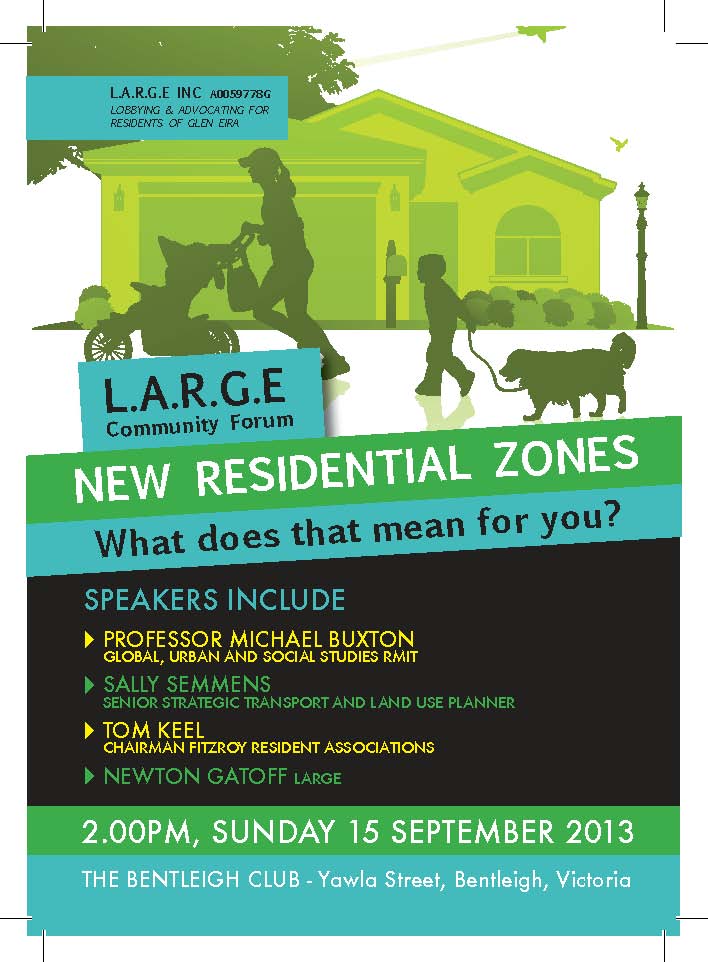
This afternoon’s LARGE Community Forum had a terrific turnout and very informative speakers. Apparently all Glen Eira councillors and some senior planning staff were invited. To their credit the only councillors to show up were Lobo, Delahunty and Magee. No officer turned up and no other councillors.

Since the afternoon was videotaped we’re assuming that LARGE will upload a full record of the formal presentation on their website (http://www.largeinc.com.au) so we won’t comment on this aspect of the event. Instead we will focus on some of the questions or comments that members of the audience made and the remarks made by the above councillors in response.

One resident asked that the map of the new zones be put up on the screen. He was from Wheeler St., Ormond which is a ‘purple area’ (4 storeys). He expressed ‘sorrow’ for anyone who lived in such areas because they were ‘high density zones’. His problem was that it was also a ‘flooding zone’ and there had been some progress with melbourne Water and council about upgrading drains but ‘without upgrades of infrastructure’ council is ‘still approving development’. They went to VCAT opposing a 3 storey development and they won. But that was several months ago, before the introduction of the zones, so the resident wanted to know what this means for the new development now – ie could there be another application and a permit granted because this is now a higher density zone. The resident asked if ‘council is stronger than VCAT?’

Professor Buxton explained that there are other forms of control via layers of overlays and if there is one he felt that VCAT would uphold it – although he didn’t know the extent of Glen Eira’s overlays. Delahunty then said that council is continuing to ‘look for new areas to apply neighbourhood character overlays’ and these are ‘primarily in the green section of the map’ (minimal change). Said that with permeability controls, height controls and other things that ‘we are quite proud of’ and that ‘VCAT cannot overturn’. She didn’t forsee any change to the current flooding zone.

Another member of the audience then began her question by saying that the data that the residential zones are based on comes from figures of the nineties. Things have changed a lot since then and the floods of 2011 impacted on a huge area near her. Yet council still grants permits and hasn’t taken into account ‘greater surface’ for buildings which means ‘greater flooding’ and all this whilst there’s been ‘limited infrastructure upgrades’. Said that she lived in the ‘purple zone’ and that council has been ‘quite remiss’ in blocking themselves off from the community. (applause). ‘there is definitely no regard for us living in this area’. Claimed that she had spoken with planners at council and asked what consideration was given to ‘infrastructure’ and their response was ‘oh, we looked at it in 2000’ and that she should take it to council. Mentioned ‘schools bursting at the seams’ and whilst a state responsibility, council still has to advocate but it ‘seems that our rights in Glen Eira have been overlooked’. Schools and kindergartens are ‘bursting at the seams’ and whilst there is a train station there is no bus service’. Talked about traffic and that ‘yes’ 3 storey limit is great’ but it’s not enough.

Another speaker then said that she finds the ‘of right uses’ (ie no permit required) ‘abhorrent’ since it removes her rights as a resident to object, ‘voice my concern, to be heard’. Asked if this is in fact an abuse of administrative and legal power as well as a ‘denial of natural justice’ (applause). Buxton answered that the government has justified this by granting ‘certainty’ and removing delays therefore saving money for everyone. Said irony of all this is that there are heaps of Section 2 uses (service stations etc.) that can then get permits. Government hasn’t prohibited anything and there are no height controls for commercial areas and will be a huge problem because these of right uses don’t have height limits applied to them.

Buxton also stated that the criteria to assess these uses in residential areas are ‘very vague’ so anything could go into a residential street. Said that these ‘criteria’ are supposed to be ‘performance measures’ but they are anything but performance measures – ie will they cause ‘detriment’ to someone. These are vague and all subjective. Buxton then went on to say that a planning scheme is a legal document and people’s rights are either ‘given’ or ‘taken away’ via the planning scheme.

Several residents then gave examples of battles they had won elsewhere and the call was for ‘people power’.

Another residents asked whether VCAT could still ignore ResCode standards if councils simply defaulted to these in its schedules since VCAT often ignored ResCode in the past. Buxton responded that if specified in the schedules such as height then this was mandatory but it was vital that councils apply ‘the maximum powers they have under the schedules’. Gave the example that council could have stipulated one dwelling per lot but Glen Eira didn’t – they’ve allowed 2 dwellings per lot. Where there is medium or high density and there is no specifications by council then they will be assessed under ResCode. Problem is that ResCode only applies to 3 storeys so applications for 4 or more storeys  in Residential Growth Zones won’t even have these ‘standards’. ‘No developer in his or her right mind is going to apply for a 3 storey development in a commercial zone when there’s no height control’. Also the guide that assesses higher density is ‘even less strict than ResCode’. So ‘not only do you get an incentive to go over 3 storeys but you’re being assessed against a weaker code’…’you’d have to be nuts not to do it’.

One ‘brown zone’ resident said she was ‘shocked’ by what has been said. Asked if it’s true that those living in these areas have no rights and no protection and that the lovely heritage places around her have no value whatwoever except for developers. Buxton said that ‘you lose rights if application relates to Section 1 uses’ otherwise people can still go to VCAT. (SECTION 1 INCLUDES ‘food and drink premises’ within 100 metres of commercial zones; shops, medical centres, places of worship etc.) Many of these are ‘high impact’ that people won’t be able to do anything about. The other problem here is that there are no height limits on such uses so a hypothetical could be a 9 storey application with no rights to objection next door to a single storey.

Comments from Backlash about population growth and no planning for infrastructure – transport. Buxton claimed that no government is confronting the planning for a city of 6.5 million people by 2050 because it will cost 25 to 50 billion just in transport.

LOBO then spoke saying that ‘it’s a pity the other 6 councillors did not turn up’. Said that Labor lost ‘because of Justin Madden’ at the last election and now we’ve got Matthew Guy ‘who became mad’ and is ‘on his way out’. Told residents that they should ‘go to the State Member of Parliament’ and that when councillors promise to stop development so that the ‘next time’ they come to ‘your house’ asking for your vote ‘throw a bucket of water on their face’. He then said that ‘personally I have to go with the council decision’ and that he doesn’t ‘agree’  and that ‘I made that very clear’ and as he’s already said that ‘Melbourne is going to be like Calcutta’.

After a few more questions and comments on community activism and networking Magee spoke.

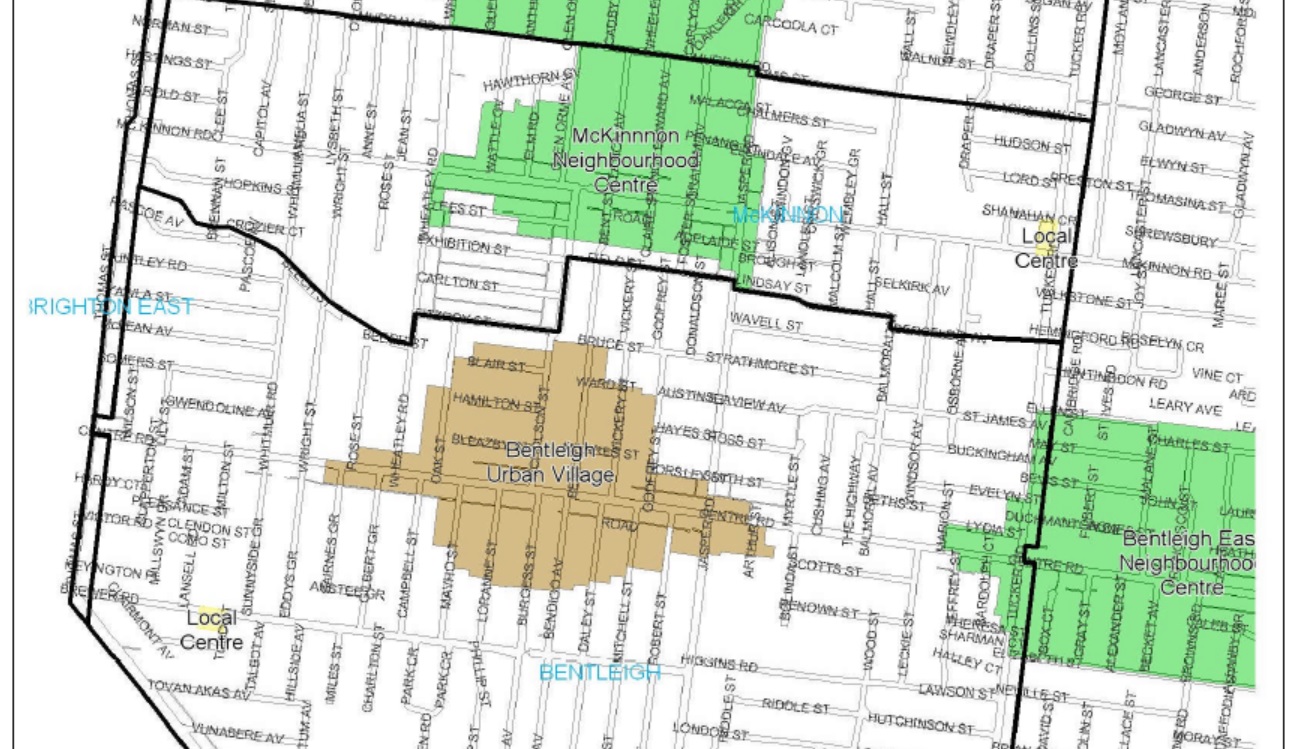
MAGEE: said he wanted to bring the discussion back to ‘some basic’ facts. Said that previously they only had ‘policies’ and not ‘zones’ and the former weren’t ‘enforceable’. This meant that ‘quite often’ at VCAT the ‘developer would win’. Claimed that ‘now’ the green areas were about ‘78% of Glen Eira’ and that developers therefore know that 2 dwellings is the maximum and that 2 storeys is the maximum. ‘that is not arguable through VCAT’. The blue zones are ‘a maximum of 3 storeys’ and the light blue is also 3 storeys and has ‘the greatest setback between the light blue and the green’. Brown is another zone with 4 storey maximum. Said that even with permitted uses in Glen Eira ‘not a lot has changed’. Said that in 2010 there was ‘quite significant’ consultation althought people might disagree with this. So all that’s happened is that the policies have ‘been changed over to zones’.

Another resident then stated that the spin doctors were outin force because the zones were rushed through and therefore they didn’t have time to consult with residents. Said that previously there were transition areas between the brown and blue zones and now there isn’t any. Asked if you own a house in a green zone and next door in the brown zone someone builds a 4 storey and blocks your solar panels what rights do residents have?

MAGEE: conceded that buildings could be 4 storeys but that ‘have to set back from 4 to 3 to 2’ and said this was a ‘natural setback’ and even in the growth zones (brown) these are ‘bordered by general residential zone’ (light blue)

DELAHUNTY: said that council had tried to have ‘transition zones in the past. Now we actually have transition zones’ and that ResCode could be applied to 4 storey buildings and council was trying to make transition zones enforceable whereas before they weren’t and now they are.

One resident got up and asked that those councillors who are present take back to their groups the community feeling that community consultation is what is needed and that rather than having the plans ‘left at the library where someone has to go with a magnifying glass’ to make head or tails out of it.

MAGEE: said that Glen Eira has the least amount of open space and that ‘there is no way that we are looking to encroach on open space’. The white areas on the maps are open space but ‘predominantly commercial zones’. Said that the first test is ‘about to come up’ in regards to the Virginia Park industrial site. Claimed that the Minister was approached by the developer to rezone without public consultation. Said that MP Miller had written to council and ‘endorsed’ the Minister’s  position ‘not to go to public consultation’. Said that ‘council has actually fought that’ and will be putting it out under normal amendment processes which means public consultation. ‘These things are not debatable in council’. Said that council and ‘i’m one of them, I’m very proud of these zones’. Said that nothing has changed except that they have ‘guaranteed’ ‘maximum height limits’ in 98%’ of the municipality.

One of the range of videos created by Moreland City Council on their proposed implementation of the new residential zones. Please note a couple of stark differences:

  • 10 information sessions for residents
  • An online survey
  • 2 months of public consultation
  • TWO STOREY LIMIT FOR GENERAL RESIDENTIAL ZONE (Glen Eira has decided that 3 storeys are fine!)


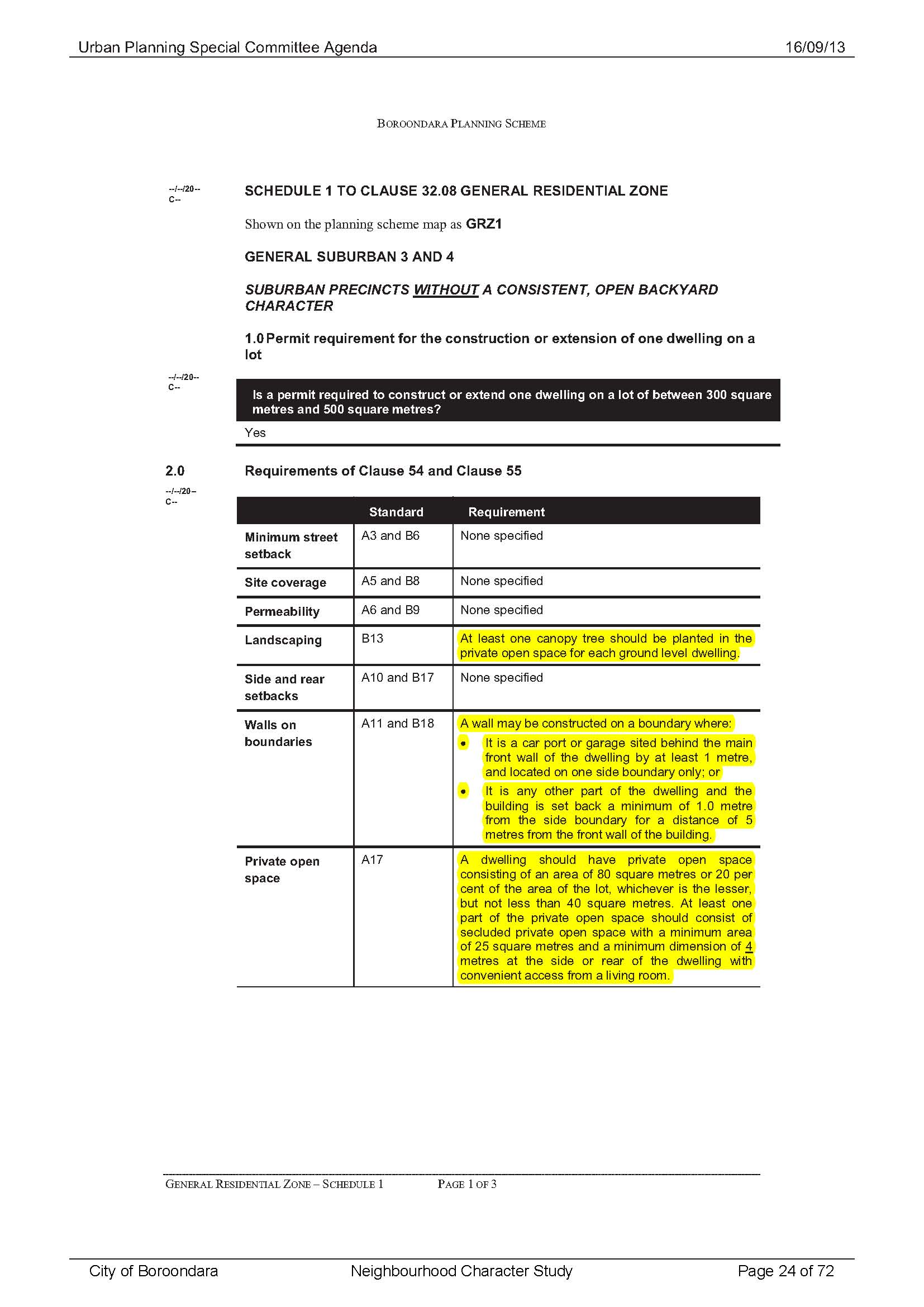
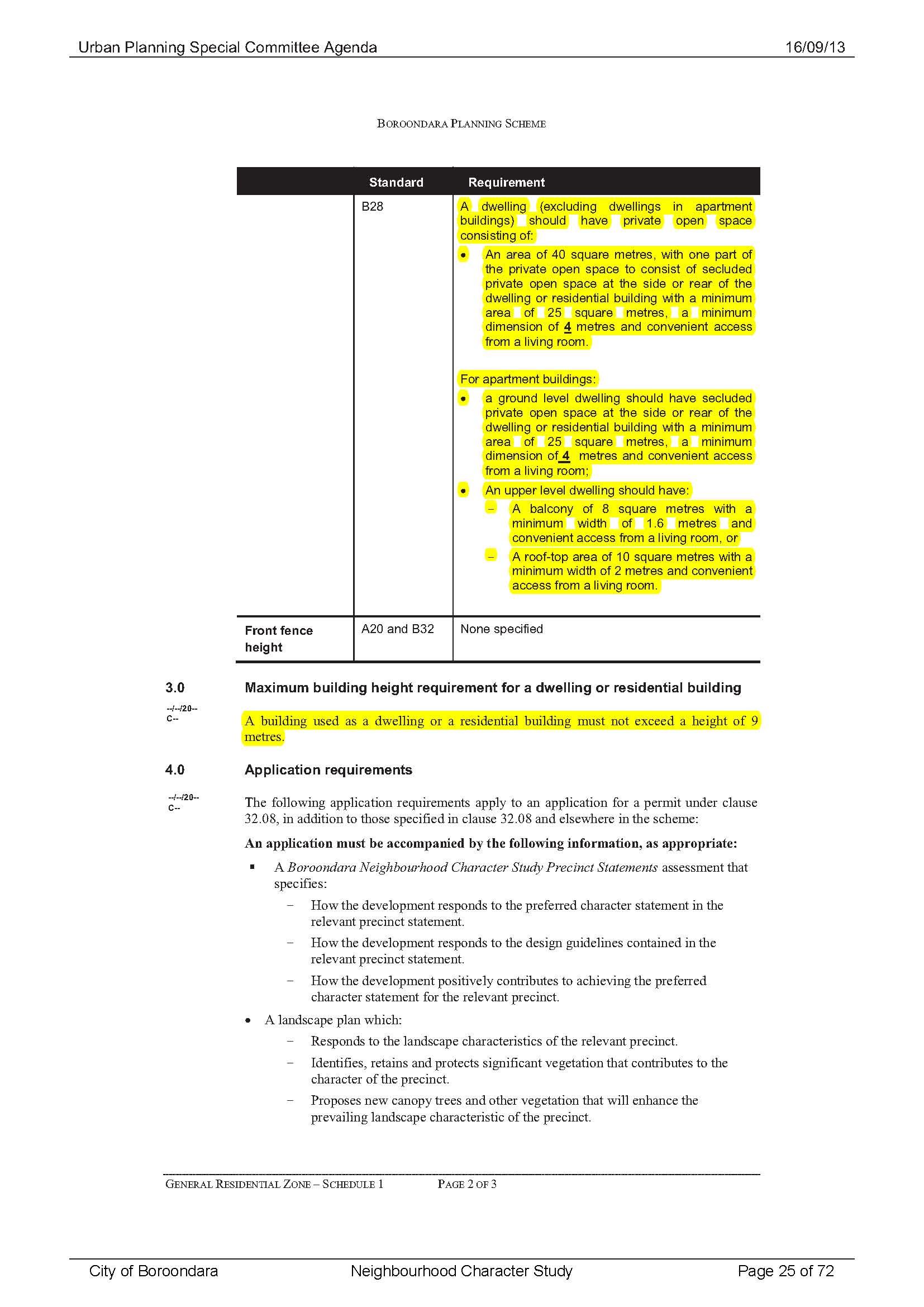
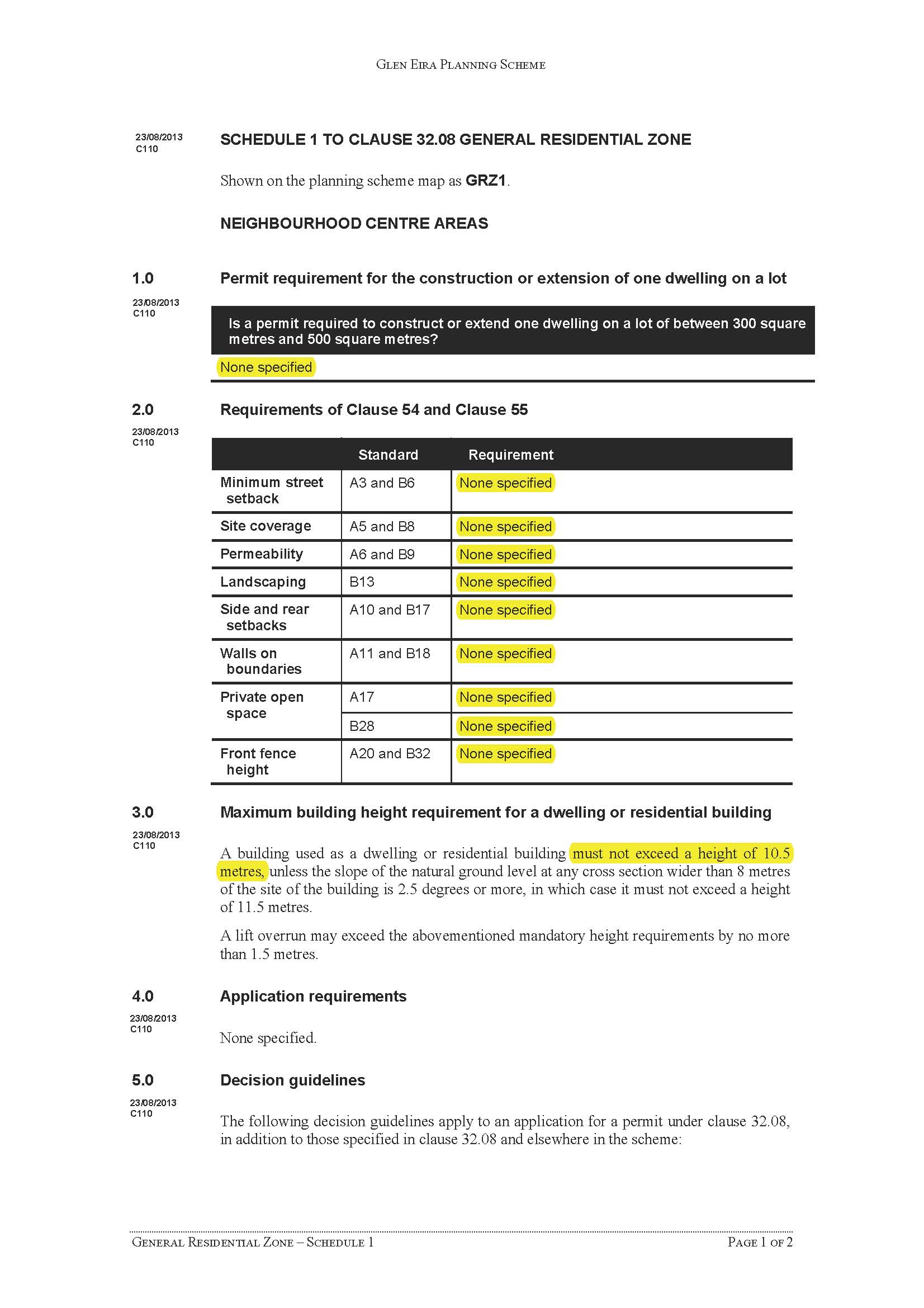
The difference between Glen Eira’s open slather approach to development compared to other councils is made even clearer when the schedules for the General Residential Zone 1 (GRZ1) are looked at side by side. In Glen Eira, the GRZ1 has been applied holus bolus to existing ‘Neighbourhood Centres’ and Main Roads. Suddenly, developers have been given the green light for 3 storey apartment blocks in countless residential streets.

Instead of using the schedules to achieve a balance, and to ensure the protection of local amenity, Glen Eira’s councillors have simply rubber stamped the Newton and Akehurst agenda.

Please note carefully:

  • Glen Eira imposes a 10.5 metre height limit. BOROONDARA FOR THE SAME ZONING IMPOSES A 9 METRE MAXIMUM.
  • Glen Eira has no limitations. Boroondara imposes plenty.

Here are the schedules from both Councils. We ask readers to compare and contrast and start questioning whether our elected representatives are indeed acting in the best interests of the community?

Pages from general residential zone schedule 1Here’s the Boroondara version for the identical zone –

GRZ1_Page_1GRZ1_Page_2

Prior to the Minister’s announcement of the new residential zones for Glen Eira on August 5th, media reports had already been stating that Glen Eira, together with Boroondara, were to be among the first councils to introduce the zones. Council of course denied all knowledge of this at the time.

Unlike Glen Eira, Boroondara has now released its draft for the zones. (Uploaded here) It differs dramatically from Glen Eira’s vision for the future. The main differences can be summarised as follows:

  • The draft incorporates over 2 years of extensive community consultation on its Neighbourhood and Urban Design Strategy (completed in September 2012)
  • No deceit, secrecy – the proposals are there in black and white
  • Extensive local analysis that has divided Boroondara into 75 distinct areas with plenty of emphasis on Heritage and Development and Design overlays. All Glen Eira has done is introduce C87 that looked at a paltry 17 areas and altered many areas from Minimal Change to Housing Diversity.
  • The most important difference lies in the proposed schedules. Boroondara has done its homework and come up with countless ‘limitations’ in the schedules that are designed to protect streets and neighbourhoods.
  • Another major difference lies in the zoning itself. All that Glen Eira could come up with was basically 5 zones (Neighbourhood Residential – one zone; General Residential – 2 zones and Residential Growth zone – 2 zones). Boroondara has 7 distinct zones including the all important GRZ1, 2, 3 AND 4.  Each of the accompanying schedules differs markedly allowing for greater control of distinct areas. Glen Eira in contrast has none of this fine detail and differentiation within the zones themselves.
  • Boroondara is also asking for a Ministerial drawn up Amendment to introduce the zones. But, at least this isn’t being done by stealth and secrecy as Glen Eira did. Boroondara also states that given they have a year to finalise the zones, there will be further amendments and the opportunity for community input.

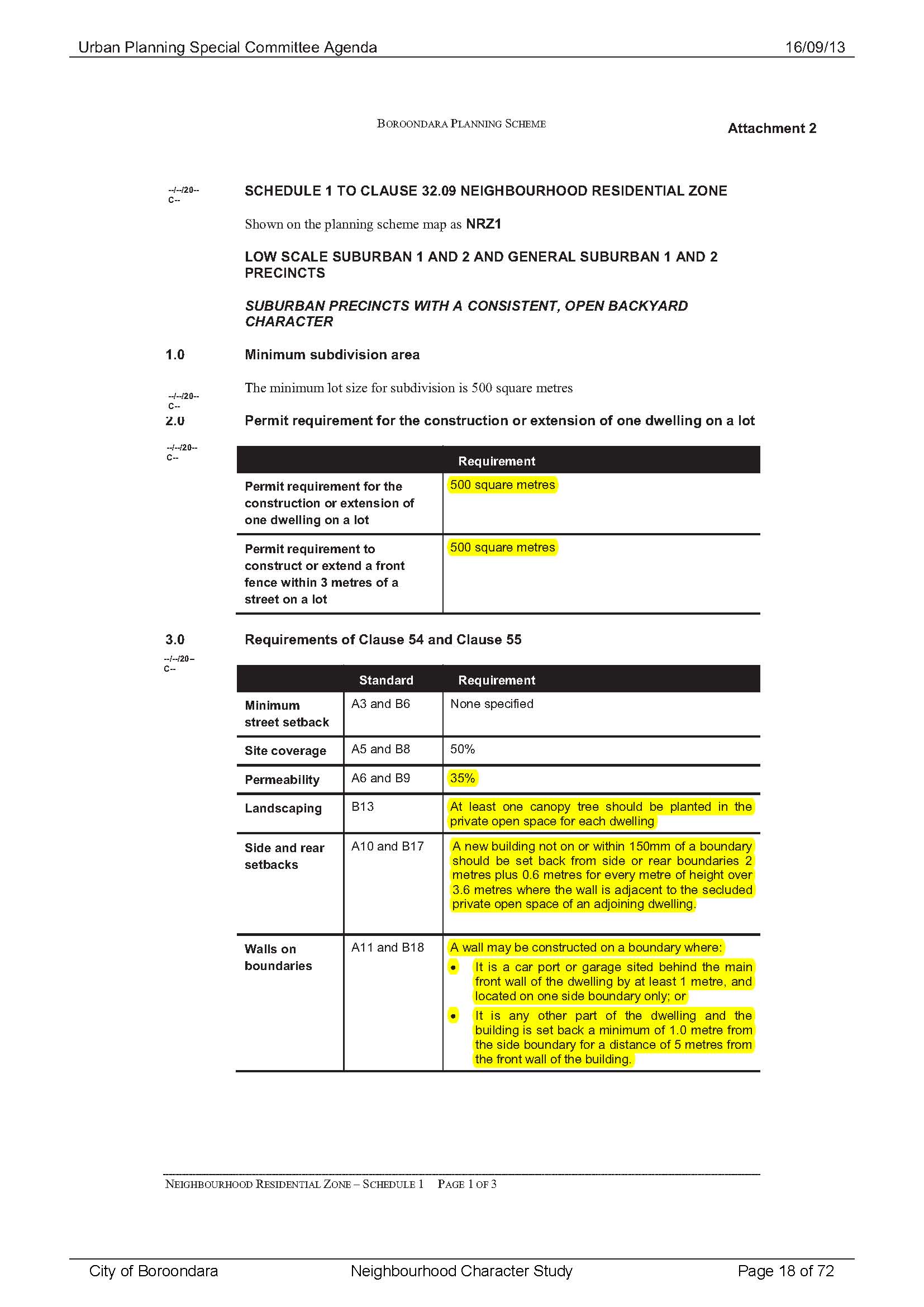
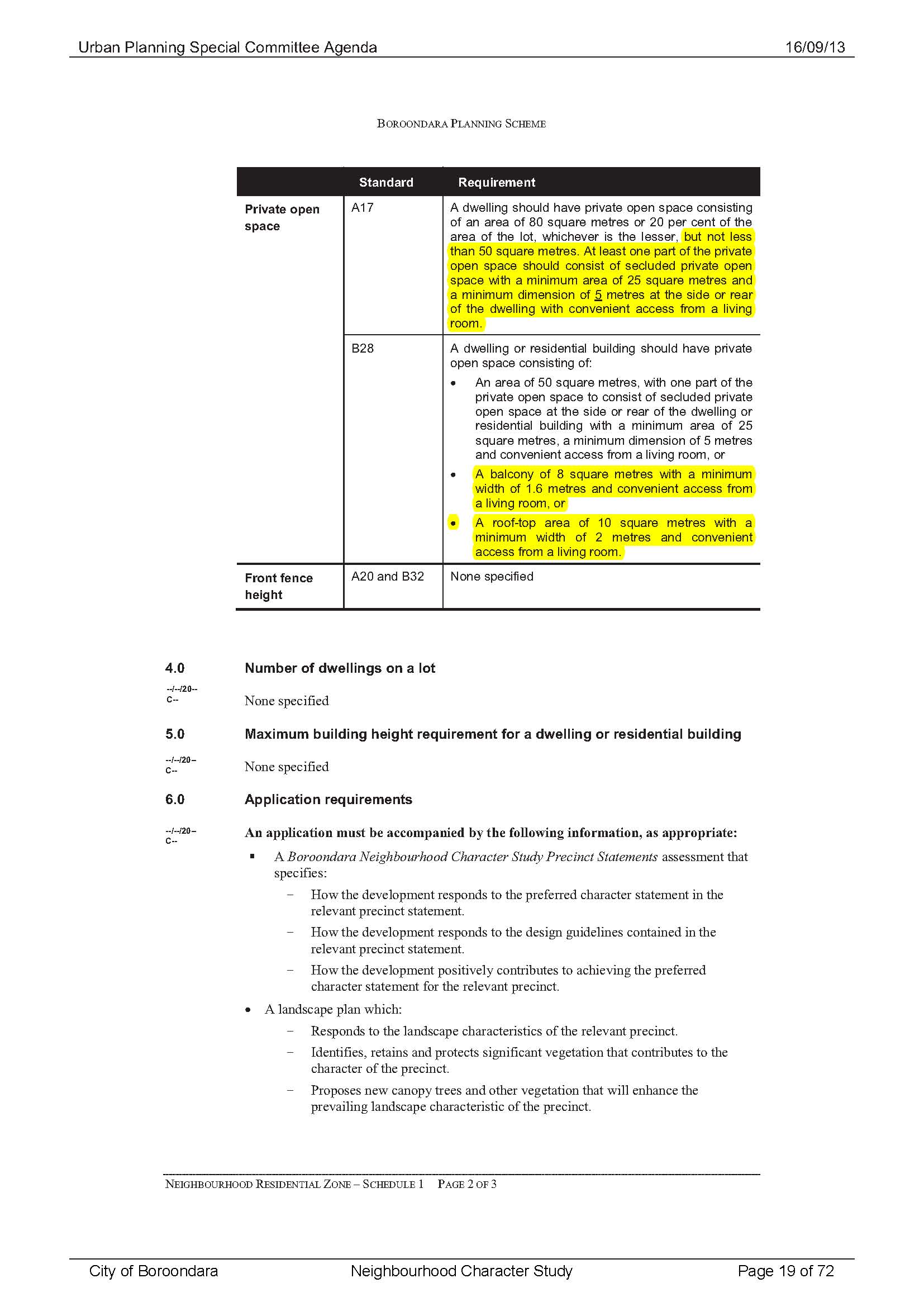
Below are some of the Boroondara schedules followed by the Glen Eira ones. Readers should note the differences on permeability, open space, tree plantings, set backs etc. They should also start questioning their councillors as to why, when the opportunity was there to really protect neighbourhoods Glen Eira has failed to act? Residents have been merely thrown the bone of ‘height limits’ – something they could have had 10 years ago. The philosophy of untrammelled development remains enshrined in these minimalist schedules to the detriment of thousands and thousands of residents.

Pages from UPC5 Neighbourhood Character Study_Page_1 Pages from UPC5 Neighbourhood Character Study_Page_2Here is the Glen Eira vision:

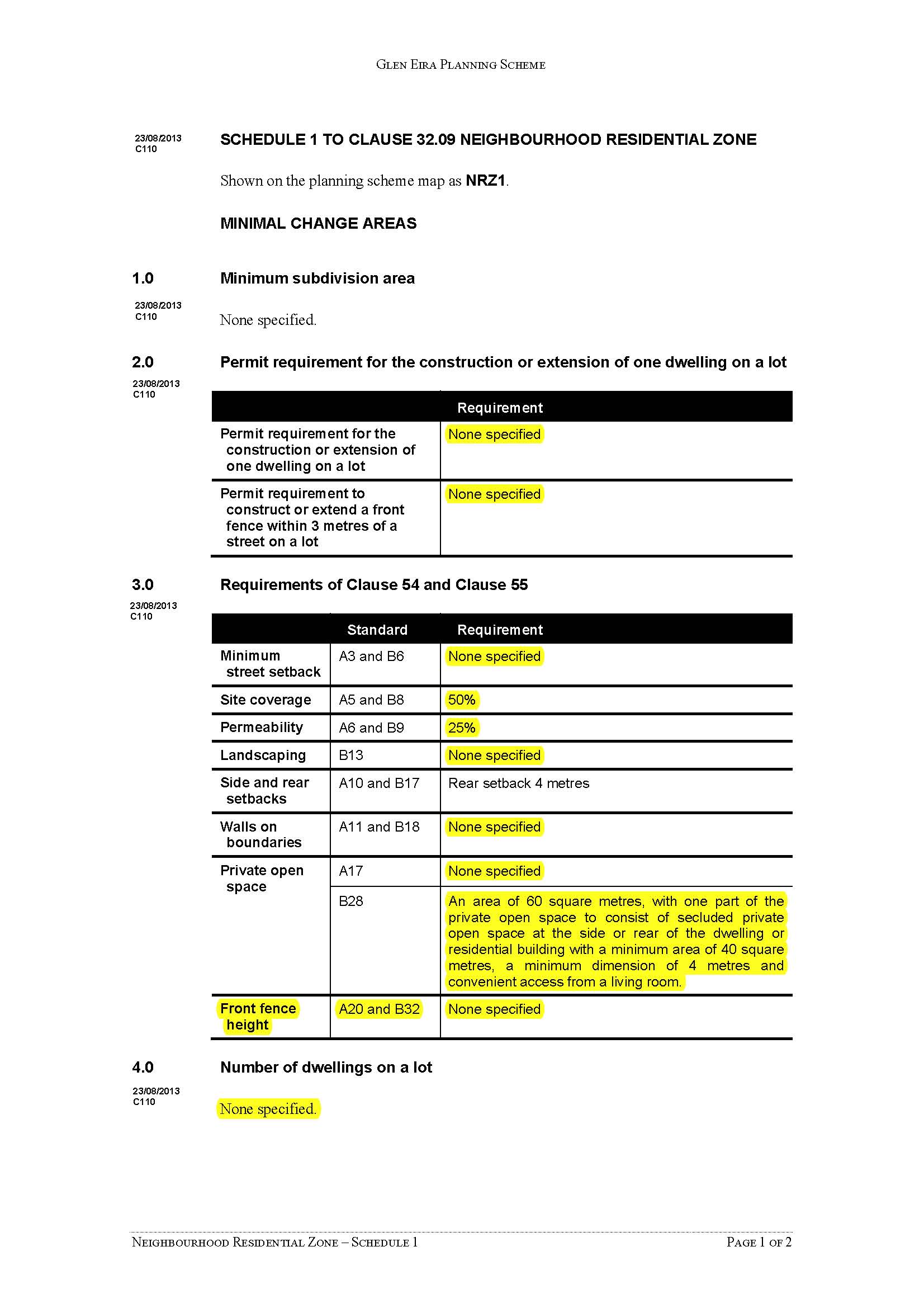
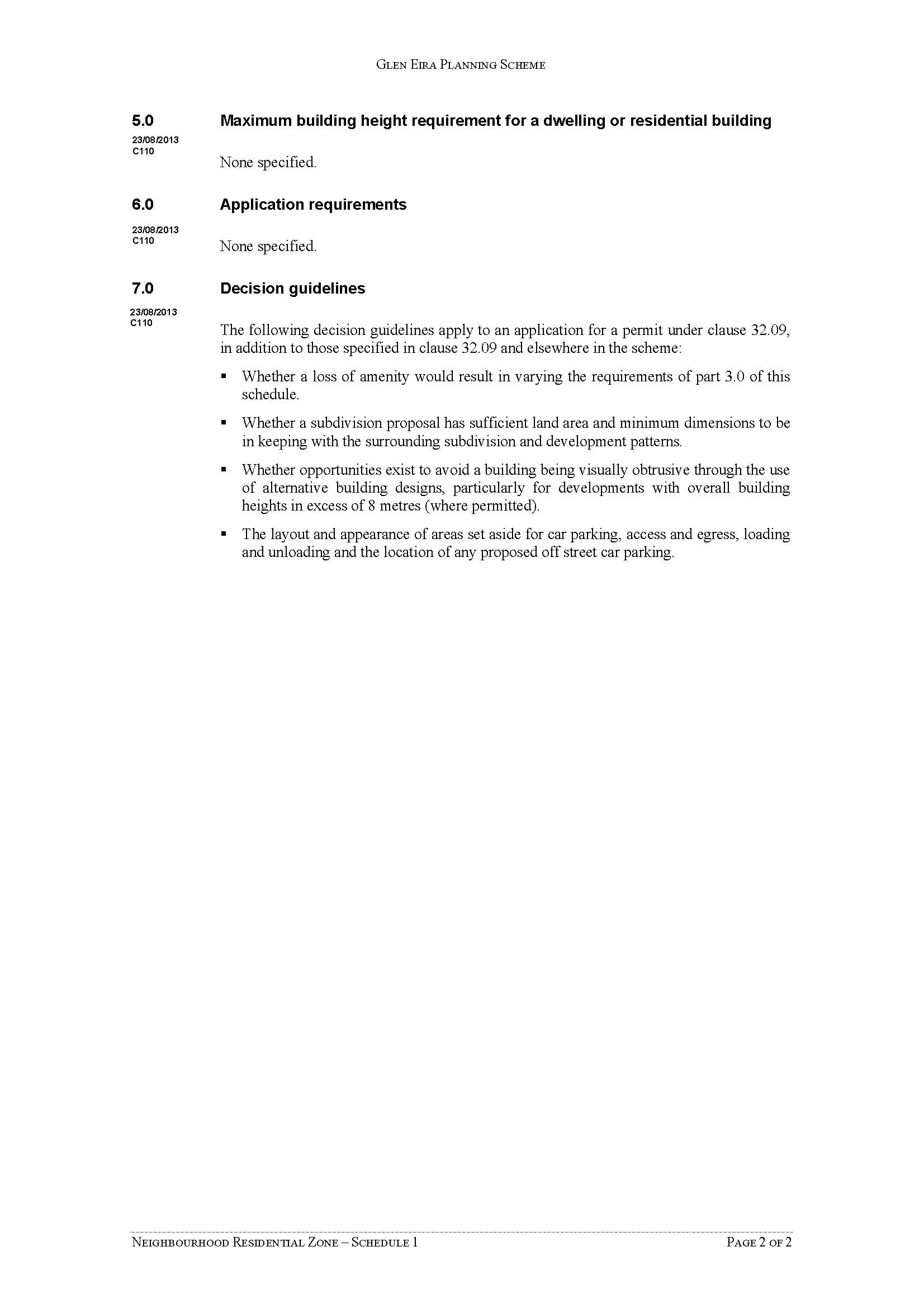
scheule to rz1_Page_1scheule to rz1_Page_2


L.A.R.G.E Postcard-PRINT-1WEBSITE: http://www.largeinc.com.au

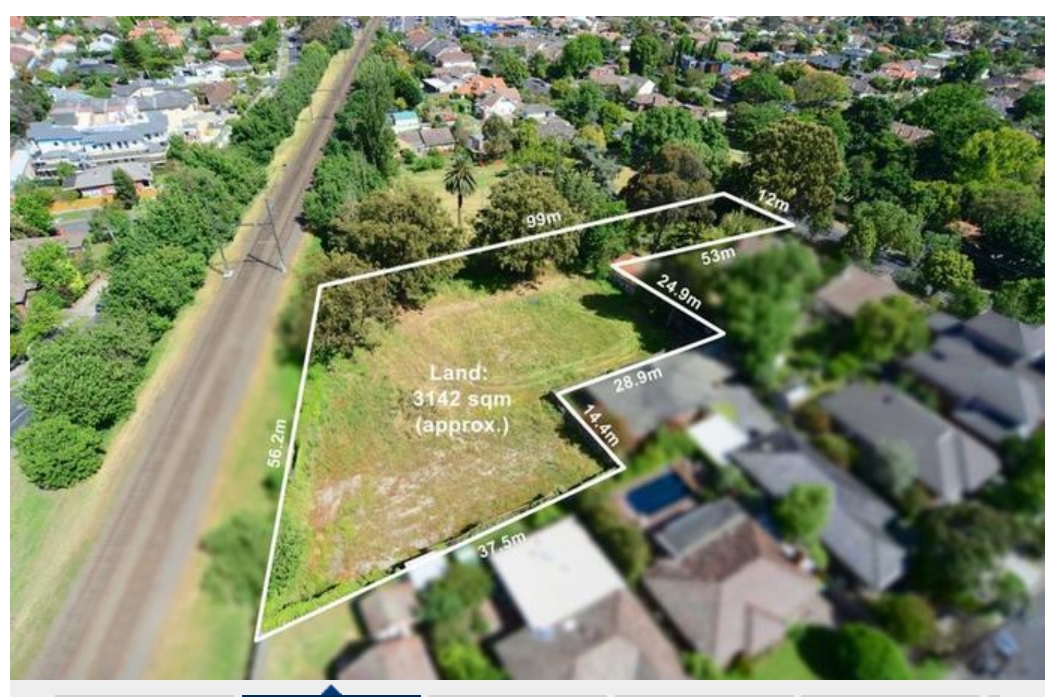
We’ve reported previously on the sale of 487 Neerim Road that abuts parkland. Council claimed that it could not buy the land to extend open space and so was sold off to a developer for over $2 million. It is on the market again – as a mortgagee’s auction! (see below). However this time, the pending sale is in concert with a planning application for 17 ‘villas’. Obviously a ploy to increase the value of the land and reap the biggest return. We reiterate, that what was originally Minimal Change is now well and truly planted in the middle of a Growth Zone. So much for council’s concern for neighbouring amenity. This speaks volumes of the incremental, secret, and ongoing increases in Housing Diversity throughout the municipality. For those interested, GERA, made several postings on this matter a while back. See: http://geresidents.wordpress.com/2013/02/09/lost-open-space-opportunity-update/

487

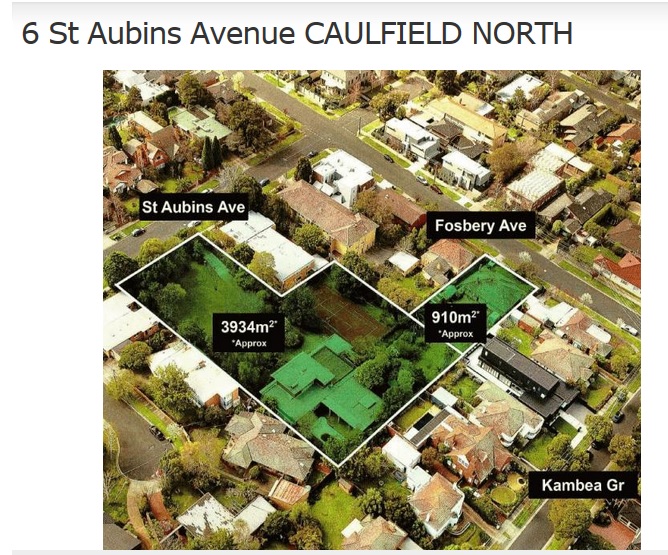
PS: Surprise! Surprise! Here’s another large sized property up for sale and Yes, there’s a planning application in for “multi-level” and 30 dwellings – all smack in the middle of Minimal Change! The application went in on the 15th August – well after the official announcement by the Minister but before the gazetting of the new zones! How convenient!

st aubins

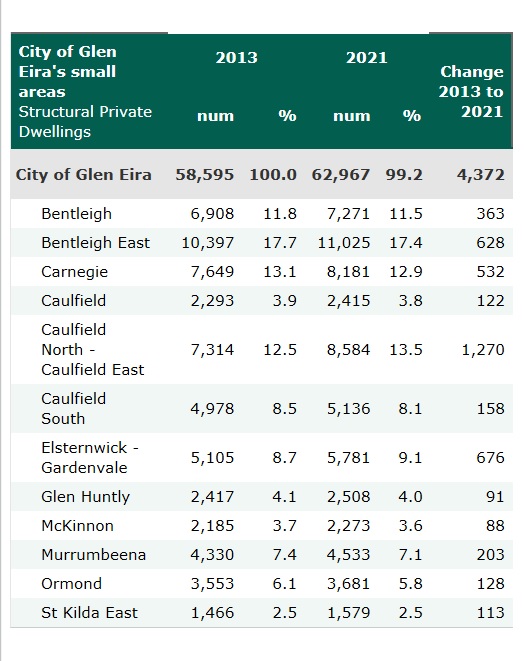
Over the next 20 years, the City will undergo moderate population growth and will see a continued decline in household sizes. As a consequence, there will be a need to plan for the additional 6,000 dwellings which are predicted for Glen Eira by 2021 as well as encouraging a more diverse housing stock (Department of Infrastructure, 1999, Victoria in Future). 

So sayeth Council in its latest spin document. When were these prognostications made? 1999? 2012? Your guess is as good as ours. But it certainly serves the objectives of the public relations department of Glen Eira. Clearly these figures are highly questionable. If the claim is that these projections represent the latest up-to-date data, then residents are being led up the garden path.

The Department of Planning’s latest version of Victoria in Future, 2012 makes the following predictions:

Currently the figures tell us that in 2011, private dwellings totalled 55,150. No figures are given for the numbers in 2013 although Profile.Id tell us that the figure is currently over 58,000. The projected figure needed for 2021 is claimed to be 59,908. Hardly an extra 6000 dwellings! (See: http://www.dpcd.vic.gov.au/home/publications-and-research/urban-and-regional-research/census-2011/victoria-in-future-2012/vif-2012-data-tables)

Profile.id.com in their predictions also come up far short of the cited 6000 dwellings.

dwelling forecastsWhat is most important is the need to take into account the development that has been rampant for the past decade. Council appears at VCAT and argues that population has already exceeded projections, so there should be some constraints on development. Yet their planning policies continue to invite massive scale developments without providing the needed strategic planning and investment in basic infrastructure such as drains, open space, etc.

Analysis of the Planning Activity Audit which is submitted by councils to the government on a regular basis reveals the extent of this development. Please note: we believe that these figures (as submitted by Council) are far from accurate given past history and if anything they underplay the scale of development. The duplication of some figures is also unexplained. The table below documents the number of applications submitted and the number of permits granted. The final column lists the number of permits for 2 or more dwellings.

Year

No of applications

Permits granted

2 or more dwellings

2003/4

1038

654

160

2004/5

950

586

143

2005/6

907

586

143

2006/7

919

522

192

2007/8

1188

1028

283

2008/9

998

946

209

2009/10

1121

910

317

2010/11

1237

1071

419

2011/12

1237

1071

337

Source: http://www.ppars.dpcd.vic.gov.au/Reports/04

At the very least the figures indicate that a MINIMUM of 7,000 dwellings have already gone into Glen Eira. The real figure  could be tenfold bigger since we’re only adding up the number of granted permits. These figures also do not reveal how successful the policy of creating DIVERSITY actually is. For example: of the thousands and thousands of units erected in the past decade, and looking ahead to the future, HOW MANY ARE 1 BEDROOM APARTMENTS? HOW MANY ARE 2 BEDROOM APARTMENTS? HOW MANY ARE 3 BEDROOM?

Do councillors ever ask for such figures? Do they in fact even know what is really going on in their neighbourhoods? Or do they leave everything to be (secretly) shunted through by an administration hell bent on more and more development at the cost of social, economic and environmental amenity for the majority of residents?

PS: We neglected to include the most vital statistic of all – the 1500+ units that will comprise the C60 development. So much for the need for another 6000 dwellings!

Here is a very real scenario that has now descended onto residents as a result of Amendment C110. To illustrate our argument the picture below features the Bentleigh carving up of streets PRIOR to the current Amendment. Readers may well ask themselves:

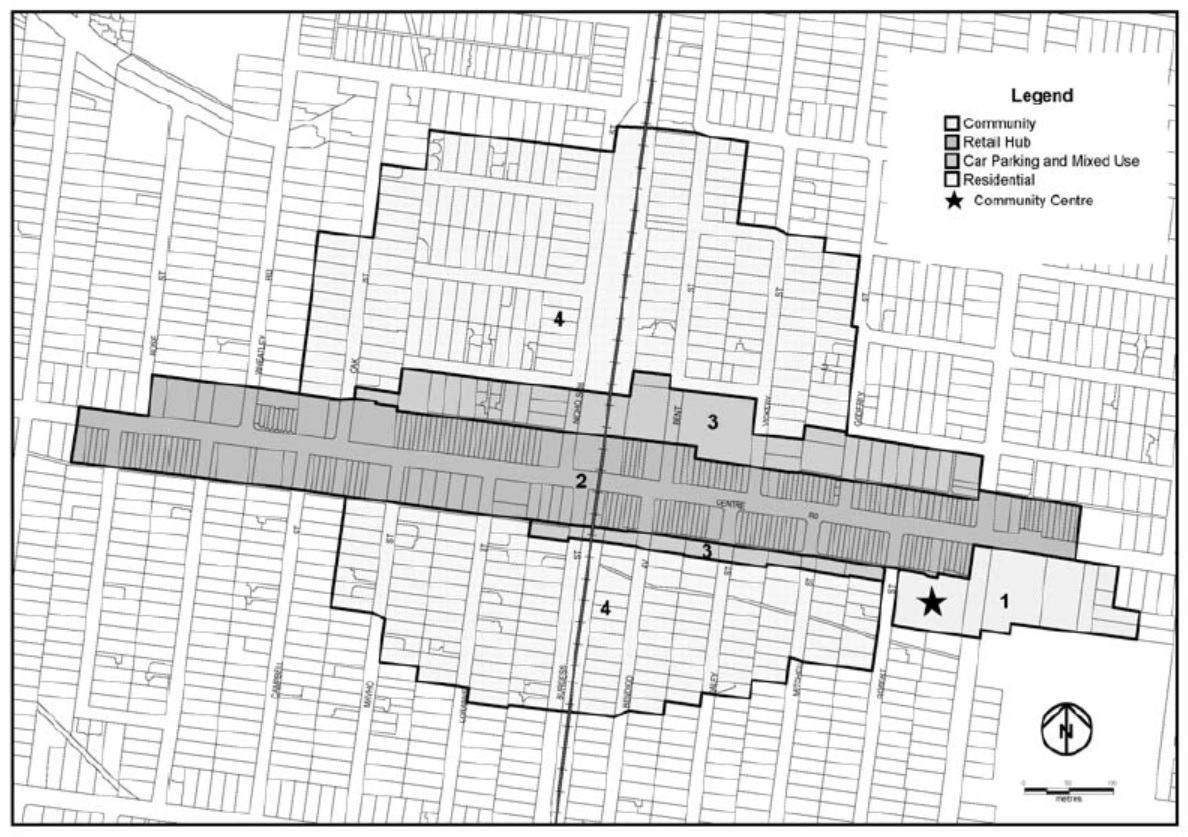
  1. Why the jagged lines everywhere? Why should a property that is 11 houses from Centre Rd be included in Housing Diversity and the house that is 12th be designated as Minimal Change? What is the strategic justification for such demarcation?
  2. Why should one side of a street be designated as Housing Diversity and the other side of the same street as Minimal Change? Again, questions about the efficacy of strategic planning and justification come into it. See map below taken from the OLD VERSION of the planning scheme.

bentleigh

With the new Amendment c110 ALL AREAS ARE NOW DESIGNATED AS worthy of 4 STOREY DEVELOPMENT (IE BROWN)

bentleigh2

Almost by stealth, residents in these areas now face the real possibility of waking up to find that their residential streets have suddenly become fair game for 4 storey apartment blocks and heaven knows how many units. But that’s if you happen to live in the 11th house along Mahvo for example and on a certain side of the street. If you reside in the 12th house on that side of the street then you are technically in minimal change. However, you do face the prospect of having a 4 storey place smack bang next to you cutting out light, overlooking, and not a peep about traffic management plans anywhere within this amendment. There’s also the prospect of 8 or 10 or 12 storeys in the commercial centres just up the road, since this is open slather with no designated height limits, structure plans, or anything for the area.  Please remember that all of this has been achieved WITHOUT PUBLIC CONSULTATION AND WITHOUT ANY ADEQUATE  EXPLANATION TO RESIDENTS. It still remains to be seen how much of this amendment will stand up to the machinations of developers and the rulings of VCAT  – and last but not least – how well this council will actually enforce its own planning scheme. We are not very optimistic on this final point.

« Previous PageNext Page »