GE Planning


At tonight’s Bayside Council meeting, councillors will decide on the draft Bayside Housing Strategy as well as the draft Information Sheets which will form the first part of community consultation on their Planning Scheme Review. We’ve decided to highlight this strategy since it stands in stark contrast to the Glen Eira approach to planning. There are several things that readers need to note:

  • The Glen Eira Housing and Residential Strategy dates back a decade. It’s genesis is even earlier. Yet the amendment which this precipitated still stands. The jargon includes ‘structure plans’ – yet no structure plans have ever been devised.
  • With the C25 amendment, Glen Eira earmarked 20% of the municipality as ripe for development.  The Planning Scheme [clause 24.04(1)] states: “Over the next 20 years, the City will undergo moderate population growth and will see a continued decline in household sizes”. This has not been adequately reviewed to determine whether the assumption still holds a decade later. Glen Eira has in fact already outstripped its projected population figures. Yet, the consequences of such a policy are rampant high density living in more than 20% of the municipality. According to the 2009/10 annual Report (page 71), only 40% of new dwellings are being located in the so called ‘housing diversity areas’. Instead of protecting neighbourhoods, there is now basically open slather.
  • Glen Eira’s approach is reactive – that is, developers submit proposals, rather than developers having to fit in with clearly designated Structure Plans that govern growth, and development
  • Glen Eira’s policies are piecemeal. There is a real failure to fully integrate, and take account of such basics as: ESD, Open Space; health and wellbeing; etc.

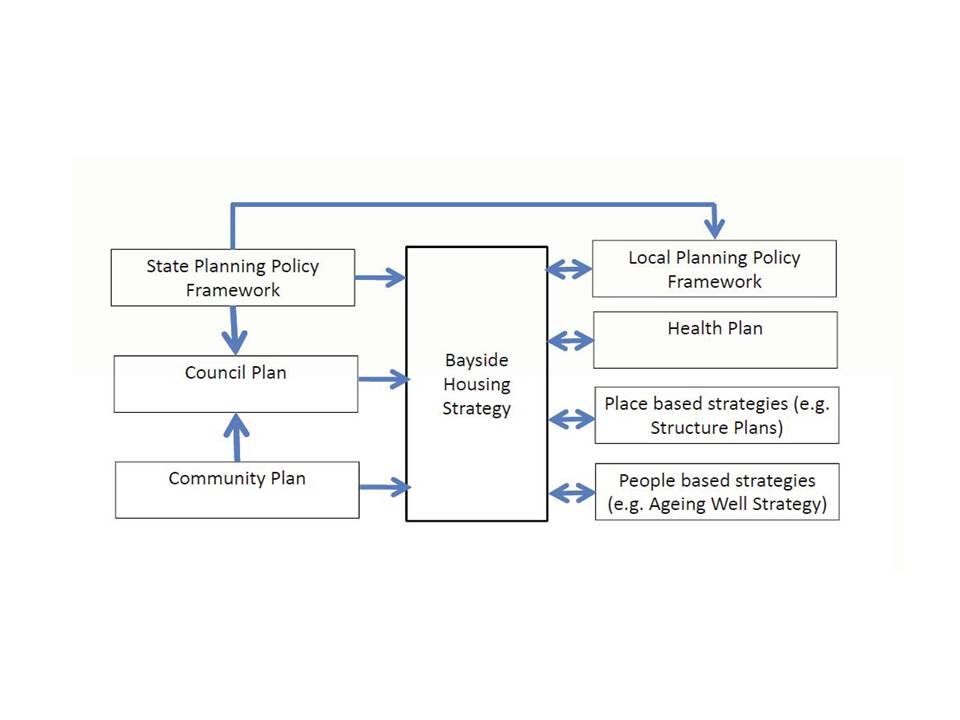
By way of comparison to the above points, we would like readers to note that the Bayside strategy works in completely different, and we contend, better ways. Firstly, their starting point has always been carefully researched and developed structure plans for activity centres that have been endorsed by the community following bone fide consultation. Bayside also concentrates on population growth, not just housing stock, and finally the imperative to incorporate community sentiments via their Community Plan is given major prominence. Glen Eira of course does not have a ‘real’ community plan. It only has a Council Plan. The Bayside diagram below illustrates the interconnection of all these facets –

Your comments are welcome.

Recent announcements by both Glen Eira Council and the State Government need exploring and the asking of many important questions. We are referring to the Grade Separation in North Rd., Ormond. This month’s Glen Eira News, carries this small announcement on page 3 –

“VicRoads has advised Council that the Dandenong Rail Corridor Project is investigating short-term and long-term measures to improve the operation of the roads intersecting the Dandenong railway line. Community engagement is likely to occur in the first half of 2011.  

VicRoads has also advised Council that the new Government’s policy includes planning for grade separation projects including North Road, Ormond (project cost $150 million, $12 million allocated in the first term) and Murrumbeena Road, Murrumbeena (project cost $150 million, $2.5 million allocated in the first term)”. (Notice the order? – a case of let’s bury this as much as we can?)

Last year, the Leader’s ‘Red Spot Survey’ on level crossings had the Murrumbeena crossing as the worst in Metropolitan Melbourne. Glen Eira Council has for the past few years also joined in the chorus for upgrading of the Murrumbeena crossing (See Glen Eira News, front page, September, 2008). In a Media Release dated 22nd November, 2010 we find this: “Coalition Leader Ted Baillieu has announced if elected Premier this Saturday, he will commit an initial $379 million to fix the problems at eight metropolitan level crossings, including North Road, Ormond and Murrumbeena Road, Murrumbeena. Glen Eira Mayor Cr Steven Tang said the separation of local level crossings is a perennial issue that has been most recently highlighted by Murrumbeena Road’s number one position in the RACV and Leader Community Newspaper’s Redspot Survey. “

All well and good! But this doesn’t explain why, when Murrumbeena has always been in the spotlight, we suddenly have the Ormond project receiving $12 million dollars in the first term, compared with only $2.5 million dollars for the Murrumbeena site!!!!! What is going on? Why have the priorities suddenly been switched around?  Are there any backroom deals going on that the community knows nothing about?

After being alerted by a comment from Streuth we’ve done a little digging regarding IKEA’s plans for expansion and development in Melbourne. Streuth cited a job ad by IKEA, where the location was listed as ‘Ormond’. We  have also found other IKEA plans on the drawing boards. If IKEA is moving into Ormond then residents need answers to the following questions:

  • What does this mean for the Caulfield Village development?
  • What does this mean for local streets and neighbourhoods when Council doesn’t even possess a Integrated Transport Plan as part of its Planning Scheme?
  • Who knows anything about this, and when did they know?
  • Does anyone stand to make a profit here?
  • Has there been collusion between the bureaucrats/councillors and the State Government – all done behind closed doors?

In the end, any such development will only provide further conclusive proof of what a total shambles the Glen Eira Planning Scheme really is. No structure plans; no transport plan; no public realm policy. A case of the ‘secret society’ at work?

One of the most important functions that any council has, especially in these ‘pro development’ times, is the power to refuse, or to grant a permit. We’ve previously pointed out how the Glen Eira delegations to officers in effect removes many powers from councillors (as a council) and redirects them to select officers.  We’ve also pointed out how this council differs fundamentally from the delegations and planning committee rules that other councils see fit to impose. But there’s worse! The very language that Glen Eira uses in its delegations is deliberately vague, obtuse, and hence allows subjective judgements rather than stringent and explicit policy to provide the framework for decision making. The end result can only be the further erosion of Council powers. We refer in particular to Section 61 (1)(a) of the Planning and Environment Act which covers delegates power to grant a permit. Glen Eira proposes the following ‘conditions and limitations’ –

“the exercise of this power is limited to the following circumstances:

i)               There has been no objections lodged; and

ii)             The application/amending plan is generally in compliance with existing policy or guidelines;

iii)           The application has not been referred to the Council or the Delegated Planning Committee (DPC) for determination

The power cannot be exercised where:

i)               an application is for use of land for a brothel; or

ii)             An application is for use of land for gaming machines; or

iii)           An application is for extension of time for tennis court illumination beyond 10,00pm; or

iv)            A proposal involves dwellings exceeding one level, except where the delegate is DCD, MTP or MStatP who may grant a permit allowing a double storey development.

The permit must not be inconsistent with a cultural heritage management plan under the Aboriginal Heritage Act 2006.”

Readers should take careful note of the above bolded and underlined words and phrases. Exactly what does ‘generally’ mean? If there are 10 conditions, will someone still get a permit if they only meet 5, or 6, or 7 of those conditions? Thus subjectivity on the part of the officer is enough it seems. As to the issue of double storey developments, compare the above with the Port Phillip version. Implicit in the latter’s delegation conditions is the acknowledgement that councillors will ACTUALLY KNOW about all applications – that they are informed. Can we say the same about the processes at work in Glen Eira? And of course, in Port Phillip and numerous other councils but NOT Glen Eira, there is the ubiquitous ‘councillor call in’ principle stated clearly again and again – “Decision to grant a permit where the application involves a two storey extension and a ‘line of sight’ principle is involved and the proposal does not meet the prescription but does, in the officers view, meet the performance approach set out in the Heritage Policy and unless a councillor requests that the application be determined by Council.”  

It’s really time that councillors took control of this council and fulfilled their fiduciary duties to the community.

We’ve received a Position Paper from Mr. Orek Tenen on the entire Phoenix Precinct and the Racecourse/C60 amendment. Mr. Tenen’s paper is quite lengthy, and there are many attachments. (+2). We’ve uploaded the full paper here, but present in abridged form his conclusions and recommendations below:  

Suggestions 

To change the unsatisfactory situation and to ensure that Phoenix Precinct satisfies and complies with the designated original Crown Land provisions and community wishes, the following points should be progressed:

  1. The whole Original Crown Land (page 86 of Murray & Well book on History of Caulfield Ref) should be strategically planned as one entity of State significance (202 ha) together with all stakeholders and residents;
  2. Glen Eira and Stonnington Councils to ask the State Government to establish a Priority Development Zone for this whole area;
  3. Current Caulfield Racecourse trustees to be replaced with those that can appropriately represent the Crown Grant terms and conditions i.e. three functions (Racecourse, Public Recreation & Public Park) plus Glen Eira Council as a Planning and Responsible Authority, and State Government as the owner of the Crown Land;
  4. Amendment C60 to be abandoned, but C60 area to be developed as a Technology Park and not a shopping centre;
  5. Training of horses to be removed from the Caulfield Racecourse public Recreation ground & public Park (CRRP);
  6. The present training track to be used by the public for close viewing of races as is done at Flemington racecourse. This will increase the attendance of the Caulfield racecourse racing as is the wish of the racing fraternity and MRC;
  7. Fencing around the Racecourse to be transformed to a modern type that allows visualisation of the CRRP ground and activities on it;
  8. Increase the Recreation & Public Park elements of CRRP to be fully within safe racing track as it is done in so many overseas and Australia’s premier racecourses;
  9. Improve access to the CRRP Recreation & Public Park elements of the racecourse;
  10. Caulfield Station to be developed as a major Transit Station, particularly for goods transport linking East and West of Victoria i.e. deep channel Westernport Bay and Avalon Airport;
  11. Remove level crossings as a priority in getting the goods transport on line(s) that link Westernport and Avalon Airport;
  12. To ensure proper implementation establish a Steering Committee and an Implementation Authority.


Key findings:

  1. The original 1858 Caulfield Heath land size earmarked for recreation reserve was 440 acres (137.6 ha).  The Caulfield Racecourse is all that remains of that with 54 ha, of which only about 8 ha is supposedly reserved as a Public Recreation and Public Park. And even that is yet to become fully available to residents with an unknown timetable.
  2. Health & Environment issues should be the driver of the Build Environment if Quality of Life is to be improved;
  3. Councils are to properly plan for the future together with their community and not rely only on legislation and bureaucratic processes. This is important for the Victorian Government as well if it is to achieve its objectives for the State;
  4. Phoenix Precinct and Caulfield Racecourse to become a State significant Project, whose economic value exceeds $10 billion. Glen Eira Council has not got the capacity or staff to handle such a big Project.
  5. Caulfield Station in a middle rank LGA is a pre-eminent junction station and should be developed as a Transit Station for goods transport to connect East with West Victoria, specifically Westernport deep channel facility with Avalon Airport.
  6. Key to the success of Caulfield Junction is a program of removing Level Crossings between Westernport and Avalon Airport to ensure cost benefit of goods transport, both on rails and roads.


Orek Tenen,

Secretary

Sustainable Villages & Suburbs Inc

A previous post commented on the upcoming delegations to officers, paying particular attention to the ‘Conditions and Limitations’ under the Planning and Environment Act. We noted the fact that in Glen Eira the Planning Committee is NOT a special committee; that there is no official ‘councillor call in’, nor does the Planning Committee consist of councillors as community reps. In our municipality power is wielded by unelected officers as outlined in this council description of what the Delegated Planning Committee is. As a further means of comparison, we’ve uploaded the current Stonnington ‘Planning Delegation Guidelines’ .  Apart from the differences in composition, and the limitations on the powers of the committee, the fact that this document is freely available online, again stands in stark contrast to the practices of Glen Eira.

Stonnington is not alone in providing its residents with policy manuals and information as to the protocols under which a variety of services operate. Kingston, for example, has  a complete listing of all its protocols and guidelines online. We challenge readers to locate any similar documents on the Glen Eira website – assuming of course, that they even exist!

Today’s Caulfield Leader –

Development protesters have got it right  

REGARDING the proposed Murrumbeena Rd/Emily St developments, I totally agree with the protesters. Buildings of this size are not appropriate in the area for all the reasons stated (‘‘Flat out protesting’’, Leader, December 14). I live in Omama Rd and there was a recent proposal to build eight units in our street. A number of residents attended the Glen Eira Council offices at the time of the submission, which was rejected by council as being inappropriate for the area. However, by the time it went to VCAT, the council had done a backflip and did not dispute the building of six units with only one visitor parking space. I can only imagine the impact in an area that is already notorious for its railway crossing. 

Green land disappearing  

LITTLE wonder Glen Eira has the lowest (amount of) space, they are developing there like crazy. The Caulfield Racecourse reserve is a classic example. Public land about to be developed into 23-storey buildings, and hardly anyone is really questioning it. In a decade or two, the racecourse club is said to have plans to sell the whole course for development. This means no more park in the centre and no trees or green areas. 

Developers close in  

UNDER the highly controversial planning scheme Melbourne 2030, developers were given a free hand to develop all over Melbourne, with no regard to the effects on the people. Now with this report, we are seeing the damage it is doing to our way of life (‘‘Space race as Glen Eira feels the big squeeze’’, Leader, January 18). It’s time for a change of direction quick smart.

At the first council meeting of the year, we anticipate that the deferred item on delegations will again be presented with the ‘conditions and limitations’ sections fully legible this time! The comments made here are limited to the planning area, but there are many other items of delegation being suggested, all of which require in-depth consideration by councillors before any rushed decisions are made.

Delegations are particularly vital in planning applications. We provide the following comparisons so that residents may see exactly how much Glen Eira cedes to Officers with the subsequent removal of decision making from councillors. These comments are not meant to decry the value of delegations per se – they are vital for any municipality to carry out its day to day operations. Whereas other councils delegate with strict limitations on the powers of officers, this does not appear to be the case here. Glen Eira delegates 97-98% of its planning to unelected council staff who, we believe, do not have guidelines from council as to what levels of development controls the councillors consider reasonable or appropriate. In many cases ‘political’ decisions and judgments must be made, but without councillors’ guidance on such matters the City Planners are at a loss to know what to do. Planners are competent to make many planning judgments, but are not ‘competent – in a technical sense – to make value judgments that require familiarity with wishes, needs, and opinions of the community. Councillors have this competence, for they are directly elected by the community to represent community values.

We ask readers to consider the following comparisons between Glen Eira and other councils in order to assess how little control our elected representatives have over planning in this municipality and how little decision making by officers is accessible, transparent and accountable to the community.

For instance:

  1. Kingston, Darebin, Moreland, Frankston, Banyule, Cardinia (amongst others) do not simply have a ‘delegated planning committee’ (DPC) – they have decreed that such committees are constituted as ‘Special Committees’. This means that agendas are published, meeting schedules are published, minutes are published, residents officially address committees (some allow 5 mins), and most importantly the committees consist of councillors – all chaired by the Mayor. The role of officers is simply to present and/or provide ‘advice’.  This is a far cry from the manner in which DPC’s operate in Glen Eira
  2. Many councils provide monthly reports to full council meetings where information is provided on: how many applications; how many permits granted by officers, DPC’s; how many refused by the various officers, etc. In Glen Eira, the only report which is published is that which documents applications before VCAT. We doubt if councillors, and certainly not the public, have any idea as to the breakdown of applications and their acceptance or refusal.

 There are many other differences as well – 

  • ‘Councillor call in’ – where a single councillor has the power to ‘call in’ any application for decision at a full council meeting (Port Phillip; Cardinia; Bayside; Kingston; Banyule; Casey; Frankston to name but a few!)
  • Number of objections clearly specified as the trigger for panel or full council determination (often 5, some 10 – In Glen Eira we find the phrase ‘significant number’!)
  • Height levels that determine whether applications go to DCP, Council or officers. In Glen Eira two storey to be determined by officers alone)
  • Parking restrictions – ie. if a development intends to waive parking restrictions whether or not this should go to council or DCP (Port Phillip)  

Glen Eira’s Delegations under the Planning and Environment Act clearly cede enormous power to select individuals. We maintain that these delegations limit councillors’ input and lack the transparency and accountability that is evident in the processes adopted by other councils. Councillors should not be simply ‘rubber stamping’ these staff suggestions. In short, Councillors are elected, of the Community, by the Community, for the Community. Council staff, on the other hand, are not elected at all. It is certainly time that Councillors took the reins in running this Council as is their required duty and to ensure that decision making on something as important as planning is not left to unelected bureaucrats alone.

MEDIA RELEASE FROM THE MINISTER FOR PLANNING – Wednesday May 28, 2003

Funds for public open space in the City of Glen Eira will grow according to the number  of residents who move into new subdivisions, the Minister for Planning, Mary Delahunty said today. Announcing approval of a scheme that will link developer contributions to the density of the subdivision, Ms Delahunty said approval of Amendment C20 to the Glen Eira planning scheme would introduce a formula to help developers determine their open space contribution.

“Although the City of Glen Eira has terrific parkland, it is a relatively meagre supply overall – running a poor second for the least amount across all metropolitan councils per head of population,” she said. “Part of what the Bracks Government is striving for under Melbourne 2030 is more open space where it is limited and where demand is growing as well as a more certain planning process, where the likelihood of dispute is reduced.”

Ms Delahunty said the amendment reflects the same open space principles that have been in place in Glen Eira, but makes the outcome more certain by fixing the contribution rate payable by developers.

The member for Bentleigh, Rob Hudson, said lack of public open space is a concern for residents and council has also struggled to bargain with developers for appropriate contributions to open space – often ending up in the hands of the appeals tribunal. He said the council had sought the reform. The changes include:

  • Developers of subdivision in suburbs relatively well-served by public open space will pay less, whereas the charges for subdivisions in suburbs less well-served will increase;
  • Developers of subdivisions close to parks will pay less;
  • Developers who provide less than 40m2 of open space for most dwellings will pay more; and
  • Subdivisions of six units or more that provide useable communal open space will pay less.

“For example, if you are building a 4-lot subdivision in Bentleigh, are within 300 metres of a park and are providing an average of 40m2 of private open space per unit, you will need to contribute 2.5 per cent of the value of that land to public open space,” he said. “These changes will make the system for creating public open space in the City of Glen Eira more certain without placing an undue burden on developers,” Mr Hudson said. “Local parks are a vital part of our urban fabric, which we must support and maintain for the long-term – so we have liveable places for current and future generations,” he said.

++++++++++++++++++++++++++++++++++

Glen Eira Council Annual Reports for the periods ending June 30th, 2002/3 to 2009/10 reveal the following income from open space levies –

2003      –             $1,249,000

2004      –             $1,453,000

2005      –             $1, 049,000

2006      –             $1,253,000

2007      –             $1,151,000

2008      –             $821,000

2009      –             $1,518,000

2010      –             $1,664,000

QUESTIONS

1.     Land prices have skyrocketed, development has skyrocketed in Glen Eira, yet from 2003 to 2010, the increase in revenue was less than half a million. Why?

2.     Monies are meant to be spent on ‘public open space’ and ‘improvements’. To the best of our knowledge only 1 property (Packer Park) has been added to the open space of Glen Eira via these monies. Why?

3.     $10,158,000 has been declared as open space levies. Where has all this money gone? Why hasn’t it been used for the primary intended purpose, especially since Glen Eira repeatedly claims to have a lack of public open space?

4.     Has council collected all the monies it is entitled to, or have various developments escaped these costs over the years? If so, how many, and why?

This is your job councillors! Insist on the answers to these questions!

Here are some ‘highlights’ from councillor and public questions from 2005. Readers should remember that recent council meetings also contained public questions on: mayoral elections and qualifications; councillor conduct; planning and ‘confidentiality’. And of course the Municipal Inspector’s report on the Newton reappointment process. The more things change the more they stay the same in Glen Eira! 

“Considering that the land for the Rosanna Street Nursing Home was re-zoned from Public Park & Recreation Zone to Residential 1 Zone, what Open Space Contribution is to be levied on this development and to what purpose will this levy be applied.” (12th December, 2005) 

“Can Cr Feldman assure us that there were no meetings by six Councillors to decide on the Mayor and why did many residents know who was going to be mayor before the vote took place?” (12th December, 2005) 

“The Whelan report concludes that the responses given to the Inspector in relation to the reason why some former Councillors changed their mind re the appointment of the CEO were not credible (page 86). On the 15th May 2005 the former Mayor, Margaret Esakoff, in response to a request from the community to explain Council’s behaviour in relation to this issue was not as open as possible about the Council’s decision in that she was unable to give reasons why Council delayed the reappointment of the CEO, nor was she able to explain why it would not have been in the public interest to do so, and I quote: ‘I do not believe there is any value to be gained delving into the minutiae of who did what, when and to whom and nor do I think it is appropriate. What is important is that the matter is resolved and we can now move on.’ Under the draft Code of Conduct and/or the provisions of the Local Government Act it is expected that Councillors are open and accountable for their decisions. What recourse does the community have should its elected representatives flaunt the Code or the Act?” (10th October, 2005) 

…. At present with its corporate structure and culture community representatives are advising only the Committees of Friendly Cities (10), Finance (3), and Arts & Culture (1), 14 in all. All other Advisory Committees have no Community Representatives. Officers and self-appointed Councillors that change each year run those Advisory Committees. Given that the State Government requires Councils to consult extensively with its communities on strategic directions using Melbourne 2030 Framework, and as part of the Sustainability Accord: 1. What steps has the Council Administration taken to involve broadly and in depth the Glen Eira community in its continuous planning processes? 2. Has the Council administration considered emulating the Consultation processes of Glen Eira creators? (10th October, 2005) 

“Will Council provide an explanation as to why Cr Goudge singled out certain members of the public gallery on 13th December 2004 and made disparaging remarks about them by saying, and I quote from the official minutes of that meeting, “they are prone to have a bit too much to drink”? Is this acceptable and approved behaviour by an elected representative of the community? (23rd May, 2005) 

Cr Goudge asked the CEO, “I’m interested to receive advice on what types of documents that senior Council Officers including yourself are privy to that are off limits to elected Councillors?” 

The CEO responded suggesting that it would be better if he provided written advice. He added; “documents that are involved in the transaction of Council business are generally available to Councillors. Documents which are covered by, for example the privacy act where the purpose for Council having the document or having the information is not related to matters that are before the Council would not be generally available.”

Cr Goudge asked the CEO, “Just so that I understand, there are some documents that are available to senior Council Officers but not available to Councillors even under request of FOI?”

The CEO responded saying; “There would be lots of those, yes, for example, personnel files.” (2nd May, 2005) 

“In Council minutes of 7/2/05, CEO Newton reported that there were only 4 ‘outstanding reports’. On this basis: 1. Will Council acknowledge the minute’s inaccuracy since Cr Esakoff on 1/12/03 requested a report on Elster Creek Trail? 2. Will Council account for the reasons for this inaccuracy? 3. Will Council inform the community as to why this report is still outstanding after 16 months?4. Will Council inform the community as to its official protocols and time limits in dealing with petitions? 5. Will Council explain why the Elster Creek ‘petition’ was refused tabling in light of the fact that its website refers simply to instructions as a ‘guide to wording’?” (11th april, 2005) 

“Why has Glen Huntly been allowed to degenerate/deteriorate into a run-down shopping strip, in marked contrast to Carnegie, Bentleigh & Elsternwick?” (21st March, 2005) 

“That a report be prepared on the potential to amend the Local Law in respect of the election of a Mayor to allow an opportunity for nominees and/or candidates to speak for up to five minutes prior to any vote to elect a Mayor.” The MOTION was put and CARRIED unanimously. (7th February, 2005) 

“It would appear that most items of interest to the Community are classed as confidential” 

“It was reported in the “Leader” that Cr Esakoff would work towards bringing harmony within the Council Chambers. Would Cr Esakoff be prepared to share with the ratepayers of Glen Eira: 1. Her plan to achieve this goal 2. the time line in which she proposes to achieve her goal 3. the cost to the Glen Eira Ratepayers to achieve this goal and 4. how will the Glen Eira Ratepayers be able to measure her success or failure to achieve this goal?” 

“Would Council assure ratepayers that open Government will be restored in Glen Eira forthwith. How can the events of this evening be justified in what is meant to be a democratic and accountable Council?” 

“The Statutory Planning report claims (14.1) “Decisions made for this quarter are higher than applications received” yet total of active applications is higher in Nov & Dec – 04. Why? Also would it not be better to show an index of Decisions Made/Applications received and by Council, Office, Manager & DPC for number of appeals which also are reported to show about a 20% increase over previous years. Why is this? (28th Feb, 2005)

We thought it would be instructive to see how Glen Eira may have changed over the years – to discover whether processes, services, and governance practices have actually improved in the past 6 years. Our guide has been public and councillor questions dating mainly from 2004. We conclude that basically residents have the same concerns today as they did six years ago – childcare, aged care, openness and transparency, effective communication/consultation and planning issues. Reading these questions it is obvious that nothing much has changed in Glen Eira – except that public questions are no longer taken on notice. The quality of current answers however is another issue!! These questions provide a sad commentary on how little has actually been achieved.

“As Council has made a profit from selling of aged care facilities within the City and not actually increased places in the City, I ask what is being done with the profit and further what is being done to seek government funding in order to increase aged care facilities in the City?” (26th May, 2003)

“What are Council’s public policy objectives for child care and how do they achieve them?”(3rd May, 2004)

“The treatment of Childcare under the State Government’s new competitive neutrality policy requires the implementation of a public interest test prior to the application of CN pricing because of the inherent public policy issues associated with childcare.Can Council please explain why it has failed to undertake a public interest test prior to applying CN pricing policies to childcare services?” (3rd May, 2004) 

Cr Sapir referred to a public interest test and asked if one had been carried out and if so to what degree. She further asked; “what consultation process did Council take to advise parents that there was a proposed fee increase”? (24th May, 2004) 

“Why Minutes of Council Meetings are not available for distribution on request at the Caulfield Library? Should not that be part of standard policy of engagement of the community? Ready availability of such documents should add to the proper governance of the Council?” (24th May, 2004) 

“Can you please advise why did the Council cut down several 25 to 30 metre high trees on the corner of Jasmine and Birch without consultation with the near byresidents?” (9th Feb, 2004) 

“Since the Glen Eira Council has decided to stop subsidizing childcare centres with ratepayer income in the next financial year, will Glen Eira ratepayers see a reduction in rates as a result?” (22nd March, 2004) 

“Re Council Statement of Financial Performance to 29 February. Can you please reveal the source or sources of the above budget revenue of $954,000 from ‘other’sources in above budget? Have our drillers struck oil?” (22nd March, 2004) 

“How does Council justify that public questions that were asked in March 2003 have received a response on 6 April 2004 advising that the questions do not conform with Council’s public question time procedure. Please provide appropriate and specific explanations as this does not comply with acceptable time frames to me as by now I have given up on getting adequate answers from Council.” (13th April, 2004) 

“Why won’t Council undertake a ‘Public Interest Test” on childcare to assess community response?” (15th June, 2004) 

“The Community Plan that was passed this evening is supposed to provide a plan for the community to use as a means of measuring Council’s performance up to 2010. The indicators for 2010 however need further clarification. Which 3 park masterplans are intended for development? What does Council mean by consulting with the University? What are the character amendments that are to be adopted?Which community centre is to be built? What about the 3rd community centre? What are the implications of keeping rates to at least 10% below our 7 Benchmark Councils? These are but a few questions that need to be answered in a Community Plan that purports to be a vision for the future?” (15th June, 2004) 

“We would be most grateful if a meeting could be arranged with relevant councillors and staff (prior to the release of second round offers scheduled for 27th August), in order to discuss the Council’s enrolment policy which fails to give priority to the children currently attending ‘3 year old kinder’ and who wish to continue on with their pre-school education at the same kinder the following year?” (16th August, 2004) 

“As Cr Erlich has observed the report to tonight’s meeting is interesting but unless a measure of input is used together with output, it is largely meaningless from the point of view of effectiveness. Will Council consider reporting the appropriate ‘INPUT’ as well as ‘output’ in future service reports?” (6th September, 2004) 

 “Will the Council apply its generous concessions given to tennis clubs to childcare centres and if not could it please explain why the council’s policy that services used by a minority of the community should be cost neutral and not subsidized by ratepayers, applies to childcare centres but not tennis clubs?” (27th September, 2004) 

“The Agenda papers for Council Meeetings have for some time included public questions and answers. I note that the Agenda papers have, for the last 2-3 meetings, not included Public Questions and Answers. Can Council explain why this is so? Is there anything preventing Council from continuing with this practice?”(8th November, 2004) 

“Of all C type Amendments proceeded with a statutory process:1. How many have used the full statutory process of 6 steps? 2. How many use only 2 steps? 3. How many used broad community consultation prior to step 1 of the statutory process? and 4. How many used a public discussion paper as part of broad community consultation prior to step 1 of the statutory process?” (29th November, 2004) 

“Will Council put the proceeds from sale of Council land toward purchase of alternative open space in Glen Eira, & that purpose only.” (29th November, 2004) 

“The Minister for Planning announced that Councils may apply for a number of interim height controls to provide for greater certainty for residents & developers. Will Council take up on this initiative?” (29th November, 2004)
« Previous PageNext Page »