GE Planning


PS: In order to clarify why this entire application has been so disastrously botched by Council we ask readers to contemplate the following and to have a close look at the zoning shown in the image. In the first place:

  • Council argued that this triple block site was ‘transitional’. The map shows it is smack bang in the middle of the RGZ
  • Council’s conditions included increased setbacks. Again ridiculous when the schedules don’t include this, plus there are already 4 storeys backing onto this site from Bent St and soon no doubt across the road.
  • The 3 block site is over 2000 square metres – positively encouraged by the planning scheme- even in the Neighbourhood Residential Zone
  • How many more times must councillors be hit over the head and realise that they haven’t got a hope in hell when they lop off a storey or two, or a handful of apartments and expect VCAT and the developer to accept this? The fault isn’t with VCAT. The fault lies with the planning scheme and lousy decision making that costs ratepayers a fortune to defend!
  • When some planner sits at a desk and draws circles on a map then insanity reigns supreme. That’s why one side of Godfrey Street will have 4 storeys opposite and other parts of Godfrey Street will have 2 storeys. As we’ve said, this isn’t planning, it is incompetence and indifference.

vickery

PPS: we are in error below. VCAT did order that council pay the developer’s appeal costs of $2,086.20

It is surely incumbent on every council officer to ensure that when a report is tabled, or a councillor says something that it is accurate, and not misleading. The number of times that Glen Eira City Council produces reports that are deceptive, lacking in complete information, and designed to portray only the ‘positives’ and these are then repeated by councillors is extraordinary. If a councillor does not know the facts, then it is his/her duty to find out. He should not as Lipshutz, Esakoff and some of the others invariably do, just regurgitate what has been put in front of them.

Our current case in point concerns Item 9.3 from Tuesday night – the so called VCAT WATCH. In the report on the decision for Vickery Street, Bentleigh, the Michael Henderson report states:

The Tribunal held that the interface between the building and the street was ‘urban’ rather than ‘suburban’, and that consequently hard surfaces, fences and limited landscaping along the front boundary are considered to be part of that ‘urban’ character.

Either this is a deliberate misrepresentation of the member’s judgement, or it reveals a total lack of understanding by our supposed ‘VCAT representative’. The full judgement can be accessed at: http://www.austlii.edu.au/au/cases/vic/VCAT/2016/920.html

Whilst it is true that the member does use the terms ‘urban’ and ‘suburban’, it is clear that his use of this terminology is based on the simple fact that COUNCIL ITSELF REFERS TO BENTLEIGH AS AN ‘URBAN VILLAGE’!!!!! He uses the term ‘suburban’ to differentiate this from the Minimal Change Areas or the current NRZ. It is NOT the member’s fault that Council’s planning scheme still contains the outdated terminology of ‘urban village’ when  the 2010 Planning Scheme Review reported that it should be removed! 6 years on, it is still there!

More to the point, the member does not simply proffer a personal opinion that says ‘urban’ areas can have ‘hard surfaces, fences and limited landscaping’ because that is part of the ‘urban character’ as opposed to a ‘suburban’ character as Henderson would like to portray. The quoted sentence appears only AFTER the member has gone through all of the policy and zoning statements on height, etc and focuses simply on fence heights . It is Council itself, which has determined via its zoning of RGZ, what is acceptable in these areas. The member is merely adhering to the schedules, or the lack of differentiation, that council in its wisdom imposed. He is thus following council policy and what the zones tell him and what the developer is permitted to exploit!

Here is some of what the member actually wrote.

In the past few years multiple planning approvals have been granted for four storey apartment buildings in and around the Bentleigh urban village. One such development is under construction on the land adjoining to the west. This and other similar proposals respond to the site’s proximity to the activity centre and the planning policy context.

Schedule 1 to the Zone applies to the review site. It limits the height of a new building on this site to 14.5 metres, as its slope exceeds 2.5 degrees over an 8 metre cross section. No clause 55 standards are varied by the schedule. In addition to the purposes of the zone, intensive development is clearly encouraged by planning policy.

The Glen Eira local planning policy framework directs the most intensive development to the Phoenix Precinct at Caulfield and urban villages such as Bentleigh. These areas are to experience the most change. Housing diversity areas adjacent to the urban villages are to accommodate incremental change….

There is strong policy support for the development of apartment style buildings in urban villages, in a manner that will result in significant levels of change. This is a deliberate and considered policy outcome sought by Council.

I am not persuaded that one storey should be removed from the proposed building. Firstly, while all of the Bentleigh urban village is identified for substantial change, opportunities for intensive development within the centre are constrained. Heritage Overlays, Special Building Overlays, small lot sizes along Centre Road, four storey building heights and fragmented ownership all constrain to varying degrees the opportunities for Bentleigh to play the role envisaged by policy. Consequently I consider that weight has to be given to using the unconstrained sites efficiently so the urban villages can contribute to broader housing diversity and compact city objectives. Opportunities should be realised, unless there are particular site constraints or unacceptable amenity impacts that arise from an intensive development. I have noted above this site has no constraints and is well located to the core of the centre

  • In the absence of specific directions in the Scheme regarding massing, site coverage or setbacks for this site (the applicable schedule does not vary an clause 55 standards), I consider any transition in height and massing is confined to the boundary of the zone where it interfaces with a zone where less intensive development is to occur.
  • Consequently I see no reason to regard the review site as being within a transition area. Rather, as I have noted I think sites that are consolidated and unconstrained should be developed efficiently, given the relatively limited opportunities in Glen Eira as a whole and in the Bentleigh urban village.

I agree with the parties the development does not comply with standard B6. I must therefore turn to the objective of clause 55.03-1, which is: To ensure the setbacks of buildings from a street respect the existing or preferred neighbourhood character and make efficient use of the site. I give limited weight to the prevailing character, and note that the scheme provides little specific guidance to a preferred character.

I also think the proposed setback can take its cues from the activity centre to the south rather than the suburban character to the north and because of the type of building that is proposed. The somewhat lesser setbacks to the street will be more consistent with the supermarket and shops within the centre that are built close to their boundaries. I consider that this built form that provides a context for the emerging character, rather than the suburban setting of detached dwellings further north along Vickery Street.

I think it is entirely reasonable that a development in an area of substantial change has a higher site coverage and less permeability than a two dwelling development in a local suburban street in a minimal change area. The responsible authority was unable to provide a basis in policy or context to justify these requirements.

Conclusions

  • Once again councillors’ grandstanding by lopping off a storey has been truly routed by VCAT because of council’s deficient planning scheme.
  • If council really wanted these properties to be ‘transition’ then why zone them RGZ? Remember that in Glen Eira there really is no ‘transition zone’ just a one house ‘interval’ between the growth zones!
  • Henderson’s report is entirely disingenuous. Almost none of the negatives noted above re council are reported and this is regurgitated ad nauseum by the likes of Lipshutz, Hyams and Magee. Either they have not read the actual judgements themselves, or they are willing to sacrifice ‘truth’ in order to maintain the myth of how wonderful Glen Eira’s planning is.
  • Council should finally thank its lucky stars that the member did not grant the developer’s wish that ratepayers fork out their costs because of council’s failure to determine this application in the requisite time!

Finally, with the current Planning Scheme Review to be produced at the next council meeting, we can only hope that for once there is a comprehensive and honest analysis of all VCAT decisions over the past 6 years. Anything less, is totally unacceptable.

Below is just some of what is happening in Glen Eira. Urban Melbourne lists over 70 major current projects. We’ve selected a mere 30! Please note that all of these have permits and many are under construction. As we’ve revealed in an earlier post there are at least another 774 apartments waiting in the wings for council approval. Also note that these mere 30 projects equal over 1300 apartments.

Our thanks to Urban Melbourne for these screen dumps.

CLICK TO ENLARGE

Item 9.5 of the latest agenda features a four page officer report on what is purportedly on parking facilities and conditions in the General Residential Zone (GRZ) and the Residential Growth Zone (RGZ). The recommendations are farcical –

That Council:

  1. notes this report
  2. continues to review parking in Glen Eira’s Residential Growth Zones and General Residential Zones in conjunction with the actions associated with the Transport Strategy.

What makes these recommendations so unacceptable is:

  • We know of no report in the past ten years which has investigated parking (as opposed to traffic management) in these growth areas
  • Residents have bemoaned the lack of parking year after year and basically nothing has been done
  • We doubt that council even knows how many parking spots are currently available for shoppers, businesses and residents in the housing diversity areas
  • We also wonder how many parking spots have been ceded to developers because of crossovers and the waiving of onsite car parking spots. One resident several years ago, calculated that just in East Bentleigh over 300 places had been waived.

And all of this has been happening despite the promises made over ten years ago and included in the planning scheme. For example:

Investigating the need for a cash-in-lieu policy to fund new car parks in various commercial centres.

Parking precinct plans

The City of Glen Eira recognises the special and often conflicting parking needs of its numerous commercial centres. Further strategic work is necessary to develop Parking Precinct Plans

Preparing Parking Precinct Policies for the following neighbourhood centres:

􀂂 Alma Village, Caulfield Park, Caulfield South, Bentleigh East, Glen Huntly, Ormond.

􀂃 Investigating the need for a cash-in-lieu policy to fund new car parks in various commercial centres.

Implementing a program of Local Area Traffic Management Plans in order to minimise disruption and increase safety of residential areas.

In Glen Eira, despite these promises there is:

  • No cash in lieu. Residents should note that Banyule Council has just had an amendment gazetted which imposes a $17,500 levy on each car parking waiver for its commercial sites.
  • No parking precinct plans for any activity centre or neighbourhood centre as promised
  • No Local Area Traffic Management Plans exist

So exactly what has this council been doing for the past ten or so years? Apart from outsourcing its Traffic Management Department at great expense, it would appear to have done bugger all!

The current 4 page ‘report’ continues this trend of ‘let’s do nothing but wait’. Basically, the report is nothing more than a rose-coloured summary of the situation. Facts and statistics are non-existent. Instead we get such comments –

Council’s Statutory Planning unit has found that applicants generally provide adequate parking for the dwellings themselves. However, it is common for applicants to request a reduction in the visitor car parking guideline

Similarly, when planning decisions are challenged at VCAT, it is usual for VCAT to uphold the dwelling parking provision, and common for VCAT to reduce the requirement for visitor car parking.

Conveniently missing from the above paragraphs is the additional fact that council’s planning department itself often waives visitor car parking and loading bay requirements – as it has done in the very first application set down for this same council meeting (Item 9.1 – Neerim Road/Elliott Avenue). Even when VCAT is involved, decision after decision shows how little council’s transport department has done to counter the claim of the developer in regard to parking facilities. Here’s just one example –

Council put to me that they accept that the provision of 12 spaces is adequate for the site….The development generates a requirement for 13.2 car spaces in total…..First Angle v  Glen Eira  CC [2016] VCAT 1124 (6 July 2016)

In the end we’re left with nothing more than further promises of action. Not action NOW, but in 18+ months time as evidenced in this paragraph from the report –

Transport Strategy

The recently adopted Transport Strategy Action Plan calls for car parking surveys to be undertaken in the Urban Villages (Activity Centres) and key Neighbourhood Centres in the next eighteen months. These car parking studies will provide Council with more information to enable the impacts of car parking in the RGZ and GRZ1 to be assessed in more detail. Furthermore, the Strategy calls for a review of the feasibility of Car Share arrangements and the development of a Car Share Policy. The scope of the policy could cover both car share for public car spaces, and for private car spaces in a development.

With modern technology nothing should take 18 months for ‘detail’ to be forthcoming. If other councils can get off their backsides with amendments that exact an appropriate cost to developers and implement local traffic management plans, then Glen Eira’s reluctance to undertake the necessary work now is simply another indication of either sheer incompetence or the pro-development ethos that has given us the zones and all its ills!

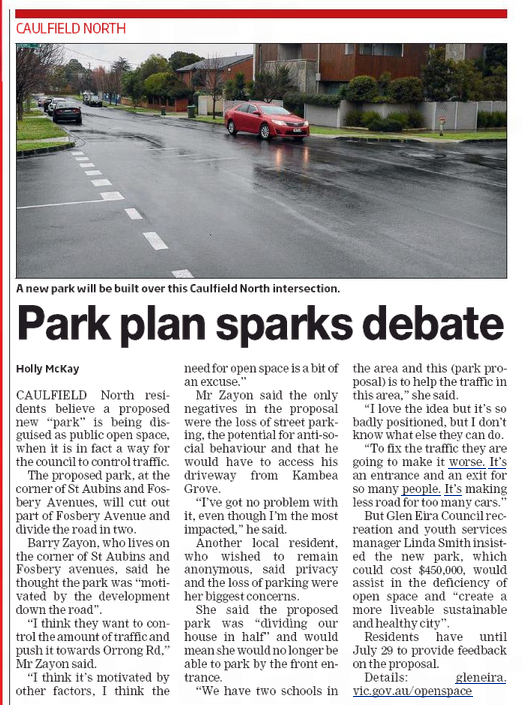
park

If these residents are correct and this proposal is all about traffic management, then it is a pretty expensive way to resolve the issue. Of course, no one knows exactly how much this ‘park’ will cost! Nor are we privy to its size or how much of this area will be covered by concrete. No traffic analysis is provided (and we doubt it’s even been done!) in order to gauge the potential impact of closing off streets.

Other issues also need to be considered –

Pocket parks are, according to the research literature designed to alleviate the lack of open space in a HIGH DENSITY area. This proposal is smack in the middle of a Neighbourhood Residential Zone – ie LOW DENSITY. When other areas such as Carnegie are literally crying out for more and more open space and have less than North Caulfield, why doesn’t this area get priority?

According to the Open Space Strategy (OSS), Carnegie has 21.07 hectares of public open space. Of the ‘recommendations’ contained in the OSS for ‘additional open space’ all of the 5 recommendations carry the priority rating of ‘Very High’. In contrast, Caulfield North has 26.28 hectares of public open space; of the 6 recommendations made for ‘additional open space’ only one carries the ‘very high’ classification and this is for ‘gap area C1’. The proposal for Fosbery/St Aubins is not C1! Another 4 recommendations are rated as ‘high’ priority and one other as ‘medium’.

Thus, on every single criterion, Council’s proposal fails to meet the recommendations of its own OSS, plus residents are being asked to comment without being provided with the necessary full information. Residents in Carnegie have every right to ask if they are viewed as second class citizens when it comes to open space and the necessary funding.

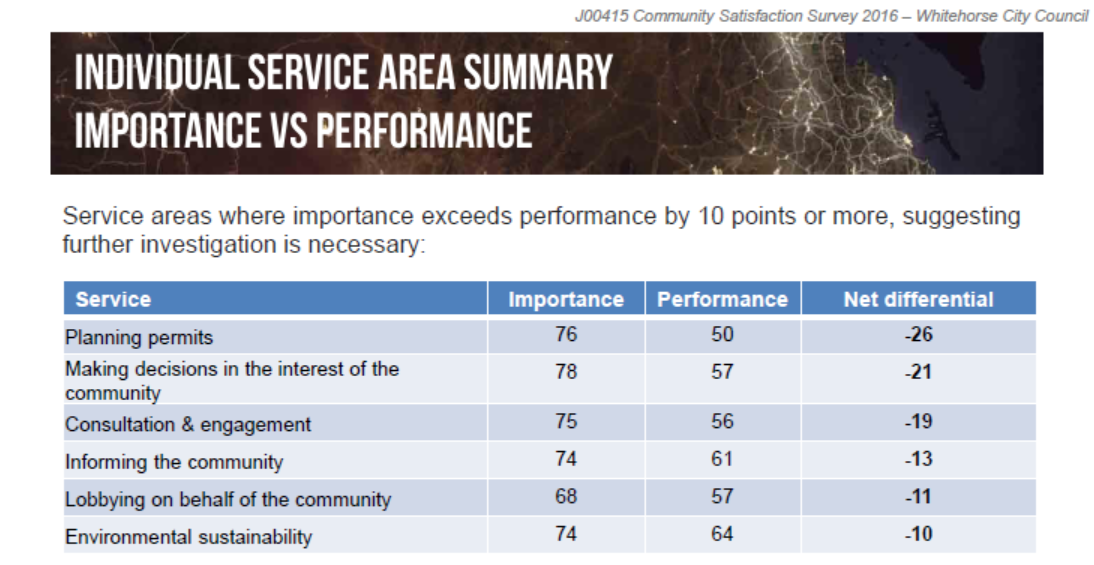
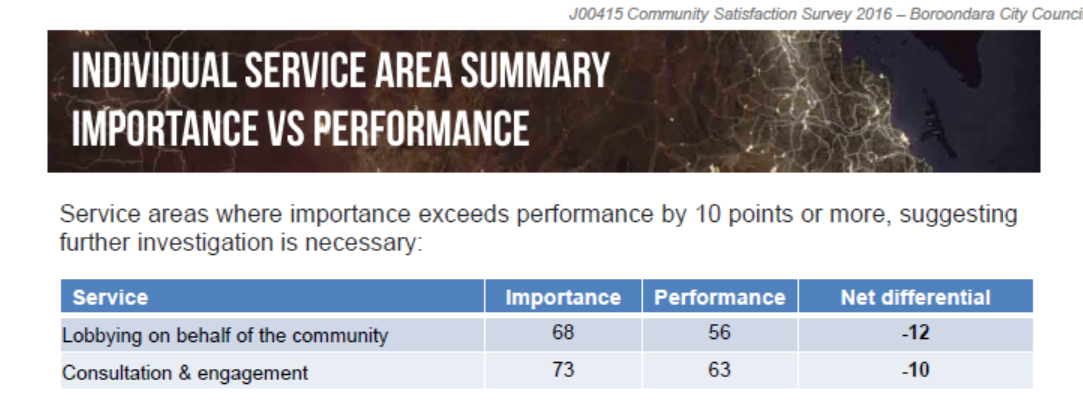
csThe most significant aspect of this survey which the Leader article does not focus on, is the discrepancy between resident evaluation of the importance of a service and the perceived ‘results’. Differentials of well over 20 signal a new low point in Glen Eira. For example: residents believe that ‘consultation’ is vital, giving it a ‘rating’ of 75 for ‘importance’. Their judgement on performance is 51! What should also be highlighted is that the differential between importance and performance has been growing steadily over the past few years – yet council has failed to address this decline. No amount of spin can disguise this fact!

Here is one page from the survey –

Pages from Community-Satisfaction-Survey-2016

PS – BY WAY OF COMPARISON, HERE ARE THE RESULTS FROM THE 2014 SURVEY. PLEASE NOTE THE INCREASE IN THE DIFFERENTIALS BETWEEN IMPORTANCE AND PERFORMANCE

Pages from Community_Satisfaction_Survey_Report_2014

PPS – Not all councils have thus far published the results of their surveys. However, we’ve taken the opportunity to highlight some of these results as a further comparison with Glen Eira. For starters, Stonnington and Greater Dandenong DID NOT HAVE ANY SERVICES WITH A GREATER DIFFERENTIAL OF 10 POINTS.  The screen dumps (below) from Whitehorse and Boroondara reveal that their residents’ angst is nowhere near those from Glen Eira’s population and the number of services with a discrepancy of 10 or more points is also well below the number to be found in Glen Eira.

whitehorse

Untitled

Presented below is a list of SOME of the new applications that have been submitted in the past 6 weeks. We have ignored many of the ‘smaller’ applications such as 2 double storeys, or 3 dwellings on one site. Council decisions are still to be made and many have as yet still to be advertised.

8 Egan Street, CARNEGIE – 16 storey mixed use (original application was for 155 dwellings – now 135)

60-64 Rosstown Road CARNEGIE VIC 3163 – 8 storey, accommodation 49 rooms

285-287 Neerim Road CARNEGIE VIC 3163 – 6 storey, 59 dwellings

322-326 Neerim Road & 17 Elliot Avenue CARNEGIE VIC 3163 – 4 storey, 38 dwellings

1110-1112 Dandenong Road CARNEGIE VIC 3163 – 4 storeys, 34 dwellings

90-94 Mimosa Road CARNEGIE VIC 3163 – 4 storey, 49 dwellings

76 Truganini Road CARNEGIE – 5 new dwellings

3 Ames Avenue CARNEGIE – 7 new dwellings

26 Woorayl Street CARNEGIE VIC 3163 – 3 storey, 10 dwellings

1 Beena Avenue CARNEGIE VIC 3163 – 5 three storeys

23 Toolambool Road CARNEGIE VIC 3163 – 3 storey, 5 dwellings

25-27 Horne Street ELSTERNWICK VIC – 7 storeys, 25 dwellings

411-415 Glen Huntly Road ELSTERNWICK VIC 3185 – 8 storey mixed use (no. of units not stated)

71 Patterson Road BENTLEIGH VIC 3204 – 4 storey, 5 dwellings

37 Nicholson Street BENTLEIGH – 4 storeys, (no. of units not stated)

45 Browns Road BENTLEIGH EAST VIC 3165 – 6 dwellings

  • South Avenue BENTLEIGH VIC 3204 – 9 three storeys

9 St Georges Avenue BENTLEIGH EAST VIC – 15 double storeys

3 Heather Street BENTLEIGH EAST – 6 dwellings

92 Kooyong Road CAULFIELD NORTH – 4 storey, 23 dwellings

1-9 Claire Street MCKINNON VIC 3204 – 44 dwellings

  • 9 Adelaide Street MCKINNON VIC 3204 – 34 dwellings

2 Adelaide Street MCKINNON VIC 3204 –  4 double storeys

12 Glen Orme Avenue MCKINNON VIC 3204 – 3 double storeys

9 Station Avenue MCKINNON VIC 3204 – 9 three storeys

229 McKinnon Road, MCKINNON – 8 three storeys

2 Adelaide Street, MCKINNON – 4 double storeys

23-25 Rothschild Street GLEN HUNTLY VIC 3163 – 3 storey, 23 dwellings

31 Rothschild Street GLEN HUNTLY – 5 double storeys

441-495 Inkerman Road ST KILDA EAST – 4 storey, 27 retired living units

43 Balaclava Road ST KILDA EAST VIC – 3 storey, 18 dwellings

3 Ardyne Street MURRUMBEENA – 3 storey, 13 dwellings

56 Hobart Road MURRUMBEENA – 6 new dwellings

126-128 Murrumbeena Road MURRUMBEENA – 3 storey, 32 dwellings

Flat 1-28 235 Balaclava Road CAULFIELD NORTH VIC 3161 – 26 dwellings

441-495 Inkerman Road ST KILDA EAST VIC 3183 – 4 storey, 27 retired living units

460-464 Glen Eira Road CAULFIELD – 6 dwellings (4 double storey, 2 single storey)

TOTAL 774 PLUS UNKNOWNS in the six weeks!

The Planning Scheme cites an average of 500-600 dwellings PER YEAR!

The facts:

  • Glen Eira has quadrupled its average new dwellings per year
  • How many of these new dwellings are single bedroom is undisclosed
  • How many of these new dwellings stand empty is anyone’s guess
  • How many ‘standards’ council overlooks in granting these permits is undisclosed
  • Why Council fails repeatedly at VCAT remains unreported (but we know why according to VCAT judgements – the fault lies almost exclusively with the current planning scheme)
  • Have any of these 2000+ new dwellings been granted an exemption in paying their open space levy and, for those that have paid, is the levy at the maximum of 5.7% in each and every case?


Item 9.8 – Neighbourhood Character Provisions

Crs Sounness/Delahunty

That Council notes this report and considers implementation of Neighbourhood Character Provisions as well as Design and Development Overlays to support existing and expected future residential character, assome of the preferred planning scheme tools to implement the findings of the City of Glen Eira Planning Scheme Review Process.

The MOTION was put and CARRIED unanimously.

SOUNNESS: said he had talked with planners and that ‘it is good to have a review and see how other councils are doing things’. The current process of ‘consulting with the community’ has resulted in a lot of issues being put forward. Council has to decide ‘what weight’ to give to these suggestions. The current officer’s report however will be useful to ‘resource us’ for what will be a useful ‘outcome’.  Said the report shows that ‘different tools achieve different outcomes’ but in ‘different ways’. Council needs to try and be in a ‘defendable position’ on policies. He supports the officer’s recommendations but would like these things as part of the consideration of the planning scheme review.

DELAHUNTY: said that councillors had had an ‘off the cuff discussion’ on Neighbourhood Character Overlays.  Said that in ‘applying’ these Neighbourhood Character Overlays there are objectors so it is ‘perhaps a little more of a vexed issue’. Said that she thinks more and more people are becoming in favour of them and sees this as ‘our obligation’ to ‘extend’ these through ‘housing areas’ that are ‘post war stock in Glen Eira’ and not just Victorian places. So ‘we are discussing Neighbourhood Character Overlays in the context of our planning scheme review’ but she thinks that we ‘ought to have more conversations about character overlays’ and ‘how to extend them’. Torres ‘tells us’ that these things do ‘carry some genuine weight’. This is ‘what people are asking for’ and will protect the ‘old parts of Glen Eira’.

Sounness declined the opportunity to sum up.

COMMENT

The officer’s report highlights the work done by neighbouring councils. Significantly, the officer report does not include a Glen Eira summary alongside so that a real comparison may be made. Nor does it spell out the various heights and other conditions these councils have implemented through their schedules to the zones – all of which stand in stark contrast to the Glen Eira (lazy) approach of ‘one size fits all’. In fact, no mention of the zones occurs at all in the councillor ‘discussion’.

More concerning is that ‘neighbourhood character’ appears to have morphed into Neighbourhood Character Overlays (NCO) only judging by the comments of these two councillors. Hardly satisfactory – especially since NCOs are tools designed for use in specific areas – generally a street or two – and certainly won’t cover large swathes of Glen Eira. What does cover large swathes of Glen Eira are the abysmal zones – which do not rate a mention from either Sounness or Delahunty and certainly did not feature in the Planning Scheme Review Discussion Paper nor did it receive the attention it required in the ‘feedback forum’ presenting the draft ‘workplan’.

Even the State Government’s Practice Note highlights the additional tools that councils may use, but which this motion appears to ignore – Different areas do have different characteristics and expectations and the VPP allows councils to set different residential development standards through either the schedule to the residential zones or the application of the NCO to achieve local neighbourhood character objectives. These can influence the nature and extent of development that can occur in order to achieve a desired neighbourhood character outcome for an area.

A further cause for concern is the stated intention of council to wait until release of the data from the August Census before anything in the Municipal Strategic Statement (MSS) is truly amended and/or updated. Again, this does not adhere to the published Practice Notes – The objectives for neighbourhood character and the strategies and implementation measures for achieving the neighbourhood character objectives should also be included in the MSS.

We can therefore only conclude that the intent of Council is to do precisely what they have been ordered to do by the Minister and nothing more! The zones remain sacrosanct – despite the outcry, petitions and media coverage from residents dismayed at what is happening to their streets. And, the longer these zones remain untouched our fear is that it will be too late to do anything to halt the destruction. Perhaps this is what it’s all about?

Hyams moved motion to accept ‘as printed’ – (ie not to do anything for a year or two!) Delahunty seconded.

HYAMS: said his request for a report was the result of ratecapping coming in and therefore reducing the amount of money ‘we would require’ to fulfil the Open Space Strategy recommendations. Said that it ‘was always intended’ that rates would ‘fund more than half’ of what was required.  Population however has increased, ‘especially in McKinnon’ where the strategy stated there would be a decline. Thus ‘once the census figures are in which will be later this year’ they could ‘recalculate based on those’ new figures.  Also said that ‘no other council’ has the high uniform rate that Glen Eira has.

DELAHUNTY:  said that the ‘premise’ that council used to argue for 5.7% ‘has changed’ because of population growth and ‘our ability to resource what we actually wanted to do’.  Therefore she thinks that it is council’s ‘obligation’ to review the levy. They need the census data to ‘add weight to what I already think is a pretty watertight argument’.

PILLING: agreed that ‘times have changed’ and limited their ability to raise funds because of rate capping. Said that raising the levy is ‘worth looking at but we need to do it properly’.  Stated that the data should ‘take 6 months to come out’ so that would be ‘early 2017’.

HYAMS: said they went through an ‘exhaustive process’ in justifying the levy. Also said that ‘we would have received’ another million dollars ‘had the planning scheme not been held up by what ultimately turned out to be pointless objections’ which ‘delayed’ things by 9 months.

MOTION PUT AND CARRIED UNANIMOUSLY

COMMENT

  • How many millions is council foregoing by deciding to wait instead of instigating the process for a higher levy now?
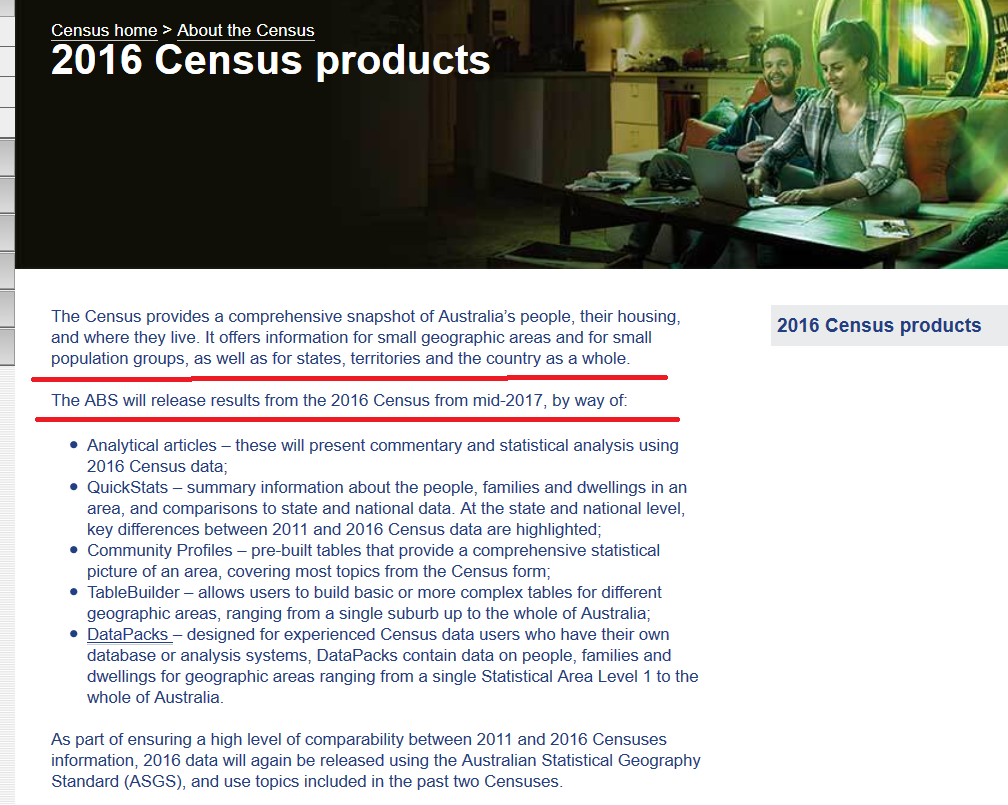
  • How many more times will Hyams be allowed to get away with misrepresenting the facts – ie. the Census website clearly states that data will be released ‘from mid 2017’ and certainly NOT ‘later this year’ as he claims.
  • How ironic that every single point made by the objectors to a levy of only 5.7% is now vindicated?
  • Parts of St. Aubins Avenue and Fosbery Street are now in council’s sights to close off the street and construct some ‘open space’. What analysis has been undertaken to ensure that council is getting ‘value for money’ from its previous street closures – ie Eskdale Road ( a stone’s throw from Caulfield Park) and another in Elsternwick? How much have these conversions cost? What is the total size? How much of these ‘open spaces’ are covered in concrete? The crucial question of course is – would residents be better served by the purchase of bona fide areas of new open space that do provide the space required for multi-purpose use?

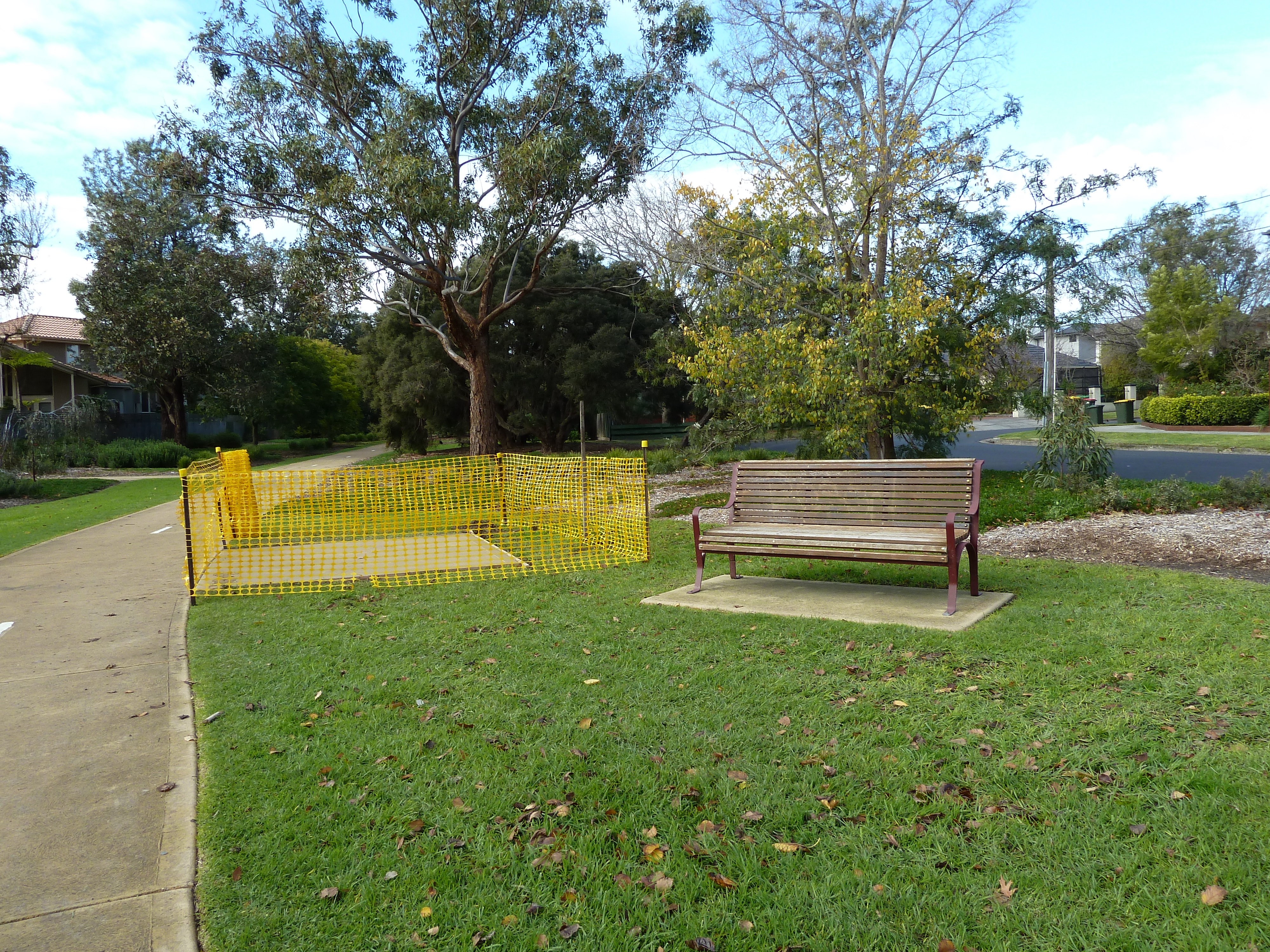
As an illustration of council’s sheer profligacy, and unbelievable decision making, we feature these photographs taken in the last week. Readers will note that a bench, on a relatively small concrete base already exists. So council has now come along and doubled the size of the concrete – presumably to move the existing seat two metres to the left! How much did this new endeavour cost for a council screaming blue murder over ratecapping and the need for frugality? Who made such a decision? How on earth can it ever be justified?

P1000438

We urge all readers to carefully consider the following report. It illustrates fully:

  • The failure of these councillors to address the ‘elephant in the room’ – ie the planning scheme and the abysmal zones. If council is now saying that a four storey development is inappropriate in this location, then why was it zoned as four storey? We also remind readers of the Hyams quote pre zones where he said that mandatory height limits means that developers will build to those height limits!
  • The zoning here is not the result of sound planning but the result of someone sitting at a desk and simply drawing a circle around a number of streets that then became the Residential Growth Zone.
  • The language used is deliberately misleading – Glen Eira does not have TRANSITION ZONES. It has pathetic ‘transition buffers’ but only for sites zoned GRZ2 and not GRZ1
  • Magee’s petty attack on Lobo reveals once more the animosity and dysfunction within this council. Of course Magee shoots himself in the foot by admitting that he also has no clue as to what clause 22.05 says or means!
  • Is Delahunty now changing her tune – ie on the rate of change?
  • Is Sounness vote really a vote for 4 storeys?
  • We also remind readers that VCAT does not legally have any role in council decision making. Its job is to look at the planning scheme that exists. VCAT does this. The fault lies mainly with council
  • Finally, we reiterate THAT ON EVERY SINGLE DECISION THAT HAS GONE TO VCAT AND WHERE COUNCIL LOPPED OFF A STOREY, OR REDUCED THE NUMBER OF APARTMENTS, THE DEVELOPER WAS SUCCESSFUL IN GETTING WHAT HE WANTS. These councillors have obviously not learnt a single thing in their four years as councillors. They keep stupidly, and nonsensically repeating the same errors over and over again!

Item 9.2 – Vickery Street, Bentleigh.

Hyams moved motion to lop off one storey to three levels instead of four and to reduce the number of apartments to 27. Seconded by Magee.

HYAMS:  started by saying that council has got a ‘policy’ about height needing to be at the centre of activity zones and that this application is ‘right on the edge’ and is ‘next to the transition zone’. So ‘it is right on the edge of this Residential Growth Zone’.  He therefore ‘believes that 3 storeys is more appropriate’ than four.  Said that he attended the planning conference where residents ‘raised’ concerns and he ‘shares those concerns’ and the motion is the result.  Residents were worried about overshadowing so 3 storeys takes care of this. Residents concern about ‘density’ is also catered for by removing  ‘a quarter of the apartments’ (ie from 36 down to 27). There are also conditions about site coverage and set backs. The conditions also want the number of 3 bedroom units increased so there will be ‘greater diversity’.  Said that residents and councillors agree that 1 car park per 2 bedroom unit probably isn’t enough but that is what ‘ResCode’ sets out and ‘that’s all that we can require’.  Residents also were worried about traffic, but the Australian Standards set the number of cars travelling  and what the various streets can ‘handle’ and ‘that’s what our officers are bound by’.  Thought that the motion represents a ‘reasonable compromise’.

MAGEE: said that the first thing done is to consider whether the application complies ‘with ResCode’ and the planning scheme.  Said that this ‘does meet those basic guidelines’. For councillors they ask ‘is this the best use of this land?’ and ‘does this improve the amenity or detract from it’. He thinks it ‘detracts’.  ‘We can sit up here and refuse it because we don’t like it’ but that would be ‘stupid’ since they know that it ‘already complies’ with ResCode and the planning scheme which was ‘put together with great community consultation with our residents’ who together with ‘council decided what can be built in what streets’.  Said this is ‘right on the edge. It is that transition zone’. Admitted that this will overlook people as a four storey building. Went on with ‘we as a responsible authority have to decide’ whether to reject the application and ‘send it off to VCAT who are then going to apply ResCode’ and maybe ‘come up with the same conclusion that the officers did’. What councillors want to do is ‘give something to the developer that is still pleasing, that is still profitable’ so they may not go to VCAT. Admitted there are problems with parking and amenity and Vickery Street is ‘right at the extreme where we start changing into the neighbourhood residential zone’. Said that this is ‘a difficult one’ but to ‘simply refuse’ is ‘the wrong way to go’ – it is the ‘weak way to go’ and they still ‘have to be the responsible authority’. ‘We can’t just stand here and want to become popular’.  It’s not ‘about being popular ,it’s about doing the right thing’. They have to ‘suit the developer’ as well as residents and probably only a two storey development will suit ‘anyone living around it’. He wouldn’t like to go into ‘my back yard’ and look up at a four storey building. Thought that Hyams motion was a ‘much better outcome’ than proposed.

LIPSHUTZ: agreed with Hyams and said that when council makes a decision it stands as a ‘quasi tribunal’ and that they have to ‘look at planning law’ and not ‘just what we feel should happen’. If they do only what ‘residents want’ then VCAT will ‘say we have no credibility’. Council has to consider  planning law and ‘issues that residents have raised’.  Said that residents had ‘raised important issues’ like overshadowing and neighbourhood character. He can ‘reject’ the application but that doesn’t ‘achieve anything’ because it will go to VCAT and ‘VCAT will overrule us’. Claimed that they ‘had looked’ at setbacks, overlooking, etc. Said he wouldn’t like a building like this ‘next to me but development is going to happen’ so ‘my job as councillor’ is to ‘ensure’ the ‘least impact’ on residents. The imposed conditions ensure ‘lower mass’, etc. The problem of ‘high rise’ is through all of Melbourne so ‘if you knock off one floor’ that ‘also reduced the number of cars’ in our congested streets.

SOUNNESS: said he had spoken to neighbouring residents and thanked them for ‘inviting’ him into their houses. Thought that reducing the application by one level is a ‘good compromise’ if it goes to VCAT. Thought it was ‘strange’ that they always ‘talk’ as if VCAT ‘were in the room’ but VCAT isn’t in the room so ‘we don’t have that opportunity’ to talk with them. But ‘VCAT is the hidden partner to our discussion’. Said he ‘recognised’ that residents will be impacted and that the planning scheme ‘is written’ and because of the zones, ‘there will be some form of development that will impact’ on people. Said he would support the ‘proposal as written’ but sees that there probably won’t be ‘support around the table’ for anything other than Hyams motion.
LOBO: said that councillors are there to ‘represent the residents’ and not governments or others. Said that the application isn’t in line with ‘clause 22.05’ of the planning scheme, and is ‘inconsistent with the character of the neighbourhood’ in terms of ‘mass and scale’, and doesn’t meet the requirements of Clause 55.02 and other bits from this clause. Said that even at 3 storeys, or 4 storeys, the ‘height of the building will be oppressive and overwhelming’ and impact on residents in Godfrey Street that it backs onto. Said that ‘aesthetics’ would change and noise level from residents living in the units increase plus looking into backyards and backyards are ‘the dream’ of Australians where they have barbecues , a ‘beer and watch the cricket or footy’. Thought that the government and council were ‘wrong’ in letting the ‘residential zones go ahead’ and ‘after seeing the tears rolling on people’s’ faces he now knows ‘they have lost their biggest asset’ – ‘their castle’. (At this point Lobo asked for the extension of two minutes to his time. All councillors except Lipshutz – who did not put up his hand – voted on extending time.) Went on to say that the proposed development will ‘destroy the character of Godfrey St’ plus their privacy. Thought that they should refuse the application like they did with 14-18 Vickery but that ‘ultimately’ was given a permit by VCAT. If the permit for 3 or even 2 storeys is given then ‘residents will be left to sing or hum – ‘there goes my only possession’.
MAGEE: asked Lobo a question in that he said the proposal ‘doesn’t accord with Clause 22.05’ and said ‘I’m not actually familiar with that’ so ‘could Cr Lobo tell us what that might be’?

LOBO: asked to ‘direct’ the question to Torres

Pilling sought to do this but MAGEE interrupted saying –

MAGEE: since Lobo said ‘he disapproved of this development’ because it doesn’t meet the objectives of 22.05 so ‘he must obviously know what that is so I’d like to hear from him what that clause is’.  Pilling then asked Lobo to ‘respond to that question’.

LOBO: said that he relies on the ‘recommendations of Ron Torres’ and that he ‘nor any of the councillors are technically aware of things’ so ‘I have to depend on him’.

PILLING then said ‘I might ask the question’.

TORRES: explained that clause 22.05 refers to ‘council’s Urban Village Policy’.

MAGEE: asked Lobo whether he ‘understands all of those clauses, do you?’

LOBO: ‘I don’t think it is your business, thank you’.

MAGEE: ‘I’ll take that as a ‘no’”

DELAHUNTY: said that she is ‘familiar’ with the policy and has been wondering ‘how to cast my vote’ by listening to everyone. She has been to the site and doesn’t ‘think that we are managing the rate of change’ in these streets and that ‘town planning is about managing that rate of change’. Referred to Lobo ‘mentioning’ some of the clauses ‘where we think this application might fall down’. Although ‘I can see very strong grounds for refusal’ she is concerned about VCAT as ‘that extra person in the room’. However, several months ago they ‘kept hammering VCAT’ for not ‘applying our policy’ and ‘we’re second guessing what they are going to do’. So it’s now ‘come to a point where I’ve got to be consistent in my arguments or I can’t expect them to be consistent as well’. Even though Hyams has done a ‘good job in providing balance, it still falls down’. Since it does ‘fall down’ on ‘so many’ areas then a refusal is necessary. Thought that ‘it is unusual to see so much tinkering’ by ‘tiny degrees’ from council and ‘not a straight out refusal’. It’s on the edge of other zones so they need to think carefully about these situations. Claimed to ‘still be in two minds’.

PILLING: thought all councillor comments were good. Said this was ‘on the cusp’ of the growth zone ‘is an issue’ and asked Hyams if he would ‘like to address those concerns’. Thought that 4 storeys is too much and that ‘I would tend to support the alternative’ since this answers residents and is more ‘realistic’.

HYAMS:   said that ‘there are some things’ in the planning scheme that are ‘cut and dried and mandatory’ and others that are ‘more subjective’ like neighbourhood character. So even though 4 storeys is mandatory they can ‘reasonably say’ that here ‘it should be 3 storeys’. Agreed with the ‘non compliance’ with ResCode that Lobo spoke about but his motion now ‘resolves those issues’.  Thought it was a ‘seductive argument’ to say that ‘we’re here to represent the residents’  and ‘so we should do what the residents say’ but ‘we need to take our responsibilities seriously’ and that means ‘to apply the planning law’. Lobo’s concern about privacy is handled by the condition of ‘screening’ so ‘you should not be able to see into those backyards’ even though the ‘people in those backyards will be able to see the building’. Thought his motion was the ‘best outcome’ and residents wouldn’t thank them if they refuse and then VCAT says that ‘council is being unreasonable’. ‘What we should be doing is to go to VCAT with a reasonable position’. So three storeys is fulfilling both the responsibility to residents and as a council. Lobo’s comments on the zones need a reply. Claimed that the zones were ‘a direct transition from our previous zones’ and the Urban Villages before are now Residential Growth Zones. Before there were no height limits and now ‘we have mandatory height limits’ and that they are the ‘only council in Victoria that has mandatory height limits across all of its residential zones’. Claimed that council also has its ‘transition zones’ and that these didn’t come out of Neighbourhood residential areas but out of ‘where the Urban Villages were’. If these weren’t there, they would all now be ‘4 storey maximum’. Said that every council has a ‘reponsibility’ to ‘cater for population growth’ and that ‘council has done the best’ it could ‘under those circumstances’.

MOTION PUT – VOTE WAS FOUR AGAINST FOUR (ESAKOFF ABSENT)

VOTING FOR MOTION: HYAMS, LIPSHUTZ, PILLING, MAGEE

VOTING AGAINST MOTION: SOUNNESS, HO, LOBO, DELAHUNTY

PILLING USED HIS CASTING VOTE IN FAVOUR OF MOTION.

The lack of open space in Glen Eira has been known for years. It is high on the list of resident priorities for some dramatic change in council’s approach – for instance, the purchase of new open space. The claim to counter this is that Glen Eira is highly ‘urbanised’ and purchasing land is very expensive. Yes, land is expensive and council did raise the developer levy to 5.7%, (only after years of collecting a pittance). Objectors in 2014 argued that even this new levy was insufficient to meet the needs of the existing and future population. Now there is an officer’s report on whether council should seek to raise the levy even further. The recommendations read:

That Council:

Σ notes the report

Σ requests that a report update be prepared following the release of the 2016 ABS Census data

The report claims that the Census data will be released in ‘early 2017’. Another porky by Council. We prefer to rely on what the Australian Bureau of Statistics(ABS) tell us and not what features in officer reports. Here’s the ABS version:

census

Thus nothing will be done for at least a year, and then another year to go through the amendment process, consultation process, possible planning panel review, and then awaiting the Minister’s rubber stamping.

Further, we see absolutely no reason why council needs to wait. All of the relevant statistics should be available right now to council. They should know precisely:

  • The number of new dwellings built
  • The location of these new dwellings
  • The number of permits granted
  • What areas these permits are in
  • If council and the consultants relied on Profile.id prognostications in 2013/2014, then they can rely on the updated figures right now!

In 2014 it was obvious that council’s and the consultants’ prognostications were inadequate given the zones and the inundation of planning permits. It is our firm belief that if council had done its work properly back in 2013/2014, then the open space levy would not now be an issue. If a correct levy was sought, then residents would now have plenty of more open space, instead of a decline per individual as is happening. Contrary to what is currently claimed by the ‘consultants’, their report, based on the statistics provided by council was totally inadequate and inaccurate. At the time of the planning panel, objectors highlighted this again and again. For example:

  • The claim was that Caulfield Village would still only be 1100-1200 units, when the Development Plan for 2046 units had already been rubber stamped and would near completion by 2026
  • Virginia Estate was ignored
  • Countless amendment rezoning to Mixed Use were ignored
  • Council’s estimate of only 5.22 hectares being redeveloped in the space of 14 years in Carnegie had already seen this number exceeded in the space of a single year and the same was true for the other activity centres. How on earth council could claim that only 5 hectares is available from 3.8 square km and over a third zoned for ‘growth’ is beyond us!
  • Council’s ‘estimate’ of existing public open space was and is, literally a joke, since they had changed the ‘definition’ of open space and of course included car parks within this calculation.

There is absolutely no excuse waiting another year before an increase is even attempted. This of course fits right into the philosophy of this council – do nothing if you can help it!

« Previous PageNext Page »