PS: AND HERE’S HOW STONNINGTON DOES THINGS RE THE RESIDENTIAL ZONES –

September 17, 2013
PS: AND HERE’S HOW STONNINGTON DOES THINGS RE THE RESIDENTIAL ZONES –
September 15, 2013
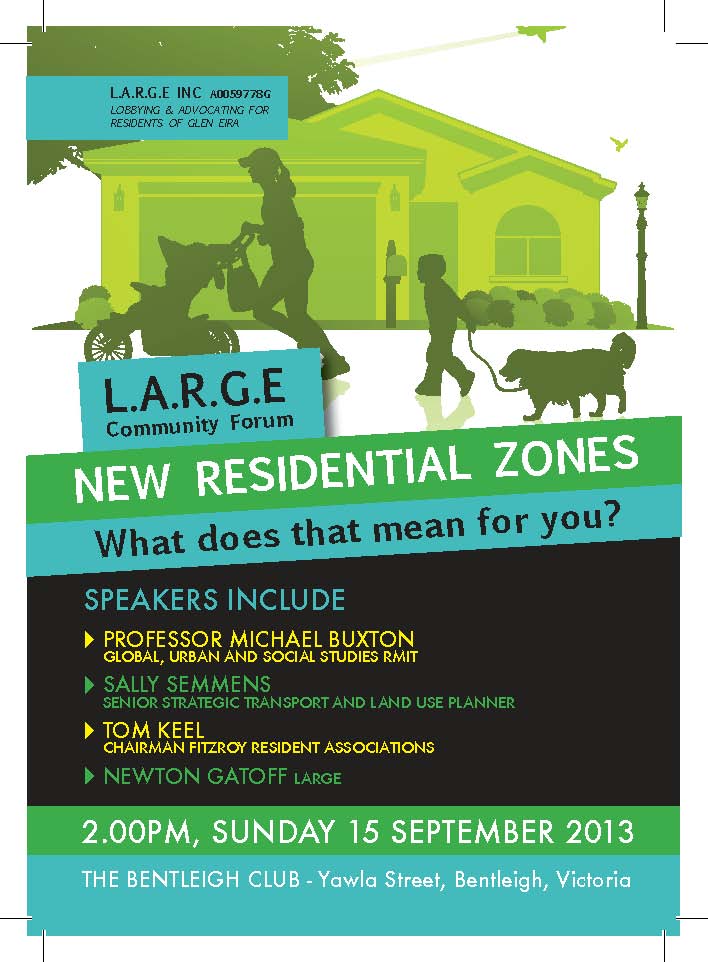
This afternoon’s LARGE Community Forum had a terrific turnout and very informative speakers. Apparently all Glen Eira councillors and some senior planning staff were invited. To their credit the only councillors to show up were Lobo, Delahunty and Magee. No officer turned up and no other councillors.
Since the afternoon was videotaped we’re assuming that LARGE will upload a full record of the formal presentation on their website (http://www.largeinc.com.au) so we won’t comment on this aspect of the event. Instead we will focus on some of the questions or comments that members of the audience made and the remarks made by the above councillors in response.
One resident asked that the map of the new zones be put up on the screen. He was from Wheeler St., Ormond which is a ‘purple area’ (4 storeys). He expressed ‘sorrow’ for anyone who lived in such areas because they were ‘high density zones’. His problem was that it was also a ‘flooding zone’ and there had been some progress with melbourne Water and council about upgrading drains but ‘without upgrades of infrastructure’ council is ‘still approving development’. They went to VCAT opposing a 3 storey development and they won. But that was several months ago, before the introduction of the zones, so the resident wanted to know what this means for the new development now – ie could there be another application and a permit granted because this is now a higher density zone. The resident asked if ‘council is stronger than VCAT?’
Professor Buxton explained that there are other forms of control via layers of overlays and if there is one he felt that VCAT would uphold it – although he didn’t know the extent of Glen Eira’s overlays. Delahunty then said that council is continuing to ‘look for new areas to apply neighbourhood character overlays’ and these are ‘primarily in the green section of the map’ (minimal change). Said that with permeability controls, height controls and other things that ‘we are quite proud of’ and that ‘VCAT cannot overturn’. She didn’t forsee any change to the current flooding zone.
Another member of the audience then began her question by saying that the data that the residential zones are based on comes from figures of the nineties. Things have changed a lot since then and the floods of 2011 impacted on a huge area near her. Yet council still grants permits and hasn’t taken into account ‘greater surface’ for buildings which means ‘greater flooding’ and all this whilst there’s been ‘limited infrastructure upgrades’. Said that she lived in the ‘purple zone’ and that council has been ‘quite remiss’ in blocking themselves off from the community. (applause). ‘there is definitely no regard for us living in this area’. Claimed that she had spoken with planners at council and asked what consideration was given to ‘infrastructure’ and their response was ‘oh, we looked at it in 2000’ and that she should take it to council. Mentioned ‘schools bursting at the seams’ and whilst a state responsibility, council still has to advocate but it ‘seems that our rights in Glen Eira have been overlooked’. Schools and kindergartens are ‘bursting at the seams’ and whilst there is a train station there is no bus service’. Talked about traffic and that ‘yes’ 3 storey limit is great’ but it’s not enough.
Another speaker then said that she finds the ‘of right uses’ (ie no permit required) ‘abhorrent’ since it removes her rights as a resident to object, ‘voice my concern, to be heard’. Asked if this is in fact an abuse of administrative and legal power as well as a ‘denial of natural justice’ (applause). Buxton answered that the government has justified this by granting ‘certainty’ and removing delays therefore saving money for everyone. Said irony of all this is that there are heaps of Section 2 uses (service stations etc.) that can then get permits. Government hasn’t prohibited anything and there are no height controls for commercial areas and will be a huge problem because these of right uses don’t have height limits applied to them.
Buxton also stated that the criteria to assess these uses in residential areas are ‘very vague’ so anything could go into a residential street. Said that these ‘criteria’ are supposed to be ‘performance measures’ but they are anything but performance measures – ie will they cause ‘detriment’ to someone. These are vague and all subjective. Buxton then went on to say that a planning scheme is a legal document and people’s rights are either ‘given’ or ‘taken away’ via the planning scheme.
Several residents then gave examples of battles they had won elsewhere and the call was for ‘people power’.
Another residents asked whether VCAT could still ignore ResCode standards if councils simply defaulted to these in its schedules since VCAT often ignored ResCode in the past. Buxton responded that if specified in the schedules such as height then this was mandatory but it was vital that councils apply ‘the maximum powers they have under the schedules’. Gave the example that council could have stipulated one dwelling per lot but Glen Eira didn’t – they’ve allowed 2 dwellings per lot. Where there is medium or high density and there is no specifications by council then they will be assessed under ResCode. Problem is that ResCode only applies to 3 storeys so applications for 4 or more storeys in Residential Growth Zones won’t even have these ‘standards’. ‘No developer in his or her right mind is going to apply for a 3 storey development in a commercial zone when there’s no height control’. Also the guide that assesses higher density is ‘even less strict than ResCode’. So ‘not only do you get an incentive to go over 3 storeys but you’re being assessed against a weaker code’…’you’d have to be nuts not to do it’.
One ‘brown zone’ resident said she was ‘shocked’ by what has been said. Asked if it’s true that those living in these areas have no rights and no protection and that the lovely heritage places around her have no value whatwoever except for developers. Buxton said that ‘you lose rights if application relates to Section 1 uses’ otherwise people can still go to VCAT. (SECTION 1 INCLUDES ‘food and drink premises’ within 100 metres of commercial zones; shops, medical centres, places of worship etc.) Many of these are ‘high impact’ that people won’t be able to do anything about. The other problem here is that there are no height limits on such uses so a hypothetical could be a 9 storey application with no rights to objection next door to a single storey.
Comments from Backlash about population growth and no planning for infrastructure – transport. Buxton claimed that no government is confronting the planning for a city of 6.5 million people by 2050 because it will cost 25 to 50 billion just in transport.
LOBO then spoke saying that ‘it’s a pity the other 6 councillors did not turn up’. Said that Labor lost ‘because of Justin Madden’ at the last election and now we’ve got Matthew Guy ‘who became mad’ and is ‘on his way out’. Told residents that they should ‘go to the State Member of Parliament’ and that when councillors promise to stop development so that the ‘next time’ they come to ‘your house’ asking for your vote ‘throw a bucket of water on their face’. He then said that ‘personally I have to go with the council decision’ and that he doesn’t ‘agree’ and that ‘I made that very clear’ and as he’s already said that ‘Melbourne is going to be like Calcutta’.
After a few more questions and comments on community activism and networking Magee spoke.
MAGEE: said he wanted to bring the discussion back to ‘some basic’ facts. Said that previously they only had ‘policies’ and not ‘zones’ and the former weren’t ‘enforceable’. This meant that ‘quite often’ at VCAT the ‘developer would win’. Claimed that ‘now’ the green areas were about ‘78% of Glen Eira’ and that developers therefore know that 2 dwellings is the maximum and that 2 storeys is the maximum. ‘that is not arguable through VCAT’. The blue zones are ‘a maximum of 3 storeys’ and the light blue is also 3 storeys and has ‘the greatest setback between the light blue and the green’. Brown is another zone with 4 storey maximum. Said that even with permitted uses in Glen Eira ‘not a lot has changed’. Said that in 2010 there was ‘quite significant’ consultation althought people might disagree with this. So all that’s happened is that the policies have ‘been changed over to zones’.
Another resident then stated that the spin doctors were outin force because the zones were rushed through and therefore they didn’t have time to consult with residents. Said that previously there were transition areas between the brown and blue zones and now there isn’t any. Asked if you own a house in a green zone and next door in the brown zone someone builds a 4 storey and blocks your solar panels what rights do residents have?
MAGEE: conceded that buildings could be 4 storeys but that ‘have to set back from 4 to 3 to 2’ and said this was a ‘natural setback’ and even in the growth zones (brown) these are ‘bordered by general residential zone’ (light blue)
DELAHUNTY: said that council had tried to have ‘transition zones in the past. Now we actually have transition zones’ and that ResCode could be applied to 4 storey buildings and council was trying to make transition zones enforceable whereas before they weren’t and now they are.
One resident got up and asked that those councillors who are present take back to their groups the community feeling that community consultation is what is needed and that rather than having the plans ‘left at the library where someone has to go with a magnifying glass’ to make head or tails out of it.
MAGEE: said that Glen Eira has the least amount of open space and that ‘there is no way that we are looking to encroach on open space’. The white areas on the maps are open space but ‘predominantly commercial zones’. Said that the first test is ‘about to come up’ in regards to the Virginia Park industrial site. Claimed that the Minister was approached by the developer to rezone without public consultation. Said that MP Miller had written to council and ‘endorsed’ the Minister’s position ‘not to go to public consultation’. Said that ‘council has actually fought that’ and will be putting it out under normal amendment processes which means public consultation. ‘These things are not debatable in council’. Said that council and ‘i’m one of them, I’m very proud of these zones’. Said that nothing has changed except that they have ‘guaranteed’ ‘maximum height limits’ in 98%’ of the municipality.
September 13, 2013
One of the range of videos created by Moreland City Council on their proposed implementation of the new residential zones. Please note a couple of stark differences:
September 11, 2013
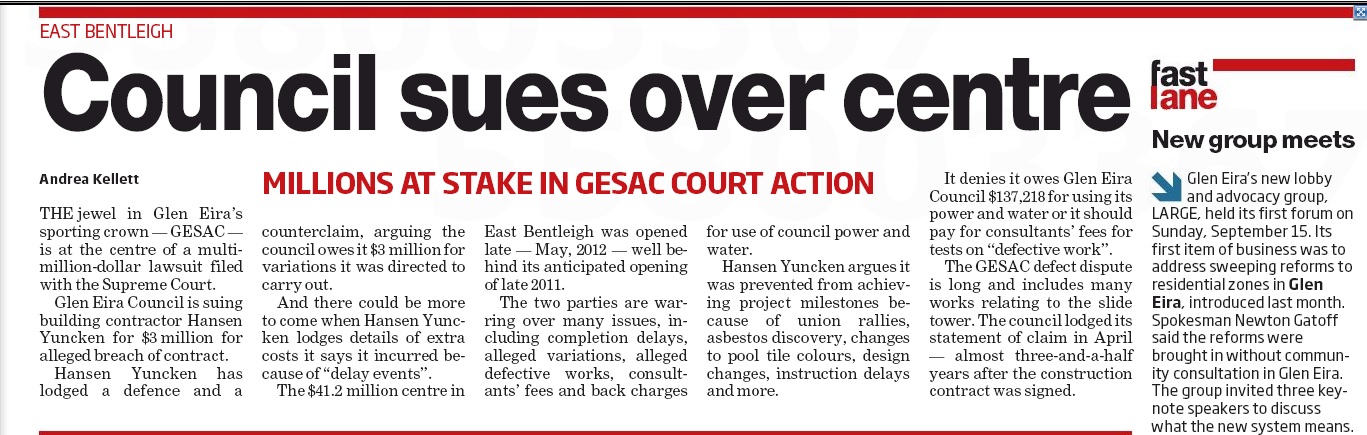
The saga with GESAC rolls on and on. Contractual problems such as liquidated damages, delays in opening, another year’s extension on final settlement, and now the unwilling admission that there are some major construction faults doesn’t paint a pretty picture of council’s oversighting of this entire project. There’s no doubt that there are problems when pools are closed for weeks at a time for ‘maintenance’ on a facility that has barely been in existence for a year. Lawyers are laughing all the way to the bank whilst council is still pouring more and more money into GESAC. In the past 6 months there’s been the diversion of $45,000 from a maternal child care centre to GESAC, plus another $15,000 recently announced. And we mustn’t forget 2 car park extensions and the ludicrous relocation of a playground that has ended up costing over a million dollars. Now full page colour advertisements have started again. When we’re repeatedly told that the place is a roaring success, then we have to ask whether continued, and expensive advertising, is warranted or even necessary.
The latest evidence of things not going smoothly just happens to be a tender advertisement in The Age.
“Contract No.: 2014.025
GESAC – Replacement of AHU and Associated Ducting
Requirement: Replacement of pool air handler and associated return & exhaust portion of ducting.
Tenders Closing date:
4 October 2013 by 4.00 pm.”
What caught our eye is the fact that it is not Hansen & Yuncken that are tendering but council. Does this therefore mean that ratepayers are footing another bill to rectify problems with GESAC? Given that this has gone out to tender, then we can assume that the costs will run into tens of thousands. Of course, expecting council to actually inform its residents as to the real state of affairs is nothing more than a pipe dream. The illusion of smooth sailing must be maintained. Here are some fundamental questions about GESAC and its overall governance:
September 11, 2013
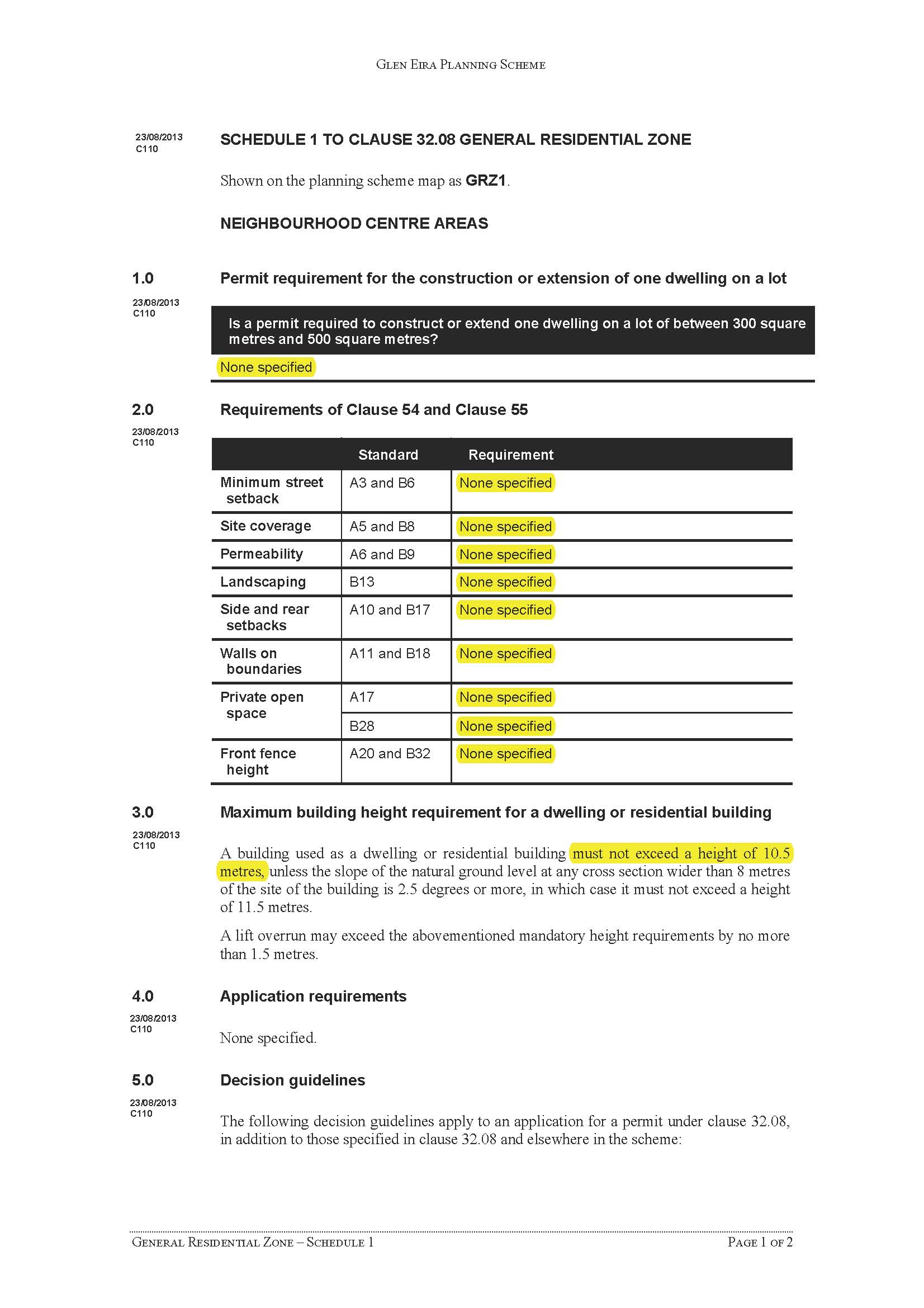
The difference between Glen Eira’s open slather approach to development compared to other councils is made even clearer when the schedules for the General Residential Zone 1 (GRZ1) are looked at side by side. In Glen Eira, the GRZ1 has been applied holus bolus to existing ‘Neighbourhood Centres’ and Main Roads. Suddenly, developers have been given the green light for 3 storey apartment blocks in countless residential streets.
Instead of using the schedules to achieve a balance, and to ensure the protection of local amenity, Glen Eira’s councillors have simply rubber stamped the Newton and Akehurst agenda.
Please note carefully:
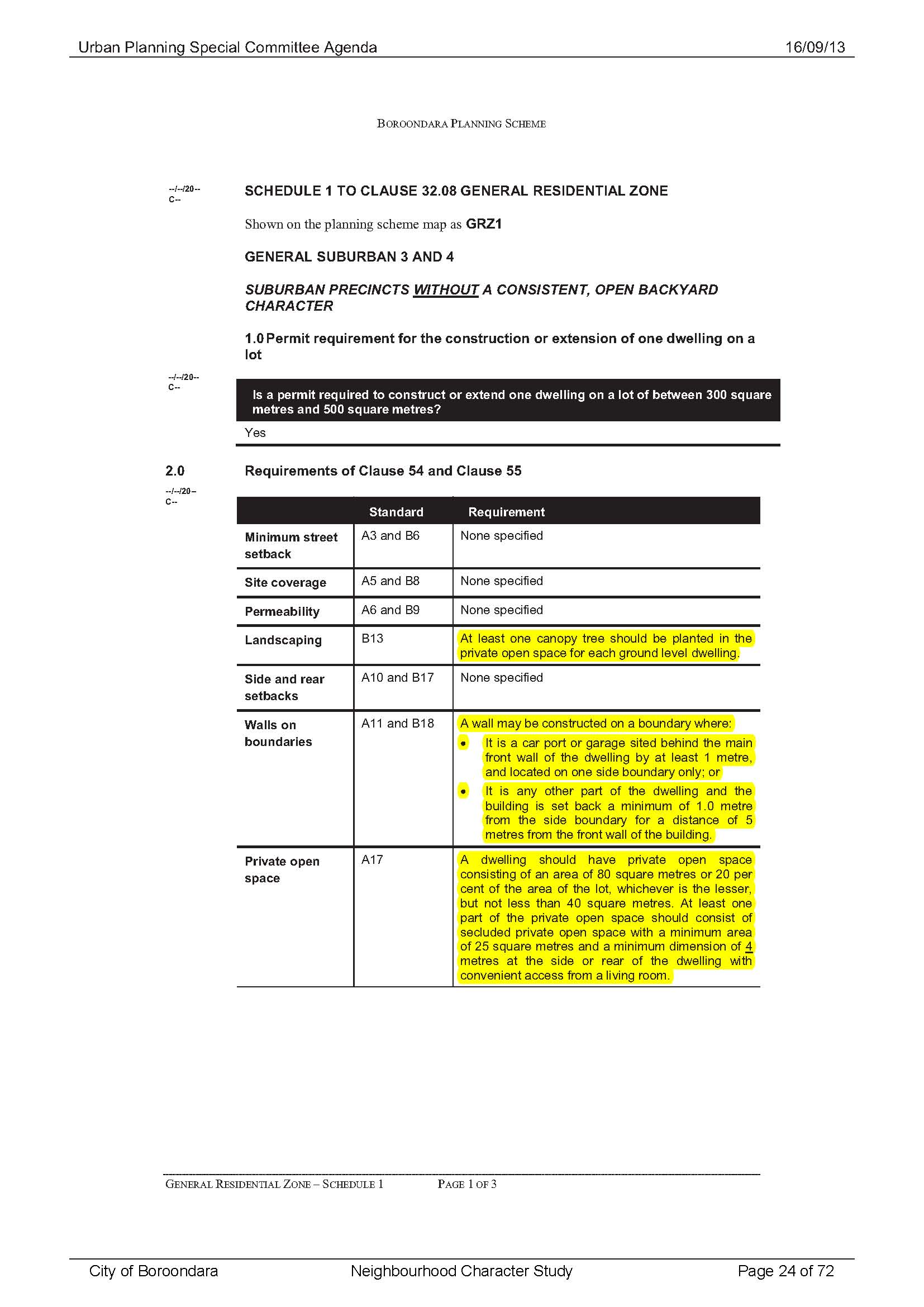
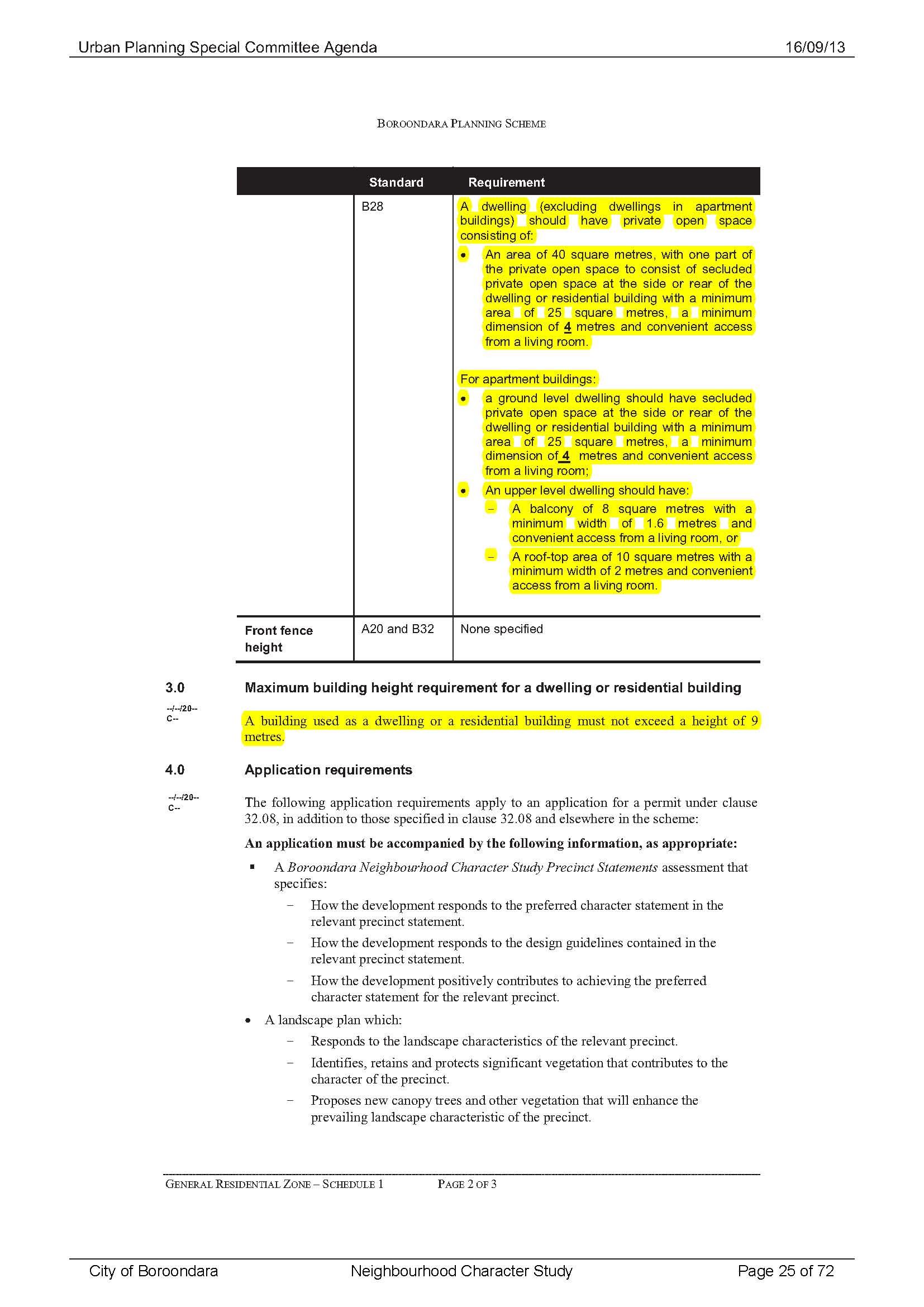
Here are the schedules from both Councils. We ask readers to compare and contrast and start questioning whether our elected representatives are indeed acting in the best interests of the community?
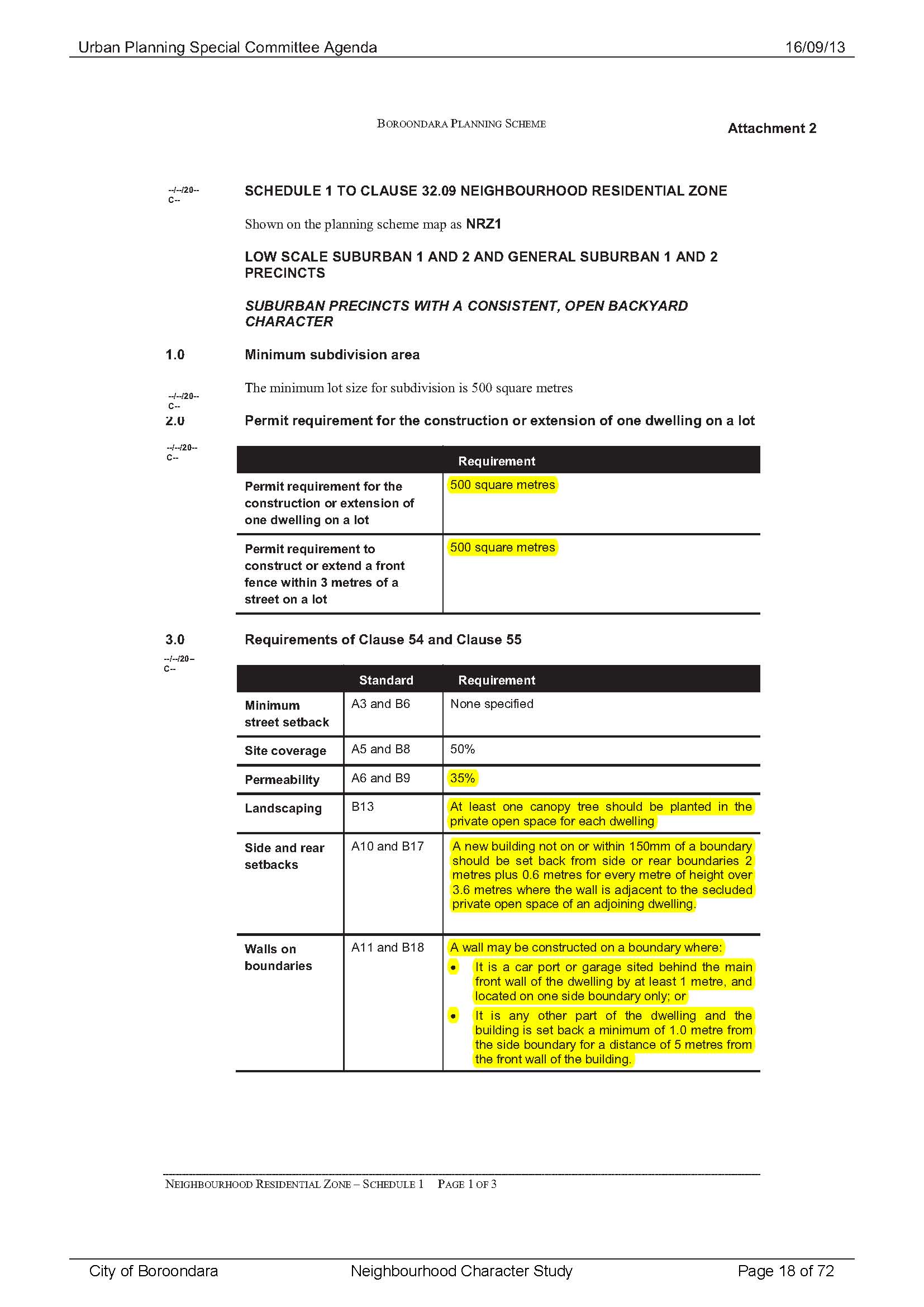
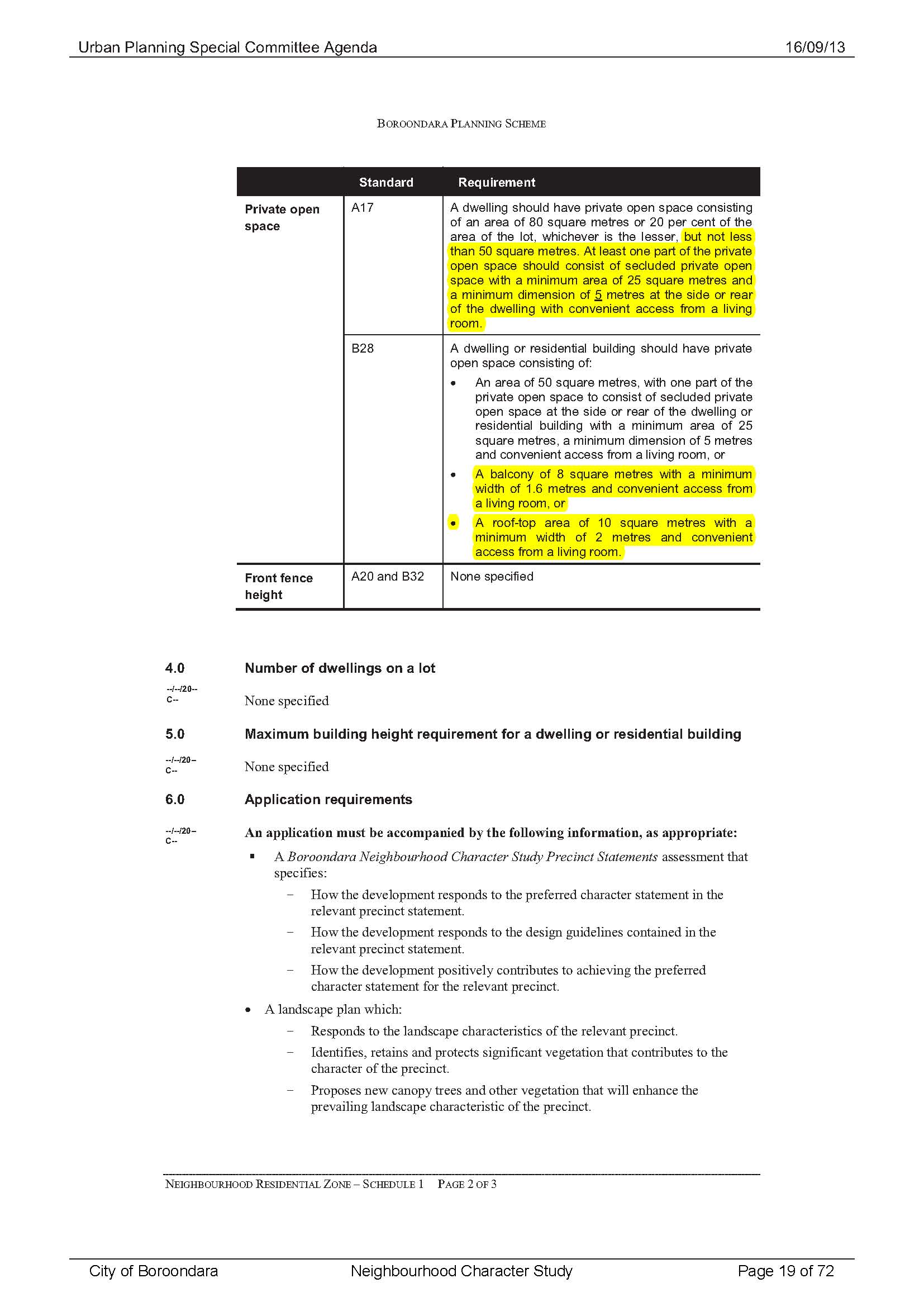
 Here’s the Boroondara version for the identical zone –
September 10, 2013
Prior to the Minister’s announcement of the new residential zones for Glen Eira on August 5th, media reports had already been stating that Glen Eira, together with Boroondara, were to be among the first councils to introduce the zones. Council of course denied all knowledge of this at the time.
Unlike Glen Eira, Boroondara has now released its draft for the zones. (Uploaded here) It differs dramatically from Glen Eira’s vision for the future. The main differences can be summarised as follows:
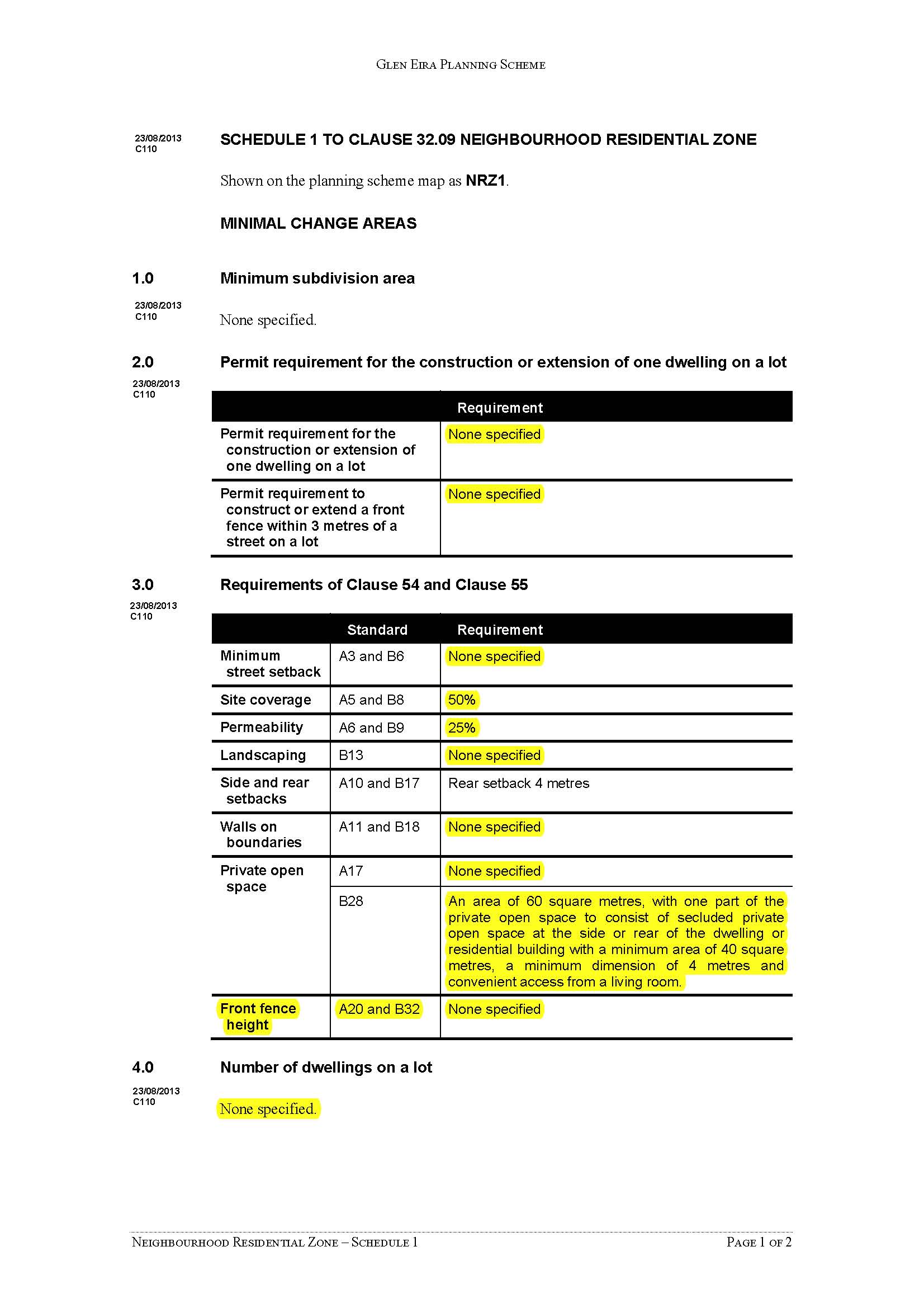
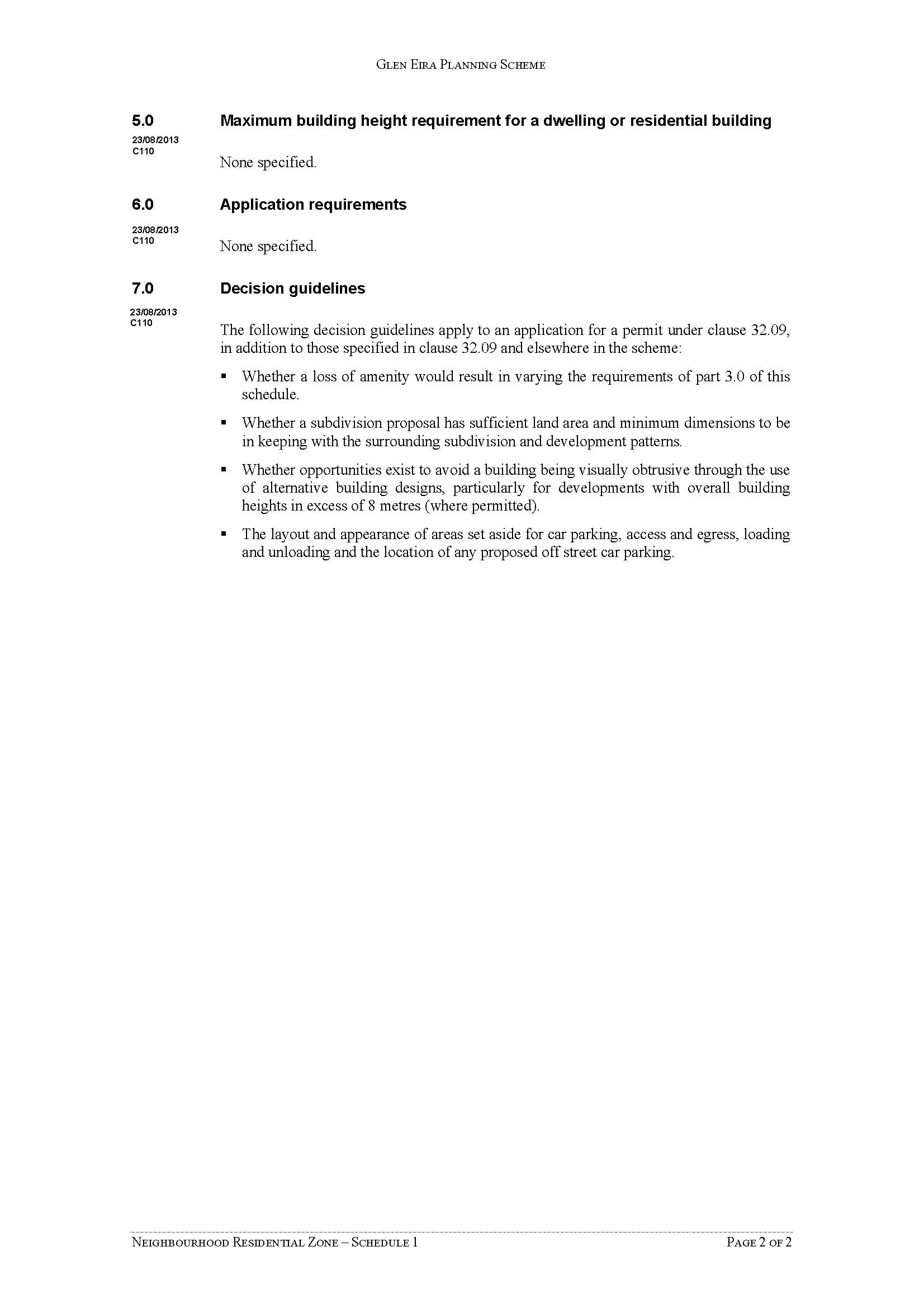
Below are some of the Boroondara schedules followed by the Glen Eira ones. Readers should note the differences on permeability, open space, tree plantings, set backs etc. They should also start questioning their councillors as to why, when the opportunity was there to really protect neighbourhoods Glen Eira has failed to act? Residents have been merely thrown the bone of ‘height limits’ – something they could have had 10 years ago. The philosophy of untrammelled development remains enshrined in these minimalist schedules to the detriment of thousands and thousands of residents.
 Here is the Glen Eira vision:
September 8, 2013
September 5, 2013
Delahunty moved the motion to accept the Code of Conduct with ‘the deletion’ of those clauses related to ‘political parties’ and the new clause 4.8.3 (ie the new ‘gag’ clause – our term). Lobo seconded.
DELAHUNTY: Claimed that the gag motion was a result of ‘some actions that I took’ regarding Elsternwick Park such as ‘releasing letters from VicTrack’ and ‘letters from the member of Caulfield’ and council letters ‘to the media’. She felt that all this information was available under FOI. With the consequent pressure that was exerted there was an ‘agreement’. Said that ‘the outrage’ that followed was ‘in stark contrast to the lack of outrage’ and ‘lack of even discussion’ and ‘inaction from our representatives’ about Elsternwick Park. so ‘here we are’ attempting to ‘insert some reactionary and dare I say conservative’ to try and ‘stop that’. Quoted the ‘guide to ethical decision making’ and asked whether her actions were ‘lawful’, ‘consistent’ with policy and the code of conduct. All answers were ‘yes’ and looking at the ‘outcomes’ it was a win for the community. ‘I didn’t talk about’ people’s individual opinions nor what ‘was said behind closed doors’. ‘I gave information that was freely available under other means’ as a form of advocating for the park. Said again that ‘the outrage towards my actions are in stark contrast to the lack of outrate’ and ‘inaction’ so ‘where are our priorities here?’ It therefore becomes ‘a litmust test for me’ whether the clause should be included. It represents a ‘ridiculous reactionary stance’ to what she believes is ‘ethical decision making’.
On the political parties clause Delahunty stated that ‘I don’t even know’ what it means and ‘can’t support something I don’t understand how it would be applied’. The code is supposed to ensure ethics ‘which is covered in other sections’ so there’s no need for this inclusion. Said that if she said that Southwick dragged his heels on Elsternwick Park would this be ‘a statement of fact’ or a ‘political’ statement. If Okotel gets up and mentions the hard work ‘is that a political statement’ or an ‘opinion’? ‘We have to act impartially – it’s in the Local Government Act’ so unnecessary. Supported other changes.
LOBO: started with personal biography and heritage (Goan, educated by Jesuits, etc) so Code of conduct ‘is important’. Called the current code a ‘soft’ version of ‘dictatorship’. Said ‘I am losing confidence in this country’ and didn’t think ‘it was true’ that ‘we are a democratic country’. When someone would tell him that this is a democratic country he would ‘tell them to piss off’. Went on to talk about ‘ethics’ and how this ‘comes out of family values’, ‘good conscience’ and ‘brains’ and ‘partnership’ and not ‘this garbage’ and it’s ‘not a democratic country’ ‘particularly this clause 4.8’ just because someone may ‘have done something wrong’ it’s an attempt to ‘put it on all of us’. (yelling at this point). Hyams then told Lobo to ‘calm down’.
LIPSHUTZ then moved an amendment which inserted into the clause ‘public interest’. Delahunty didn’t accept the amendment. Okotel formally seconded the amendment. Lipshutz then said that he was overseas when the matters about Elsternwick Park were raised. Said he doesn’t know what ‘went on and frankly I don’t care’. What he’s concerned about is the ‘councillor group’ and since there’s ‘no opposition’ they have to ‘work as a group’. Claimed that the clause didn’t have anything to do ‘with one councillor going off and showing documents’ outside. Delahunty should have come to the councillor group. Said that as a councillor they get confidential information and information that is ‘half-baked’ and what they are ‘trying to do’ is that for the public they present ‘one voice’. That doesn’t mean that people can’t talk about things but when documents come into council it should be ‘approved’ by the councillor group to go out. On Lobo’s statements said that he ‘wasn’t sure’ whether anything he said has ‘to do with the Australian people’. The clause doesn’t hinder democracy but instead ‘makes sure we’re a team’. On the political party clause there ‘are people here’ who are aligned and that’s okay but as a group they ‘have to work together irrespective of our party allegiances’. Everyone ‘brings to the table’ their own ‘ethics, their own views’ but ‘working as a group’ political party purposes shouldn’t enter. The clause ‘makes us work as a team’.
OKOTEL: said that when elected they were elected to provide leadership and to make decisions in ‘as a group of nine councillors’. The objective of the code of conduct is to ‘facilitate that’ and the rules are there to ‘ensure that we are able to work together’ and without rules ‘people may not understand their role’ or ‘how best to interact with one another’. The two clauses in contention ‘will assist that’. Clause 4.83 is important because information can ‘be presented to help us in our decision making process’ so that when documents are coming in and out that these aren’t ‘released too readily’. It ensures ‘that we are able to function productively’ and ‘work together as a group’ and ‘make good decisions and not shoot ourselves in the foot’ when in negotiation.
Pilling then asked for clarification as to what the amendment actually was and whether it was the inclusion of the words ‘in the public interest’. Hyams confirmed that this was correct.
Lobo then asked Okotel if she could ‘tell me in a few words what is a document and what is a letter?’ Went on to say that MP Miller had sent a letter to Hyams to support a development at Virginia Estate, so he wanted to know what the difference was ‘between the two documents’.
OKOTEL: said that if Lobo was looking for a ‘legal definition’ then he should look at the Macquarie dictionary. She hasn’t got a dictionary in front of her but refers Lobo to that.
LOBO: (Hyams again asked Lobo to ‘calm down’ to which Lobo said ‘I can sing’)Lobo then asked Okotel about smart metres and ‘Cr Esakoff has got a box full of complaints’. Went on to say that ‘some people have complained that they cannot reach you’. Said that council has written to Michael O’Brien about the metres and he had replied to council. He asked if he ‘shouldn’t show this letter to the press’ .
Lipshutz then interrupted with a point of order. ‘That’s not a question. It’s a debate’. Lobo tried to continue talking and Hyams informed him that when a point of order is raised the speaker must be silent. Lipshutz said that Lobo’s comments ‘were not the point of the’ item.
Delahunty then made a ‘point of order on a point of order’ saying that ‘that’s not the grounds that a point of order can be considered upon’. Lobo yelling out ‘we have to stop this nonsense’. Hyams ruled that it was in relation to the comments that Okotel had previously made. She then asnwered –
OKOTEL: Said that on the Minister’s letter she did let residents know the Minister’s and her ‘position’
PILLING: then said that he thought the reference to political parties ‘was too wide’. On 4.8,3 he supported ‘the vast majority of wording’ and would change the last bit about councillor group ‘approval’ to ‘councillor group being notified’. Foreshadowed his own amendment if this didn’t get up.
DELAHUNTY: thought that the inclusion of the words ‘contradicts the guide to ethical decision making’ and that there are ‘contradictions’ to other clauses and other bits of legislation such as the Local Government Act.
MAGEE: was against the amendment. Said everything they get is ‘written’ and rarely verbal. Therefore he would ‘have difficulty with this’. On Virginia Park he said that Miller knew more about what was going on than ‘council did’. Said that when a ‘media organisation’ asks for ‘detail’ ‘what do you say? I’m sorry, I’ve got to go back and ask everyone?’ Said a developer writes to the Minister and then the local member and the result is that a resident ends up with a 3 storey building looking into his back yard ‘without giving him the right to go to the minister’ and without the right to go to council. Saw no problem with giving documents out and gave an example of the MRC writing and he being gagged so he would ‘have great problems with that’. Said there ‘could be a situation where 5 or 6 councillors decide what is important and what’s not important’. Said that they’ve got a good system already and therefore this isn’t necessary.
HYAMS: said he ‘preferred’ the clause in there because of previous council where documents were leaked. When people write to council ‘it’s better for all us’ and for the community that ‘they can do so in confidence’ and not ‘used against them’. If it did happen to be ‘in the public interest’ then like the Magee example on the racecourse he ‘doubts’ that council would say ‘go jump’
LOBO: said that with this clause it amounted to ‘doubting the integrity’ of people. Esakoff then said she’s going deaf and for Lobo to tone it down. Lobo apologised and said he would bring ear plugs ‘next time’. Thought the clause attacks ‘my integrity’ because he’s been a banker for 27 years and at not stage ‘has a finger of mine been chopped’. Didn’t believe that the clause ‘should be applicable to grown ups’. People have to be treated with respect.
Amendment put and LOST. Back to Pilling’s foreshadowed amendment.
PILLING: included the terms ‘public interest’ and ‘councillor group notified’. Sounness seconded. Delahunty then asked Burke whether anything has ever been so ‘weighty’ that he couldn’t ‘advise councillors’. Burke couldn’t but also said that there was no time when he didn’t feel ‘confident’ to raise something with councillors. Delahunty then refused to accept the amendment.
Pilling said that he saw the clause like anything else that was ‘discussed in assemblies’ and that it was all about ‘working with the councillor group’. Thought there was some ‘responsibility’ on councillors so this was a ‘compromise’ that would capture the ‘intent’ of the clause but not leave it completely in the hands of the ‘councillor group’ by being ‘notified’ rather than ‘approve’. It therefore ‘strikes the right balance’.
SOUNNESS: thought that councillors ‘should be sensible’ about this. Said he saw both sides where public interest was important but also that the ‘opportunity’ to phone other councillors and have ‘a chat’ was important. The outcome would be ‘successful’ because ‘councillors would talk to each other a lot more’. ‘I want us to work better as a team’. Said that the staff ‘give us frank and fearless advice’ and that’s important.
Hyams then turned to Newton and asked him if he felt that this clause in any way contravened current legislation. Newton said that ‘in my opinion’ it doesn’t.
Amendment put and passed unanimously.
The amendment then became the motion and was carried unanimously.
September 4, 2013
Item 9.5 – Meeting procedures
This involved 3 motions moved by Delahunty. The first was on the Notice of Motion and that the Local Laws Committee draft some ‘appropriate guidelines’ for its operation. Pilling seconded.
DELAHUNTY: started off by asking whoever provided the officer’s report how long it took them to compile and draft the report and if anything similar to the report had come to council previously. Newton responded that not to a motion like this. Delahunty then said that Notice of Motion (NOM) is a ‘basic function of every other council but not Glen Eira’. NOM gives councillors the right to ‘do what we were elected to do’ as in other councils and that the report proves that ‘we’re grossly out of step’ with everyone else in terms of ‘best practice’. Said that when she publicised this other councillors from other councils couldn’t believe that Glen Eira didn’t have a NOM and that the meeting procedures at Glen Eira ‘were a joke’ according to an ex Glen Eira councillor. Read out the ‘purpose’ of council and councillors from the Local Government Act which emphasises providing a ‘system’ for good governance. This shouldn’t be different for someone who lives across a road in another municipality – all councils and residents should have the same rights. Said that the officer’s report ‘pretty much makes the case’ as to why a NOM is ‘needed’ but that there will be opposing argument put that will be ‘confusingly contradictory’. She went on to outline the likely arguments that would be put up – (1) there’s no difference between NOM and calling for a report. Delahunty said that she ‘agrees’ with this ‘in part’ but that requests for report ‘take a lot longer’ , waste time and money on the part of officers. The report on NOM took time and ‘all the information is freely available’. Said she didn’t go into this topic without knowing the bottom line or something about it so there was no need to ‘waste officer’s time’ in compiling reports. Said the report and its ‘colours’ were nice but there was nothing in it that an ‘informed person couldn’t figure out for themselves’. Spoke about councillors ability to do some research themselves. Another argument that was likely to crop up was that decisions should only occur when ‘the information is present’. Residents expect councillors to be ‘informed’ and make their own decisions. Answering this argument Delahunty says ‘do your job’. Calling for a report ‘wastes money’. (2) another argument would be that requests for reports provide greater detail and information. Countering this argument Delahunty said she’s not arguing against removing the request for report because if councillors want more information then that’s the avenue to get it. Said she realised that what she’s proposing ‘is a shake up for the city of Glen Eira’ but not for every other council in the state.
At this point Delahunty asked for a 3 minute time extension. Lobo seconded. LIPSHUTZ, ESAKOFF AND HYAMS VOTED AGAINST. Motion carried.
Argument 3 that councillors would likely raise is that NOM would ‘drag on’ and make meetings interminable and that NOM would be used ‘as a nuisance tool’. Said that this argument was ‘so condescending’ that it wasn’t even worth ‘refuting’. Said that ‘this is our job’ and that NOM was an ‘avenue’ for councillors to represent community views. Repeated that systems should ‘be consistent across municipalities’. Claimed that you can’t have the argument that NOM is the same as Request for Report and then turn around and argue that the former is a waste of time if they are the same. And if they were the same then ‘we would already have this nuisance like behaviour’. Said that the ‘arguments for are very clear’ and that the opposing arguments are ‘contradictory and condescending’. ‘It is only a progressive councillor group that can change this’. Thought that the motion was very important for the municipality and that the public wouldn’t see much of a change except that less of their money would be wasted on officer reports.
PILLING: said that it has come up before and that now it’s a ‘sign of maturity’ by council that it’s come up again and that the time is right to fall into line with other councils. Thought that both NOM and requests for reports can sit ‘side by side’ and that it does ‘require responsibility by councillors’. Shouldn’t ‘pre-judge’ what councillors might or could do with NOM. Councillors need ‘all the available tools’ and as representatives of the community they have the ‘responsibility’ of using these tools ‘wisely’. Time and wasting money was an ‘issue’ but also what’s important was having ‘all the tools’. didn’t think that ‘the world’s going to fall in if we do have NOM’. Rather councillors would have ‘more options’ and they can ‘pick and choose’ which option is best. This can ‘only add to our governance duties’.
LIPSHUTZ: objected to the argument that if you’re speaking against the motion that you’re ‘condescending’ and ‘not progressive’. Just because every other council does this doesn’t mean that Glen Eira has to follow ‘if we’re getting it right’. Said that there are other areas where Glen Eira isn’t following others and they are still getting it right. ‘They should be following us and not the other way around’. Because others are different doesn’t ‘mean that they are right’ and it doesn’t mean that they’re following ‘best practice’. Said that when he first got on council he was in favour of NOM but then he realised how council works and that making ‘important decisions’ was vital. Claimed that ‘I live in the real world not the fancy world’ and that Delahunty’s claim that the public expects councillors to be ‘informed’ people ‘is rubbish’. Councillors are elected because they are ‘aligned with a particular area’ such as Greens, Labor. Said that he’s seen councillors showing up who haven’t read a thing on the agenda or reports and then voting. ‘That’s simply the real world’. As councillors they have to make important decisions and represent people ‘as we see fit’ and that when he wants to represent people at council he ‘wants to know what the facts are’. Gave the example from last council where a mulch shed was closed ‘simply because one councillor did his own research’ from the internet and then ‘convinced a whole lot of councillors’ that the facility should be closed. ‘That was a wrong decision and council reversed it’s decision’. Since everyone lives ‘in the real world’ it could come down ‘to factions’ and raising a whole lot of things which has got nothing to do with a council report. Currently ‘the system works’ and people have got the chance to raise something by asking for a report.
Lipshutz asked for a 3 minute extension. Delahunty seconded. Carried unanimously.
Claimed that ‘no councillor here is denied the right’ to raise any issue but they ask for a report so they get ‘informed decisions’. They can then reject or challenge the report. This way it’s an informed decision rather than an ‘ad hoc decision’. Said that other councils ‘can’t do that’ and that the time it takes officers is part of their job. Said that in every level of government no-one goes into parliament and ‘off the top of their back’ make ‘a motion and seek to change the law’. Referred to Kevin Rudd asking for ‘multiple reports that he probably never read’ but he ‘asked for reports’. Everyone asks for reports so that they can make ‘important decisions’. Admitted that this does cause delay and gave the example of Sounness asking for a report on Caulfield Park and that they will get that report. Then with the report the information is there and it is ‘totally transparent’. If it’s urgent then there’s ‘urgent business’. Summed up that the issue isn’t about time or money or being progressive but all about councillors ‘being informed’. ‘If every other council does it it’s not the reason why we should do it’. Delahunty talks about people living across the street and they should all be the same. Said that planning law is not the same and that Port Phillip is different to Glen Eira – ‘we are out there on our own’ and that ‘other councils want to emulate us’. Said he couldn’t think of ‘one thing’ that in his time on council they didn’t do ‘properly’ with request for report and he couldn’t see ‘one thing’ that a NOM would solve.
ESAKOFF: said that not only did she take offence at being called ‘condescending’ but took offence at many of the other comments. They are elected but aren’t ‘experts’ in ‘any one thing’ and that’s why they have CEO’s and other senior administrators. They’re there because councillors can’t do their jobs and that’s what they are there for. Glen Eira has got requests for reports and no other council has this. ‘we don’t have notices of motion. We have a superior product’. They can ask for a report and get it back that details the ‘pros, the cons and everything else in between’. ‘It is transparent completely’ and councillors aren’t making ‘decisions on the run’. Councillors don’t ‘have the time to become a director in any one department’ since councillors have other lives like work, parenthood, running households, jobs, and ‘we need to sleep at night’, ‘we’re not Kevin Rudd’. Councillors don’t work this way. They get reports from officers upon which ‘informed decisions’ are made. ‘That is best practice’ and she didn’t think that ‘what other councils do is best practice’. She’s spoken to councillors from other councils and ‘many do not like’ the NOM because they see it as ‘abuse’ and a ‘tool that is used for the wrong reason’ not always but sometimes. ‘It is used as a political wedging tool’ and is ‘unfair’ because it means that councillors ‘are forced to make a decision on the run and without any proper information’. Repeated that she ‘resents’ a ‘lot of the things that have been said’ and that it is a ‘disgrace’ to have been ‘brought to this table’.
LOBO: said that councillors ‘should try to work together as a team’ and that ‘good councils talk and explains their point of view’ and puts on a ‘good show for the public’. ‘we are on a stage’ where councillors ‘should know our script’. There shouldn’t be any ‘holes’ in this script. Said that council should also try to be ‘innovative’ and try to be ‘different from other councils’ but also seeing ‘what is good’ in these councils. Concluded that balance is needed and that councillors have to show that ‘we are united’ on various issues.
SOUNNESS: said he took Esakoff’s point that he’s not an ‘expert’ and that’s why he appreciates officer’s reports. Was ‘very pleased’ with the way the requests for reports processes have worked and been ‘satisfied with the quality of the result’. ‘It’s a good system’ and since he’s never been on any other council he ‘can’t compare’. He had spoken to other councillors and in the end it was still ‘council that made the decisions’. Thought that how other councils did their notice of motion ‘was a bit much’. Noted that there was the option of laying the motion on the table because councillors felt that they didn’t know enough and wanted more information. Agreed with Lobo that council was a ‘stage’ and that people get ‘stagefright’ and might rush a decision although he didn’t know anything about the mulch issue. He would be ‘comfortable’ with both NOM and requests for report but would prefer the requests for report since ‘the product at the end of the day is much better’. Went on to say that he did question how he could speak to something if it wasn’t on the agenda but that this was really a ‘very small element’. All this was ‘inconsequential’ because the really important policy decisions like the Health Plan come through an officers’ report. Said he couldn’t see that NOM would be used that often but that didn’t mean that ‘it wasn’t a good tool’. But tool’s ‘need to be designed to serve a purpose’ and he wasn’t sure ‘what that purpose is’. Thought it important that councillors respect officers and that the reverse should also be true.
Asked for a 30 second time extension. Seconded by Magee. Motion passed unanimously.
Wasn’t sure if NOM ‘was a solution’.
MAGEE: when he became a councillor knew nothing about NOM. Thought that requests for reports worked pretty well but it ‘often’ doesn’t contain the information ‘that you wanted’ but it does have information that is ‘right’. Thought that the NOM was therefore one way of ‘circumventing’ the ‘disappointment of an officer’s report’. But on further reflection he realised that a notice of motion wasn’t something that just appeared. It had to be given notice of and therefore there still was the opportunity for ‘other councillors’ to knock it on the head if they thought the NOM ‘was silly’. And officers can also come back and ask ‘have you thought of this’ and if councillor wants more information then it can be turned into a request for a report. So ‘just because someone raises a notice of motion doesn’t mean it’s going to get through’. Said that he didn’t think he would ever use a NOM because he likes to reflect on things before he sends off emails to councillors or officers. But the NOM option is a tool and can be ‘used as well as’ a request for report he doesn’t see anything wrong with this. Said that previously he had supported Pilling’s original attempt but had come to council tonight thinking he would vote against it but has changed his mind because he now thinks that it can’t do any harm. If the NOM is ridiculous then it won’t get through and it does give people time ‘to comment’.
OKOTEL: asked whether there could be a ‘dual system’ since there was nothing in the report about this.
NEWTON: said that there could be both on the same agenda if councillors decided that after a notice of motion they wanted further information which would lead to a request for a report.
OKOTEL: asked that if there was this dual system what ‘would be the benefits’ of having NOM
NEWTON: said it was up to council to decide on meeting procedures and not up to officers to provide ‘opinions’. Council could institute ‘one or the other or both’.
OKOTEL – did not speak further at this point.
HYAMS: concurred with Esakoff and Lipshutz about Delahunty’s comments and thought that ‘we should stick to the arguments’. There are arguments for and against NOM and there shouldn’t be ‘derogatory comments’ made. Said that Glen Eira is ‘the only council’ that has requests for reports and that’s why there is no NOM and did think that ‘the current system is superior’. When first elected claimed he was in favour of NOM until a fellow councillor of the time sent him a fax of a proposed NOM and it was ‘very derogatory and attacking’ and it implied that ‘this is what I could do’ and inform the papers that the NOM would be moved. As a result of the media coverage it wouldn’t then matter if the NOM got passed or not since it had already made it ‘out there’. Went on to say that Delahunty was ‘lucky’ because Glen Eira was her first and only council and there are instances where ‘people’s motives aren’t always pure’. Then asked the rhetorical question ‘what is it we can’t do under the current system?’ Claimed that councillors can ‘get anything we want on the agenda’ by just putting in a request for a report or in urgent business. In contrast to Delahunty who said that her conversations with councillors from elsewhere was surprise that Glen Eira didn’t have a NOM, he had spoken with councillors who said ‘how lucky’ Glen Eira was that they didn’t have this process ‘because of all the shenanigans they put up with at their councils’. Gave the example of the East West Link where a request for a report came back with ‘good information’. Said that if it was only a NOM without the ‘background information’ he ‘would have probably voted against’. Didn’t think that a request for a report would have come out of such a NOM because the matter was pretty much ‘cut and dried’ in that ‘either you thought it was’ a good idea or ‘you don’t’. ‘We don’t just want to make decisions here, we want to make informed decisions’. It may be fine to think that councillors would do their own research but some councillors don’t even read the agendas so expecting them to do their own research is ‘asking a bit much’.
Asked for a 3 minute extension. Delahunty seconded. Motion passed unanimously.
Hyams went on to give 2 examples of councils with NOM who got things wrong and wished that ‘they hadn’t’ got it wrong in the first place. Cited Marrackville council who passed a motion about boycotting Israeli products only to discover that their computer systems contained Israeli made parts. To change would cost millions so then they ‘voted against it’ and he thought that it cost the Green’s candidate a seat in parliament because it ‘made council look so bad’. Went on to give another example of Yarra City banning restauants from using outside heaters on environmental grounds. Said they banned them and then discovered it was ‘actually causing more carbon emissions to wash all the blankets’ that they wanted restaurants to use. They then went back to heaters and ‘probably wished they hadn’t done that either’. Argued that ‘sometimes we don’t know what we don’t know’ so there’s the chance that an officer’s report wouldn’t be called upon and that the NOM would stand. They are all elected as a council so council determines what goes on the agenda and not ‘one or two councillors’ and that’s ‘democracy’ whilst NOM ‘doesn’t conform with my idea of democracy’ which is that ‘the group makes the decisions’. ‘I don’t think it’s broken so I don’t think it needs to be fixed’. ‘The current system we have is better than anyone else’.
OKOTEL: wanted to ‘echo’ the thoughts of Hyams, Esakoff and Lipshutz. When elected she saw herself as a community person but ‘never claimed to be an expert’ and can’t be. She hasn’t ‘studied every area that council is involved in’ and ‘very much’ relies on information from officers. Without officer information she did think that there was a ‘danger’ about making wrong decisions. Said that in the case of NOM and someone didn’t vote but abstained because they didn’t know enough then that ‘vote would be taken as a vote against’. Thought that it was ‘so important’ that ‘we do have the information to support our positions’. Referred to the East West link report and that even though the media had covered this widely it was still good to ‘have information provided’ by officers so that councillors ‘could sit down in your own time’ and discuss with others and therefore make an ‘informed decision’ rather than ‘on the night’ and ‘under pressure’ to make a right decision. Councillors take ‘seriously’ the responsibility of ‘making the best decisions for our community’. Couldn’t see ‘any benefit’ in a NOM that would assist this obligation. Didn’t think that she could make good decisions without information.
Okotel asked for a minute’s extension. Magee seconded. Motion passed unanimously.
Referred to Hyam’s points about council’s making wrong decisions and then rectifying those decisions these council’s ‘have expended ratepayer’s money’. Would hate to see this as an outcome in Glen Eira even though the motives behind any NOM are ‘well intended’.
DELAHUNTY: started by saying that she ‘mis-spoke’ in that she wasn’t suggesting that people were condescending but that the arguments were. In the past perhaps people abused NOM and in other council’s but didn’t think that they should be making procedural laws on the basis of the past and what might happen. Also said that she didn’t see how comments on Rudd were relevant and that she was intent on ‘playing the ball and not the man’. Agreed with Pilling that NOM is about ‘all available tools’ and that councillors would use the ‘appropriate’ tools. Said that her view was that NOM should be delivered to councillors at least ‘5 working days’ beforehand so they have got the chance to think about it, discuss with others and if included for the next council agenda then there would be the opportunity top discuss at a councillor’s assembly. So it’s not decision making on the run. ‘This is actually more time than a request for a report’ is given to councillors to decide on. Joked that she was ‘actually kicking myself’ that in her foreshadowing of the opposing arguments she forgot the one about ‘if it ain’t broke why fix it’. Does think that it’s about ‘conservative versus progressive values’ but doesn’t think there’s anything wrong with people calling themselves either or thinking along these lines. Said that ‘if it ain’t broke why fix it’ is a conservative catchcry and ‘doesn’t make sense’.’Why would we wait until something is broken before we fix it’. Went on to give an analogy with her roof and the water damage this was causing. Tiles aren’t ‘broken’ but they need fixing in order to fix the follow on problems of water damage.
Delahunty asked for 2 minute extension. Seconded by Lobo. Motion voted against by Lipshutz. Motion carried.
Council’s meeting procedures are ‘broken’ in a subjective way because they are ‘inconsistent’ with others, and ‘potentially wastes money’. ‘Our system is out of step’ and needs fixing and ‘won’t be the end of the world’. didn’t think there would be ‘nuisance behaviour’ because ‘I trust people around this table’ despite different values.
MOTION PUT AND DEFEATED
September 3, 2013
It was a marathon meeting tonight which we will report upon in detail in the coming days. However Glen Eira continues to be run by the Newton acolytes and hanger-ons such as Lobo and Sounness. There is no prize for guessing who voted against council finally embracing what every other council in the state has such as Notice of Motion. Democratic process and respect for community views are dead in Glen Eira thanks to Lipshutz, Hyams, Esakoff, Okotel, Lobo and Sounness who voted against Delahunty’s motion. Her support came from Magee and Pilling.
Delahunty’s attempts to right the wrongs of the Right of Reply, as well as engendering public participation into Public Questions also failed. Lipshutz even attempted to have an amendment which called for public questions NOT to be recorded in the minutes. This fortunately did not get up.
But perhaps the most telling and reprehensible action by Hyams Lipshutz and Esakoff occurred early on when Delahunty asked for an extension of time to deliver her argument. These three voted against the time extension. Unheard of and definitely the first time in living memory that anyone has sunk so low as to deny the mover of a motion the opportunity to present their reasoning in full.
 Glen Eira Debates