GE Service Performance


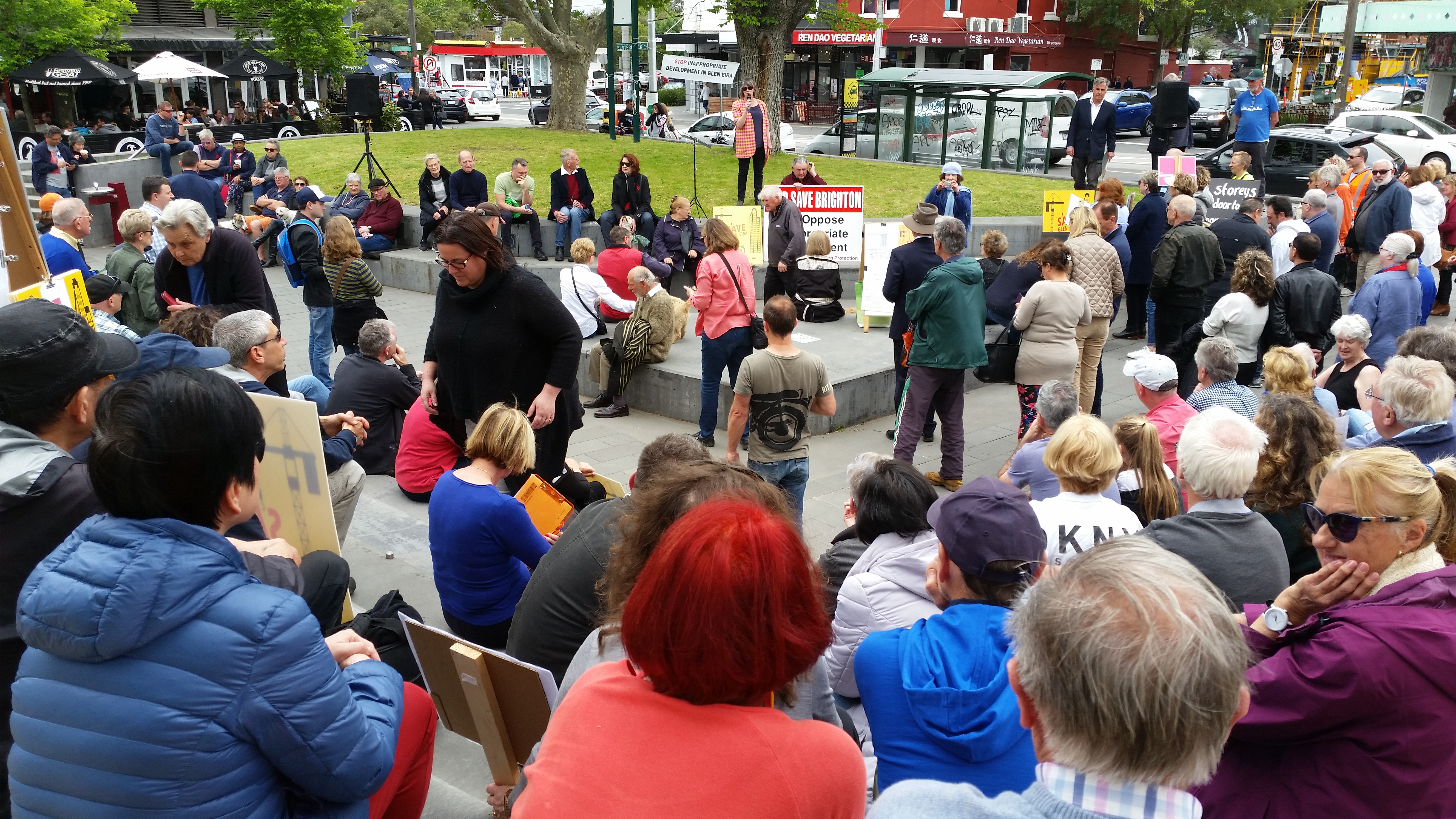
Another terrific turnout for the Save Glen Eira lobby group. Yesterday’s rally at Elsternwick Plaza showed that opposition to Council’s inept and autocratic planning processes were well and truly on the nose.

Tellingly, all councillors were invited to attend. The organisers reported that only two had responded with their apologies: Silver and Hyams. The other 7 councillors didn’t even bother.

Several residents addressed the gathering and highlighted what we all know about this council:

  • A ‘tsunami’ of overdevelopment
  • A failure to adequately plan for sustainable growth
  • A critical lack of open space
  • Consultation that simply endorses decisions already made

Several MPs closed the meeting:

  • Clifford Hayes spoke about his private members bill which will be up for debate this week in parliament. He is advocating limiting the Minister’s and VCAT’s power and ensuring that planning is truly ‘democratic’ and that residents are at the centre of all planning.
  • David Southwick was joined by Georgie Crozier and Tim Smith. Each spoke about the need to ‘maintain the rage’ as well as rescinding some of the Labor Government’s recent moves on planning.

All in all, the take home message was clear. Glen Eira City Council via its elected representatives are not doing their jobs. They are demonstrably failing their residents.

Please listen very carefully to the following audio. It concerns the recent VCAT decision for a 14 storey application in Horne Street, Elsternwick where the members were far from complimentary about council’s planning approach. At a recent council meeting a resident stated that this decision represents an ‘indictment’ of council’s strategies and processes.

Hyams of course resorts to his usual tactics. Blame the ‘messenger’; accuse him of ‘cherry picking’ and providing ‘misleading information’. These very same allegations can be made against Hyams too!

Hyams neglects to mention the following:

  • The planning officer recommendation was for a permit of 12 storeys instead of the proposed 14 storeys that reached a height of 59 metres (equivalent to a 16 or 17 storey building). The structure plan and the DDO provides a maximum height of only 43 metres!) The officer recommended a height of 46.3 metres and a ‘overrun’ of up to 50 metres. Thus both the structure plan and the DDO are being ignored by council’s own planning department!
  • The structure plan and the DDO do not regard the surrounding residential areas as deserving of ‘transition’ protection. So council is now willing to have 12 storeys next to dwellings that are zoned as RGZ meaning 4 storeys.
  • Hyams faith in the ‘doyen’ of planning (Akehurst) is now on very shaky ground given that all of council’s current documentation explicitly admits to the failure of this ‘doyen’s’ vision in the current structure planning for Bentleigh, Carnegie and Elsternwick. Here is one example quoted verbatim: There is currently a conflict in planning controls with the Heritage Overlay located within the Residential Growth Zone — an area that encourages high density development. and The residential areas to the north of Glenhuntly Road are largely protected by a Heritage Overlay and those to the south by a Neighbourhood Character Overlay zoned for growth, allowing 4 storey apartment buildings. This presents a significant conflict in policy which seeks to achieve two opposite objectives. What geniuses couldn’t see back in 2013 that the ‘conflict’ was fundamental and made a mockery of the planning scheme. Yet it was allowed to go through and linger until the present day.
  • We also have the admission that creating 3 separate zonings in the same street is planning chaos: In certain areas such as the residential land south of Centre Road (ie. Mavho, Loranne, Mitchell and Robert streets) transitional issues are caused by irregular ‘radial’ zone boundaries and multiple zones within a single streetscape. This creates inconsistency with four storey apartment buildings and low-scale detached housing in the same street
  • Hyams’ claim that VCAT has changed its interpretations is nothing more than bunkum. Time after time VCAT addressed the failures contained within council’s planning scheme: its lack of height controls; its lack of any urban design or built form guidelines; its lack of preferred character statements for the housing diversity areas. We have previously cited countless VCAT decisions which point out these failings. Please see: https://gleneira.blog/2015/10/07/statistics-glen-eira-style/
  • Hyams is also guilty of ‘misleading’ statements when he sees the Horne Street decision as setting a precedent that DDOs are vulnerable or, that if neighbourhood character/context was taken into account then there would be no need for structure plans and DDO’s. Here are some quotes from recent VCAT decisions which show the exact opposite:
  • In any DDO  a relevant consideration is whether the bulk, location or appearance of any proposed building or works will be in keeping with the character and appearance of adjacent buildings, the streetscape or the area. (Vodafone Hutchinson Australia Pty Ltd v Greater Geelong CC [2019] VCAT 1729 (4 November 2019).
  • there is no basis to justify the recommended 9 metre setback in the DDO  design objectives.(Burrows v Port Phillip CC [2019] VCAT 1431 (18 September 2019)

Finally, we go to the Horne Street decision itself and cite the following comment:

We appreciate that different typologies of building heights and setbacks are found at various interfaces between commercial and residential properties in activity centres. Different approaches are often adopted depending on a variety of factors, including whether the residential properties are within the boundaries of the activity centre, the nature of the residential zone that applies, the existing character of the residential area and the extent of change to that character that is encouraged, and the position of the activity centre within its hierarchy. Despite this acknowledgement that a number of different approaches occur across metropolitan Melbourne, we have struggled to identify another location where a building of this scale, would be setback at such a distance from the rear boundary of residential properties.

The last sentence in the above says it all. Glen Eira is indeed unique for its woeful planning that sees nothing wrong in placing 12 storeys next to 4 or determining setbacks that are so minimal that they might as well not exist. Hyams can denigrate residents and accuse them of ‘cherry picking’ and providing ‘misleading’ information. What he cannot do is justify council’s planning decisions that are devoid of all strategic justification and plain old common sense!

PS: In order for readers to appreciate all the information we have reposted below what the resident said at the previous council meeting.

The evidence keeps piling up on how Council refuses to listen and act in response to resident views. The latest example concerns the Local Law which is up for decision next Wednesday night. Readers will remember that included in the all time record for submissions (28) residents asked for:

  • The removal of the clause which allowed the use of fire pits on private property. Submitter after submitter outlined the dangers of allowing such a practice. Much scientific evidence was cited.
  • The demand that public questions be moved to an earlier part of the meeting so that residents don’t have to sit through hour upon hour of ‘debate’ before their public question is read out.
  • The demand that agendas be published at least 5 working days prior to meetings in line with the ombudsman’s recommendations.

None of these issues are earth shattering and certainly could be easily accommodated. But they weren’t. Council has simply ignored everything that residents asked for.

Adding insult to injury, the accompanying officer’s report does not provide one single word to explain or justify why council is recommending no change to its initial proposals. At least in 2009, there was some piddling attempt to respond to submitters and provide some explanation behind the final decision. (Uploaded HERE). Not so now.

Needless to say, Glen Eira remains the only council in the state without a Notice of Motion. Nothing in the initial officer’s report, or the current agenda refers to this issue at all. Which leaves us to ponder: why does council even bother to undertake ‘consultation’ when resident views are so often ignored. The boxes are ticked and legal requirements are met. However, nothing changes. Consultation remains a farce in Glen Eira.

STRATEGIC PLANNING

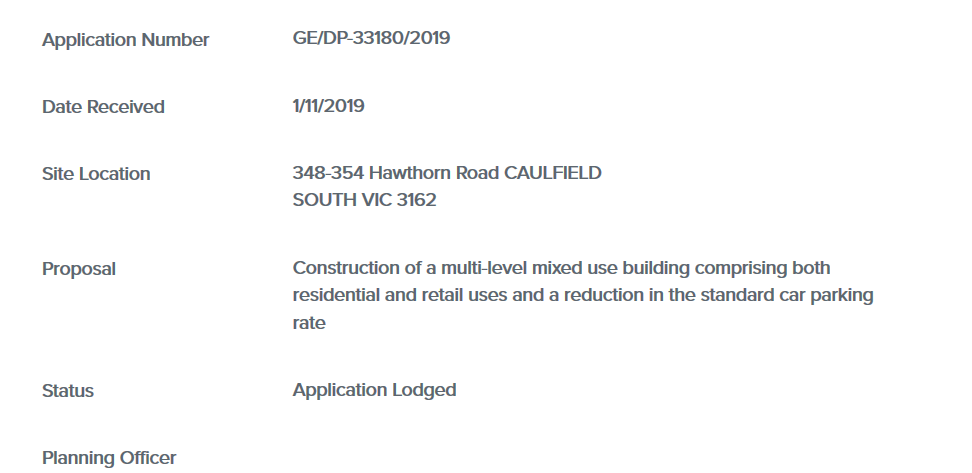
On another issue which highlights Council’s failure to protect its neighbourhoods an application has now arrived for the Indoor Bowling Club in Hawthorn Road, Caulfield South. The property was sold in June 2019 so the developer certainly isn’t wasting any time.

Council has stated that an ‘urban design’ will only commence in 2021 for this area. No promise has been made as to structure planning or mandatory heights. We already have a 9 storey application awaiting decision near this site, plus another 7 storey application. The height of this current application is not disclosed! Thus, whilst council continues to sit on its backside our unprotected neighbourhood centres are being destroyed.

Structure planning is complex. It is supposed to be accompanied by indepth analysis that leads to valid strategic justification. It is also meant to be done with significant community input. At least that’s what the State Government’s Practice Note No 58 says. Here’s just one example, from many, to be found in this document: Community engagement is essential for the structure plan and involves the wider community and may include targeted consultation.

The Practice Note also goes on to state that a ‘Discussion Paper’ is an important part of the process. This Discussion Paper should also: identify existing and proposed built form outcomes based on a comprehensive built form analysis

Interestingly, the VPA (government’s development arm) has neatly sidestepped this requirement in its current survey for the Caulfield Station Precinct. Plus, all previous ‘vision statements’ have also ignored this important component. We have plenty of ‘vision’ statements, plenty of feel good generalisations, plenty of motherhood statements about ‘sustainable development’, ‘high quality architecture’ and so on. What is missing entirely is anything that would provide a clue as to ‘built form outcomes’. Residents are being asked to respond to a survey which is basically meaningless and intentionally evasive. We have absolutely no idea of:

  • How high will buildings be allowed to go?
  • What will happen to heritage overlays that currently exist?
  • What setbacks are being considered and why?
  • What are appropriate overshadowing requirements?
  • How many apartments can satisfactorily be housed in the area?
  • What parking arrangements are being made?
  • How will Monash and the Melbourne Racing Club be ‘accommodated’ in terms of building heights and use of open space?
  • What levies are likely to be imposed on developers?

So instead of a Discussion Paper that provides some answers to the above, we get the following type of questions shown below. We note that the answers are a given. No one in their right mind would object to ‘sustainable development’, access to open space, etc. This is simply another example of a Clayton’s consultation that leads exactly where the developers want it to go! We will only receive some inkling of what’s in store when the draft structure plan is published. By then it will be far too late! Council should be congratulated once again for its appalling processes in (not) working with the community in an open and transparent fashion.

From today’s Caulfield Leader

We’ve been forwarded the following flyer:

At the recent Save Glen Eira residents’ gathering, MP Clifford Hayes (a former Bayside councillor and now elected to the Victorian Council) stated that during his time at Bayside it was councillors who ran the show. They gave orders to officers and not the other way around. In Glen Eira the reverse has always been the case. Unelected bureaucrats run everything and our so called ‘representatives’ allow this situation to continue, often to the detriment of ratepayers.

Another question from a residents at the last council meeting illustrates this perfectly. Please also note the response from our current Mayor.

The audio below also comes from last Wednesday night’s council meeting. It presents a resident’s question on the development rate in Glen Eira and how council can justify its proposed structure plans, especially the nominated heights, when this is in complete opposition to what residents have stated repeatedly they did not want.

We urge everyone to listen very, very carefully to the response that Hyams gave. He is certainly not averse to embellishment (being kind) or straight out misleading and erroneous statements. Needless to say, the resident’s question was not answered in any shape or form.


Some observations:

  • Hyams’ claims that structure plans are there to present a very, very long term vision (ie 50 years) in order to cater for projected population growth. Nothing could be further from the truth! Structure plans have a time span of roughly 20 to a maximum of 30 years and certainly not 50 years as claimed. Secondly, even the State Government’s Plan Melbourne Refresh, only goes to 2050. That is a time span of 34 years. No reputable institution, and certainly no council, plans ahead for 50 years. This is a blatant untruth. Something that Hyams knows, or should know given his time on council since 2003!
  • As an example of how other councils view the function of structure plans, we present below two screen dumps on CURRENT structure planning consultations by Bayside and Kingston. Please note the duration of both these plans! Hardly 50 years!!!!!!

  • We also note that the resident’s question has not been answered! Nothing Hyams has stated explains why these councilors so willingly adopted heights of 12 storeys in the face of constant community opposition and outrage. Where is the justification for this? The recent VCAT judgement made it stunningly clear how sub standard planning is in Glen Eira!

The audio presented below is from last night’s council meeting. The ‘message’ is clear. For far too long this council has continued to ignore residents and implemented planning decisions that fly in the face of both common sense and resident views.

VCAT has handed down its decision for the Daily Planet, Elsternwick application. This was for a 14 storey building with 21 apartments. Readers should note that council’s Structure Plan states that this area be 8 storeys but with ‘community benefit’ be allowed to reach 12 storeys. With Wynne’s interim height amendment (C157) the site was granted discretionary heights of ‘up to 12 storeys’.

What is remarkable about this decision is the fact that VCAT has spelled out in full the sheer incompetency of Glen Eira Council’s planning; their lack of action, and once again councillors who do not have the guts to do the right thing by their residents. On this last point we quote the decision:

We choose to observe that, if the Council had determined to refuse to grant a permit for the proposed development, rather than condition a reduction in height by six storeys, we would have readily supported that decision that no permit be granted.  We agree with the submissions of nearby residents, lead by Mr Jones and Ms Smith, that the proposed building results in a range of built form impacts, that will even be considerable with a reduction in height to 8 storeys.  Unfortunately, we find ourselves in a position where a permit has been granted, and we are left to determine particular contested conditions, which only influence particular elements of the overall proposal.  Having regard to the various considerations that we need to balance in our decision making task, we consider that the fairest outcome we can offer to all parties, is to support the Council’s position in relation to building height. 

At the council meeting of 19th March 2019, Delahunty & Magee moved the motion for refusal. This was defeated and an alternate motion granting a permit of 8 storeys was carried. The movers for this second motion were Silver & Sztrajt. So much for  Camden ward councillors protecting their ward! This was carried. Thus the developer got his 8 storeys. Yes, better than 14, but certainly something that could have been avoided.

But there’s far, far more to this decision that pin points exactly what is wrong with our council and by implication asks how on earth Wynne could have rubber stamped the interim amendment when there is absolutely no strategic justification for anything!

Here are some of the quotes from the decision and we’ve uploaded the full document HERE

…. by grouping the review site with the adjacent residential neighbourhood in Precinct 3, despite its commercial zoning, the policy at Clause 22.05 undersells the development potential of the review site.  …..One reason for this conservative policy position is the age of this policy, which we understand dates from 1999, and therefore does not take account of successive redrafting of State policy which increasingly raises the bar for the extent of redevelopment expected in higher order activity centres

While Clause 22.05 forms part of the Glen Eira Planning Scheme and must contribute to our decision making process, we choose to give it limited weight, given its inconsistency with the next two documents, and its failure to be revised in a manner consistent with the progress of State policy over time.

1           Under the ESP (Elsternwick Structure Plan), the review site is identified as having a height of between 8-12 storeys.  These heights are only expressed as storeys, and not as metres. (meaning that the developer has put in a height that is equivalent to approx 50 metres!) …..

2            It is fair to say that we have some concerns with the content and guidance contained in the ESP, which we summarise as follows:

  1. The ESP contains no urban design or built form analysis, and no meaningful strategic planning analysis, which explains how the recommended heights of 8-12 storeys are arrived at. The lack of any rigour or meaningful analysis in establishing these heights, lends us to give less weight to them.
  2. The ESP contains a series of eleven design principles, without explaining how these design principles are intended to interact with the recommended building heights. Relevant to the review site are the following two design principles.
  3. As we have already observed, the ESP is largely devoid of any urban design or strategic analysis that supports the heights set out in that structure plan, which appears to form the basis for the discretionary height limit set out in DDO10.
  4. The ESP identifies the need for more analysis and assessment to be undertaken to further refine building heights, as well as the treatment of interface locations and the likely shadows to impact residential properties. It appears that none of this work has been undertaken prior to the introduction of DDO10.
  5. DDO10 contains very little guidance to enable a decision maker to assess whether a building that is at or under the discretionary height limit, achieves an appropriate built form outcome for a particular site. We accept that a useful decision guideline exists for developments that seek to exceed the discretionary height limit.  Decision guidelines and requirements also apply that relate to particular elements of a built form, such as the use of materials and colours, the provision of entries, the placement and design of building services, the potential overlooking of nearby dwellings, the treatment of interfaces to heritage places, and the desired treatment of the lower levels of the building.  However, when one comes to assess the appropriateness of the overall height and scale of a building, the extent of guidance is very thin, and amounts to not much more than the following statements, some of which are only somewhat relevant to the issue of building height and scale.

Firstly, we form that view having regard to the absence of any genuine urban design or strategic analysis that supports the 43 metre discretionary height limit currently set out in DDO10. Secondly, we are also concerned that the existing DDO10 is an interim control, and that the more permanent planning controls and built form guidance for this activity centre are still being created. In the absence of a considered, tested and permanent set of built form controls for this activity centre, we are loath to approve a 14 storey 59.8 metre tall building on the review site, that will have the effect of permanently transforming in a significant manner the built form language for this activity centre

CONCLUSIONS

We have been asking for years now for council to provide strategic justification for its planning decisions. These answers have not been forthcoming. This judgement makes it absolutely clear that:

  • There is NO STRATEGIC JUSTIFICATION for a 12 storey height limit
  • There is no strategic justification that covers this height and the overshadowing impacts
  • There is no adequate building design
  • We have a planning scheme that belongs in the museum of antiquities
  • We have councillors who do not have a clue and repeatedly betray their constituents


« Previous PageNext Page »