GE Service Performance


The Elsternwick draft concept plans are ‘interesting’ to say the least.  First off there is the admission how badly this council and its zones architects stuffed up in 2013. When an activity centre has so many areas covered by Heritage Overlays, Newton, Akehurst, Hyams, Delahunty, Magee and Esakoff, all saw fit to go ahead and allow these areas to be zoned as Residential Growth Zone (RGZ). Thankfully the current plans attempt to redress this incompetence. However, they do a lot more ‘damage’ elsewhere in another example of clearing the ground for major high rise development!

Here is a summary of what is proposed –

  • As with Carnegie, the central shopping strip will have 3-4 storey (orange) but some of this strip will allow 8 storeys directly behind Glen Huntly Road (ie Sinclair and Beavis Streets) which abut heritage areas. Thus like Carnegie, heritage areas will be overshadowed by anything up to 8 storeys.
  • Several heritage sites along Nepean Highway will be, as with Carnegie, directly overshadowed by 12 storeys
  • The ‘borders’ of the activity centre have, like Bentleigh, mushroomed out to practically double the size – now extending to Glen Eira Road.
  • Ripon Grove and Gordon Street will now also become 8 storeys (from the current 4 storeys) and once more they sit alongside Heritage areas.
  • The most startling changes will occur all along Horne Street to Nepean Highway. These sites can now become 12 storeys – again encircling previous NRZ zones that are now upgraded to 4 storeys.
  • The amount of land now given the go-ahead for 12 storeys is alarming!
  • Possibly the most important change is the inevitable rezoning of those areas currently marked as C2Z to Commercial 1. This would allow residential and the height proposed is 12 storeys (ie along Nepean Highway).

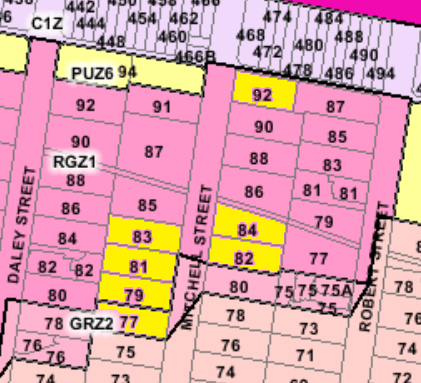
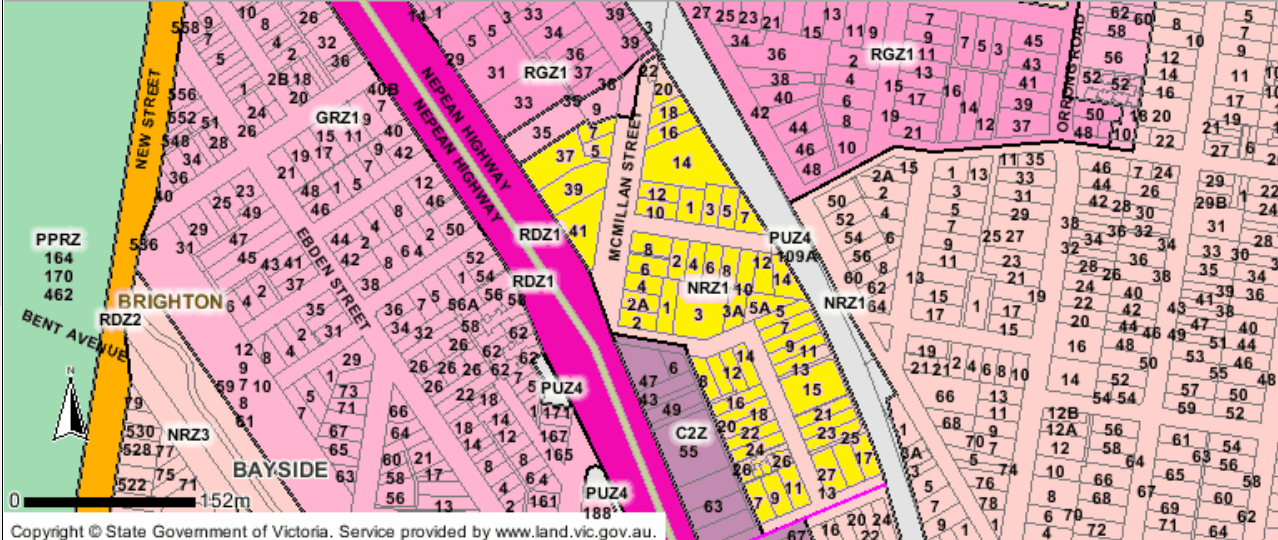
The map below shows one example of what is envisaged. The yellow markings indicate some sites which are now being upgraded from 2 storeys to 4 storeys.

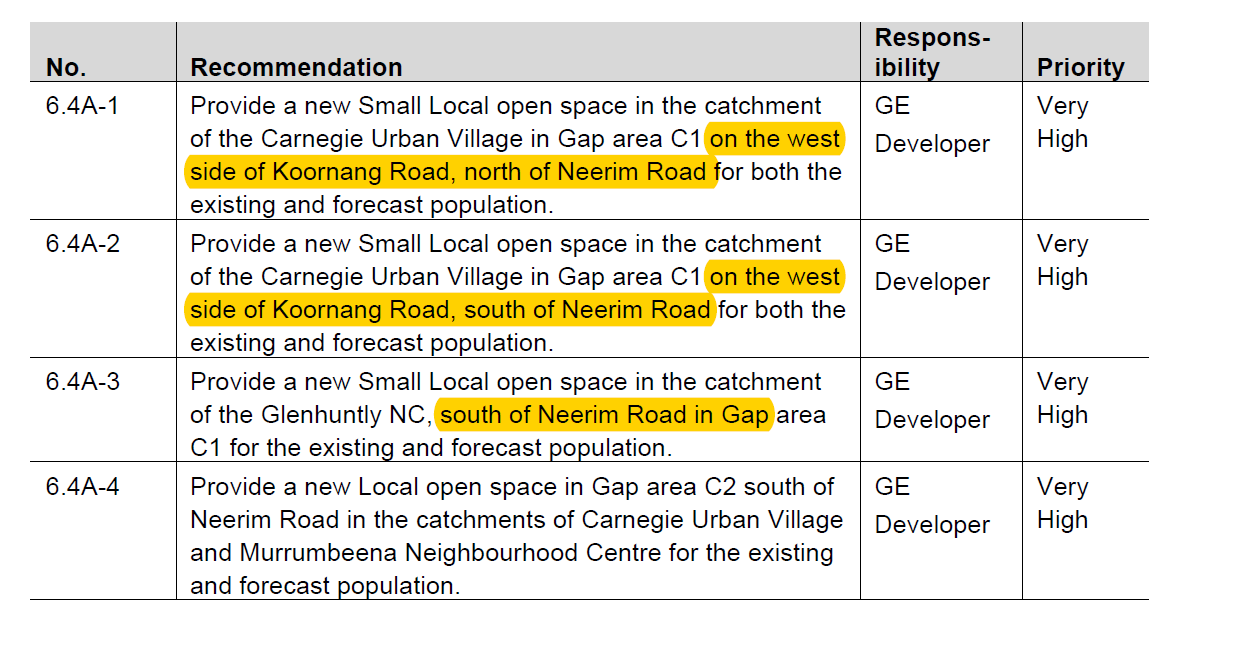
Not for the first time does it appear that those residents living in Camden ward are for more ‘privileged’ than those living in other parts of Glen Eira.  In the Records of Assembly minutes we find that council has been considering creating open space in Long Street, Elsternwick. We also assume that this was the item discussed at the closed August 2nd Special Council Meeting for which no minutes have as yet appeared!

We unequivocally support the creation of new open space. Thus far however, Camden ward has been the major beneficiary of council funds expended. Here is the list of very questionable ‘purchases’ or the mega bucks spent on under-utilised and in our view, totally inappropriate placements –

  • Aileen Avenue house for $2.1 million which is currently rented and a stone’s throw from Princes Park
  • Closing off of street between Eskdale and Fitzgibbon –another stone’s throw from Caulfield Park
  • Elsternwick Plaza – continued problems with ‘paving’ and tons of concrete
  • Proposed $1m ‘development’ of Harleston Park – meeting with strong community opposition

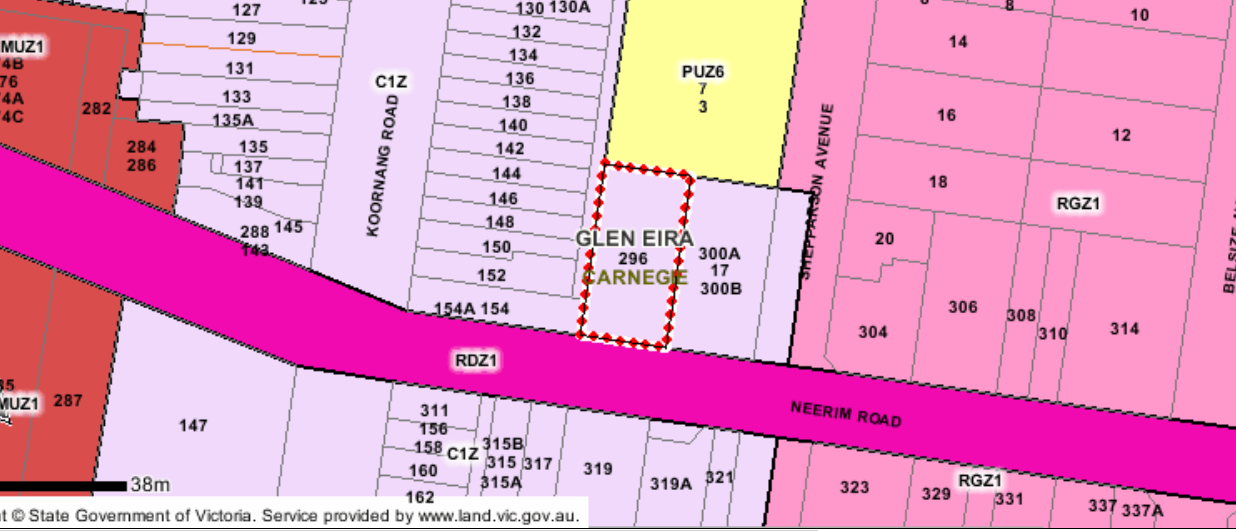
Now we have another proposal we assume to purchase a property in Long Street. As the map below reveals this is barely 500 metres from Harleston Park!!!! Hence the following questions:

  • Why is Camden Ward the flavour of the month when Carnegie in particular is crying out for additional open space given its continued over-development?
  • What kind of ‘business plan’ accompanies these proposals? Why is nothing published by council to justify the expenditure of millions in Camden?
  • What vested interests are possibly at play here?
  • Why isn’t the available funds spread where it is most needed, or at least equitably?

We’re focusing on one tiny corner of the Carnegie plan this post as the perfect example of planning gone mad. With typical double speak nonsense, council tells residents that they are concerned about ‘transition’ – we even get titles like ‘Building Transition Plan’.  We urge all residents to carefully consider the following and at tonight’s public relations exercise at Carnegie to really hone in on this lunacy.

Here’s what the above image reveals:

  • Rosstown Road ‘upgraded’ to 4 storeys from 2 and now abutting some remaining 2 storeys to the South-West of Rosstown Road.
  • The ‘pink’ coloured areas in Egan and Arawatta (up to 12 storeys) enclose ‘heritage character/shop top’ of 3 to 4 storeys
  • These ‘pink’ areas of 12 storeys also overshadow Chestnut Street (heritage overlay) of 1-2 storeys.
  • To the north of Chestnut we again have 4 storeys along Dandenong Road overlooking 2 storeys.

When all of council’s propaganda for the past 4 years has been about protecting the community via appropriate transition (ie 4 storeys, down to 3 storeys, down to 2 storeys via RGZ, GRZ1 & GRZ2 respectively) to now come up with this nonsense is literally beyond belief. It is even more unbelievable that such plans could even get off the ground and be put up for ‘consultation’. Who is responsible for this? Where is the strategic justification? What secret deals have already been made with developers and/or governments? And how on earth can 9 councillors even come close to believing that this is worthy of consideration by ratepayers? We would also question how much of ratepayer’s money has been spent on ‘consultants’ and producing glossy flyers, letters, and brochures that are nothing short of embarrassing!

Aiden Mullen has admitted that the residential  ‘demarcation’ zones  introduced in 2013 made ‘no sense’. The critical question now is whether council’s proposals do in fact make more ‘sense’ and whether they are justified in strategic terms as well as improving residential amenity in our local streets. From what has been published thus far, the answer is an emphatic and unequivocal ‘no’.

Council has produced some ‘Quality Design Principles’ that are literally nothing more than pretty picture pipe dreams and totally unattainable given current State legislation, council’s own planning scheme and the schedules to the zones. In this post we will focus on Council’s version of ‘garden apartment’ which is really the current Residential Growth Zones allowing 4 storey development. The definition of this component, as supplied by council, reads –

The Garden apartment (three to four storeys) building type seeks to ensure that apartments located within these residential streets look and feel residential with a strongly vegetated garden setting, and a recognizably residential building form.

A nice bit of mumbo jumbo with no specifics, no detail, and not a hope in hell of achieving any of these aspirational objectives. In addition we also get this bit of humbug –

Several things are clear from these ‘principles’ and the examples:

  • There will probably be no 3 or 4 bedroom apartments in these buildings given the groups selected in the ‘housing opportunities’ section. Most will be 1 or 2 bedrooms – which does not match council’s own current planning scheme!
  • Does council really believe that any developer would constrain himself to build 3 storeys instead of the allowable 4 storeys? The past 4 years provide ample evidence of what a joke this is. Or will we eventually see some further zoning that differentiates between 3 storeys (GRZ) and the 4 storeys (RGZ)?
  • How can a ‘front and back corridor’ be maintained when nothing in the legislation mandates this beyond the current inadequate ResCode ‘standards’ that are not worth the paper they are written on and which both council and VCAT disregard repeatedly?
  • 4 storey ‘garden apartments’ are supposed to be along ‘residential areas along arterial roads’. Why then do we have a large section of Rosstown Road in Carnegie changing from 2 storeys to 4 storeys WHEN IT IS NOT AN ARTERIAL ROAD? Why do we have sites along Centre Road, Bentleigh changing from 2 storey to 3 storey, when Centre Road IS NOT AN ARTERIAL ROAD? Why do we have Truganini, also falling into this category? How much more misleading information will council put out for ‘consultation’?

The real sticking point however is the legislation and Wynne’s recent introduction of Amendments VC110 & VC136. The important points to note from these two pieces of legislation are:

  • There is no mimimum ‘garden requirement’ for the Residential Growth Zones (RGZ)
  • According to Clause 55.07, the only mention of ‘communal open space’ is when the number of dwellings exceeds 40 or more. Anything under this number would therefore be exempt according to the legislation!
  • Council’s current schedule to the RGZ zones has the mimimalist standards of 60% coverage, and 20% permeability. There is nothing in these schedules, or in the entire planning scheme, that will MANDATE anything like a ‘garden setting’. Thus is council deliberately conflating ‘private open space’ with ‘garden’ requirement in order to mislead?

CONCLUSION

Council has not provided any information as to how it will:

  • Change any of the schedules and what these changes might be. We are confident that what will happen is that these crucial ‘details’ will be held back until the very last moment when council will vote to write off to the Minister under Section 20(4) of the Planning & Environment Act and thus deny residents all objection rights, much less their final say on what will be in the final amendment.
  • Most alarming is that not council, nor any single councillor has made mention of the Minister’s latest amendments when they are so crucial to determining sound strategic planning.

The table below presents the latest ABS figures for building permits granted in the 2016/17 financial year.

Glen Eira romps it in as the south eastern region development capitol once again!

We well and truly trounce Stonnington and even Port Phillip where both councils have triple the amount of commercial zoning that Glen Eira has and where most of their development goes. This means that in Glen Eira the majority of development is not happening in those sites zoned commercial, but in our quiet residential streets.

Adding further insult to injury, council is now set on a course of facilitating further development in these very streets. Residents need to start questioning why? – especially since the Plan Melbourne Refresh has lumped Glen Eira together with Stonnington, Bayside, and Boroondara.   The most interesting and frightening statistic is that Glen Eira comes in third in the entire state behind Melbourne City & Moreland for the number of apartments built!

We invite readers to peruse the ABS data (uploaded HERE) – it reveals a fascinating story of development for development’s sake in Glen Eira!

In the interests of factual reporting and honest communication with residents we highlight a comment put up by Hyams on the Residents’ Action Group Facebook page in response to the residents’ letter featured in our previous post.

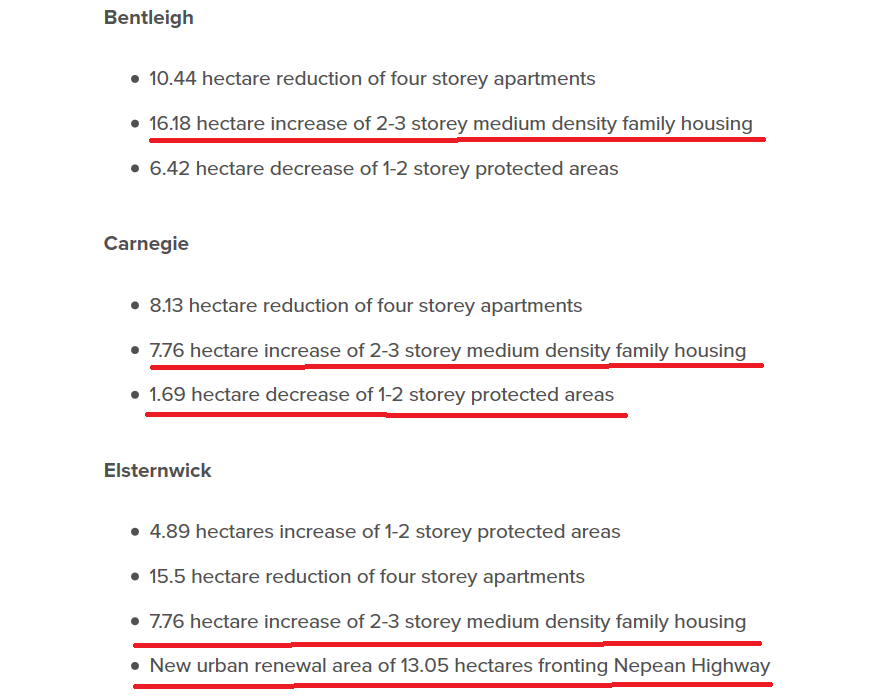
I have a completely open mind about this, and I’m looking forward to seeing the results of the consultation, but it’s a great shame the anonymous authors of the letter chose not to mention the large areas where four storey development is now permitted that the proposed changes would reduce to two storeys or three storeys.

Now whether one believes that council has reduced the Residential Growth Zone in ‘large areas’ or not, the important considerations here are:

  • How many 4 storey developments already exist, or are up for decision in these proposed 3 storey areas?
  • What impact do the already existing 4 storey apartment blocks have on the street and is this merely a case of too little, too late – that the horse has already bolted?
  • What Hyams does not address is how many sites have now been converted from 2 storey maximum height to 3 storeys? – much less the need for such changes given that Glen Eira is well and truly surpassing its housing needs for population growth.

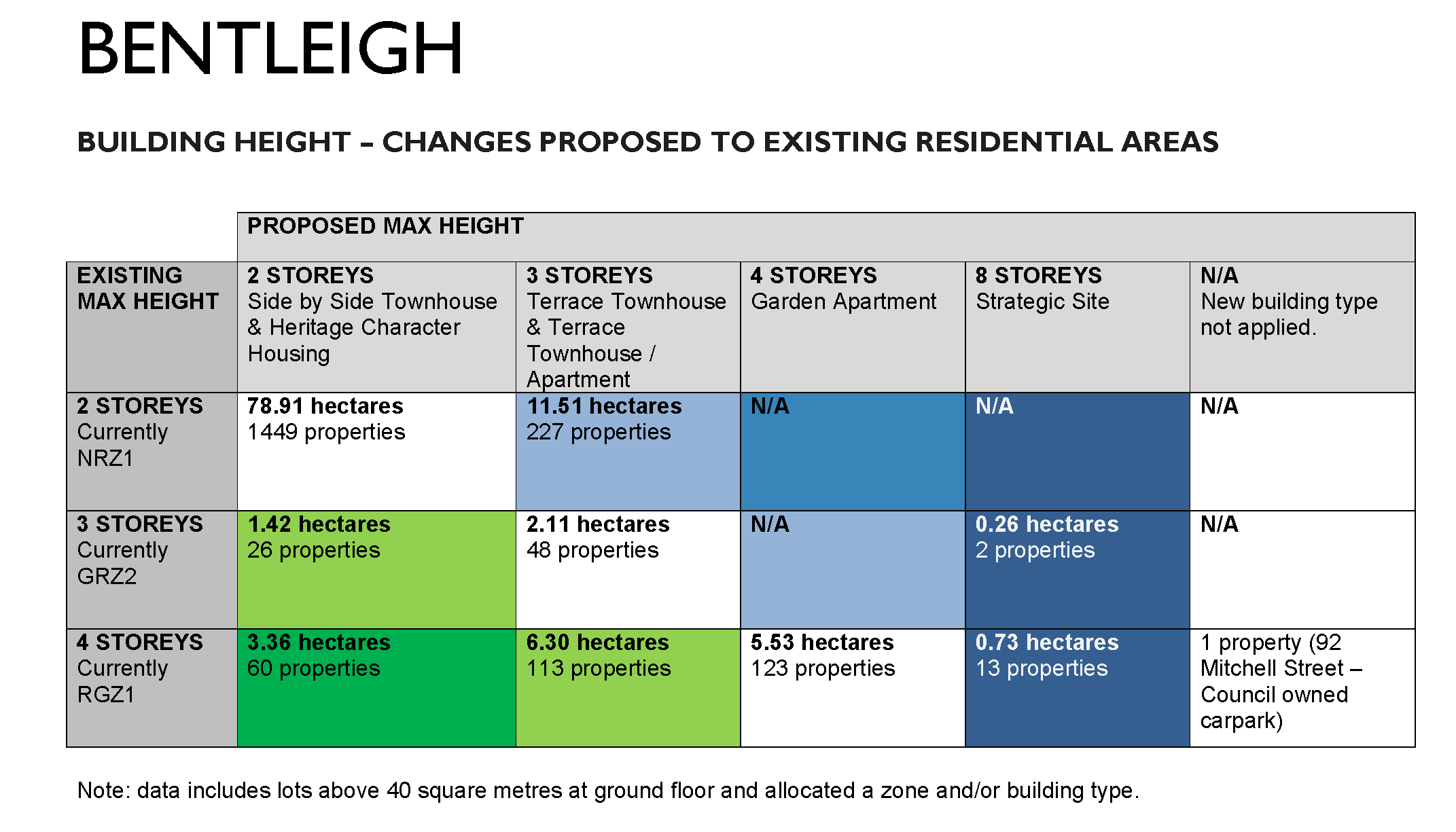
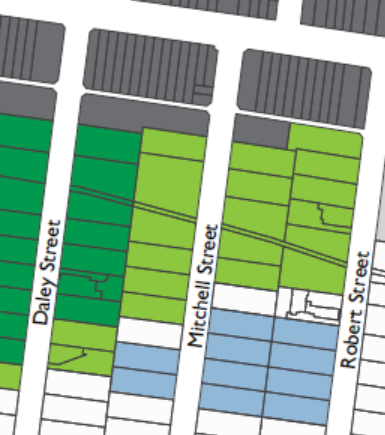
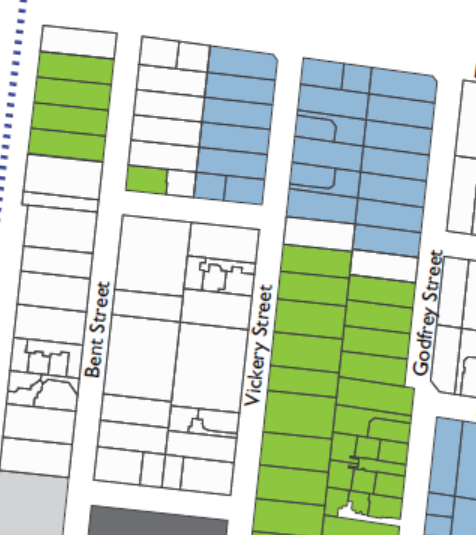
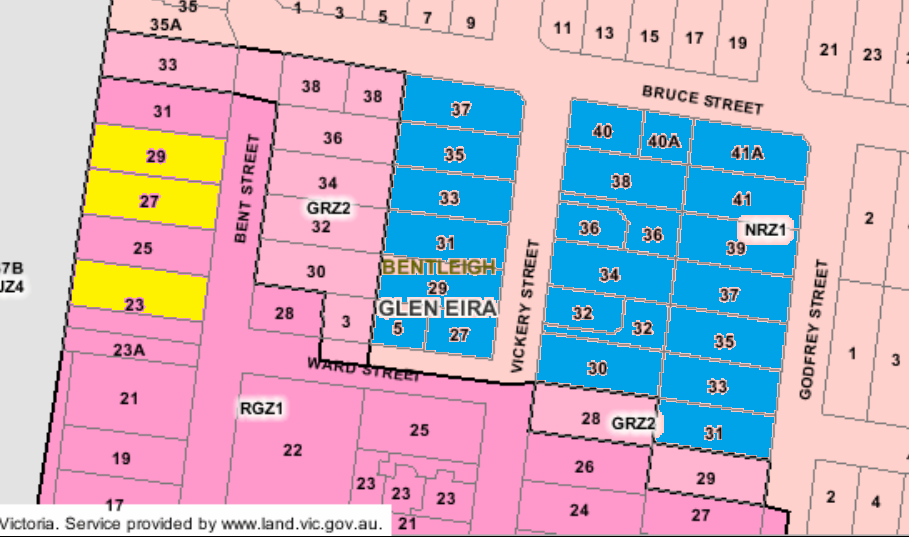
As the perfect example of what we are on about, council is proposing to rezone the area north of Ward St along Bent Street from 4 to 3 storeys. There are 6 blocks of land in this area – 3 of which have already been granted permits for 4 storey developments. They are –

27 – 29 Bent Street BENTLEIGH – 4 storey, 31 units

23 Bent Street BENTLEIGH – 4 storeys, 29 units

Thus 50% of this small side of the street is already 4 storeys and 60 units! But it gets worse. The East side of Bent St is currently zoned for 3 storey (ie grz2). This is now extended to 6 properties further east along Vickery street which is currently zoned for 2 storeys.

Hyams of course does not mention any of this!!!!

Here is the map and again those sites highlighted in yellow already have permits for 4 storeys. The green markings indicate those sites earmarked for 3 storey development. This is not quid pro quo – it is an expansion of development potential throughout the municipality.

At the last council meeting, councillors voted unanimously to endorse the Activity Centre, Housing and Local Economy Strategy. The discussion on this item should be further cause for concern since:

  • The emphases is clearly on growth and more growth despite the Hyams’ effort to deny this
  • Bentleigh East residents should definitely be gearing themselves up for at least 6 storey developments and probably many more areas earmarked for GRZ and possibly RGZ
  • The lame excuse that up-to-date census figures are not included because council is waiting for vital employment data. Please note that this release will basically reveal figures of work by sex, age, and broad categories of employment – ie ‘professional’, etc. The only scrap of really important data would be how residents travel to work – ie walk, car, train, bus. There is literally no valid excuse why current figures have not been incorporated into these latest documents – except that they prove several things that council would like to ignore – ie less population than projected; increase in apartments standing empty; decline in residents over 75; well above state average for 1 and 2 bedroom apartments, etc. etc.

Readers should also question why the gallery is repeatedly subjected to waffle and more waffle instead of actually focusing on the documents themselves and DEBATING the issues and the recommendations.

+++++++++++

Athanasopolous moved motion to accept as printed. Taylor seconded.

ATHANASOPOLOUS:  said that everyone knew at end of last year that council was ’embarking’ on structure planning and this ‘document is one part of that body of work’. It was ‘a great piece of work’ and there will always be ‘some things that aren’t identified’. But ‘the community was consulted on this’. Thought that the ‘outcome, balances the community expectation’ and ‘what the state expects’. Congratulated council and officers and ‘the community for being a big participant’. Hoped that ‘we will continue to produce work like this’ to ‘shape the future’ of the city.

TAYLOR: said it was a ‘huge body of work’ with over 4000 responses to the consultation and she wanted to ‘keep this coming’ in the further consultation. There will be plenty of options that inform people so council ‘isn’t hiding’ this from people and they really want input. The ‘standouts’ were that people wanted a ‘diversity of housing’ that catered for different ‘age-groups’ and for ‘people of different ability’ and ‘different socio-economic backgrounds’ plus ‘families’. People wanted ‘density’ to focus ‘on the activity centres’ and ‘less on the smaller streets’. People also wanted to ‘maintain the heritage and character’ of places. Said that ‘we do have to wait for Census data’ since she’d seen something on social media that asked ‘why do you need to wait?’. Said that ‘we have to wait’ until October 2017 because ‘we will get more important data’ on employment, and people’s vocation, ‘work place address’, and how they get to work. ‘We can’t ignore this vital information’ and they want a complete report. Without it, the report ‘won’t be useful and it will have gaps’ and ‘won’t serve the community in the way it needs to do’. Stated that it’s ‘important to have a dynamic document that continues to respond’ to the community and ‘this important data’ that they currently don’t ‘have access to’. The 4 structure plans are really important in that council has a ‘clear roadmap’ of ‘where we’re going’.

HYAMS: thanked submitters. Said this isn’t the end of a stage because the document ‘will be changed’ because ‘of further census data’ and more feedback from ‘the other consultations’. Called the document a ‘set of’ ‘guidelines’ that is the ‘skeleton’. Said there ‘were some changes from the original’ and these were that ‘the word vibrant was taken out’ since ‘that word did seem to cause a fair bit of angst’ and that people wanted their centres to be ‘lively’ but also ‘safe’ and ‘sedate’. Student housing also went in as an additional category of housing. This was important because people were thinking we ‘are allowing student housing when we’re actually not’ in certain areas. Caulfield South and Bentleigh East were also changed and ‘redefined as larger neighbourhood centres’. This is ‘basically the same as a neighbourhood centre’ but ‘maybe a bit more development’. Worth noting that in terms of shop floor space that Bentleigh East is ‘larger’ than Glen Huntly but has got less public transport and that’s why ‘it’s not the same’ but ‘it is probably appropriate that it be differentiated’ given its commercial size. Thus the housing ‘might be more 4 to 5 storey shop-top’. ‘We shouldn’t be seeing this as an attempt to encourage growth’. ‘We don’t want growth but have to accept that growth is happening’. So they have to ‘channel it in the most efficient way’. The plan therefore ‘sets out where employment opportunities should focus’ and ‘where different types of housing’ should go. So ‘if you’re looking for an absolutely prescriptive plan for every house in Glen Eira’ this isn’t it but rather a ‘broad brush’ stroke.

SZTRAJT: Said that council can accept or reject development applications but ‘at the end of the day other bodies such as VCAT’ ‘make the decisions’. ‘If we don’t provide these types of guidelines’ then council is ‘opening ourselves up to unelected officials who don’t live in the area’ making decisions ‘about what’s appropriate’ for us. ‘This is a way’ for the community to ‘tell us not only where development should happen’ but ‘what it should look like’ and ‘how it should be integrated into public transport’.  Said that ‘this is the ideal’ that it’s a plan ‘where we (say) what we want for our community and as a community’. Said he is ‘proud’ of what has ‘gone into’ the document and it is a ‘very impressive process’ of consultation.

MAGEE: said this is ‘all about building a much stronger local community’. The document moves council forward but ‘it is not the end of the journey’. This has to work with Plan Melbourne as well as the community/council plan. ‘This is something that will continue to evolve’. Said he had talked with a resident who had moved into Carnegie and she was ‘absolutely amazed’ what a great ‘city’ Glen Eira was. She hadn’t thought she ‘could afford’ to live in Carnegie ‘next to a railway station’ and a ‘really vibrant place’ as she ‘called it’. Council didn’t ‘supply’ the building but council did make sure that the building ‘complied with out planning scheme’. Council has to look at ‘where people live and where people work’. Said ‘I would hate to see Glen Eira purely as a residential city’. It has to be a place where people can work and not have a ‘one hour commute’. Said it’s been ‘nice’ to hear positive comments coming from residents especially around the Bentleigh and East Bentleigh area on ‘what’s happening in the city’.  There are ‘several tiers’ to the structure planning and this is ‘one tier’. Looking forward to further feedback and currently it is ‘8 to 2’ on the feedback – 8 positive and 2 negative.

DELAHUNTY: said it was an ‘incredibly’ important and ‘detailed piece of work’ and that ‘I’ve learnt a lot’ like what to call ‘that bit around Caulfield Station’ since ‘we’re all calling it different names’ and ‘what goes in a framework and what stays out of a framework’. Strategic planning is ‘sometimes about patience and getting the levels right’. So this ‘sets up the framwork’ for the future in how the ‘city looks and reacts’. Wasn’t ‘sure that I completely agree with Cr Hyams’ in saying ‘we don’t want growth’. Want ‘growth that we will be able to manage it in a way’. ‘We don’t want necessarily to shut the gates’. Victoria is the ‘recipient of the great benefits that growth has given’ but a bit ‘overwhelmed’ in how to ‘manage that in people’s best interests’. ‘We can’t shut the gates in Glen Eira’ and the plan is how to ‘manage the look and feel’ of growth. Agreed with colleagues that the strategy has been commented upon and had changes as a result of consultation. Thanked residents and ‘officers for their work’.

ATHANASOPOLOUS: thanked councillors for explaining ‘what this strategy means for you and what you got out of the process’. Said that one of the ‘most glaring’ stats he’d seen was that 80% of residents worked outside the municipality. Thought that ‘number is quite high’. Said that ‘retail is fantastic’ in most places including neighbourhood centres. Other forms need to be ‘encouraged’ and that the city is ‘craving’ for this. ‘great work’ and thanked the community ‘for being involved’.

MOTION PUT AND CARRIED UNANIMOUSLY

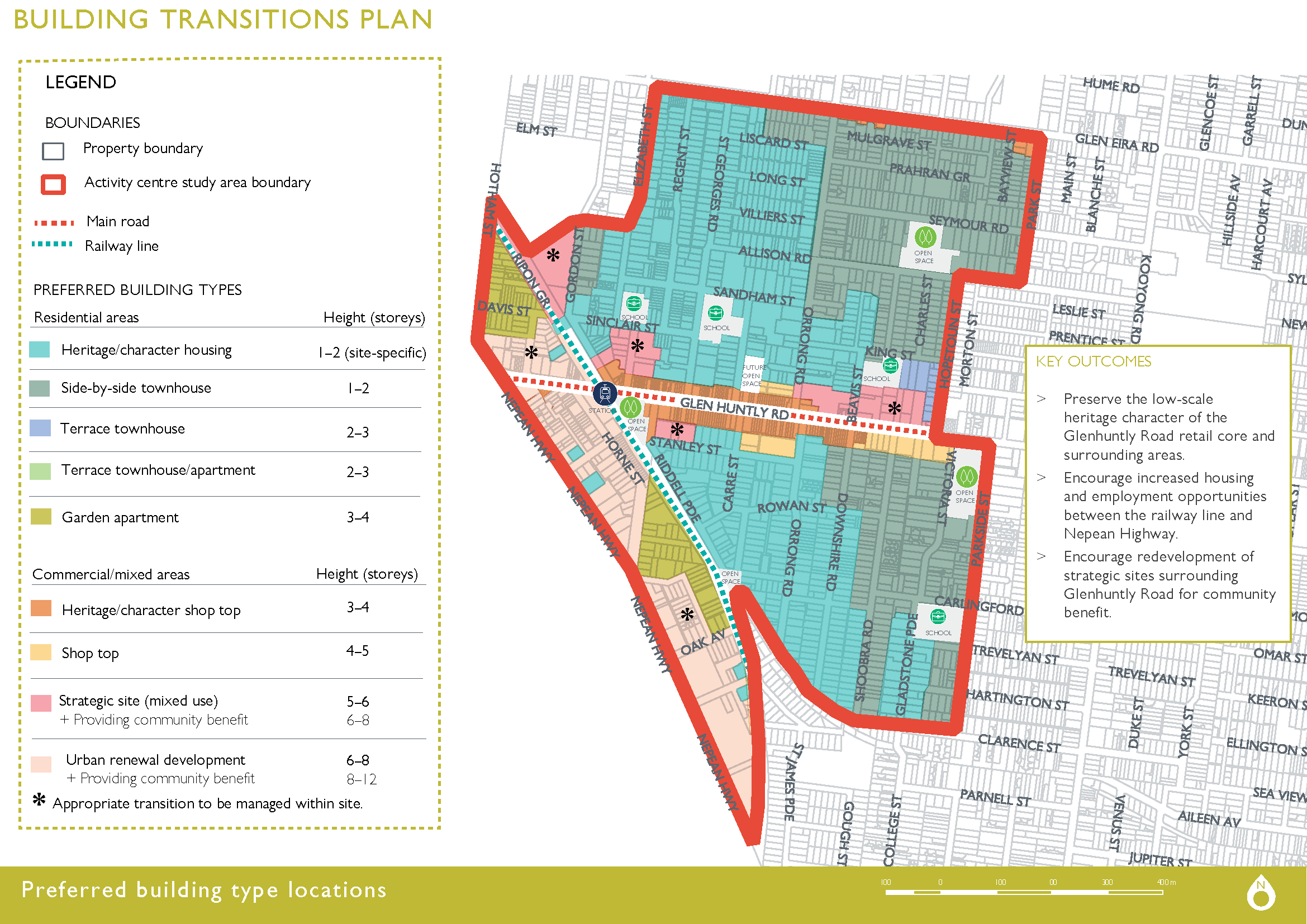
There’s a sublime irony in council calling one of its structure planning documents the Building Transition Plan. ((uploaded HERE)According to council’s ‘vision’ the objective is to “manage the transition between housing densities’. If this is indeed the objective then we have to scratch out heads and wonder how on earth the following can even be contemplated  –

  • Potential eight storey buildings directly abutting 4 storey buildings
  • Rezoning 2 storey buildings to either 3 or 4 storey buildings and then to claim that this Manage(s) growth in a way that responds to Bentleigh’s suburban residential character.

The above comments relate to the Bentleigh structure plans, but they apply equally to Carnegie as well as Elsternwick. Here’s what’s planned in greater detail.

Translated this means –

The areas marked in green (currently zoned for 2 storeys) will now be either 3 or 4 storeys.

The areas marked as PUZ6 are designated as a potential 8 storeys. Please note that these directly abut 4 storeys – yet council has the gall to call this ‘transition’!!!!!!!

When tens, if not hundreds of thousands of ratepayers’ dollars are spent on consultants then surely it is incumbent on those consultants and the officers who advise and vet the final reports to ensure that they are accurate. This is not the case with the latest Planisphere document entitled Urban Design Analysis – Bentleigh, Carnegie & Elsternwick (uploaded HERE).

Consultants are ‘hired guns’ – employed to do a job where they are bound by their brief and terms of reference set by council and completely reliant on the data that is provided to them by officers. How much they are paid is also correlated to the amount of work expected. If the data is deliberately skewed and the brief so narrow that it becomes meaningless, then the validity of any ensuing ‘report’ must be questioned. This is the case with the Planisphere effort.

Here is the section highlighting the recommendations on Carnegie –

Please note the following:

  • There are no ‘approved’ permits of 16 storeys in Carnegie. The 8 Egan St application for 16 storeys has twice been rejected by both council and VCAT. The first in 2015 and the second in May 2017. Why does Planisphere then state that VCAT approved this application? Readers can check these decisions at – http://www.austlii.edu.au/au/cases/vic/VCAT/2015/1565.html and http://www.austlii.edu.au/au/cases/vic/VCAT/2017/695.html
  • As far as we know there has also not been a 13 storey permit granted. The application was for 12 storeys. Emphasising these illusory ‘permits’ is intended to bolster the argument that greater heights are now a reality in Carnegie and hence the proposed ‘urban design’ is warranted.
  • There is no explanation provided as to why this document concentrates exclusively on the areas nominated in the interim height amendment – especially since many of council’s proposed changes are OUTSIDE the areas included in the amendment – Rosstown Road for example. There is not a single word about Elliott, Tranmere, etc. Why? If the brief was this narrow, then council needs to tell its residents the reasons why and on what basis the changes in other areas were made.
  • The language used is also a concern in our view. For example: south of the railway line we find that an 8 storey permit is labelled as only a ‘minor breach’ of the interim height guidelines of a preferred 6 storey height limit. Yet, North of the railway we find the language changes to ‘significant breaches’ when only one permit has thus far been granted. We remind readers that the overriding reason given by VCAT for this permit was the lack of any height and building design guidelines in the planning scheme!
  • The most startling comment is the recommendation for a 9 storey height limit. Council’s ‘concept plans’ nominate an 8 to 12 storey height limit in this area. Thus we have the ludicrous situation where consultants recommend a potential for 9 storeys and council for some unjustified reason decides that 12 storeys is appropriate! Whether or not this is simply council’s opening ambit claim with the intention of ‘softening’ up the community and making them feel relieved that it will ultimately only be 9 storeys remains to be seen. But surely it is strange that so called experts call for 9 storeys and council wants 12 storeys?

There is much, much more throughout this consultant’s report that needs challenging – especially when activity centres as in Bentleigh have doubled in size and the consultants completely ignore what is happening outside the immediate commercial areas. And surely by any accepted definition ‘urban design’ must include analysis of setbacks, open space, traffic, etc. Planisphere is silent on these issues and residents are left to wonder what else council has up its sleeve?

PS: WE’VE RECEIVED THE FOLLOWING FLYER AND ENCOURAGE RESIDENTS TO ATTEND

« Previous PageNext Page »