GE Transport


Year after year after year, the results of the Community Satisfaction Surveys repeat the same results. Each year for over a decade now the areas that are causing greatest concern for residents are:

  • Planning
  • Population growth
  • Traffic/parking
  • Consultation
  • Informing the community

But nothing seems to change when council knows only too well that these are the areas that need to be focused on. Even more disconcerting are the results as presented in the following table. They reveal the importance that people place on these various areas, plus how they evaluate overall council ‘performance’ for those categories. When there is a discrepancy of over 20 points, then remediation is well overdue.

Council can pat itself on the back all it likes, but the main areas of discontent remain and even grow.

Over the next 6 months or so, council officers will be creating what is arguably the most important planning document of the past two decades – the Housing Strategy. Readers may be surprised to learn that Glen Eira City Council does have such a document – it is dated 2002 and is based on 1999 stats. That’s how out of date this council is.

What has been stated several times is that this upcoming Housing Strategy will form the foundation for council’s land use planning. It will set the parameters for our structure plans, and other policies.  Community consultation therefore becomes an essential component for the strategy. Thus far, we have certainly been underwhelmed with what council has produced on this front – one forum that featured Bernard Salt, et.al – and which had very little relevance to Glen Eira itself. (See: https://gleneira.blog/2021/07/15/the-symposium/)

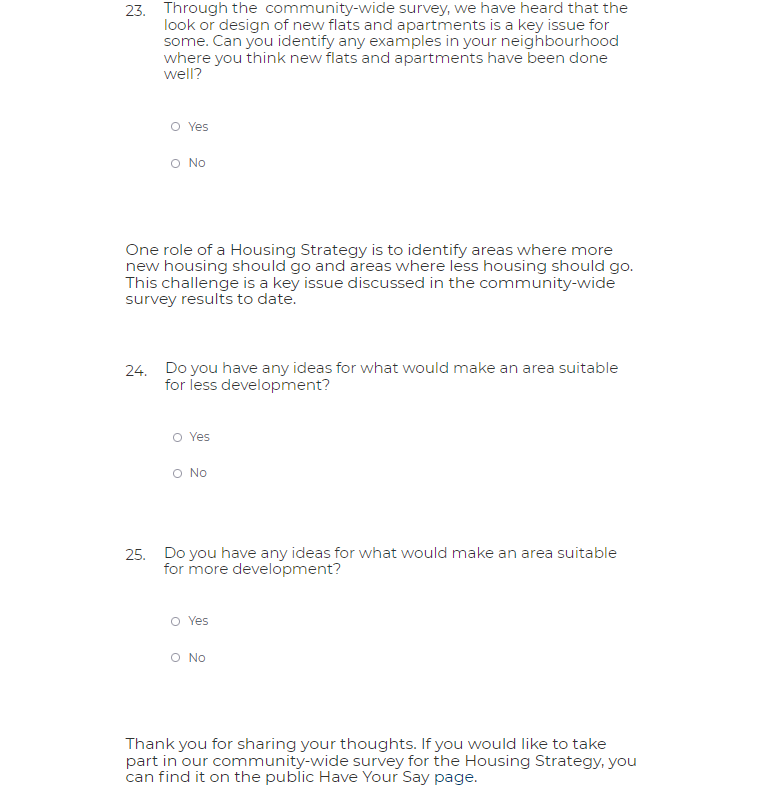
Council’s latest effort consists of a ‘mini-survey’ for those residents who are members of Community Voice. As an adjunct to the larger questionnaire on the Have Your Say site, one would have hoped that the questions are meaningful, valid, and relevant. They are anything but. Here is the most important section:

COMMENTS

The first question asks for a simple ‘yes’/’no’ response as to whether residents can ‘identify’ any apartments that have been ‘well done’. There is no opportunity for an in-depth response; no opportunity to define/elaborate on what ‘well done’ might mean- and whether individuals interpret this phrase the same; no opportunity to identify location. Thus if readers tick the ‘yes’ option, does this mean that they are happy with what is being built overall? Or does it mean that maybe a minority of apartments fit the bill of ‘well done’?  The same kind of questions would apply to those who selected ‘no’. Nor do we know what either response tells us about housing in Glen Eira and how any result will be interpreted. Secondly, how are people meant to judge what is ‘well done’? Have they been inside the apartment blocks? Are they aware of how much open space is provided? Do they know how many car parking spots are onsite? What do they know about overshadowing, or the thermal efficiency and sustainability of any of the apartments? Simply asking for a ‘yes’/’no’ answer is to put it bluntly a joke!

The second question on ‘suitability’ for more or less development repeats the shortcomings of the previous question. It becomes impossible to understand any of the responses,  given that they are not broken down into specific criteria. Some people might feel that heritage is an important constraint on increased development. Others might believe that the lack of open space is crucial. Then again, others might be convinced that Glen Eira already has enough development and that no single area should be burdened with more.

Even if responses choose the option for more development in certain areas, we are still left without reasons for this selection or potential  locations. It’s all very well to push the mantra that activity centres require increased development, but unless residents are provided with the necessary data on the availability of open space, the proposed increase for individual centres, etc. any response is again totally meaningless.

CONCLUSION

All of the above, then raises the question of why is council doing this? Why do we get presented with survey after survey that is at best skewed, and at worst, totally meaningless?  We firmly believe that what passes for consultation in Glen Eira is nothing more than a ‘tick the box’ exercise so that council can claim to have met its legal obligations. If it were otherwise, we would surely have better surveys and processes.

This leads to even more fundamental questions of governance and transparency. For example:

  • How many more times will councillors allow this administration to get away with sheer incompetence when it comes to community consultation/surveys?
  • How many more times will money and time be expended to produce, analyse and report on meaningless questionnaires that lead nowhere and certainly don’t provide any insight into what the community feels
  • Who produces these surveys so they can be held to account?
  • Who authorises their publication so they can be held to account?
  • What ‘testing’ (if any) have they undergone?
  • What is their purpose?
  • How valid are any of the results produced?
  • How much does each cost in terms of officer time?
  • What say do councillors have in their creation?

Until we have councillors willing to put a stop to this constant charade and sham, poor governance and certainly the lack of transparency in Glen Eira will continue!

CLICK TO ENLARGE

As we wrote in our last post, we believe that it is incumbent on current councillors to owe their primary allegiance to their constituents and not to any state or federal political party. It was very clear last night on the multi-level car park issue, that most councillors chose the latter.  The community, and their wishes, was not the prime concern. Rather political point scoring definitely was.

Consistency has never been a hallmark of some councillors. Last night was no exception. On the Woolworths application, here is part of what occurred.

Cr Parasol in seconding the motion to refuse the Woolworths application said – ‘being on council you have to listen to the residents’…..I feel we need to support their claims’. Athanasopoulos in his response stated: ‘there will be some form of development and ….and just saying the community don’t want it and therefore you as a councillor have to vote that way, I don’t really appreciate that type of interaction’. …it’s not just for me to do a poll survey around an area and then land on a decision’. He needs ‘all information’ and a ‘prudent councillor would do that’ before he decides. He wants good ‘interaction’ ‘rather than dictating to me what I should do as a councillor’.

When the multi-car park item came up, Athanasopolous moved a complex motion that included ‘consultation’ on whether the community wanted to accept the grants, and the locations of the newly proposed builds. What’s important is that he also said that the consultation would provide council with a MANDATE!!!!! In other words, if the community says ‘yeah’ or ‘nay’ then this is the basis upon which he, as a councillor would vote. In our view, this totally contradicts what he stated in the Woolworths item! Isn’t this proposal nothing more than a ‘poll survey’ which was dismissed several items earlier? And if we consider the definition of ‘mandate’ then this also implies voting in accordance with community views.  Furthermore, readers would do well to remember Athanasopolous’ comment in September 2020 when he stated that councillors should not appear to be ‘in the pockets of residents’. Taking all this into account, we have to wonder whether any consultation result would deter certain councillors from voting on issues that they have already made up their minds about!

What last night so sadly showed was that ideology is the greatest criterion in many councillor’s decision making. Residents, and purported ‘genuine consultation’ is nothing more than a tick the box exercise to legitimise predetermined decision making. Indeed a very, very, concerning night for residents.

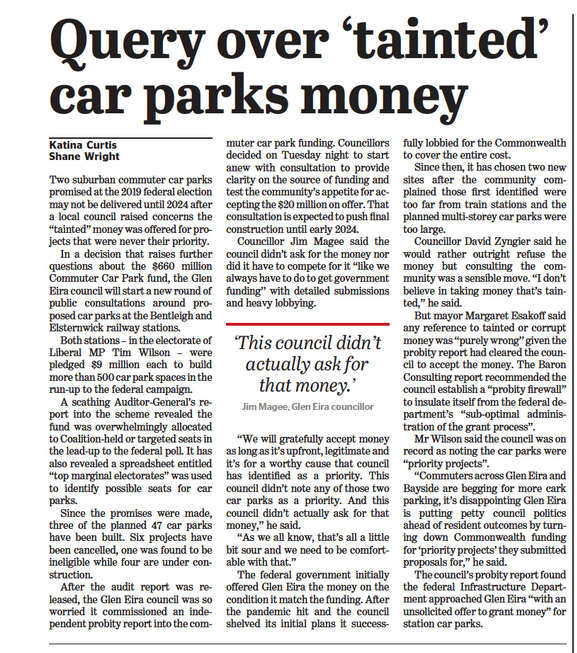
Item 8.5 on the current agenda features the multi-deck car park(s) issue. We are finally told several interesting things:

  • Council has secured $20.6M in grants
  • This amount means that council does not have to fork out any ratepayers’ money
  • The car park locations have changed in both Elsternwick and Bentleigh
  • The car parks will be ‘smaller’

Three options are then provided:

  • Proceed with a ‘feasibility’ study and community consultation on design
  • Proceed with ‘soft’ community consultation first
  • Return the money to the federal government and abandon the project

Whilst all this sounds wonderful, a myriad of questions remains and detail of course is missing. For example:

  • Multi-level car parks cost the earth. Council in its Strategic Resource Plans (SRP) for 2018/19 put the cost for the Stanley Street edifice at $18M and the Horsely Street versions at $14M – and that was three years ago! Admittedly, the later first drawings were for the equivalent of 5 and 4 storey constructions. We are now told that the proposals will be ‘smaller’, so supposedly cheaper!  What then needs to be stated is: if the car parks will be smaller then how many actual car parking spots will they contain? And how does this reduced number correlate to the previous studies that told us we need xxxx amount of car parking spots? Was this initial figure wrong and we are now supposed to accept a lesser required number?  Even more dramatic is the change in location. Whilst the new recommendations make sense, it again calls into question the first set of recommendations. How could planning have got it so wrong the first time around?
  • We are also concerned about council’s track record on major infrastructure projects. Each and every one has cost heaps more than first suggested. So, will $20M really be the final cost and if not, then how much will council need to put in to complete the projects? There is much in the officer’s report claiming that it will not cost council a cent. We remain unconvinced.

THE OPTIONS

Option 1 – Proceed with full feasibility and site due diligence, including development of concept designs. The problem with this option is that it basically pre-empts community input on the first question that needs asking – ie does the community support the development of multi-level car parks? If all the community is asked to respond to is the draft designs, then the first essential question is neatly side-stepped.

Option 2 – Proceed with a light-touch engagement phase to gauge community support for the commuter carparks prior to undertaking full feasibility and concept design. What on earth does ‘light touch engagement’ mean? Is this a euphemism for another half-baked consultation process? Even if the consultation is genuine, what happens if the Elsternwick proposal gets support and the Bentleigh one does not garner majority support? Will council still proceed? Return half the money?

Option 3 – Abandon the projects and return the funds to the Federal Government.

Our problem with these options is that there is no logical sequencing of process. Surely the first step must be whether a majority of the community even supports the idea of multi-level carparks. The next step would be to proceed with a business/feasibility study, etc. If there is no support, then ‘yes’, return the money – or if one site is shown to be acceptable to the community, then proceed with this alone. The drafting of the options does not provide this logical sequence. With the officer’s report recommending Option 1, the go ahead is taken for granted.

Looking back, residents have never been asked the crucial question – do you want multi level car parks? That should and must be the starting point. Residents also require far more specifics in order to come up with any informed opinion. Given that council as far back as 2018/19 was able to come up with some base-line costings, then they should be able to do this now as well. They should also be capable of telling residents what is the difference between ‘commuter parking’ and shoppers’ parking. Will certain levels be set aside for train commuters alone? How will this be monitored and enforced? Will there be any parking costs? This is information that should inform any consultation process. What we have in this report fails miserable on all these counts.

Finally, the recent publicity regarding the alleged pork barrelling by the Liberals in the grant process, should not have any impact on what decisions will be made by councillors. Federal Labor is of course using this as a great opportunity to lambast the Libs. It is therefore incumbent on our councillors to focus on their roles – ie the Glen Eira community and not to play politics! They are councillors first and last and owe allegiance to their constituents – not some political party!

Council has produced what it calls an ‘issues and opportunities’ paper on its upcoming housing strategy. One should therefore reasonably expect that residents be provided with:

  • An overview of the current situation,the various ‘issues’ confronting the municipality, and
  • How these ‘issues’ might be addressed via planning controls

In order to achieve the above, any decent discussion paper should provide readers with a detailed explanation of the issues, the problems, the potential solutions, and then insert specific questions that seek responses. Sadly, in the 13 page document, we find that only one single question has been included. It reads: How will we provide for the housing needs of an evolving community while continuing to support the sustainability, attractiveness and liveability of our City?

We are told nothing about our ‘evolving community’ (whatever that means!), nor anything about the controls that council has at its disposal in order to ensure ‘sustainability’ and ‘liveability’. Unless readers are aware of what is possible, their ability to respond meaningfully to such a question remains limited. For example: council introduced its residential zones in 2013 (without consultation). Nothing in the accompanying schedules to these zones has been reviewed, amended, or questioned. Whilst other councils have up to 40% permeability requirements even in their General Residential Zones, Glen Eira is content with maintaining its 20% requirement. This also applies to size of underground basements, open space requirements, etc. If sustainability is the objective, then residents need to know that council can and should be amending its schedules, and even reviewing the placement of the various zones. None of this has been communicated.

As for our ‘evolving community’, nothing in the issues paper identifies what this actually means or what the implications are and how they relate to a housing strategy. We are provided with a breakdown of detached housing figures, percentages of lone person households, and families with children (page 9). All we get are generalised comments such as ‘Housing diversity is important. There is support for housing diversity’. None of this has been explained, examined, and defined.

We also find statement after statement that deserves to be challenged. For example: ‘There is a need for student accommodation close to Monash University……’ We are not told how many student accommodation places currently exist and given COVID, how many might be required over the next 15 years. And if over a third of our current households are families with children, then surely, ‘housing diversity’ should pertain to the size of apartments built, the number of 3 and 4 bedroom homes, or the size of available open space? We are not provided with any data that reveals what is currently being built in Glen Eira or how council can introduce policies and standards that impact what is being built.

Page 12 of the paper exemplifies everything that is amiss with council’s consultation methodology. Under the banner of ‘Sustainability’, we are informed about 867km of footpaths (!), and the number of solar households in Glen Eira. Surely there is more to ‘sustainability’ than the length of our footpaths and even the number of homes with solar energy? We then also find the sneaky inclusion of this sentence: Higher densities in established areas can help contain urban sprawl on the edges of Melbourne. Is this simply setting the scene for more and more development and what does it have to do with ‘sustainability’ in Glen Eira itself? Not a single word is included on exactly what ‘higher density’ might entail and most significantly, what tools council has available to ensure that our streets, our open spaces, and our amenity is protected.

We started off this post by noting council’s refusal to provide questions that address and seek informed feedback on the central issues that any housing strategy should encompass. By way of comparison, here are some questions that other councils thought necessary to include in their respective discussion papers on their housing strategies – BUT ONLY AFTER SOME POTENTIAL SOLUTIONS WERE LISTED! –

KINGSTON

Thinking about new housing which has been built in Kingston over the last 10 years: a) Which specific developments or which types of development do you think have been successful? Which have been less successful?

BENDIGO

How important is the issue of housing affordability and to what extent should the Council and the private sector be involved?

Is this assessment accurate and is there additional land within the UGB (Urban Growth Boundary) that should be made available for housing or are there sites where development is not feasible or appropriate?

Council has identified a major future long term growth front to the north west of Maiden Gully –how appropriate is this area to accommodate residential growth in the future?

DANDENONG

What considerations should be taken into account when identifying locations for medium to higher density development?

How can Council improve the quality and location of medium and higher density housing?

There are several other councils which are currently reviewing and updating their housing strategies. We urge readers to have a look at what Bayside and Stonnington are doing in terms of their consultation methodologies.

Tomorrow night, council is holding a ‘symposium’ on the proposed housing strategy. The speakers are:

Bernard Salt (demographer)

Lester Townsend (Planning Panels Victoria)

Kate Breen (Affordable Development Outcomes)

Maria Yanez (Nightingale Housing)

Whilst these four individuals are undoubtedly ‘experts’ in their respective fields, we need to consider why these people have been chosen by council and exactly how much they know about Glen Eira and its current housing needs, its zones, its development rate, its lack of strategic vision! It’s all very well to look at the ‘big picture’ across the state, but housing strategies are meant to be ‘individualised’ and pertain to unique municipalities.  We are therefore very sceptical as to the value of tomorrow night’s symposium and how well it will address the fundamental issues facing Glen Eira. Yes, what is happening statewide and nationally is important, but even more important is what is and what has been happening in Glen Eira.

Even more disconcerting are the following statements (cited verbatim) all taken from this link – (https://www.haveyoursaygleneira.com.au/our-housing-our-future/widgets/344509/faqs#80192)

The event is the opener for our early community engagement phase which will continue to the end of August.  A second phase of consultation will take place in early 2022 on the content of a draft housing strategy.

Council has stated that the Housing Strategy will be completed in April 2022. Does the above paragraph then imply that the ‘second phase of consultation’ will simply be on what council produces as its one and only draft strategy? Why the huge gap of 6 months before any further ‘consultation’ takes place?

This might have been kosher if the survey and the issues paper were up to scratch. They are not. Once again we find that detail is lacking, pertinent questions and options are lacking, and residents are asked nothing more than irrelevant Dorothy Dix Questions, that add nothing to a full understanding of Glen Eira’s future and the role council needs to play.

Finally, we have this other quote:

As the purpose of the event is to explore information about demographics and housing rather than specifically about the current housing strategy project, Councillors and Council officers will not be answering questions on the night.  Drop-in sessions on 22 and 26 July are planned and will be an opportunity for the community to discuss the themes of the housing strategy discussion paper and the housing stragegy (sic) project with Council officers.

 Why then hold such a forum if it does not relate specifically to our local housing strategy? Why deny residents the opportunity to ask questions of officers and councillors? How much has this public relations exercise cost?

In the coming days we will analyse the survey and reveal why it is nothing more than another bogus exercise in so-called ‘ consultation!

PS: In 2019 Stonnington Council also held a symposium for its revamped housing strategy. They did include speakers from Planning Panels and Nightingale just like Glen Eira is doing. However, they also had someone from Profile.id – a company that Glen Eira and most other councils in the state rely on for their ‘individualised’ information. This presentation focused exclusively on Stonnington – its population growth, its development rate, its age structure, etc. See the presentation via this link: https://drive.google.com/file/d/1odRg-PHd-pmfAGCJ_oN44sI5rJkJR5oN/view. In Glen Eira such information is deemed unnecessary it would appear!

Council will be voting on the draft budget this Tuesday night. The differences between the May version of the budget and what is now presented is remarkable. Whilst some areas have received increased funding, the issues that were highlighted in the submissions have been totally ignored. This once again raises the question of why bother to ask for community input, when the recommendations are so flagrantly ignored year after year? Residents are never given the opportunity to specify what their priorities are. Instead we continue with the top-down approach and the minimalist adherence to the legislation. God forbid that residents be given the opportunity to answer such questions as: where do you want your money to be spent and how much?

The submissions made it very clear that what was needed was:

  • Increased funding for the urban forest strategy. This still remains at the May version of $200,000!
  • More funding for the acquisition of new open space. Nothing has changed from the $7M proposed in May.
  • Residents wanted the bicycle strategy to receive a minimum of $500,000. We are still stuck on $250,000.

At this rate, we can be waiting well into the 22nd century before our tree canopy reaches any reasonable target, or there is sufficient open space to accommodate the increasing population.

Yet council has still managed to find and allocate huge increases to various projects that are not only questionable, but where we believe most residents would argue aren’t necessary and certainly not on the top of the priority list. Please note, we are not arguing that these things shouldn’t be done. What we are suggesting is that given all the other major issues that are currently confronting Glen Eira, that much of this money should have been directed into those areas that demand immediate action – such as open space, the urban forest strategy, structure planning, amendments for development contribution levies, etc.etc. Five years on from the ordered Planning Scheme Review, we have practically nothing in concrete outcomes.

Below is a table which depicts the monies allocated for the various projects according to the May and then the June draft budgets – and all with hardly any detail.

PROJECTMAY DRAFT BUDGETJUNE DRAFT BUDGET
Caulfield Park Masterplan$600,000$710,000
Duncan Mackinnon Netball$200,000$250,000
Pedestrian Safety$205,000$355,000
GREAT WALKS STREETNot listed$700,000
Outer Circle$40,000$700,000
Lord Reserve/Koornang Park master plan implementation$500,000$680,000
Hopetoun Gardens$40,000$220,000
Tennis Strategy$75,000$275,000
Caulfield Park master plan implementation$40,000$790,000
Princes Park Playground upgradeNot listed$1,250,000

Surely some of these projects, and their massive increases in funding, could be deferred until this council sorted out its other major concerns as we’ve listed above.

Finally, it is also remarkable that in the space of one month, we have gone from an estimated deficit of $45,000 to a suggested surplus of over $11M where the announced government grants somehow don’t add up to this amount!

Our final comment is that until this council is prepared to provide full and comprehensive explanations for its decision making and budget allocations, residents are once again left in the dark with no real say as to how their money is and should be spent.

Public submissions for the draft budget and Strategic Resource Plan, have one consistent theme running through nearly all of the presentations. This is best summed up with this sentence from one such submission –

It is one thing to have a strategy and action plan in place, it is quite another to implement them. As Councillors would well know, implementation requires funded projects. It is here that Council is lacking.

Time and again throughout all of these well documented and thoughtful submissions we find similar statements. Council has policies, plans, strategies but implementation is either non-existent, or years behind schedule, and simply underfunded and/or forgotten about. This applies across all departments – from Caulfield Park implementation of the Master Plan, to bike paths, open space, the Urban Forest Strategy or the Climate Emergency. Nothing seems to have been done or certainly not funded enough to ensure real progress on any of these issues.

Then we also have the penny pinching that is so common in Glen Eira. Child care fees go up another $3 per day. Council’s persistent claims about such repeated rises is that they are on a par with the private providers. Only now the differences are made clear thanks to these submissions – ie whilst the fee per day might be equitable, council does not provide lunches or nappies. As for the car share options, that has remained static, yet for all the talk about reducing the number of cars on our roads, very little has been done to expand this option for residents. Instead fees are through the roof! Glen Eira’s car share policy first came to notice in 2016. Its subsequent policy is dated 2017-20 – hence defunct and out of date. We currently have 12 car share spaces in comparison to: Yarra – aiming for 231 in the next 5 years; port Phillip in 2018 had 181; and as far back as 2015 Moreland had 40. The rhetoric and the reality are simply miles apart on so many issues.

Council can ratify as many policies/strategies as it likes, but until there is a genuine commitment to fund such projects adequately nothing will change. Policies become nothing more than another worthless piece of public relations providing the illusion that council does give a damn about the lack of open space, the destruction of our tree canopy, and the failure to progress the bicycle strategy or provide sufficient car share opportunities. Residents should really start asking themselves whether this council’s priorities are in line with ratepayers’ thinking. Of course, ratepayers have never been provided with the opportunity to have a say in what these priorities should be before they are presented with the draft budget. In Glen Eira it would be fair to say that residents are nothing more than cash cows!

At last night’s Zoom forum on the Built Form Frameworks for Caulfield South, we had Kate Jewell (Co-ordinator City Strategy) make the pronouncement that’s in the header to this post. This statement followed resident after resident complaining vigorously about council’s reluctance to impose mandatory heights.

Here is the audio of this interchange:

Jewell’s statement tosses the ball straight back into councillors’ court. They have the power to oversee policy direction. They also have the power to pass resolutions which officers are mandated to follow. We have already had some examples of this – namely the abandonment of Amendments for Glen Huntly and for Bentleigh & Carnegie. This is no different. The question thus becomes:

  • Will councillors have the courage to insist on mandatory heights for all neighbourhood centres?
  • Will councillors, as representatives of their constituents, act in accordance with the community’s wishes?
  • Will councillors finally see the folly of this planning department and insist that the foundation for all strategic planning must derive from a comprehensive Housing Strategy that should be prioritised immediately and certainly before any decisions are made on structure plans or built form frameworks.

We also have to wonder whether Mr Slavin’s quick intervention in the above audio, cutting off the Jewell response, was that he perceived she was heading into ‘dangerous waters’ for the bureaucrats?

Save Glen Eira has published the following media release that we believe is well worth a read and consideration. Professor Michael Buxton’s comments are spot on and call into question Council’s track record on planning.

« Previous PageNext Page »