GE Transport


Phase 2 of the ‘consultation’ for the Virginia Estate development has been announced.

Feb – 11 – 2016 9:26 am Community drop in events announced

The owners of the East Village precinct have announced the first round of community drop-in events as part of consultation on the development of a 20 year masterplan for the Bentleigh East industrial area.

Three sessions are open to all residents and interested parties:

Tuesday 23rd February from 6.30pm to 8.30pm
Wednesday 24th February from 6.30pm to 8.30pm
Saturday 27th February 2pm to 4pm

All sessions will be held at 18 North Drive, 236-262 East Boundary Road, Bentleigh East.

Read our media release for more information.

+++++++

The Level Crossings authority dates are as follows –

Hughesdale Saturday 13 February, 1:30pm – 4:30pm Hughesdale Community Centre, 160 Poath Road Hughesdale

Murrumbeena Tuesday 16 February, 5:00pm – 8:00pm Murrumbeena Pavilion, 28 Gerald Street Murrumbeena

Carnegie Tuesday 23 February, 5:00pm – 8:00pm Boyd Room, Carnegie Community Centre, 7 Shepparson Avenue Carnegie

Hughesdale Thursday 25 February, 9:00am – 12:00pm Hughesdale Community Centre, 160 Poath Road, Hughesdale

Clayton Saturday 27 February, 9:00am – 12:00pm Clayton Community Centre, 9-1 5 Cooke Street, Clayton

Murrumbeena Thursday 3 March, 5:00pm – 8:00pm Murrumbeena Pavilion, 28 Gerald Street Murrumbeena

Carnegie Saturday 5 March, 9:00am – 12:00pm, Boyd Room, Carnegie Community Centre, 7 Shepparson Avenue Carnegie

++++++++++++++++

A great shame that Council with its multitude of staff devoted to ‘community liaison’ and ‘public relations’ cannot have anything up on its website that informs residents of these important events – unlike other councils of course. All you will find is this, dating from August 2015 – http://www.gleneira.vic.gov.au/Council/News-and-media/Latest-news/Level-crossing-removals-in-Glen-Eira

Mr DIMOPOULOS (Oakleigh)—The matter I raise is for the Minister for Public Transport, and the action I seek from the minister is that she produce any documentation she may have that will clarify the position of Glen Eira Council in relation to consultation on the Andrews Labor government’s proposed design to remove all nine level crossings between Caulfield and Dandenong. There have been recent pieces of misinformation being spread by one particular Liberal Party member of the Glen Eira Council. As I said in this place yesterday removing level crossings is the no. 1 priority for the residents in my community. It took the Andrews government and a very active Minister for Public Transport to get on and do this—and the government will be doing it all by 2018.

I take this time to refer the minister to comments that I have been reported and that have been provided to me from media outlets in my community about a meeting held at the City of Glen Eira between councillors and the Level Crossing Removal Authority. They are sourced from a councillor at the City of Glen Eira, who has suggested amongst other things that rail lines on the ground will stay there for years, councils will have to pay to develop the new parkland and—here is a cracker—councils will get into the business of shopping centre development and the government will be gifting them a whole lot of land to do it. What absolute scaremongering nonsense. Yet more nonsense being peddled and organised directly by those opposite.

I have it on good authority that these comments are from the Liberal Party member of the Glen Eira City Council, Karina Okotel. We may remember Cr Okotel from when she campaigned for my opponent at the last election. We may also remember her as a prospective Liberal Senate candidate for the next federal election, which was mentioned in the media recently. If this is conduct that she thinks is appropriate, God forbid that she gets elected to the national Parliament. You might also know her from the protests in my community recently, despite the fact that we keep hearing that these protests are not political. Not political? The last protest had no less than five Liberal members of Parliament, including the Leader of the Opposition and the Deputy Leader of the Opposition.

I recognise that there are people in my community who have genuine concerns and from day one the Premier made it clear that each affected resident would have their own dedicated case manager. I understand there will be a range of things provided for each resident, but this will be done in a calm and considered way by a caring government, one by one with all residents. What I do not recognise is the scaremongering, misinformation and out-and-out lies spread by those opposite. I have even heard that staff members of those opposite have been out doorknocking my community and staff members of the Leader of the Opposition have been canvassing shoppers in Koornang Road, Carnegie, about their views on sky rail without identifying who they are. I have also heard that members of the Leader of the Opposition’s staff have been doing other activities to coordinate this anti-campaign. I look forward to welcoming the minister to my community again through the duration of this project and I look forward to her clarification on these matters.

RESPONSE

MS ALLEN (Minister)…..Finally, the member for Oakleigh has raised a matter with me. It is quite a concerning matter because it does go to some misinformation that has been produced in his local community for purely political purposes. I know the member for Brighton is shocked. She is shocked at what is going on in the Oakleigh community. The member asked for me to produce documentation that would clarify the position of Glen Eira council.

I am looking to read into the record comments that I have in a letter. I am prepared to make the letter available to the house this evening. I received this morning a letter from the office of the mayor, Cr Neil Pilling, in response to an issue that was raised in the Herald Sun today about some claims about a meeting that was held with the Glen Eira council and the level crossing removal project team on Tuesday evening. Sorry, it was not to me. I should be clear. It was to Kevin Devlin, the CEO of the Level Crossing Removal Authority. I would just like to make that correction: it was to Kevin Devlin. He indicated that the discussion was, and I quote:

robust but productive, and it was helpful to gain a greater insight into not only your plans for further consultation with the community

He goes on to say, and I quote:

It has come to our attention that one of our councillors has distributed her personal interpretation of matters discussed at the meeting to a wider audience … I would like to emphasise that this communication is neither an official record nor an accurate record of the discussion, nor does it represent the views of the collective council group.

I apologise that this has occurred as it is inconsistent with both the intent of the briefing and the courtesy that council seeks to afford to guest presenters.

As I have said, I appreciate the mayor taking immediate steps to correct the record from his council’s perspective following the reports in the media today. Is it not such a shame that the mayor has had to write a letter apologising on behalf of his council for the actions of a renegade councillor who is choosing to put her own party political interests above the good of the council and the good of the local community? It is incredibly disappointing. I hope for the member that that clarifies the position of the Glen Eira council. I appreciated the opportunity to briefly meet with the CEO and the mayor this afternoon as they were meeting with members in Parliament.

I also just want to mention too that we really look forward to working with the Glen Eira council on both the project and the opportunities that come from removing nine level crossings in the way that it is going to be done, creating those 11 MCGs worth of open space. The Glen Eira council has the least open space of any municipality in Melbourne, so this presents a unique, one-off opportunity not only to get rid of level crossings but to run more train services, to reduce road local community. It is going to be an opportunity. The Andrews Labor government has already said that we look forward to funding new facilities—they will be municipal facilities but new facilities along this corridor—and then providing funding to the councils in the longer term for them to maintain the upkeep of these facilities. That is why we want to work constructively and proactively with councils like Glen Eira and others along this rail corridor as we deliver an incredibly exciting infrastructure project for this community.

PS:  From The Age – http://www.theage.com.au/comment/sky-rail-more-an-eye-opener-than-an-eyesore-20160210-gmq1mi.html

PPS: Daniel Bowen’s view – from his blog – http://www.danielbowen.com/2016/02/11/skyrail/

No compensation for residents with proposed sky rail tracks above their houses, councillors told

Herald Sun

Councillors in a secret meeting have been told the sky rail proposal will go ahead despite fierce protest.

HOUSES along the planned sky rail in Melbourne’s southeast won’t get compensation once trains run above their houses, councillors have been told.

Level Crossing Removal Authority representatives acknowledged to councillors in Glen Eira that elevating rail lines along sections of the Cranbourne-Pakenham was “unexpected”, but the $1.6 billion project was unlikely to be dumped no matter how fierce community protests became.

A closed meeting was held between councillors and the Authority on Tuesday night, after the Andrews Government revealed details of the sky rail plan on Sunday.

The project will see nine level crossings removed along Melbourne’s busiest train line, with three sections of the track to be elevated to nine metres above the ground.

Residents along the line are outraged, and have expressed alarm about safety, noise, and property values.

But the council meeting was told that families along the train line would not get compensation, and that home values may even increase.

Residents say they were not told of the sky rail plan during consultation sessions last year.

They said that potential bidders had been given a “blank canvas” to design the project, but that community input did influence final design.

But representatives from the Authority said consultation participants had been shown four possible options for removing level crossings, including putting train tracks over roads.

tom.minear@news.com.au

Source: http://www.heraldsun.com.au/news/victoria/no-compensation-for-residents-with-proposed-sky-rail-tracks-above-their-houses-councillors-told/news-story/a908e905a000e3f0435efd01c9774678

The issue of ‘Skyrail’ has become major news in the past 36 hours culminating in protest meetings and petitions to parliament. All accompanied by major TV, newspaper and radio focus. Many comments are also going up on our website. Hence, this post is basically a few reflections on the processes involved by all players to this stage – Liberal, Labor and Council. Please note that we are not advocating for any specific pro or con position on ‘skyrail’ – there is so much that is unknown that at this stage at least, it is impossible to form a cogent and valid viewpoint – unless one is gullible enough to swallow hook line and sinker the multi-million dollar public relations videos and flyers. What is undeniably clear is:

  • The failure to inform the community
  • The failure to consult with the community prior to such major decisions being made
  • The reprehensible game of politics where the Liberal Party is so very quick to seize the opportunity to oppose the project whilst when in government they also had ‘secret’ plans to sell off land to developers and produce ten storey apartment blocks in the south-east. Why weren’t residents consulted here? – See: http://www.theage.com.au/victoria/highrise-plan-for-railway-hubs-20140503-37p6f.html
  • Next there’s Council with Hyams and Okotel (Liberals) taking full advantage of yesterday’s public protest meeting. Where was Delahunty, Magee, Lobo (nominally Labor) – especially since the mantra is that councillors are not representing political parties but the local community? Where were the Labor pollies?
  • Where is Council right now with its pathetic Draft Action Plan on Transport – that is already behind schedule and most of the ‘actions’ not due to happen for at least another 2 years? Council has not raised a finger to allay resident concerns about high rise developments alongside stations, or the further loss of public open space, or sought in any shape or form to protect native vegetation or 600 year old trees. No public statements, no media releases on council position on these things. Now rumour has it that Kitmont St and the Riley Park area could be devastated by construction yet there is only one Vegetation Overlay in the entire planning scheme and no Significant Tree Register.

Each and every one of these players deserves to be condemned for their secrecy, their short sightedness, their indifference to community concerns, and the awful political games they all play at the expense of local residents and proper governance. In the end the only possible conclusion is how poorly we are governed overall and how powerful certain vested interests are.

PS: If anyone has any doubts as to our councillors being “community representatives” or political party disciples, then the minutes from 8th April 2015 should resolve all doubt. Item 9.10 of that meeting included ‘debate’ on the timing of grade separation. A motion was put and then Sounness and Delahunty moved the following amendment –

Amend section (a) to read; (a) Thanking her for her letter and commending
her and the Andrews Government on the recent announcement regarding the
Cranbourne Packenham line upgrade which will mean a great deal to our
residents.

The vote on the above was:

FOR : Sounness, Delahunty, Lobo, Magee, Pilling

AGAINST: Hyams, Lipshutz, Esakoff, Okotel

Need we say any more?


Here is part of the blurb that the developers for the Virginia Estate have published.

Source: http://www.eastvillagemasterplan.com.au/future-needs/

Population Growth and Make-up

  • Melbourne’s estimated population of 4.5 million in 2015 is projected to reach 5.3 million by 2025 and almost 6 million by 2031.
  • At this growth rate Glen Eira will not be able to accommodate its share of Melbourne’s projected population growth in the next 15 years.
  • Of the established local government areas in metropolitan Melbourne, Glen Eira has the highest proportion of its residential areas covered by the Neighbourhood Residential Zone (NRZ) –  the zone that gives the greatest protection to existing residential character and densities.
  • The 84% coverage of Glen Eira’s residential areas by the NRZ will be a major factor in slowing population growth levels, limiting housing diversity and choice.
  • Bentleigh East has no appropriately zoned land for higher density housing other than the possible redevelopment of small areas of business land in the Centre Road shopping area.
  • Based on the latest State Government ‘Victoria in Future’ population projections (2015), there is a projected need for an additional 7,500 dwellings in Glen Eira over the 15 year period from 2016 – 2031 of which 68% will be either ‘couples without children’ or ‘lone person’ households.

COMMENT

There are several unsubstantiated claims in the above which need to be seriously challenged. For example:

On what basis is the statement made that Glen Eira ‘will not be able to accommodate its share’ of population growth when the total number of new net dwellings in the municipality has risen by at least 350% for the past 3 years in a row? The planning scheme claims an average of 600 new dwellings per year is required. In 2014/15 Glen Eira had over 2000 net new dwellings. In the first quarter of 2015/16 (July to September) the figure, according to Planning Permit Victoria was 559 net new dwellings. For the second quarter this number rose to 634 net new dwellings. Thus, at least another 2200 new dwellings in a year if this rate continues. We also mustn’t forget that Newton and Hyams promised Guy an 80+ year supply of land and an 89 year supply if the comnmercial zoning is taken into account. Thus the ability to ‘accommodate’ new dwellings is well and truly there without the grand vision of potentially thousands more at Virginia Estate!

Given that ‘residential’ remains undefined, we seriously query the statement that Glen Eira from all its neighbours has the highest percentage of land zoned as Neighbourhood Residential. Bayside for example claims over 80% of its land is zoned NRZ whilst Glen Eira only claims 78%. Even this figure is a myth – NRZ constitutes just under 70% of the municipality and if the number of LARGE sized lots which can legally have many more than 2 dwellings are taken into account, then Professor Michael Buxton estimates that the Neighbourhood Residential Zones in Glen Eira amount to a paltry 55% of the municipality.

The most unbelievable claim however is that Bentleigh East has only ‘small areas of business land’ available for ‘higher density’ development. Not true! Bentleigh East has more land zoned as Commercial 1 than Elsternwick or Carnegie – both of which are supposed to be Major Activity Centres and Bentleigh East is a Neighbourhood Centre. Only Bentleigh (a Major Activity Centre) has more land zoned as commercial than Bentleigh East. The figures (in square metres) are:

Bentleigh East – 136,551

Bentleigh – 149, 768

Carnegie – 134, 415

Elsternwick – 125,628

Gillon et al are correct however in stating that the latest government population projections (ie Victoria in Future) state that there will be a need for another 7500 dwellings from 2016 to 2031. This figure will be well and truly met within the next 4 years at the current rate of over 2000 net new dwellings per year. And, please remember that this doesn’t include the additional 1500+ dwellings for the Caulfield Village Project that will be coming up pretty soon. In short, Glen Eira will well and truly have fulfilled its fair share of ‘accommodating’ population growth by 2020 – much less by 2031! Of course, no one dares say what figure equates with this ‘share’, nor what ‘capacity’ is and how much all of the necessary infrastructure upgrades will cost and whether or not any of this over-development is sustainable!

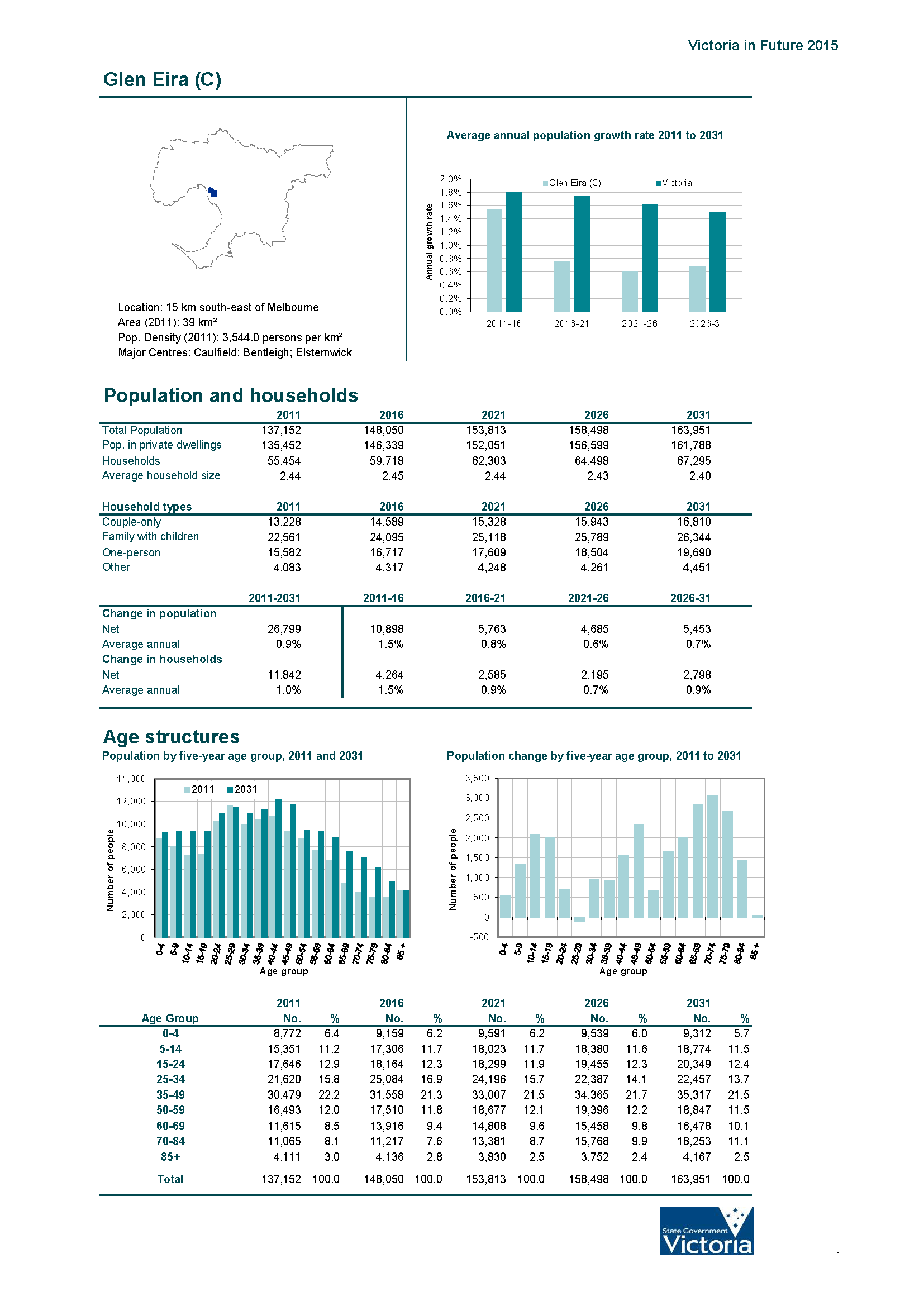
Gillon et al also claim that ‘couples without children’ and ‘lone households’ represent 68% of the required 7500 new dwellings. Not so! The Victoria in Future figures which they rely upon (see below) forecast that there will be 16,810 ‘couple only’ households, and 19,690 ‘one-person’ households in 2031. That makes a grand total of 36,500 households. The overall projection for 2031 is 67,295 households. Hence, the percentage is not 68% as claimed, but rather 54.23% on these figures.

We make these points not because we want to indulge in nit-picking, but when information is put before residents so that they can have an ‘informed’ say, then it is incumbent on the distributors of that information to ensure that it is accurate, honest, and not designed to obfuscate at best and mislead at worst.

Glen-Eira_VIF2015_One_Page_Profile-1


Some background on this suburb is necessary. Glen Huntly is the second smallest suburb in the municipality coming in at 0.89 square km. Only Gardenvale is smaller at 0.25 sq km.

The planning history of Glen Huntly and how council has handled this area is abysmal. According to the State Government this is designated as a Major Activity Centre. Council regards it as a ‘neighbourhood centre’. Thus, when applications have gone into VCAT, the judgements have always been that State legislation over-rides council views and thus the developer has been granted his permits for far more intense development. What makes this situation even worse is that the State Government granted Council $45,000 to undertake the necessary work to produce a structure plan. Council returned that money and refused to implement any structure planning or anything else that could mitigate the ongoing development in Glen Huntly. So Glen Huntly is now stuck in the ‘never-never land’ of being technically a Major Activity Centre, with no Urban Design Frameworks, no parking precinct plans and no real vision as to the future of this suburb and its shopping strip. Retailers have time and again lobbied for improvements – to little avail. But development continues unimpeded – thanks to the zones.

What is even more questionable is the way the zones have been applied. The breakdown is:

31% of this suburb is zoned as GRZ1 and GRZ2 – ie available for 3 storey development

5.39% of the suburb is zoned Commercial 1 – no height limits

0.72% is zoned – Mixed Use Development (MUZ) – no height limits

Add in the Road Zone Category which also welcomes 3 storeys along major roads and close to half of Glen Huntly is ripe for the picking and far greater development. Glen Huntly does admittedly already have large numbers of units. These are products of the 50’s and onwards and will be demolished and new ones built of far greater density and even height.

Yes, there is plenty of public transport, and an incredibly busy rail crossing. But without proper planning that actually addresses the social, environmental and economic aspects of growth, Glen Huntly will continue along the path of unsustainable development.

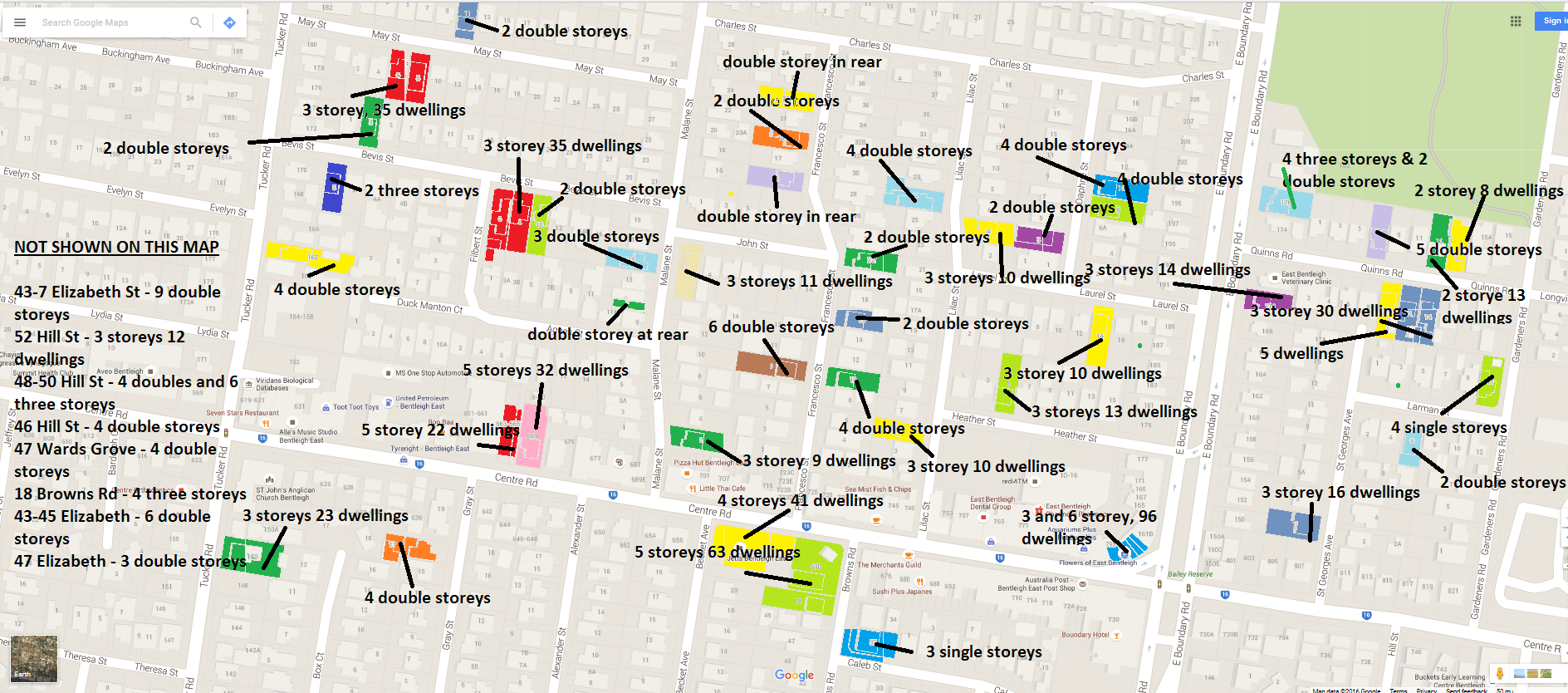
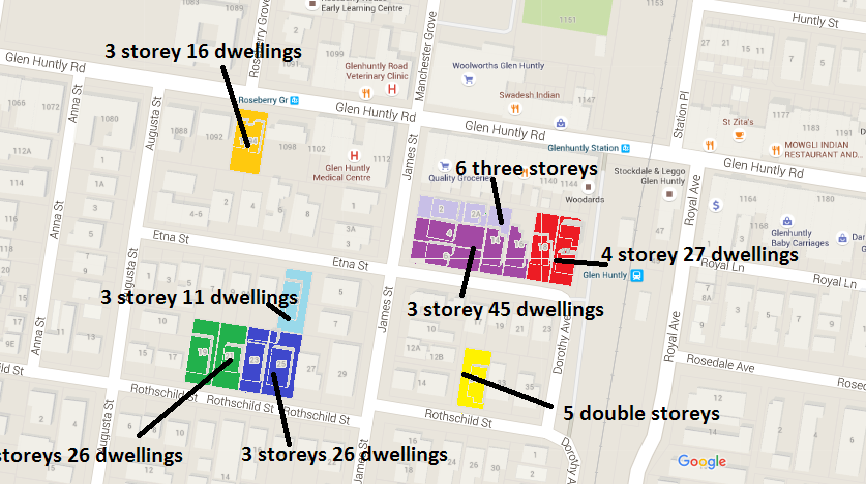
One perfect example of this in just one small area, is shown below. These are applications that have been decided since the zones and most have been granted permits. Those ‘refused’ by council will undoubtedly end up at VCAT.

gh

PS: here is an example of the point we made above – http://www.conquestea.com.au/news/2014/5/8-glen-huntly-block-sold-on-48pc-yield

UntitledCLICK TO ENLARGE

Why on earth does council even bother to put in submissions to state government reviews when they are invariably of such poor quality? Most are a few pages of self congratulation with a total lack of analysis, detail, and real contribution to the debate. And lest we forget, without endorsement via a council resolution and made public only ‘after the fact’. Frankly, council ought to be highly embarrassed in comparison to what other councils are capable of producing.

The latest effort concerns the State Government’s Plan Melbourne Refresh – a very, very important document that will have a major impact on strategic planning for Melbourne for the next 30 years. There is much in this document that should concern residents:

  • The ‘suggestion’ that middle ring suburbs should contain a 70/30 split of future housing growth
  • Notions of a 20 minute neighbourhood centre
  • Environmental sustainability
  • Changes to planning legislation, and much, much more.

So what is Glen Eira’s response to all these vital issues? Readers should note what our council, unlike countless others, fails to even mention –development contribution levies, tree protection on private and public land. We’ve uploaded the full submission HERE. Below are a few extracts and then a comparison with the views of other councils.

This is a very, very long post, but we urge readers to carefully consider the views presented below.

ON HOUSING AND THE 70/30 SPLIT

The Glen Eira Council view – It is proposed to accommodate the majority of new housing in Melbourne’s established areas, rather than in the growth areas. Glen Eira adequately accommodates population growth through its longstanding housing policies and suite of residential zones. These serve to co-locate higher densities of housing with public transport. A balance has been achieved in maintaining low scale residential areas and channelling housing into locations that can best support change. We have obtained government approval for maximum heights over all residentially zoned land where there were no limits before. Any move through Plan Melbourne 2016 to dilute the protection that Glen Eira has over its residentially zoned land will not be supported.

COMMENT

There is much in the above paragraph that needs to be challenged. For example:

  • How many residents would concur with council’s interpretation of ‘adequately accommodates population growth’ when all the complaints are about traffic mayhem, lack of public open space, lack of well designed buildings, and lack of infrastructure support.
  • What exactly does ‘higher density’ mean when neighbourhood centres such as McKinnon, Ormond, Murrumbeena, and East Bentleigh have the highest proportion of GRZ in their suburbs. Further, if public transport is the ‘key’ to locating ‘higher density’ then East Bentleigh certainly does not fit into this category.
  • What exactly does ‘locations that can best support change’ mean when council has not lifted a finger to introduce any parking precinct plans, urban design frameworks, etc. And how can certain ‘locations’ ‘support change’ when there is absolutely no preferred character statements in the planning scheme for any of the housing diversity areas?
  • Another major furphy is the claim that ‘maximum heights’ are the be all and end all of good strategic planning. And of course there is also the blatant unfounded mantra that ‘all residentially zoned’ land in Glen Eira is now better off. No mention of course of Mixed Use Zones which give a lie to the claim that all residentially zoned land now has height limits.

Thankfully other councils have taken the trouble to analyse and provide some data to support their assertions. They also oppose the introduction of the 70/30 split but at least their arguments have far greater validity, or raise concerns that are never mentioned by Glen Eira – ie neighbourhood character, heritage, employment, etc. Some examples:

BOROONDARA – Council is particularly concerned with the point around ‘low suburban density’ and “to encourage high urban densities and foster more diversity and choice in the housing sector, in closer proximity to public transport and jobs.” Many areas in Boroondara which adjoin public transport corridors consist of high quality residential streets which should be protected from intensive development, particularly apartment buildings. This includes some areas in the vicinity of train stations.

, accommodating the majority of new dwellings in established areas within walking distance of the public transport network can lead to a loss of trees and canopy cover in those areas. Therefore, any regulatory framework needs to take account of the local context and competing objectives and allow a level of discretion in managing these requirements. Further, Council questions the notion of protecting environmental and liveability assets on the urban fringe at the expense of another area’s environmental assets. This includes protecting valued tree canopy cover that reduces urban heat island effect and other valued aspects of Boroondara’s liveability.

The proposed housing target ignores the expectations which Boroondara has around the quality of new development. Importantly though, it makes broad based assumptions around the capacity of existing infrastructure in established areas such as Boroondara to support such intensification. In many instances, local development and social infrastructure already operates at or above capacity. Further, increasing development within these areas will only exacerbate the situation. Established area councils therefore require better infrastructure funding mechanisms to meet  increasing demand and renewal of infrastructure assets.

Council also refutes the claim being made in the Discussion Paper that Melbourne’s middle ring suburbs are accommodating a steadily increasing share of Melbourne’s housing growth – from 25% of building approvals in 2002 to 40% in 2014. This is on the basis of Footnote 6 in the Discussion Paper which states “This is an indicative measure of change in middle suburbs as building approvals include knock down and rebuild developments and therefore not necessarily net additional dwellings.

While knock down rebuilds distort the data, overall, new supply has increased in middle suburbs.” In other words, the Discussion Paper cannot readily point to any data which suggests that new dwelling supply in the middle suburbs has increased to a level which can justify a 70/30 target or sub-regional or municipal wide housing targets more generally. Further, the Discussion Paper notes that Melbourne 2030 aspired to a (roughly) 70/30 housing target, but (at best) Melbourne is being planned on the basis of 61% of new dwellings being located in established areas to 2051 under Victoria in Future 2015……Council does not believe the MAC or the Minister for Planning has strategically justified the imposition of a 70/30 housing target.


MONASH

The issues with existing infrastructure and service levels within the established suburbs of Melbourne is significant and is the major impediment to achieving the 70/30 split and ensuring the Melbourne continues to be a liveable and functional city. If the strategy is to encourage increased density within established suburbs (including parts of Monash), the need to upgrade and provide additional physical and community infrastructure needs to be given a much higher priority and be more clearly acknowledged and planned for in Plan Melbourne.

The Refresh paper identifies ‘low suburban density’ as a problem that needs to be addressed. However, it does not explain why this is a problem. In stating that this ‘problem’ will be overcome, it does not explain whether it still proposes to enable the retention of existing elements of suburban development that many within the community value – such as key elements of the existing neighbourhood character – and how the aspiration to increase the density rather than continue to expand the urban growth boundary will work with the ‘green our city’ elements of the Plan Melbourne strategy.

The Refresh Paper criticises the current aspiration in Plan Melbourne for 50% of metropolitan Melbourne being within the Neighbourhood Residential Zone because ‘applying a zone according to a percentage is an unconventional approach’., however it appears to be taking a similar approach to setting a 70/30 split for new development. Further justification should be provided to support this proposed split, which, if achieved, will lead to a significant change throughout suburban Melbourne. It is not appropriate, for instance to completely remove from any decisions around housing scale, consideration of the character of the area (built or natural / landscape character.

WHITEHORSE

Transport infrastructure has the potential to shape the built form and land use activities of our city. Many investment decisions are made based on the proximity to transport infrastructure regardless of whether it is included in a metropolitan or local planning strategy. However, simply being adjacent to a bus route should not automatically mean that development intensity can be increased. For example, the bus service may be infrequent, or there may be a sensitive environmental or neighbourhood character area nearby that warrants protection. One option is to rank bus or transport routes by frequency and quality before allowing more intensive development across the board. Council notes that it considered this sort of information when it introduced the new residential zones suite into its planning scheme, with this information balanced against environmental and neighbourhood character considerations.

Council would also like to emphasise the importance of integrating planning and building systems and a recommendation along these lines could be included in Plan Melbourne 2016 here. For example, single dwellings on a lot over 300 square metres in most instances do not require planning permission, which often results in a dwelling which is out of character with the surrounding neighbourhood. By being in the building system, Council cannot control the built form outcome on these sites. More consideration to neighbourhood character in the building system, or alternatively, consideration of single dwellings in the planning system, is needed.

MORELAND

Council does not consider increased density should occur at the expense of adversely affecting valued urban character by excessive building height, allowing sub-standard accommodation (as is occurring with some apartment developments) and on the assumption that there is adequate infrastructure in established areas to accommodate increased growth in established areas.

COMMENT

What stands out clearly from the above quotes is that Glen Eira continues with its myth about the new zones being in the ‘right locations’. Every other council comments on the fact that being close to a transport node is not necessarily the best or sole criterion for increased density – especially not if it means the destruction of heritage, neighbourhood character, and environment. But in Glen Eira we have heritage overlays smack in the middle of Residential Growth Zones because they are allegedly ‘close’ to railway stations; we have street after street of beautiful Californian bungalows and Edwardian cottages gone – ie Bent St., Bentleigh and Elliott St., Carnegie, plus countless others. And of course we have moonscaping that is allowed to go on unabated. And even with this unprecedented growth in Glen Eira, there is no attempt to re-introduce development contributions levies or a decent open space levy.
PS: It hasn’t taken the developer long to resubmit another application for Claire St., McKinnon. It is still 3 storey, and instead of 36 dwellings, the application is now for 33 dwellings. Yes, the VCAT decision certainly stymied the development, didn’t it? So much for Magee’s  faith in council’s planning scheme and its non-existent neighbourhood character statements for housing diversity areas.


  1. We are promoting additional transport options including more and better train, tram and bus services; car sharing, cycling and walking

Oh yes, Glen Eira is definitely transport conscious! That’s why the funding for bicycle paths has been cut despite budget promises. That’s why car sharing was put off and councillors never even told that a proposal had been submitted to officers years ago. When a report finally made it to council the decision was (typically) to delay for another year. The next year a tiny number of spots was set up. And how much credence do we give to council’s ‘promotion’ and ‘advocacy’ power, when they can’t even get a bus to run past East Boundary Road? Then there’s the fabulous Road Safety Strategy which lapsed in 2008 and hasn’t been updated, or newly ratified.

  1. We fine builders if they breach safety requirements on building sites

We challenge any reader to find one single vcat decision where council has sought an order against any builder for ‘safety’ breaches. There aren’t any. As for fines – well we’ve featured countless photos of unsafe and illegal works (for pedestrians) alongside development sites. How many of these have been fined – despite the fact that the offences occur day after day!

  1. We are advocating for all development costs to be paid for by developments and not fall on existing ratepayers.

Really? So is this the reason that Esakoff moved a motion at the last MAV state conference that basically asked for ‘all development costs’ – BUT ONLY FROM COMMERCIAL DEVELOPMENTS?!!!!!! Forget the fact that this was never endorsed by any formal vote much less discussed in council chamber with supporting reasoning. Commercial development almost pales into insignificance when compared to the developments occurring in GRZ and RGZ and now MUZ. Why these developments ARE NOT targeted is the $64 question?

The best of course is last –

  1. We are providing additional public open space and have imposed the highest Open Space Levy on multi-unit developments of any suburban council (estimated $5 million per annum)

Some very neat phrasing here which is technically not only untrue, but deliberately misleading. Glen Eira has NOT imposed the ‘highest’ levy on multi-unit developments. Plenty of other councils have much higher levies directed towards their activity centres, and suburbs where development is likely to occur at an intense rate. The perfect example of this is Stonnington which has the second lowest amount of public open space. In their proposed amendment they sought an 8% levy across the board in contrast to Glen Eira which has the least amount of public open space and only sought 5.7%. Admittedly Stonnington were not successful in getting their 8% for the entire municipality. However, they did achieve an 8% levy from developers in 4 suburbs, including Prahran and South Yarra. Achieving 8% from these 4 suburbs (given the size of these areas)plus the 5% from the rest of the municipality means that Stonnington is well ahead of anything that Glen Eira can achieve. Their Annual Report cites an INCREASE of $4.65 million in open space levies and this amount does not take into account the full year’s impact of the 8% in the four suburbs.

Nor is Stonnington alone. Moreland for example has had in place for years now the following levies for developments in their various suburbs –

Brunswick – 6.3%

Coburg – 6.8%

Faulkner – 5.7%

Glenroy – 6.5%

Then there’s Dandenong with 20% for this stated area – – Any residential or commercial subdivision in the area bounded by Springvale Road to the west, Cheltenham Road, Dingley Freeway Reservation, Dandenong Southern Bypass to the north, EastLink to the east and Hutton/Greens Roads to the south.

Further, whereas countless other councils included in their amendments the clause that for certain ‘significant’ sites , the levy payable be higher than the levy for other areas, Glen Eira council was quite prepared to accept the obscene figures of 4 and 5% for the 2000+ development of Caulfield Village. They were even prepared to accept the ‘normal’ rate for the Virginia Estate with its proposed 4,600+ dwellings of 5.7%.

Readers should also remember that at the 11th hour, council reneged on its two previous resolutions that all monies collected from open space levies would be used to PURCHASE ADDITIONAL OPEN SPACE. Instead, revenue is now basically ploughed into more of the same – mega palaces (ie pavilions) and car parks within parks that constitute ‘open space’. The only purchases of land in the past 12 years have been two properties in Packer Park and now one in Magnolia Road that could have been bought years ago for a much cheaper price given that there’s been the on-off-on farce with the public acquisition overlay. An appalling record for a council that has known for decades that open space is a priority for residents.

We estimate that with the population increase, open space in Glen Eira per resident will DECREASE if this current policy continues. This in fact has been admitted by the Open Space Strategy itself. So what is council doing about this? Bugger all in our view. Spending millions on ‘redevelopment’ is not the answer to the continued growing lack of public open space.

  1. While the boom is being driven across Melbourne by external factors, Council is acting to limit heights and contain development to strip shopping centres and public transport routes

More deceptive phrasing we suggest. Most people would interpret ‘strip shopping centres’ as meaning the actual ‘strip’ itself and not residential land that is some 800 metres from the street. The use of present tense is also a concern. If council is ‘acting to limit heights’ then apart from 2 amendments for MUZ there is no evidence to suggest that council is doing anything to change the zoning. Council ‘acted’ in 2013. They are now totally ‘inactive’ except to refuse application after application and blame VCAT for everything.

Finally, the fact that such a piece of shonky, deceptive and deliberately misleading (mis)information could have gone out to residents without councilors’ knowledge says much about governance in Glen Eira and the kind of leadership that has been at the helm for far too long.

There has never been such a set of agenda papers as released today, which reveal in full glorious detail everything that is awry in Glen Eira. We will go through each item and pinpoint the atrocities –

Item 9.1 – 68 Kangaroo Rd Murrumbeena.

Application to extend physiotherapy centre from 2 to 5 staff; extend hours, extend car parking. Recommendation – permit be granted with reduced hours.

There were plenty of local objectors to this application and one pro-forma letter supporting application. All well and good. What is not acceptable though is the following –

Under the ‘applicant category’ we get – Susan Ross (formerly) Foresite Planning & Bushfire Consultants (currently). Exactly what does ‘formerly’ mean, or even allude to? Or is this simply council trying to camouflage the fact that Susan Ross was once upon a time employed as a council planner and that the property just happens to be owned by Jacquie Brasher’s (a current employee and strategic planner) husband? We might also query how ‘ethical’ it is for Ms Brasher, whilst still employed by council, to write to objectors?

Item 9.4 – ‘apartment boom’.

This is the ENTIRE REPORT – ‘ANONYMOUS’ reigns supreme again!

Purpose

Council has distributed the attached Circular to all properties in the municipality.

It is self-explanatory.

  1. Recommendation

That the report be noted.

Now wouldn’t an apology for all the bullshit and lies be appropriate here? Wouldn’t it be nice to know exactly how much of ratepayer money was wasted on this fiasco?

Item 9.6 – Transport strategy – draft action plan 2015-1017.

This is the most amazing document of all time. Before we highlight the inanities, it needs to be pointed out that –

  • all references to council’s ‘Road Safety Strategy’ are a misnomer. There is NO CURRENT STRATEGY – IT EXPIRED IN 2012 AND HAS NOT BEEN UPDATED!
  • The action plan is supposed to be from 2015-2017. Yet, some of the proposed actions extend into 2018!!!!!! and even then nothing will happen because only the ‘report’ is supposed to be available.

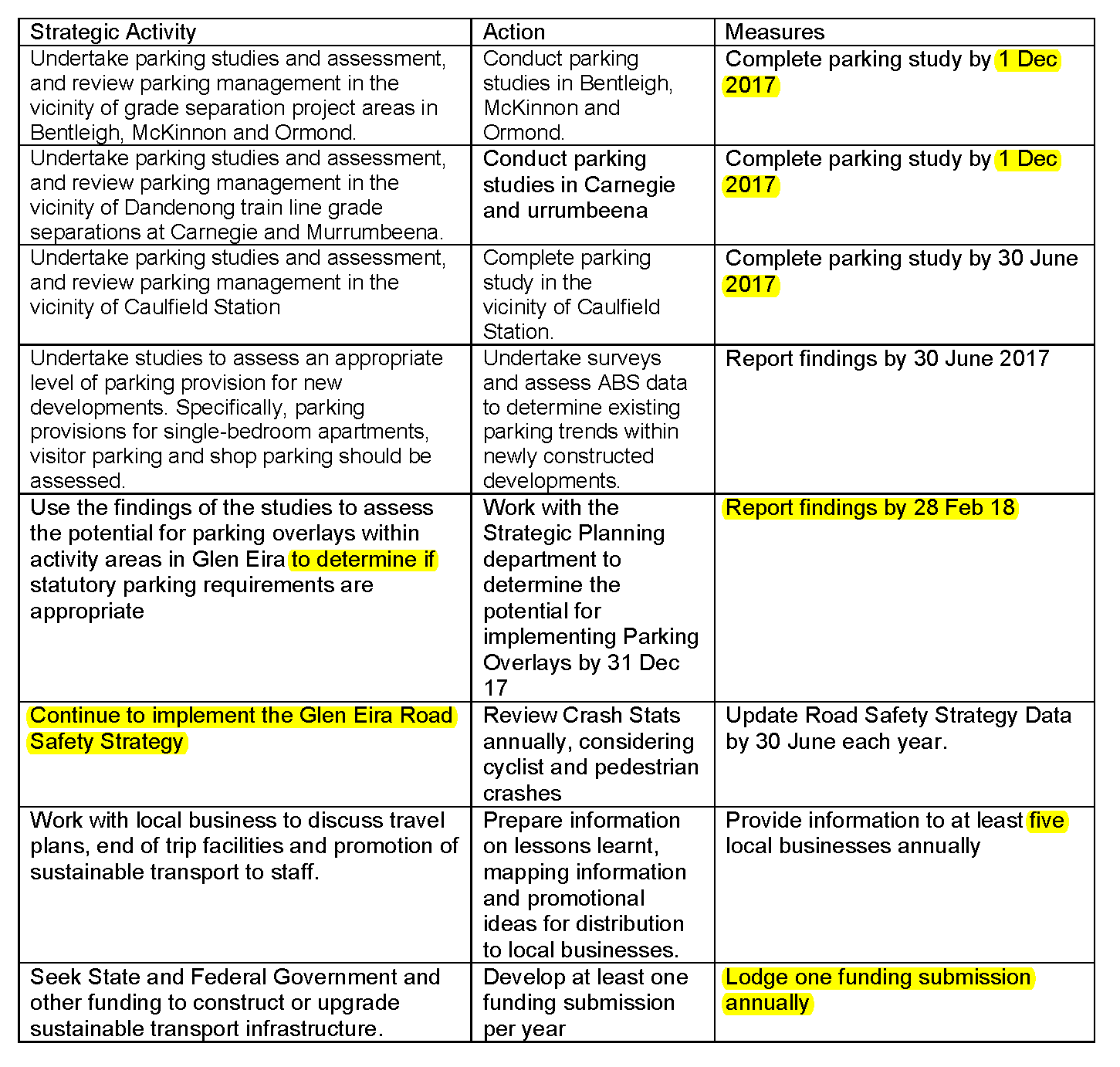
Here are some of the ‘actions’ listed. Please note that the vast majority (which we didn’t include) involve ‘advocacy’ and even this is proposed to take years to figure out what to do! Utterly amazing! It is also stunning that it will take years to do a traffic analysis! In short, great on empty, meaningless promises and very, very short on real action!

Strategic Activit1

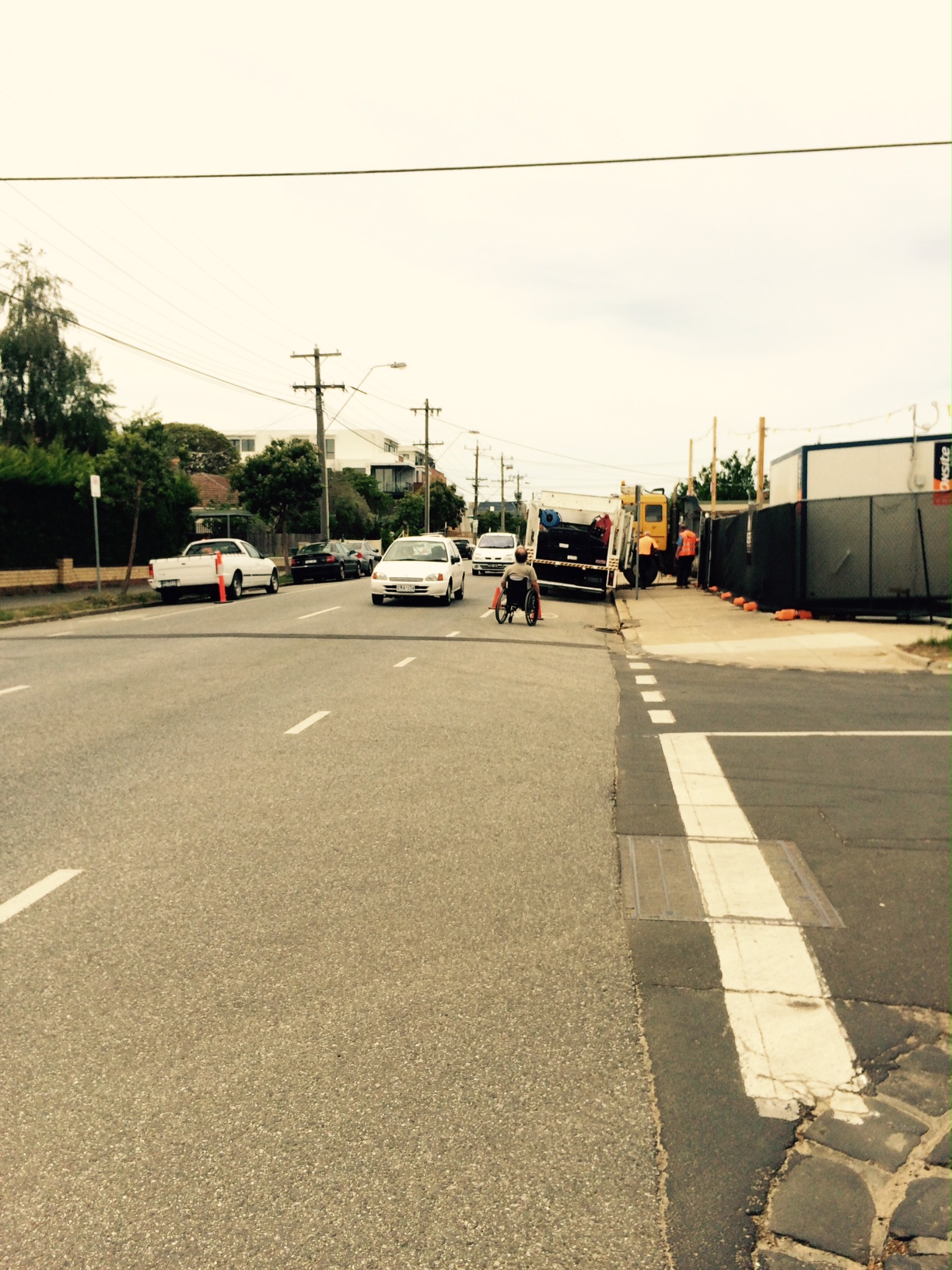
And by sheer coincidence we received the following photographs this morning from two alert residents in Carnegie. Doesn’t this say it all about council’s ‘road safety’ enforcement and how it clamps down on developers?

cr Neerim FullSizeRender

« Previous PageNext Page »