GE Transport


Residents have their chance to address council on the budget this Tuesday night. 17 submissions have been sent in – a huge increase. The comments (highlights presented below) range from unacceptable charges and rate increases, poor policy documents, that are so out of date they belong in a museum, and lack of real consultation with residents.

Before presenting these ‘highlights’, we draw readers’ attention the most ridiculous set of tenders ever entertained by this council. When councils all over Victoria are being urged to tighten their belts and be accountable for the expenditure of ratepayers’ hard earned dollars, Glen Eira council is its wisdom is about to spend a million dollars on unnecessary ‘trifles’. It appears that for this council the major priority is to promote itself rather than address the needs of residents. Here are the details of the proposed tenders –

  • Mystery shopping program for GESAC – $40,000
  • Point of Sale system for Glen Eira Sports and Aquatic Centre – $150,000
  • The supply of promotional items for sale/giveaway from Glen Eira City Council – $400,000
  • And $390,000 to plant a few trees and grass in the Carnegie forecourt! (mind you, no ADDITIONAL open space, just the usual expensive tinkering – which begs the question why the first design was ever countenanced).

This expenditure should be read in the light of resident comments below –

Deliberate, repeated deception and secrecy in governance and cover up continuing

I note that Glen Eira’s half-page Street Lighting policy dates from 2002 and as such is completely out of date. I suggest that this policy be comprehensively revised with the inclusion of the environmental and health impacts of light at night before such a program (ie LED) is contemplated.

…this year’s planned increase in rates of approximately 4.94 per cent, which is almost four times the current inflation rate, is completely unnecessary and unacceptable. (Please note: this resident has obviously been duped by the manner in which council has publicised its rate increase. The increase is 6.5% and NOT 4.94%!)…During March of this year, most of the kerbing, footpath and landscaping at this location, has been reworked at considerable expense to the Ratepayers of the City. In my opinion, the works appear to have only completed superficial changes, which I regard as unnecessary. Furthermore, it is unconscionable that the developer of this site is able to reap the profits, when the roadworks surrounding this property development have been required to be reworked as a direct cost to Glen Eira Ratepayers. ….it appears that the Council decision makers are intending to apply different principles because their accountability is obscure, and Ratepayers do not generally feel that the outcome of the objection process is likely to be worthy.

I consider the $450,000 allocated towards the construction of the Eskdale Road/Fitzgibbon Crescent Caulfield North new open space to be an unnecessary and terribly wasteful expense. The proposed new open space is small and is unwarranted as it is located within easy walking distance of Caulfield Park and therefore is unlikely to be used by many residents.

Supply of places (childcare) may exceed demand due to council charging too high fees for the service the centres provide. Whilst I am very conscious of the quality of care and the homely environment provided for children at the centre my child attends (which was a primary factor in choosing this centre), it is my understanding that other centres in Glen Eira provide nappies and even cooked meals. Parents have to provide these at the conoucil-run centre in Carnegie. Other centres also provide excursions…..It is actually my understanding that kinder places are funded by the State or Federal Government (which makes the cost significantly lower for parent who have the flexibility to put their child into a straight-up kinder program) and that the City of Glen Eira is not passing that funding on to parents through reduced fees for children in the Kinder-year.

Currently, there is no allocation in the budget to redress the steady erosion of resources and facilities for passive usage of Caulfield Park….Since the Conservatory has been removed, there is no shelter in the western end. This means that young and old have neighter shelter from the scorching heat of the summer sun, nor from biting winter wind and rain.

I appreciate that there are many opportunities for community input and consultation to Council deliberations generally, however feel that one area in which these opportunities are lacking, is in relation to the Children’s Centre. As far as I am aware, formal parent involvement in the governance of the centres is limited to an annual online survey, the results of which are not communicated. Input from the parents and the community has the potential to have direct impact on the bottom line, through suggestions that have cost savings, or revenue enhancement, implications.

As I can see the tennis courts are regulary used (ie at Carnegie pool) and appear to be in very good condition, why is $130,000 being spent to change them? Has there been any community consultation, and what is the reason for the change? (ie to convert to small sided soccer pitch)

The Draft Community Plan – Transport – page 28 proposes to improve pedestrian and bicycle facilities but “only where balanced against maintaining traffic flows”. Is the council really wanting “more traffic faster” as the overriding objection of transport planning in Glen Eira? The priority for more faster traffic reads like a strategy from the 1960’s for freeways and not a way to create a livable local community with good sustainable transport choices. Instead the plan and councils transport planning programs and works should firstly prioritise pedestrians, then bikes, then public transport and lastly cars – as is current transport planning best practice…..The Walking Plan is mentioned in the transport section but is missing from the list of all strategies on page 42 – is that an oversight or a statement of priority?….The proposed investment of $150,000 would be insufficient to build more than 1 set of traffic lights on the Rosstown Rail Trail – let alone the many that are required. Does carrying over funds from last year also indicate poor action on implementation and a need to review how the plan is managed?

How can $50,000 be allocated to Thomas Street Reserve, McKinnon? Surely, four large old trees surrounded by bark and drought affected grass, on a double housing block, doesn’t constitute a ‘Reserve’….Only two seats are provided at bus stops between Thomas Stret and Wheatley Road North side and no seats on the South side. Elderly people sitting on fences and students sitting on the kerb, waiting for the bus, is demeaning.
Second reading

MrWYNNE (Minister for Planning)—I move:

That this bill be now read a second time.

Speech as follows incorporated into Hansard under sessional orders:

Victoria’s planning system encourages community participation in decision-making. This is especially true of the planning permit process. The community enjoys broad rights in the permit process to consider and object to proposals and to seek review of decisions through the Victorian Civil and Administrative Tribunal (VCAT).

Community participation has many benefits. It improves the decision-making process and often leads to better planning results. Objections can provide important insights into the potential effects of a proposal, not just on those who live or work nearby but also on the wider community. In the right circumstances, the number of objectors to a proposal can also provide such insights.

This bill amends the Planning and Environment Act 1987 to ensure the extent of community objection to planning proposals is considered. It does this by requiring the two key decision-makers in the permit process—responsible authorities and VCAT—to have regard, where appropriate, to the number of objectors when considering whether a proposal may have a significant social effect.

This new requirement must be considered before a decision or determination is made, together with other matters that must be considered under the Planning and Environment Act 1987, such as the objectives of the act, the planning scheme, and any significant economic and environmental effects that the proposal may have.

The bill amends two key provisions in the Planning and Environment Act 1987: sections 60 and 84B. Section 60(1) sets out matters a responsible authority must consider before deciding on a permit application. Section 84B sets out an equivalent set of matters that VCAT must consider. The bill inserts the new requirement in both sections to promote consistent decision-making.

Decision-makers must already consider whether a use or development may have a significant social effect. Social effects are not defined in the act but may include matters such as:

  • services.
  • access to social and community facilities.
  • choice in housing, shopping, recreational and leisure services.
  • community safety and amenity.
  • the needs of particular groups in the community, such as the aged.

This bill makes it clear that the number of objectors may be a relevant fact that ought to be considered in this assessment.

Whether it is appropriate for the number of objectors to be taken into account in a particular case is a matter for the decision-maker. In making a decision about whether to take into account the number of objectors, the decision-maker may be influenced by:

  • what the objectors have said in their written objection about the proposed use or development.
  • whether the issues raised in the objections are relevant planning considerations and relate to the reasons why the proposal requires a permit.
  • whether the issues raised in the objections point to a significant social effect on the community which is supported by evidence.

It will be for the responsible authority and VCAT to determine this based on the particular circumstances of the case.

The number of objectors alone will not establish that there is a significant social effect. However, the number of objectors may be indicative of the scale of a social effect on the community, the presence of a specific social need in the community that may be affected, or the social significance of a site to the community

The new requirement is likely to be particularly relevant where a proposal may reduce access to or enjoyment of community facilities or services or adversely affect public health and safety. The number of objectors, and the consistency of views expressed by objectors, may demonstrate that the community or a section of the community may be significantly affected.

This bill does not seek to reduce the weight given to the views of a single objector or a small number of objectors. It also does not seek to promote the consideration of irrelevant matters in decision-making. As is the case now, an objector will need to put their concerns in writing and state how they would be affected by the grant of a permit. The relevance of the issues raised will continue to be an overriding consideration in the assessment of all objections. It is the intention of the bill that decision-makers will ensure that the objections are a genuine reflection of an anticipated significant social effect that is supported by evidence, rather than simply the views of a number of objectors.

I commend the bill to the house.

Debate adjourned on motion of Mr PESUTTO (Hawthorn).

+++++++++

Bentleigh electorate

Mr STAIKOS (Bentleigh)—(Question 259) My question is to the Minister for Planning. I ask the minister if he will visit Bentleigh to explain the changes the government is making to the Victorian Civil and Administrative Tribunal (VCAT). For two years Glen Eira City Council has been implementing Matthew Guy’s residential zones, which have seen Californian bungalows in quiet residential streets make way for four-storey apartment buildings.

Councillors often oppose these individual applications and send them off to VCAT. The Planning and Environment Amendment (Recognising Objectors) Bill 2015 means VCAT can now recognise the social impacts a future development may have. Previously VCAT had no mechanism to recognise community concerns about development proposals. This change means the community’s voice will be given consideration in VCAT decisions. The government will also review the former Minister for Planning’s residential zones later this year. I ask the minister to visit my electorate and meet with interested local residents about these issues.

+++++++++

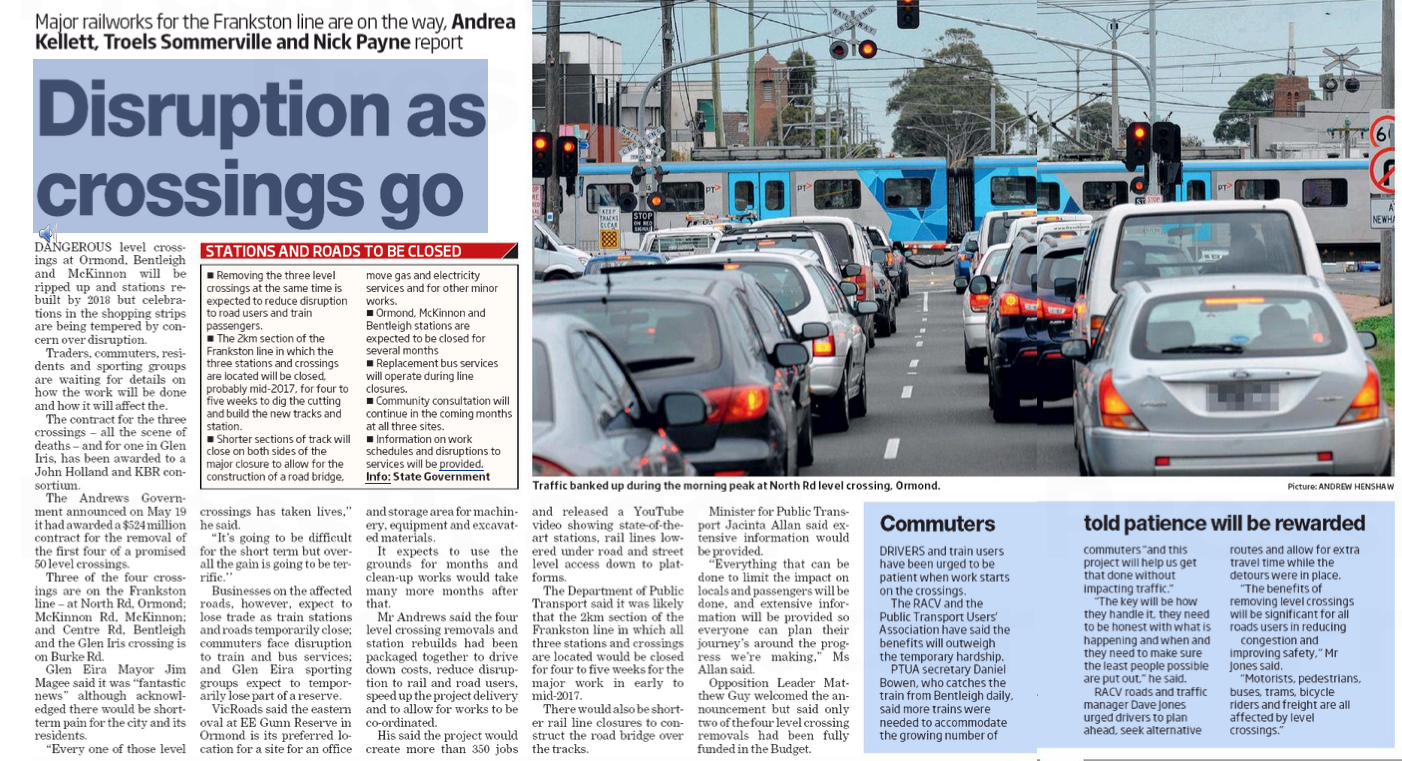
Bentleigh level crossing

Ms CROZIER (Southern Metropolitan)—While the announcement by Premier Andrews to remove the Centre Road, Bentleigh, level crossing is welcomed, it will be a hollow promise until proper funding has been allocated. While the Premier may have promised to remove the Centre Road crossing, the $2.5 billion allocated to crossing removals does not exist, as it is dependent upon the sale of the port of Melbourne.

This morning we heard the government making more announcements about the removal of level crossings on the Cranbourne-Pakenham line, with vague dates and what appears to be a rushed and panicked process so that it can meet its election promise of removing 50 level crossings. But questions remain about how this will be paid for and how the disruption it will cause will be managed. In Bentleigh the public is still unaware of when construction on the Centre Road level crossing will begin, how long construction will take and what impact the construction work will have.

The success of the traders on Centre Road is contingent on traffic flows and the availability of parking, yet there have been no community forums to discuss these issues. Premier Daniel Andrews has not released a credible plan to minimise interruptions caused by the crossing removal. Questions such as whether the car park adjacent to the station will be closed during the construction phase and what transport arrangements will be in place once the line is closed need to be answered. The people of Bentleigh deserve better than this, and all Victorians need to understand how these level crossings will be paid for. The budget papers clearly state that all capital funding for level crossing removals beyond 1 July 2015 is to be confirmed and highlight that the only level crossings which have been actually funded are those that were funded by the coalition.

letter

crossingsCLICK TO ENLARGE!

Council’s Community Plan asserts that in order to meet population demand the city will have to provide for roughly 9,700 new dwellings in the period between 2011 and 2031. Victoria in Future 2014 predicts a higher figure – approximately 9,800. At the rate we’re going, and even if we assume a forecast figure of 10,000, this target will be reached within another 18 or so months. That is 15 years ahead of schedule! Plus, it does not even take into account what will be the final figures for the Caulfield Village!

Data from Planning Permit Victoria reveals the following numbers for ‘net new dwellings’ from 2011/12 onwards. Please take careful note!

2011/12 – 1280 dwellings

2012/13 – 934 dwellings

2013/14 – 1716 dwellings (council’s published data)

For the period from July to December 2014, another 1519 new dwellings were on the horizon according to Planning Permit Victoria. This makes it a grand total of 5449 in three and a half years. If the current rate of development continues, then the target of 10, 000 will be reached by the end of 2017 – even earlier once all the 2046 dwellings at the racecourse have been given the rubber stamp by our very accommodating administration and councillors.

So exactly what is council doing about this predicted future? What initiatives have they introduced, or even thinking about, that will ensure that such a rate of development is sustainable and doesn’t completely destroy the fabric and lifestyle of existing and future residents?

There are countless questions that should be raised and must be answered. For example:

  • What is ‘saturation’ point? When will it be acknowledged that the city is fast approaching breaking point and that no further development is possible unless major environmental, social, and economic safeguards are implemented?
  • How many speed humps in quiet residential streets have to happen, and at what cost, before proper Parking Precinct Plans in all activity centres are introduced and the waiving of car parking requirements ceases?
  • How well is the drainage infrastructure coping and how well will it cope with another 10,000 dwellings?
  • How many double levels of underground car parking will council allow before the water table becomes a real problem? How many of these have resulted in structural problems for the development and/or their neighbours?
  • What happens post 10,000 new dwellings? How many more are feasible?
  • How much will it cost to ensure that infrastructure is adequate?
  • How much should developers contribute to this new infrastructure or is it council’s intention to keep subsidising development and keep raising rates?
  • How much will open space provision decline per person as a result of population increase? Apart from the Booran Road Reservoir, what is council’s long term acquisition plan? Does one even exist, or are we to have more and more pavilions, car parks, and removal of trees and pretend that this is fulfilling our open space needs?
  • Will councillors have the temerity to demand amendments that actually do something to alleviate congestion, shoddy building design, environmental sustainability, or are they as impotent as they appear?
  • When will common sense prevail and council gets off its backside and starts proper strategic planning and consulting with residents as to the future of this municipality? And when oh when will the archaic, inept, and totally out of date planning scheme be reviewed in a proper consultative fashion with residents?
  • And last, but certainly by no means least, when will standards that mean something be introduced and adhered to by this planning department and councillors?

PS: readers may be interested in the following application. Interestingly the developer has bought up surrounding GRZ properties and is now contemplating having 3 storeys alongside 7 storeys on East Boundary Road, which is already a disaster given recent applications and, of course, GESAC. We suggest that residents attempt a left hand turn from Centre Road into East Boundary Road to see for themselves the traffic conditions in this area. And East Bentleigh isn’t even a major activity centre! It merely is a de facto one!

795-807 Centre Road and 150 East Boundary Road BENTLEIGH EAST VIC 3165 – Construction of a part three (3) and part seven (7) storey building comprising 110 dwellings and 4 shops, use of the land for dwellings, reduction of statutory car parking requirements, waiver of loading bay requirements and alteration of access to a Road Zone Category 1

Parking is without doubt a central concern for Glen Eira residents. Council’s ‘solution’ has been to either waive parking requirements (especially for commercial uses) or refuse residential parking permits forcing car owners to park their vehicles in surrounding local streets.

Despite the Planning Scheme stating that Parking Precinct Plans will be devised, and that Public Acquisition Overlays will be introduced to provide public parking Council has done absolutely nothing on these matters. They have not purchased land and converted this into public car parks – rather they have ceded space in Centre Road in exchange for a yet to be built public toilet! Nor has council done anything in terms of introducing Parking Overlays that really address the issues.

Glen Eira has basically two Parking Overlays within its planning scheme:

  • One for the Caulfield Village Development, and
  • One for student housing in several areas throughout the municipality

We note that the Caulfield Village overlay has no visitor carparking in its mandate and the student housing overlays stick to the minimum allowable.

WHAT CAN BE DONE

At last council meeting Hyams claimed that Council is powerless to change ResCode parking standards. Not so! Council has the power to introduce schedules to any Parking Overlay that outstrips ResCode. (Clause 56.02-5). This would operate in the same manner as schedules to the residential zones. Basically, councils have been given the right to determine what parking provisions go where in their municipalities. Glen Eira has chosen to do bugger all in stark contrast to what countless other councils have achieved.

What is even more galling is that under the legislation councils can also exact a monetary payment from developers for any car parking space that council decides to waive. Glen Eira does not have such a clause in its existing overlays. Here is what some other councils collect if they decide to waive one spot –

Campaspe – $2000 per space

Cardinia – $16,935 (excl. GST) per space

Casey – $16,935 (excl. GST) per space

Colac – $13,000 (excluding GST)) per space

Greater Bendigo – $10,000 per space (no GST) per space

Greater Dandenong – $19,000 (excl. GST) per space

Monash – $11,000 (plus GST) per space

The minutes for the last Bayside City Council included the following –

Council has commenced the preparation of Car Parking Plans for the four Major Activity Centres of Bay Street, Brighton; Church Street, Brighton; Hampton Street, Hampton; and Sandringham Village, Sandringham to better manage car parking in these centres. The Car Parking Plans will provide the basis for Parking Overlays, to form part of the Bayside Planning Scheme. A Parking Overlay can be applied to a geographic area and can regulate financial contributions (such as cash in lieu scheme) amongst a range of other car parking management improvements.

We have been told that under the old Caulfield City Council regime developers paid $10,000 per car park waiver. This is now gone. How much money could Council have collected in the last 14 years? How much public car parking space could have been purchased to assist in alleviating what is now a nightmare for residents?

But it gets even worse once comparisons are made with the finer points of the various schedules that other councils have introduced. Councils can determine the number of spaces for various commercial uses. Glen Eira in its 2 parking overlays has basically stuck to the minimalist ResCode guidelines. They even argue in their planning officer reports that since a shop is ‘small’ that no parking is required, or that loading bays can be waived. Not so other councils. Here are some examples that show what can be done when there is the will to protect local amenity –

Office

Boroondara – Office 3.5 spots to each 100 sq m of net floor area)

PLEASE NOTE THAT for the Caulfield Village Council has 2 per 100square metres for office.

Manningham 2.5 per 100 square metres

Casey – 3.5 per 100 square metres

Restaurant

Manningham – 0.36 for every seat available

Monash – 0.45 spaces to each seat available .

Shop

Monash – 4 To each per 100 sq m of leasable floor area

Banyule – 4.6 for shop

Casey – 4 for any shop under 2000 square metres

There are plenty more categories (ie offices, supermarkets) where other councils have far exceeded what ResCode states. Not only has Glen Eira done literally nothing to address the parking concerns of residents but they have literally squandered the opportunity to garner hundreds of thousands, if not millions of dollars over the years which could have been used to purchase property (as the planning scheme states) and alleviate the congestion in activity centres and the flow on effects to local streets.

The failure to act is in keeping with so much that is amiss within Glen Eira. Of course, introducing Parking Overlays that actually address the problem would mean:

  • Current and effective analysis and possibly decent structure planning
  • It would also go against the grain of a council that is so developer friendly!

Glen Eira zoning scheme has homeowners up in arms

Anger is mounting over the Glen Eira Council’s planning scheme with homeowners worried ab

Anger is mounting over the Glen Eira Council’s planning scheme with homeowners worried about the future of the suburb. Picture: Chris Eastman

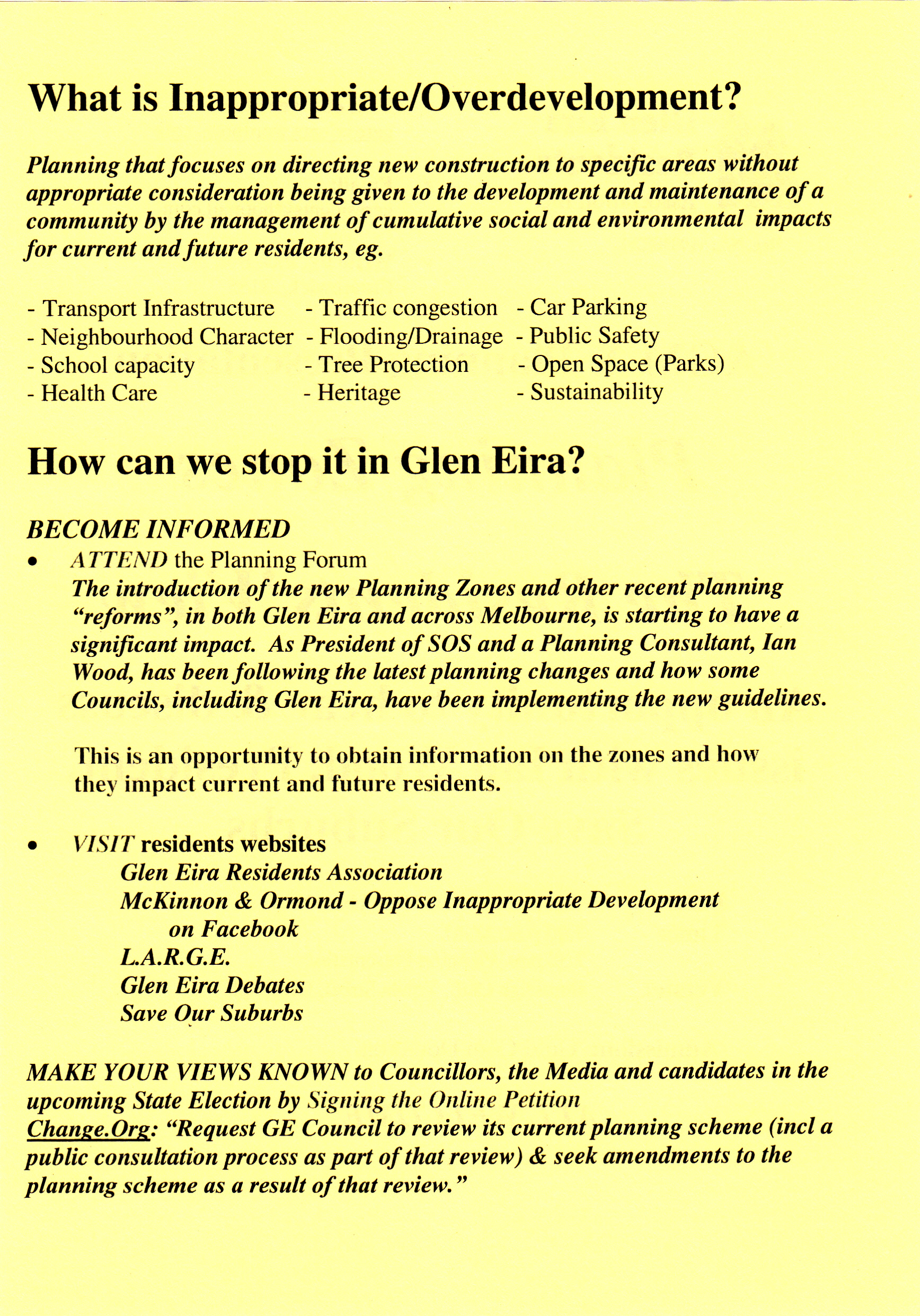
GLEN Eira residents angry at the pace and density of residential development in their streets are demanding the council review the planning scheme.

Residents used a planning forum in Bentleigh to slam the city’s reformed residential zones and council’s lack of community ­consultation.

They now want councillors to review and amend the planning scheme.

To amend the residential zones the council must approach Victoria’s planning minister.

The four councillors who attended the forum, among them new mayor Jim Magee, were told the State Government and Glen Eira Council’s claims the zones would offer a new era of protection were a farce for those in the higher density General Residential Zone and Residential Growth Zone.

Others in the protected Neighbourhood Residential Zone said they were still adversely affected by three and four-storey developments just doors away.

“Why has Glen Eira Council identified areas even 1km away from transport corridors for this increased density?’’ a resident asked.

A Bentleigh resident of more than 30 years and traffic engineer said: “I can’t see streets coping with traffic and parking levels’’.

Concerns were raised for packed schools and others accused the council of siding with developers.

Cr Magee argued height limits were brought in to protect the city from inappropriate development and was heckled when he said the zones were not to blame for the pace of development in areas such as Carnegie, McKinnon and Bentleigh.

And last week Baysiders blasted their council’s management of residential growth at a special meeting.

About 120 people packed the Brighton chambers to voice concern over residential growth zones. The meeting was held to discuss a recent State Government about-face on zoning of parts of Highett, Cheltenham, Hampton East and Brighton East.

The Liberals have said they would now not demand the council ­include quiet residential streets such as Major St in Highett as areas for intense development. Labor plans to rejig the whole zoning system if they win power next week.

Kingston council has yet to adopt the new zones.

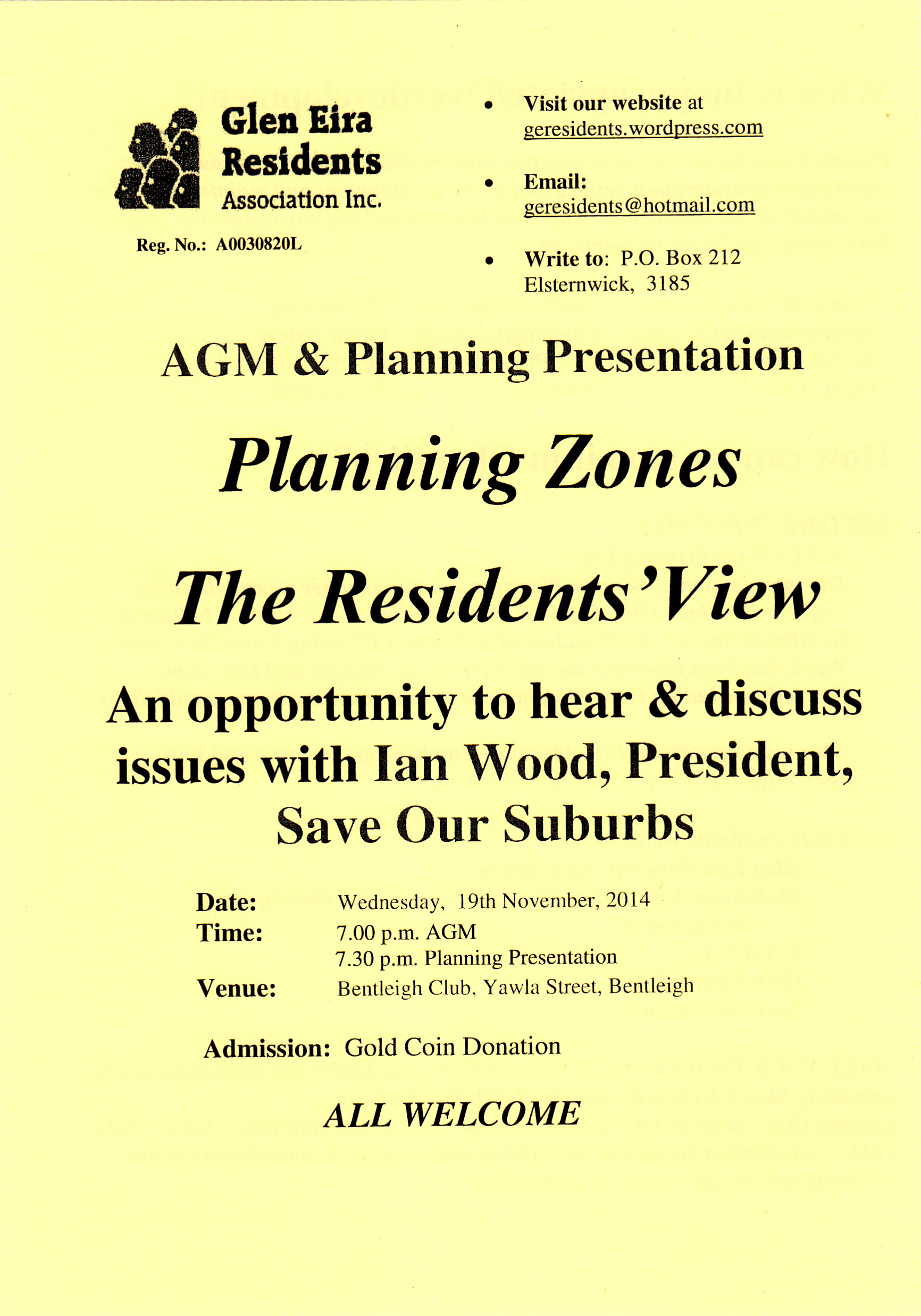
The Glen Eira Residents Association is petitioning the council for change at geresidents.wordpress.com

IMG

IMG_0001

photo

The bastardry, skulduggery, and pattern of capitulation which has dogged the entire Caulfield Village fiasco, is now complete. Council has once again caved in completely to the MRC/Developer judging by the VCAT order resulting from the August ‘mediation’. (full document uploaded here).

We remind readers that in May this year the Development Plan was rubber stamped by the majority of councillors. Attempting to simply save face, Lipshutz and Sounness put forward an amendment which was meant to ‘rectify’ the problems such as ‘fixing’ the vast number of miniscule balconies, and car parking issues. (See: https://gleneira.wordpress.com/2014/05/21/defending-the-indefensible/).

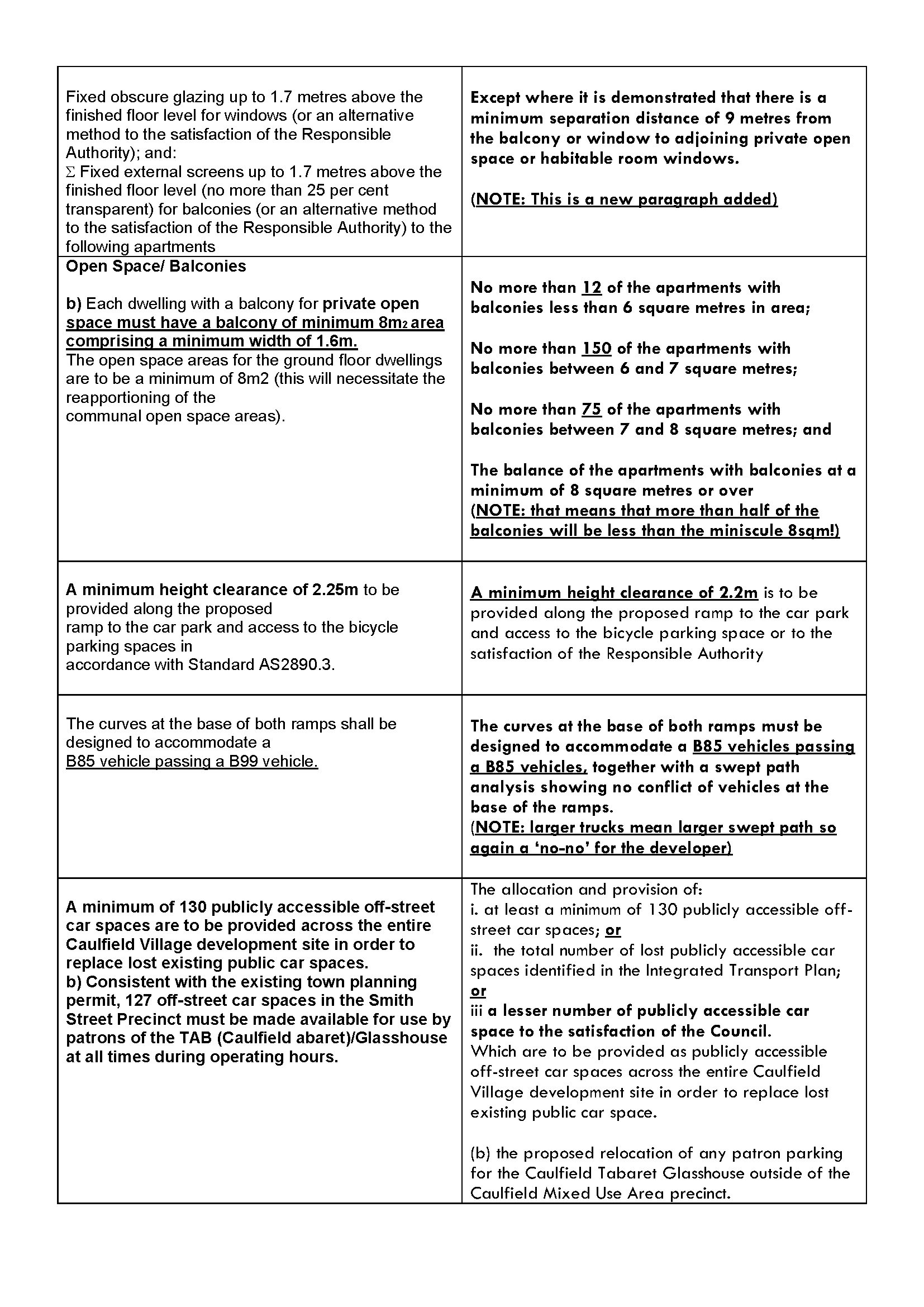
Well, surprise, surprise, surprise – the developer got practically everything he wanted! The two most important conditions (balconies and car parking) were practically tossed out the window and many other conditions eroded away in favour of the developer. All that council appears to have gained is to force the developer to provide more detailed information on soil depths so that the promised ‘garden of Eden’ will have enough soil to actually survive a year or two!

Which leads us to some pretty important questions:

  • Why didn’t council insist that this goes to a full hearing and not mediation if they were so adamant that their conditions were vital?
  • How much did this mediation cost ratepayers since we would bet that council employed barristers, planning ‘experts’ etc.?

We also must congratulate all those ‘backroom boys’ for their years of plotting, since this development is now exclusively OUT OF THE HANDS OF COUNCILLORS. Everything is now up to the ‘satisfaction’ of the ‘responsible authority’ – ie officers (exclusively). Hyams, Lipshutz, Pilling, Esakoff have done their work and handed the MRC their biggest prize ever to the detriment of every single resident living in Glen Eira.

Below is a summary that we’ve drawn up. On the left hand side is what the resolution of May 2014 stipulated. On the right hand side is what has now changed according to the VCAT order. These are all verbatim. Please read carefully and then ask yourselves whether or not you believe that Glen Eira is indeed the ‘cave in Kings’ of the State!!!

There’s undoubtedly a lot more buried in the technical detail of this order, so we welcome your views on what we’ve left out.

mrc


« Previous PageNext Page »