GE Transport


Two things stand out like sore thumbs when it comes to development applications and the submitted plans:

  • They are often inaccurate and simply WRONG
  • Council has no intention of doing its own required homework. They are more often than not content to rely exclusively on the developer’s documentation – especially on such vital aspects as traffic management and overshadowing.

Recent planning conferences verify the above completely. There have also been some incredible statements that have issued from the various architects and planners working for the developer. For example:

On the Belsize, 4 storey and 52 dwelling application the planner conceded that the balconies (which encroached on setbacks) were largely there for ‘aesthetic’ value. Otherwise the building would look ‘like a box’!!!!!! Topping this off was the comment from the project architect when it was pointed out that the ‘standards’ on permeability, etc. had not been met. His response? – Under the standard it allows for breaching. Needless to say this was met with howls of laughter!

When residents raised concerns about the water table and what damage excavating for a double underground car park would do to the table and surrounds, the response from both the council and developer planner, was that there was no Melbourne Water Overlay on the property. That of course doesn’t answer the question and nor does it safeguard residents since the permit can be issued, problems subsequently confronted, and the damage is done. The $64 question is whether any of these things will even get a mention in the officer’s report and recommendation? And even if it is mentioned, has there been ‘consultation’ with appropriate engineering expertise?

Residents also picked up numerous ‘clerical errors’ and what can only be described as inadequate traffic reports from developers. The Penang Street planner admitted that the submitted plans included dwellings that were marked as two bedroom, which were in fact single bedroom dwellings. But it got a lot worse. According to the submitted shadow diagrams, everything was hunkey dorey! There was no overshadowing that did not meet the ResCode standards. Or so they would like everyone to believe. It was only when one resident pointed out that she had photographic evidence of a current room full of sunshine that would now be facing a three storey blank wall, that the ‘inaccuracies’ of the plans were revealed.

Some of the best quotes however came from the Loranne St (4 storey, 42 dwellings) planning conference. Hyams, who chaired the meeting, is literally starting to sound like a broken record! Once again he began the evening with assertions that the new zones did not add to development and that anyone who was telling people something different must have ‘political motives’. The plans that were available were practically indecipherable so that it was impossible to ascertain the sizes of each apartment. Also missing from the handout was the requisite shadow diagram for the equinox – ie September 22nd at 3pm!

Rachel Bowden represented the developer. We remind readers that she was at one time a senior planner for Council. And didn’t she sound it! Council’s public relations department could not have done a better job than the praise that Ms Bowden lavished on council! We guess that the planning/development circles are small, and certainly incestuous! When it came to answering questions about ‘quality’, all Ms Bowden could provide as an answer, were statements about setbacks, height, and how everything was in accordance with the planning scheme. Not a word of course about basic internal amenity in relation to quality – except that the developer would ‘keep’ some of the units and therefore have control over the Body Corporate. The implication being that this was unlike other developments. When pressed as to whether this meant they would be ‘rented’ out, the answer of course, had to be ‘yes’. Oh the games that these people play!

Our advice for all future objectors on any development is:

  • Check the developer’s plans carefully and ensure that they are accurate in every single respect
  • Check the accompanying traffic report – make sure that the ‘survey’ was conducted at a reasonable time and on more than one single day – ie the Penang Street traffic survey occurred on one single day at 9am and again at 7pm. Totally inadequate since there is a retirement village right next door and visitors are not likely to be parking and filling up the streets before 9am and certainly not much after 7pm. Some of the Penang people also went to the trouble of ‘measuring’ the supposed car parking available spots. Guess what? – the plans were wrong again!
  • Harass, harangue every single councillor. Get publicity! Tell your neighbours, tell your friends. Tell anyone who will listen that your problems will soon become their problems because of the Glen Eira Planning Scheme and the councillors who permitted this to occur in secret and without community consultation.

Finally, that old chestnut of planning decisions. Each and every time residents are told that the officer’s decision on the application will be made available on the FRIDAY afternoon. Council meetings are on the following Tuesday evening. As we’ve stated ad nauseum – people work; people may be reluctant to intrude into councillors’ weekends. That basically leaves two days for residents to absorb the detail, and attempt to lobby councillors. Not good enough. We see no reason why officer decisions on any planning application should not be made available far earlier. Councillors receive their agendas at least 8 days prior to the council meeting. Why should residents only have a few days?

And why oh why are all of these extremely important planning decisions all being crammed into the one single council meeting? What that means is that we estimate that each item will be lucky to receive 5 or 10 minutes of ‘debate’ time. Not good enough when people’s lives and lifestyles are being decided. The advantage for council is of course that everything is done and dusted in the one 2 or 3 hour period. The more the merrier, so to speak, so that everything blurs into one time slot and the pressure cannot be repeated meeting after meeting. This has traditionally been council’s tactics. All decisions of major import somehow manage to find themselves on the one single agenda. Coincidence? Not bloody likely we say!
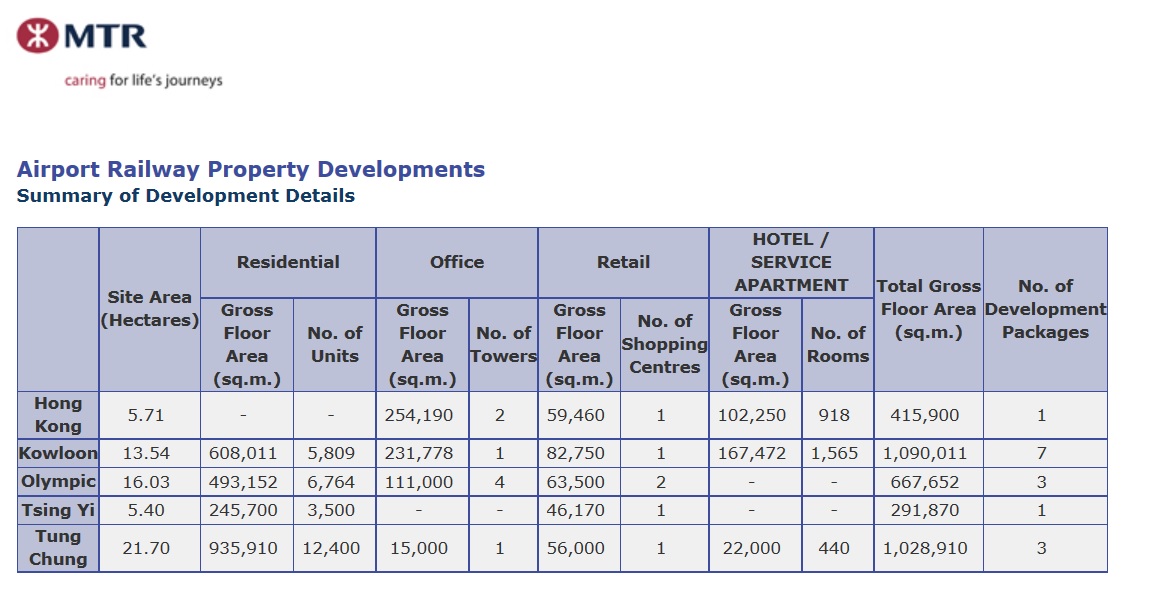
Yesterday’s post concerning Carnegie, Murrumbeena rail crossings/station redevelopments, noted that the company involved was MTR. Here is a snapshot of what they also do –

UntitledSource: http://www.mtr.com.hk/eng/properties/prop_dev_sdd.html

Designs revealed for new railway stations at Carnegie, Murrumbeena, and Clayton

Date:July 9, 2014 – 1:56PM

A concept design for Carnegie station.A concept design for Carnegie station. Photo: Supplied
Three ageing suburban railway stations in Melbourne’s south-east will be demolished and replaced with new station buildings under concept plans released by the Napthine government on Wednesday.

The plans involve rebuilding the stations at Carnegie, Murrumbeena and Clayton, which would be put partially underground as the Dandenong railway corridor is sunk and four busy level crossings removed.

Crossings at Murrumbeena Road – consistently rated one of Melbourne’s worst in RACV’s congestion surveys – Neerim Road in Carnegie and Clayton and Centre roads in Clayton are to be removed as part of a $2 billion to $2.5 billion upgrade of the Cranbourne-Pakenham rail line.

The project, due to start next year and be completed in 2019, will force the closure of Melbourne’s busiest rail corridor for an estimated six weeks as level crossings are grade separated and stations rebuilt. The removal of the Murrumbeena Road level crossing alone is predicted in project plans to require the Dandenong line’s closure for about five weeks.

Concept designs for the three stations show improved commuter facilities such as new footbridges and commuter car parking, but give no hint of the scope of potential commercial development around the station that is slated to happen as part of the project.

Melbourne’s rail operator, Metro, has negotiated development rights at the three stations, as its Hong Kong-based parent company MTR regularly does in that city.

Premier Denis Napthine and Public Transport Minister were challenged by Glen Eira mayor Neil Pilling to reveal how the station environment at Murrumbeena Station would change. Mr Pillings said residents were concerned “large-scale developments” would go up in the mostly low-rise suburb to help pay for the project, which is being delivered as a public-private partnership.

“One of the concerns that is raised [by residents] is about what sort of development will happen around the station here … there is a lot of VicTrack land here, it’s very important for parking, people drive here from all over,” Mr Pilling said.

Mr Mulder said any future development around Murrumbeena station would be secondary to the needs of public transport users.

“We don’t really want the development opportunities dictating what the station would look like, we want the station precinct, the public transport outcomes … to dictate what we could do with other available land,” Mr Mulder said.

The public has been invited to comment on the concept designs, which can be viewed here.

COMMENT
What a pity that the government page which includes the concept designs contains 90% spin and 10% ‘information’ of value to residents. After years and years of promises, it is most disappointing to see that the ‘concept plans’ are so devoid of fine detail (and some even look like they’ve been drawn by a two year old!) as well as failing to deliver on the most important aspects of policy – that is provision for extra tracks!

High-rise plan for railway hubs

Date:May 4, 2014

Royce Millar and Adam Carey

Residents of Melbourne’s politically sensitive south-east face the possibility of high-rise development at their rail stations including Murrumbeena, under a confidential deal between the Napthine government and a consortium led by the city’s private rail operator.

The deal for the proposed multibillion-dollar upgrade of the Pakenham-Cranbourne rail corridor – contained in documents leaked to The Sunday Age – includes a specific clause about development around sites identified for level crossing removals.

”Key” issues to be negotiated with the Hong Kong-based rail operator Metro Trains Melbourne (MTM) and its partners include ”exploring value capture opportunities associated with land development at grade separation sites”.

The Sunday Age is aware that MTM views the Pakenham-Cranbourne project – including property development – as the first of a series of schemes across the Melbourne network.

The ”commitment deed” spelling out the in-principle understanding between the government and the consortium, is one of a batch of high-level leaks to Fairfax Media about ”Project Flinders”, including cabinet-in-confidence documents.

In March the government made a surprise announcement about the upgrade, which it said would deliver a 30 per cent capacity boost along the congested Dandenong corridor. The revamp includes removing level crossings at Murrumbeena, Koornang, Clayton and Centre roads and rebuilding Murrumbeena, Carnegie and Clayton stations.

At the time no mention was made of the potentially controversial property development component of the project. Detail, such as the precise areas to be developed, and planning issues such as height, are yet to be finalised. So too, it seems, is any agreement about the millions of dollars likely to be generated from the sale of apartments, and commercial space.

In Hong Kong, MTM’s parent, MTR, has overseen skyscraper development around its celebrated rail network. Melbourne’s planning politics is unlikely to allow such building height or density.

More likely is the kind of development already overseen by the government-owned rail property agency VicTrack, such as the $70 million, 10-level apartment and commercial development at Glen Waverley. Other VicTrack projects either under way or in the pipeline include stations at Jewell in Brunswick and Alphington, Hampton and Pascoe Vale.

University of Melbourne transport academic Chris Hale said development around a station like Murrumbeena should be 15 levels at least.

Dr Hale said many people want to work in the CBD, and live near rail stations, but could not afford inner-city houses. He said there was a lack of housing opportunities near stations in the middle suburbs, within a 30-minute train trip to the CBD.

He called for care in planning such high density schemes. ”Rather than concrete canyons they should be lively green zones with plenty of trees and grass and great architectural qualities. State and local government needs to become more effective in their stewardship of transit-oriented design and planning.”

On Saturday, Treasurer Michael O’Brien confirmed the government would ”explore” development opportunities through the Pakenham-Cranbourne upgrade. But he stressed the government would drive a hard bargain in any such deals.

”It is the Victorian government, not third parties, that will determine whether and how any value capture opportunities are pursued.

”Any suggestion that the Coalition government has sold a right to develop land around level crossings as part of the Cranbourne-Pakenham rail project is barking up the wrong tree,” he said.

Project Flinders is Victoria’s first ”unsolicited proposal”, a new and controversial policy that allows the private sector to propose new infrastructure, even if the projects identified are not government priorities. It is Australia’s biggest rail public-private partnership.

While the government spruiked the scheme as a $2 billion to $2.5 billion (in today’s dollars) project, The Saturday Age reported yesterday that Victorians would have to pay up to $5.2 billion, or almost $1 million a day in annual services payments to the consortium until 2034.

The Saturday Age also revealed the project had been expedited to ensure contracts were signed before the November state election and that a key ”milestone” was ”contractual close” by September 29, two months before the election

Project Flinders also includes buying 25 ”next generation” high-capacity trains, high-speed signalling and a new train-maintenance depot on green wedge land at Pakenham East.

Read more: http://www.theage.com.au/victoria/highrise-plan-for-railway-hubs-20140503-37p6f.html#ixzz30hCKbwUu

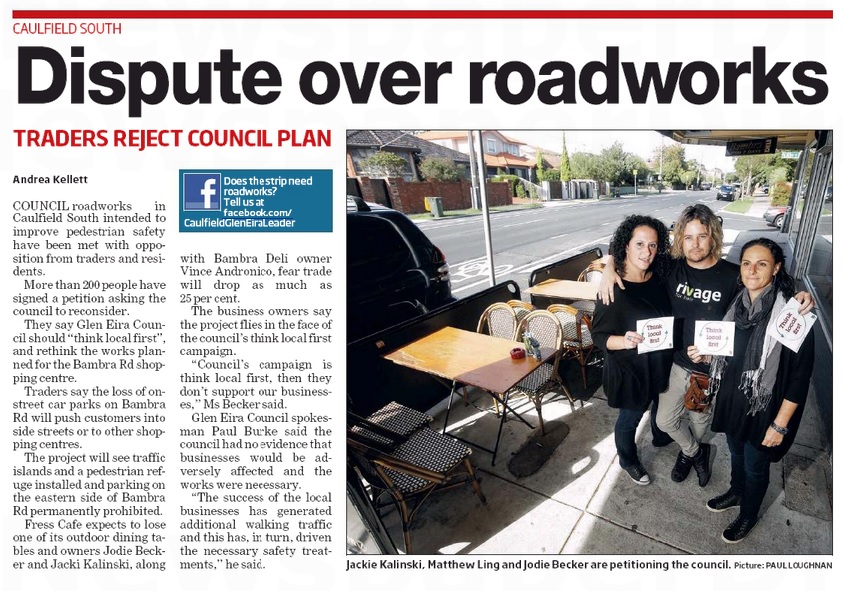
localPaul Burke states that there is “no evidence that businesses would be adversely affected.” Research by Monash University certainly casts major doubt on such a statement!

Driving a changed approach to shopping

11 April 2013

Parking restrictions, single lanes, local council controlled parking areas, higher parking fees, train crossings and traffic lights were seen as barriers to shopping at local centres.

Small suburban shopping centres are disproportionately threatened by policies on climate change and traffic congestion that discourage consumers from using their cars, research shows.

The Monash University study found many people already favour larger shopping malls over local centres because of the perceived ease of parking and access.

Dr Vaughan Reimers from the Department of Marketing examined the importance shoppers gave to car convenience, recognising that urban sprawl and decentralised retail options had contributed to reliance on the car. He found that irrespective of age, gender or income, shoppers regarded access and parking as important determinants of where they chose to shop.

He also assessed perceptions of shopping malls and shopping strips, and then compared the actual level of convenience provided by both for people travelling by car. The results were published in Transportation Research Part A.

Dr Reimers’ study showed that although shopping malls had more parking than local centres, people were more likely to be able to park close to desired stores at their local centre. However, it was commonly believed that large shopping complexes always had better parking options – a belief that has helped contribute to the rise of the mall.

Parking restrictions, single lanes, local council controlled parking areas, higher parking fees, train crossings and traffic lights were seen as barriers to shopping at the smaller centres by respondents.

“On the basis of the results of this study, any strategies designed to deter car-usage are likely to tip the balance even further in favour of the mall,” Dr Reimers said.

“Many policies related to tackling climate change have not only failed to achieve their objective but have also had a negative effect on the retail sector.”

Dr Reimers said modern transport systems needed to find a balance between environmental sustainability and economic growth, a fact that was particularly significant in light of the competitive disadvantage faced by suburban shopping centres.

“Policy makers and urban planners must give careful consideration to the negative consequences that may stem from strategies designed to deter car-based shopping,” Dr Reimers said.

Source: http://monash.edu/news/show/driving-a-changed-approach-to-shopping

We’ve received an email from a resident which in our view epitomises everything that is wrong with the Glen Eira City Council administration and, in particular, its penchant for secrecy and putting every single obstacle it can in the way of residents.

Here’s what happened.

  • A resident went down to council offices and asked to see the Melbourne Transport Victoria submission on the Caulfield Village Development Plan.
  • An officer finally came down with the submission and told the resident that photographs or copies were verboten.
  • The resident, not to be put off, then started to transcribe the submission in full.
  • The officer remained watching the resident write for at least ten minutes and was clearly bored out of his brain and inwardly fuming. He then called in an underling to continue with the surveillance.

What is so outrageous about this behaviour is:

  • There is NOTHING, not a single word, in the Planning and Environment Act which precludes residents from taking a photo of a submission. The ‘embargo’ by council is simply another example of their determination to make things as difficult as they possibly can for residents. It is simply another ‘rule’ concocted by council to prevent widespread dissemination of a public document.
  • It also illustrates the common council practice of ‘if it’s not stated in the legislation’ then we can’t do it. Or the reverse is also true – if it’s not stated in the legislation, we can do it’. It all depends on the situation and the objective – for example: the Local Law and the Meeting Procedures and attempts to dissent from the chair!
  • Residents need to ask: how much did this officer surveillance cost ratepayers? How many dollars went down the drain when two employees stood around watching someone else write instead of getting on with the work they are paid (by us) to do?

Finally, here is the transcript as forwarded to us. All that has been left out are the reference numbers –

Received – 27th February 2014


Public Transport Victoria

Ref FQL

Rocky Camera

Coordinator Statutory Planning

Thank you for your letter dated 28/01/14 referring the Caulfield Village Development Plan to Public Transport Victoria. Please find Public Transport Victoria’s comments below.

While the accompanying Integrated Transport Plan (ITP) has made references to most items as outlined in Schedule 2 to the Property Development Zone PTV requires the following additional information to be able to conduct a proper assessment of the plan.

1/ Demonstrate how Station Street will accommodate the ‘Undivided Connector Road – B’ as detailed in the Public Transport Guidelines for Land Use and Development (i.e. a minimum 4.2 metres shared carriageway for both vehicles and bikes and a minimum 2.3 metres wide parking lane).

2/ Provide further information regarding the layout and location of the proposed bus stop at the intersection of Station Street and The Boulevard. Confirm that such bus stop would be funded by the development.

3/ Further detail on how existing tram services along Normanby Road and bus services along Station Street will be impacted by the proposed development (i.e. delays to journey time) including the intersection plans showing the proposed works, how they will accommodated within the road reserve and how they will operate.

4/ Further detail on the future planning for the Normanby Road / Smith Street tram stop (i.e. timing, planning location and design of a potential Superstop).

In addition, PTV does not support the introduction of a shared tram and traffic lane as suggested in Table 4.3 of the ITT on the Normanby Road/The Boulevard/Smith Street intersection. Introducing additional traffic to the existing tram right turn would cause travel time delays to the tram service. The intersection should be designed as not to detrimentally impact the current levels of tram operation.

The PTV would prefer that the Implementation Plan submitted with the Development Plan documents clearly sets out how each intersection across the development will be constructed and the timing for delivery detailed in an approved implementation plan.

Yours,

Richard McAliece

Manager

Land and Planning

24 / 2 / 2014

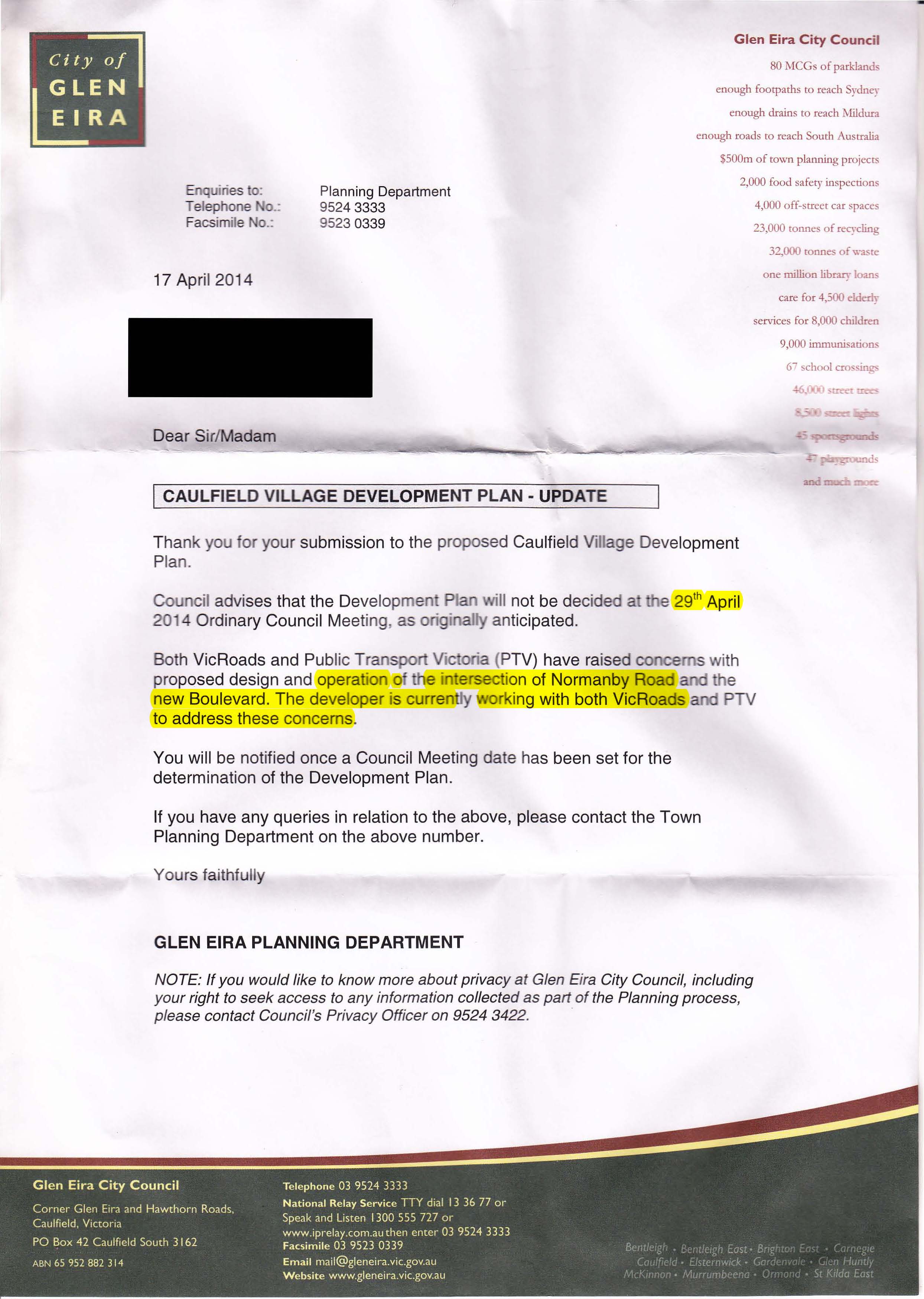
Submitters to the MRC Development Plan have received a letter from council. We urge readers to note the following:

  • April 29th was never the set date for decision. Pilling announced it was to be April 8th. This delay far exceeds the requirements of Schedule 2 associated with the C60.
  • Normanby Road intersection is not the only problem highlighted by VicRoads as we’ve already shown in an earlier post. (https://gleneira.wordpress.com/2014/04/10/caulfield-village-vicroads/). Yet Council only mentions this one example. Why?
  • The VicRoads submission also mentioned working with the developers AND COUNCIL. In  this letter the role of Council does not even rate a mention! Are residents supposed to believe that Council has no role, no function, and no say in what changes are now made? Hardly!
  • Why, given these objections, and the countless other problems outlined by residents has Council not simply rejected outright the entire Development Plan? Why this ongoing behind the scenes manoeuvring? It couldn’t be could it that by rejecting the Development Plan council would be providing residents with the green light for third party objection rights?
  • Question after question on traffic, drainage, etc. has not been answered by this council except for the stock response of ‘we’re investigating’. After 4 months Council should well and truly have determined all the flaws in the plans. They should also have conducted their own traffic analysis as any decent council would if they were truly concerned about the flow on effects. Thus far and to the best of our knowledge, this Council has done nothing but accept the developer’s version of reality as factual and sacrosanct!
  • Finally, it beggars belief that official missives of Council fail to include the name of those individuals responsible for their decision making. The blanket title of ‘Glen Eira Planning Department’ will simply not do! Who is responsible? Who signs off on such letters and planning decisions and why is there no accountability and/or transparency within this administration?

IMG

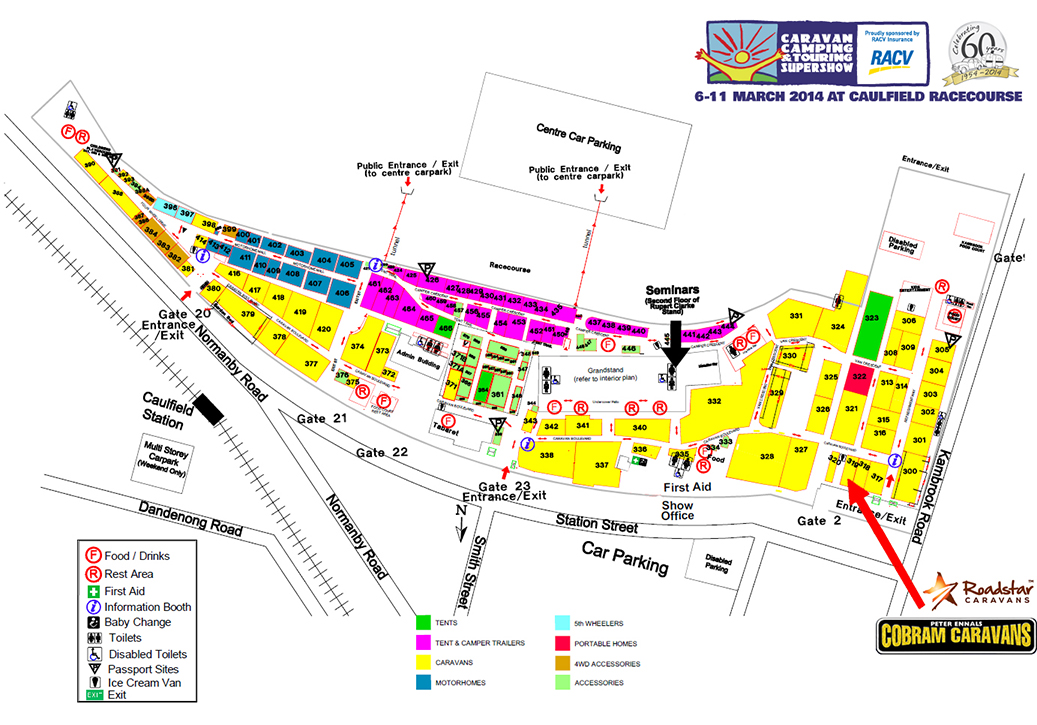
The Car Parking Management Plan for the whole of the land states that for major events the following car parking spots within the racecourse are available (from page 6 of the Plan) – Kambrook Road entrance (674 spaces); Guineas Car park (536 spaces) and centre of the racecourse (3000 spaces). The claim is that all of these are sufficient to cater for demand – especially for the Caravan and Camping Show which draws the largest crowds and puts the greatest demand on car parking spaces.

It’s a pity that the consultants haven’t included a full and accurate picture of what actually happens with the Kambrook and Guineas car parks during the Caravan and Camping Show. They disappear and are replaced (of course) with caravans and camping gear. That means that 1210 sp0aces that the MRC is banking on to support its unsupportable claims do NOT EXIST. Where these 1210 cars end up is obvious – in all quiet surrounding residential streets!

The map below (for all those who haven’t driven past the grounds) provides a clear picture of the nonsense that is contained within the Parking Management Plan.

Edited_map_smaller

The Caulfield Village Planning Conference was held last night with a very good turnout of articulate residents who quite forcibly put forward their views on the development plan. Of councillors, only Lipshutz and Esakoff were non attendees. What follows is a summary of the evening.

Pilling began the evening by introducing the planners (Rocky Camera and Ron Torres) who would be explaining the plan and answering questions. Went over the ‘procedures’ for the meeting and said that there would be a rep from the applicants who would ‘speak’ and ‘also possibly’ answer some of the ‘queries you’ve raised’.  Wanted to confirm that no decision had been made and that the evening was ‘purely about explanation’ and ‘clarification’ and giving people the ‘opportunity to ask questions’. Admitted that there was a lot of ‘history’ involved but that this wasn’t why everyone was present.

Rocky Camera, using overheads  explained the application and pointed out that there would be 8 stages of which the current one represented three stages. Stated that buildling heights for this precinct ranged from 2 to 6 storeys and all were within the preferred heights of the incorporated plan. Went through all the ‘internal’ referrals to other Glen Eira departments such as traffic, landscaping, etc and that they were waiting for feedback which would be ‘available’ in the council report. Said that council had received 26 submissions and that some the ‘key concerns’ were: neighbourhood character, amenity, car parking and congestion, trees, lack of open space, infrastructure and inconsistency between the incorporated and development plan. Camera then listed 3 main issues as he saw them –  accordance with the incorporated plan, car parking and ‘design elements’ as well as internal amenity. Pilling then asked for an overview of the C60 and the incorporated plan. The audience was then told of the approval of C60 which resulted in rezoning into a Priority Development zone and approval of the incorporated mixed use plan. Said that the latter was a ‘blueprint’ for future development and that it includes building heights, setbacks and this lead to the Development Plan which has ‘finite detail’. The project could take 15 years to finish.

Pilling asked that appeal rights be explained as well. The officer then explained the impact of Amendment c111 and the ‘minor impacts’ that this allowed like balcony intrusions and ‘no appeal rights’ since this wasn’t a ‘typical application’ but if there is a difference then it would go to the normal planning application process. Pilling then asked people to give their names and addresses before they spoke.

SPEAKER 1 – talked about the need for recreation facilities and ‘recreational support’ and that ‘increased volume’ of people means increased support for ‘community based clubs’.

SPEAKER 2 – from Queen’s avenue. Density and scope had greatly increased. Was also worried about ‘lack of public space’ and car parking. Said that ‘most of the car parks’ were currently being used at the racecourse for the Caravan and Camping show so there’s ‘very little car parking’. Didn’t think that the Monash plans had ‘been taken into consideration’. ‘It’s all smoke and mirrors as far as I’m concerned’.

SPEAKER 3: was concerned that only some of the development plan documents concerned the entire 3 precincts but the discussion was being focussed only on the one precinct and the published Incorporated Plan is incorrect. Asked whether council was going to approve plans that ‘relate to the whole of the development’ without details of these other precincts. The officer replied that the developer has to submit plans for the ‘overall project’ so council would be approving all the other documents. The speaker then stated that if the developer changes their mind about the amount of commercial space, there’s the situation that the car parking plan is then ‘set in concrete’. Planner stated that ‘that would need to be amended’ if there were changes and these amended plans would have to ‘show those changed details’. Residents would be able to ‘comment’ on these changes. Speaker than asked about the ‘validity’ of the discussion since the Incorporated Plan doesn’t include building height. ‘Why are we comparing (the development plan) to a document that council knows is incorrect’? Camera replied that this was about the Smith St precinct and it was ‘an error made by State Government’ and that this is currently being ‘rectified’ but in the mixed use precinct the height control ‘is correct’. Speaker said again that residents are being asked to compare the plan which isn’t correct and that there should be an expectation that residents are given the ‘correct information’.

SPEAKER 4: said that he’s heard what the ‘developer is doing but what is council doing in relation to’ traffic management. Pilling then answered that there’s no decision as yet and the application is being considered. Speaker said again that this answer only tells him how council is dealing with the developer and not what they are doing off their own bat especially in relation to the areas outside the site. The officer then spoke about the Section 173 Agreement which requires the MRC to put in ‘some key infrastructure’ projects about traffic management such as the ‘creation of a new road’ and making it safe for pedestrians around the railway station. Went on to list all the requirements of the Section 173 Agreement. The speaker then asked again what council itself is doing about the limited car parking in areas surrounding the site. Officer responded that the ‘car parking rates’ are now ‘set’ as a result of the C60 and it was the ‘Minister for Planning’ who ‘set those rates’. Said these are ‘ResCode rates’ (ie 1 car space for 1 and 2 bedroom places, etc.). Speaker again said that the answer was all about the specific site and that ‘I am asking’ about the surrounding areas and what council has done about ‘trying to accommodate the overflow’. Camera again said that the developers have put in their Development Plan a submission about what ‘happens to displaced car parking’ and council has to decide whether ‘we are satisfied’ with the proposals. Speaker then said that from what he’d read Newington was named as a ‘low priority’ street and disagreed very much with this labelling. Said he didn’t know when this study was done nor by whom and when the cars were counted but it was wrong. Since Eskdale Rd now has 2 hour parking along one side of the street it is now Newington which is receiving the ‘overflow’. Camera again said that council has to decide whether they will be ‘satisfied’ and advised the resident to look at the displaced car parking figures.

SPEAKER 5: in regards to the agreement with the MRC on centre of the racecourse parking, there was originally only to be 5 such days. Said that this appears to have ‘gone by the by” and requested confirmation whether the agreement still stands. Pilling said that the agreement ‘is still in place but that is a separate’ issue to the development plan. Speaker then said that parking is an issue and race days make this even more significant. Pilling restated that the agreement stands but has little to do with the application. Several audience members disgreed claiming that they are ‘interlinked’.

SPEAKER 6: asked what is the precise amount of open space and how many apartments were not going to receive natural light. Camera said that the Guidelines for High Density development cover open space and that ‘unlike ResCode that doesn’t give you a broad figure’. Said that for apartments ResCode recommends 8 square metres so ‘there’s no figure’ for council to ‘assess against’. Said that council would look at this and they might specify a figure for the apartments. Speaker then asked about the ‘public open space’ and not ‘the private’. Camera then said that ‘there is a provision for public open space’ and that this is through a ‘contribution’ (ie the 5 and 4 percent open space levy). Speaker then stated that the question hasn’t been answered in that the question referred to ‘exact acreage’ of public open space and not about money to be collected. Said that ‘here’s a plan where nobody knows the amount of public open space’ and that it was ‘incongruous’ that councillors would be ‘deciding on something’ when they can’t answer such basic and specific questions. Camera then replied that about access to sunlight ‘we don’t have a figure right now’ because they are ‘still going through the plans’. Conceeded that some apartments don’t have sunlight and that this was raised with developers via a council letter. This would form part of planners recommendations to council.


We’ve received the following comment from a reader and believe it deserves to be highlighted as a separate post. The issues that are raised are significant –

  • To what extent is Council ‘facilitating’ the C60 development with ratepayer funds?
  • How ‘competent’ is the traffic department’s report and when errors are pointed out these are totally ignored? Why?
  • Council’s ‘policy’ states that any traffic calming initiatives must first undergo ‘community consultation’. When 92% of residents in a local street state that suggested works are unnecessary, then why is Council so insistent that the works go ahead?
  • If councillors ‘decided’ to support officers, then again and again we have major governance issues relating to decision making behind closed doors.


The Redan Road bicycle lane installation smacks of collusion – everywhere else in the municipality installing bicycle lanes only involves painting a white line on either side of the road and adding some cycling symbols.

Not so Redan Road – it involved
– landscaped traffic calming treatments all along the street and which at one point reduced a wide four lane road to one lane
– a loss of about 15 on street parking spaces (a number of residences are single fronted Victorian/Edwardian that have limited on-site parking capacity and on-street parking is already in high demand) which was disputed by the Glen Eira/O’Brien Traffic Department who claimed only a loss 5)
– 93% of residents signed a petition against it – under the proposal several the landscaped traffic treatments would permanently prevent them from parking within 100 metres of their residence.
– Resident discussions with Ward Councillor/s and the Glen Eira/O’Brien Traffic Engineers proved several of the engineers claims blatantly wrong, described the cost of the installation as a waste of ratepayers money particularly as all residents wanted was a couple of speed humps and the cycling lanes.
– Residents and Councillor/s agreed the speed hump solution would be pursued.
– Residents have now been advised that at the last Councillor Assembly (despite the local law prohibits decisions being made in Assemblies) it was decided to implement the Glen Eira/O’Brien recommendation. No doubt the tactic of letting ward councillors off the hook on contentious issues by non-ward councillors (who have probably never seen the Road) out voting them on the basis of “greater good” for the community is once again being played.

Oh did I forget to mention
. Redan Road, North Caulfield, is an wide angled road (approx. 400 metres in length) that links Balaclava Road with Kambrook Road.
. The Balaclava junction is smack dab across from Caulfield Park next to the controlled Bambra and Balaclava Roads intersection.
. Kambrook Road end is smack dab opposite the MRC’s Caulfield Village’s main Kambrook Road pedestrian access point and that the MRC is going to undertake the installation of pedestrian safety treatments at the Kambrook Road/Redan Road intersection.
. That Redan Road residents do not have a major traffic volume/speed issue since the 40 k/h speed limit and combined the restricted left turn and pedestrian safety refuge (from Kambrook to Redan) was implemented in 2007/2008. Ditto with the Balaclava Road/Redan Road intersection.
. That the Caulfield Village Development Plans focus on Redan Road as a major pedestrian/cycling route to access Caulfield Park and a tram stop that is further away then the Kambrook/Balaclava tram stop.
. How lovely it would be for the Caulfield Village residents to stroll/cycle down a wide, landscaped, tree lined avenue on their way to the already “at capacity” Caulfield Park – not to mention a photo op for the Caulfield Village marketing materials.

No doubt the Redan Road residents are greatly consoled by the fact that their already Caulfield Village impacted amenity will be further reduced by unwanted traffic treatments, that will prevent them from parking near their residences and that are being partly funded from their rates.

« Previous PageNext Page »