GE Transport


The extracts featured below, all come (verbatim) from the officer’s report tabled in the minutes of 12th August 2002 on Amendment C25 – ie. the brainchild for the Housing Diversity and Minimal Change carve up of the municipality. Admittedly, it can be argued that times are different and that things have changed. What CANNOT be argued is that this Amendment was sold to residents on the basis of promises that have never been kept. Now we are lumbered with the new Residential Zones that (without community consultation or even forewarning) were rushed through in secret on the basis of Amendment C25.

Please note: the 80/20 Minimal Change/Housing Diversity policy is not only a dud but iniquitous. Housing diversity has grown and grown. Yet this was supposed to be ‘sufficient’ to cater for some nebulous population figures. What we now have is rapid creep into Minimal Change Areas where streets that were predominantly single storey and single dwelling are being transformed into 2 double storey dwellings on various lot sizes. Remember that Council, unlike others, has not limited the size for subdivision! Instead they are working on another amendment to allow more dwellings on larger lot sizes regardless of the fact that these are in Minimal Change.

The ‘proof’ that the 80/20 split is a myth and not working is provided by council itself. Buried in very small print in the Quarterly Report from September 2013, there is this staggering admission – ” 56% of dwellings approved were in Housing Diversity Areas”. So much for 80/20! And it’s getting worse! The rush is on for infill and that means Minimal Change. Yet, residents were told and dare we say ‘promised’, the following in relation to Amendment c25 which set this all up – (we’ve omitted comments regarding open space and that old chestnut – a Significant Tree Register!)

A radical change in character is not envisaged in the residential areas of the housing diversity areas. The most intensive development is sought in the commercial areas where apartments and shop top housing is envisaged. In the residential areas of housing diversity areas, the policy is intended to allow for some multi-unit development to meet Glen Eira’s housing needs whilst ensuring that it does not:

  • Exceed prevailing building heights
  • Dominate the street scape
  • Adversely affect the amenity of neighbouring properties
  • Result in the loss of landscaped front yards (all in accordance with the standards of ResCode)

The Housing and Residential Development Strategy recommends that structure plans and urban design frameworks be developed to manage the specific issues of each housing diversity area. These would examine issues such as the type, form, scale and character of development and would be implemented through further Planning Scheme amendments and other actions. The development of the structure plans and urban design framework will require wide-ranging consultation with traders, developers, residents and the wider community.

Designating these areas as areas of housing diversity does not mean that council would entertain leniency beyond the provisions in ResCode ie any reduction in open space, cr parking standards, etc.

Traffic and parking

While critically important to the viability and functioning of any commercial centre and character of residential areas, traffic and parking issues largely sit outside the jurisdiction of the planning scheme local policy. The proposed policy, therefore, does not attempt to comprehensively address existing or anticipated traffic and parking issues…..ResCode provides parking standards for residential development The Housing and Residential Development Strategy acknowledges that parking and traffic are issues in the city and should be addressed through a number of measures outside the Planning Scheme. These include parking precinct plans in the commercial centres and the surrounding residential areas and the investigation of local traffic management plans in residential areas.

There’s much, much more in these papers, but readers will have got the overall gist by now. The take home message is absolutely clear:

  • Promises have never been kept much less delivered
  • The 80/20 carve up is failing and will only get worse – dwellings are NOT going into Housing Diversity, but increasingly into Minimal Change.
  • Traffic, parking, open space identified as major concerns over a decade ago has not been addressed.
How many residents’/loading bay/visitor car parking spots has this council waived in the past few years? We wouldn’t be surprised if it approaches a thousand places given the rate of development that has occurred in Glen Eira. What all this means is that local neighbourhood streets are primarily bearing the full brunt of such dispensations. Heaven help residents who just happen to be living off any of the main shopping centre strips. They represent the immediate casualties.

We’ve decided to present some of the officer decisions on major developments for the life of this current council. All of these ‘recommendations’ were approved by councillors with a little bit of tinkering via conditions. Please note the:

  • Contradictions regarding stackers for visitor car parking
  • The failure to provide quantifiable ‘evidence’ for recommendations
  • The constant repetition – at times verbatim!
  • Logic that defies belief!

1056-1060 DANDENONG ROAD CARNEGIE – 12 storeys, 173 dwellings,  (13th November 2012)

264 car spaces proposed and Planning Scheme requires 276 (12 shortfall)

Council’s Transport Planning Department consider the planning scheme requirement of 3 parking spaces per 100 square metres of restricted retail floor area to be greater than the likely parking demand in this area. A parking provision closer to 2 spaces per 100 square metres is considered more appropriate (therefore a minimum of 32 spaces is required compared to the provision of 35 spaces for the restricted retail use component). It needs to be noted that non-compliance with a planning scheme car parking requirement does not necessarily flag a car parking shortfall for a particular site. This is because the planning scheme requirement is general in nature and the provisions are premised on a lower number possibly being acceptable having regard to the circumstances of a particular site. There is availability of on-street parking in the area for any overflow short term parking. In addition, the existing use of the site would have generated some demand for on street parking.

127-131 Gardenvale Road,Gardenvale –  4 storey building; 2 retail 12 dwellings (2 shortfall) 

No visitor parking has been provided. The Planning Scheme requires 2 on site visitor car spaces as a “starting point” (1 space for every 5 dwellings) however this can be reduced or waived depending upon traffic evidence and local circumstances. On the one hand, Council’s Transport Planning Department has requested the provision of two at-grade visitor car spaces. On the other hand, the applicant’s traffic engineering advice suggests that no visitor car parking is required given the ability to accommodate this parking demand in the surrounding streets. On balance, a dispensation is considered reasonable in this instance”   (27th November 2012)

483-493 GLEN HUNTLY ROAD ELSTERNWICK – 8 storey; 4 retail; 57 units (Shortfall 16)

In this case, a reduction in the visitor car parking requirement is justified. If sustainable transport modes are to be promoted, then a reduction in the visitor car parking requirement should be encouraged. It is considered appropriate to provide a modest level of visitor parking. However providing additional on-site parking for visitors will only encourage more vehicle traffic to an area which anecdotally has issues with traffic. It is also noted that a visitor parking rate of 1 space per 10 dwellings (as proposed in this case) has been supported previously in activity centre locations. Notwithstanding this, a shared arrangement could be incorporated with the 4 retail car spaces being made available outside normal business hours (achieving the 9 spaces suggested by Transport Planning).

(5th February, 2013)

451-453 SOUTH ROAD BENTLEIGH – 5 storey; a shop; 12 units  (Shortfall 2)

No visitor parking has been provided. The Planning Scheme requires 2 on site visitor car spaces as a “starting point” (1 space for every 5 dwellings). However this can be reduced or waived depending upon traffic evidence and local circumstances. Council’s Transport Planning Department has not raised any concern with the lack of any on-site visitor car spaces. On balance, a dispensation is considered reasonable in this instance/ (2nd July 2013)

674 CENTRE ROAD, BENTLEIGH EAST – 3 storey; 2 shops; 8 units (Shortfall 3)

A total of 8 car spaces have been provided on site within two car stackers. A total of 8 spaces are set aside for the residential component (as required by the Planning Scheme) and no spaces for the retail component. No visitor parking has been provided. The Planning Scheme requires 1 on site visitor car space. Transport Planning also prefers that 2 retail spaces are provided on site (1 for each shop). However these spaces can be waived depending upon traffic evidence and local circumstances. On balance, waiving the visitor space and the retail spaces is considered reasonable. (24th September 2013)

2 MORTON AVENUE, CARNEGIE 6 storey; 40 units; 1 shop (Shortfall 7)

The proposal generates a parking requirement of 49 car spaces. The proposed provision of 42 car spaces provides the required car parking rate for each of the dwellings (and provides an extra car space for one of the dwellings) but seeks to waive 7 visitor car spaces and the shop car space. The applicant is also seeking to waive the requirement for a loading bay for the shop. With the current permit, the waiving of 1 required visitor car space for the dwellings and the waiving of the loading bay for the shop were allowed. One car space was provided for the shop. It is considered satisfactory in this case to waive the parking and loading bay requirements for the shop given its small size, even in the enlarged form anticipated through the conditions addressing urban design issues. However, it is considered that at least 2 car spaces should be provided for visitors to the dwellings. This would necessitate the installation of a larger car stacker system.

It is noted that there is one visitor car space for the proposed 38 dwellings on the adjoining site to the east at 3 Morton Avenue. The primary justification for a reduction in the number of visitor car spaces is the availability of vacant spaces within on-street and public car park areas. Additionally, a note will be included to prohibit future residents from obtaining resident and visitor parking permits with a condition stating that the owner is to inform residents about this limitation.

(COMMENT: the argument that visitor car parking cannot be provided via stackers, has gone out the window on this application. Again, so much for consistency!)  (6th November 2013)


730A CENTRE ROAD BENTLEIGH EAST – 5 storey; 29 units; ‘food and drink premises’ (Shortfall 6)

Car parking has been provided for the residential component only (one space per dwelling). Given all dwellings are one or two bedrooms, this complies with the Planning Scheme. However a waiver of car parking for visitors and for the food and drink premises has been proposed. Council’s Traffic Engineering Department has reviewed the proposal and consider at a minimum three car spaces for the visitors and nine car spaces for the food and drink premises should be provided.

A recommended condition will require minimum car parking rates as follows:

 1 car space per dwelling (one or two bedroom)

 9 car spaces for the food and drink premises

A minimum of 3 visitor spaces (December 17th 2013)


 677-679 Centre Road BENTLEIGH EAST – 4 storey; 10 units; 2 shops  (Shortfall 2)

No visitor parking has been provided. The Planning Scheme requires 2 on site visitor car spaces as a “starting point” (1 space for every 5 dwellings). This can be reduced or waived depending upon traffic evidence and local circumstances.

Council’s Transport Planning Department has not raised any concern with the lack of any on-site visitor car parking. On balance, a waiver is considered reasonable in this instance given

(17th December 2013)


eegunn

COMMENT

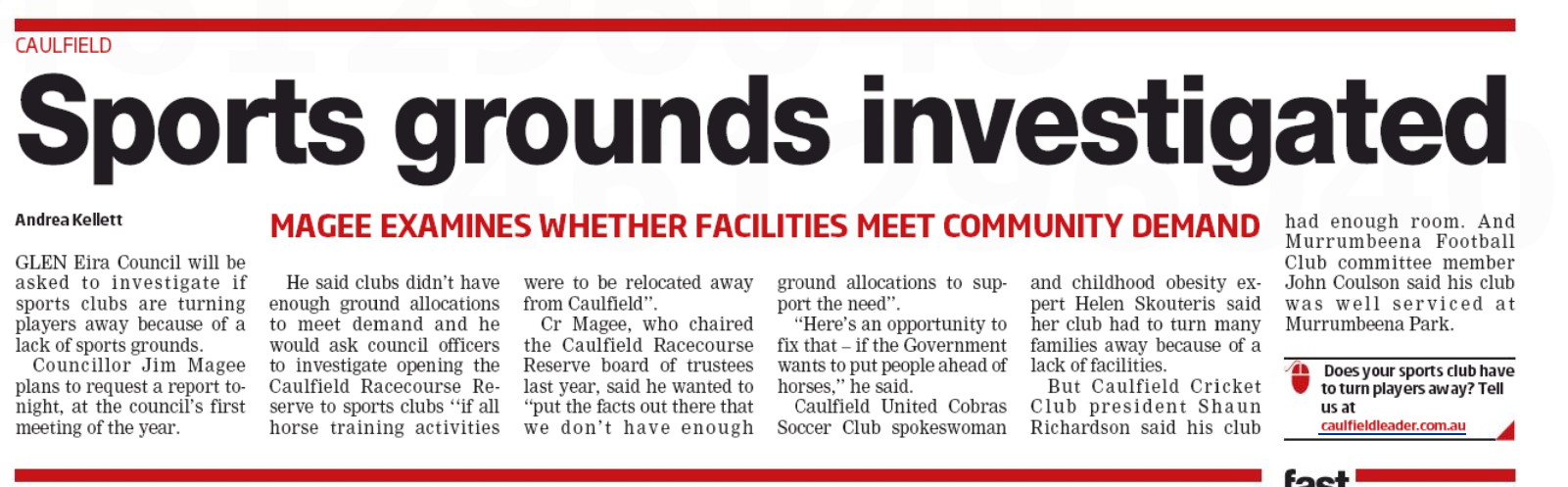
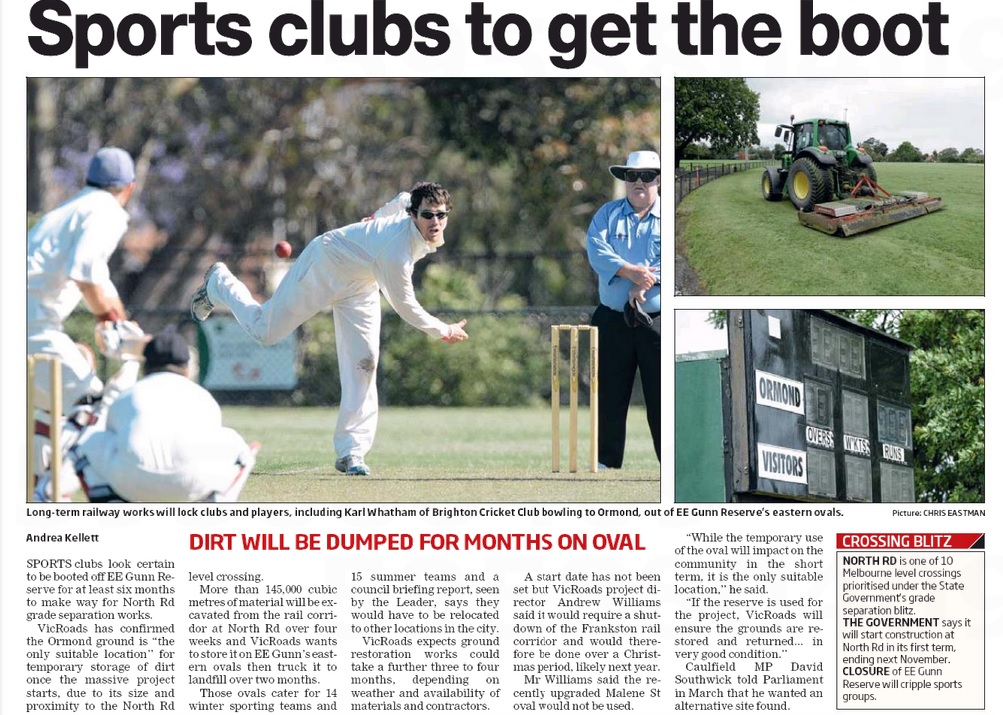
If this scenario eventuates, then it will undoubtedly be one of the most stupid decisions ever made by a government body. It does however add fuel to the council fire for greater access to the racecourse and for the expansion of ovals in Caulfield Park. One sentence in the above Leader article should be carefully noted: “a council briefing report, seen by the Leader….”.  Briefing sessions and the associated documents are ‘secret’. Was this deliberately leaked? If so, by whom? Or is this just another example of rules, regulations, and adherence to ‘governance’ going out the window whenever certain people decide it suits their agendas?

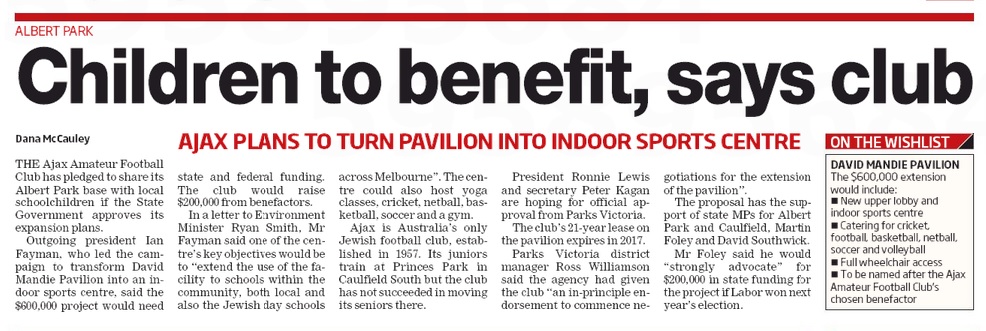
PS: And from the Port Phillip Leader

ajax

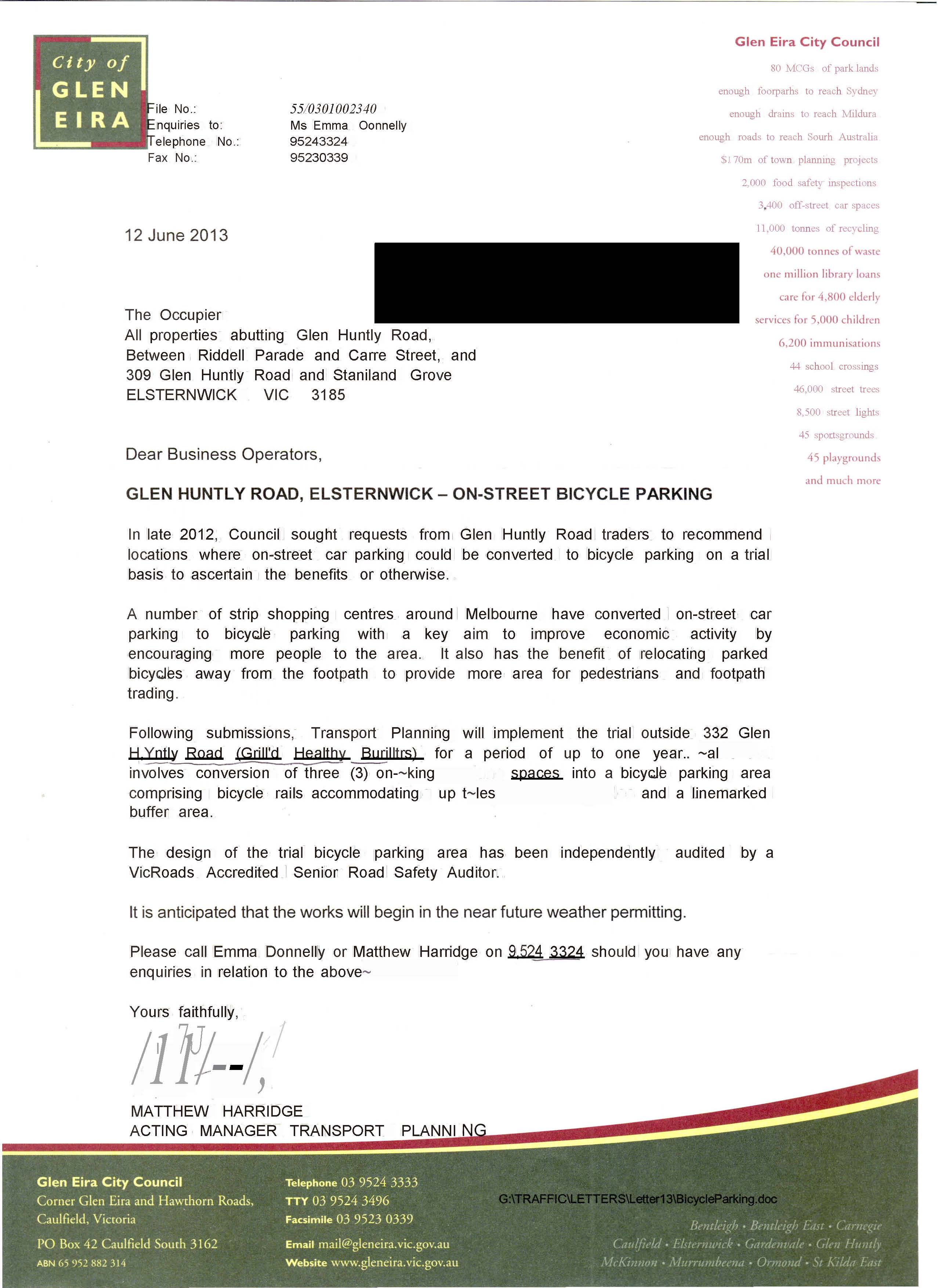
Glen Huntly Rd Bicycle Parking0001_Page_1

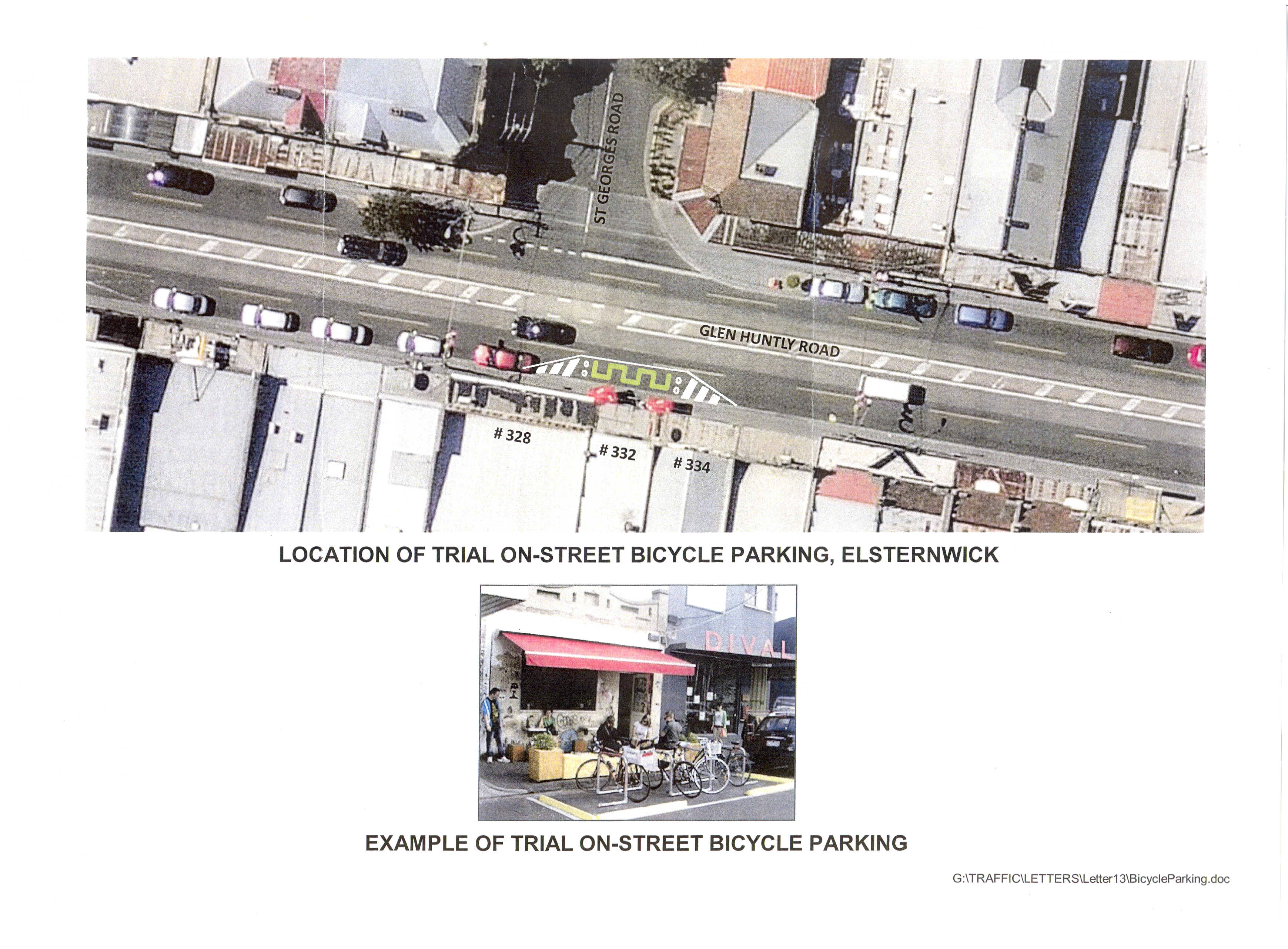
Glen Huntly Rd Bicycle Parking0001_Page_2

Another item up for decision on Tuesday night is the residential parking permit scheme. Our take on the proposals are that whilst Rome is burning our glorious council keeps fiddling and fiddling rather than addressing the problem head on as countless other councils have done – some in fact have been at it for over a decade. All Glen Eira seems capable of doing is burying its head in the sand whilst pretending to protect streets in Housing Diversity. But the horse has well and truly bolted so the suggested solution is akin to putting a bandaid on a gaping and suppurating wound. What is required is radical surgery.  Here’s why –

  • Council totally ignores the fact that Minimal Change Areas are being reshaped by 2 and 3 unit developments – ie the ‘problem’ is not just in Housing Diversity
  • Granting permits for car parking waivers only exacerbates the problem everywhere
  • The consistent refusal to introduce well researched and designed Parking Precinct plans or parking overlays (except for student housing) means further adhoc and hence substandard planning.
  • A policy that shunts car parking to ‘neighbouring’ streets is only transferring the issue elsewhere

The Akehurst ‘solution’ is simple – no Residential Parking permits in Housing Diversity (We’ve uploaded the report here).  It does not hold up to close examination and is a tacit admission of council’s spectacular failure to protect amenity and manage the issue. We highlight the following extracts from this ‘report’:

The policy has been applied for 10 years. In this time 457 dwellings have been excluded from obtaining a RPP (Residential Parking Permit).

COMMENT: From 2002 to roughly 2007/8 Council approved 600 dwellings per year. Since then the figure has escalated to approximately 1000 dwellings per year with only about 30% being single dwellings. On such estimates we can argue conservatively that around 5,500 units have been built. To only have 457 dwellings EXCLUDED in a decade is thus a total joke.

Akehurst does briefly note that “some councils deliberately selectively choose to under provide car parking in terms of the ResCode rates” but Glen Eira has always applied the standard ResCode rates related to bedroom numbers and no change to this position is envisaged in this review.

COMMENT: That’s it! A blanket statement with no justification, no facts, no figures, no nothing. Once again, this council washes its hands of anything that involves change and might just threaten the profits of developers. The ‘excuse’ that if change is required then it is considered preferable to link this to new developments  totally ignores that fact that ‘new developments’ are also rampant in Minimal Change! What’s even more damning is that Akehurst himself goes on to define ‘medium density’ as ‘two dwellings or more’!

Councillors and residents have to ask:

  • Why is this policy only applicable to Housing Diversity given that 2 or more dwellings are also mushrooming in Minimal Change and will continue to do so given that the infill in diversity areas is running out?
  • Why the failure to plan strategically, holistically, and appropriately?
  • Why can other councils (listed below) introduce a variety of options and Glen Eira is totally incapable or unwilling?

Moreland – Council issues up to two residential parking permits depending on whether or not there is a driveway crossover to your property.  If you have a crossover, then you are eligible for one permit only. AND Properties are not eligible for parking permits where approval of a planning permit for subdivision was issued after 31 August 2011 and this results in an increase in the number of separate occupancies on that site. (http://www.moreland.vic.gov.au/parking-roads-and-transport/parking-permits-moreland/residential-parking-permits.html)

Bayside –  – 3 permits AND Multi Unit Development Properties are not eligible to participate in the scheme. (http://www.bayside.vic.gov.au/parking_residential_parking_permits.htm)

Port Phillip – One action pursued by the City of Port Phillip since 1997 has been not to issue resident or visitor parking permits to owners or occupiers of properties in instances where the developer / applicant for Planning Permit had not provided sufficient off street (on-site) car parking in accordance with the Planning Scheme or other council policies.  Foreshore Parking Permits are still permitted at No Parking Permit Note properties.

As of the 1 October 2002, this policy was extended to include all new residential developments* where the number of households increased on a property, irrespective of the level of off street parking provided. (http://www.portphillip.vic.gov.au/resident-visitor-foreshore-parking-permits.htm)

Darebin – Each household can have a maximum of two permits. Households with off-street parking (eg driveway), right of way (laneway between house blocks) or with a garage are entitled to one permit only. (http://www.darebin.vic.gov.au/page/Page.aspx?Page_Id=6215)

Monash – single dwelling 2 permits; 2-4 dwellings 1 permit; 5 or more dwellings no permit

Whitehorse – 1 dwelling 3 permits; 2-5 dwellings 1 permit; more than 5 dwellings no permit.

It’s also worth noting that Frankston has a visitor car parking scheme based on the WIDTH OF THE RESIDENTIAL ROAD/STREET. The narrower the street, no parking! (http://www.frankston.vic.gov.au/library/scripts/objectifyMedia.aspx?file=pdf/309/09.pdf&..)

Boroondara – multi unit development prior to 2001 receive one permit. Post 2001 don’t get a permit. (http://www.boroondara.vic.gov.au/~/media/Files/Your%20Council/Parking%20and%20traffic/ResidentialParkingPermitPolicy2011pdf.pdf)

Rail plan threatens homes

Date: April 23, 2013
The rail plan.

Homes and business premises in Melbourne’s south-east could be wiped off the map to make way for extra tracks along the Dandenong railway line to carry freight trains from the Port of Hastings.

The plan to build ”an additional track or tracks” along the heavily congested rail line is contained in a briefing to Premier Denis Napthine and Transport Minister Terry Mulder, which was obtained by Fairfax Media through freedom of information.

The plan revives elements of the former Bracks government’s doomed $1 billion Dandenong triplication project. If that project had proceeded, a large number of houses and commercial premises along the rail line – particularly between Caulfield and Oakleigh stations – would have been acquired.

Illustration: Ron Tandberg.

Illustration: Ron Tandberg.

The Napthine government plan, tentatively dubbed the ”Eastern Regional Rail Link”, would involve widening the Dandenong rail corridor to lay dedicated track for freight trains and V/Line trains from Gippsland. It also includes provision for a new line along the Western Port Highway from the Port of Hastings to Lyndhurst on the Cranbourne line, which connects with the Dandenong line.

A spokesman for the Department of Transport, Planning and Local Infrastructure confirmed the plan but said it was too early to say whether properties would be acquired.

”That said, should any property acquisition be required, we will ensure full and proper consultation as we are required to under various acts,” he said.

The plan, outlined in a September 2012 briefing by department deputy secretary Gillian Miles, predicts the existing two tracks in the corridor between Caulfield and Dandenong will cope with freight train traffic for the next decade.

”Nearly all freight is presently carried by trucks on the M1, Dingley and other arterial roads,” the briefing says, adding that the M1 and the Princes Highway ”are already at capacity”.

By contrast, just nine freight trains currently use the Dandenong line each week, plus two trains a day on the Frankston line from Hastings that join the Dandenong line at Caulfield.

”Beyond 10 years, commissioning of new container capacity at the Port of Hastings is likely to result in a steep change in freight demand,” Ms Miles wrote.

She warned that with the advent of Hastings as Melbourne’s second major port, ”demand will outgrow the existing infrastructure and additional tracks will be needed”.

Tony Morton, of the Public Transport Users Association, said there was an argument for extra tracks to cater for more freight and regional trains, but not at the expense of private properties.

”There are ways to accommodate more trains, especially if we improve the signalling on the Dandenong line and get rid of the level crossings,” he said.

Labor’s spokesman for ports, freight and logistics, Natalie Hutchins, said the government should drop its plan for a second port at Hastings and build it in Melbourne’s west, arguing it would cost half as much and be much closer to the city’s industrial areas.

Read more: http://www.theage.com.au/victoria/rail-plan-threatens-homes-20130422-2iasd.html#ixzz2RF9wsJyx

Bayside has a very interesting item set down for decision at its March 19th council meeting. A major development on Bay St. has been given the go-ahead by VCAT. Concerned about potential ‘rat-runs’ and other traffic problems for neighbouring streets as a consequence of this development, Bayside queried the developers’ Traffic Management Plan and did its own research and consultation. We’ve uploaded the full officers’ report, (minus photographs and diagrams) but wish to highlight here the extent that the community has been involved in shaping the outcomes for their neighbourhoods. Of course, nothing like this ever happens in Glen Eira!

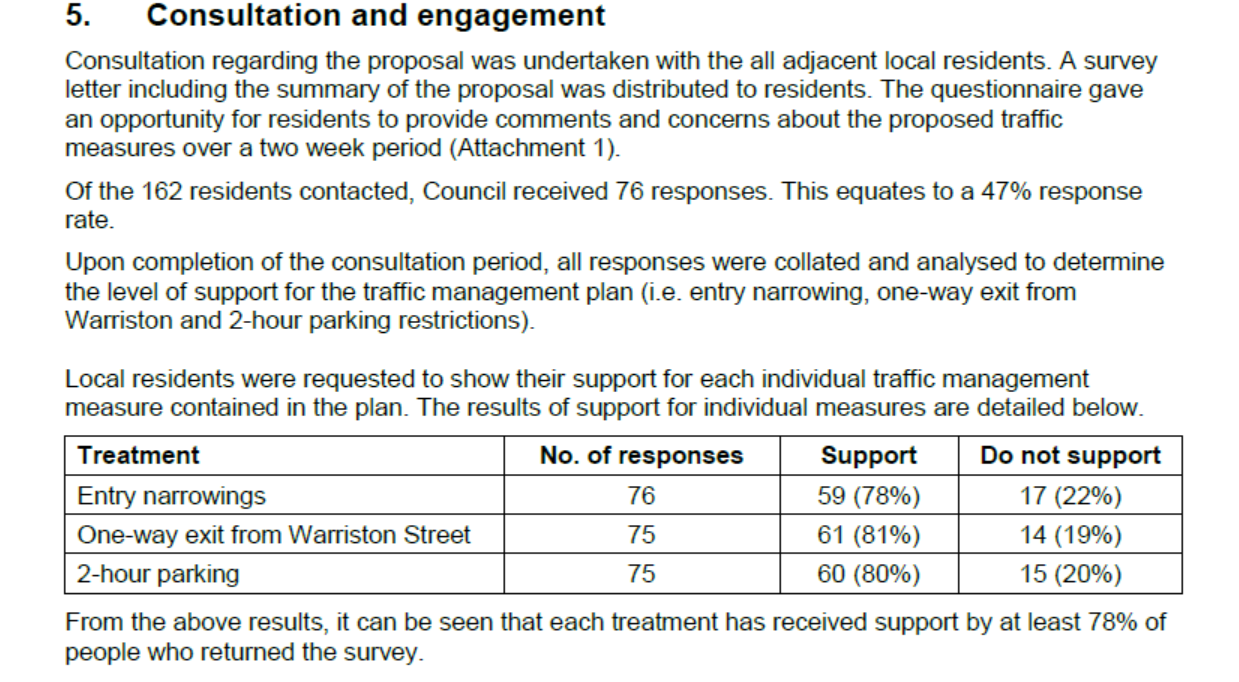
Please note the extent of the following consultation –

traffic

sports

letterstreescrossing

Another item on the agenda for Tuesday night is car sharing. As expected, the Akehurst report is another ‘do nothing’ recommendation. We quote:

“Overall, the sharing of cars may be most viable where the availability of car spaces is lowest and the cost of provision highest, such as in the inner city. A significant number of developments have been approved in both City of Melbourne and Port Phillip comprising dwellings with no car spaces. To the extent that this phenomenon appears in Glen Eira, the viability of car sharing may increase.”

However, what irks us even more is the (deliberate?) distortion of the facts and an unholy game of semantics. Akehurst claims: “Only Melbourne and Port Phillip City Councils have policies adopted by council”. Not true, incorrect, and pure bunkum!

After only half an hour of investigation, we have discovered that NUMEROUS OTHER COUNCILS INCLUDE CAR SHARING SCHEMES in their respective Transport Policies. Others such as Stonnington have already run year long trials. Please note – all of these are policies which have gone through the normal channels – ie. public consultation and accepted by full council meetings and subsequent formal resolutions. So, either Akehurst has not done his homework adequately enough, or the claims in this report are far from “clerical errors”!

Here is our evidence taken directly from the respective policies. We have even uploaded the full Moreland policy where car sharing is given major prominence. Below are some extracts from other councils –

Car sharing is one way of limiting car ownership for people with very occasional car use.  Such schemes are generally used by people who would not be able to make the journey by public transport, cycling or walking or who don’t use a car frequently enough to merit owning one.  Council is supportive of car share schemes as they can reduce the need for numerous car parking spaces and unnecessary car ownership. Council currently provides parking spots and signage to car share companies and in addition encourages support through promotion at Council events and in the Yarra News. (Yarra City – Strategic Transport Statement – 2006)

“Policy 26: Council will support the expansion of car sharing in Maribyrnong

Issues and Justification

The popularity of car sharing schemes across Melbourne has increased significantly in recent years. Car sharing allows registered members to book and rent a ‘pool’ car for, generally, short term usage, typically ranging from a few hours to a day or two. Car sharing is most effective in mixed-use areas with good public transport, cycling and pedestrian networks, which make it possible for residents and workers to undertake most of their daily activities without a car, while offering the flexibility of car usage for special occasions. Car sharing can also be effective as an alternative to owning a second car…….

Actions

Action 26.1: Support the provision of at least one car sharing space to be installed on-street adjacent to all new high density residential and commercial developments.

Action 26.2: Exempt car sharing vehicles from parking fees in all Council-controlled off-street carparks.

Action 26.3: Explore mechanisms to extend parking privileges to car sharing vehicles (similar to vehicles displaying Resident Parking Scheme permits) – in selected areas throughout the municipality in support of short-term parking access while avoiding unintended consequences such as long-term commuter parking.

Action 26.4: Explore mechanisms to provide car share parking spaces (in addition to car share ‘pods’) in highly sought after locations as an incentive to car share users. These parking spaces would not be associated with a particular parking management policy – council resolvedvehicle or car share company, but could only be used by car share vehicles. (page 84)

(http://www.maribyrnong.vic.gov.au/Files/Maribyrnong_Integrated_Transport_Strategy_2012.pdf)

The latest Census figures literally make a mockery of both the State Government’s, but more importantly, council’s pronouncements. The over-riding rhetoric has been that people who live near railways, major transport routes (in essence, Housing Diversity Areas) will not require as many cars. This myth, and its associated problems, has been further compounded by council’s failure to:

  • Implement Parking Precinct Plans across the municipality, and especially in Activity zones even though the planning scheme still contains clauses that promise to do this. We’re still waiting!
  • Council continually waives car parking requirements in development after development. The argument is that residents will avail themselves of public transport!
  • There is no home-grown analysis of the impact of parking in adjacent streets or the creation of ever increasing ‘rat-runs’.
  • Potential, albeit partial ‘solutions’ such as car share are pooh-poohed by administrators and put on hold
  • Residential parking permits are handed out almost willy-nilly with no thought, or follow up, of what happens in all those ‘adjacent’ streets
  • We also remind readers that there was the promise to ‘incorporate’ all the latest Census figures into the Community Plan once they were available. The community plan is coming up for review. We won’t hold our breaths however for any radical revisions!

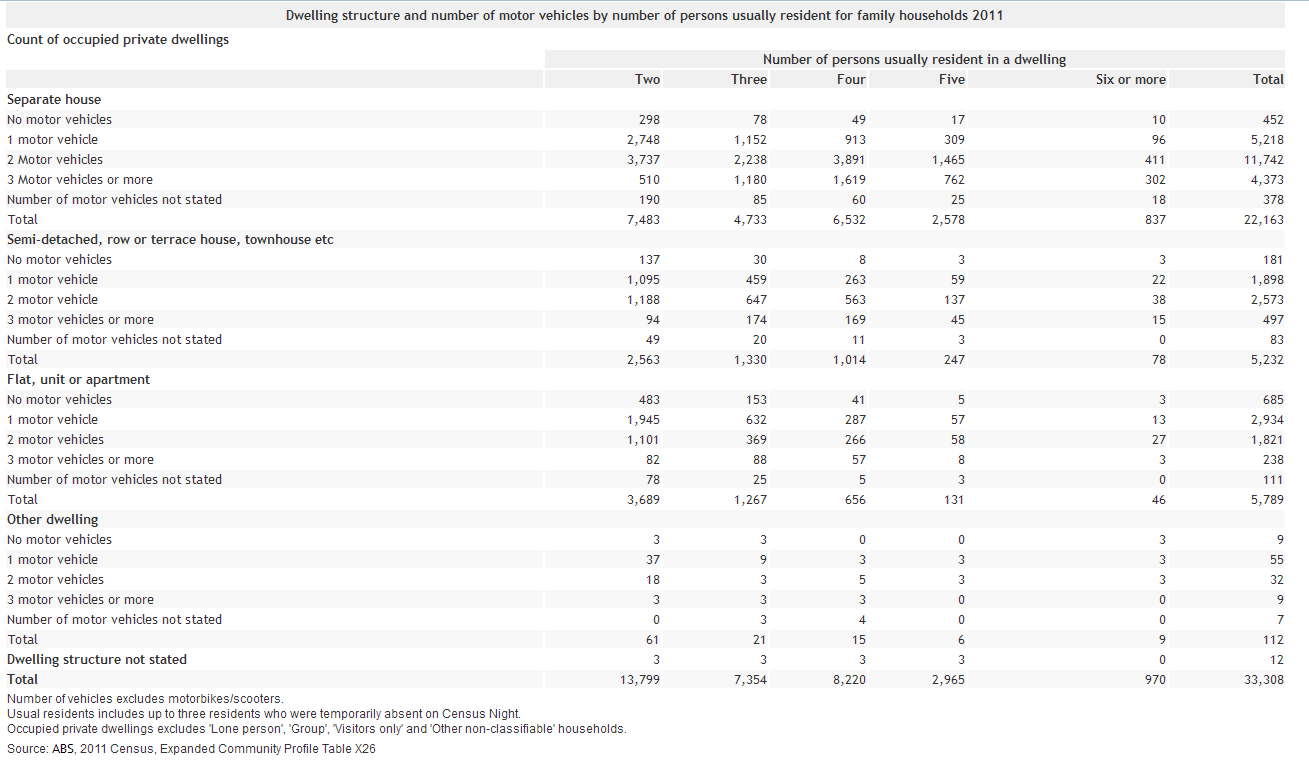
The following statistics taken from the VicRoads Transport Portal (http://www1.transport.vic.gov.au/VTSP/homepage.html) should be carefully assessed by all residents. They reveal what we already know – a steadily worsening situation!

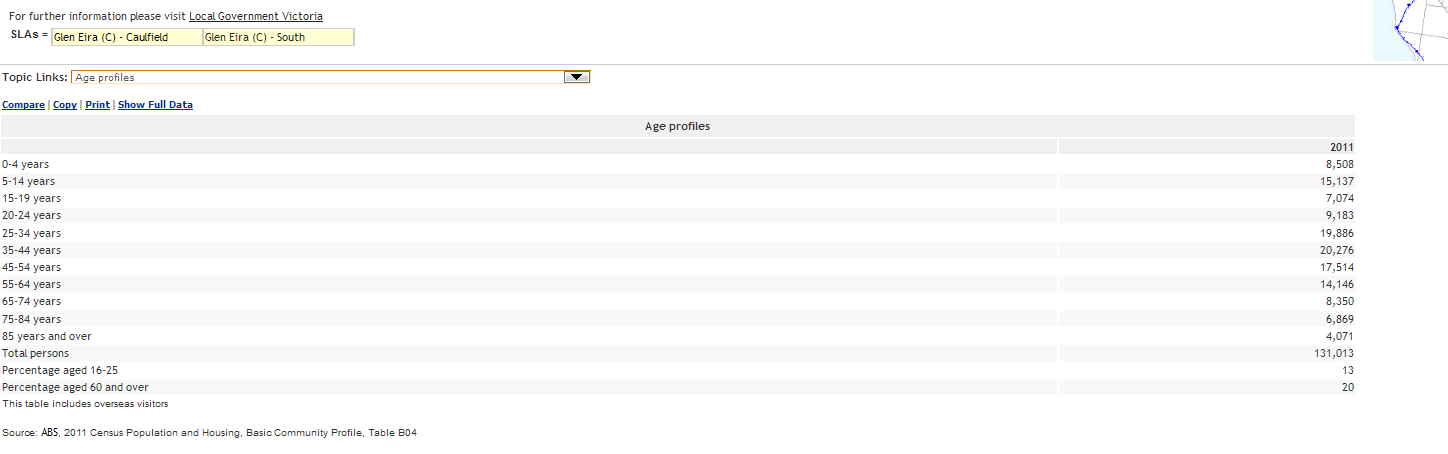
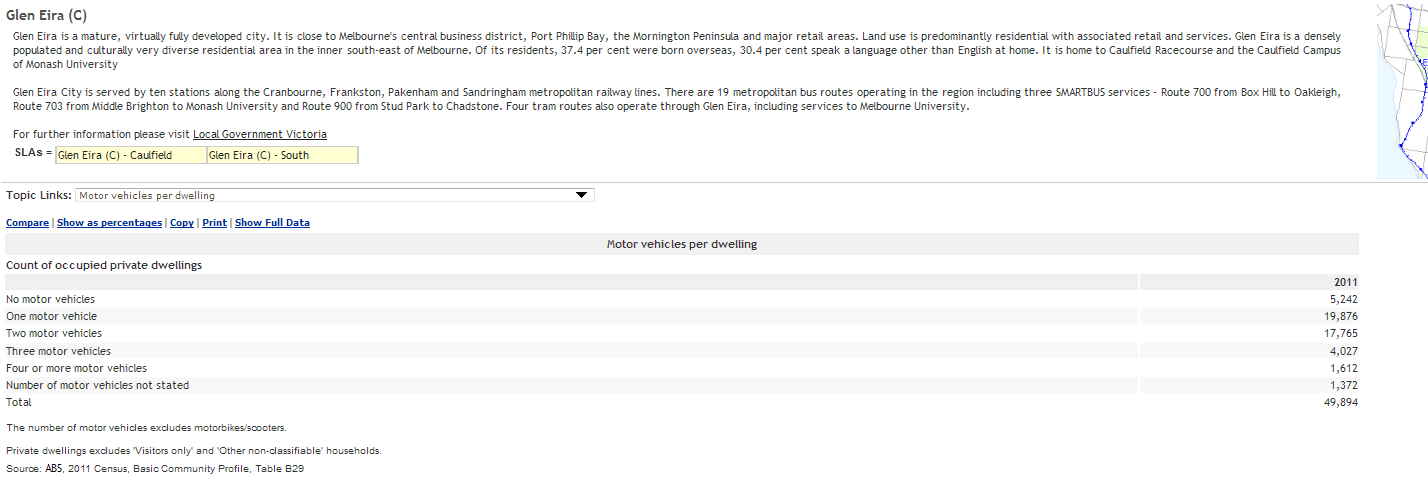
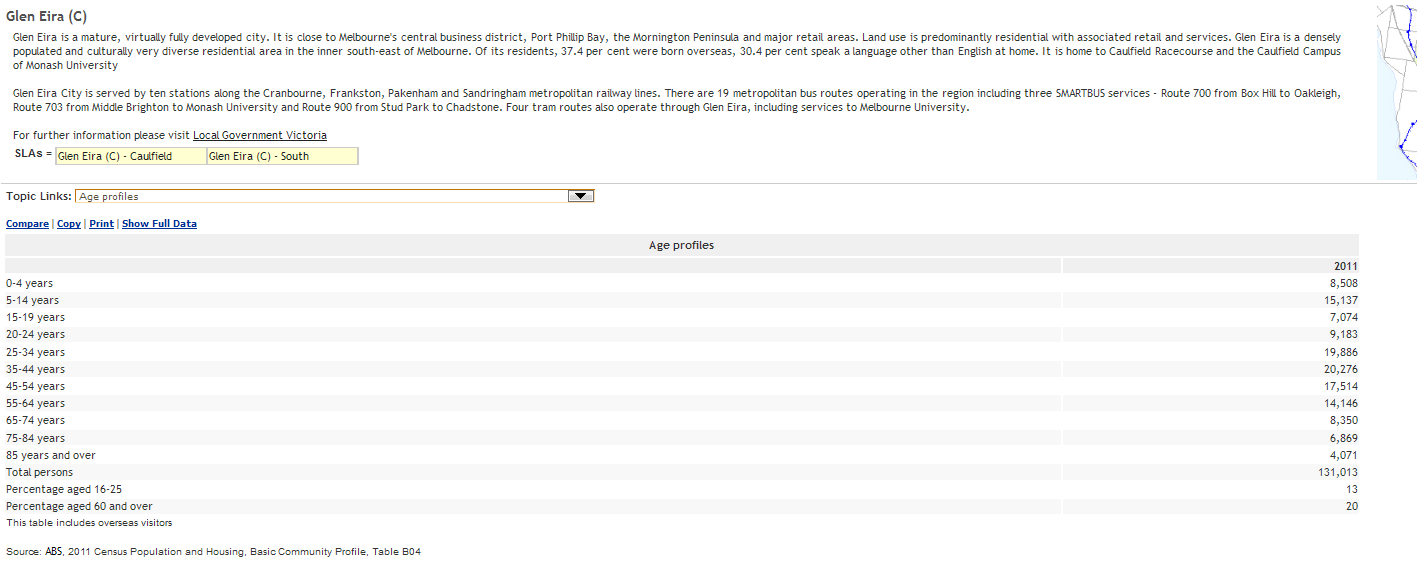
  • We learn that there are about 48,500 cars in Glen Eira.  Of the 131,000 estimated population, just on 30,000 are 19 years or younger. That means there is close to one car in Glen Eira for just about every 2 people eligible to drive.
  • We also learn that the numbers of people driving to work has increased by 2,200 since the 2006 census. Bike riding has only gone up by 170 individuals.

The ramifications of these figures must be addressed. The problems associated with parking and general traffic management have been brought up again and again by residents. Yet Council, true to form, has done practically nothing except produce ‘policies’ that are good on rhetoric and spin, but totally deficient in action, planning, and real analysis that should form the bedrock of all action plans. Real vision and long term planning simply does not exist.

Here are the stats. Click on each image to enlarge.

cars age2

age2

car numbersage profile


« Previous PageNext Page »