GE Transport


This message was approved for distribution by the Office of the Campus Manager for and on behalf of the City of Glen Eira Council’s Major Projects Coordinator.

**********************************************************************************************

As part of Glen Eira City Council’s 2012/2013 Capital Works Program, Council has allocated funding to undertake traffic and pedestrian safety improvement works in Sir John Monash Drive, between Derby Rd and Princes Ave.

Works will include; renewal of the road pavement, footpaths, kerb and channel and underground drainage, two new flat top speed humps with incorporated zebra crossing points and pedestrian safety improvements linked to new streetscape improvements.

Works will commence the week starting 10 September and are anticipated to take 8 weeks to complete (weather permitting).

Sir John Monash Drive between Derby Rd and Princes Ave will be closed to all through traffic for the duration of the works. Access to the off-street car-park behind Coles and to the Building J car-park will be available at all times via Princes Ave.

There will be pedestrian access to shops and railway station ramps at all times during the works. Bus stops will be relocated to Derby Rd for the duration of the works with appropriate signage directing patrons to the temporary stops.

We understand that these works will be very disruptive but this is an important project undertaken by the City of Glen Eira to deliver long term benefits to the community.

For further information on the works, or any queries you may have through the duration of the works in Sir John Monash Drive, please contact City of Glen Eira Council’s Major Projects Coordinator, Mr Frank Romania, on 9524 3333 during normal office hours.

The minutes of last council meeting record the following in regard to a public question on traffic management –

“Councillor Lipshutz, our question to you is: Did you in fact inform the traffic department of the agreement you had reached with the Rowan Street Elsternwick residents group to hold off implementation? If so when did you inform the traffic department? How many survey returns did Council receive in order to proceed with this work? What was the total cost of running the Council survey & implementing the 6 parking restrictions signs in this small section of Rowan Street?”
Cr Lipshutz read Council’s response. He said:

“I met with two residents and requested the Transport Planning department on 5 June 2012 to hold off while the residents returned their surveys. At this time, the Transport Planning Department advised that the installation would be placed on hold for one month. The signs were not installed until 25 July 2012.

Eight questionnaires were received from residents during the consultation held in April 2012.

The parking restriction consultation was undertaken as part of the day-to-day operation of the Transport Planning Department. I am advised that the cost of six parking restriction signs manufactured and installed by Council’s depot was less than $200.”

All well and good EXCEPT that the first part of the question has been edited out. Whilst not strictly a ‘question’, the background provided is essential in order to understand the situation and the actions taken by council.

This is not the first time that residents’ questions are conveniently edited (censured?). The old excuse of exceeding 150 words is also invalid since many questions have been published that far exceed this count.

Residents rightly expect that when public questions are submitted that the full text of that question will be entered into the minutes. Without a firm, written and public policy on how public questions will be recorded, the pattern of rewriting history remains unchallenged.

Here is the full question:

“Below are questions personally directed to Councillor Lipshutz

Following notification by Council’s traffic department to Rowan Street Elsternwick residents in April/May 2012, of Council’s intention to erect 2HR parking restrictions in Rowan Street (section between Shoobra St & Orrong Rd, a group of residents met with Councillor Lipshutz on Monday 4 June 2012 to voice their concerns regarding Council’s decision to proceed with the parking restrictions, based on a very small number of responses received to its Survey. Of the total 15 properties abutting Rowan Street, 8 responses were received, which according to Council traffic department 5 supported the restrictions & 3 did not.

At the 4 June 2012 meeting, Councillor Lipshutz agreed to request Council traffic department to hold off implementation until all 15 properties had been surveyed by the residents group. The residents group kept Councillor Lipshutz informed of progress via email on following dates 7/6/12, 8/6/12, 13/6/12, 20/6/12, 13/7/12).  The last email to Councillor Lipshutz from the residents group dated 13/7/12 stated that as 2 properties were vacant (one being renovated & the other being rebuilt), efforts were being directed at locating the 2 owners and the email emphasised that it was expected as per our agreement, that in the meantime, the restrictions would not go ahead. The email also stated that of the responses received to the residents group survey, the majority were not in favour of the 2HR parking restrictions proposed by Council.

However, to the absolute amazement of the Rowan Street Elsternwick concerned residents group, despite the agreement reached with you Councillor Lipshutz, the Council traffic department disregarded this agreement you had with us & proceeded to implement the 2HR parking restrictions in late July 2012.

Councillor Lipshutz, our question to you is:

Did you in fact inform the traffic department of the agreement you had reached with the Rowan Street Elsternwick residents group to hold off implementation? If so when did you inform the traffic department?

How many survey returns did Council receive in order to proceed with this work?

What was the total cost of running the Council survey & implementing the 6 parking restrictions signs in this small section of Rowan Street?”
This comment has come in from a reader. Given the current shambles of traffic management in Glen Eira, we publish this in the public interest.

“My mind boggles at council’s approach to parking and traffic management.  Major road works are underway in Kokarib Road Carnegie, the street behind Koornang Road where Safeway is located.  The street is being totally rebuilt and council in their wisdom appear to have removed the angle parking outside Safeway and are replacing it with parallel parking.  This will mean the loss of about around 8 or 9 car parking spaces outside the supermarket. These car spaces were nearly always fully occupied.  My amazement at this loss of parking in Carnegie follows from seeing the result of roadworks and parking  in Glen Huntly near Safeway.  They effectively removed up to four car parking spaces on  each side of the road near the post office.. I know traffic lights have  been installed, but why would you reduce car parking?  What benefit is there to shop keepers?  What benefit is there to shoppers? What are the benefits at all?”

And we mustn’t forget another important question – what is the cost?

The following stems from another public question asked at last council meeting. Whilst the original question is admittedly long and not numbered, we have attempted to organise the question and answer along some logical lines. This proved to be a most difficult task given that there is no real connection between what is asked and the response! All the questions relate to parking and traffic management in an upcoming Murrumbeena development. 

Why hasn’t the council been pro active knowing that post development there will be traffic and parking issues?  

Answer – William Street, Murrumbeena is situated within Council’s Housing Diversity Area. A key reason for this designation is the good access to public transport (including Hughesdale Railway Station) which provides opportunities for residents and their visitors not to use private vehicles. Development is therefore directed towards these areas.

What are councils plans regarding parking and traffic flow in and out of William st knowing that reports are already available.? 

Answer – It is acknowledged that some additional vehicle movements will be experienced in William Street as a result of the new development however State Government Planning Guidelines state that reasonable traffic volume targets for local access streets are variously between 1,000 – 3,000 vehicles per day.  

Why does the council continue to fail the residents and stakeholders regarding this development?  

Answer: Council annually receives many requests for traffic management works but resources for works of this type are finite requiring prioritisation of resources. Resources are directed to those streets in greatest need of attention (not where new rateable homes are provided). Council operates a warrants system whereby streets are prioritised for attention on the basis of objective criteria including vehicle speeds, traffic volumes, reported crashes, peak hour traffic volumes and land uses (activity generators).

Why cant the the council be proactive and involve the residents and stakeholders with and open forum to appease concerns regarding access in and out of William st let alone parking post development? 

Answer: Traffic counts will be undertaken following the occupation of the new apartments to determine the number of vehicles using William Street. 

It is obvious that there will be traffic issues in William st post development, imagine 50 cars trying to get in and out of Poath rd in peak hour. keeing in mind cars parked in the street.  

Answer: It is not appropriate to assume that traffic and parking impacts after construction will be unreasonable. 

The resources are available as there is 41 new rateable homes, The information regarding traffic management is available and already supplied.  

What is the councils plans to assit and appease the residents and stakeholders concerns regarding traffic and parking in William St Murrumbeena?”

Answer: Once data is collected in William Street, it will be added to this list to determine its priority for traffic management works.


Residents’ rat-run rage

Andrea Kellett  

COUNCIL CHALLENGED OVER TRAFFIC AND PARKING ISSUES

GLEN Eira residents fed up with rat runs and limited parking have gathered to vent their anger and discuss change. The Glen Eira Residents Association held a forum in Elsternwick last week titled ‘‘Rat runs and no parking — a feature of life soon. What’s the alternative?’’

President Don Dunstan said it was the association’s first forum on the issue and 50 people turned up. He said the association had surveyed residents and found traffic and parking were causing angst. ‘‘People are fed up,’’ Mr Dunstan said. ‘‘There are quite a few streets where, at night, you can’t get parking because there isn’t any.’’ Rat runs had formed in Elsternwick as a result of lower speed limits in Glenhuntly Rd. ‘ ‘ The only way to get change is to change the council in October,’’ Mr Dunstan said.

The association said speed cushions on McKinnon Rd were also causing problems. Traffic and parking management were common concerns raised as part of Glen Eira Council’s 2013- 2017 community plan consultation early this year. Mayor Jamie Hyams said the council was ‘ ‘ aware these are issues of great concern’’.

+++++++++++++++++++++++++++++++++

City picks up super shortfall  

Donna Carton  

OPERATOR NEED PAYOUTS TO FINANCE PENSIONS

GLEN Eira Council is still waiting to hear how much it must pay out in extra super payments.

Local governments are reworking t heir 2012- 13 budgets as they anticipate the extra payments, likely to be in the millions of dollars. Super fund operator Vision Super last month confirmed it needed significant additional payments from councils to meet pension needs. There is speculation that the shortfall in its defined benefits scheme could be bet ween $ 5 0 0 million and $750 million.

Glen Eira community relations director Paul Burke said the council was ‘‘awaiting notification of the figure’’ but that it would be spread out over a number of years. ‘‘It will be factored into council’s existing planning and budgeting cycle and incorporated in the 2013 strategic resource plan that will go out for community consultation,’’ Mr Burke said.

Port Phillip estimates it will have to pay $4 million over five years, but mayor Rachel Powning said it was budgeted for. Mornington Peninsula Shire fears it is facing a $10 million superannuation shortfall. Vision Super chairman Rob Spence said the global financial crisis had hurt its performance and council payments must increase.

Approximately 50+ residents showed up to last night’s commununity forum to hear the latest on traffic management and parking. First cab off the rank was Dr. Bruce Corben who emphasised the importance of speed reduction in local residential streets and arterial roads and the health and environmental benefits this would achieve. Research revealed that pedestrians were at greatest risk even when cars were travelling at 30km per hour. He commented that the objective of all street calming projects was to lower car speeds and that roundabouts were the most effective in achieving this aim.

Cr Narelle Sharpe outlined the holistic 8 step program that Moonee Valley Council is employing. The beauty of this scheme was that it included in-depth research and analysis of entire areas resulting in 22 precincts that were ‘weighted’ according to various criteria such as traffic volume, speed, surrounding facilities, and most importantly, community consultation. The plan for each precinct cost in the vicinity of $45,000 and Moonee Valley had undertaken to complete 2 precincts per year. It was therefore a long term vision based on a thorough understanding of the needs of each local area rather than a single street.

Cr Serge Thomann highlighted Port Phillip’s approach and the pressures that this municipality faced in terms of incredible high density, tourists and visitors, as well as the ensuing parking problems. The strategy adopted by council was: (1) a hierarchical road strategy that placed pedestrians at the top followed by cyclists and then cars. (2) council’s refusal to issue residential parking permits for new developments; (2) extensive community bus services; (3) different street calming measures that varied across the municipality – ie raised pedestrian crossings in line with footpaths.

Whilst each municipality is unique, it is obvious that common problems exist. How these problems are approached by decision makers is what is important. We maintain that in Glen Eira the approach is haphazard, and lacks a truly integrated vision. If safety is the most important criterion then councils must be pro-active as both Moonee Valley and Port Phillip appear to be. It just is not good enough for residents to be told that your street is within the 85th percentile on speed and traffic volume so we won’t do anything! The old adage that prevention is better than cure certainly applies in this domain.

Today’s Melbourne Bayside Weekly –

Sporting chance for parkers  

bridget.fitzgerald@fairfaxmedia.com.au  

A SHORTAGE of car park space at the new Glen Eira Sports and Aquatic Centre is causing problems for users of a neighbouring sports ground.

Soccer club members who use Bailey Reserve, on East Boundary Road, are being forced to park in neighbouring streets because of a lack of spaces.

Glen Eira Moorabbin Softball Association president Ian Bahn believes the problem will worsen when the softball season starts in October. “Our season hasn’t started yet, but we have been down to Bailey Reserve to have meetings, and seen that it [parking] is going to be a problem,” Mr Bahn said. “Come summer, when it gets busier with people using the pool and the ground, it’s going to be very interesting.”

GESAC opened on May 7. Despite opening four months late because of building delays it reached a membership of 4000 on its first day. Glen Eira council spokesman Paul Burke said limited parking was proving to be an issue. “We now have about 5700 members. The problem is that these members are still getting used to how they use the facility and are still creating a routine,” Mr Burke said.

Adding to the shortage, some Bailey Reserve car park spaces were lost during construction of the new facility. East Bentleigh Soccer Club is the primary winter tenant of the ground. Club secretary Chris Loose said parking was an issue. “We have had members of our club making other arrangements, parking in surrounding streets, on East Boundary Road, or walking – but that is obviously not so desirable in winter,” he said. Mr Loose said the club had notified the council of the issue and believed GESAC and Bailey Reserve tenants could work together to find a solution.

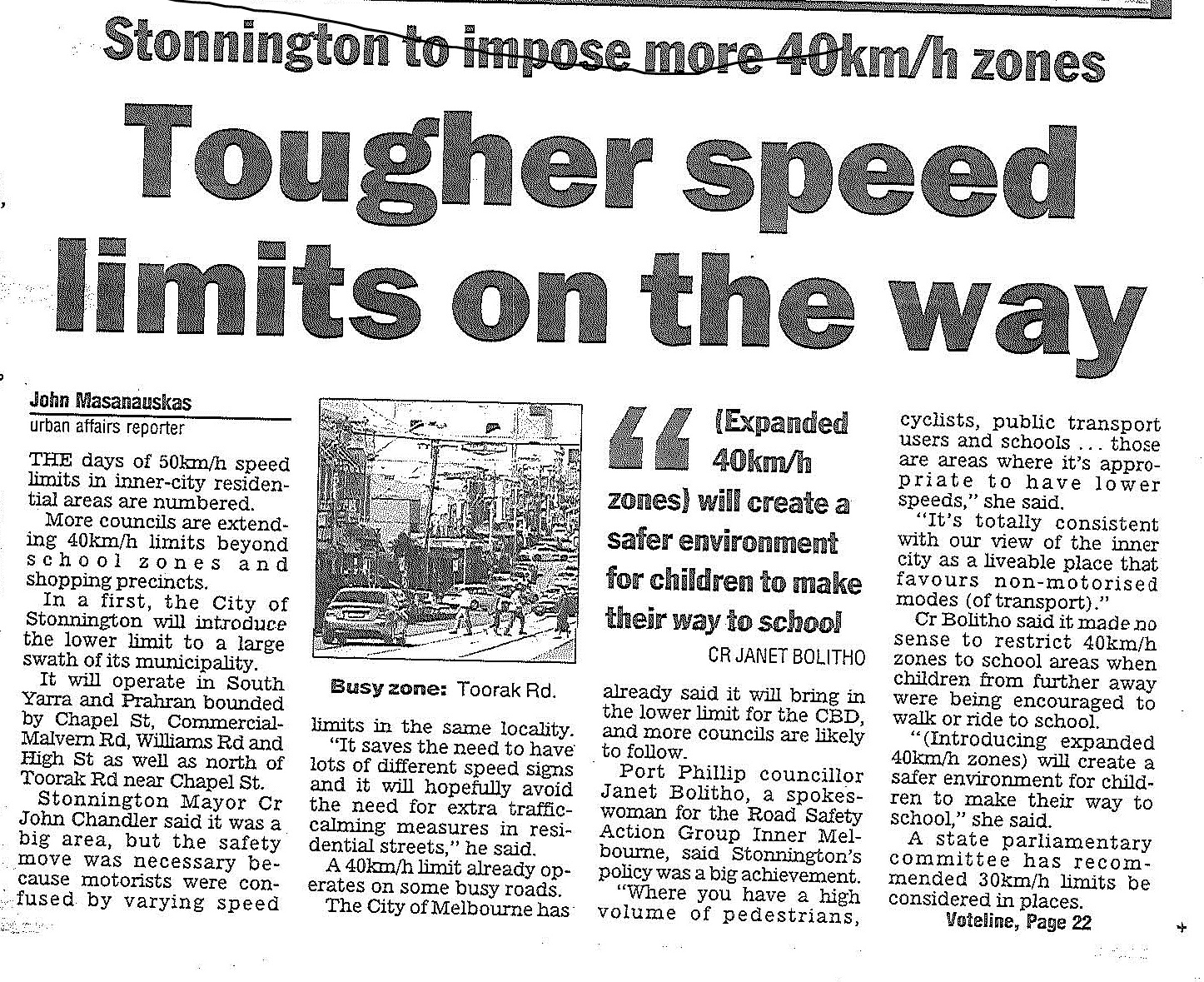
Community safety is supposed to be the bedrock of many Council policies – especially road and pedestrian safety. That’s why the following Leader  article caught our eye. It says a lot about the gulf between rhetoric, spin, and public relations compared to the realities which confront residents on a daily basis. Council’s response is woeful. When safety is an issue it should not take 3 years for any responsible action. We remind readers that when it was deemed necessary (as an afterthought) to extend the GESAC carpark and relocate a playground, nearly $1 million dollars was found overnight! This tells us plenty about the priorities of this administration.

McKinnon residents’ fears over traffic black spot

3 Jul 12 @  05:05am by Jessica Bennett

MCKINNON residents fear someone will be killed if Glen Eira Council does not act on a traffic black spot.

Andrew, who did not want to include his surname, and neighbours have been rallying council to improve safety at the corner of Lindsay St and Balmoral Ave.

He said there had been at least six incidents over the past eight years with drivers losing control around the sharp, narrow corner and smashing through residents’ fences – which happened again on June 6.

“This one is more serious in that the whole car came off the road, mounted the nature strip and smashed into a tree before driving away,” he said.

Resident Richard Kellaway said locals feared someone would be killed at the corner, a popular route for children walking to school, if council did not act.

In a letter to Andrew, council’s transport planning manager Matthew Harridge said a road safety auditor recommended resurfacing/reconstruction of Lindsay St within three years.

He also said the installation of a high-friction surface would be brought forward in the 2012/13 financial year.

PS: A reader has sent us the following. This Council’s ‘proactivity’ needs comparing with the innovation of others.

We’ve repeatedly stated that where there’s a will, there’s a way. This is abundantly clear when it comes to traffic management, road safety, and parking innovation. Glen Eira’s approach has been, and remains, ad hoc and ineffective. We present below how other councils approach these issues and how they actually PLAN, fund, and develop strategies to deal with 21st century dilemmas. We ask readers to compare this approach to what our administrators and councillors come up with.

Such comparisons are even more important given that today’s Melbourne Bayside Weekly features a news clip stating that Council is ‘advocating’ to the State Government for action on Carnegie Station since “long delays and associated traffic congestion may hamper a retail development being built north of the line.”!!!! Good to see that Council has its priorities right! More to the point, this identical “advocacy” features on Council’s homepage which hasn’t been updated since October 2008!

In stark contrast we present two documents: a Media Release and a Municipal Parking Strategy (uploaded here) from Moonee Valley Council.

Media Release

Wednesday, 16 May 2012 

Plan in place to review traffic and parking around the city

Last night, Moonee Valley Councillors adopted a long term plan to review and improve parking across the municipality.

The plan involves dividing the municipality up into 22 Local Area Traffic Management (LATM) precincts and rolling out a timeline of scheduled reviews for each one.

Moonee Valley Mayor Cr Jim Cusack said the LATM precincts were identified a few years ago.“Last year we incorporated them into our new Municipal Parking Strategy,” Cr Cusack said. “The Municipal Parking Strategy (MPS) adopted late last year provides a set of tools to effectively manage traffic and parking around the city now and in the future.

“The inclusion of the LATM precincts in the MPS will allow Council to develop a more strategic and proactive approach to managing traffic and parking in Moonee Valley.“Council is taking a local area approach when it comes to traffic and parking in order to help coordinate and integrate parking initiatives around the city.

The use of LATM precincts allows Council to address specific neighbourhood needs, whilst keeping an eye on the wider parking and traffic trends and issues across the municipality such as through traffic. It also enables Council to have a systematic approach to particular traffic and parking challenges such as school zones, encourage parking demand to be spread throughout an area and plan for capital works associated with traffic and parking improvements more strategically.”

“Moonee Valley is a city in transition. As Melbourne grows, our population continues to increase and the level of usage of our road network changes. We want to meet local needs and also take into consideration the wider community and help our residents, workers and visitors move towards more sustainable travel practices.”

Portfolio holder for Traffic and Transportation Planning Cr Narelle Sharpe said Council decided to review two LATM precincts per financial year.“The review of each LATM precinct is a lengthy process as it entails traffic and parking analysis as well as consultation with the local community,” said Cr Sharpe. “With 22 LATM precincts, we needed a set of criteria to help us prioritise the review and implementation program of each area.

“The ranking system we adopted reflects our focus on safety. It is based on numerous criteria ranging from resident and community concerns, traffic volumes, traffic speed and accidents, to more proactive criteria such as the number of activity centres and number of facilities that generate a lot of pedestrian and car traffic like railway stations, schools and community centres.

“To ensure the ranking is fair, we adopted a weighting system so that LATM precincts with a larger number of streets are not artificially advantaged.

“The Fletcher and Newmarket LATM precincts were identified as the highest priority precincts and therefore will be the ones Council will review first.

“Traffic management projects have already been developed for the 2012/13 financial year and we will work towards completing these as soon as the budget is finalised and approved.”

A map of the LATM precincts as well as details of the criteria used, the weighting system and scores of each Precinct are available on request.”

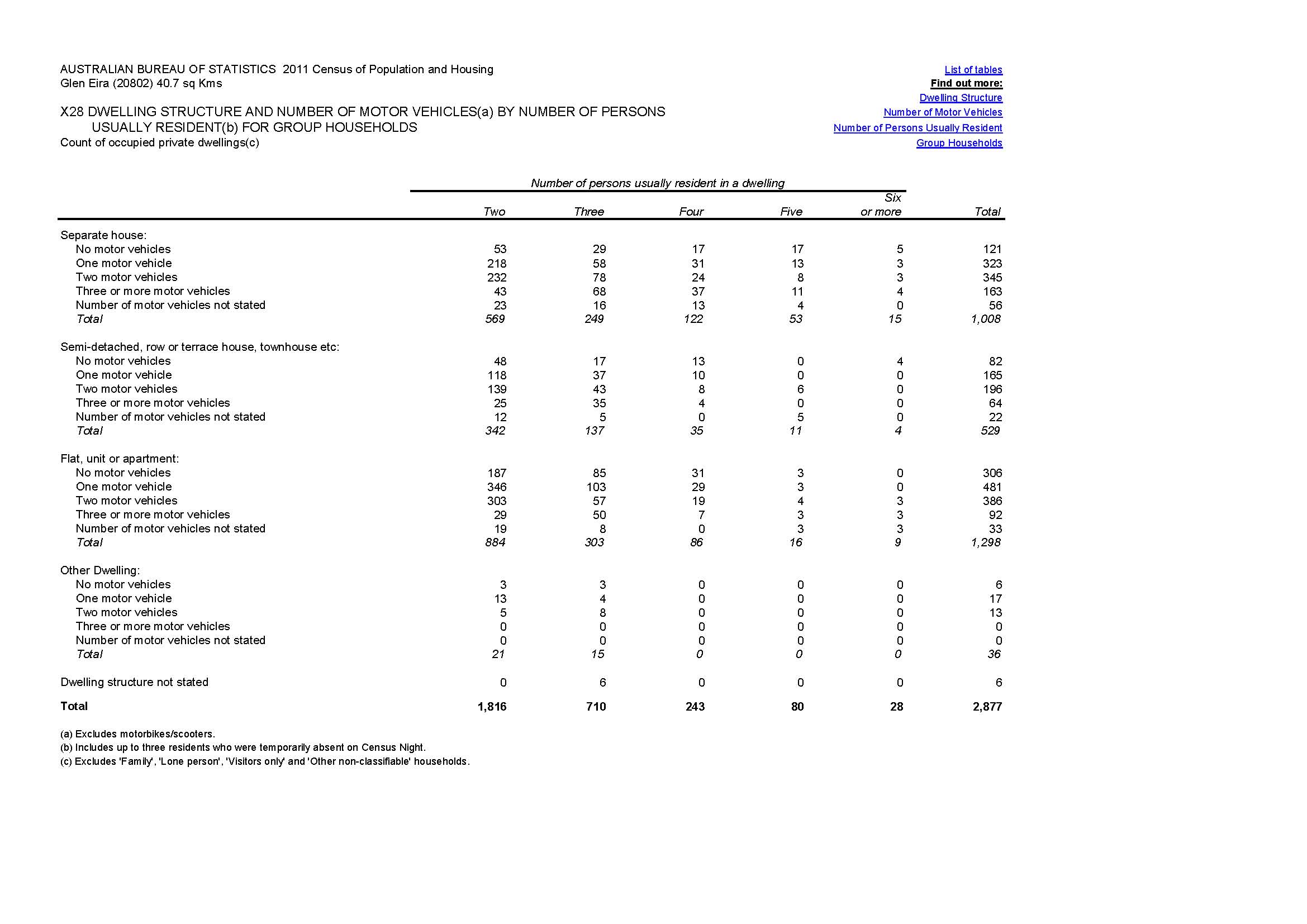
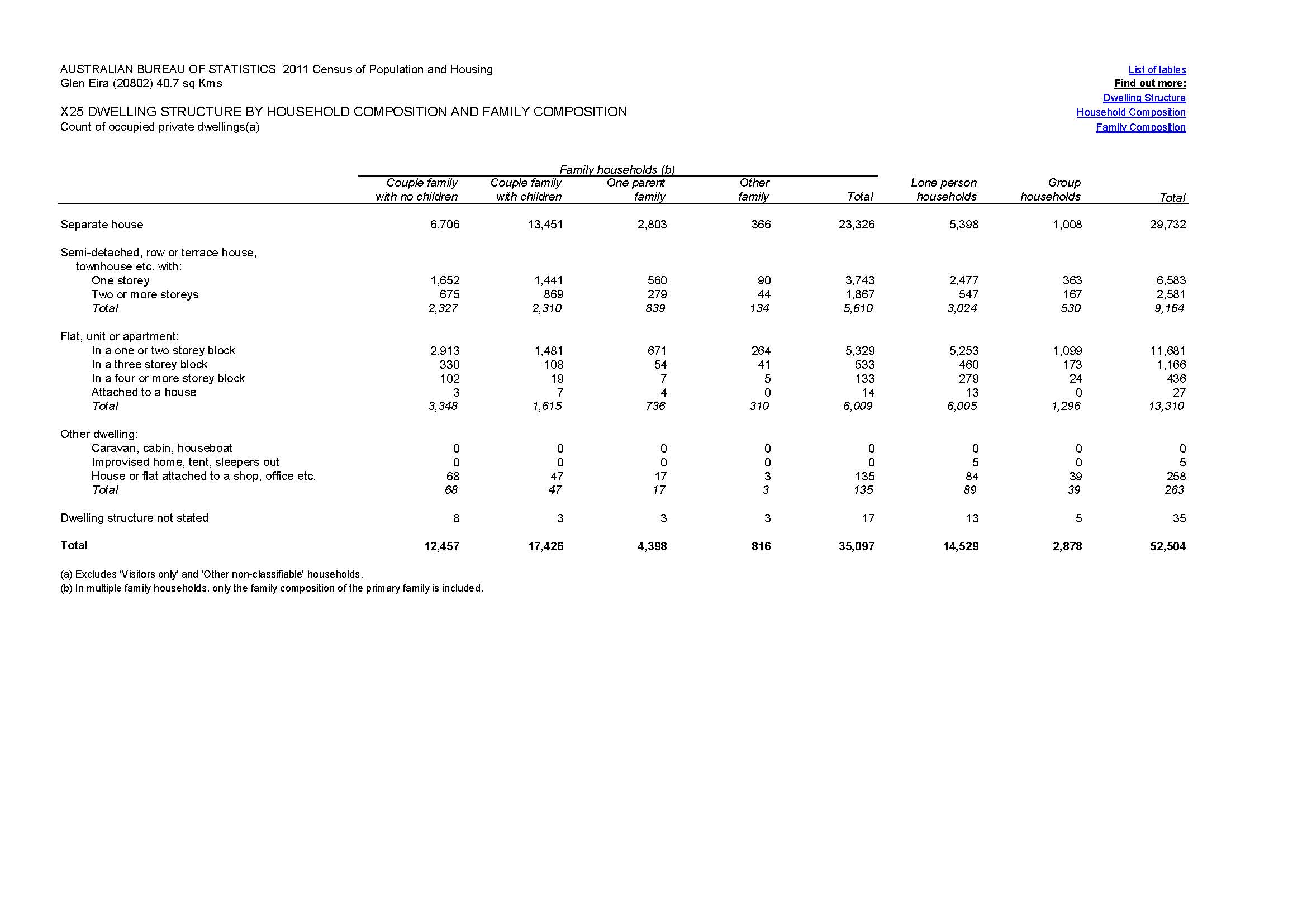
The Australian Bureau of Statistics has started releasing its data from the last census. Many residents, and a few councillors, have stated that they would prefer to wait for all the figures to come out BEFORE a Community Plan is ratified. The reasoning is clear. Unless we know hwo many people, how many cars, how many dwellings, how many aged, etc. planning can be hit and miss.

We present below two sets of figures:

1. The number of dwellings and their composition (ie family, lone person households) as well as the structure of these dwellings.

2. The number of cars per family/dwelling

Both sets of figures provide some startling results. For example: lone person and single parent households represent nearly a third of all Glen Eira residents making this an extremely high proportion who will be hit the hardest by continual rate rises. Then there are the number of cars per family/dwelling. Again, if anyone wanted ‘evidence’ as to our reliance on the motor car, then it is here in spades. Yet, the question needs to be asked: what is council doing about traffic management, pedestrian safety, bike safety, etc. etc.

Please have a look at the tables and offer your thoughts. Click on the tables themselves to enlarge.

« Previous PageNext Page »