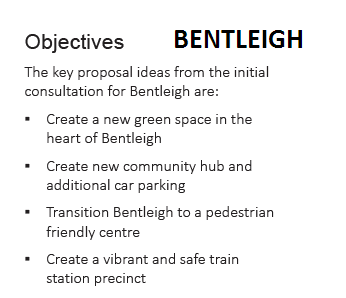
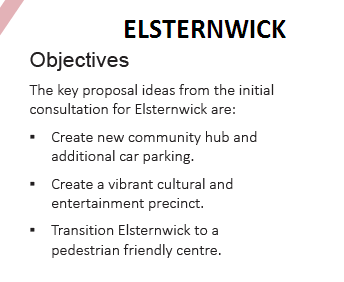
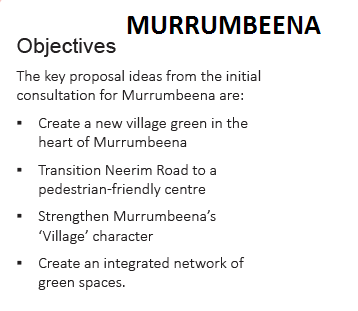
Council’s recent release of documents related to its ‘structure planning’ must, in our view, be treated with a huge grain of salt. This is the first in a series of posts analysing what has been placed in front of residents and how valid, accurate, and transparent these documents really are. Are we again being taken for a ride via data that are highly questionable and manipulated to present already determined decisions?

The first document is called ‘Activity Centres Snapshot: February 2017’. It purports to be ‘based on similar studies carried out by Melbourne City Council’ in its Places for People and Local Liveability 2015 Study. (uploaded HERE). The aim is to ‘provide a more comprehensive understanding of how the city performs for everyday people’. Yet, when both of these documents are compared, the Glen Eira version is anything but ‘comprehensive’. For starters we are told that:

  • All data used in this document is current (February 2017) except for residential and employment population data, which is taken from the Census carried out by the Australian Bureau of Statistics in 2011. How much credence should then be placed on this ‘snapshot’, especially given the rate of development since 2011?
  • The land uses were determined using Council’s internal database and does not include residential land within the study areas. How on earth any study can ignore ‘residential’ is simply mind boggling! Or is this simply more confirmation of the fact that council is focusing exclusively on the single street shopping strips themselves and not the zones that have blighted countless people’s lives?
  • Then of course, there is this wonderful ‘escape clause’ – Disclaimer: this document is provided for information purposes and does not claim to be complete. Although due diligence has been applied to ensure that all information contained in this document is accurate, it cannot be guaranteed that this document is without errors or omissions. Why publish anything if its accuracy and integrity cannot be assured?

We’ve drawn up a table below which illustrates just some of the differences between the Glen Eira version of good planning and what the Melbourne City Council included in their study. To therefore claim that this piece of paper represents a ‘snapshot’ of what is happening in Glen Eira, and is the basis upon which to plan for the future, is not only ludicrous, but deliberately misleading and invalid.

MELBOURNE CITY COUNCI1

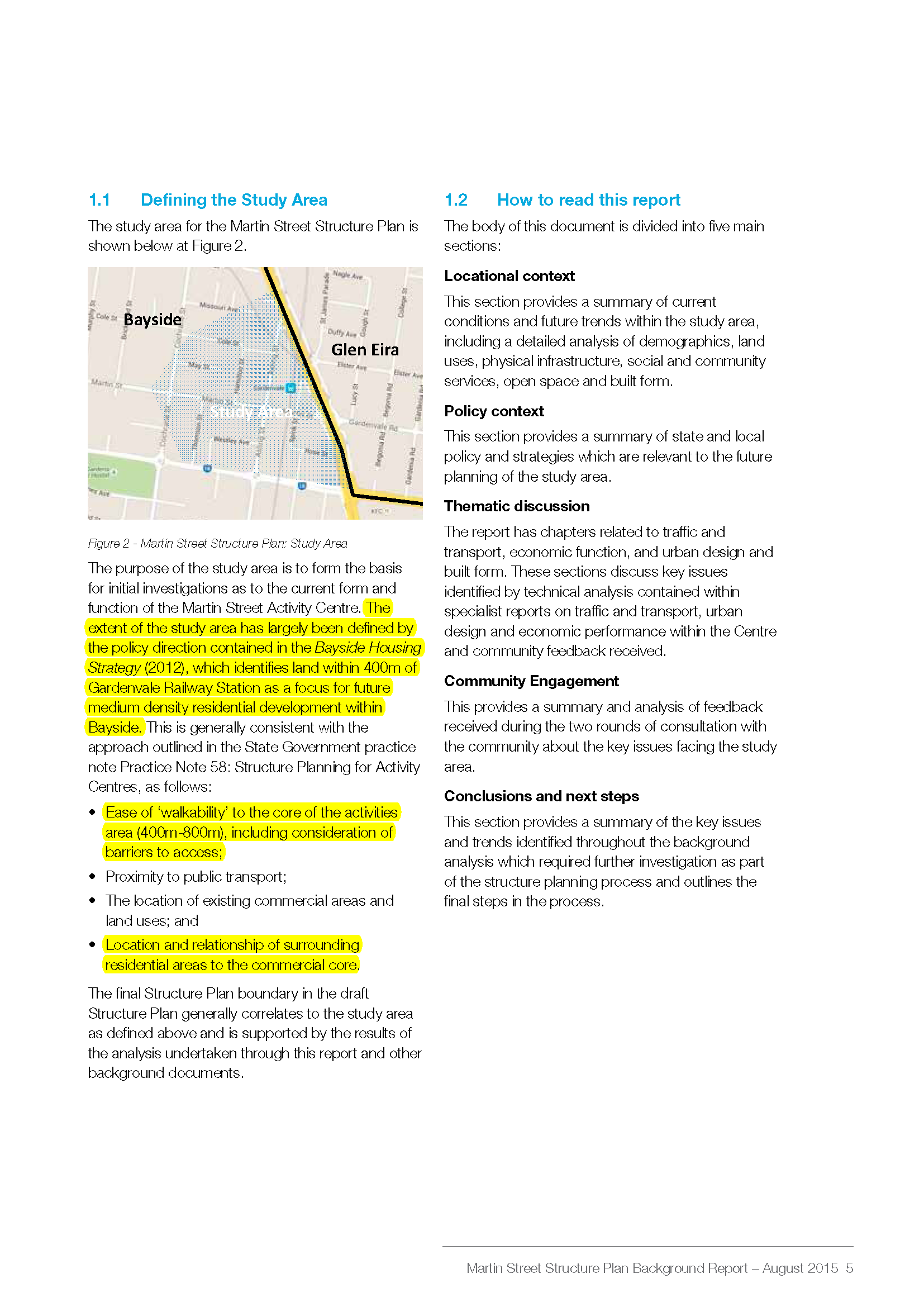
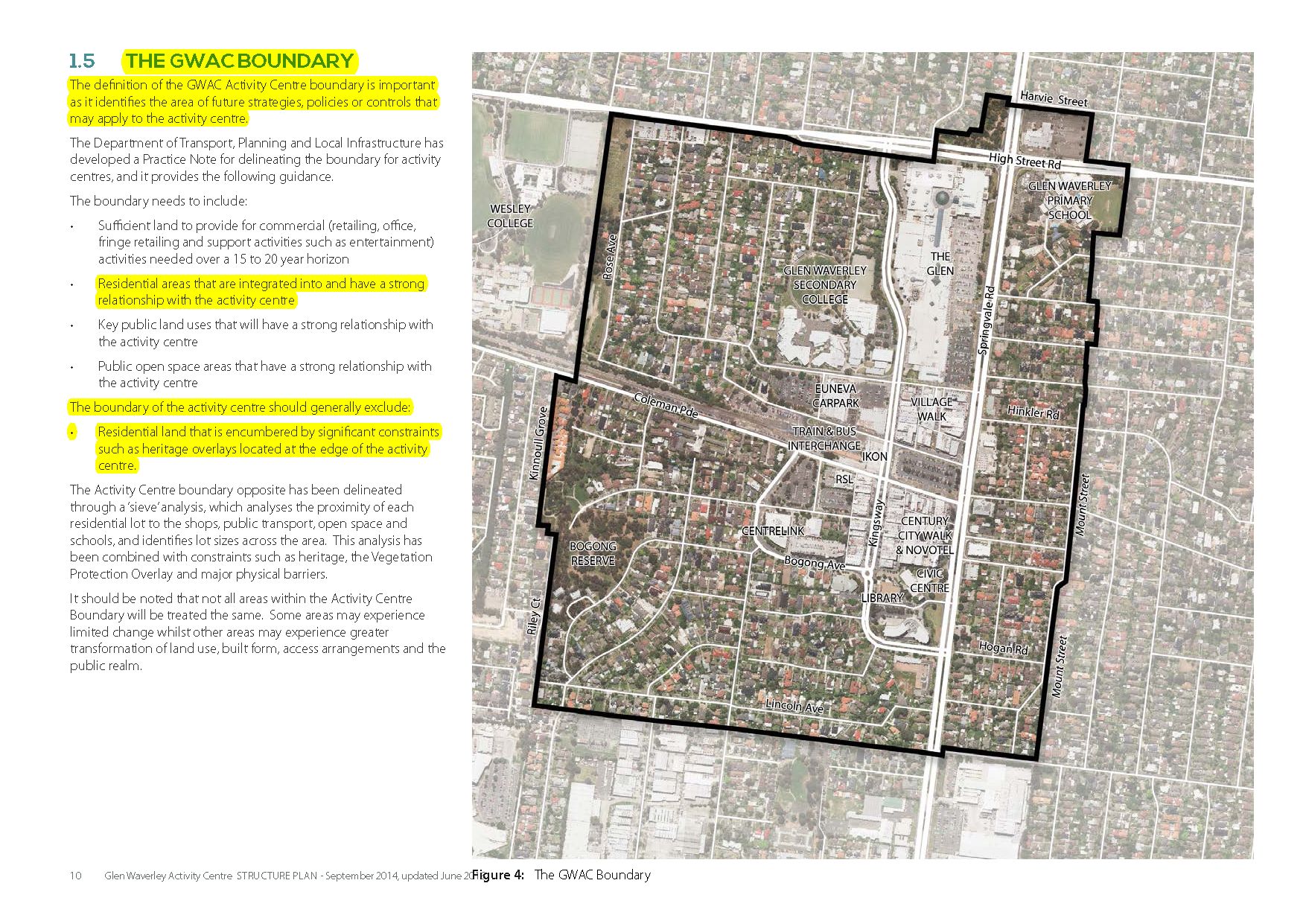
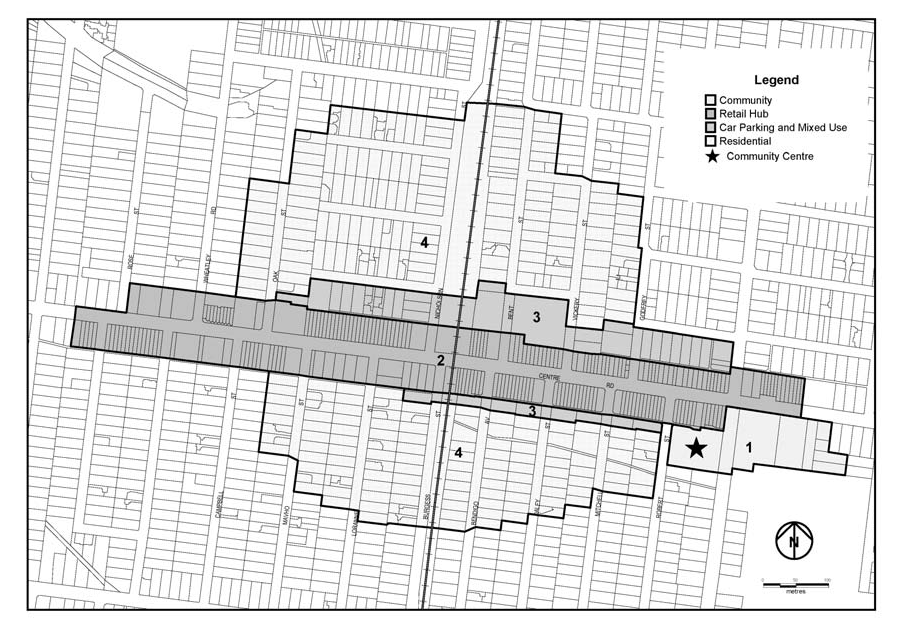
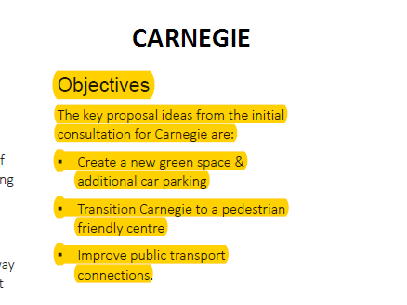
Compounding all of the above, we then have neat little maps of the various areas under consideration – with no explanation, no criteria, and again, lines drawn on a map. The City of Melbourne’s study clearly defined how its various neighbourhood borders were selected –

To understand the Local Liveability 2015 Study area at a local level, 5-minute walking catchments were identified across the study area to effectively act as a sieve and allow for disparate urban geographies and their components to be compared ‘apples for apples’. For greater rigour and to reflect the true local urban conditions, real 5-minute walking catchments were determined rather than standard ‘as-the-crow-flies’ walking radii.
Local Movement as defined by Melbourne then includes ‘Car Spaces Per Employment’, ‘Car Spaces Per Resident’, and the numbers of bus stops, tram stops, etc.  All Glen Eira includes are the latter. As mentioned previously parking does not figure at all. Instead we are presented with nice little maps, that may look ‘professional’ and pretty, but which don’t reveal very much when terms, borders, and important categories are omitted!
The Bentleigh snapshot is typical. Depicted is a huge area that is overwhelmingly ‘residential’ – which we’re told has been excluded. Thus, what knowledge and what kind of basis for future planning can be drawn from this effort? Finally, Melbourne has no qualms in pinpointing areas that are ‘poor’ in terms of ‘liveability’ for its neighbourhood areas. In Glen Eira of course, the category ‘poor’ simply does not exist – everything is ‘great’ or ‘good’!!!!!!!!!

We’ve received the following notice and handout –

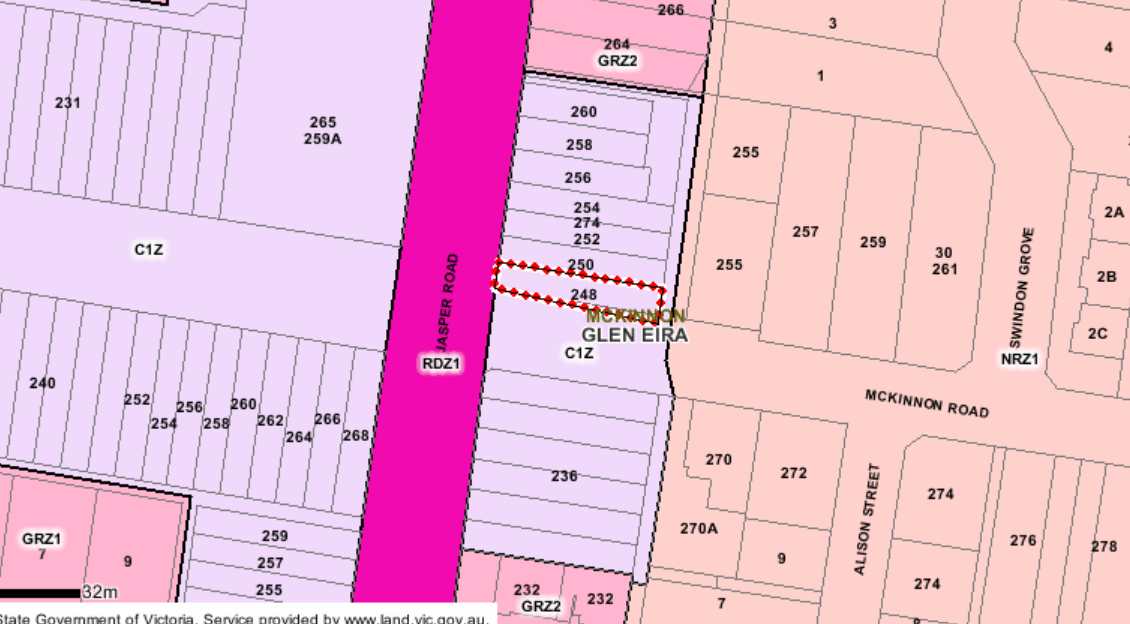
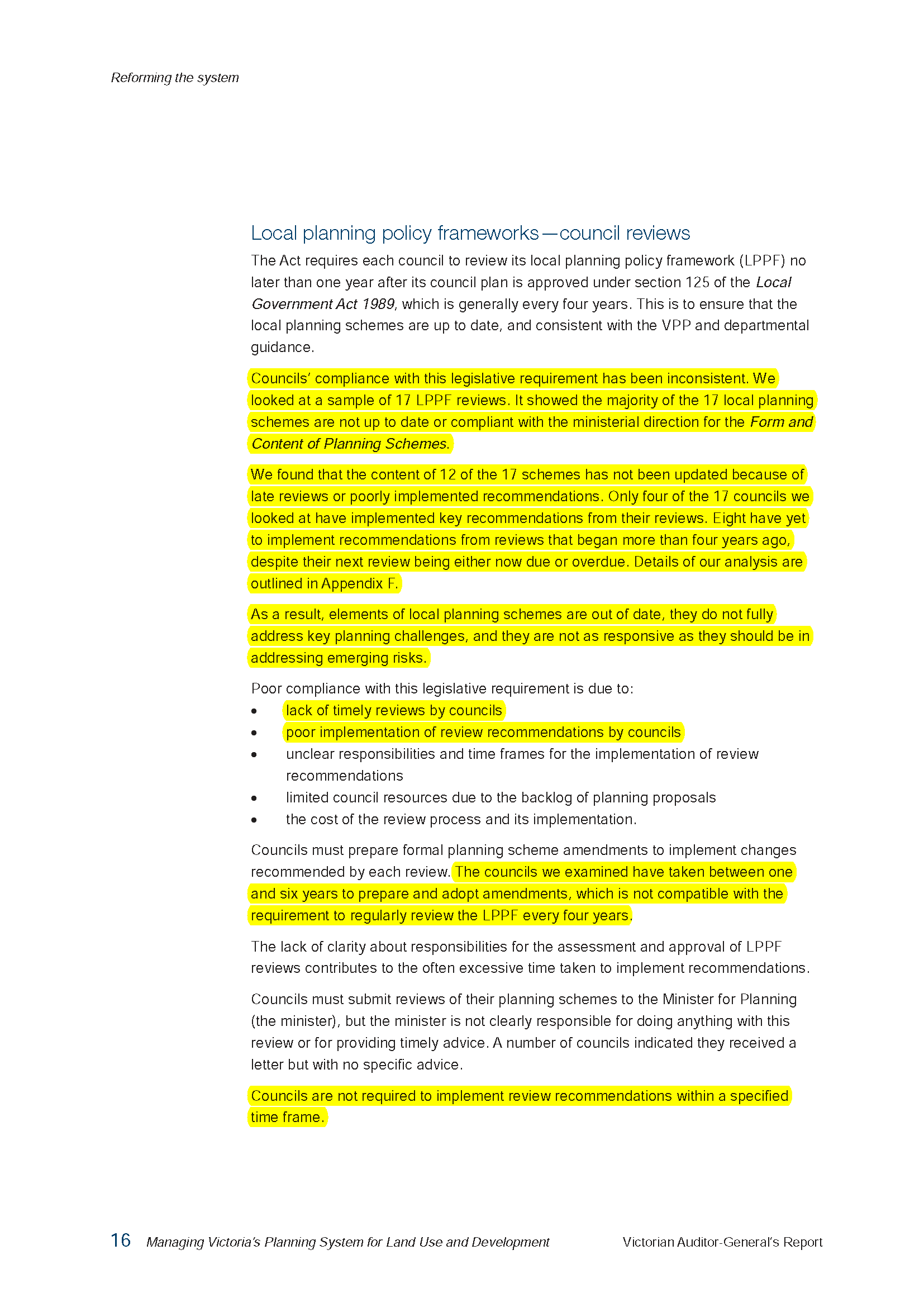
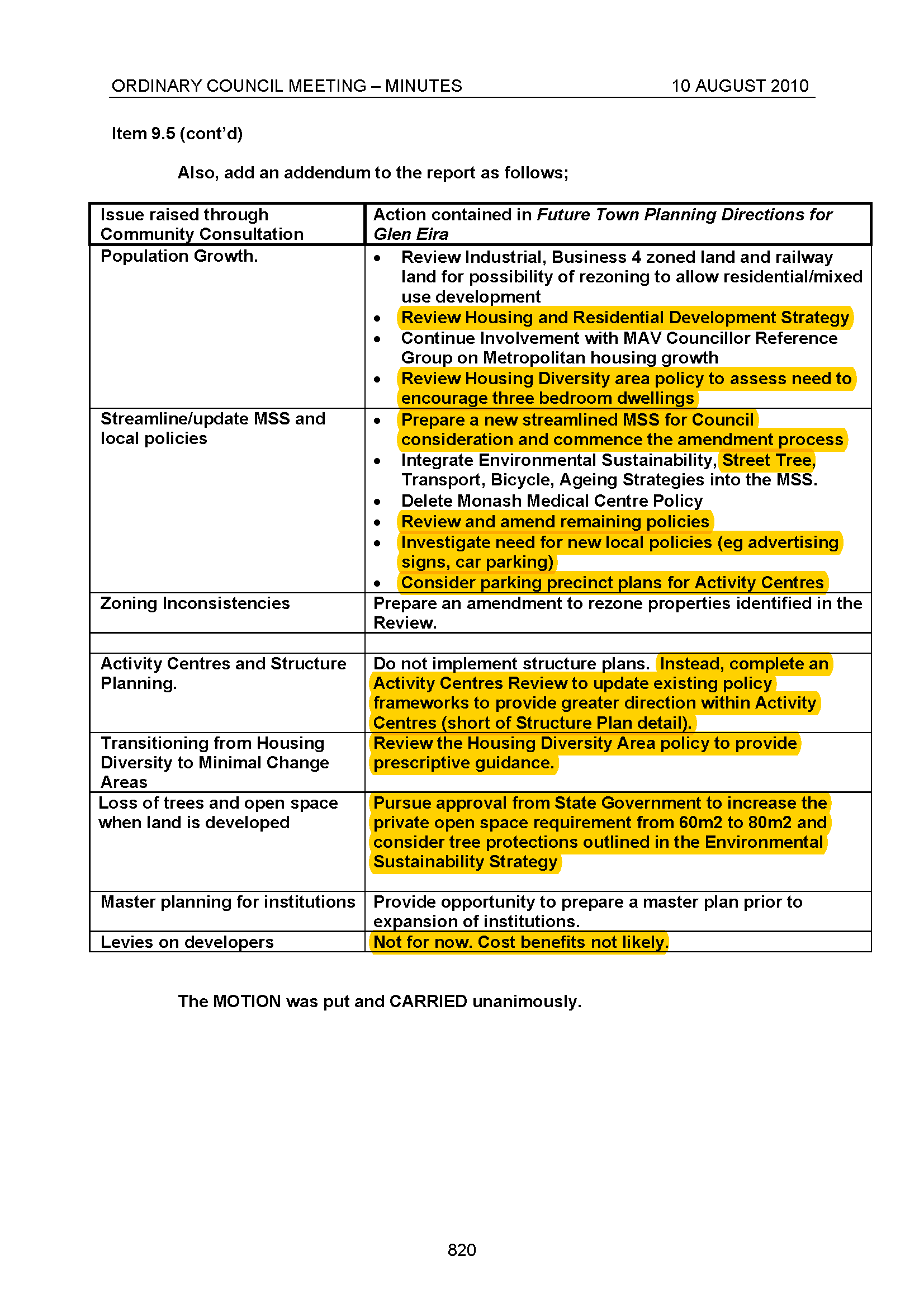
The image seen above comes from page 20 (of 424 pages!) from the current agenda. The Item concerns the controversial rezoning of the corner of McKinnon and Wheatley Roads to a Mixed Use zone with a 4 storey height limit. It is currently zoned Industrial 3 and hence not available for residential development.

We urge readers to carefully note the highlighted sections since:

  1. This is the first time in living memory that council has finally admitted that the Mixed Use Zone is classified as ‘residential’ according to its planning scheme! Previously all references to ‘residential areas’ have been cited as Neighbourhood Residential Zone, General Residential Zone and Residential Growth Zone only.
  2. Residents have objected on the basis that the land should be rezoned to GRZ in keeping with its proximity to surrounding residential properties. Whilst council admits that a GRZ rezoning ‘could also comply’, there is not one single sentence in the officer’s report which seeks to explain, much less justify, why this alternative zoning solution is not mentioned again or even considered. Given the real possibility that the ensuing planning application could include merely one shop or office, and 50 or so units, then we do not see that this will have any real impact on residential profits for the developer!
  3. The quoted planning scheme policies, also emphasise either ‘residential’ exclusively (ie grz) or, ‘residential or mixed use activity where appropriate’. Whether or not the proposed site is ‘derelict’ is of course another issue entirely.

Thus we have a situation where council has completely ignored 186 objectors (and 6 supporters) and instead of considering even the possibility of rezoning to GRZ or abandoning the amendment entirely, have recommended going to a panel. Given the location of this site surely a decent discussion of the most appropriate zoning needed to occur. Instead we get a recommendation that lacks transparency in our view, as well as justifiable validity.

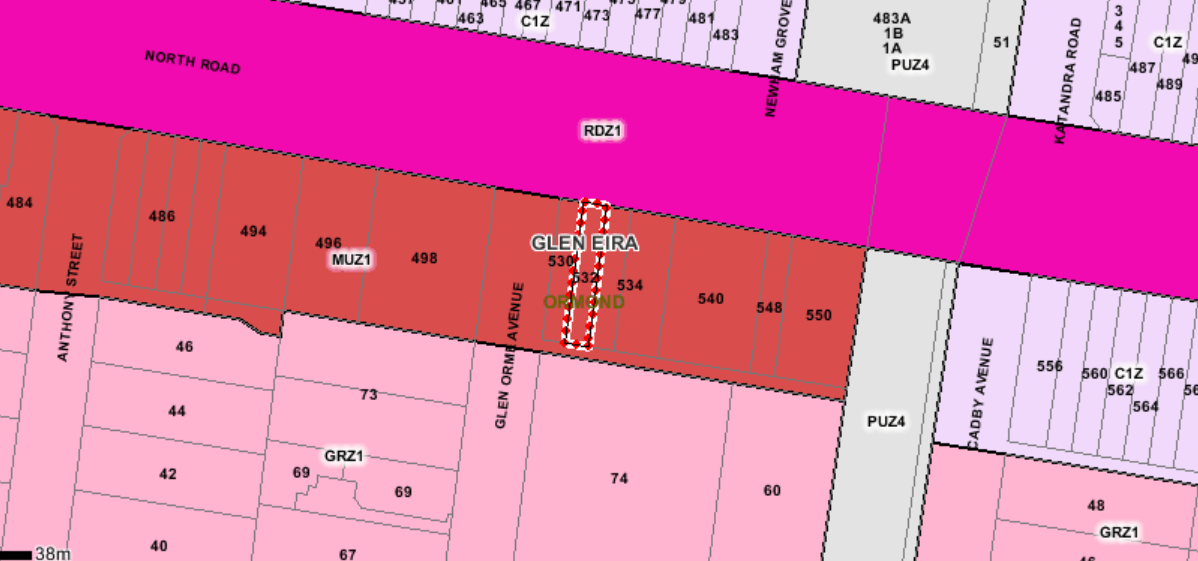
PS: for an interesting comparison, we remind readers of a recent Amendment for North Road Ormond (C121) where the site was rezoned from Commercial 2 to Mixed Use Zone with its own special MUZ Schedule of NO.3. The height limit for this particular amendment  was a mandatory maximum of 10.5 metres! In McKinnon Road the proposed height is not merely 10.5, but 14 metres – well and truly above even the Residential Growth Zone stipulated heights! Thus, where there’s a will, there’s definitely a way! Here’s the North Rd site –

CLICK TO ENLARGE

PS – FINALLY THE ‘SLAP ON THE WRIST’ TO COUNCIL FROM THE ADVISORY COMMITTEE REPORT

Wynne’s announcement of his ‘vision’ for Plan Melbourne continues the Matthew Guy tradition of:

  • releasing major news late on the eve of a weekend or long weekend
  • misleading and deceptive spin aimed at the uninformed and ignorant
  • no documents that provide the full details – ie nothing on the department’s website as to the actual amendments
  • 8 months to ‘consider’ the advisory committee’s report that remains ‘secret’

Result? Developers and their cohorts continue to exert undue influence to the detriment of communities!

CLICK TO ENLARGE

CLICK TO ENLARGE

For all the talk about ‘consultation’ the single thing that residents have been clamouring for over the past few years is being totally ignored – a review of the residential zones.

The image above provides clear, unassailable evidence of how disastrous the implementation and maintaining of the current zoning has been. Please note carefully:

  • The vast majority of development since the introduction of the new zones HAS NOT OCCURRED in those areas zoned as Commercial – which is what the planning scheme states should happen. Instead, street after street has been destroyed because it is zoned as suitable for 4 storey development.
  • Many of these streets are not within cooee of the railway station (circled in red) which is the reason for designating these areas as an ‘activity centre’. They might be 400-600 metres away from the station, but only as the crow flies. Walking distance (ie properties in Mimosa, Beena, etc) would make these sites at least one kilometre from any railway station.
  • Activity centres are also supposed to incorporate community facilities such as open space. The map reveals not a skerrick of nearby open space!
  • Other councils do their structure planning on the basis of recent Housing Strategies. Glen Eira’s fossilised strategy originates from 1998 data. Yet, we now have the spin about structure planning that will extend over the next 10 to 15 years, WITHOUT any new housing strategy!
  • Even Matthew Guy had enough sense in his July 2014 directive to mandate – A planning authority must use a housing strategy to inform the balanced application of the three residential zones. We assume that Guy’s order would presume recent analysis and data, since those councils who chose the option of going to a committee for the implementation of their zones were told that their proposed zoning couldn’t go ahead since their data is too old! Glen Eira as a result has no strategic justification for its implementation of the new zones according to what the committee told numerous other councils!
  • Guy even states – A planning authority must evaluate and monitor the implications of the application of any of the three residential zones within two years of their gazettal into a planning scheme. Planning authorities must specifically assess the affect of the residential zone(s) on housing supply, housing prices, infill development site land prices and the availability of land for infill development but are not limited to those matters. Three and a half years down the track and residents are yet to receive any decent ‘report’ as to the efficacy of all the zones – are they working? Where is development really going? What needs changing? How best to protect residential amenity?
  • Residents also should realise that when Amendment C25, which created the Housing Diversity/Minimal change areas in Glen Eira, the panel appointed to evaluate the amendment clearly saw this as an ‘interim’ measure. The word ‘interim’ was used over 20 times in their resulting panel report. Here is one example of what was stated – The boundaries of the neighbourhood centres identified in the amendment are considered by the panel as interim at best. Thus, we are stuck with ‘interim’ housing diversity borders and for the past 17 years no inclination by Council to do what it promised – ie review the areas and implement controls that will protect residents.

The take home message is that unless these councillors have the courage to admit that disastrous mistakes have been made, the rot will continue until the bottom falls out of the housing market. We simply ask:

  • Why can’t the borders of housing diversity areas be reduced given the fact that instead of the required 600 new dwellings per annum, Glen Eira is now accommodating over 2000 net new dwellings per annum?
  • Why should suburbs such as Ormond have over 40% of its area designated as suitable for 3 storey developments? – especially when large swathes are zoned as heritage?
  • Unless there is a comprehensive review of the zones, then residents have every right to label this council not only as incompetent, but negligent in its duty.
  • Creating structure plans only for the Commercial areas will not solve the problem of street after street being over-run with substandard dog boxes. This isn’t planning. It is cow-towing to the development industry and the refusal to admit that the Newton & Akehurst vision for Glen Eira is a total disaster, especially when residents have had no say in what happened!

As a reminder of the human cost involved, we re-publish an email we received a while back from an Elliott Street resident. It spells out everything that is wrong with planning in Glen Eira –

We live in the house next to the 51 units, 4 storeys, 3-9 Elliott Ave. It is on our north side! We will also be opposite 60 more units in Elliott Ave. Only 6 out of 20 houses left in our part of this small suburban street…… what can we say. We explored all avenues including going to VCAT, employing a Planner for quite a substantial fee. We achieved some minor concessions with shadowing and setbacks. It has been an exhausting process. I wonder if we are completely stupid to continue to stay here after 36 years, enjoying the peace and convenience of living in Carnegie. However, all has changed. The council has won. The peace and joy of living here is shattered. We will stay and see how things pan out. The world is changing at such a rapid pace around us and I’m afraid we’ve lost faith in the Council and its concern for the community. We will look back in a few years time at the implementation of these zones and wonder how it could happen. In a bizarre way it makes me empathise with the first people of our country and the bewilderment of colonisation! Rapid change can leave a community depleted.

Another planning conference tonight on the 9 storey application for Centre Road, Bentleigh. Another round of listening to outraged residents. Another round of hearing complaint after complaint about council’s lack of adequate planning, council’s failure to inform residents, and council’s failure to provide sufficient notice of the meeting.

It is unacceptable that the planner tasked with presenting the application doesn’t even know where the site fits into the submitted draft interim height control guidelines. Initially the attendees were told it is in the requested mandatory 4 height limit. Residents had to correct him and state that ‘no’ – the site is in the ‘discretionary’ 5 storey height limit! Not good enough by a mile.

Nor is it good enough that a resident living 10 houses down from the site wasn’t notified by council. She found out via an anonymous letter placed in her letter box. Another example of residents doing council’s work! Nor is it good enough that several residents complained that they were only notified of the meeting this morning, and luckily they had decided to check their emails – otherwise they wouldn’t even have known the meeting was on.

Informing people should be the basic duty of council. A 9 storey application must surely qualify as a ‘major development’. This should appear on council’s website – preferably on the home page. The plans should be uploaded and dates and times for every planning conference, or delegated planning committee also published on council’s website – as plenty of other councils do.

In regard to ‘advertising’, surely something as significant as a 9 storey application deserves to be highlighted to all surrounding areas and not merely the legal guidelines of ‘adjoining’ properties. Clear and precise policy should be followed – especially since it is NOT COUNCIL who pays for the letters, but the developer.

All this simply boils down to either incompetence, or the desire to keep the public ignorant. Either way it is par for the course when it comes to the Glen Eira version of transparency and community involvement.

east-bentCLICK TO ENLARGE

Apologies for the jumbled mess – hard to get all the ‘signage’ in given the amount of development. We’ve undoubtedly also missed some, especially along Centre Road. Not all double storeys are included, whilst the handful rejected by VCAT are included given that the developer will undoubtedly have a second go. Needless to say the vast majority rejected by council will also eventually get their permits, albeit with a dwelling or two chopped off.

We would welcome feedback on the following:

  • Has anyone seen any recent drainage works in any of these streets?
  • Has anyone had any traffic management works in their streets?
  • Has anyone seen parking officers patrolling these areas?

For at least the past decade the two main issues that have occupied residents’ minds has been (over)development and traffic management (including parking). Each successive council plan has noted this. The planning scheme since time immemorial has promised to introduce parking precinct plans. Such plans have never materialised.

Over the past year council has, without consultation, created havoc in local streets by changing existing parking restrictions. First there was Phillip Street in East Bentleigh (see: https://gleneira.wordpress.com/2016/06/08/councils-parking-management/). Next came the streets around the town hall and the Caulfield Hospital – again without consultation. Council’s response back in June last year was that the new restrictions will be ‘reviewed’. Item 9.7 constituted this ‘review’. The ‘recommendation’ based on the so called ‘surveys’ was that there was ample parking available so nothing much needed to be done except to work with the hospital and to close their pedestrian gates so people won’t be able to get through and therefore not park in these side streets.

The ‘debate’ that ensued on Item 9.7 is fascinating for several reasons –

  • Silver with his statement that ‘it’s a numbers game’ confirms what we all already know. Decisions are not made in council chambers, but behind the scenes at assemblies. If it were any different, his motion to delay further would not have occurred.
  • Since practically every single councillor who spoke confirmed that there was a major problem with parking and safety, then how can these councillors accept the officer report which concluded that there is now a reasonable on-street parking supply that balances the diverse parking needs of the community
  • If it is a ‘numbers game’ then it is incumbent, according to the councillor code of conduct, for councillors to be accountable for their decisions in the council chamber. Davey and Taylor failed to utter a word to justify their vote and Athanasopoulos’ comments were largely irrelevant to the issue!
  • If councillors weren’t happy with the fact of no consultation, then why wasn’t there any resolution to either update the archaic 2002 ‘policy’, or rescind the appropriate delegation, or simply move a resolution which mandated public consultation? Apologies in our view only go so far unless there is action to implement the change desired!

Residents attended in force on Tuesday night. Their anger and frustration was palpable. Here is some of what they said.

RESIDENT #1 – named all the streets that are affected by parking changes around the Caulfield Hospital site and ‘your responsibility is to us, not the public hospital’.  Whilst applauding the government’s investment in health care it shouldn’t be at the expense of the local community. He also accused council of not adhering to its own policy on carbon reduction by increasing traffic, and pollution in the area. Claimed that it made no sense to have restricted parking on main roads like Hawthorn and Kooyong but all day parking in narrow side streets! Asked ‘who thinks like that?’.

RESIDENT #2 – said that staff parking at the hospital is $2.50 but she can’t get out of her driveway and didn’t realise that the hospital could take over her land. Stated that no other hospital such as Cabrini or the Epworth does this.  Reiterated that council’s major responsibility should be to its residents and not to the hospital. Complained about merely getting a letter with no consultation, telling them that this would be done without warning. Wondered if council had any idea how many people lived in these streets, how many cars they had, how many kids, etc.

At this point Delahunty apologised for the lack of consultation but also said that it wasn’t a decision made by councillors!

RESIDENT #3 – started by saying ‘I am mystified’ on what ‘grounds’ the decisions on parking were made. Said that as soon as one side of Sylverly Grove was made all day parking  the street is jammed with traffic. ‘It amazes me. Doesn’t this council have traffic engineers?’ Wondered about council’s transparency. The website contains all the appropriate ‘touchy feely’ words about consultation he just wanted to know ‘on what grounds, the basis, of the decision to change parking restrictions’. Ended by saying ‘I haven’t seen them and I would be amazed if they exist’.

There was also a question as to whether council could provide any parking fine figures for those cars parked in the 2 hour spots. Delahunty responded with ‘probably not’ without notice and she ‘acknowledged’ that ‘monitoring needs to step up’.

Another resident queried the methodology used in the officer’s report since about a dozen streets were listed and the number of vacant spots were noted on an hourly basis. Therefore, did the surveyors have 20 people walking the streets every hour and counting? Council were asked to also include an explanation of methodology in all their reports. Delahunty admitted she had no idea as to methodology. Torres responded by saying that there are ‘staff on the streets’ who do the counts. One resident chimed in and said that he had never seen anyone counting in the street at 7am

There was then a motion to have Item 9.7 dealt with at this point in time instead of later. Passed unanimously.

Silver moved motion to accept recommendations plus that a ‘further report’ be presented in April and that the community plan include as a ‘priority’ traffic management. Sztrajt seconded.

SILVER: started off by saying that he would ‘prefer to stand up and say’ return 2 hour parking ‘right now’ but ‘unfortunately this is a numbers game’ but the main problem is the ‘gate’ at the hospital. His proposal is that ‘we’re not changing right now’ but to tell the hospital to close the pedestrian gates. Said that ‘people should not feel marginalised’ ‘simply because they are not happy with changes to parking restrictions’. Claimed he saw the problems in Sylverly and the bottlenecks created and ‘risks’ that happen on turning into intersections. ‘Ideally we would be changing the restrictions back now’ but ‘it’s best not to take a street by street approach’. The report and motion offers a ‘consistent, thorough approach’  and ‘puts the ball squarely in the hospital’s court’ and once the gate is ‘closed’ will this ‘settle things down’. ‘Ideally I would like to restore them (conditions) now’ but ‘it is a numbers game unfortunately’ and he assures residents that if this doesn’t work then they he will favour restoration. ‘I would like to be announcing a different motion but it is a numbers game’.

SZTRAJT: started by saying that the community ‘has spoken’ on this and he doesn’t think ‘that there are councillors here who want’ the situation to ‘continue’. Claimed that the ‘reality’ is that the hospital charging its staff for parking has ‘ultimately created the circumstance’. So ‘if we are going to offer free parking right outside the hospital’ via the 2 hour parking spots, but this won’t be the ‘ultimate’ fix. The ‘ideal fix’ is to have hospital staff ‘parking at the hospital’ and for residents to be able to park for longer than 2 hours. The ‘way to do that’ is to ‘close’ the gate so ‘council needs to implore the hospital’ to do so. If this happens then the hospital could even get more money in because more staff would be parking there. The hard part is that ‘council needs to have a view beyond’  one street. So the motion is ‘let’s look at the immediate solution of closing the gate’ and then have traffic management investigate the impact ‘in the entire area’. Solving parking in ‘one street is going to move to next street’. Closing the gate is ‘going to make residents happy’ and help solve ‘what is a growing issue for residents’.

ESAKOFF: was against the motion because she thought ‘this needs immediate action’. Thought that the ‘reversal’ of restrictions was ‘very unfair’. Said she said she’s driven down all the streets and ‘found them very heavily parked’ and ‘generally speaking they were all appalling’.  There was also the worry that driving through these streets there was the ‘fear that you wouldn’t get out the end of them in one piece’. ‘They were atrocious’. Thought that what should happen is to ask the hospital to close the gate but also ‘not wait til April’ and ‘see if this fixed the problem’ in all these streets affected by the hospital. Said that people are ‘inherently lazy’ so once the gate is closed the problem should ‘sort itself out’. Stated that ‘parking is required’ for every development application that comes to council and ‘wasn’t sure’ if hospitals were exempt from this requirement. Torres responded that they ‘don’t need’ planning approval on this. ‘We cannot impose a parking scheme on the hospital’.

MAGEE: said he will ‘support the motion but I don’t like it at all’. Believes that ‘every councillor’ gets at least 3 or 4 parking enquiries from residents. The same issues occur around schools and railway stations. ‘To be constantly tweaking and changing’ for this area, then that area’ isn’t effective. Said that council has done ‘traffic studies before’ but things ‘change so quickly’. The hospital ‘knows very well the issues’ and the problems with parking. No-one likes their streets having strange cars parked there but ‘to simply keep reacting’ and changing things, when ‘really what is needed is a holistic approach’ that goes forward into ‘the next decade, the next 2 decades’ on parking and traffic. Council needs to ‘fix’ these issues but ‘it has to be science based’ and looking at ‘who’s coming in, who’s leaving’ and the ‘demographics for the future’. He would ‘hate to push the traffic out of these five streets into the next five streets’ and then ‘in 6 months time doing exactly the same thing again’.

ATHANASOPOULOS: said the first thing he asked was ‘was there consultation done?’ and that he is ‘really a firm believer’ that as ‘this collective group’ ‘we go out to the community first’ before making any decision. He ‘believes’ that ‘our council is also supportive of that outcome’.

HYAMS: said that as a council they have residents who want to be able to park in their streets and ‘exit their driveways’ and on the ‘other hand’ the ‘streets are public assets’ so the ‘question is getting the mix right’. Said that ‘we have a policy’ that prior to any imposition of parking restrictions ‘we always consult with the residents’ and ‘we’ve learnt that we also need to extend this policy for when we change parking restrictions’. Claimed that ‘we didn’t cause this problem, the hospital caused this problem’ by starting to charge fees. (at this point residents called out ‘you are talking rubbish’. Another resident said ‘I am disappointed at the standard of this local government’). The surveys found that ‘the streets were underparked – on the whole’. He acknowledged the frustration in ‘driving around’ all streets ‘looking for a parking spot near a facility’ and the streets happen to be empty but they are all 2 hour parking. Thought that ‘this motion at the moment strikes the right balance’.

SILVER: said he understood that residents ‘aren’t happy with this decision’ and admitted that ‘there should be consultation in the first place’. Thought that the mayor’s apology was ‘very appropriate’. Continued that council ‘would take the steps to ensure there is less traffic in the streets’ but ‘restoring the restrictions’ is not the way to go. Residents ‘should have been consulted. We are consulting now, belatedly, we are going through the process’. ‘we are going to get less traffic either way’ – that is closing the gate or greater monitoring.

MOTION PUT AND CARRIED.

VOTING IN FAVOUR – SILVER, SZTRAJT, HYAMS, MAGEE, ATHANASOPOULOS, DELAHUNTY, DAVEY

VOTING AGAINST – ESAKOFF

A short, preliminary report on last night’s lengthy council meeting.

Item 9.1 (19 storey Kooyong Road application) created a first in Glen Eira. Instead of cramming scores of the public into the chamber, this item was moved into the larger hall with councillors and officers up on the dias and supplied with microphones. As expected, the application was unanimously refused. Delahunty moved an amendment that should the developer decide to go to VCAT, then council would be asking the Minister for Planning to ‘call the application in’. This effectively means that it is the Minister who would, under these circumstances, be making the decision.

Following this item the meeting resumed back in the chamber. Many residents were present to hear the outcome of the parking restriction items – especially those streets around the Caulfield Hospital. In line with previous meetings there was the suspension of standing orders for the gallery to ask questions for 15 minutes. Council and councillors received the most scathing criticism from several people for their failure to consult, to be transparent, and to employ basic common sense. Delahunty did apologise on behalf of council for not consulting when this issue of changing the 2 hour parking layouts occurred. The report and the final decision (to basically do nothing except wait some more) resulted in many residents walking out in disgust.

This issue has now been allowed to continue for at least 9 months. We remind readers that council’s so called ‘policy’ states that parking decisions will be made with a survey of the streets involved. This was not done, and it is not being done now. Please refer to our previous posts for details and how other council approach such issues –

https://gleneira.wordpress.com/2016/07/23/parking-glen-eira-versus-moonee-valley/

and

https://gleneira.wordpress.com/2016/06/20/q-a-2/

For the nth time a request for a report by Taylor on the possibility of community gardens was passed unanimously. Terrific stuff, since this issue has been around since 2003!

We will provide a far more detailed summary of the ‘debates’ in the days ahead.