A reading of recent VCAT judgements can only lead to the conclusion that Council’s presentations at VCAT are not only sub-standard, but that the necessary work required has simply not been done. When millions upon millions of ratepayer funds are used to fund a planning department, then it is incumbent on that planning department to ensure that when it fronts up to VCAT, that it has done its required homework and that all documentation supports council’s decisions.

Council continually uses VCAT as a scapegoat complaining that council ‘policies’ are overlooked, ignored, etc. But when the Planning Scheme is entirely silent on an issue; when so many ‘tools’ are missing that could restrict over-development, and when council itself chooses to over-ride its own scheme, then VCAT is definitely not the culprit that Council would like residents to believe.

Two important and recent judgements provide plenty of evidence for our above assertions.

2-4 Penang Street, McKinnon (See: http://www.austlii.edu.au/au/cases/vic/VCAT/2015/1073.html)

Readers will remember the huge community reaction to this application for a 3 storey apartment block in a GRZ1 zone. Because of the number of objections, publicity, etc councillors voted to reject the application. This is part of the published VCAT judgement. Please note, that ‘no decision’ has as yet been made. It represents an ‘interim’ order, giving the applicant the opportunity to fix up a few details and to resubmit an amended application. Here are some extracts – but residents need to read the entire decision.

…..the planning scheme encourages a significant degree of change in the built form and density of development in this neighbourhood

The residents do not want an apartment building on this site. Many of them are opposed to the significant extent of change envisaged and encouraged for this neighbourhood in the planning scheme. The Tribunal must consider the acceptability of a proposal having regard to the physical context and the planning policies and controls that are in the planning scheme or that are seriously proposed to be included in the planning scheme (e.g. a well advanced planning scheme amendment). In this case, the Council has not advised that there are any proposed planning scheme amendments of relevance. Hence, we must consider and give weight to the planning scheme policies and controls. If the residents consider these controls and policies are not appropriate for this neighbourhood, that is a matter for them to pursue with the Council acting in its role as the planning authority for the municipality (responsible for proposing changes to its planning scheme).

If there was any doubt about the extent of change envisaged for this neighbourhood (e.g. units and townhouses rather than apartments), the nomination of a maximum building height clarifies this. A building height of 10.5-11.5 metres is not akin to the mostly two storey recent developments referred to by Mr Ziltzer. Rather, it is a three storey building height. This means a three storey apartment building on this site is an acceptable planning outcome.

We agree with the residents that the available on-street car parking lessens as you get closer to the train station. The residents also said there is limited on-street parking around the Clarendon Terrace retirement village next door in Graham Avenue due primarily to staff and visitor parking. We did not experience this during our inspection of the site and surrounds, which may have been due in part to the fact that it was a weekday when there may be a fewer number of visitors to Claremont Terrace. Nevertheless, even if we accept the residents submissions on this point, we also have Ms Dunstan’s expert evidence that includes car parking surveys. These surveys demonstrate that there is available on-street parking immediately surrounding this site on all days of the week. The Council does not oppose the proposed reduction of one on-site visitor car space and raises no concern about any impact upon available on-street parking. On the basis of Ms Dunstan’s evidence and the Council’s support for this aspect of the proposal, one additional residential visitor car parking on the street is an acceptable outcome that will not adversely impact upon the general availability of on-street parking.

Mr Morgan questioned the accuracy of the shadow diagrams, particularly the afternoon shadow impact upon the rear open space area of 6 Penang Street. We note that the accuracy of these shadow diagrams was raised during the processing of the permit application and there is a comment in the Council officer’s report that the shadow plans would be checked by both the Applicant and the Council officers (as a result of the Planning Conference with a councillor, council officers, objectors and the Applicant). This does not appear to have happened and Mr and Mrs Morgan are frustrated and concerned about this. We asked the Applicant to review and update the afternoon shadow diagram during the hearing. This was provided on day 2 of the hearing and it generally accords with Mr Morgan’s estimate of the extent of shadow. The 3pm shadow will extend almost to the east side of the rear addition of Mr and Mrs Morgan’s house. This impact is acceptable as it leaves the majority of the rear secluded private open space area, including the area in the centre and to the southeast, free of shadow.

Overall, there will be a significant change to the west side of 6 Penang Street and the outlook from the west facing windows and from within the rear open space area will be different. This extent of change is acceptable because of the planning controls and policies that apply to this area.

The residents submit in 2011 water flowed down Graham Avenue, along an open drain that abuts the southern rear boundary of this site, through this site (both 2 and 4 Penang Street), onto Penang Street and then across into the properties on the north side of Penang Street, including Mr and Mrs Forstmanis’ property. The residents also submit that cars floated down Graham Avenue. These submissions about the path of overland flow do not accord with the mapping of the SBO. The Council made no submissions about this issue during the hearing. Its drainage engineering referral comments request no net increase in peak stormwater runoff in Council’s drainage network with post development stormwater discharge to be maintained at pre-development level for 10 year ARI. There is no mention of whether there are any potential overland flow issues for the basement car park or the ground floor apartments, particularly those cut into the natural ground level. The Applicant submits this issue is a matter for the drainage authorities to address by reviewing the SBO in light of submissions such as those made by these residents. The Applicant sought advice from the Council during the hearing about this issue. We were told the Applicant was unable to obtain any information about a flood level for this site, and that the Applicant was advised there is no proposal to place a flooding overlay on this site.

Melbourne Water’s views have not been sought during this permit application process; and it is not known whether the extent of impervious surfaces proposed with the cut into the natural ground level is acceptable given the submissions that this site and much of the surrounding area are liable to overland flow.

In light of the mapped extent of the SBO in Penang Street and the residents submissions and photographs tendered about the overland flow, we are concerned about whether the basement may be liable to flooding and whether the ground floor units and associated paved courtyards cut into the natural ground may be liable to overland flow from the south (e.g. the rear open drain and Graham Avenue). This is a matter that should be further considered and addressed as part of the preparation of amended plans in response to our interim order. We note that the Housing Diversity Area Policy at clause 22.07-3.2 has specific policies for those areas that are affected by a SBO. This includes recognising that such areas may have a limited capacity for multi-unit development as they are liable to inundation from overland flows. Whilst this site is not in a SBO, we are not persuaded any implications associated with the potential for overland flow have been fully considered. Given all of these circumstances, we have decided that the views of Melbourne Water and the Council’s drainage engineering section should be specifically sought on any amended plans for this proposal.

This brings us to the most difficult issue in this case – how does this proposal respect the neighbourhood character? The purpose of the General Residential Zone (GRZ) includes implementing neighbourhood character policy and encouraging development that respects the neighbourhood character of the area. Clause 55 elaborates on this by encouraging development that either respects the existing neighbourhood character or contributes to a preferred neighbourhood character. A preferred character would be one identified through a neighbourhood character policy. In this case, the Council submits there is no preferred neighbourhood character statement or policy because this site is in a Housing Diversity Area. Unfortunately, the Housing Diversity Area Policy provides no helpful guidance on how development in such areas should respect the neighbourhood character. Similarly, the Schedule to the GRZ does not contain any requirements other than the maximum height of 10.5-11.5 metres. So we are left with having to make a decision about how a modern three storey apartment building will respect the existing neighbourhood character.


411-415 Glen Huntly Road, Elsternwick (See: http://www.austlii.edu.au/au/cases/vic/VCAT/2015/1074.html)

This application was in Commercial 1 zone and within a Heritage Overlay. The application was refused by both Council and VCAT. However, once again, the refusal was achieved because of the VCAT member’s concerns, and not anything that Council put up.

The Council did not raise any internal amenity concerns in their grounds of refusal. Nor did they raise any concerns in their submission at the hearing, or in their questioning of the expert witnesses. In contrast, I have some serious and significant concerns regarding the potential for the future occupants of these dwellings to experience an acceptable or reasonable level of amenity. I have two main areas of concern.

  • My first concern is regarding the overall size and layout of some of the apartments that face either north or south. Inherent in this design is an effort to squeeze as many apartments as possible with either a northern aspect to the public car park or a southerly aspect to Glen Huntly Road. On the one hand, this intent is a positive one as it is far preferable to have apartments face public land, rather than adjoining private properties. On the other hand, when taken too far it has the potential of creating very narrow apartments. I fear that this is one design response where a good intent has been taken too far. As a result, there are a number of apartments that are relatively narrow, as evidenced by a living space that is around 2.8 metres wide. Of the 32 apartments proposed in this development, 14 have a living space of this width.
  • Surprising, 12 of these 14 apartments comprise two bedrooms, and so will potentially have a larger number of occupants than the one bedroom apartments. In some cases these narrow living spaces are combined with relatively tight bedrooms, at around 2.7 by 2.8 metres. In some apartments, these narrow living areas are provided in relatively small apartments, with two of the two bedroom apartments measuring 55.8 square metres, and another at 56.2 square metres.
  • I sought to explore my concerns with Mr D’Amico and Mr Sheppard, and also received submissions from Mr Pitt. I think it is fair to conclude that the apartments that are before me are at the smaller end of the spectrum of what might be considered acceptable apartments, where some of the internal spaces are rather tight. What I sought to do with my questioning of Mr D’Amico in particular is to try to establish whether these apartments sat within the range of acceptability, or whether indeed they have spaces that bring into question their usability and functionality, and their ability to provide a reasonable level of amenity. I accept that such a decision is a matter of subjective judgement, in the absence of any set of standards that I might apply to apartment designs. However it is a subjective decision that I take very seriously.
  • My second concern is with the proposal to design one inboard apartment on each level, with a sole orientation to the western side boundary. On each level this inboard apartment consists of one bedroom, and ranges in size from 45.6 to 46.2 square metres. The apartment has a 5.9 square metre balcony, and both the balcony and the living room window are set 4.4 metres from the western boundary, and in a light court measuring 5.7 metres wide. Three sides of the light court are enclosed by the proposed development to the top of the fifth floor. The only opening to this light court below the top of the fifth floor is via the adjoining property to the west.

Conclusions & Questions

  • Why does this Council continually front up to VCAT without the necessary ‘evidence’ to support its decision making?
  • Why doesn’t Council do what it stated it would do at the planning conferences – ie shadow diagrams review?
  • Why doesn’t council know what areas are subjected to flooding and why haven’t the SBO’s been reviewed?
  • Why is there no ‘preferred neighbourhood character’ statements for Housing Diversity Areas? Why is Council not pursuing an amendment to introduce such controls?
  • Why are applicant’s often ‘dubious’ traffic reports accepted at face value without council checking for veracity?
  • Why does ‘internal amenity’ rarely get a mention in council’s reports and arguments?
  • How much longer will Council continue with the farce that all the problems can be laid at the feet of VCAT?
  • How much more of ratepayer’s money will be expended on substandard presentations at VCAT?

Carnegie’s 1880s Frogmore House tower demolished after being deemed unworthy of heritage protection

The historic Frogmore House tower in Carnegie has been demolished. Picture: Valeriu Campa

The historic Frogmore House tower in Carnegie has been demolished. Picture: Valeriu Campan.

THE tower at Carnegie’s historic Frogmore House has been demolished.

The 1880s feature has been bulldozed six weeks after Glen Eira Council deemed the property unworthy of local heritage protection.

Glen Eira Residents Association president Bette Hatfield said it was “an absolute disgrace”.

The bulldozers were sent in after an unusual, split council vote was won by just three councillors.

Crs Michael Lipshutz, Neil Pilling and Jamie Hyams voted to abandon plans to protect the property.

The site post bulldozing. Picture: Valeriu Campan.

The site post bulldozing. Picture: Valeriu Campan.

The Frogmore House site when demolition began earlier this month.

The Frogmore House site when demolition began earlier this month.

Councillors Thomas Sounness, Oscar Lobo and Karina Okotel had wanted other options explored; Mayor Jim Magee was absent and Crs Mary Delahunty and Margaret Esakoff declared conflicts of interest and did not vote.

More than 1000 residents had petitioned the council to save Frogmore House.

New owner Jewish Care will now redevelop the 7,917sq m site into a 120-bed Jewish aged care centre.

++++++++

And the current online comments –

Two of the councillors who opposed the heritage listing appear to have Jewish surnames?

How is it we live in a world where 1000 people want this historic 1880 building saved and it is not considered worth saving ? We have so many conflicts of interest and back room deals going on and the end result is another piece of history gets bulldozed

what no Australians allowed what a disgrace

A disgrace. We have sold our souls in melbourne. Anything can be demolished.

Yes i wish they would demolish councils full stop

Untitled

The last Planning Scheme Review was conducted in 2010, with a Discussion Paper, that was anything but a genuine discussion paper. Crucial issues were ignored; information was scant and skewed; and all subsequent actions were to be done ‘internally’. That is a euphemism for non-community participation! When the ‘review’ finally made it onto the council agenda, the resolution endorsed the ‘action plan’. Of course, barely a fraction of what was promised 5 years ago has been done. Now we have the situation that this out-of-date Planning Scheme will not be ‘reviewed’ for at least another 18 months – and that’s on top of councillors knowing full well that there are so many deficiencies that the whole scheme requires immediate attention and amendment. But what has Council done? Asked the Minister for a two year extension on having to review the scheme. The Minister agreed to a one year extension. Thus residents have seen their suburbs destroyed because of the failure to act and close off the countless loopholes that ensure developers will get what they want.

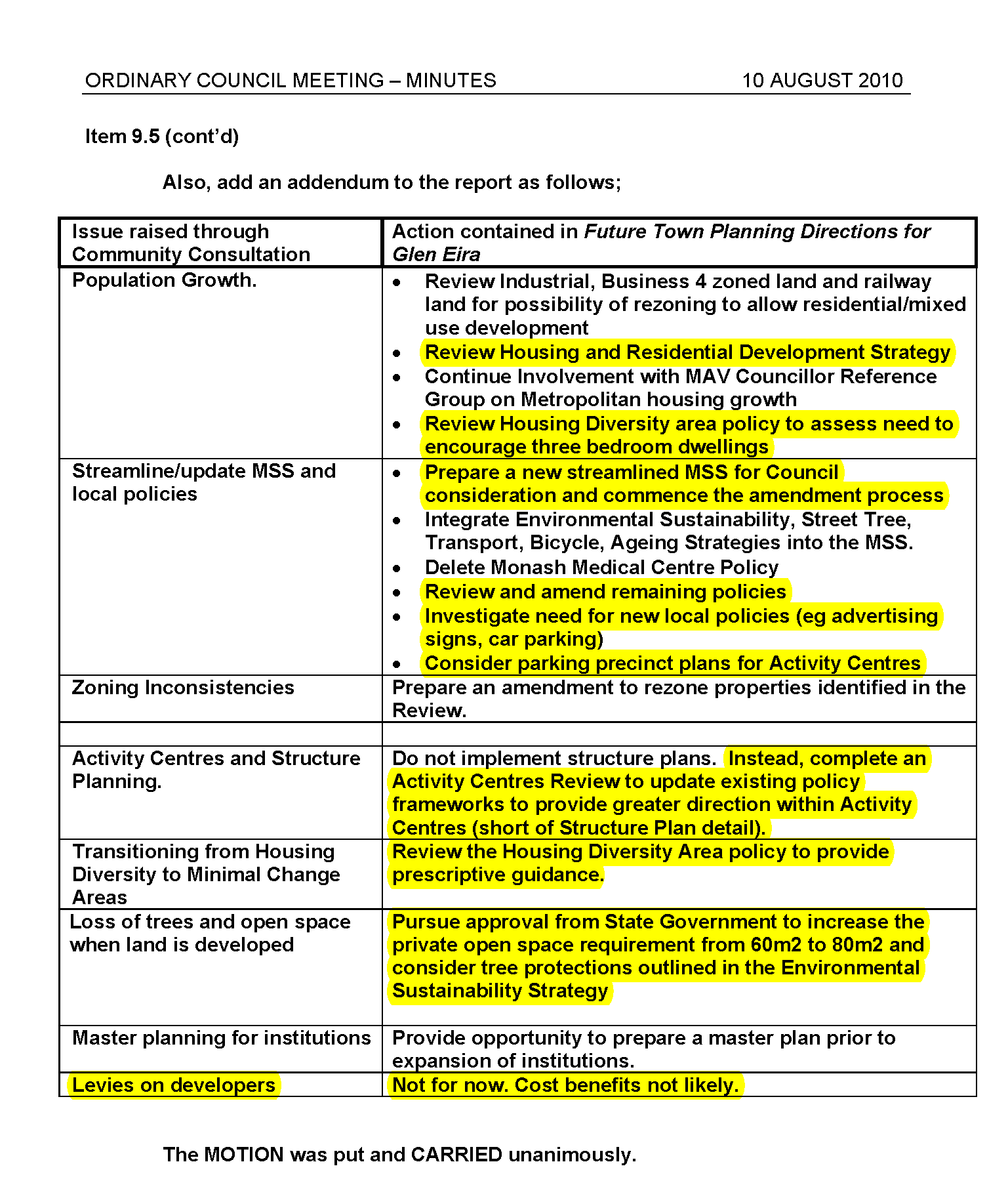
Below is a page taken from the 2010 item on the Planning Scheme Review. It illustrates perfectly how resolutions in Glen Eira mean absolutely nothing. They are continually ignored and consigned to the dustbin of history, or overturned when it suits those with vested interests – ie removal of the conservatory in Caulfield Park; heritage protection for Frogmore; creation of a significant Tree Register. But none of these betrayals equals what has been happening (or more correctly, not happening) in the domain of planning. The highlighted sections of the image below indicate what was promised 5 years ago, and many even repeat what was stated as ‘action items’ from 2003! That’s what resolutions mean in Glen Eira – bugger all. Please remember this when you vote next year!

Pages from 2010August10-2010-MINUTES

Hyams moved to abandon amendment plus ‘affirming’ Amendment C75 (which set up the C1 in the centre and 10 storey heights) and Plan Melbourne. Lobo seconded.

HYAMS: went basically went through the officer’s report outlining the history of the site and what occurred with C75 amendment in 2010. There was ‘maximum of 2000 square metres of retail’ with this amendment so that ‘it would service the people who work there’. Council sent 600 notifications and got 15 submissions – objectors didn’t turn up to the Panel hearing. In 2012 Minister changed zoning and now developer wants to put up to 1250 apartments and 12000 square metres of retail. Said that there are two options before council – to send to a panel or abandon amendment. On officer’s recommendation to go to panel said that this was ‘not an unreasonable recommendation’ because that would mean ‘we do some more investigation’ and the panel would ‘weigh up’ the evidence and make their own recommendations which council is then ‘free to accept or reject’ or modify. It then goes to the Minister. However, he thinks that sending it to a panel ‘would be a waste of everyone’s time and money and effort. ‘ Claimed that this view was only formed ‘late last week’ after he read the objections. In fact, ‘I can’t see myself ever supporting what the applicant is asking for’. Has ‘grave concerns’ about the ‘residential component’ and the impact on traders and ‘allowing this to proceed to the Development Plan Process’. Stated that Gillon ‘proposed’ that the amendment be changed to 1250 apartments but officers’ advice was that this may not have ‘statutary weight’. He thought that even 1250 and 3000 people is ‘still too many for this site by a long way’.

Unlike Caulfield Village this isn’t a ‘transport hub’ with only buses and would ‘increase population’ by 10% in East Bentleigh, plus the retail component could do ‘significant’ harm to local traders and shopping strips. Said council received a ‘peer review’ on the applicant’s retail impact statement and that ‘points out’ that shops ‘on the border of Glen Eira’ were ignored by the applicant’s consultants.

Said that ‘neither’ the residential or retail ‘fit our strategy for this site’ which is for Virginia Estate to ‘continue to be an employment hub’. His ‘concern’ with the Development Plan process was that if the amendment is passed and they make a ‘subsequent decision on the Development Plan’ that is ‘ultimately reviewable by VCAT’ and ‘I absolutely have no faith in VCAT’. He wants ‘something of this significance to remain under Council control’ and not the ‘whims of VCAT’.

On the survey it was ‘not from Council’ and people have two choices – either they believe it is a conspiracy or incompetence and he sees it as incompetence because he doesn’t believe that ‘the applicant actually intended to mislead’ people. But ‘the nature of the questions’ were ‘fairly distasteful’ and ‘designed to produce the desired outcome’. But ‘distasteful as is it’ they ‘don’t make planning decisions to punish’ people and so ‘this hasn’t influenced my decision’.

Wanted to address some comments made at the Planning Conference. Once was from Staikos who ‘said that it is the new planning zones that are causing development’. Said that ‘our new planning zones are not causing development’ since apart from ‘one small patch’ developers can’t build what they could before and there’s only been a ‘rush in development’ between the announcement and the gazetting because developers tried to get their applications in on the old system. Others question why council is ‘only getting 5.7%’ as an open space levy. Said that ‘experts’ determined how council ‘could get the most money’ and they said that a ‘flat rate’ for all areas was better because if they wanted more for sites such as Virginia Estate then ‘we couldn’t have got’ the 5.7% for the rest of Glen Eira. In fact the ‘person who raised that at the conference was responsible for holding up’ the amendment and costing council ‘one million dollars’. So ‘that’s what you call chutzpah’.

Now the applicant can ‘get on’ with developing the park according to Amendment C75 ‘which is in accordance with our strategy’ or they can put in a new amendment together with a planning application and ‘that way we know what we’re getting’.   This was one major cause for worry for residents and councillors because ‘beyond broad parameters’ no-one knows ‘what they’re getting’. So with an amendment and planning application ‘we know what we’re getting and we make the decision’ and ‘not VCAT’.

LOBO: ‘I rise to speak for the people of East Bentleigh’. ‘People elected me to represent them and I will’. Said he won’t support amendment because ‘people do not want’ it. ‘My loyalty is towards the people of East Bentleigh’.

PILLING: said he chaired the planning conference which was a ‘good meeting’. Wanted to thank the community for their input. Said he supports the motion for 2 ‘chief’ reasons – lack of public transport and it’s not like the Caulfield Village which has a major transport rail line. Other reasons was ‘concern’ from the traders’ associations. The amendment isn’t ‘suitable and doesn’t fit our strategy’. Agreed with Hyams on the new zones that ‘you can’t get something now that you couldn’t before’ and that ‘you could probably get less now’. Plus ‘drawing a long bow’ then all parties at federal level are responsible because they ‘encourage population growth’. ‘Our job is to manage that population growth and set standards’. There’s been a lot of ‘criticism’ of council. Most ‘constructive’ but some ‘over the top’ and that’s like ‘criticising an umpire before the decision is made’. ‘Overall’ he ‘welcomes the community’s input’.

DELAHUNTY: said that in ‘making my mind up’ she is concentrating on ‘three particular areas’ – strategic reasons, planning reasons and community input. If she lets this go to a planning panel then didn’t think that she would be ‘upholding’ the premises of ‘local government’ – ie ‘listen to the community’ and then apply the strategic and planning ideas. Said mainly to the ‘applicant’ that when ‘you seek community consultation’ this must be done with ‘integrity’ and is ‘about a two way conversation’ and not just about ‘telling the community what you are about to do’. So it’s listening, ‘taking on board’ what people say and then ‘making some changes along the way’. Conceded that there ‘had been some belated attempts to do so’ and she commended the applicant on that. SAid that the Municipal Strategic Statement from the planning scheme identifies this as moving from industrial to a ‘really important employment node’. Said that ‘I don’t see any strategic reason’ why this objective should ‘go’. On planning grounds, if there is to be the upholding of this site as an employment zone then ‘commercial 2 is the best way to do this’. So, ‘I don’t find that there are planning reasons to move this forward’.

LIPSHUTZ: said that he suggested at one point that a panel would be the ‘best way to go’ so that residents could go and make submissions and it would come back and ‘we could look at it’. But he then ‘thought’ about it and decided that even if it went to a panel “I couldn’t support it, so why go to a panel in the first place?’ Repeated that ‘we intended this to be an employment hub’ and won’t be ‘under this proposal’. ‘I don’t think you can trust what the developer has said’. Hyams said incompetence, he suggests ‘conspiracy and they’ve been ‘deceptive’. Said there’s been ‘bandied around’ 4000 and 1250 units but ‘I don’t know what’s going to happen and I don’t trust them’. But ‘that’s not the reason’ why he is voting as he is. This ‘isn’t C60’ and isn’t CaulfieldStation and it will ‘kill business in this whole area’. Said he wanted to see the area ‘developed’ and for it ‘to go forward’. ‘Not something that is forced on the community’.

SOUNNESS: Said he was sure that the applicants don’t consider the issue as ‘dead’ and there will ‘have to be a discussion and the presentation of something new’. For people in the gallery there ‘will be more discussion in the future’ on ‘how is this going to be the best thing for Glen Eira’ and how ‘to meet the needs and expectations of residents’. He expects the applicant will now ‘have a chat’ with the community and officers. Suggested that ‘you maintain an eye out’ and ‘stay aware’ of any developments and ‘be part of the conversation’. It’s the ‘applicant’s land’ but ‘your city’ and the job of council is to ‘mediate’ between the two to achieve the best outcome. Said there are gaps in the planning scheme and that’s made him ‘uncomfortable’.

ESAKOFF: said that this has a ‘long history’ and she remembers her childhood when it was W.D & H. Wills. Glad that there has been such a great response from the community because it’s been a ‘terrific exercise in community consultation’. The amendment ‘doesn’t meet council’s strategic planning’ or council’s ‘sustainable transport’ strategy that seeks higher density in transport hubs. This isn’t one of those transport hubs. Admitted that council ‘tried hard’ to get the bus to go down East Boundary for GESAC but ‘to no avail’ and if council ‘can’t get it’ she didn’t know how the developer could.

OKOTEL: thanked both applicant and residents for the ‘amount’ of ‘information that was provided’ because ‘this was critical in our decision making’ and ‘helped us raise questions with the officers’ . Agreed with others and mainly about the impact of ‘density’ and what this means for residents in the area in terms of ‘traffic and infrastructure’. Even though she wasn’t a councillor when C75 came in, she thought this was a ‘better fit for the area’ than leaving it as ‘industrial’. However, ‘changing the zoning would lead to over-development’ and therefore can’t see ‘any reason why’ the amendment should go to a panel.

MAGEE: said that in his 7 years on council ‘nothing has scared me more’ than this. He lives in East Bentleigh and the weight of the decision meant many ‘sleepless nights’. Accepted that the ‘developer’ is trying to ‘maximise the return on his investment’ but the ‘cost is our community’. East Bentleigh was the most liveable city but not if this goes through. ‘Something will be built on this site’ but if it’s about ‘land’ then every inch is important in Glen Eira. Said that council has to ‘maximise’ open space ‘where we can’ but ‘more importantly we have to maximise the amenity’. We know that there will be ‘change’ because there are 1000 residents each year who ‘want to come and live with us’. SAid the developer has to think whether it’s all about ‘maximising’ profit or also giving residents ‘something that benefits them’. Amendment C75 is not ‘in place’ and thought that ‘we will be back here in 18 months time’. Ultimately ‘it’s about maximising the best use of the land’ and he doesn’t ‘want this change’.

MOTION PUT AND PASSED UNANIMOUSLY (APPLAUSE FROM GALLERY)

Planning Permit Activity reports are now available for the entire financial year of 2014/15. The figures represent ‘net new dwellings’. From July 2014 to June 2015, another 2885 dwellings have received permits. This is on top of the 1713 from the previous year. Population projections for Glen Eira tell us that in order to meet housing needs the municipality will require 9000 new dwellings by 2031. Since the zones have come in the numbers have gone through the roof – 934, 1713, and now 2885 – for a grand total of 5532. Hence in the space of three years Glen Eira has achieved an average of roughly 1800 dwellings per year – triple what is stated in the fossilised Planning Scheme. At this rate, the 9000 new dwellings will be reached in 2018 and not 2031!

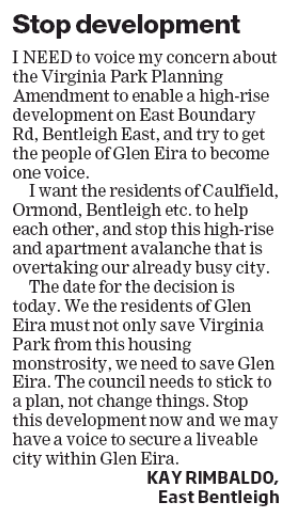
Given these figures, today’s Letter to the Editor, is very relevant.

Untitled

The officer’s report for the proposed Virginia Estate Amendment recommends that the Minister appoint an ‘independent’ Planning Panel. No surprises there! Nor is the ‘quality’ of the report itself a surprise. Once again it is short on justification, short on comprehensive analysis, and most importantly fails to adequately address and answer residents’ concerns.

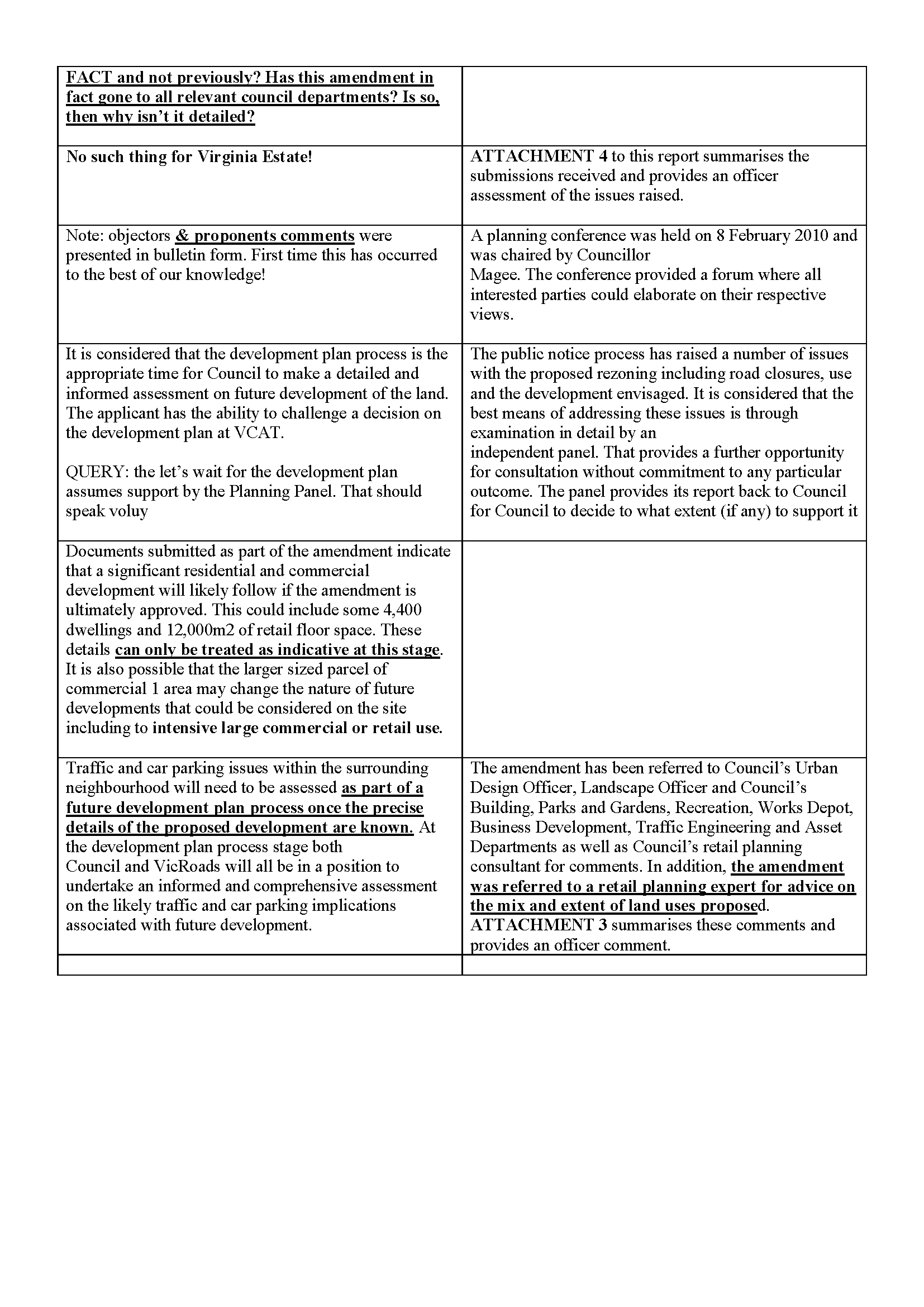
By way of contrast, we feature below the officer’s report from 17th March 2010, which recommended sending the Caulfield Village Amendment C60 off to a planning panel. Whilst this Amendment itself is steeped in controversy and back room wheeling and dealing, we ask readers to carefully consider the far greater detail that went into this report – in contrast to what’s been dished up now with the Virginia Estate amendment. We also acknowledge that the C60 was based on what was called an ‘incorporated plan’ rather than a Development Overlay as with Virginia Estate. However, the end result is basically the same – ie setting height limits, etc and both needing a Development Plan in the future.

Please compare the two and note the details that are lacking for this current amendment. It highlights once again in our view:

  • The failure to present all the relevant information
  • Questions need to be asked regarding how ‘unbiased’ and ‘objective’ the report actually is?
  • And the most vital question – why are residents once again ignored, spurned, and not listened to?
  • FYI – we’ve uploaded the officer report HERE

VIRGINIA ESTATE_Page_1VIRGINIA ESTATE_Page_2

PS OFF TOPIC – BUT, ‘BELIEVE IT OR NOT’! – http://www.heraldsun.com.au/leader/inner-south/developer-irate-after-glen-eira-phone-survey-goes-horribly-wrong/story-fngnvli9-1227442664907

PPS: Here’s The Age’s version of the latest events – http://www.theage.com.au/victoria/developer-faces-public-relations-disaster-after-misleading-telephone-poll-20150715-gid64n.html

The outcry over inappropriate development is gathering voice and momentum. Residents in all suburbs are now experiencing the results of Glen Eira Council’s lack of timely, competent, and justifiable strategic planning.

Two amendments (C11 and C25) are the cause of what is now happening throughout Glen Eira. The former established what is known as the ‘urban villages’ (ie major activity centres of Bentleigh, Elsternwick and Carnegie) and the latter set up the inequitable ‘minimal change’ versus ‘housing diversity’ areas incorporating what are known as ‘neighbourhood centres’. Murrumbeena, Ormond, McKinnon, Bentleigh East for example are all ‘neighbourhood centres’ and not major activity centres.

Each of the above amendments went off to a Planning Panel. The Panel’s recommendations and comments are worth a revisit since they clearly state what Council was required to do in order to fully justify its proposals. Needless to say, after 14 years since the Planning Panel report on C11 was handed down, absolutely NOTHING HAS BEEN DONE. The introduction of the new zones merely reinforced all the already existing inequities and shortcomings without undertaking the required strategic work.

Here are some extracts from the two Panel Reports. The bolded sections are our emphases and pinpoint the tasks that were demanded but which Council has not completed.

Amendment C11 – Setting up the Major Activity Centres

Traffic/parking studies and urban design/built form frameworks are to be undertaken/developed to address traffic/parking issues and to ensure that design outcomes are appropriate.

The Panel recommends that, after approval, Council develop building design guidelines for all three centres

Council believe that “Urban Villages” provide many benefits for the immediate and wider community including:

• More energy efficient housing, environmentally sensitive development, pedestrian activity and social interaction;

• Improved amenity, quality open spaces and more accessible services and facilities;

• More vibrant town centres by increasing population in their catchments and by enhancing their attractiveness through improvements in amenity;

The Panel believes that proper “urban village” planning must address the following issues at the very least:

• Land use planning

• Built form

• Urban design

• Capital works spending based on the strategic allocation of developer contributions, open space contributions or other public funds.

• Car parking

• Traffic analysis

• Community facilities and services

• Public realm and the provision of spaces conducive to the needs of the resident, consumer and visiting population

• Public transport improvements and integration

• Open space connections

• Interfaces and transition with surrounding areas

• Promotion of aspects of the valued cultural attributes of the village such as unique ethnic or activity strengths


Amendment C25 – ‘Minimal Change/Housing Diversity’

The most damning comments in this Panel Report relate to the interim’ nature of the Amendment and the amount of work that Council still had to undertake. What was declared as ‘interim’ morphed into ‘permanent’ and was further ‘cemented’ with the new zones. The ‘neighbourhood centres’ in particular received much comment as did their arbitrary lines on a map.

The Panel concludes that boundary issues are something that are best addressed through detailed assessment of each centre, as indicated in the amendment as future strategic work. The boundaries identified in this amendment should only be seen as interim arrangements until structure planning exercises are undertaken.

The boundaries of the neighbourhood centres identified in this amendment are considered by the panel as interim at best. They will require review as part of detailed assessment of each centre.

The Panel does not agree with the concept that all activity centres categorised as neighbourhood centres in C25 are automatically suited for higher density residential development.

The Ormond Neighbourhood Centre is an example of an activity centre that, while obviously having a strong commercial base and a railway station, may not necessarily have the character or form to make it automatically attractive as a focus for intensified residential development. It is located around a wide, heavily trafficked road (North Road), it is not compact, easy to circulate through or have a distinctive urban form. Furthermore, the uses in this centre are dominated by office uses and the type of specialty shops the (sic) serve a regional rather than a local catchment. There are few shops providing the type of goods (especially food) that would service a purely local population

The Panel considers that rear boundaries should be preferred as boundaries rather than street frontages, to overcome problems where one side of a street is treated differently from the other side of the street.

A stated objective of C25 is to assist the vitality and economic basis of Glen Eira’s activity centres. This is an admiral objective but one that the Panel considers will not be addressed simply through residential initiatives. Further, the pursuit of residential initiatives in isolation from other economic, traffic, access and business development initiatives may actually be detrimental to the overall well-being of the centres.

At best C25 provides a holding mechanism until more specific and effective policies are developed for each of the neighbourhood centres individually. This issue is a serious one that must be addressed directly in the development of the Structure Pans for individual centres.

Traffic and parking issues should be addressed in the structure plans Council proposes to develop for its neighbourhood centres. Provided the structure plans take into account, and cater adequately for, increased demand, the impact on local streets need not become a significant issue. The Panel recommends that the structure plans to be prepared by Council for each neighbourhood centre address issues of parking and traffic generated by both residents and shoppers

The other significant issues noted by the Panel are the need for the further work identified by Council to be undertaken as soon as possible. This applies especially to the preparation of a Structure Plan for each neighbourhood centre that reflect both its current and future role as an activity centre and its potential

And then of course there is the Planning Scheme itself – full of broken promises that the following quotes reveal.

Clause 21.04 – Developing local structure plans / urban design frameworks to guide development in the neighbourhood centres

Developing “suburb” plans for each suburb which integrate land use and development planning, with planning for infrastructure, capital works, recreation, parks and gardens, street trees and business development.

Developing local area traffic management plans and parking precinct plans to control the effects of parking and traffic intrusion in residential areas.

Implementing local area traffic management changes in existing areas in consultation with communities to improve safety and amenity and discourage use by inappropriate traffic.

Investigating mechanisms which require developers to undertake street tree planting.

Investigating the development of additional development contribution mechanisms based on accepted principles of need, equity, nexus, accountability and timing.

Investigating urban design improvements to the public domain surrounding major public transport hubs in consultation with public transport service providers


Preparing Parking Precinct Policies for the following neighbourhood centres:

􀂂 Alma Village, Caulfield Park, Caulfield South, Bentleigh East, Glen Huntly, Ormond.

􀂃 Investigating the need for a cash-in-lieu policy to fund new car parks in various commercial centres.

Implementing a program of Local Area Traffic Management Plans in order to minimise disruption and increase safety of residential areas.

CONCLUSIONS

  • The basis and strategic justification for the introduction of the new residential zones is entirely suspect given that Amendment C25 was clearly seen as an ‘interim’ measure.
  • None of the required work has been undertaken by Council
  • The new zones fly in the face of many of the recommendations by the Panels
  • It is inexcusable that so much of the Planning Scheme is nothing more than words on a page and the promised ‘further strategic work’ is allowed to lie dormant and untouched to the detriment of all residents
  • The lack of consultation, review, and action needs to stay firmly in the minds of all residents when they next vote in 2016. Residents have literally been duped, deceived and dudded!

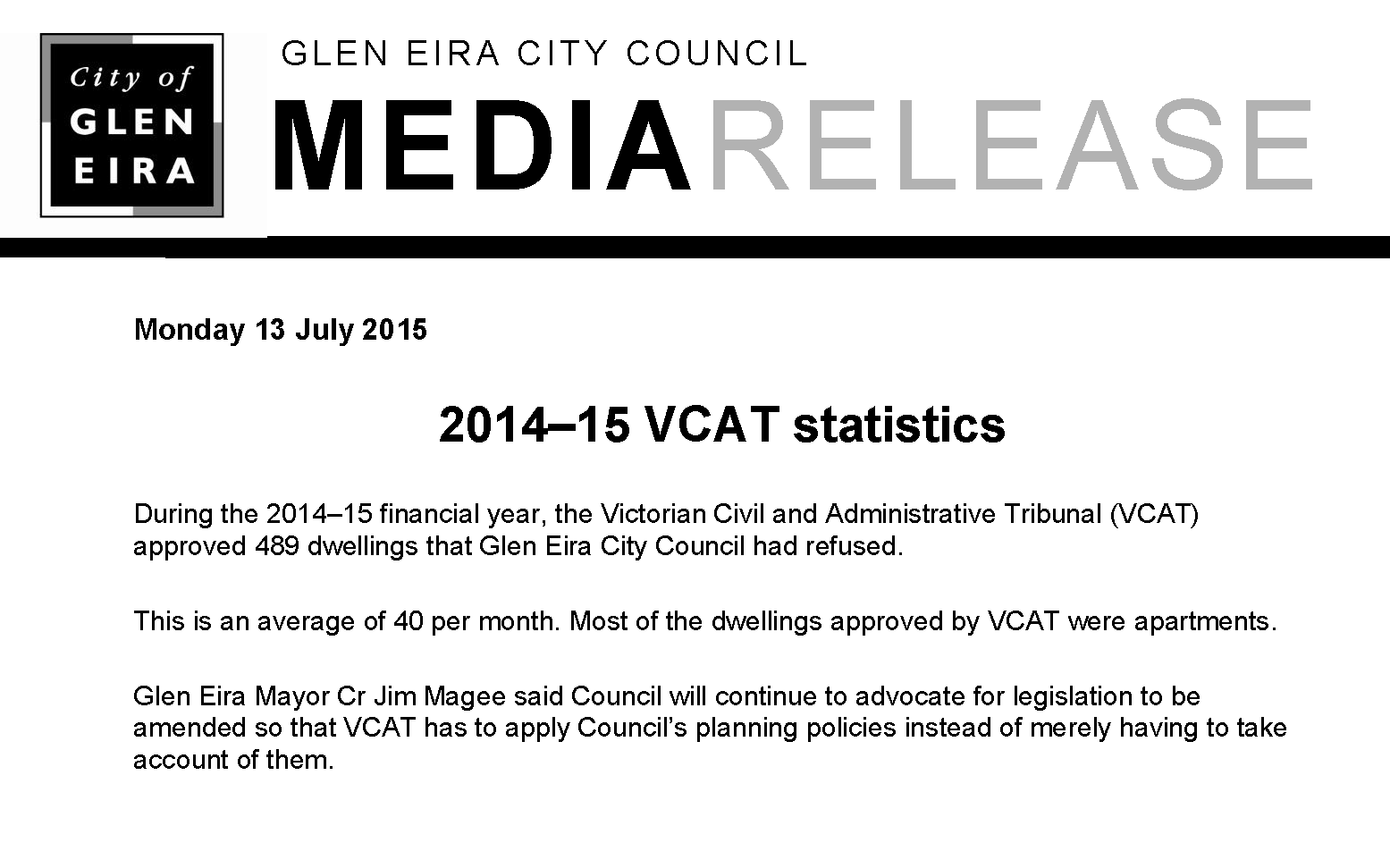
VCAT_Statistics130715c

We have repeatedly stated that VCAT is no angel and that its powers are extraordinary. However, this does not excuse council from repeatedly passing the buck as the above media release obviously intends to do. Reform starts at home – with the planning scheme and with the quality of Glen Eira’s representation at VCAT hearings and the substantiated grounds for their refusals.

Below we feature some extracts from recent VCAT hearings. Readers should note the lamentable performances of council at these hearings – ie ill considered conditions that fly in the face of the current planning scheme; statistics that are not corroborated with clear and decisive evidence, etc. etc. If VCAT has in fact granted all these permits then residents should start asking if they are getting value for money in both the council representations at VCAT, and why councillors do nothing to change the Planning Scheme that provides developers with an open invitation to continue their onslaught.

http://www.austlii.edu.au/au/cases/vic/VCAT/2015/938.html

6 Prince Edward Avenue, McKinnon – Council originally refused a permit for 2 storey building with 6 apartments. An amended plan was submitted. The site is zoned GRZ1 and land size is 724.6 square metres.

The decision –

In principle, I consider that the zone, the absence of overlays, the consideration of relevant planning policies and the locational attributes all lend support to a more intensive development on the review site. Although residents may prefer medium density developments of not more than two or three double storey townhouses, that intensity of development is inconsistent with the extent of built form expected within a neighbourhood centre and in a housing diversity area.

State and local policy, the zone and the absence of overlays together with a location accessible to a range of services and facilities supports increased dwelling density and housing diversity on the review site. Anticipation of change to neighbourhood character is acknowledged in local policy for this area by its inclusion in a ‘housing diversity area’ where there is no preferred neighbourhood character identified.

http://www.austlii.edu.au/au/cases/vic/VCAT/2015/959.html

At the hearing there was some dispute over the proposed site coverage. The plans indicate 50%, though Mr Clarke for the Applicant acknowledges that this does not include the roofed areas to the two alfresco areas, which he offers to have removed by permit condition. The Council’s delegate report refers to a 54% site coverage, including the roof alfresco areas. However at the hearing Mr Henderson for the Council alleged the site coverage is 58%, although I was not provided with any detail of the calculations used to arrive at this figure.

  • In its submissions the Council placed great reliance on the proposed site coverage, and how this varied from the site coverage found on the surrounding properties. Mr Henderson even submitted a cadastral plan where he had calculated the site coverage of surrounding and nearby properties. With respect, I consider that this analysis misses an important point. The review site is proposed to be subject to a medium density development. While the site falls within a Minimal Change Area and is covered by a Neighbourhood Residential Zone, medium density development of two dwellings on a lot is possible, and one might say encouraged by the broader urban consolidation policies found at a State level.
  • In is inevitable that any proposal for medium density development will invoke some differences compared to a single detached dwelling. One of those changes in an increase in site coverage, which must increase as a result of having two dwellings on a comparable site to surrounding single dwellings. It is not relevant for a party to identify that the site coverage of proposed medium density housing is not in the range of site coverage found on surrounding single dwelling sites, and then present this as some form of evidence that the proposal stands in contrast on neighbourhood character terms. Such a submission demonstrates a level of misunderstanding of what is meant by ‘respect for neighbourhood character’ and the extent to which two dwelling developments should integrate into Minimal Change Areas. For these reasons I am not persuaded by the Council’s submissions on this matter.

http://www.austlii.edu.au/au/cases/vic/VCAT/2015/992.html

It is relevant that in applying the policy, the condition in dispute, as proposed by the Council, allows the upper floor level of both dwellings to extend well past the rear of the single storey dwellings on the two adjoining properties. However, in imposing the condition, the Council has come to the view that the setback should be increased by about 1.8 metres. How the Council came up with this figure is unclear and somewhat vague. From the submissions presented, the setback required by the condition is not based on any standard. The requirement is not based on any specific policy requirement. Nor are the increased setbacks required to achieve the improvement of amenity of neighbouring properties with respect to matters such as daylight or shadows. At best, the additional setback required by the Council seems arbitrary.

Here is another example of what is happening to our suburbs. Truganini Road, similar to Bent Street has multiple zonings ranging from Residential Growth, General Residential and Neighbourhood Residential. Whilst this is admittedly a Road Zone, with a tramline along certain sections, the amount of development is entirely inappropriate for the location. It would also appear that the right hand at council has no idea what the left hand is doing. For example: several years ago residents living along the road were granted a ‘parking dispensation’ – namely that because of the trams, they were granted permission to park on their nature strips as a safety measure. Since then, many have received fines and this has necessitated them going down to council, producing the official letter and having the fine removed.

Now with the rampant development along the road and the continual waiving of car parking the issue of trams, pedestrians and cars all mixing and trying to get out of their driveways is a real safety issue. Needless to say, council has yet to address this issue.

Once again the online planning register is devoid of sufficient detail to accurately ascertain the number of dwellings that will be erected on this road. The item for 86 Truganini simply states ‘construction of two or more dwellings’. Given this is zoned GRZ2 we are not very optimistic that this means 2 dwellings – especially when there is the demand for a reduction in car parking.

Thus, our conservative total for Truganini is at least 141 new dwellings post zones.

TRUGANINI ROAD

9 & 9A Truganini Road CARNEGIE VIC 3163 – 4 storey, 20 dwellings (RGZ1)

21-25 Truganini Road CARNEGIE VIC 3163 – 4 storey, 41 dwellings, (AMENDED) (RGZ1)

44 Truganini Road CARNEGIE VIC 3163 – 2 double storey (PERMIT) (NRZ1)

54 Truganini Road CARNEGIE VIC 3163 – 2 double storey attached (NRZ1)

86 Truganini Road CARNEGIE VIC 3163 – Construction of two or more dwellings on a lot (GRZ2) Buildings and works (SBO) Reduction in the standard car parking requirement (52.06) (GRZ2)

90 Truganini Road CARNEGIE VIC 3163 – 3 storey, 13 dwellings (REFUSAL) (GRZ2)

93-97 Truganini Road CARNEGIE VIC 3163 – Construction of a three-storey building comprising twenty-eight (28) dwellings with a basement car park and reduction of the dwelling (visitor) car parking requirement on land affected by the Special Building (AMENDED) (GRZ2)

98-100 Truganini Road CARNEGIE VIC 3163 – Construction of a 3-4 storey building comprising 28 dwellings with 2 levels of basement car parking on land affected by the Special Building Overlay (AMENDED) (GRZ2)

115 Truganini Road CARNEGIE VIC 3163 – 3 storey, 6 dwellings (AMENDED) (GRZ2)

124 Truganini Road CARNEGIE VIC 3163 – Construction of two (2) double-storey dwellings on land affected by the Special Building Overlay – Amended (GRZ2)