Councillor Performance


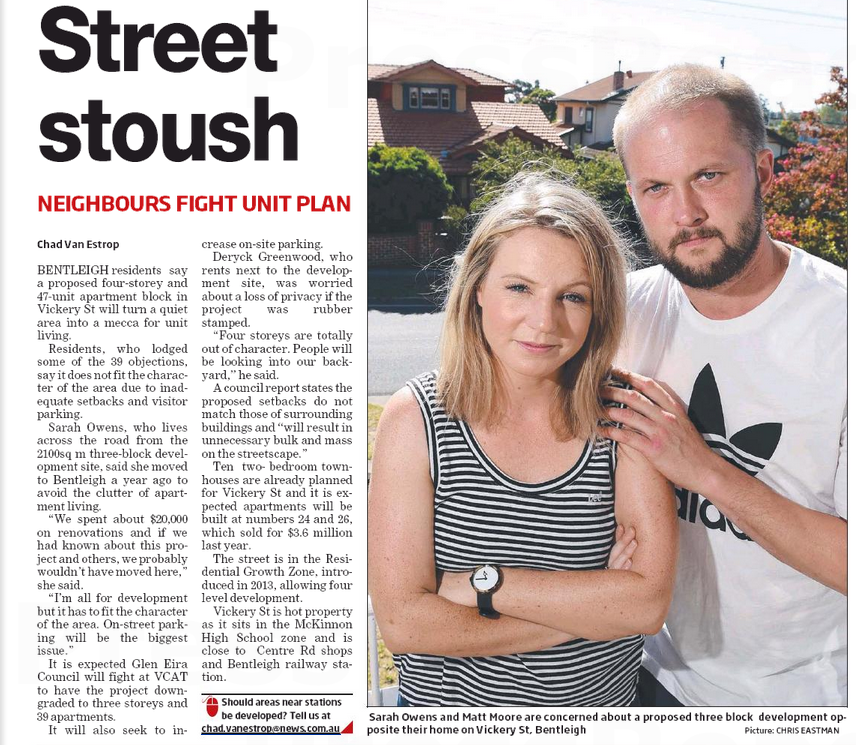
It is becoming a regular occurrence that council cannot get its act together and determine an application within the required 60 day period. Thus, the developer side-steps council and goes directly to VCAT. This occurred on the first item of the agenda – ie. the application for 4 storeys and 47 dwellings in Vickery St., Bentleigh. Council received the application on the 7th October 2015 and despite the excuses of Christmas that Hyams throws up, the 60 days would have expired well and truly before the holiday period and still leaves most of January for a decision.

Hyams moved motion to advise VCAT that if Council had the power to make a decision they would have issued a permit for 3 storeys and ‘up to 39 dwellings’. He also included several other conditions involving site coverage, increased setbacks and visitor car parking spots. Seconded by Magee.

HYAMS: explained that they were informed at ‘seven minutes past four this afternoon’ that the developer had gone straight to VCAT because of failure to determine within 60 days. Said that ‘given Christmas holidays’ it is ‘very difficult if not impossible’ to get a decision for ‘to be sorted out within 60 days’. Claimed that the developer ‘chose to appeal’ because it ‘suggests they weren’t prepared to accept anything’ that council would put up as conditions. Said the ‘effect’ of this was ‘neglible’ because now council goes to vcat and says ‘this is what we would allow them’. Objectors can still be ‘a party’ to the case. Said that ‘it gives them no advantage at all’ and maybe the ‘outside chance’ that the developer would ask for costs against council. But since it is on the ‘agenda and just over 60 days’ then unlikely. ‘Their tactics are up to them’. Admitted that the site is ‘near station’ and ‘not near the edge’ of the Residential Growth Zone, but it is ‘still fair to say’ that 4 storeys is too much in that it would ‘impact unduly on residential amenity’ and the ‘slope of the street would make it appear higher’. Therefore ‘three storeys in this case is more appropriate’. Said that there were increased street setbacks to ‘reflect other properties’. And so it would be ‘less impactful’. Council accepts the argument of objectors who ‘passionately’ made the point about car parking in the street so they are asking for full visitor car parking spots. Outlined the conditions related to site coverage and ‘safety’ with sight lines into the basement garages.

MAGEE: said objectors talked about ‘height and scale and massing’ and now ‘council has listened to that’. On landscaping, council has also taken note by ‘increasing setbacks’. Said that there is an ‘impact on infrastructure as we know in that area’ and with grade separation they are looking at ‘storm water’ and that ‘will help’. Said that objectors concerns had ‘been addressed’ by the conditions. It was ‘unfortunate’ that the developer went to VCAT but that was because he wasn’t prepared to ‘accept’ what council conditions were after he saw the officer report on Friday and he probably wouldn’t accept what Hyams moved either.

OKOTEL: supported the motion because the application was ‘certainly out of keeping with neighbourhood character’ and because there’s already so much ‘congestion on the street’ the conditions about car parking is important. Asked Torres a question – since there were 39 objectors, will they be informed about the VCAT hearing?

TORRES: replied that VCAT ‘will now’ go through its processes and inform all objectors.

DELAHUNTY: thanked objectors for their ‘informed’ participation in the planning conference and that this ‘helped set the conditions’ for the application. Said that ‘something will go on this site’ and it ‘will probably be a larger building’ than what people ‘at the moment want to see’. But ‘it’s a great place to live’ and whatever happens at VCAT she hopes that it ‘strikes the right balance’ between protecting amenity and catering for population growth.

HYAMS: reiterated that ‘all objectors are part of the process and will be notified by VCAT’. Objectors have ‘the right to be involved’.

MOTION PUT AND CARRIED UNANIMOUSLY

COMMENT

  • How many more times will council fail to determine an application in the statutary time limit? Please note that in recent cases VCAT has awarded costs against various councils on this very ground.
  • How many more VCAT decisions have to point out to this council that its zoning is the determining factor in its decision making and that lopping off a storey in a growth zone is doomed to failure?
  • How many more times will these councillors continue to blame VCAT rather than the current planning scheme?
  • How much longer will council continue to pretend that its planning scheme is god’s gift to Glen Eira residents, rather than the inept, and archaic document it really is?

And as a final nail in the coffin to the arguments that are presented above, we quote from the latest VCAT decision on another site in the Residential Growth Zone.. Either these councillors are deaf, dumb, and stupid, or derelict in their duty to analyse each and every VCAT decision and then to ensure that they amend the planning scheme to close off the gaping loopholes that now exist. Please consider how each of the following statements totally contradict all of Hyams’, Okotel’s and Magee’s assertions

The source for the following is: http://www.austlii.edu.au/au/cases/vic/VCAT/2016/66.html#fn7

Neither the purposes of the RGZ or clause 22.05 refer to the character of the neighbourhood as a benchmark for the way a development might fit into the area. The Tribunal has consistently found that land within the Urban Villages is encouraged to be developed more intensively than the prevailing housing that is in garden settings. New development is to be measured by reference to a preferred or emerging character rather than the existing neighbourhood character. The extent of change between the existing and the new built form can be substantial rather than a gently nuanced transition.

Consequently I consider that policy contemplates that the height, massing and setbacks of development within the RGZ should not be defined by adjoining one or two storey dwellings in a suburban setting.

No guidance is provided in the schedule to the zone or local policy to support greater setbacks.

PS: no surprise that ratepayers have to find out from the media rather than council that Glen Eira is seeking to increase rates more than the government’s imposed rate-capping. Another example we maintain of ignoring and disregarding residents.

See: http://www.theage.com.au/victoria/the-21-victorian-councils-trying-to-dodge-rate-caps-20160202-gmjjuh.html

The list of councils (taken from above article) is:

The councils which have applied for a higher rate cap are:

  • Bass Coast Shire Council
  • Buloke Shire Council
  • City of Ballarat
  • City of Casey
  • City of Darebin
  • City of Greater Geelong
  • City of Melbourne
  • Glen Eira City Council
  • Hepburn Shire Council
  • Hindmarsh Shire Council
  • Horsham Rural City Council
  • Latrobe City Council
  • Maribyrnong City Council
  • Mitchell Shire Council
  • Moorabool Shire Council
  • Murrindindi Shire Council
  • Pyrenees Shire Council
  • Yarra City Council
  • Yarriambiack Shire Council
  • Wyndham City Council

PPS: we’ve uploaded the ESC Media Release (here). Glen Eira’s submission should make for fascinating reading – especially the response to the criterion regarding the “views of ratepayers”!!!!!

The Labor Government has introduced legislation to impose ‘rate capping’ on Councils. If Councils seek to impose a rate increase above what is specified they have to submit their case to the Essential Services Commission (ESC). Any such appeals had to be in to the ESC by January 31st, 2016.

In Glen Eira there have been rate increases of 6.5% (except for one year of 6%) for at least the past 8 years – well above CPI. Plus of course countless increased charges for kindergartens, rubbish collections, etc. We anticipate that given Glen Eira still has a huge loan repayment outstanding, plus further payments on Superannuation of several million, they will have applied, or will be applying, to the ESC for permission to keep increasing our rates. Of course, council has kept mum and not a word has been published regarding their intention on this issue. This contrasts with the Stonnington council’s statement that it will not seek such permission – see article presented below. It would be nice for once, if Council was upfront with its residents, instead of its usual practice of silence so that residents are always the last to know!

rates

Having reduced Bent Street Bentleigh to ‘Calcutta’, developers are now moving into the next street – Vickery St. In the current agenda there is an application for 4 storeys, 47 dwellings over 3 lots (15-19 Vickery). This site backs onto Bent St (14-16) where a permit was granted for 4 storeys and 50 dwellings. Thus 6 houses now make way for 97 units!

But as with Carnegie, where developers first ruined Elliott Avenue, then set their sights on Tranmere, and the next street along, Vickery in Bentleigh is going the same way – all due to its zoning as Residential Growth Zone.

Other properties recently sold or being developed in Vickery include:

24-26 Vickery – sold for $3.6 million (2015)

14 Vickery – permit for 10 x 2 storey townhouses

Item 9.8 of the current agenda continues the council tradition of presenting officer reports that are sub-standard and which tell only half the story. Here are our explicit criticisms of the Camera Report which was supposed to present evidence of the ‘inconsistencies’ of VCAT decisions:

  • Of the hundreds of cases that have gone to VCAT, Camera plucks out only 6. Why these specific 6 are chosen is not explained.
  • Much vital information such as land size, council accepting amended plans, etc is not reported upon – thereby guilty of selective editing at best, and at worst, misrepresenting the truth.
  • Comparing cases in Minimal Change versus Housing Diversity is like comparing apples and oranges given that the latter has practically no protection written into the planning scheme.
  • Why are there no Residential Growth Zone cases included? – overdevelopment in this zone is surely the biggest complaint from residents? (ie Bent St., Mavho St., Elliott Avenue; Neerim Road, etc. etc.)

We conclude that the report is useless except as another piece of council propaganda and damage control. It fails to reveal what has really happened at VCAT and the role of council’s too frequent incompetence in handling cases.

First off, we wish to highlight several comments made by VCAT members on the cases presented by Camera. They encapsulate everything that is wrong with this planning scheme and why council claims of ‘inconsistency’ (especially in these cases) are hogwash.

“This brings us to the most difficult issue in this case – how does this proposal respect the neighbourhood character? The purpose of the General Residential Zone (GRZ) includes implementing neighbourhood character policy and encouraging development that respects the neighbourhood character of the area. Clause 55 elaborates on this by encouraging development that either respects the existing neighbourhood character or contributes to a preferred neighbourhood character. A preferred character would be one identified through a neighbourhood character policy. In this case, the Council submits there is no preferred neighbourhood character statement or policy because this site is in a Housing Diversity Area. Unfortunately, the Housing Diversity Area Policy provides no helpful guidance on how development in such areas should respect the neighbourhood character. Similarly, the Schedule to the GRZ does not contain any requirements other than the maximum height of 10.5-11.5 metres. So we are left with having to make a decision about how a modern three storey apartment building will respect the existing neighbourhood character”. (from the Penang Street judgement)

There’s also this succinct summation of the problem –

“The residents do not want an apartment building on this site. Many of them are opposed to the significant extent of change envisaged and encouraged for this neighbourhood in the planning scheme. The Tribunal must consider the acceptability of a proposal having regard to the physical context and the planning policies and controls that are in the planning scheme or that are seriously proposed to be included in the planning scheme (e.g. a well advanced planning scheme amendment). In this case, the Council has not advised that there are any proposed planning scheme amendments of relevance. Hence, we must consider and give weight to the planning scheme policies and controls. If the residents consider these controls and policies are not appropriate for this neighbourhood, that is a matter for them to pursue with the Council acting in its role as the planning authority for the municipality (responsible for proposing changes to its planning scheme)”.(Penang St.)

Here are the cases listed by Camera. We will provide the background information that Camera just happened to omit from this report.

4 Lilac St (zoned GRZ) – one lot of 650 square metres. Proposal 3 storey and 10 dwellings

This case boiled down NOT to an ‘inconsistent’ interpretation of council policy but overall developer greed. Here are some quotes from the judgement –

Its sheer three storey presentation to the north is a particular concern, with the skewed visual ‘weighting’ of the building toward the adjacent property to the north when viewed from Lilac Street. It is also relevant that the upper level does not meet the ResCode B17 setback.

This combines with what I regard as a compromised level of internal amenity by virtue of screening for upper level dwellings, a southern orientation for some secluded private open space areas and fenced secluded private open space within the frontage setback.

The aim to fit too much on this site is also evidenced by the extent of boundary construction which includes a vehicle turntable within the basement to provide sufficient space to manoeuvre. It has also resulted in minimal side setbacks for in ground planting to assist a building of a vastly increased scale to integrate within its surrounds.

Significantly the proposed provision of screening to this development, while intended to satisfy ResCode, is excessive and would result in unacceptably diminished liveability for future residents, especially where used on small and confined balconies. For example, on level 2, all windows and balconies for dwellings 5, 6 and 7 are entirely screened.

In addition, it is concerning that Dwelling 3 would be provided with poor solar access to its open space that would not comply with B29 of ResCode.

I regard these aspects of the design as further indicators of excessive development proposed for this site.


36 London St (zoned NRZ) – 650 square metres. Two double storeys.

In this case Camera neglects to inform readers that amended plans were submitted by the developer and that apart from a few further ‘modifications’, Council had found these new plans ‘acceptable’. An objector appealed to VCAT. Given that the application basically met all of the ResCode ‘standards’, this decision again had nothing to do with being consistent or inconsistent, but adhering to what the planning scheme said. In this example Camera quotes council’s concerns about ‘upper floor and bulk’ but he neglects to state the following –

The Council supports the amended design response of increased setbacks from the eastern boundary of Unit 2 that faces Ms Rodger’s property. The amended plans propose 2m at ground level and 2m up to almost 4m of the first floor. The Council believes these setbacks provide sufficient visual relief from building bulk because of the resulting vertical and horizontal articulation, and that the setbacks will allow an acceptable degree of landscaping.

It is common ground between the parties that standard B17 is not only met but that the proposed side (and rear) setbacks readily exceed those that would be calculated under this formula. The dispute about this proposal is whether the amenity objective will be still met notwithstanding this compliance with B17. To a lesser, but no less relevant degree, issues are also raised about neighbourhood character of the building form.

The rear setbacks of 11m at the upper level and 10m of the lower level are almost three times the rear setback requirement of 4m under schedule 1 of the zone. In the context of its relationship to the adjoining open space to the west, I agree with the Applicant that the combination of these setbacks and the building forms articulation provide an acceptable level of relief from building bulk and massing.


4-6 James st (zoned GRZ) – land size is 2462 square metres. Proposal is 3 storeys and 45 dwellings.

Being within a residential area very close to the commercial area of the neighbourhood centre, high density residential development is expressly encouraged by local policy. There is a clear strategic direction for such areas

The proposal accords with the policy at clause 22.07-3.1 to ‘Encourage the consolidation of sites to promote residential development opportunities’ in the residential areas of Housing Diversity Areas. It is also policy to ‘Encourage a decrease in the density of residential development as the proximity to the commercial area of the neighbourhood centre decreases’. Conversely, an increase in density is to be encouraged on sites close to the commercial area. The subject land is very close to the core of the activity centre/commercial area, in that the laneway to the north of the subject land is the boundary of the commercial area.

With respect to the site context, it must be appreciated that the neighbouring properties are also within a Housing Diversity Area and are thus candidates for a change in character. In particular, I agree with Ms Bowden that there is no rationale to modify the proposal to be more deferential to residential neighbours such as property to the north. Indeed, an application to redevelop 2 and 2A James Street was lodged this year. The plans tendered by Ms Bowden show a three level building accommodating six attached townhouses. The application has not yet been advertised, and it may be a long time before a development is approved, but there is clearly an intention to redevelop that land. Furthermore, the owner of the land to the north offered no objection to the proposed development on the subject land.

The immediate context includes the development at 18-20 Etna Street. The Tribunal proceeding regarding that site was an appeal by objectors against the Council’s decision to issue a permit for a four storey development. There is also a four storey development on the southwest corner of James Street and Glen Huntly Road, a short distance to the north of the subject land.

No concerns have been raised by any third parties about the impact of the proposed development on neighbouring properties.


Prince Edward avenue (724 square m) (zoned GRZ) – proposal was 3 storeys and 10 dwellings

In this case, greed is again the main culprit

In principle, I consider that the zone, the absence of overlays, the consideration of relevant planning policies and the locational attributes all lend support to a more intensive development on the review site. Although residents may prefer medium density developments of not more than two or three double storey townhouses, that intensity of development is inconsistent with the extent of built form expected within a neighbourhood centre and in a housing diversity area.

However I make the point that more intensive development does not necessarily mean that individual lots along Prince Edward Avenue  will be capable of accommodating three storey apartment style buildings containing ten dwellings. It may be, for example, that individual lots are unable to comfortably accommodate such development and that lot consolidation will provide a means whereby such buildings can be comfortably accommodated in this area. It is certainly the case that policy at Clause 22.07-3 encourages lot consolidation to promote development opportunities.

They also concern those ResCode requirements which are not subject to assessment against a numeric standard but which, when taken together, suggest the proposal is trying to do ‘too much’ on a single width suburban site. These include the location of ground level open space for Dwellings 1 and 2 in the front setback behind a 1.8 metre high fence, the location of the primary area of open space off the living area for Dwelling 2 on the south side of the building and shadowed during the relevant equinox assessment period (the secondary open space for this dwelling in the front setback is accessed through a bedroom), the small 8 and 8.4m2 first floor balconies at the rear screened on all sides, and all upper floor windows except those facing the street have high sill heights or are screened to avoid overlooking. A number of these shortcomings were discussed at the hearing and could be addressed by permit conditions requiring changes to the design. However, those changes do not address the issues of scale and density which I have discussed earlier in my reasons.

Penang st (zoned GRZ)

This judgement basically says it all. Policy is adhered to throughout and council’s ineptitude is also clearly evident. Please note that this case involves 2 judgements. In the first, the VCAT member made an interim order requiring amended plans. These ‘new’ plans he deemed to have met all conditions required. The following quotes are from both judgements – again something that Camera does not mention.

From interim order – Whilst we are cognisant of the residents’ submissions and photographs tendered about the overland flow, the view of the Council is that this site is not affected by a probable 1% in any one year occurrence of flooding from the local Council drainage system; and the view of Melbourne Water is the northeast corner of the site is below the applicable flood level for the  Penang Street  road reserve. The amended design addresses the potential for flooding of the basement in a manner that is acceptable to Melbourne Water. For these reasons, we are now satisfied that the implications associated with the potential for overland flow have been fully considered by the relevant authorities. In absence of any further submissions or evidence regarding the flooding potential of this site, we must give weight to the views of the relevant authorities. As such, there is insufficient reason to refuse this proposal on the basis of this issue.

This site is a consolidated parcel of land comprising two residential lots at the southeast corner of  Penang Street  and Graham Avenue. Apartment developments already exist in the neighbourhood centre close to McKinnon Road. This proposal for a further apartment building contributes to the mix of dwelling types that are encouraged. For all of these reasons, an apartment building on this site is an acceptable planning outcome.

If there was any doubt about the extent of change envisaged for this neighbourhood (e.g. units and townhouses rather than apartments), the nomination of a maximum building height clarifies this. A building height of 10.5-11.5 metres is not akin to the mostly two storey recent developments referred to by Mr Ziltzer. Rather, it is a three storey building height. This means a three storey apartment building on this site is an acceptable planning outcome.

The Council does not oppose the proposed reduction of one on-site visitor car space and raises no concern about any impact upon available on-street parking. On the basis of Ms Dunstan’s evidence and the Council’s support for this aspect of the proposal, one additional residential visitor car parking on the street is an acceptable outcome that will not adversely impact upon the general availability of on-street parking.

The residents are concerned that the traffic generated by this proposal will adversely affect traffic safety in the surrounding road network. They made mention of recent accidents involving bicycles and pedestrians in the surrounding major roads, particularly McKinnon Road, that are not included in Ms Dunstan’s evidence. Their concern is not shared by the Council or Ms Dunstan.

There will be shadow cast by the proposed building towards Claremont Terrace. However, the setbacks of the building from Claremont Terrace comply with the clause 55 standards in regard to overshadowing of open space and north facing windows. This is not to say that this proposal will not have an impact. It will, but the impact is acceptable and continues to provide for some sunlight access to the north facing units and the communal open space area along the north side of Claremont Terrace.

We acknowledge that the development of a three storey building on this site will impact upon the extent of westerly sunlight enjoyed by 6  Penang Street  . The planning scheme only seeks to provide a level of protection to northern sunlight, so there are no design standards relevant to the loss of morning or afternoon sunlight. When this fact is combined with the context of a residential zone that allows for buildings of between 10.5 and 11.5 metres in height, the loss of afternoon sun is an acceptable amenity impact in this case.

Overall, there will be a significant change to the west side of 6  Penang Street  and the outlook from the west facing windows and from within the rear open space area will be different. This extent of change is acceptable because of the planning controls and policies that apply to this area.

The Council made no submissions about this issue (flooding) during the hearing. Its drainage engineering referral comments request no net increase in peak stormwater runoff in Council’s drainage network with post development stormwater discharge to be maintained at pre-development level for 10 year ARI. There is no mention of whether there are any potential overland flow issues for the basement car park or the ground floor apartments, particularly those cut into the natural ground level. The Applicant submits this issue is a matter for the drainage authorities to address by reviewing the SBO in light of submissions such as those made by these residents. The Applicant sought advice from the Council during the hearing about this issue. We were told the Applicant was unable to obtain any information about a flood level for this site, and that the Applicant was advised there is no proposal to place a flooding overlay on this site.

CONCLUSION

There is absolutely nothing in Camera’s report to support the contention that VCAT is ‘inconsistent’ in applying council policy. We would in fact argue the reverse – that in every single one of the decisions listed, the VCAT member has diligently and conscientiously applied council policies as stated in the woeful planning scheme. The fault lies not with VCAT in these instances but with council’s determination to continue to pull the wool over residents’ and councillors’ eyes. It is surely time that council stopped pretending that its scheme is adequate and went back to the drawing board to come up with a planning scheme that is worthy of the name. The first step for councillors is to insist that officer reports are up to the necessary standard. In this instance, Camera’s effort must be relegated to the dust bin!

Whilst countless other councils have gone about their task in preparing or reviewing their housing strategies, Glen Eira has sat on its backside and basically done nothing. Glen Eira’s Housing Strategy was adopted by Council in October 2003. It is based on data going back to 1999. Yet, council’s rationale for doing nothing in 12 years is that in 2003/4 they got is so right that they are streaks ahead of every other council!

Once again, nothing could be further from the truth. Other councils have also had housing strategy policies for eons. They have also reviewed and updated it repeatedly with the latest statistics and with community consultation. For example Moonee Valley’s 2010 version was updated in 2015; Bayside within 2 years. And Glen Eira? Nothing since 2003! Given what is happening with the zones, then reviews are essential – unless of course, incompetence, or inability, or the pro-development agenda, forbids change.

Here is a list of what some other councils have been able to achieve – most post zones. The year of introduction is in parenthesis. Please note that these councils have also introduced numerous amendments (not listed here) in support of their housing strategies and to ameliorate the impact of the zones for their residents.

Banyule (2010)

Bayside – 2012 (reviewed 2014)

Boroondara (2015)

Brimbank (2014)

Cardinia (2013)

Casey (2015)

Darebin (2013)

Frankston (2013)

Greater Dandenong (2014)

Hobson’s Bay (2014)

Knox (2015)

Manningham (2012)

Maribyrnong (2011)

Maroondah (2015 and ongoing)

Melbourne (2014)

Monash (2014)

Moonee Valley (2015)

Shepparton (2011)

Wangaratta (2013)

Warnambool (2013)

Whitehorse (2014)

Yarra (2010)

Untitled

mv

Source: http://www.mvcc.vic.gov.au/about-the-council/council-meetings/current-meetings.aspx

Here is part of the blurb that the developers for the Virginia Estate have published.

Source: http://www.eastvillagemasterplan.com.au/future-needs/

Population Growth and Make-up

  • Melbourne’s estimated population of 4.5 million in 2015 is projected to reach 5.3 million by 2025 and almost 6 million by 2031.
  • At this growth rate Glen Eira will not be able to accommodate its share of Melbourne’s projected population growth in the next 15 years.
  • Of the established local government areas in metropolitan Melbourne, Glen Eira has the highest proportion of its residential areas covered by the Neighbourhood Residential Zone (NRZ) –  the zone that gives the greatest protection to existing residential character and densities.
  • The 84% coverage of Glen Eira’s residential areas by the NRZ will be a major factor in slowing population growth levels, limiting housing diversity and choice.
  • Bentleigh East has no appropriately zoned land for higher density housing other than the possible redevelopment of small areas of business land in the Centre Road shopping area.
  • Based on the latest State Government ‘Victoria in Future’ population projections (2015), there is a projected need for an additional 7,500 dwellings in Glen Eira over the 15 year period from 2016 – 2031 of which 68% will be either ‘couples without children’ or ‘lone person’ households.

COMMENT

There are several unsubstantiated claims in the above which need to be seriously challenged. For example:

On what basis is the statement made that Glen Eira ‘will not be able to accommodate its share’ of population growth when the total number of new net dwellings in the municipality has risen by at least 350% for the past 3 years in a row? The planning scheme claims an average of 600 new dwellings per year is required. In 2014/15 Glen Eira had over 2000 net new dwellings. In the first quarter of 2015/16 (July to September) the figure, according to Planning Permit Victoria was 559 net new dwellings. For the second quarter this number rose to 634 net new dwellings. Thus, at least another 2200 new dwellings in a year if this rate continues. We also mustn’t forget that Newton and Hyams promised Guy an 80+ year supply of land and an 89 year supply if the comnmercial zoning is taken into account. Thus the ability to ‘accommodate’ new dwellings is well and truly there without the grand vision of potentially thousands more at Virginia Estate!

Given that ‘residential’ remains undefined, we seriously query the statement that Glen Eira from all its neighbours has the highest percentage of land zoned as Neighbourhood Residential. Bayside for example claims over 80% of its land is zoned NRZ whilst Glen Eira only claims 78%. Even this figure is a myth – NRZ constitutes just under 70% of the municipality and if the number of LARGE sized lots which can legally have many more than 2 dwellings are taken into account, then Professor Michael Buxton estimates that the Neighbourhood Residential Zones in Glen Eira amount to a paltry 55% of the municipality.

The most unbelievable claim however is that Bentleigh East has only ‘small areas of business land’ available for ‘higher density’ development. Not true! Bentleigh East has more land zoned as Commercial 1 than Elsternwick or Carnegie – both of which are supposed to be Major Activity Centres and Bentleigh East is a Neighbourhood Centre. Only Bentleigh (a Major Activity Centre) has more land zoned as commercial than Bentleigh East. The figures (in square metres) are:

Bentleigh East – 136,551

Bentleigh – 149, 768

Carnegie – 134, 415

Elsternwick – 125,628

Gillon et al are correct however in stating that the latest government population projections (ie Victoria in Future) state that there will be a need for another 7500 dwellings from 2016 to 2031. This figure will be well and truly met within the next 4 years at the current rate of over 2000 net new dwellings per year. And, please remember that this doesn’t include the additional 1500+ dwellings for the Caulfield Village Project that will be coming up pretty soon. In short, Glen Eira will well and truly have fulfilled its fair share of ‘accommodating’ population growth by 2020 – much less by 2031! Of course, no one dares say what figure equates with this ‘share’, nor what ‘capacity’ is and how much all of the necessary infrastructure upgrades will cost and whether or not any of this over-development is sustainable!

Gillon et al also claim that ‘couples without children’ and ‘lone households’ represent 68% of the required 7500 new dwellings. Not so! The Victoria in Future figures which they rely upon (see below) forecast that there will be 16,810 ‘couple only’ households, and 19,690 ‘one-person’ households in 2031. That makes a grand total of 36,500 households. The overall projection for 2031 is 67,295 households. Hence, the percentage is not 68% as claimed, but rather 54.23% on these figures.

We make these points not because we want to indulge in nit-picking, but when information is put before residents so that they can have an ‘informed’ say, then it is incumbent on the distributors of that information to ensure that it is accurate, honest, and not designed to obfuscate at best and mislead at worst.

Glen-Eira_VIF2015_One_Page_Profile-1


crlobo

PS: RESIDENTS BEWARE! THE PROPOSED VIRGINIA ESTATE LAND APPEARS TO HAVE BEEN EXPANDED WITH THE ‘PARTNERSHIP’ OF THE MAKE PROPERTY GROUP. NOWHERE IS THIS MENTIONED IN THE DOCUMENTATION PROVIDED – EXCEPT ON THE MAP BELOW.

Untitled

Please note that the land under question now extends to Griffith Avenue. The original draft amendment did not include this land – ie from the minutes of 21st July 2015

council mintes

The land abutting Griffith Avenue is currently zoned Industrial Zone1 (ie no residential). Thus, the site under discussion would appear to have increased dramatically – without residents being informed in an open and transparent fashion! Not a great start for ‘consultation’!!!!!!!! Secondly, if the land mass is increased significantly, does this mean more dwellings? Another amendment that wants the entire area rezoned to Commercial 1? Or is it simply a case of a leopard does not change its spots?

Here is the planning map of the site as it currently stands –

Untitled2


We have received the following media release –

Media Statement - Community engagement launch January 180116

« Previous PageNext Page »