GE Consultation/Communication
April 13, 2016
Leader
Posted by gleneira under Councillor Performance, GE Consultation/Communication, GE Governance, GE Planning, GE Service Performance, GE Transport[7] Comments
April 10, 2016
The ‘Discussion Paper’ – #1
Posted by gleneira under Councillor Performance, GE Consultation/Communication, GE Open Space, GE Planning, GE Service Performance, GE Transport[9] Comments
The opening few pages of council’s Discussion Paper on the Planning Scheme Review correctly state that:
- There has been a dramatic increase in the number of ‘mid to high rise’ apartment blocks built in middle ring suburbs such as Glen Eira
- That population growth in Glen Eira is anticipated to require 12,000 new ‘households’ up to and including 2031. This figure is calculated from 2011 according to Vic Future 2015 and not 2016 as implied. That means that Glen Eira needs an average of 600 net new dwellings per year to meet its ‘quota’.
What the Discussion Paper DOES NOT REVEAL and is essential for a complete understanding of what is happening in Glen Eira due to the Planning Scheme and the zoning, is –
- that building approvals are approaching 2000 new dwellings per year. Hence a 300+% increase on what is deemed as necessary to meet demand.
- Building approvals of course, do not take into account the number of planning permits granted and these figures have also gone through the roof since the introduction of the zones. Even if only 50% of these planning permits are acted upon and construction completed by 2031, we estimate the number of net new dwellings per year to be in the vicinity of 2,500 new dwellings given current trends.
- Council does not reveal that since the introduction of the zones close to 5000 planning approvals for net new dwellings have been granted. Thus, apart from the 300% increase per year, Glen Eira will meet its nominal ‘quota’ not in 2031 but more likely in 2020 at this rate!
Council provides no figures that enable comparisons with other neighbouring councils. Residents have no idea as to building activity in these other municipalities. No comparisons are provided on number of new houses built compared to number of apartment blocks; no comparisons in terms of ‘density’ and what this ‘building boom’ does to overall density and impacts on open space. This is significant since Glen Eira with its meagre 38+ square kilometres has one of the highest population densities in the state. The only council with a higher population density is Port Phillip – but this council is unique in terms of its Capital Zone Status, its ‘inner ring’ categorisation, the Docklands, etc., and its large tourist and commercial centres.
The table presented below is worth considering in our view. It reveals how Glen Eira compares with its neighbours in the Southern Region and elsewhere in terms of building approvals for the six months from July 2015 to December 2015. The stats come from the Australian Bureau of Statistics published in early 2016.
| COUNCIL | DENSITY PER SQK | SIZE – SQK | BUILDING APPROVALS FOR HOUSES | BUILDING APPROVALS FOR UNITS | TOTAL NEW DWELLINGS |
| GLEN EIRA | 3385 | 38.7 | 198 | 741 | 942 |
| BAYSIDE | 2680 | 36.0 | 199 | 160 | 375 |
| CARDINIA | 57.92 | 1280.6 | 812 | 74 | 888 |
| CASEY | 615.72 | 409.9 | 1867 | 161 | 2041 |
| FRANKSTON | 1032 | 131.0 | 163 | 93 | 259 |
| DANDENONG | 1627 | 36.26 | 289 | 220 | 514 |
| KINGSTON | 1479.4 | 91.0 | 206 | 217 | 425 |
| MORNINGTON | 200.09 | 518.23 | 483 | 252 | 738 |
| MORELAND | 2887 | 51.0 | 240 | 858 | 1120 |
| DAREBIN | 2719 | 53.0 | 167 | 820 | 995 |
| GEELONG | 177.64 | 1247 | 1105 | 111 | 1222 |
| HUME | 332.5 | 504.0 | 1133 | 239 | 1372 |
| MARIBYRNONG | 2458 | 31.2 | 99 | 1339 | 1441 |
| MELTON | 536 | 527.3 | 894 | 153 | 1047 |
| PORT PHILLIP | 4871 | 20.62 | 27 | 1176 | 1217 |
| WHITEHORSE | 2365 | 64.0 | 296 | 1050 | 1348 |
In Glen Eira, the relationship between single house replacements and multi unit development is around 1:74. That means that for every single new house built, there are 74 apartments built. With just under 39 square km, and no open space to speak of density, infrastructure, traffic, will inevitably be impacted upon.
So what does the Discussion Paper propose, or even ask, in response to these trends? What can the Planning Scheme do to halt the further erosion of residential amenity? If we are to go on the questions proposed it would seem that very little can be done. We do not agree and feature some preliminary questions below that residents might like to consider asking at the forums. We welcome any other suggestions that readers would like to proffer.
- Will council be introducing any Environmental Sustainability or Water Sensitive Urban Design policies into its planning scheme as Bayside, Yarra, Stonnington, Whitehorse and other councils have done? If not, why not?
- Will Council be introducing Parking Precinct Overlays into its RGZ and GRZ zoned areas to manage traffic in its centres? If not, why not? Will Council be creating the long promised Parking Precinct Plan for its activity centres? If not, why not?
- Will Council be introducing any tree protection measures into its Planning Scheme in order to halt moonscaping as other councils have done? If not, why not?
April 8, 2016
Revisiting Hyams’ Bullshit!
Posted by gleneira under Councillor Performance, GE Consultation/Communication, GE Governance, GE Planning, GE Service Performance[8] Comments
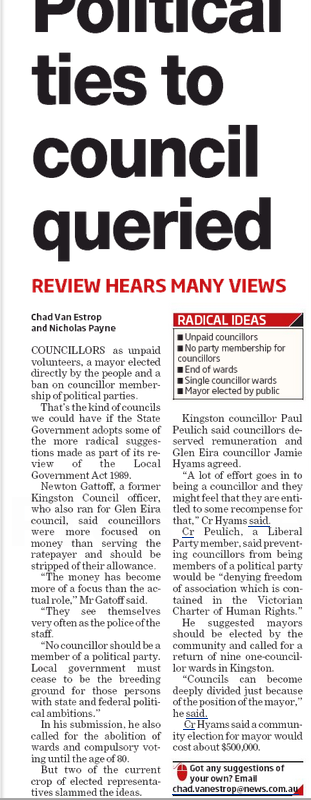
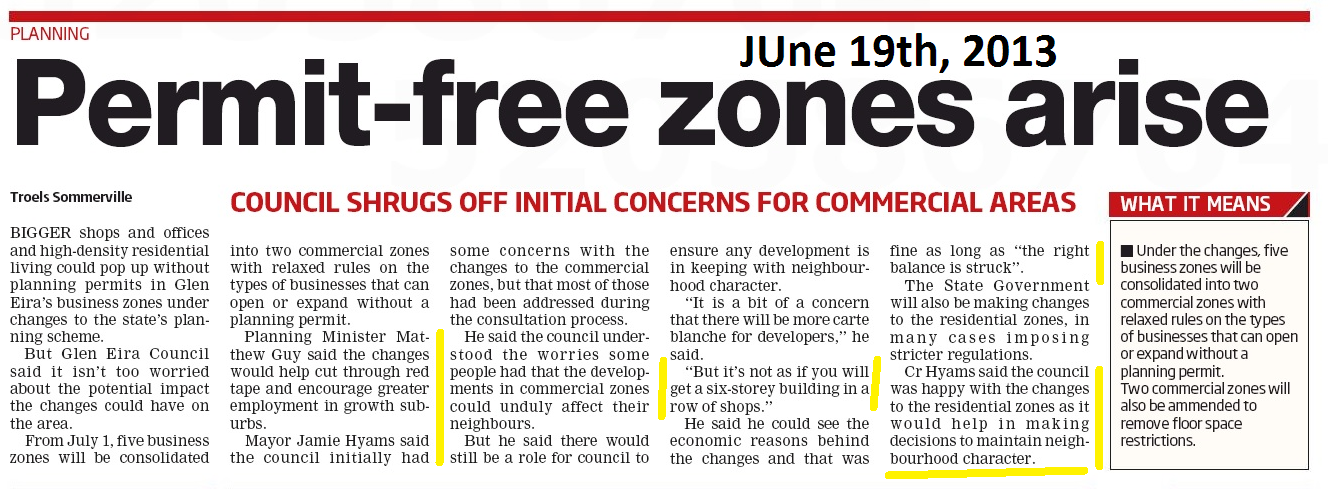
Given recent events, we thought it would be illuminating to revisit one of our earlier posts (June 19th, 2013) so that residents may gauge for themselves how much credibility to assign to anything our councillors say, and especially Hyams. Here is an article from the Leader of that date. The comments for that post are also worth re-reading since time has proven them to be very prescient.
April 5, 2016
Item 9.2 – Planning Scheme Review
Posted by gleneira under Councillor Performance, GE Consultation/Communication, GE Council Meeting(s), GE Planning, GE Service Performance[12] Comments
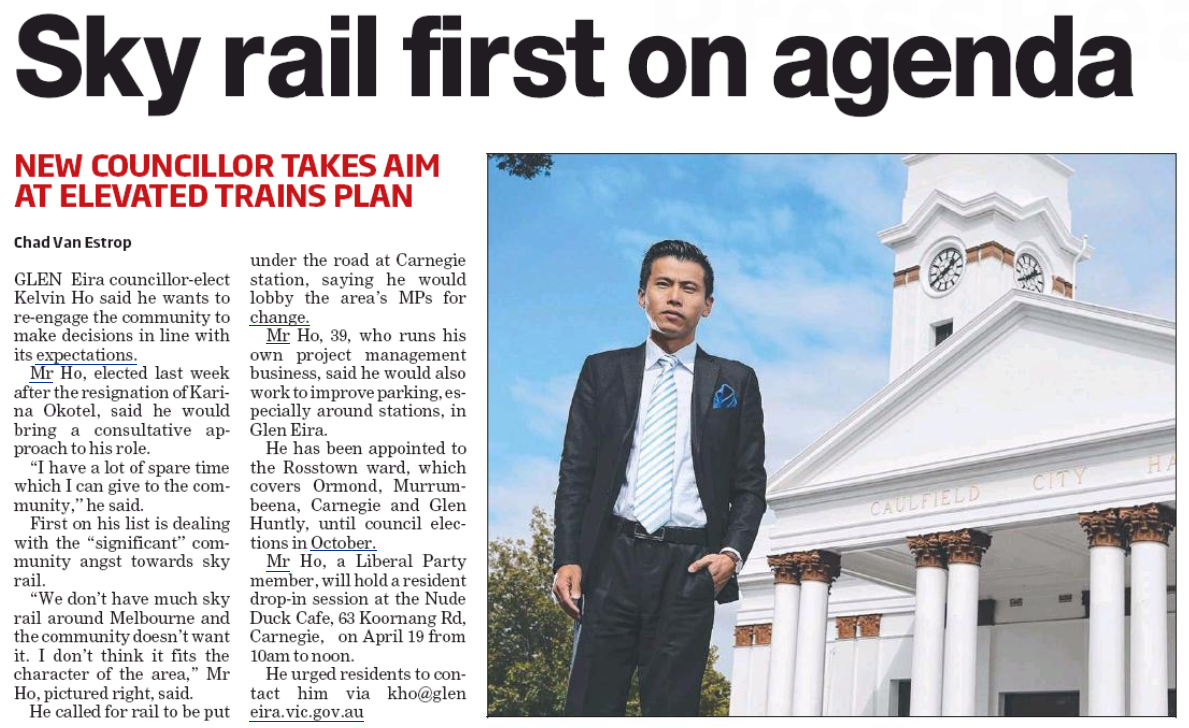
NEWS FLASH: KELVIN HO IS COUNCILLOR ELECT
Motion to accept moved by Hyams and seconded by Lipshutz.
HYAMS: started off by saying that one of the ‘requirements’ for councils is to regularly review their planning schemes and this was last done in 2010/11. People then told council that they ‘wanted mandatory heights’, ‘transition zones’, and ‘better protection of neighbourhood character’. Council therefore ‘implemented neighbourhood character overlays’, plus the new zones ‘had height limits’. In regards to Commercial zones then VCAT ‘disagrees’ with officers who believe that ‘our policies should protect’ against ‘this type of height that VCAT has been allowing’. Said ‘I don’t have a lot of faith in VCAT’ but they make the decisions and this is ‘binding’ so it’s ‘something that we need to look at’ in order to give Commercial zones ‘greater protection’ in regard to heights. The government is now looking at the residential zones, so ‘it is good’ that the discussion paper ‘doesn’t focus directly on those’ because ‘whatever we decide’ can be over-ridden by the government. Stated that the original Plan Melbourne talked about 60% of development going into established suburbs, but with the new Plan Melbourne Refresh the figure is no 70% of development in established suburbs so that means ‘cramming more dwellings into established suburbs’. He hoped therefore that the ‘protections that we do have aren’t diminished by Plan Melbourne Refresh’.
Claimed that ‘community consultation’ is very important and that ‘what the community tells us’ from the review ‘will guide us’. Went through the various scheduled meetings and the themes of the discussion paper. Said that council would collate all the information and then send it off to the Minister in August. Changes ‘will require a formal planning scheme amendment’ so this will ‘need to go through a lengthy process’ of consultation, planning panels and then council’s position sent off to the Minister. So even if ‘we all agree’ about height limits in commercial zones, and other things, it will still depend on the Minister.
LIPSHUTZ: planning schemes are ‘integral’ because it ‘certainly affects everyone’ so it is ‘important that the community be involved’. Agreed with Hyams that it’s important that people are involved and they come to the meetings and ‘present their views’ because they can then ‘go to the government’ and say that ‘we’ve listened to the community; we actually know what the community wants’. Said it’s not 9 councillors saying this is what we like, but the ‘community saying this is what we require’. With the new zones people were saying that there is now development that ‘wasn’t allowed before’ well, ‘no one can build anything now that they could not before’. People can ‘twitter’ as much as they like and use other social media but ‘at the end of the day’ it’s ‘so important’ that people come ‘to these meetings and put your views’. Thought that the ‘zones are working well, but they can be improved’. Problem is VCAT because ‘they allow one thing in’ and the ‘next development comes along’ and they say ‘it is a street that is changing, therefore we will allow a second one’ and this ‘opens the floodgates’. Welcomed the review and wanted community ‘answers’ to take to the government’.
MAGEE: said he welcomed the review and that he wrote to the Planning Minister ‘last year asking for various types of reviews’ especially on the commercial zones and imposing overlays. ‘We had already commenced those discussions with the Minister’. So it is good that the ‘MInister is now formally requesting us to do what we were asking the Minister to let us do’. Said that ‘we can change our planning scheme, we can change our zones’ but this ‘won’t make one iota of difference’ if the Minister doesn’t also review VCAT. VCAT must ‘apply’ the planning scheme and shouldn’t be able ‘just to consider’ it. So council ‘can do all this work’ which they have done in 2002 and in 2010 and the ‘community told us’ what they wanted. ‘We knew street by street’ what people wanted through the minimal change areas. This was then changed into the new zones and ‘there were still problems’ because those problems are due to VCAT. Perfect example is Claire Street, McKinnon where there was a ‘totally inappropriate’ application. The ‘applicant lost at VCAT and came back to us a few months later’ with a new application which is ‘very little difference’. ‘So if there is no clear guidance from the Minister to VCAT’ then this planning scheme review is just ‘window dressing’. ‘It looks good, it sounds good, we’re all happy’ until the first council rejection goes to VCAT and ‘they disregard our planning scheme’. ‘You’re in the hands of an individual at VCAT’. Welcomes community input and ‘that will be what this council puts forward’ but unless the Minister looks at VCAT then ‘I worry that we are doing all this for no reason’.
ESAKOFF: said she was looking forward to community views and that ‘it is hard to imagine that anyone would want more’ development. Thinks that people will say that they want ‘less development’. Said she remembers community forums in 2002 where people were ‘horrified’ at the thought of 3 storey shop-top housing. For Council ‘to put forward what our community says’ is ‘going to be a difficult one’ because for ‘us to go back with a lesser footprint if you like’ that what is there now, ‘we know where that is going to be put’ and ‘it won’t be accepted’. ‘Anything other than more won’t be accepted’. Hoped that she was wrong in this forecast. What the community has got to say is ‘important’ because they might come up with ‘ideas’ that council ‘has yet to hear’ so this is ‘well worth listening to’.
SOUNNESS: said he’s got some experience in planning elsewhere where height and density is combined in other states. Victoria is different and complex and hard for people to understand. Said that the themes are good and people should respond not with planning language but with ‘your vernacular’. Thought that the 3rd theme on environmental sustainability was ‘vital’. Said he’s got a major concern about climate, and how ‘we adapt and manage’ these changes. Temperature increases mean less water and impacts on farming and food production.
LOBO: said he would try not to be ‘controversial’. Said he forecasts that the zones could ‘remain the same’ but people will have the opportunity to voice ‘their concerns’ and ‘what they have lost and hopefully what they will not lose in the future’. Said that the repeated ‘sentence’ that you can’t do now what you could do before’ is true, but the ‘zones’ have given ‘authority to builders to open up the floodgates’. Council can’t stop this or stop VCAT. So council is insisting on ‘democracy for Skyrail’ and ‘in this case we may have overlooked the democracy of asking the residents to comment’.
PILLING: said that Carnegie and Bentleigh East were ‘the real hotspots’ where residents ‘are concerned’ as well as the activity centres. ‘This is a chance for residents to get involved’. Thought this would be a ‘really valuable exercise’.
HYAMS: commented on the consultation on the zones and the consultation on Skyrail that Lobo referred to. The zones ‘were a direct translation’ from minimal change and housing diversity areas. The difference was that ‘in each of those zones we actually put more restrictions on what could be built’ and put on mandatory heights and increased setbacks. ‘So we actually did provide better protection right throughout Glen Eira’ and that’s why ‘we didn’t feel it was necessary to consult because’ it was basically a ‘transition’ and they were only ‘implementing the findings of the previous consultation’ where people wanted height limits and transition zones which ‘came with the’ new residential zones. But with Skyrail the government is ‘proposing to put in something that completely changes the neighbourhood amenity’. Didn’t think there was ‘any valid comparison’ between the two examples. Urged people to ‘take advantage of the opportunity’ to comment and let council know ‘what they are thinking’. Said there’s a ‘tension’ between the need to ‘preserve neighbourhood character and residential amenity’ and to cater for a ‘substantial population growth’. This is what they tried to achieve with the zones by directing growth to transport corridors, ‘closer to shops so there would be less driving’. Not everyone’s going to ‘get what they want’ but important that people have a say.
MOTION PUT AND PASSED UNANIMOUSLY
NOTE: DELAHUNTY WAS ABSENT
April 1, 2016
The ‘Discussion Paper’ – #1
Posted by gleneira under Councillor Performance, GE Consultation/Communication, GE Council Meeting(s), GE Governance, GE Planning, GE Service Performance, GE Transport[13] Comments
We’ve uploaded the Planning Scheme Review Discussion Paper HERE.
Please peruse and we welcome your (initial) views.
March 31, 2016
Lest We Forget!!!!!
Posted by gleneira under Councillor Performance, GE Consultation/Communication, GE Governance, GE Planning, GE Service Performance[4] Comments
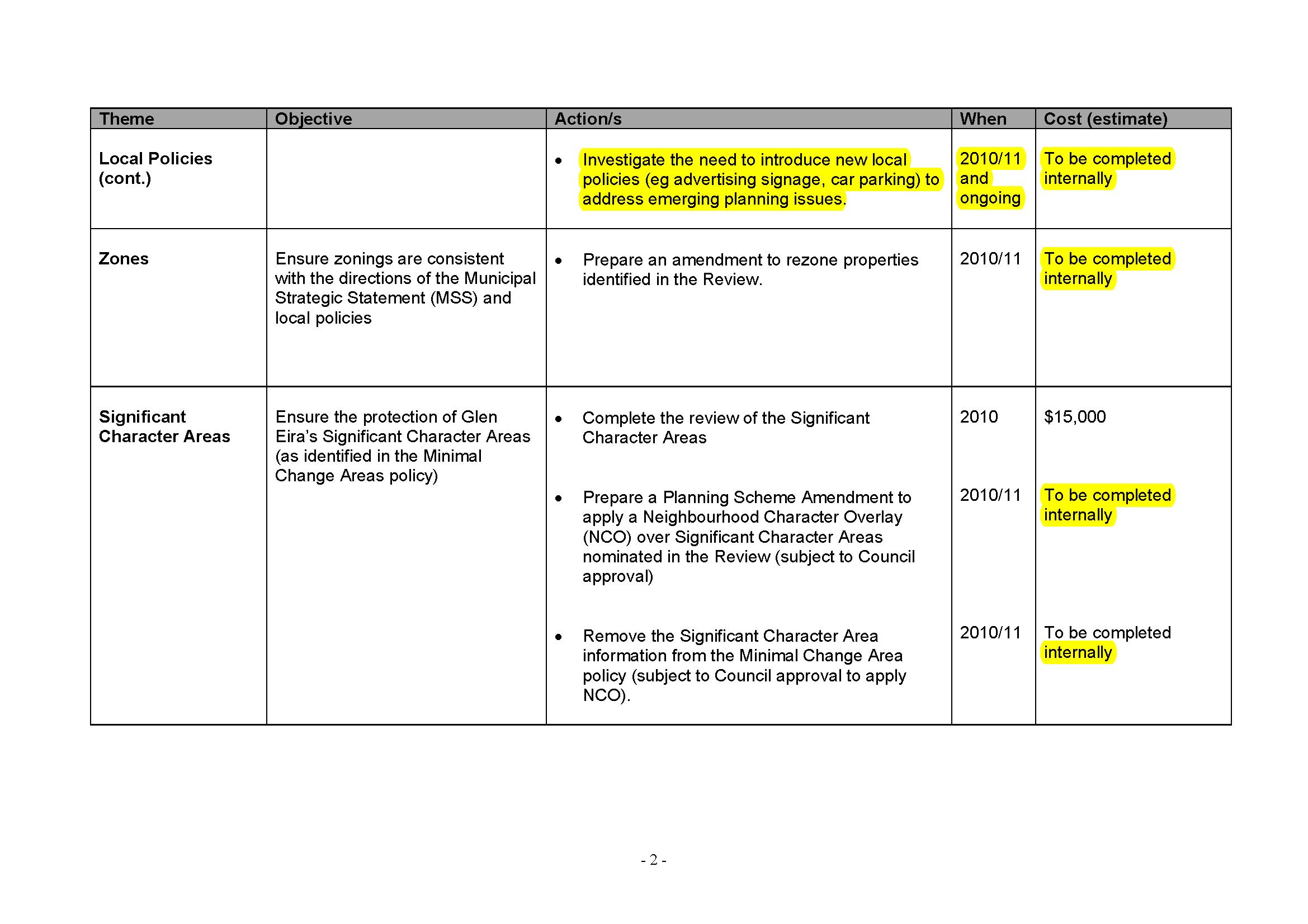
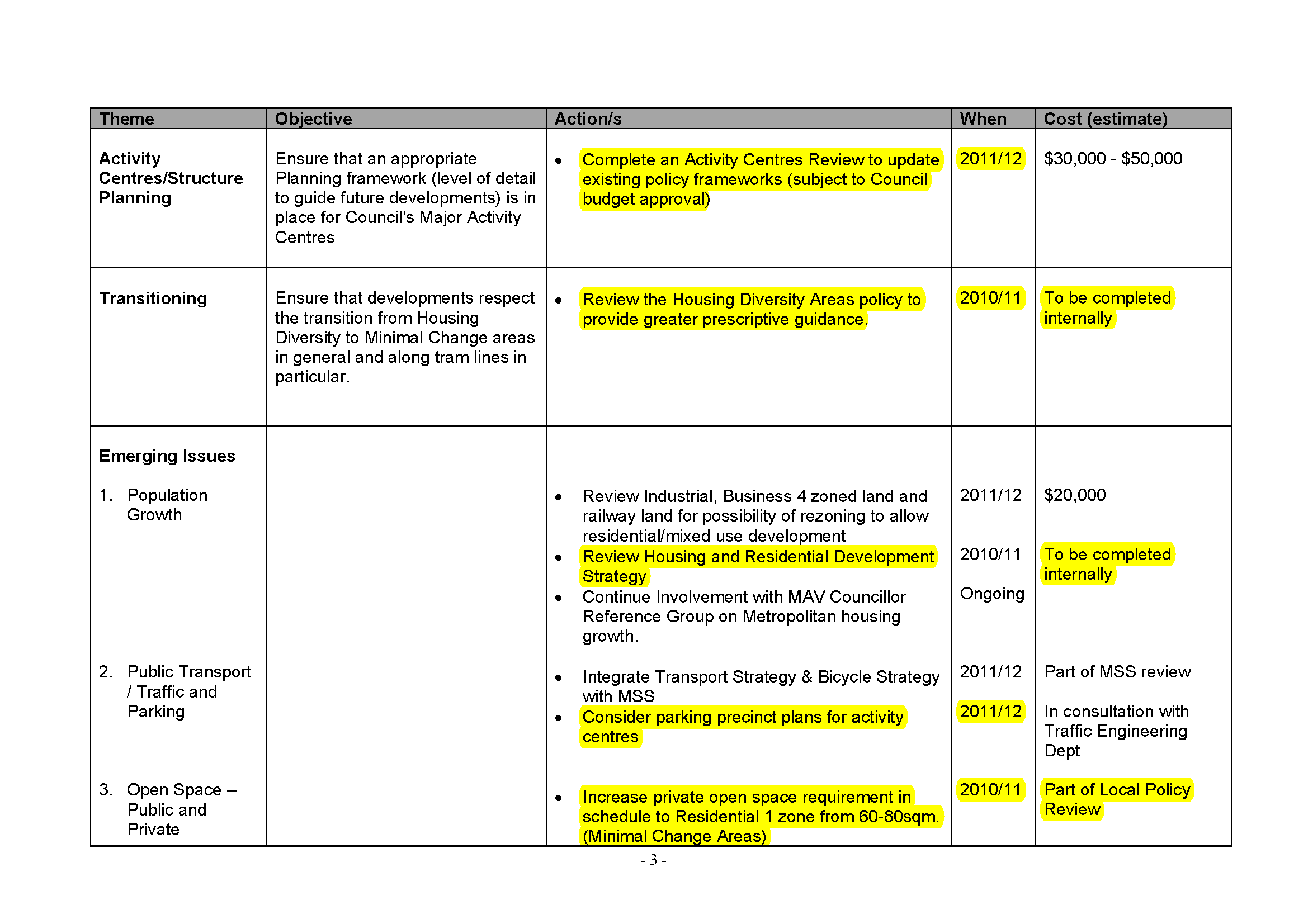
In 2010 Council went through the motions of a ‘review’ on its planning scheme. The councillors who partook in this ‘review’ and remain on council are: Lipshutz, Hyams, Esakoff, Pilling, Magee and Lobo. They resolved to pass the ‘action plan’ that is pictured below (from the minutes of August 2010).
We urge readers to note the following:
- Items highlighted in YELLOW have not been completed or even attempted as far as we know
- Time frames (ie the ‘when’ sections) mean absolutely nothing.
- All initiatives to be done ‘internally’ – very few reported on!
Thus, these images stand as a damning indictment of these councillors and administration. A repeat of this sham must not be allowed to happen with the current ‘review’.
March 30, 2016
March 29, 2016
The Zones ‘Review’ – #2
Posted by gleneira under Councillor Performance, GE Consultation/Communication, GE Governance, GE Planning, GE Service Performance[7] Comments
What stands out like a sore thumb in the Glen Eira submission is:
- the lack of detail and justification for the various positions – ie of the 72 ‘recommendations’ made by the committee, council does not provide any comment for 44 of these.
- The hypocrisy is literally astounding when we find that for some recommendations (ie inclusion of structure plans, urban design frameworks, etc Council is in agreement! Pity that this ‘agreement’ has not seen any action for the past 14 years!)
- Even more hypocritical is the repetition of this sentence – Boundaries should be based on housing policies and community consultation.
- All in all, council’s submission is another attempt to justify what it has done and to maintain the status quo. Developers should be very pleased with Council’s set of responses!
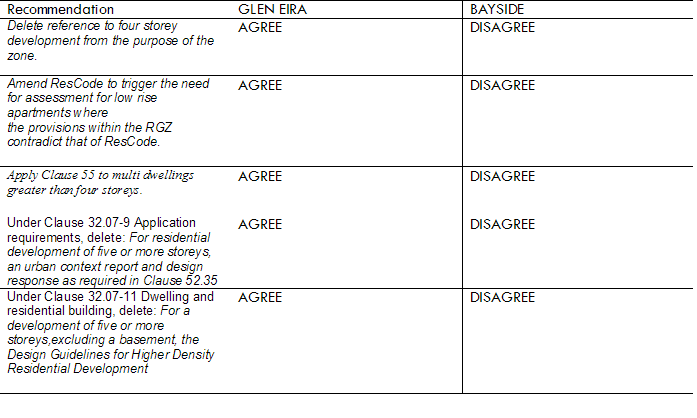
The ‘evidence’ for these claims is obvious once we compare Council’s stated position with some of its neighbours. Below is Glen Eira versus Bayside. Whilst these two councils do agree on numerous items, their differences are what is most telling. We focus in this post on the recommendations for the Residential Growth Zone only (RGZ). A quick summary –
Recommendation #20 – Delete reference to four storey development from the purpose of the zone.
GLEN EIRA – AGREE (no comment provided to justify or explain this position)
BAYSIDE – DISAGREE – The purpose of the RGZ is to enable new housing growth and diversity in locations that offer good access to services, transport and other infrastructure. In developed areas, a transition between areas of more intensive use and development and areas of restricted housing growth is required. A four storey development outcome will be appropriate in these circumstances and therefore it is recommended that the current reference remains in the purpose of the zone.
RECOMMENDATION #21 – Amend ResCode to trigger the need for assessment for low rise apartments where the provisions within the RGZ contradict that of ResCode.
GLEN EIRA – AGREE – (no comment provided to justify or explain this position)
BAYSIDE – DISAGREE – ResCode was not intended to provide direction on apartment typology. It is recommended that the Better Apartments tool be implemented as the new assessment mechanism for apartment’s development of any scale.
RECOMMENDATION #30 – Apply Clause 55 to multi dwellings greater than four storeys.
GLEN EIRA – AGREE – ResCode should apply to all forms of multi-dwelling residential development. The lack of prescription in the State Government’s Higher Density Design Guidelines (6 storeys and above) creates uncertainty
BAYSIDE – DISAGREE – Rescode was not designed to assess multi storey building typology. A more appropriate tool such as the Better Apartments should apply for multi dwellings greater than four storeys
RECOMMENDATION #41 – Under Clause 32.07-9 Application requirements, delete: For residential development of five or more storeys, an urban context report and design response as required in Clause 52.35.
GLEN EIRA – AGREE – Agree subject to ResCode applying to multi-dwelling residential developments of five or more storeys
BAYSIDE – DISAGREE – An urban context report and design response are required to ensure that the purpose of the zone, the future vision of the area and any sensitive interfaces are taken into consideration
RECOMMENDATION #42 – Under Clause 32.07-11 Dwelling and residential building, delete: For a development of five or more storeys,excluding a basement, the Design Guidelines for Higher Density Residential Development
GLEN EIRA – AGREE (no comment or explanation provided)
BAYSIDE – DISAGREE – In the absence of a more current policy to guide Higher Density Residential Development it is considered that the Design Guidelines for Higher Density Residential should remain. It is recommended that it be replaced with the Better Apartments policy once it is implemented.
March 24, 2016
The Zones ‘Review’
Posted by gleneira under Councillor Performance, GE Consultation/Communication, GE Governance, GE Planning, GE Service Performance[8] Comments
Glen Eira has finally published (without a formal council resolution and after the fact) its submission to the ‘review’ of the residential zones. This post is the first in a series where we will analyse this submission and highlight its incompetency, hypocrisy and once again council’s determination to insist that it got it right in August 2013.
Council’s incompetency and attempt to mislead is clearly shown in the following statement which comes from page 12 of its submission. (please note that the actual submission is really only a page or two since most of the 19 pages consist of regurgitating previous submissions and then tables from the committee’s recommendations).
Council writes –
Glen Eira will need to provide 800 dwellings (red line in Figure 1) each year to cater for the increase of 12000 households over the next 15 years.
Wrong on all counts!!! In the first place the figure of 12,000 households does not originate from 2016, as this sentence implies, but from 2011 as calculated by data from both Victoria in Future 2015, and profile.id. Thus what council has done is divide 12,000 by 15 years, instead of the 20 years specified by the government. That brings the average required addition of dwellings to 600 per year and NOT the claimed 800 per year.
Yet Glen Eira has over 2000 net new dwellings going up per year ever since the zones came in thus tripling its required net new dwellings in order to meet population growth. Nowhere in this submission will residents find any statement to this effect – unlike other councils’ submissions. In Glen Eira it is a case of the more the better, but without any thought given to ensuring that residential amenity, open space, infrastructure is capable of meeting this 300% over supply.
We urge all residents to read this council submission (uploaded here) and to ask themselves:
- How can such poor quality be produced time and time again?
- Why are residents deceived time and time again with faulty and incomplete data?
- Why is there no formal resolution by COUNCIL?
- Why can other councils produce pages and pages of well argued submissions, table their documents in council, and seek a formal resolution and this council can’t?
March 23, 2016
Some More, Great, Big, Whopping Porkies!
Posted by gleneira under Councillor Performance, GE Consultation/Communication, GE Governance, GE Service Performance[6] Comments
Source: http://www.gleneira.vic.gov.au/Resident-services/Rates/Rates-and-charges
The ‘reality’? From the 2015/16 Strategic Resource Plan –
We wonder how long it will take council to remove this latest webpage!!!!!!!!!!