GE Consultation/Communication


The Melbourne Racing Club (and their development arm) are at it again with the latest development plan for Stage 9 of the Caulfield Village. As in all the previous applications, the Incorporated Plan of 2014 is a completely worthless piece of paper that should be shredded and assigned to the dust bin. At every step of this process, we have had council caving in time and again – on heights, on borders of precincts, on the need for social housing, on open space, on parking requirements. Now we have another application and have to wonder why for such a major development:

  • Why this wasn’t prominently displayed on council’s home page?
  • How many letters were sent out to nearby residents?
  • How long was the advertising period? (which has now closed).

In summary, this application is for:

  • 354 apartments – of which 245 are single bedroom making that 69.2% of proposed units. There will be only 3 three bedroom apartments and the rest are either 2 bedroom or miniscule ‘studio apartments’.
  • Parking spots total 250 and only 8 for ‘retail parking’ – hence a huge shortfall in what is required.
  • Heights will be 14 storeys over two towers
  • Trees will be removed along Station Street
  • Open Space will be in shadow most of the day as will the Boulevard.

THE IMPORTANT POINTS

  • The Incorporated Plan envisaged the maximum height for this precinct at 12 storeys. The recently released Caulfield Station Structure Plan, also had this site as 12 storeys. This increase in height is similar to what has happened with all the other precincts and allowed by this council without any fight whatsoever.
  • We still have Stage 9 and 10 to go – which will be a minimum of 20 storeys and likely much higher!

Of greatest significance to residents is council’s private dealings with the developer and their reactions to the initial plans. The developer’s responses to council’s ‘requests for further information’ luckily include council’s original views in the advertised documents.

When council has previously agreed to documents that establish a projected development of approximately 1100 dwellings, and clearly defined height limits (admittedly discretionary), why do we get double the number of apartments and heights well above what was agreed? Why doesn’t this council fight tooth and nail so that the developer has to comply with the original agreement?

Here is our planning department’s response to the issue of height and parking waivers –

….there are a number of variations sought to the indicative built form shown in the approved development plan and associated controls.

Whilst the Urban Planning Department has no issue in principle with a number of variations, such as the increased height and the reduction in car parking sought, additional justification and supporting documentation should be provided to support all other variations, such as podium setbacks, podium height, etc.

The above says it all we believe!

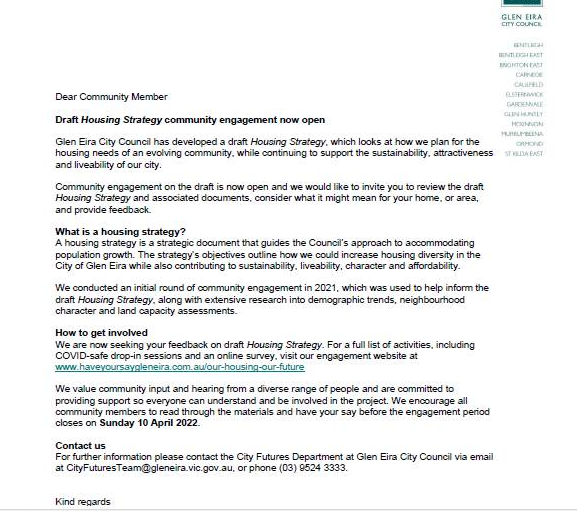
We’ve received an email from a resident containing the letter which council claims to have sent out to thousands of ratepayers about the Housing Strategy consultation. Incredibly, not one word in this ‘invitation’ provides a clue as to what is being proposed in the strategy, nor how the recipients of the letter may be impacted. In other words, a whole lot of verbage with no relevant or vital detail.

If council was really serious in eliciting feedback, then surely a summary of proposals was essential? Even if those receiving the letter followed up and investigated the Have Your Say webpage they would be confronted with the same waffle and the lack of pertinent information – unless of course, they were prepared to wade through 589 pages!

This is not consultation! It is a ‘tick the box’ exercise designed to comply with legal requirements rather then finding out exactly what residents think or want!

Council’s current agenda includes the Design & Development Overlay (DDO) for Caulfield North. This follows the previous ‘consultation’ on the Built Form Frameworks for Caulfield North, Caulfield South and Bentleigh East. We have previously commented on the value of the ‘consultation’ and its drawbacks.  (See: https://gleneira.blog/2021/05/12/is-this-fair-dinkum-consultation/)

There are very few changes from the originally advertised documents. So much for ‘listening’ to residents. Worth noting that the officer’s report, as is typical, fails to even make mention of the feedback, and how this has ‘influenced’ or not, council’s current version.

In summary, the DDO will:

  • NOT have mandatory height limits except for the sites in a heritage overlay. The majority of the precinct will have 6 storeys discretionary. The City Plan has 5 storeys. No explanation provided in anything we’ve seen as to why these Neighbourhood Centres should be 6 AND NOT THE 5 STOREYS recommended in the City Plan.
  • Overshadowing to the public domain relies only on the summer solstice – no consideration given for the winter solstice. Plus, overshadowing is said to be avoided for the most ‘active’ parts of the day. For one area this is equated to 10am to 12 pm!!!!!
  • Rear laneways of 3m are deemed appropriate for egress and ingress! This means that two cars travelling in opposite directions cannot pass each other.

We’ve highlighted some of the paragraphs from the officer’s report and ask readers to consider them carefully – as this, presumably, is supposed to be the rationale and justification for the proposed DDO.

Proposed DDO12 will apply to all commercially zoned land within the centre. The introduction of these planning controls will ensure Council can regulate growth and change at an appropriate rate and manage the competing priorities of the community, and the development industry. The proposed controls are not seeking to increase the rate of development within the centre, rather they introduce standards to manage development when it does occur.

COMMENT: What does ‘appropriate rate’ mean? 100 new apartments per annum? Or 200 per annum? The use of the word ‘rate’ is a neat sleight of hand designed to avoid the conclusion that once you raise the allowable height of a building, then it becomes more tempting and profitable for a developer. It has very little to do with the ‘rate’ or presumably ‘speed’ of development which council has no control over anyway.

Mandatory controls are not considered necessary for street walls along this section of Balaclava Road and may even be to the detriment of good development outcomes (for example, preventing on-site outdoor dining terrace areas at the front of cafés). No heritage or character overlay controls affect this section of Balaclava Road and the mandatory requirement has therefore been changed to a preferred setback requirement. This will make it consistent with the Caulfield South Activity Centre DDO.

COMMENT: Since when does a mandatory street wall height prevent ‘outdoor dining terrace areas’? and how will a discretionary height which could allow a four storey wall height contribute to ‘good development outcomes’? Here are some quotes from the original Urban Design doc:

A two to three storey building height at the street is recommended for the Caulfield Park NAC, which will maintain a scale that is both compatible with existing heritage and non heritage shopfronts, and does not overwhelm the streetscape. This has been evidenced with recent developments in the NAC that provide a three storey street wall.

As for the proposition that this is fine given it is ‘consistent’ with what has already been approved for Caulfield South is not a justification. Each Neighbourhood Centre is unique, as admitted even by council. There is no demand for ‘consistency’. Instead each area should be evaluated for what it is, rather than how it can fit into the ‘one size fits all’ model so preferred by this council.

The proposed planning controls only focus on the commercial zones within the centre, a key growth area which places less pressure on our residential areas where tree retention/planting and maintaining site permeability is important.

COMMENT:  if the objective is to protect the surrounding residential environment as claimed above, then perhaps council needs to explain why the Housing Strategy is advocating the removal of the mandatory garden requirement, reducing permeability, and doing nothing specific about tree retention.  The entire area surrounding the commercial land is zoned GRZ, where all of the above changes will impact directly on these properties. Coupled with the impacts of these changes, we will now have a minimum of 6 storeys abutting a mandatory 3 storey zone. And that’s okay for this council.

Here’s a map of the current zoning. Please note the extent of GRZ (3 storeys) and their connection to the commercial sites.

CONCLUSION

Once again we find that council has failed to live up to its so called ‘engagement strategy’. We do not know:

  • How and where community feedback influenced the final decision
  • Why the heights are increased despite the approved council City Plan
  • And finally, ‘consultation’ in name only given the pathetic survey questions

Readers should find the following cut and paste from the council website both laughable and illuminating.  Laughable, because this is an example of the emptiness of all council promises. Illuminating since it illustrates again and again that what goes into the public domain is nothing more than an exercise in public relations spin. In Glen Eira, the chasm between words and actions would challenge the Grand Canyon!

We quote verbatim from the second half  of the webpage found here: https://www.gleneira.vic.gov.au/services/planning-and-building/planning-scheme-and-amendments/glen-eira-planning-scheme-review-2018

During this wide ranging program of consultation a number of issues and opportunities were raised which have been grouped into themes below. These issues and opportunities are generally the same as those identified in the 2016 Review. Our ongoing engagement with the community has reinforced initial community feedback rather than revealed anything new. In light of this, it was not considered necessary to consult the community again for the specific purpose of this 2018 Review.

Work plan

The work plan adopted by Council includes projects that will cover:

  • Loss of neighbourhood character, more specifically:
    • The need for additional design guidelines within zones
    • More landscaping opportunities and vegetation
    • Better transition between developments
    • Curb the rate of growth
    • Reduce basement encroachments
    • Improve garden character
    • Protect backyards
    • Reduce hard surfaces in private open space areas
    • Front fencing
    • Streetscape integration
    • Better quality architecture
    • Greater front setbacks
    • Reduce building heights
  • Overdevelopment in Activity Centres
  • Development transition between zones
  • Protection of heritage
  • Traffic and parking
  • Lack of open space
  • Developer contribution to infrastructure
  • MSS and Local Policy framework
  • Loss of trees
  • Environmentally Sustainable Design

The Planning Scheme Review report and work plan has been submitted to the Minister for Planning, with work commencing immediately.

COMMENTS

The above quotes relate to the 2018 so called Review Of the Planning Scheme which, as stated, did not involve any community consultation. It is now 4 years since the updated work plan from 2016. We were promised another update for this year. We are still waiting. Nor have we heard anything about another Planning Scheme Review which is also required – unless of course, officers have applied for another extension!

But what is particularly frustrating is the stated ‘commitment’ of this council to undertake all of the things so important to residents – ie height controls, tree protection; open space, traffic, etc. We have bolded and underlined all of council’s promises which relate to these issues in the above. So, how is it possible that the current draft Housing Strategy flies in the face of all these promises?

How on earth can you:

  • ‘Curb growth’ and at the same time rezone at least 10,699 properties for more development when you already admit to a capacity for 50,000 net new dwellings and only need 13,000 out to 2036?
  • ‘improve garden character’ by removing the mandatory garden requirement in over 7000 sites?
  • ‘protect backyards’ when rear setbacks are mooted to be removed in GRZ2 and reduced in NRZ?
  • ‘reduce hard surfaces’ when you intend to decrease permeability requirements in several zones?
  • Have ‘developer contribution’ still absent after 6 years?

What the Housing Strategy proposes is completely at odds with resident views and council promises. Add to this the fact that so little has been achieved in six and a half years and the results are shameful and incompetent.

How much longer will council officers be allowed to fudge the facts and get away with it? Statement after statement made by these officers at Thursday night’s webinar was not only incorrect, but it was selective, misleading, and failed to provide participants with the full picture. Either these planners are not acquainted with the relevant legislation, or they are misrepresenting what is written in order to support the decisions they have already made. Either way, they need to be called out and held to account. This is the purpose of this post.

Two officers claimed that the Planning Practice Notes only require councils to ‘consider’ neighbourhood character in the General Residential Zone. The major quote was:

The General Residential Zone is a zone that allows up to three storey development and the Practice Note associated with the Residential zone says that the purpose of the zone is that it is to consider neighbourhood character as opposed to the Neighbourhood Residential Zone which is to respect existing neighbourhood character….

COMMENTS

The Planning Practice Notes are basically there to ‘explain’ and expand on the Victorian Planning Provisions that are in every single planning scheme.

The word ‘consider’ does not feature anywhere in the Practice Notes in relation to the General Residential Zone. What is stated is this (from Planning Practice Note 91):

While the purpose of the GRZ includes ‘To encourage development that respects the neighbourhood character of the area’, it is unlikely that neighbourhood character can be respected if existing development is single and double storey. However, the GRZ may be the appropriate zone to apply to areas with existing three-storey development.

Council should then have to explain why they have ear marked countless streets that contain only single and double storey buildings to now become 3 and 4 storey given the above paragraph. Clearly, the intent is for increased density and nothing else as explained in another quote from this practice note:

…. it may be appropriate to exempt the minimum garden area requirement in the GRZ where a planning authority is seeking to recognise existing development conditions or to promote a denser urban form of housing than currently exists to achieve other housing objectives

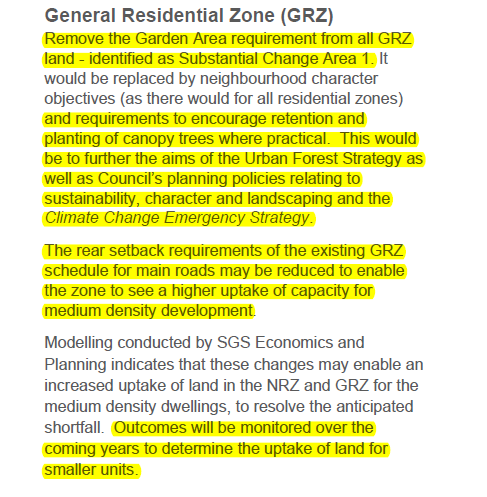
From the following image taken from the Housing Strategy, it appears that Council would have us believe that removing the garden requirement is primarily so that the Urban Forest Strategy and sustainability can be ‘improved’.

The Housing Capacity document is far more forthcoming when it states: Garden area requirements appear to be a constraint on development take-up and density in both the GRZ and NRZ (page ix)

And then from the very same document we also find: The GRZ zones have relatively high average development densities, as most developments in this zone are three storey apartment buildings rather than townhouses or villa developments. (page 48)

And from page 68: With the proposed changes …..the current extent of the general residential zone limits the take-up rate, and so applying this zone to more land will provide a greater supply of potential sites to developers and increase the development rate.

Finally this statement from page 69 – A further increase in development rates in areas formerly zoned GRZ2 of 50% will occur reflecting the reduction or removal of rear setback requirements to facilitate development.

If the argument as presented by council is that what is required is townhouses and ‘medium density’, then the above quotes illustrate completely, that the real objective is to cram as many new apartment blocks as possible into our suburbs. How on earth this council even has the gall to argue that removing the garden requirement in the GRZ will facilitate better ‘sustainability’ and landscaping outcomes is simply mind boggling, or that what will eventuate are townhouses!

There is absolutely no way that last night’s webinar could be construed as ‘consultation’. It was nothing more than an officer talk fest, carefully designed to limit community participation and for this administration to fully control every aspect. We elaborate:

  1. The only voices (and faces) that were seen and heard, were those of the four officers in attendance and the facilitator
  2. The number of participants was not revealed and nor could they read out their questions.
  3. Questions contributed during the evening only went to the officers and were not revealed to participants. We have no idea how many questions were submitted.
  4. Many of the questions were paraphrased by Torres, rather than read out verbatim
  5. Responses were general and more than half did not specifically answer the question. For example, the rationale for height increases was simply put down to ‘urban design’ recommendations. Responses on ‘sustainability’ were frankly abysmal.
  6. Specifics were totally absent – ie no mention of the removal of the garden requirement; no mention of the proposed new nrz which would increase site coverage, reduce setbacks, etc.
  7. Responses to questions submitted prior to the evening lasted precisely 13 minutes. We then had another 13 minutes of ward ‘explanations’ that again refused to mention the most important aspects of the proposed changes.

More disappointing is that only four councillors were announced as being present – Esakoff, Magee, Szmood and Zyngier – although they could not be seen and nor were they given the opportunity to say anything.

What happened last night is nothing short of disgraceful. We would even go as far as stating that there has literally been NO CONSULTATION whatsoever on the housing strategy. When residents are denied the opportunity to speak, to hear/or read what other residents think, and to be continually fobbed off with double speak and weasel words, this is the opposite of ‘consultation’. At best, this was nothing more than another ‘information’ evening – and even that failed to reveal the full facts to participants. Providing skewed and misleading information is NOT consultation. At no point in anything that has happened thus far have residents been asked the most important question that genuinely seeks their views – namely:

  • What do you think of our proposed changes to zones, garden requirements, sustainability, etc?

For those readers who wish to hear what occurred last night we have uploaded the full audio. The audio starts after about 40 seconds. Apologies for the quality of the sound. Council couldn’t even get this right it seems!

Also worth mentioning that the evening finished 10 minutes early.  Does this mean that all questions were dealt with, or it was simply decided to cut the evening short?

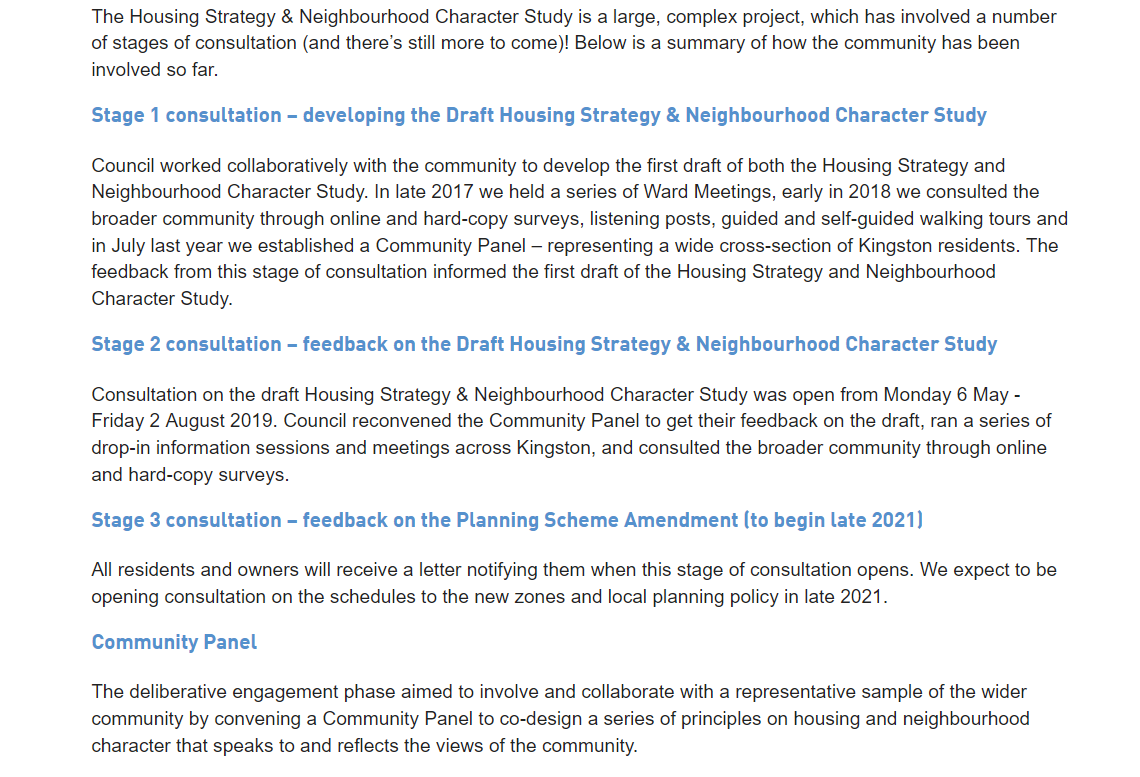
PS: BY WAY OF CONTRAST HERE IS WHAT KINGSTON COUNCIL DID IN TERMS OF CONSULTATION WITH THEIR COMMUNITY.

Source: https://www.kingston.vic.gov.au/Property-and-Development/Planning-for-our-future/Housing-Strategy-and-Neighbourhood-Character-Study

Council has now provided the Zoom link for tomorrow nights Housing Strategy Webinar. They have also included an agenda, presented below.

Judging by the published agenda, ‘presentations’ by officers will dominate most of the 90 minute scheduled meeting. Unacceptable!!!!!!!

Furthermore, why is the program divided into wards? Does this mean that comments made by Tucker Ward residents will not be admissable if the program is at the Rosstown ward section? Again, unacceptable!!!!!!

Furthermore, a Housing Strategy, is NOT about wards. It is about the entire municipality, and the principles embedded in the strategy that will shape land use. For example: the general residential zoning exists in all wards. What if some residents wish to comment on the proposed removal of the mandatory garden requirement, as a concept, and not necessarily how it relates to either Rosstown, Tucker, or Camden? Will they be told ‘this isn’t a question’ as stated in the agenda?

All in all, the deliberate and calculated machinations of this council to avoid anything resembling genuine consultation is quite literally unbelievable. Either those in charge have no idea of what consultation means, or they are simply doing everything possible to negate and undermine the expected flood of negative responses. But, and a big but, the URL is now available. We again urge all residents to log on and to tell this council administration, planners, and some councillors, exactly what they think of their strategic planning and continued failure to represent community views.

Criticism after criticism has for ages now been directed at council’s ‘consultation’ methods. Countless comments have highlighted:

  • The failure to incorporate, or even acknowledge resident feedback in officer reports
  • The absence of Discussion Papers that provide a complete and accurate overview of what is proposed in an accessible, short summary format. Instead residents are expected to plough through hundreds upon hundreds of pages instead of simply being told: this is what we are planning to introduce.
  • Survey questions that are anything but open ended or are geared to gaining genuine and relevant feedback
  • Drop in sessions that are mostly set down for times that are unsuitable for many residents.
  • The failure to implement councillor resolutions – ie on the Housing Strategy both councillors and the Consultation Committee were to be part of vetting the survey questions. We have been informed that the Consultation committee received the draft questions late Friday afternoon and were told to provide feedback by the coming Sunday. In order to provide any decent feedback, this meant that the committee members had to have read 589 pages of associated documentation – all on a weekend! We doubt that any changes occurred as a result of any feedback that did come in.

Adding further insult to injury, this coming Thursday, (24th March @ 6.30-8pm) council has scheduled a ‘webinar’ on the Housing Strategy. Registration is essential. The blurb states: Our independently-facilitated webinar will include a presentation by our planning officers, followed by a Q&A session. What this actually means is:

  • Probably one third to half of the 90 minutes will be taken up by officers
  • A Q & A session is not designed to hear what residents really think. It would come under the rubric of an ‘information session’ and not a ‘feedback session’.
  • In the past very few councillors attended. Will this be the same on Thursday?
  • For the past few ‘webinars’ residents were unable to copy items from the chat feature. This must be changed so that all attendees can see and respond to what others have said.

If council is really serious in receiving feedback from its residents then the following should happen:

  • No officer introductions. Immediate hand over to residents to state their views on various aspects of the Housing Strategy.
  • No registration required. If someone wants to log in at any stage they should be able to do so.
  • The evening be recorded and uploaded on council’s website for all to see/listen
  • Full zoom features to be available to all participants.
  • Councillors free to comment without being gagged.

For too many years now, this council has been allowed to get away with a ‘tick the box’ consultation methodology, that is anything but genuine consultation.  If residents, and councillors, really care about what is happening to the municipality, then it is vital that resident voices are heard loudly and clearly. Please attend this Thursday evening.

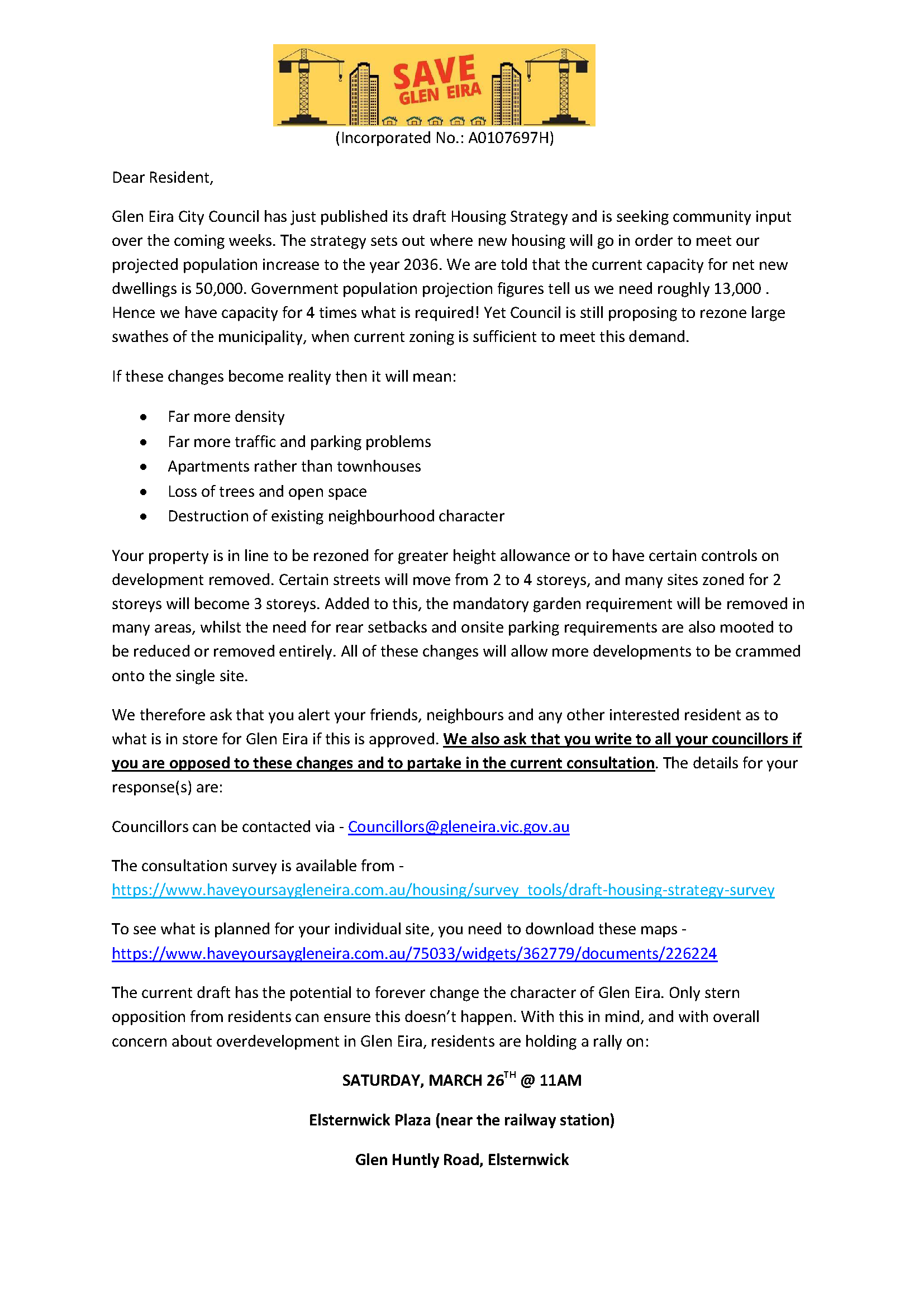
PS: We’ve just received the following from Save Glen Eira which is being distributed to all streets impacted by the proposed changes in the Housing Strategy.

PPS: please have a read and listen to the following. Another example of the depths this council can stoop to. Remember that twice this application was unanimously rejected. Now decisions are made in secret by what constitutes a minority of councillors.

The following audio is from last night’s council meeting where one resident addressed council basically telling them how inadequate strategic planning has been and the consistent refusal to incorporate years of community feedback into the draft housing strategy. Please listen carefully:

It is vitally important that residents have a clear understanding of the various ramifications of the proposed Housing Strategy and its associated documents. Council has acknowledged that approximately 11,000 current sites are in the firing line for various changes. Making matters worse is that areas currently zoned as General Residential Zone (3 storeys) or Residential Growth Zone (4 storeys) will basically remain unchanged – unless they include precincts with a heritage overlay. Only a handful of properties are mooted to have lower height requirements. The vast majority of these changes include:

  • Currently zoned properties in NRZ (2 storeys) will become available for 3 storeys and some 4 storeys
  • Currently zoned properties in GRZ (3 storeys) will have the mandatory garden requirement removed, setbacks removed, open space reduced
  • Currently zoned properties in NRZ (2 storeys) will have increased site coverage allowed; permeability requirements reduced, rear setbacks removed.

The stated justification for these changes are at best dubious, and at worst, statistically unjustified. We are told that the municipality has capacity for 50,000 new dwellings. All we ‘require’ according to population projections out to 2036 are 13,000. If this is indeed the case, then what is proposed is not only unnecessary, but will further destroy our suburbs and amenity.

The Council Argument

Despite our capacity for 50,000 new dwellings, council argues that what is missing are smaller ‘townhouses’ and ‘villa units’ (or medium density housing). This they believe will result in cheaper housing options, and hence all the proposed changes.

Here are some quotes taken directly from the last council agenda which state:

Under the existing policy settings, there will not be an adequate provision of medium density dwellings (small townhouses and villa units, whether attached or not) to meet the needs of the households anticipated to be seeking them. (page 173)

Current policy settings support the development of large side-by-side dual occupancy development across a large proportion of the municipality but does not support the development of more than two dwellings (units or townhouses) on a lot on the vast majority of sites. (page 177)

The research for the housing strategy indicated that policy should allow for more units and small townhouses to be constructed to meet the community’s needs for diverse housing and at a range of prices.(p.180)

COMMENT

Council’s planning scheme has always allowed more than two dwellings per lot in the NRZ zones – provided that site was greater than ‘conventionally sized lots’ and larger than its immediate neighbours. Wynne’s introduction of Amendment VC110 in 2017 simply reinforced this by removing the 2 dwellings per lot condition from all NRZ zoned sites in the state. Yes, it is true, that most NRZ developments are for side by side townhouses – but not exclusively. We have had apartment blocks built in NRZ in the past. This is continuing today and there is no guarantee that these will be cheaper or even smaller. Here is a list of some of the sites which have had more than 2 dwellings granted a permit. All are in the NRZ zone.

239 Kooyong road, Elsternwick – 3 double storeys (1013 square metres)

35 Brett Street, Murrumbeena – 3 double storeys (667 square metres)

19 Fosbery Avenue, Caulfield North – double storey building with 3 dwellings (897 square metres)

39 Amelia Street, McKinnon – 3 double storeys (699 square metres)

24 royal avenue, glen huntly – 3 double storeys (761 square metres)

456 Glen Eira road, Caulfield – 5 double storeys (1055 square metres)

5 Porter Road, Carnegie – 4 double storeys (permit issued by consent) – (880 square metres)

45 North Avenue, Bentleigh – 3 double storeys (556 square metres)

613 Warrigal Road, Bentleigh East – 3 double storeys (766 square metres)

7-9 St James Avenue BENTLEIGH – 7 double storeys (1876 square metres)

46 Orrong Road ELSTERNWICK – 4 dwellings (697 square metres)

50 railway Crescent, Bentleigh – 4 double storeys (313 square metres)

1 Riddell Parade ELSTERNWICK – 3 double storeys (

2 Shanahan Crescent, McKinnon – 3 double storeys  (791 square metres)

743-745 South Road Bentleigh East – 7 double storeys (1400 square metres)

11 Nina Court BENTLEIGH EAST – 4 double storeys (735 square metres)

304-306 Koornang Road CARNEGIE – 6 attached dwellings (742 square metres)

15 Leamington Crescent CAULFIELD EAST – 3 double storeys (846 square metres)

17 Leila Road ORMOND – 3 double storeys – (968 square metres)

16 McKittrick Road BENTLEIGH – 3 double storeys (700 square metres)

Council even acknowledges that they have absolutely no ability to determine what is built where. So how does all the above hype about ‘smaller townhouses’ hold up to reality? If a developer wants to, he can build whatever style of housing he/she wants. We quote from council agendas where this is clearly stated:

DELWP has advised that the residential zones cannot dictate what type / form of housing is acceptable in each location. A clear message from the State Government in releasing Planning Practice Note 90 and 91,is that Council’s housing strategy cannot be based on preferred building typologies (agenda 4th February 2020, page 234)

Councils cannot prescribe preferred housing typologies. All residential zones allow for any type of housing typology. Built form requirements within the zone schedules (e.g.: heights and setbacks), may result in some forms of housing typology being more likely in particular zones, however ALL residential zones are deemed to allow for any form of housing, including detached dwellings, medium density dwellings, townhouses and apartments. (agenda 4th February, 2020 – page 397)

DELWP has advised that some of the content in the existing Minimal Change Area Policy cannot be translated into the new scheme. This includes the policies for one or two dwellings only, and identifying preferred housing typologies of single dwellings or multi dwellings under specified circumstances. Both these policies do not align with State housing policy and will not be permitted in the new scheme. (agenda 19th December, 2019 (page 92)

More telling of course, is if council really wants ‘smaller townhouses’, then how does rezoning streets to 4 storeys achieve this? No developer is going to build 4 storey townhouses! What will happen is 4 storey apartment blocks of basically one and two bedroom developments – akin to what has happened in all RGZ zones thus far.

COUNCIL’S CONTRADICTIONS

Council recently provided input on the State Government’s Land Framework Plans. Their submission included the following comments:

Direction 5 – Prioritise housing growth in areas with access to jobs, services and good public transport

This Direction refers to opportunities for new medium and higher density housing to be considered within an 800 metre walkable catchment of activity centres. This is not supported. Many of Glen Eira activity centres are linear and relate better to a 400 metre walkable distance at the most. A radial measurement is not appropriate and opportunities for new housing should be considered at the local level, through structure plans, where the community is involved. (Agenda: 3rd November, 2021 – Page 551)

The draft Housing Strategy has clearly forgotten this position in that plenty of streets are set to be rezoned or have the requirements reduced and are certainly 800 metres or more from the commercial areas of the activity centre. Some streets are not even in cooee of an activity centre!

Finally, what would seem to undermine completely everything that council has put into its Housing Strategy is the following sentence taken from the Capacity Analysis itself –

The GRZ zones have relatively high average development densities, as most developments in this zone are three storey apartment building rather than townhouse or villa developments. (Capacity Analysis – Attachment 4 – page 48 – agenda 22/2/2022)

So, on the one hand we are being told that we have enough high density development and require smaller townhouses of ‘medium density’. Council’s ‘solution’ is to rezone hundreds upon hundreds of streets to three storey where all we are likely is more of what we allegedly could do without!

This isn’t a housing strategy. It is a disaster that totally ignores residential amenity, environmental impacts, and overall density. Enough is enough. Make your voices heard, loudly and clearly!
« Previous PageNext Page »