GE Transport


The long awaited Ombudsman’s report has now been released. See: https://ombudsman.vic.gov.au/our-impact/investigation-reports/investigation-into-three-councils-outsourcing-of-parking-fine-internal-reviews/

What we discover is that councils (Glen Eira, Stonnington & Port Phillip) all owe millions to drivers who were fined by outsourced agencies (ie Tenix) and requests for review were not done by council but this agency. This is seen by the Ombudsman and government as contrary to law under the Infringement’s Act and the Road Traffic Act.

What is even more reprehensible is that all of these councils knew of this for years but did not notify the public. In refusing to remove parking fines none of these councils made it crystal clear that Tenix was the body reviewing the fines and not council officers. Furthermore, all rejection letters included anonymous signatures such as  ‘Appeals Review Officer on behalf of Glen Eira City Council’. The lack of transparency and accountability is commented on repeatedly. Even more insulting is that all of these councils had meetings, legal advice, etc. without once informing residents. Adding salt to the wounds is the refusal of these councils to furnish the ombudsman with the legal advice provided (which councils are legally entitled not to do). But, unless there is something to hide, why not furnish these documents? In short, the name of the game was to keep mum, avoid responsibility, and hope all this goes away.

It didn’t thanks to the public announcements by such councils as Monash and Kingston, the complaints forwarded and the initiative of the ombudsman.

All of this simply makes us wonder what else this council is keeping quiet about. When a council foregoes it duty to be open, transparent and accountable, we are in trouble.

Here are some quotes and stats from the report that relate specifically to Glen Eira.

  • In 2017/18, 68,000 parking infringements were issued
  • Glen Eira said that it ‘relied on Tenix to provide appropriate advice in accordance with its contractual arrangements’. Tenix responded that ‘in no way could it be reasonably interpreted that the council would require that Tenix act as its legal advisor as regards whether or not the council had the authority to contract the services in the first instance’.
  • When Ombudsman officers asked the councils why they did not identify decision makers in their letters to motorists, Glen Eira said: Council is unaware of any requirement under legislation that the decision maker is identified by name in the decision notice’.
  • Glen Eira has more than 36,000 affected infringements valued at $3.67 million

The most scathing and salient comment by the Ombudsman’s office is arguably the following:

The councils’ statements that they currently have no express legal obligations to identify internal review decision makers or answer questions from lawyers overlooks their broader obligations as public authorities. Councils have been entrusted with a service to the public that affects people’s rights and liabilities. With that trust comes a responsibility to behave accountably and transparently. The Infringement Act only permits certain persons to make internal review decisions. Affected motorists cannot tell whether their internal review decision was authorised and valid, unless they know the identity of the decision maker. This transparency builds public confidence in the system.

Finally, here’s Glen Eira’s lamentable response:

Despite the lack of any legal determination regarding the reasonableness of Council’s actions, we do take our responsibility to act ethically and with integrity seriously. Council will therefore reflect on the findings and recommendations of this report and give early consideration to what further action may be appropriate in the circumstances, including consideration of an in good faith reimbursement scheme.

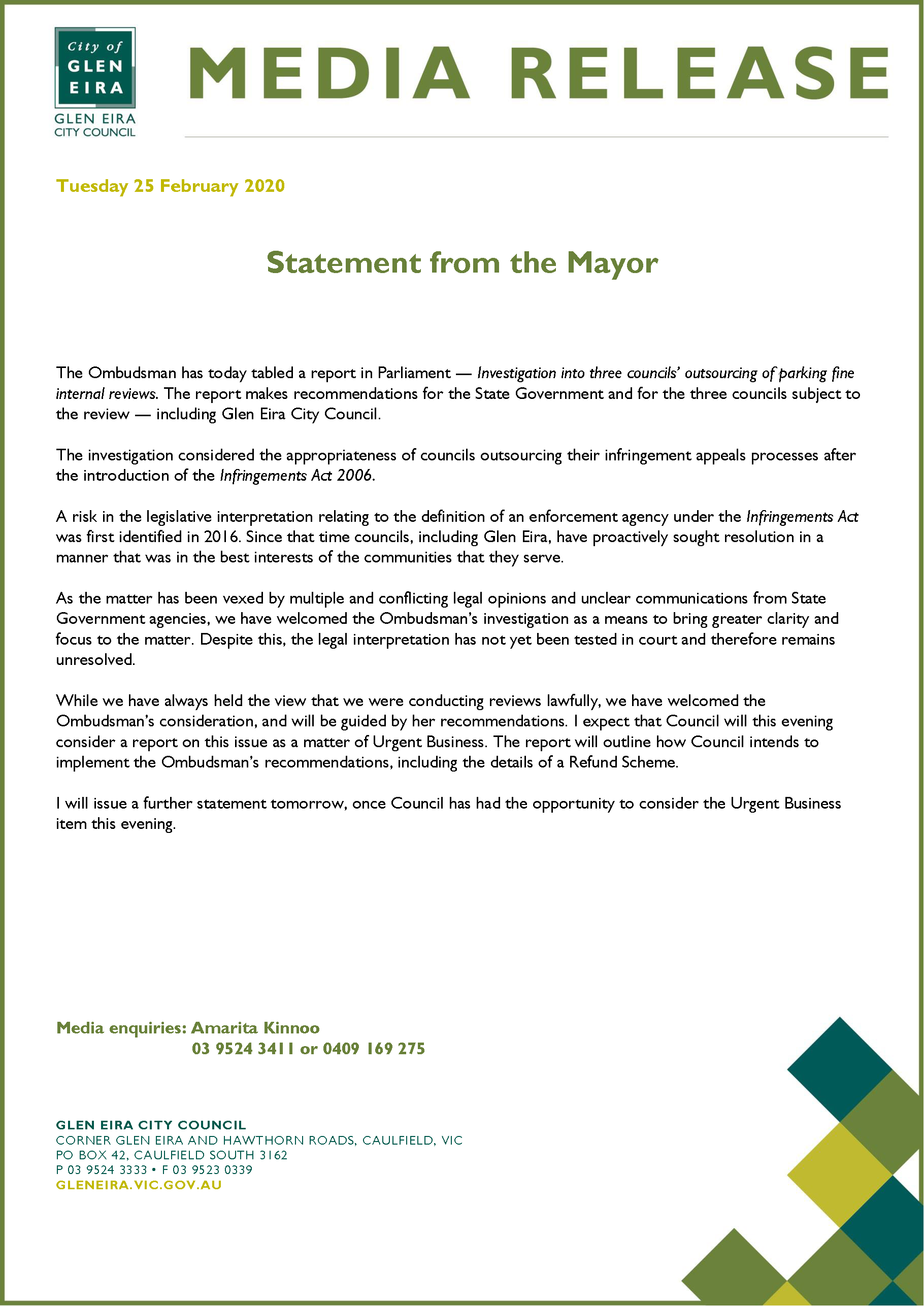
PS: COUNCIL’S MEDIA RELEASE

As we’ve stated repeatedly, every aspect of the Caulfield Village planning process for the past 9 years has resulted in council’s rolling over and granting the MRC everything they have applied for. The latest application for Section 7 & 8 development continues this sorry and pathetic tale.

Please note the following:

  • The Incorporated Plan of 2014 stated that there would be between 1000 and 1200 apartments. We are now well over 1200 with the Smith Street precinct (the largest and highest) still to occur.
  • The Incorporated Plan had maximum preferred heights of 5 storeys in the residential precinct. We got 6. The second precinct stipulated 8 and we have 10. The current proposal wants 9 when the incorporated plan says 8 and 6 for the centre. We get 9 and 7. These additional heights are because council refused to fight for MANDATORY provisions plus the fact that they did not stipulate the number of storeys. Instead they simply worked on height according to the Australian Height Datum (AHD) which looks at ground level. In other words, if the land slopes, plus lowering the ceiling heights and it is possible to fit in several more storeys (meaning more apartments) whilst still meeting the AHD requirement. We envisage that the last Smith Street Precinct will be anything from 22 to 24 storeys in height given past history.
  • Following amendment after amendment the developers have succeeded in: decreasing the initially proposed commercial/retail component and instead increasing the number of apartments. Money these days rests in residential, not commercial. All agreed to by council!
  • Council has made much of its ‘social/affordable’ housing policy. When they had the chance to enforce this at VCAT, council voted to abandon the proposed amendment with the argument that it would cost too much. What is still to be determined is whether the ambition of a 5% social/affordable housing component is 5% of the entire project, or simply 5% of the current application. Even this has been watered down to 16 apartments instead of 21!!!!! Again acceptable to council going by the officer’s recommendation.

The Current Proposal 

Here’s the breakdown of the major aspects of the proposal:

  • 437 apartments
  • 4 buildings of 7 storeys, 2 of 9 storeys
  • 94 studio apartments (average size 40 square metres)
  • 191 single bedroom apartments (average size 50 square metres)
  • 142 two bedroom apartments (average size 70 square metres)
  • 10 three bedroom apartments

That makes it 2.28% of dwellings that are three bedrooms. Council calls this satisfying the planning scheme’s clause regarding ‘diversity’ 

Worthy of mention is that there is not a single word in the officer’s report that mentions size of actual apartments, no figures are provided on overshadowing or overlooking. Basically we get an officer’s report that is devoid of all detail and strategic justification for the recommendation of a permit. Instead we find the following nonsense:

As part of the Whole of Land plans, it was originally anticipated that the Mixed-Use Precinct (which encompasses Stages 4-8) would have a residential yield of 732 dwellings, a supermarket space of 4000 sqm, retail space of 3,658 sqm and 798 sqm of office space.

The proposed mix is now 834 dwellings, 3,800sqm of supermarket space, 2,646sqm of retail space and 798 sqm of office space. This represents an increase in dwelling numbers (102 additional), a decrease in supermarket and retail space (by 400 sqm). The proposed office space remains the same. 

The increase in dwelling numbers has been managed within the permissible building envelope while maintaining an acceptable mix of dwelling sizes. This is considered to be consistent with the Incorporated Plan. 

Are we then supposed to accept the statement that 2.28% of apartments represents an ‘acceptable mix of dwelling sizes’? What then becomes ‘unacceptable’? And how is this considered to be ‘consistent’ with the Incorporated Plan when nothing is stated in the plan except the desire for ‘diversity’?

Interestingly, nothing in the officer’s report mentions the fact that a previous amendment to the development plan increased the size of the Mixed Use precinct. Council did not object and hence granted the MRC land that could then be developed even more as opposed to its original designation as ‘residential’!!!!!

Parking Waiver(s) 

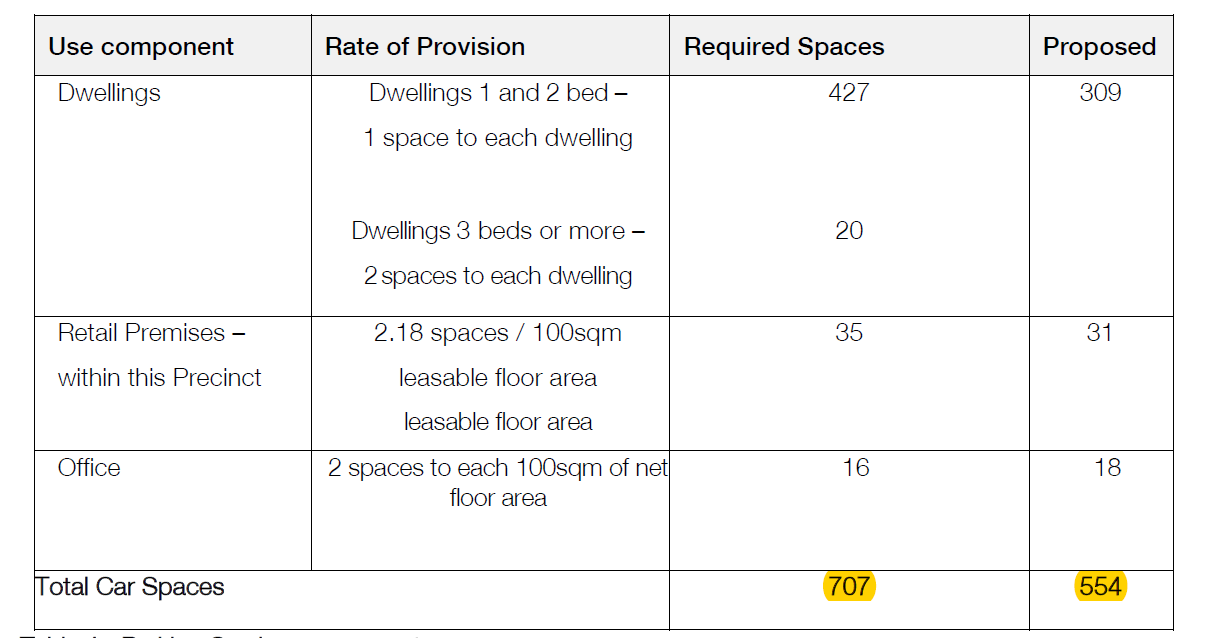
Since council is such a stickler for claiming that everything is established via the Incorporated Plan, it is therefore amazing that the developer has asked for a car parking waiver of 154 spots and council officers think this is okay!! So much for the ‘certainty’ that residents were told again and again was provided as a result of the Incorporated Plan.

Here’s the council’s excuse for another cave in:

Council’s Transport engineers have reviewed the information provided and agree with the reduced rates for the supermarket, retail uses and the reduced rate for the 1 and 2 bedroom dwellings.  

This is considered worthy of support because there will be a number of residents across this development who are attracted to the location because of the excellent public transport options which negate the need for a private vehicle. 

Affordable Housing 

Instead of achieving 21 apartments under the banner of ‘affordable housing’, we now find that this has been reduced to 16 only. We have no problem with the provision of 2 or 3 bedroom apartments. Our problem is with the proviso that the ‘net floor area’ originally planned remains the same! There is nothing in the Incorporated Plan regarding net floor area for social housing. Another brilliant move by our council.

Even more disquieting is the fact that these arrangements will only be for 10 years!!! What happens after that? Will tenants be tossed out and the apartments sold off? And what of the entire precinct since it is not earmarked to be sold but 437 apartments to be rented out! The potential slums of the future perhaps? Also, neatly sidestepping the requirements for student accommodation, the studio and single bedroom apartments are not called ‘student accommodation’. What are the chances that they will be anything but student accommodation given their size and proximity to Monash Uni? Again, nothing in the officer’s report about this loop hole!

CONCLUSION

The willingness of this council to bend over backwards to facilitate more and more inappropriate development is again being displayed. Every aspect of Glen Eira’s dealings with the MRC has been disastrous for the community. This latest application is simply one more in the long line of disasters!

PS: we forgot to mention that because of the ‘wisdom’ of Hyams, Esakoff, Pilling & Lipshutz at the beginning of the proposals, there is NO VISITOR CARPARKING ALLOCATION for anything that is developed on this site!!! Thus over 2000 apartments will not have to provide for visitor car parking.

Another item of interest in the current agenda is the proposal to steam roll ahead with spending $51+ million on the redevelopment of the Carnegie Pool. Needless to say by the time anything is constructed this figure will have increased tremendously so we could easily be looking at a cost of $60 million plus.

As with all council proposals, residents are not given the opportunity to have a real say. The formula is to present a series of options determined from above. Surely before council commits to such huge expenditure residents have a right to see a Business Case, costings for various options, detailed ‘community benefit’ outcomes. Instead, all we often get are pretty pictures and no real detail.

Reading through the comments on the Carnegie pool, the overwhelming majority state again and again that they do not want a miniature GESAC created. The emphasis is clearly on outdoor pool and open space and the retention of the history and ambience of this pool.  The writing is on the wall that council wants another GESAC (albeit smaller)!

Next we have a forecast expenditure of $5 million on the creation of Eat Street in Bentleigh and another $5 million upgrade for the library (which underwent an upgrade less than 4 years ago). So that’s another $10 million at this stage. Add in the Inkerman Road bicycle path and the real possibility that it will be council paying for everything, then millions more are set to be spent.

We are not against upgrading ageing facilities. Nor are we against providing important community infrastructure. What we are questioning is whether all of these projects provide ‘value for money’ and how essential they really are? When council is soon to borrow another $30 million whilst still owing about $10 million, we have to query the wisdom of such decision making, especially when the community is crying out for more open space and some decent strategic planning that would safeguard our neighbourhoods. These two areas have been put on the back burner and instead we get project after project that ignores these most pressing issues.

In Glen Eira residents do not have a say on budget priorities. It is definitely time that they did.

Two planning applications are up for decision next Tuesday night which will forever change the face of Caulfield East and Caulfield South. Both have officer recommendations for approval. The recommendations are further evidence of:

  • Cow towing to the MRC in spite of what the 2014 Incorporated plan for Caulfield Village actually specifies. This is simply the continuation of the voting by Esakoff, Hyams, Lipshutz and Pilling going back nearly a decade and looks set to continue.
  • The Caulfield South (Hawthorn Road) decision flies in the face of council’s adopted strategy from last council meeting. How the planning department can ignore its own policy statements is beyond belief.

For this post we will only concentrate on the Caulfield South application.

380 Hawthorn Road, Caulfield South

The application is for the Godfrey’s site and is asking for 7 storeys, 42 apartments, 3 shops and a car parking waiver of 26 spots. The officer recommendation is for 6 storeys and the granting of a 20 spot waiver.

We find this recommendation totally unacceptable on the following grounds:

  • At last council meeting, councillors voted in the new City Plan. This included height limits for our neighbourhood and local centres as being 5 storeys. We are, 3 weeks later, being told that 6 storeys is now acceptable!
  • Having decided that a 20 spot car parking waiver is ‘acceptable’, we find that council’s urban designer had other ideas. We quote from the report: Whilst Council’s Urban Designer has advised that the reorientation of the on-street parking in Olive Street would be desirable and would improve the streetscape and safety, this is considered to be unnecessary as it would reduce the number of on-street public car spaces in the area. So first you waive 20 spots and then worry about on street car parking availability. More importantly safety becomes a lesser priority than forcing the developer to provide sufficient on site parking!!!!!
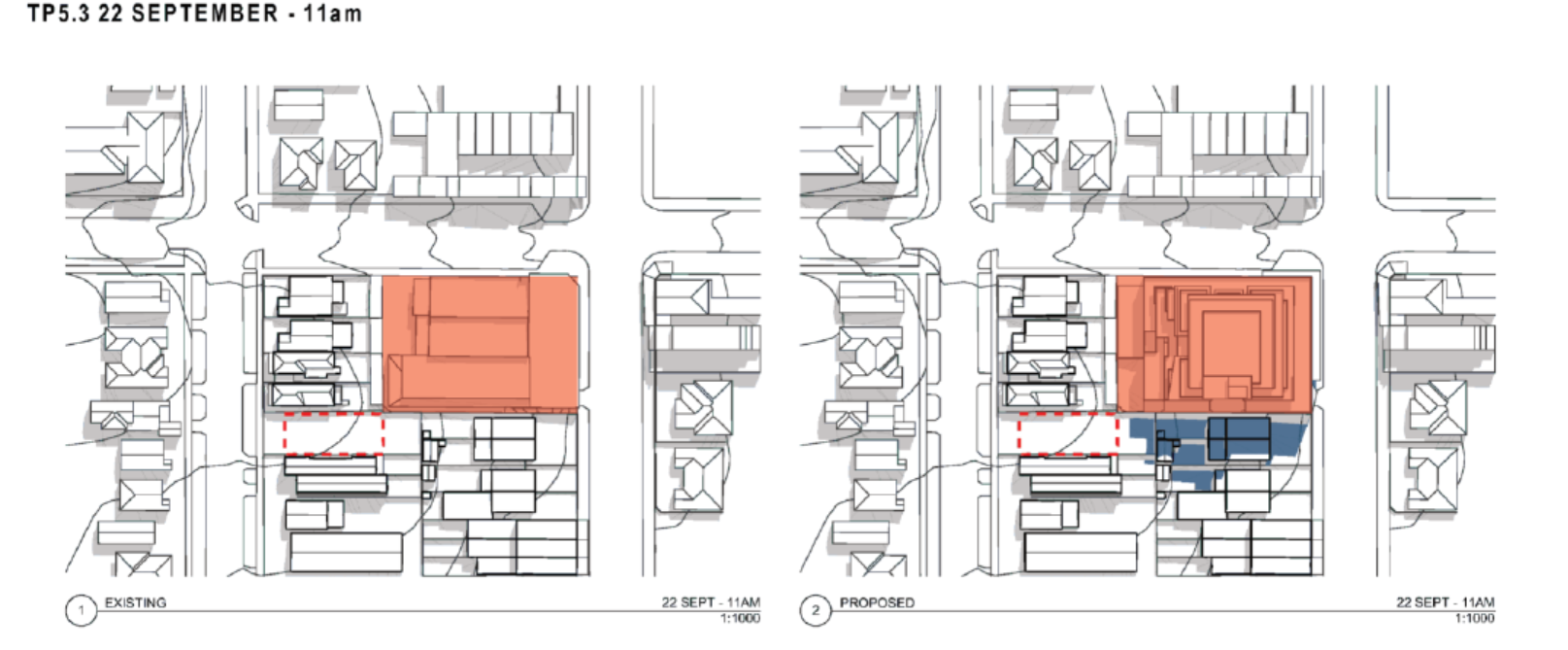
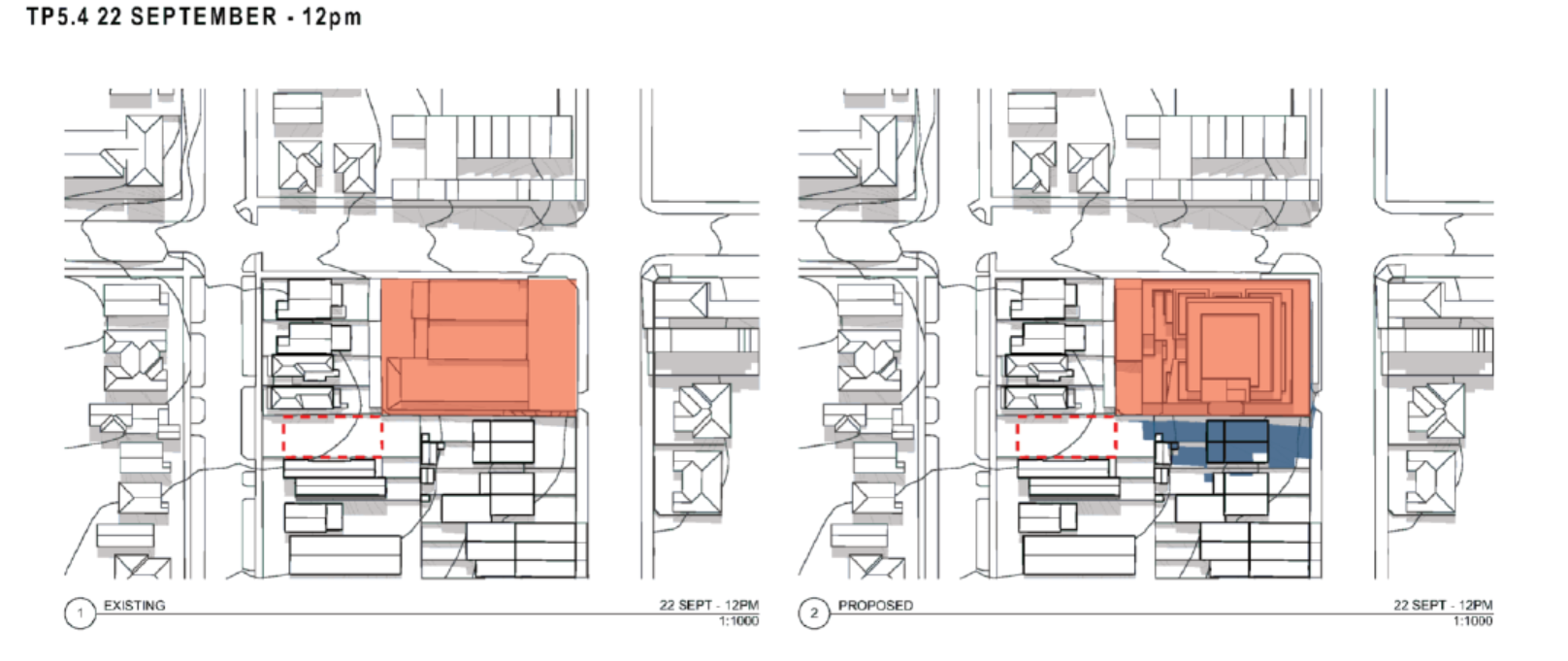
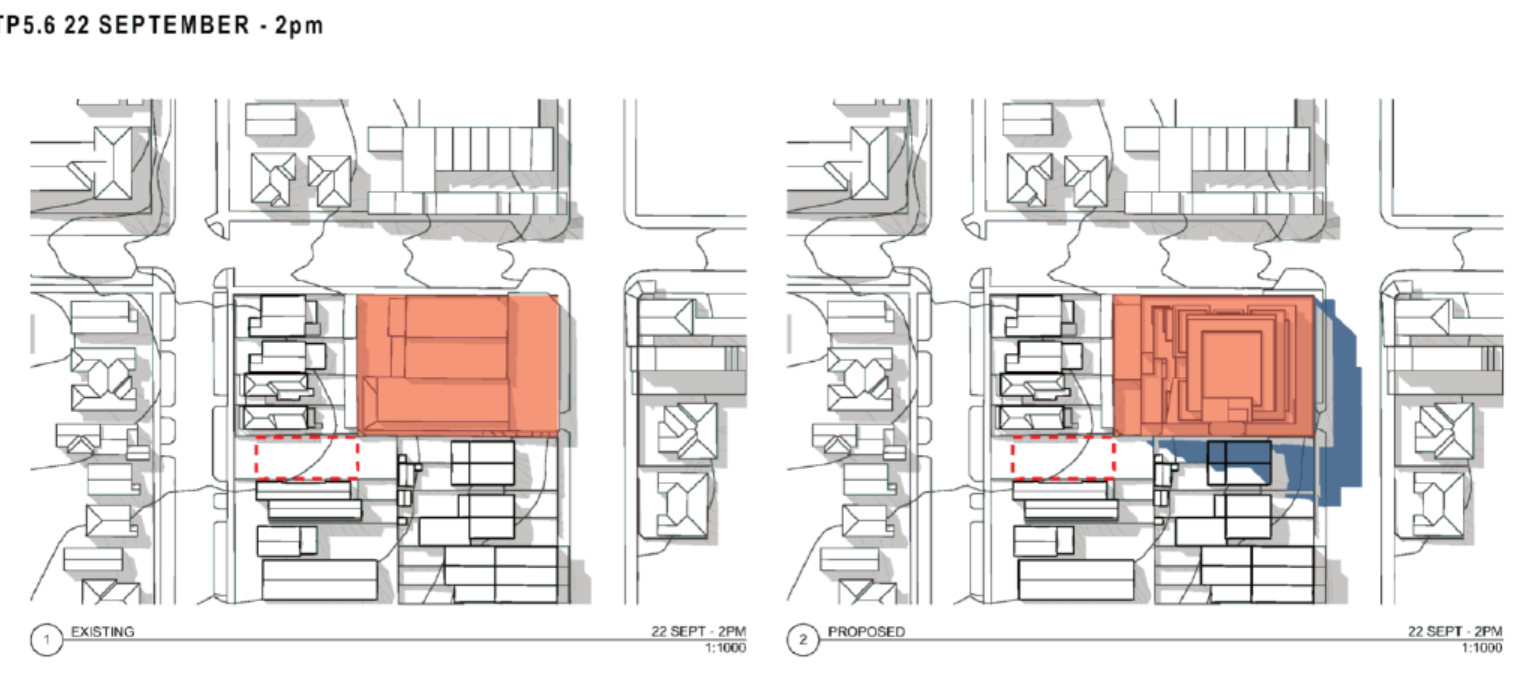
  • On potential overshadowing we get this comment: It is acknowledged that overshadowing is a significant concern for residents. The most affected properties would be those at 24-34 Cedar Street. The applicant has provided hourly overshadowing diagrams for the Equinox (September 22) from 9am to 3pm showing the effects of the proposed building on adjoining properties and the surrounding area. A review of this information has been undertaken and it is considered that the overshadowing impact of the proposal would not be unreasonable as adjoining properties, whilst experiencing new overshadowing, would still have an acceptable level of solar access, from 11am to 2pm. It is acknowledged that shadows cast in Winter would be longer and affect the Cedar Street properties to a greater extent than the Equinox shadows.

Shown below is the developer’s shadow diagrams for this period of 11am to 2pm. How on earth these diagrams can then be interpreted as an ‘acceptable level of solar access’ is truly mind boggling! And with no attempt to introduce winter solstice controls into the planning scheme the impact in winter is totally ignored.

Even more disturbing is the following:

It is acknowledged that there are currently no maximum mandatory or discretionary height limits for this area. Detailed strategic planning work will be done by Council for this activity centre in the near future. It is considered that the recommended 6 storey height of the proposed building, will not prejudice that work or the orderly planning of the area. 

But what will it do in terms of setting a precedent we ask, especially when surrounding applications are asking for 7 and 9 storeys? 

Council has been promising further work ‘strategic work. Yet this report also contains on page 31 of the agenda, under the heading of ‘seriously entertained amendment’ the response of ‘NONE’. Does this therefore mean that:

  • Caulfield South will not be part of any structure planning amendment?
  • Caulfield South will not be part of any Design & Development Overlay? or
  • Caulfield South will only be granted some wishy washy Urban Design Guidelines that are not MANDATORY and may not even be included in any shape or form into the planning scheme? They will simply remain as council ‘policy’. We remind readers that at last council meeting Hyams specifically used the term ‘urban design guidelines’. Hence, isn’t it time that residents got a firm answer as to council’s intentions?

There are many other comments throughout this report that should be severely questioned. Things are also missing. For example: legislation now requires ‘communal space’ for 40 or more dwellings. There is no discussion of this in the officer’s report. Even more disquieting is the constant referral to other applications that have not as yet been decided. Yet they are part of this decision making!

It will be mighty interesting to see what councillors do with this application given the potential, precedent setting decision.

It is becoming increasingly obvious that this council is not working for residents. Its major beneficiaries have been, and remain, developers. Nowhere is this more apparent than in its latest strategies, namely, the Open Space Refresh and the appallingly named City Plan.

The outcomes that will eventuate from such policies will only further assist in encouraging more and more development to the detriment of residents.

OPEN SPACE  

Councilors were patting themselves on the back at the last council meeting proclaiming how wonderful an 8.3% open space levy was. Admittedly, this is an increase on the current 5.7% levy. The question that residents need to ask themselves is whether or not an 8.3% levy is sufficient to meet the open space requirements of this municipality. It is not!!

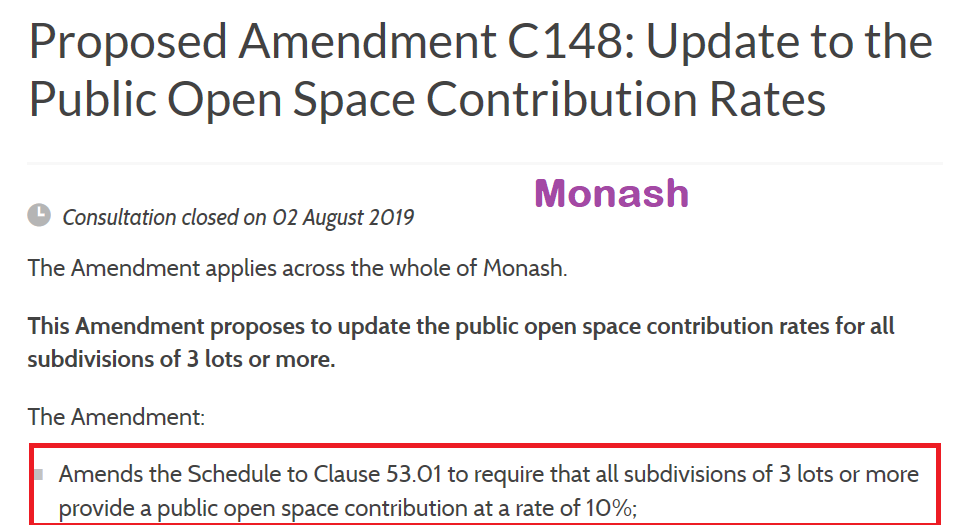
Why is council opting for this sum when other councils such as Monash and Darebin are currently seeking 10% and municipalities such as Yarra are also contemplating up to 10%. In terms of existing open space, both Monash and Darebin have far more than Glen Eira. They are also much larger with Monash being 80 square km compared to Glen Eira’s 38.7 square km. The rate of multi unit development in Glen Eira is also outstripping what happens in these councils. Yet, Glen Eira sees fit to ask for much less. Why? Surely the only feasible answer is that they do not want to put too much of an impediment in the way of developers! Residents’ needs for open space is second to facilitating more development!

Here are the proposed amendments from these other councils:

CITY PLAN

Here’s another policy that leaves much to be desired and is an insight into the shoddy strategic planning that has been endemic in Glen Eira for decades. With no up to date, genuine housing strategy, with no real activity centre strategy worth the name, council has been forced to do another slap dash, one size fits all ‘refit’. If planning had been done properly years ago we would not be in the position we are in now.

Nowhere is this ‘one size fits all’ approach illustrated more clearly than in the proposed five storey height limit for our local centres. Each centre is treated as if they are identical and all will be allowed to have 5 storey discretionary height limits. No thought has been given to the differences that exist between each local centre in terms of surrounding residential areas, transport, amount of commercial space, etc. All are treated as identical! Again, this is not planning. It is policy without strategic justification.

Once again Glen Eira stands in the shadow of how other councils go about their planning. Bayside for instance in its Amendment C126 had this to say about its local and neighbourhood centres:

Only when councillors stop endorsing such poor planning will they be doing their mandated jobs of proper oversight. Thus far they have failed dismally.

Presented below is the statement/question from one resident concerning planning for Caulfield South. We urge residents to listen carefully to the question the response from Torres.

COMMENTS

Given what has been happening in South Caulfield in recent times it is extraordinary that this council has refused to progress the work on this centre in any meaningful way. We do not for one instance buy the excuse of lack of resources, or for that matter the need to provide sufficient strategic justification that will take another 2 years at least. One could very well ask:

  • How much strategic justification was submitted for the first interim height amendment for Bentleigh & Carnegie in 2017? One FOI result clearly indicated that practically nothing was submitted to justify the minister’s intervention. The outcome was surely ‘political’ rather than based on sound housing strategy!
  • Torres would like readers to believe that the so called City Plan is something entirely new compared to the Quality Design Guidelines that were accepted by council years ago. These guidelines had already stated on page 4: Protection of character and lower scale of shopping streets Community feedback has demonstrated a clear priority to protect the character, heritage and lower scale that define Glen Eira’s shopping strips. These strips are the communal centre of Glen Eira’s diverse neighbourhoods and as such they are a physical representation of the community’s collective culture. Recent planning applications for taller buildings in the heart of these shopping strips, have demonstrated the community’s strong concern about the potential erosion of the character of Glen Eira’s shopping strips.

The Quality Design Guidelines seek to address this aspiration and concern by developing

appropriate guidance for the traditional shopping strips that encourage:- protection of heritage facades and street scale; andlimiting building heights to a maximum of 5 storeys.

Hence, the proposed height limits had been set years ago and not as Torres implies with this latest document!

The Implications 

One thing is abundantly clear. The longer council (deliberately) delays and delays then it will become almost impossible for any Design & Development Overlay, or any Structure Plan to successfully argue for 5 or less storeys, when permits have been granted for 9 storeys. Is this the secret agenda?

The latest example of what’s happening is the newly advertised application for the old bowling centre in Hawthorn Road. It seeks:

  • 9 storeys
  • 90 apartments
  • A supermarket
  • 182 car parking spots (with waivers of 10)

Some statements from the actual application are worth citing given council’s pathetic definition/interpretation(s) of ‘community benefit’, its archaic Municipal Strategic Statement and the abject failure to provide anything in the planning scheme to ensure sustainable development (ie landscaping). All of these gaps the developer naturally uses to his advantage:

The height of the proposal is considered appropriate on the basis that it clearly addresses its principal Hawthorn Road frontage, with the provision of a community benefit through an activate road corridor which integrates with the streetscape, the design response appropriately considering its relationship to neighbouring land uses and built form. 

Clause 21.-01-2 recognises that Glen Eira’s population will continue to increase slightly over the next 20 years, however the size and growth of households are anticipated to be noticeably different. It highlights the State Government’s projection that the city will have 58,000 households by the year 2021, resulting in an increase of 13,000 dwellings from the recognised 45,000 households in 1996 

Given the neighbourhood centre context and otherwise the locational circumstances of the site relative to existing built form, the site does not lend itself to extensive landscaping. Nor is there an opportunity to provide deep soil planting areas. This arrangement is not uncommon within this part of the activity centre. The insistence on the provision of this would unreasonably compromise the development and would be inconsistent with the activity centre context. 

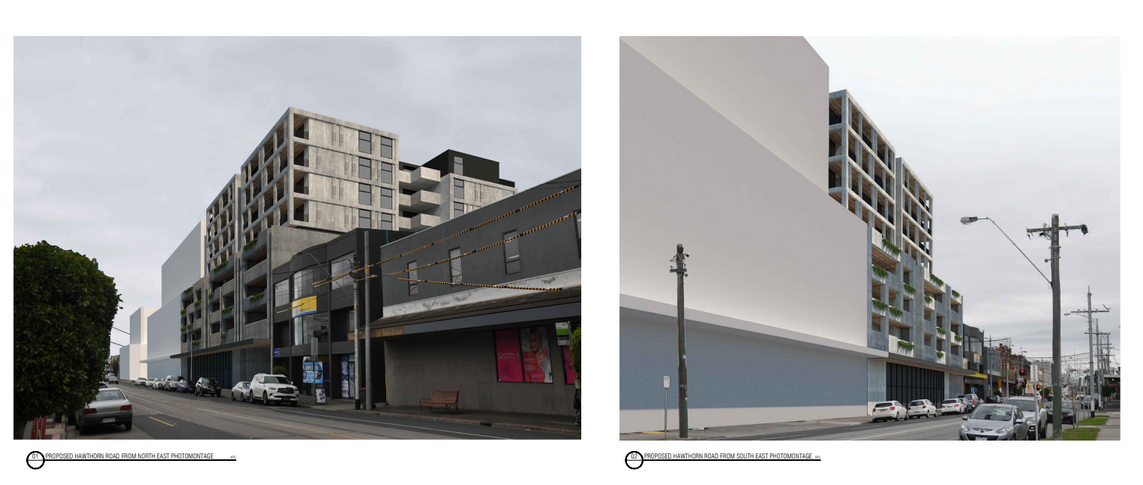
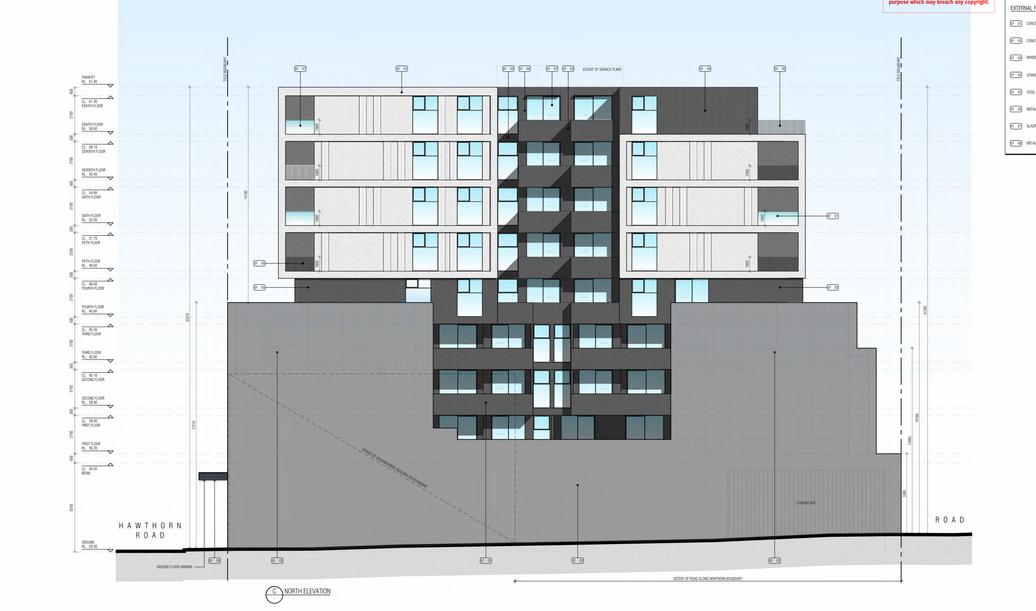
If this application does get up, then Hawthorn Road will look like this! Plus, the possibility of 3 supermarkets within a 70 metre radius, plenty of car parking waivers and the potential creation of a great wind tunnel given recent proposals. Well done council! Everything appears to be working to plan!


Last night’s council meeting, to say the least was ‘interesting’.  All the ingredients were there: wonderful grandstanding, the inability to answer questions directly from residents, and of course, the ‘gift’ of Wynne and labor culprits to camouflage the failures of Glen Eira City Council for the past few decades. Note: we certainly are not endorsing the woeful changes introduced into planning by Wynne. But to simply pass the buck and agree to everything is not in residents’ best interests either.

Here are some of the results from last night:

  • The Nepean Highway 9 storey development was refused. Delahunty was the only councillor to vote against refusal.
  • The Hawthorn Road 4 storey (heritage) development was also refused with an unanimous vote. Suddenly heritage was important, despite the fact that in Derby Road, these same councillors allowed a 12 storey development!
  • The changes to the Bentleigh & Carnegie structure plans carried with only Magee voting against and arguing that heights should be mandatory.
  • Open space strategy lauded as wonderful as is the 8.3% levy. Of course, no one mentioned that other councils were either pursuing, or had already achieved 10% for their entire municipalities! One comment from Delahunty was instructive when she implied that 8.3% was high enough not to stop development! Here is the bottom line we suspect: a 10% levy would greatly reduce developer interest and thus put some break on development in the municipality. That’s anathema to our council!
  • In response to a public question council revealed that not too much of the 2014 open space recommendations had been achieved. Six years then of getting money and hardly anything to show for it!

Until these councillors are prepared to stand up and fight for residents, then we do not anticipate that there will be any positive changes in this municipality. The argument that everything is imposed by government does not mean that councillors and council remain silent and accepting

A long post, but an important one.

The agenda for Tuesday night contains two officer recommendations for planning approval that are nothing short of staggering. In this post we will concentrate on the first one, which proposes:

217 Nepean Highway Gardenvale. A 9 storey building with 21 apartments; waiver of 4 parking spots; 88 square metres of retail and 182 square metres of office space.

Why the recommendation for a permit is unacceptable

The site is zoned Commercial 1 and hence is permitted residential development. There are no mandatory height limits. It is designated as a LOCAL CENTRE in council’s planning scheme. These are assigned a much lower priority in the development pecking order, behind Urban Villages like Bentleigh, Carnegie, Elsternwick etc. and then Neighbourhood Centres such as Ormond, East Bentleigh, McKinnon, etc.

The officer report cites the planning scheme objectives for these local centres and it is acknowledged that Gardenvale and Patterson local centres may be candidates for more intense developments. However the objectives as stated in the planning scheme refer to a 2 storey height limit overall and the possibility of somewhat higher in Gardenvale and Patterson.

What is completely mind boggling however is the following spurious ‘justification’ for 9 storeys in Gardenvale:

The Gardenvale Local Centre is specifically mentioned within the policy, noting that a taller built form may be accepted. The policy requires consideration of potential offsite amenity impacts such as overlooking, overshadowing, visual bulk and noise. These are important considerations and will be addressed later in this report (under the section ‘offsite amenity’).However, in terms of residential context, the site benefits from having only one residential abutment (and even in this case, the land is zoned commercial). 

The outstanding issue, and one which has been raised by objectors, is that this development exceeds anything that is currently approved or constructed in this local centre. While this statement is correct, there is nothing in the local policy which explicitly prohibits a development of this height, in this location. 

With this final sentence, we have a clear indication of the sham that is this council’s planning department and its agenda for anything goes. Just because there is a gaping hole in the planning scheme, does not mean that going from a stated preferred 2 storey height or even a 5 storey height to 9 makes it acceptable. Council often uses this strategy ie if not stated we don’t have to do it, or the reverse. If nothing is explicitly stated we can do it!

Even worse is that council has completely ignored its own policy documents already embedded in the planning scheme. We refer to Glen Eira City Council Quality Design Guidelines– Commercial and Mixed Use Areas (March2018) which is in the planning scheme as a Reference Document and covers all commercial and mixed use areas in the municipality. Under the heading of Shop Top (Standard) on page 424 of this document we find the following statements:

To provide commercial and mixed use buildings that maintain the low-scale and fine grained streetscape character of traditional shopping strips and respond appropriately to sensitive interfaces. 

Preferred height > 3 to 5 storeys (subject to site context), unless otherwise defined in the Glen Eira Planning Scheme or a locally specific strategic plan. 

Well, one could argue that 2 storeys is noted in the planning scheme although nothing is specifically ‘defined’ or made mandatory. Hence the question remains why we now have the recommendation for a 9 storey building which flies in the face of council’s planning scheme and its associated policy documents. Please note that even the latest document included in this agenda, specifies a 5 storey height limit for its neighbourhood and local centres! A four storey differential is simply ignored. Existing and proposed policy is ignored. Also ignored completely is this from the planning scheme:

Encourage gradual changes in building heights between existing buildings and new developments in the commercial areas of the Patterson and Gardenvale local centres 

Council’s interpretation of ‘gradual change’ becomes at best 4 storeys, and at worst,7 storeys.

Ultimately, the question basically boils down to why have a planning scheme at all? Why spend a fortune devising policies that in the end are dispensible and useless? Why is this planning department ignorant of its own guidelines or sees fit to override them? This will truly test the mettle of our so called ‘representatives’ who have repeatedly stuck to the mantra that ‘policy is policy’ and should be adhered to (in particular: Delahunty and Esakoff).

More to the point is the question of how and why a planning department can recommend that permits be granted when the proposals are so out of kilter with their own planning scheme and current strategy documents. Perhaps the answer is quite simple? If 9 storeys can go in this section of Nepean Highway, then anything goes along the current car yards and fits in perfectly with council’s ambitions for high rise development as part of the Urban Renewal South of Elsternwick. This is merely the first step in the process. Precedents are set and they are all in the developer’s favour!

This is NOT planning. It is fulfilling a predetermined agenda set in secret and without community input.

The new year has not got off to a great start in our municipality with the release of the latest agenda. Planning in Glen Eira remains incompetent, ad hoc, and entirely pro development. The current agenda proves this in spades. Council can of course now cite Wynne and the Labor government as a very convenient scapegoat for the proposed changes to the current amendments/structure plans for Bentleigh & Carnegie. This however, does not absolve them of years upon years of inaction and disastrous strategic planning.

A brief summary of the agenda is in order.

  • All heights for strategic sites/urban renewal sites have now become ‘discretionary’ rather than mandatory as they currently are. That of course means that developers can go for broke in terms of heights.
  • Our estimation is that about 180 sites in Bentleigh and Carnegie have been ‘upgraded’ so that they will now go from 2 storey height limits to either 3 or 4 storey height. Others that are currently 3 storey will now be permitted 4 storey. No justification for any of these changes has been provided. Nor is there any explanation provided as to why Godfrey Street in Bentleigh from number 9 to 27 will now be assigned a 4 storey height limit. Why not number 29 Godfrey Street, especially since the argument proposed by council is that they are attempting to ‘fix’ the problems of 2013 when single streets had multiple zonings. This kind of decision is simply repeating the mistakes of the past. Literally unbelievable! The same questions apply to changes to other streets throughout these suburbs.
  • We also have an admission that council’s ‘uplift’ policy, that was based entirely on what Melbourne City Council had created was a definite ‘no/no’ in order to determine what constitutes ‘community benefit’. They have now been told that what is required is a Development Contributions Levy. Of course, council’s response to this (after promising it in the 2016 planning scheme review) is:

Incorporating a Development Contributions Plan into the Planning Scheme for Carnegie will not be able to be undertaken as part of Amendment C184 due to the length and complexity of this process and may be worth examining at a later date.

So is this another council promise out the window?

  • Gone as well is the useless Quality Design Guidelines that was so vague and nebulous that you could drive a truck through it.
  • Most important is the simple fact that this council does not have an up to date Housing Strategy. The last one was done in 2001. Instead we now have the smoke and mirrors exercise of a ‘city plan’ that is supposed to do the work of examining closely every single street in the municipality. It doesn’t come within cooee of a decent housing strategy. Also worth pointing out to readers is that countless other councils have had housing strategies for well over a decade and have reviewed them continually. Not Glen Eira. The question that then needs asking is how can you perform decent strategic planning when no such overall strategy or policy exists. As per normal, this council does things arse backwards. First, and only because you’ve been ordered to, you get structure plans done, and then worry about a housing strategy!!!
  • Wynne and the department also recommends the use of Neighbourhood Character Overlays. For the past few years, council has been bent on removing NCOs from the planning scheme! So is it back to the drawing board again on this one?
  • As for the schedules to the zones themselves, council is quite happy with what already exists, instead of improving things like permeability, site coverage, etc. We’ve pointed out previously how other councils make a mockery of Glen Eira in that they have even 40% permeability in the GRZ zones whilst Glen Eira is stuck on its meagre 20%!!! Another big opportunity lost to do something positive! RGZ 4 is the most remarkable. Here site coverage can be 90% and permeability a fabulous 5%! Well done council!

There is much much more in this agenda that requires commenting upon. We will provide updates in the coming days. However, we believe that it is important that all those residents who will be affected by changes in zoning to fully comprehend what the changes will mean.

Below is council’s list of the proposed changes:


Wishing all our readers a healthy, peaceful and fulfilling 2020.

Reflecting on the past year, change is definitely needed as highlighted in the image below. We require:

  • a council that fights tooth and nail for its residents
  • a council that is open, transparent and accountable
  • a council that engages in genuine consultation
  • a council that listens and acts upon majority views
  • a council that implements immediate height limits for all mixed use and commercial zones
  • a council that has councillors equipped to deal with their oversight obligations

« Previous PageNext Page »