GE Transport


Item 9.3 – North Road, Ormond

An application for a 6 storey, 39 apartment  dwellings is up for decision this coming council meeting. The site is in the Ormond Neighbourhood Centre , zoned Commercial and abuts a GRZ area (3 storeys).  The officer recommendation is to grant a permit with some minor tinkering of conditions – eg. increased setbacks on a few of the proposed apartments, car parking requirements, and a landscape plan, etc.

As an augur of what is to come, this application is significant –

  • Council has already admitted that it sees nothing wrong with an 8 storey development over rail in Ormond. Thus a six storey development in a Neighbourhood Centre is also welcomed. What this means for our other Neighbourhood Centres is ominous! And without any hope of getting structure planning done for these centres in the next 2 years at least, developers can rest easy that council will bend over backwards to support their applications.
  • Council is now quite content to allow a 3 storey differential between its current zoning. Several years back there was an application for a 6 storey development in Hawthorn Road, Caulfield North. The officer report at the time recommended a 5 storey height limit and included this comment – The General Residential Zoned land to the west has a known future height limit of 10.5m or 3 storeys. The transition of the 6 level proposal to the existing residential land to the west is considered to be too abrupt to the substantially single storey dwellings. This holds even if the land to the west is ultimately developed in accordance with the GRZ provisions. Nothing has changed in the planning scheme regarding North and Hawthorn Roads. So where is the consistency? If anything, the Caulfield North site (now viewed as a Major Activity Centre by Plan Melbourne is more ‘suitable’ for 6 storeys than is North Road which still remains a neighbourhood centre. We remind readers that these ‘recommendations’ make a complete mockery of council’s current planning scheme.

There is much in this officer’s report which should be questioned. For example: the proposed height of 23 metres is considered ‘acceptable’ because of previous permits granted that are smack in the middle of the commercial centre and NOT ON THE EDGE as this land is. Council however resorts to the jargon of this building representing a ‘gateway structure’ to the Neighbourhood Centre! Please remember the arguments on Wynne’s 13 storey proposal where councillors such as Esakoff saidwhat makes a building a landmark’? Didn’t think that a landmark building ‘needs to be 2 storeys higher’ than its surrounds. Landmarks are building of ‘some special design feature’ and not just height . Sztrajt also commented on what constitutes a ‘landmark’ building when he said that the State Government is  – ‘calling this landmark’ in order to ‘give them the possibility of creating a cash cow’ and to ‘recoup’ their costs for the grade separation. They are therefore ‘using the word landmark to convince us that a residential tower’ is ‘something special in a shopping area’.

As for the other components of this report, residents should note the following:

PARKING – The applicant advised (at the planning conference) that if required, an additional 14 car spaces could be provided on-site (by providing an additional basement level). This will result in a total of 29 car spaces provided for the retail component which is a shortfall of only 7 spaces. This is considered a reasonable outcome and forms part of the recommendation. 

DIVERSITY OF DWELLINGS: The application proposed 39 dwellings of which 33 are two bedroom and 6 are three bedroom. The planning scheme under Section 58.02-3 states –To encourage a range of dwelling sizes and types in developments of ten or more dwellings.  Council’s response to this clause is – Whilst only proposing two primary forms of dwelling (two bedroom apartments and three bedroom apartments), it is considered that this is a suitable response. No explanation of course is provided as to why such a configuration is ‘suitable’ nor how a building that contains 85% of 2 bedrooms can be considered to meet the standards of a ‘range’ of ‘types’. Yes, there are no single bedroom apartmens but surely diversity does not mean 85% of two bedroom units?

Given the location of this site we also find it remarkable that only 9 properties were notified!

Our last comment reflects on the ‘consistency’ of council. A table is included in this report which purports to present ‘compliance’ with the various provisions of the planning act. Why such a table should only feature for one application and not all applications is beyond us. Secondly, we invite readers to again compare the quality of such a table with what other councils provide. Please note Bayside’s interpretation of ‘diversity’ in the image below.
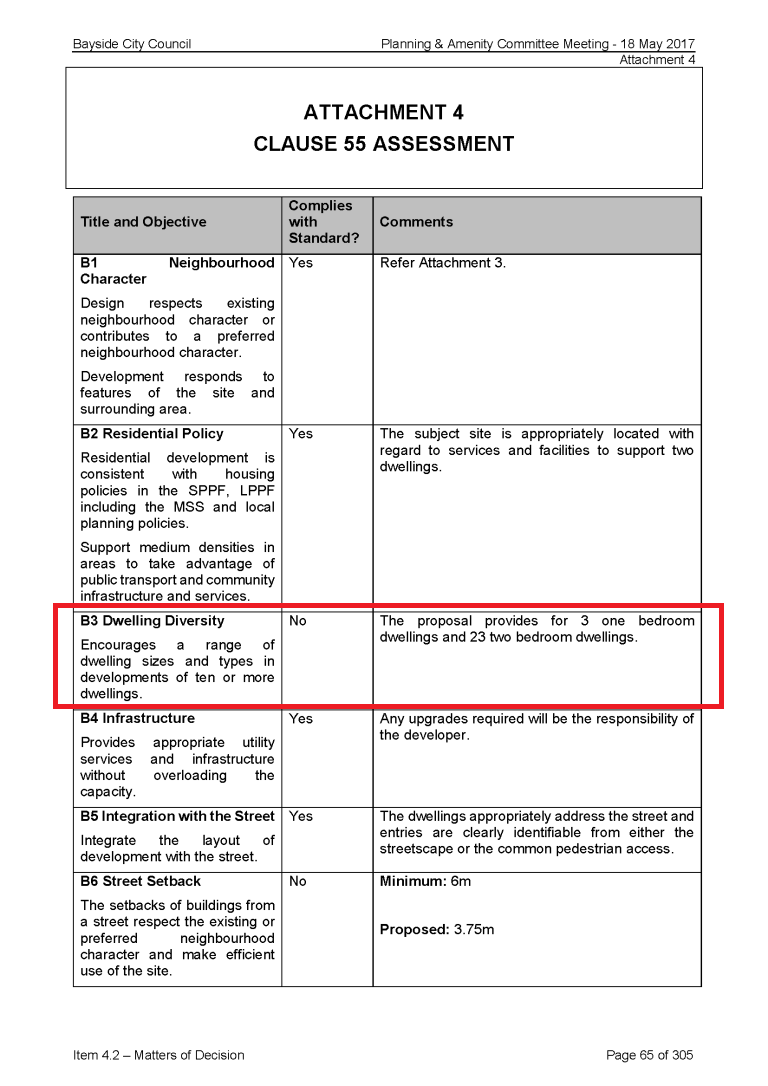
As long as councillors continue to accept sub-standard officer reports and base their decision making on such reports, then we are indeed in deep trouble!
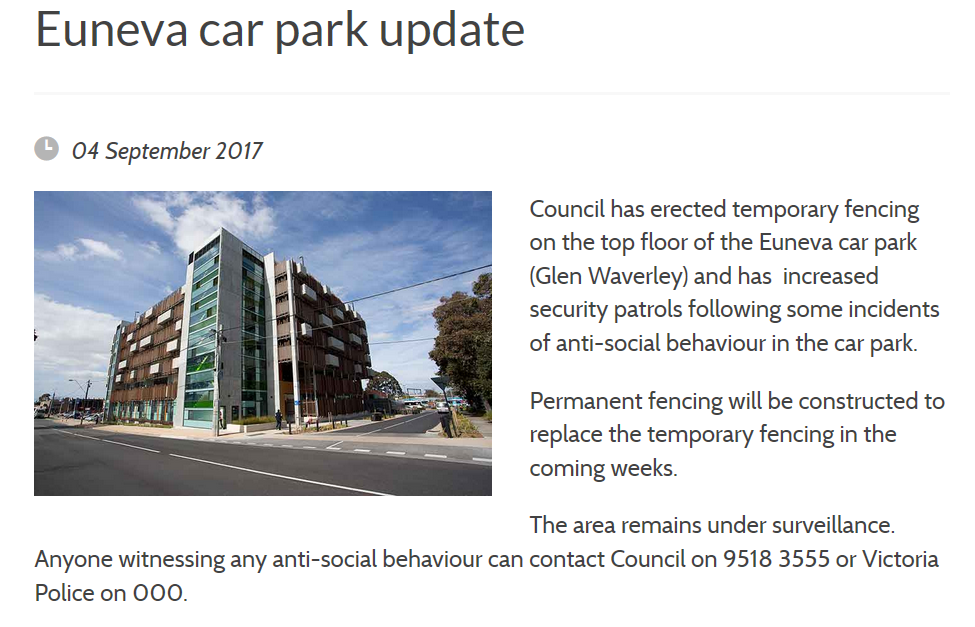
Source: https://www.monash.vic.gov.au/About-Us/Euneva-car-park-update

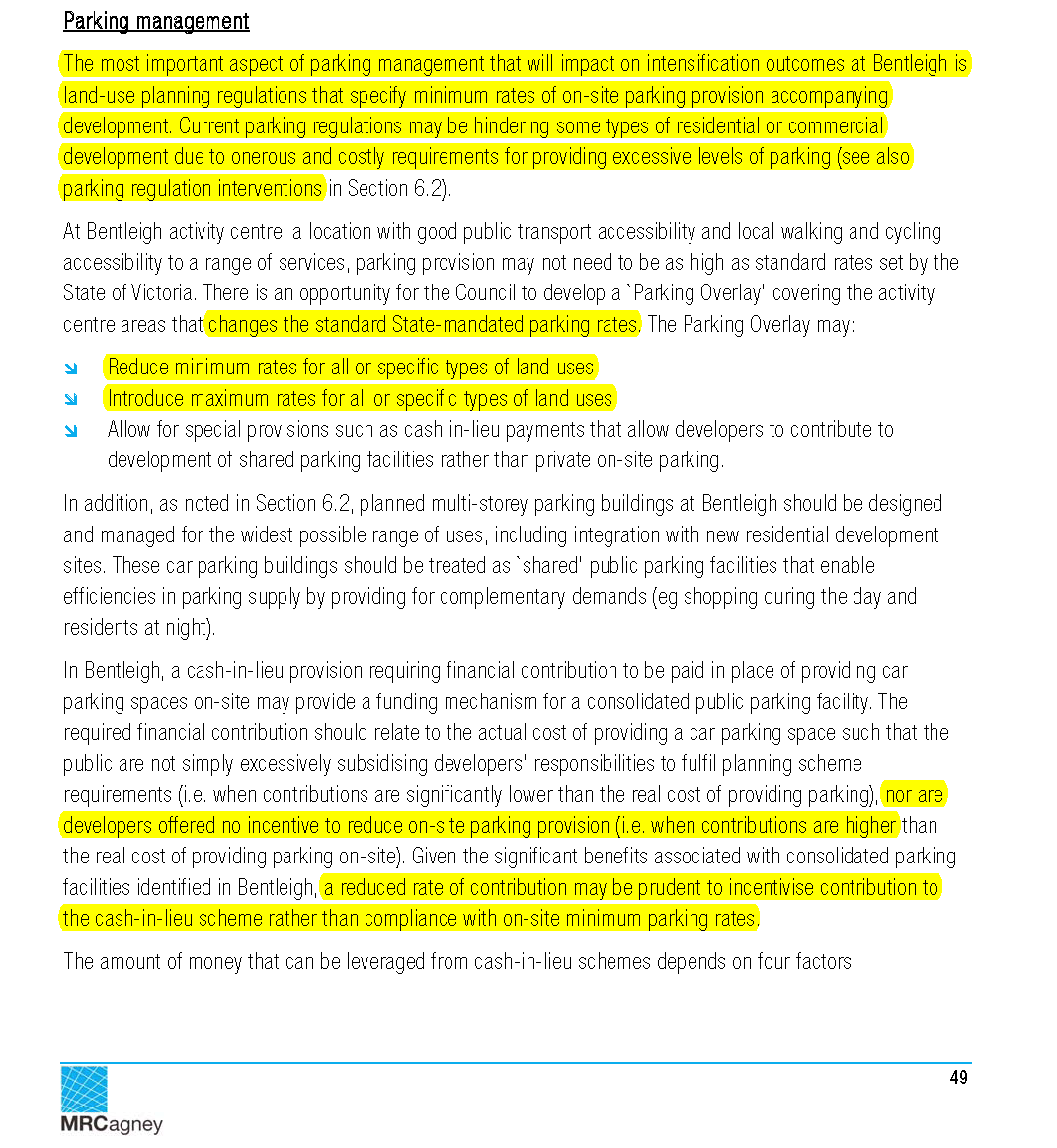
The following screen dumps and quotes all come from council’s consultant’s report – Glen Eira Transport Analysis & Forecasting. (Uploaded HERE).

The examples we’ve chosen whilst concentrating on Bentleigh apply to all centres and make it absolutely clear that:

  • Council intends to flog off public land for multi-storey parking lots
  • Traffic management/parking plans will see a reduction in the current regulations for both commercial and residential development in our activity centres (more on this below)
  • The agenda has always been, and remains more and more development and less and less car parking and decent development levies.

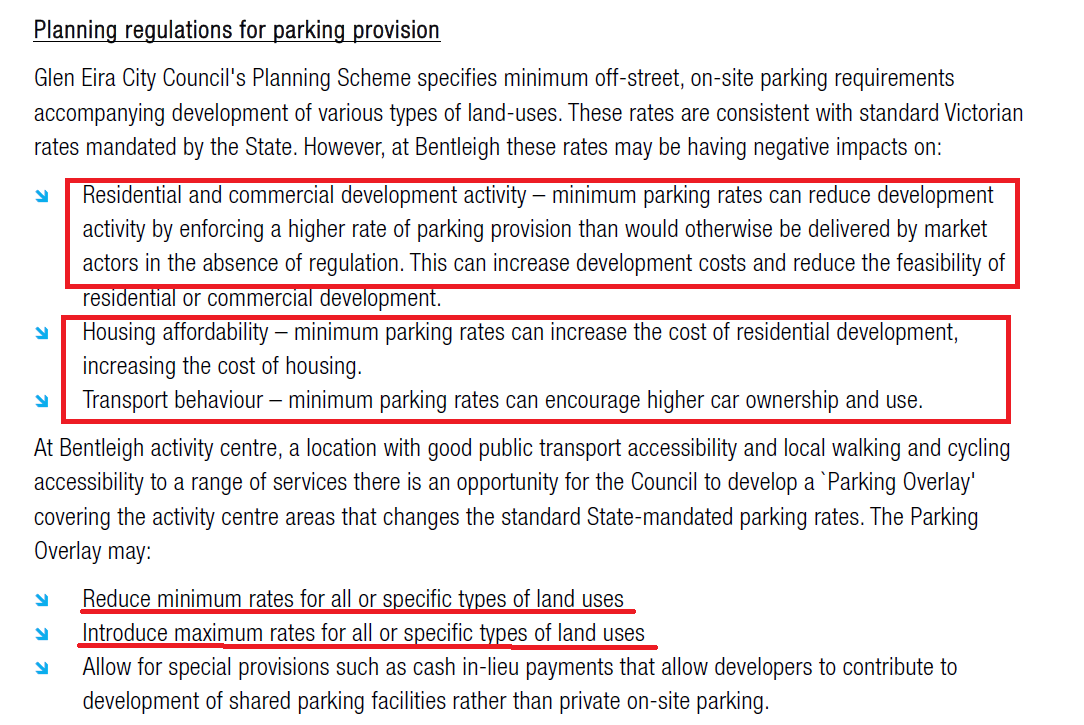
Currently the State Government ‘standards’ are clear (ie 1 car space for single bedroom, 2 car spaces for 3 and more bedrooms, plus rates for commercial enterprises depending on their nature and floor size). Council has the right to introduce what is known as parking overlays and thus change these requirements. Currently Glen Eira’s handful of parking overlays only concern student accommodation. We do not have any that control the commercial areas, or our activity centres. Council is now set to introduce such overlays.

We certainly have no objections to fostering greater ‘walkability’ or increased use of public transport. Our concerns relate to what is currently proposed and the spurious arguments that accompany these proposals. The central issues are:

  • Parking overlays that include MAXIMUM rates instead of the current MINIMUM rates. If a maximum rate is imposed that means that developments can supply anything up to the maximum – ie a lot less! By contrast a minimum rate sets out the standard that must be met!
  • Introducing a levy on developers for car parking waivers is fine in theory. It is not ‘fine’ however when the recommendation is a ‘reduced’ waiver so as not to deter development!

When for year after year residents have complained about the lack of adequate parking provision for residential and commercial with shop-top housing, then the intention to further reduce the meagre current demands is totally unacceptable.

We urge readers to carefully consider the following and what they could mean for Glen Eira!

Here are some quotes from this ‘discussion paper’. Again, please carefully note the implications and how some of these comments even contradict what is in council’s ‘Parking Analysis’ paper for Bentleigh, Carnegie & Elsternwick!

While this analysis suggests parking is sufficiently or perhaps slightly undersupplied in Bentleigh, consideration of some additional best practice benchmarks for parking supply is instructive, and highlights the extent to which parking may in fact be oversupplied in Bentleigh (page 18)

the Bentleigh activity centre has a significant oversupply of car parking, relative to best practice guidance on appropriate parking supply for centres well-served by public transport (page 19)

The expanse of parking to the north of Centre Road, however, has a much greater negative impact on the public realm, as shown in Figure 4-8. The space allocated to parking is disproportionate to the size of the public space available on Centre Road, and significantly reduces the potential residential catchment within a walkable distance to local retail, restaurants and public transport. Additionally, the large carpark dominated environs lack quality shaded footpath links, ‘eyes on the street’ and visual variation, further reducing the safety and appeal of active travel (page 25)

Cl. 52.06 rates are designed to provide parking supply that matches demand, essentially ensuring parking does not become a scarce resource. This however removes a potential signal to encourage people to alter parking behaviour and travel choices. The unintended consequence of this is that the extent of parking supplied in adherence to minimum parking rates significantly detracts from the vibrancy and quality of the public realm, and excessive space allocated to parking can crowd out the potential for greater active travel participation. (page 28)

As intensification and redevelopment of the activity centre occurs, there is likely to be some demand for car-free housing options. Planning policy that does not cater to this demand will impose unnecessary costs on housing provision and may encourage higher car ownership and usage (Page 29)

The substantial drop in population density with a 5-minute walkable catchment in comparison to a 10-minute catchment is also of concern, and suggests some additional main street shop top housing options would be welcome, as well as some infill development of existing surface car parking sites. (page 31)

Ahead of development of multi-story parking buildings or other replacement uses, Council should improve its understanding of the current use of existing parking facilities. Replacement of parking spaces on a like-for-like basis may not be required, depending on occupancy of current facilities and the future use of management tools such as pricing that may reduce parking demands. Benchmarking of parking supply at Bentleigh against best-practice guidelines (see Section 4.3.1) suggests parking supply may be significantly higher than levels that are appropriate in locations such as Bentleigh with high levels of public transport accessibility. Review of occupancy data further suggests that like-for-like replacement of parking spaces would be unnecessary and probably inappropriate (page 45)

There are many questions/issues regarding the so called structure planning for Virginia Estate that residents have been left in the dark about.  Unfortunately, the 9 documents released by the VPA provide few answers. It should also be noted that three of the most important documents only made their appearance following the closure of ‘community consultation’!!!!!

What we still don’t know and what will have a major influence on the final development plans are:

  1. Will the entire 24 hectare site be rezoned to Commercial 1 or a Combination of Commercial 1 and Mixed Use. If this occurs then the entire site will be available for residential development. Or will we have a rezoning that makes this site a Priority Development Zone akin to Caulfield Village and thus opens up a completely different kettle of fish?
  2. If there is to be ‘office’ accommodation (ie a zoning of Commercial 2) then how much of the land will carry this zoning and therefore prohibit residential development?
  3. Will we have MANDATORY HEIGHT LIMITS or discretionary height limits?
  4. Will we have height according to Australian Height Datum (AHD) as with the Caulfield Village instead of a fixed number of mandatory storeys?
  5. Will the existing Schedule which states that any development plan SHOULD be exhibited be replaced with MUST BE EXHIBITED? If this isn’t changed then residents need to be aware that legally this means there are no objection rights once the plans come in and council doesn’t even have to exhibit the plans!
  6. Thus far nothing has been released about traffic, drainage, and levies payable by the developers. Reading between the lines it appears that council will be quite prepared to accept a meagre acre and a half for open space instead of exacting either a decent allocation of open space or some major financial payment. As for traffic and drainage, all we get are admissions that these present some major problems and will be attended to further down the track!
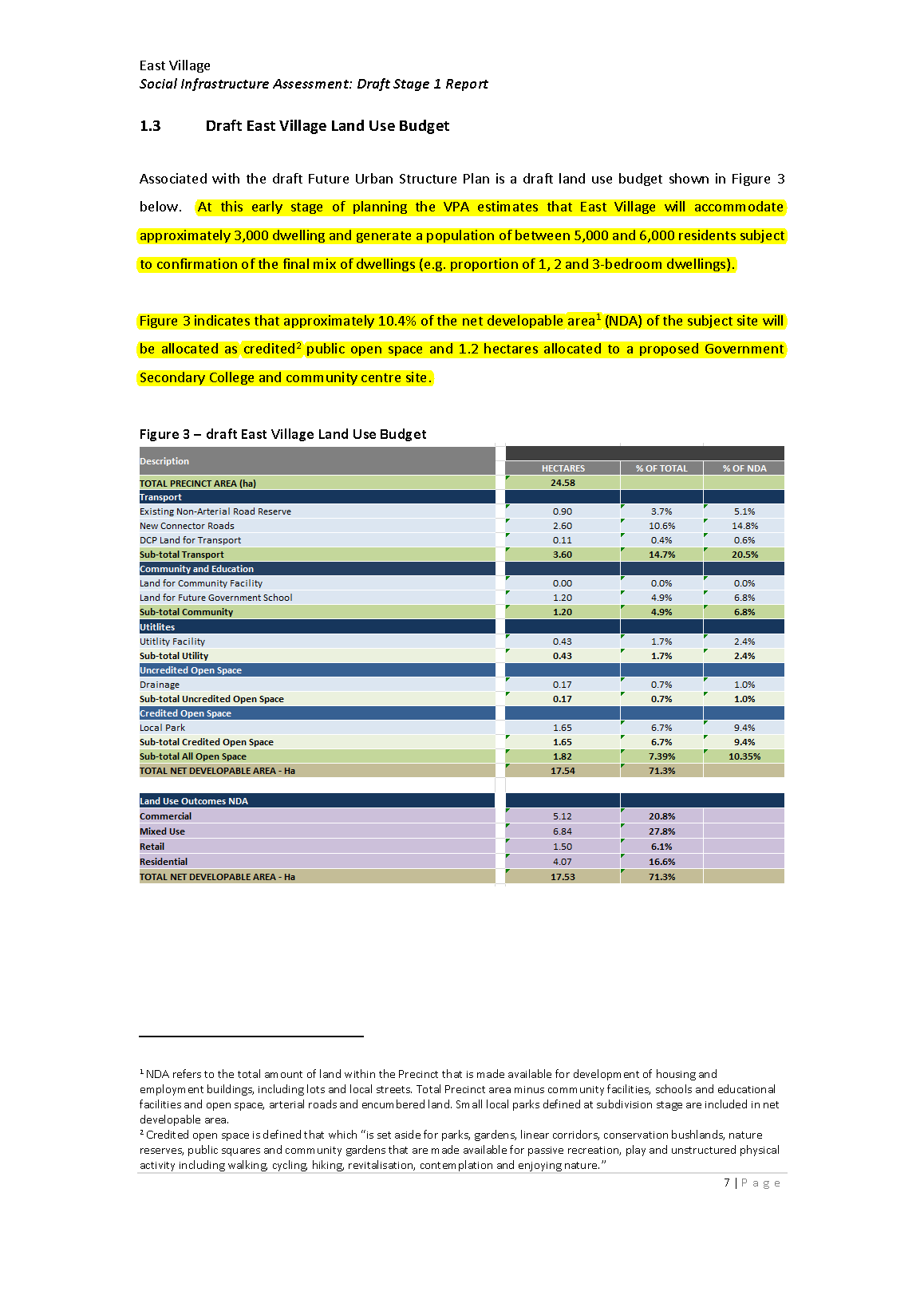
  7. We also are very sceptical regarding the stated number of ‘preliminary dwellings’ – 3000. When the site was 12.5 hectares Gillon proposed over 4000 dwellings (see below). Now that the site has literally doubled in size and there are two new ‘partners’, we are told that with a doubling of land size available the owners have magnanimously decided to only erect 3000 dwellings! The ‘escape clause’ is of course the word ‘preliminary’!!!!!! Beware we say!

What is even more disturbing about some of the documentation provided is to be found in the following:

As far as we know, the criterion of ‘net developable land’ is used only as part of calculations for open space levies/developer contributions – and not for ‘structure planning’ per se. Its inclusion here raises countless questions.

Further, if we look at ‘land use outcomes’ then a mere 4.7% as ‘residential’ is really pushing the limits of credibility. As it stands all of these categories (ie Commercial, Mixed Use and Retail) can allow residential development. A lot more clarity, precision, and less sleight of hand by the VPA, council and the developers would be highly welcomed!

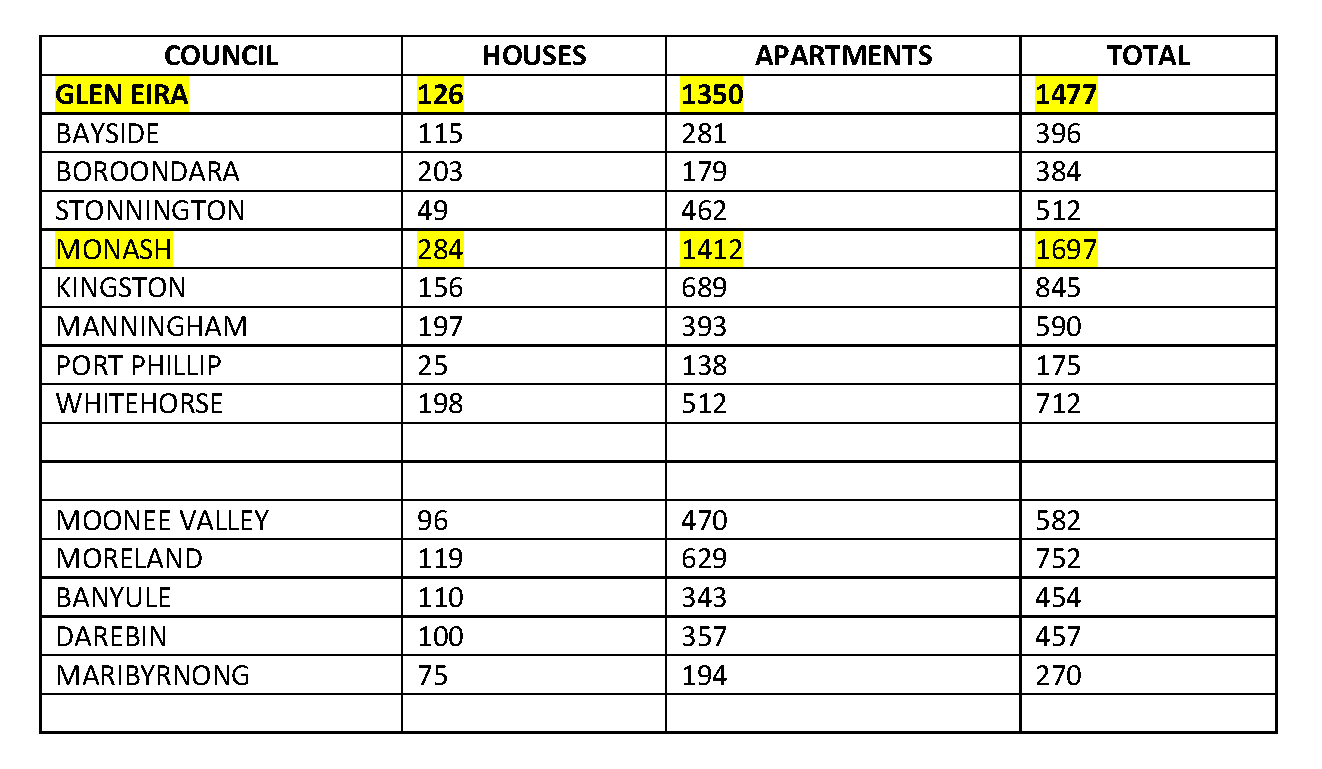
The Australian Bureau of Statistics (ABS) has released its latest figures for building approvals in local councils. The numbers are for a six month period – July 2017 to December 2017. As can be seen from the table below, only Monash has had a greater number of permits granted. However, once we take into account Monash’s size (81 square km) and its proportion of houses to apartments, then Glen Eira still leads the pack in terms of increasing density, lack of open space, minimal single house replacements, and most mind boggling is how our ‘neighbours’ can have less than half of the developments that are occurring in this municipality.

Given these figures it is unbelievable that our council is paving the way for more and more development via its current planning strategies rather than attempting to seriously curb this growth.

PS – WE’VE UPLOADED THE ABS DATA HERE

2017 has been interesting to say the least. 5 new councillors elected in 2016 brought hope that much which was amiss in Glen Eira would finally be rectified. Alas, whilst there has been some ‘progress’, there is still a long, long way to go.

Our ‘summary’ –

The Positives

  • Telecasting of council meetings – finally
  • The promise of a tree register – finally (although this could go much further and be part of the planning scheme rather than the Local Law)
  • ‘Community participation’ sessions at council meetings
  • Ostensibly, increased ‘community consultation’
  • More concrete action on heritage – ie application for Dandenong Road property

The Negatives

  • The (deliberate) drip feeding of information on structure planning
  • Extension of one year on work completion resulting in more opportunity for inappropriate development
  • The refusal to listen to the majority of community views – ie Harleston Park basketball court; height limits for Carnegie, Elsternwick; Virginia Estate, etc
  • Inundating residents with masses of documents released simultaneously
  • Lack of detail and justification in these documents – ie no ‘discussion papers’ that objectively present the pros and cons of each issue
  • No explanation as to why the Local Law has to wait until 2019 for review & no mention of notice of motion
  • Support or silence on State Government’s so called ‘reforms’ on planning
  • ‘Consultations’ that fail to ask the ‘right’ questions
  • Repeated refusal to answer why, when Glen Eira is exceeding its housing ‘quota’ by miles, this council is determined to facilitate more and more development
  • Continued and significant decline in ‘community satisfaction’ surveys and yet no action on the perennial problems – ie parking, traffic management
  • Majority of open space levy goes to existing open space and NOT THE PURCHASE OF ADDITIONAL OPEN SPACE. Plus the recent change to reporting on open space expenditure where monies spent on ‘improvements’ no longer feature together with the levy income.

The ensuing months should reveal whether or not these councillors are prepared to listen and then act on what the community has so emphatically stated in regard to structure planning and what their priorities are.

We would also like to thank all our readers for their support and wish everyone a fabulous 2018!

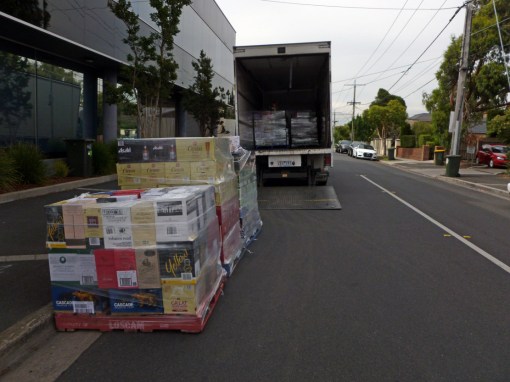
PS: Here’s a photo sent in by a resident to show what happens when loading bays are waived. (1) truck parks in ‘no standing zone’ (2) parks next to white line forcing other cars into oncoming traffic (3) no safe ‘sight lines’

one_street_off_loading_wheatley_rd_bentleigh_1_18-12-17

An application for a 13 storey, 115 or 117 unit development at 233-247 Glen Huntly Road & 14 Rippon Grove, Elsternwick raises innumerable questions about ‘consultation’ within Glen Eira and the quality of officer reports.

The recommendation is for a 12 storey building and the reduction of units to 111. VCAT has already approved a 10 storey development.

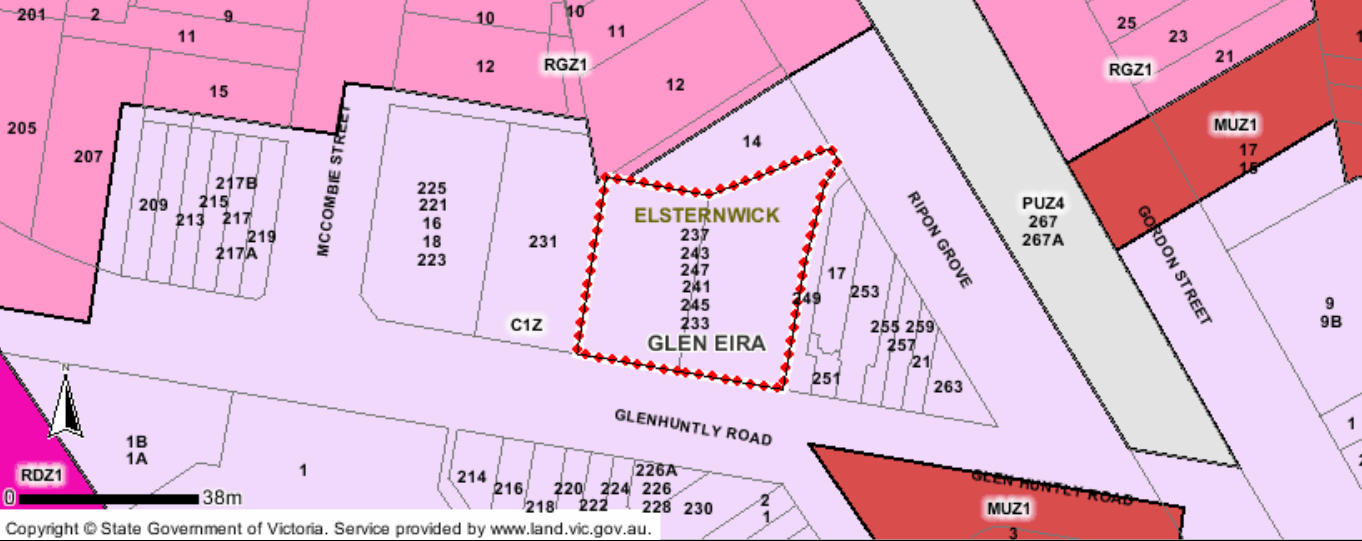
Below is a screen dump of the current zoning. What this means is that there is the potential for a 13 storey development sitting alongside 4 storey developments, according to the zoning. Council sees no problem with this – in line with some of its current ‘structure plan’ for Elsternwick! Readers should note that the officer report does NOT include this map, rather it is an aerial shot that reveals nothing about zoning! Deliberate?

The vast majority of the proposed dwellings are 2 bedroom. On page 11 of the officer’s report we find this bullet point:

High density residential development is acceptable at this location; however the building should incorporate a more diverse mix of apartment sizes. The design is overly dominated by two-bedroom dwellings and does not contribute adequately to diversity in the centre. 

Then on page 17, ‘compliance’ with the Planning Scheme on housing diversity is listed as – The application consists of a good mix of dwelling sizes’. The point here is that this is supposed to be a response to DWELLING DIVERSITY, and not simply DWELLING SIZE! When the proposal is for 2 one bedroom, 4 three bedroom and 111 two bedroom dwellings for a total of 117, then what ‘diversity’ is achieved? It’s also unclear as to whether we are talking about 115 dwellings or 117 dwellings since this number alternates throughout the report.

On parking we find council is again very generous in what it is willing to waive.

The most disturbing aspect of this report however is the following  –

Council is in the process of preparing a Structure Plan for Elsternwick and Quality Design Guidelines that will potentially inform future planning controls such as local policy, zoning and overlay provisions for the area. These are currently undergoing the second of two phases of consultation before going to Council for adoption in early 2018. In these plans, the site is designated within an area that is identified as being suitable for 8-12 storeys in height.

Whilst the Structure Plan is not at a stage that can influence the decision making process for this application, the recommendation to delete one floor will result in a building height in keeping with the expectations for this area. Notwithstanding, based on the existing character and built form outcome in the area, a building at 12 storeys is considered appropriate.

Everything in the above suggests that council has already determined that 12 storey height limit will remain in its structure planning and that for all the guff about ‘consultation’ and listening to the community, this aspect is set in concrete and will not change.

Finally, we repeat that council’s record in lopping off one or two storeys for cases that end up at VCAT is appalling. They have not been successful in even one such instance that we are aware of. Thus get ready for 13 storeys in Elsternwick and others that will be even higher given this precedent!

What is the future for ‘Moorabbin’ likely to be? We have used inverted commas, since council’s plans for ‘Moorabbin’ are really plans for Bentleigh! Moorabbin as such, is in Kingston and not Glen Eira! Admittedly Plan Melbourne has nominated ‘Moorabbin’ as a Major Activity Centre. The borders of this ‘activity centre’ are not identified in Plan Melbourne and everything has been left up to local councils.

The rail station is in Kingston. There is a structure plan already in existence by Kingston where their side of South Road and Nepean Highway is divided up into a number of precincts. The tallest buildings will be 7 storeys, mainly along Nepean Highway and one fronting South Road. All the rest according to the structure plan will be 3 and 4 storeys.

We can only speculate what Glen Eira has in mind, but it behoves residents to consider the following and its implications:

  • Moorabbin (aka Bentleigh) has been allocated the prize of a Major Activity Centre with ‘opportunities for urban renewal’
  • It is thus upgraded from a Neighbourhood Centre
  • It also includes ‘major focus for housing growth opportunities’

Given that ‘urban renewal’ means the potential for 12 storeys in Glen Eira terminology, is this the future set down for this area? And if not 12 storeys, then how high? – 7 storeys? 8 storeys?

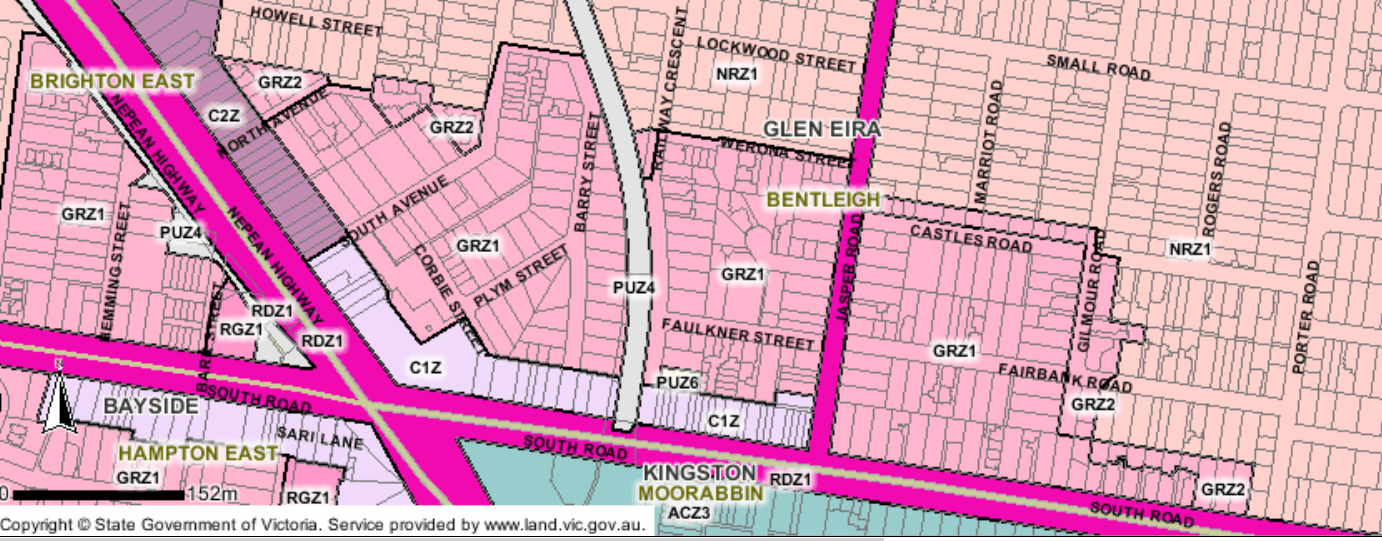
Below is the current zoning for this proposed new Major Activity Centre. Please note that surrounding the commercial area, the zoning is mainly GRZ1 – ie 3 storeys.

We speculate that the following is likely to occur –

  • Three storeys up against 7 or 8 or 9 that will become the ‘urban renewal sites’ is not feasible. That would mean that many of the streets surrounding the commercial zones will also have to be ‘upgraded’ – ie to 4 storeys or even higher. You wouldn’t want 3 storeys sitting alongside even 6 storeys!
  • Since the borders are also likely to be expanded, it would not surprise if the GRZ zone was expanded into the current Neighbourhood Residential zones.

We admit this is all speculation. However, knowing how our council has operated throughout this entire process, nothing would come as a surprise. If we are wrong, then all council has to do is be upfront and deny categorically that this is what they are planning! Silence of course can only be interpreted as ‘consent’!!!!!

The following example highlights what can be achieved when residents and council work in unison to deliver positive outcomes for the community. It features Banyule Council’s fight to ensure that the Ivanhoe Activity Centre Structure Plan contains MANDATORY, rather than ‘discretionary’ height limits.

Unlike Glen Eira City Council, Banyule was not prepared to sit back and argue that mostly ‘discretionary’ height limits was the way to go. They lobbied the Minister in conjunction with their residents and have recently achieved complete MANDATORY controls for the entire activity centre. Further Banyule council is also part of the ‘pilot program’ investigating mandatory heights for all activity centres. Moonee Valley is also part of this program. Why isn’t Glen Eira? Has our council even asked, much less uttered one single official word to put any pressure on government? The answer is NO!

We also present the Save Ivanhoe letter to Wynne asking for (and ultimately getting) mandatory heights.

The joint effort by both residents and council should be a salutary lesson for Glen Eira. And so should the processes undertaken by Banyule – ie open, transparent consultation and consensus!


Helen Carr and Luke McNamara
Co Convenors
Save Ivanhoe Residents Group
http://www.saveivanhoe.com/
info@saveivanhoe.com

Hon Richard Wynne
Minister for Planning
Victorian State Government
richard.wynne@parliament.vic.gov.au

19 September 2017

Dear Minister

RE: Mandatory Controls for the Ivanhoe Activity Centre

We are following up progress on the implementation of Mandatory Controls for the Ivanhoe Activity Centre.  This proposed action comes out of the Banyule Council community meeting in May when you stated that you were happy to introduce such controls given the extraordinary level of planning by the community and Council in the delivery of the Ivanhoe Structure Plan.

The Ivanhoe Structure Plan was developed through an unprecedented intensive and extensive Council planning process over three years. The community engagement was extensive. There were dozens of community sessions and workshops held and attended by traders, residents, developers, Council staff, Councillors and state politicians. Banyule Council employed the services of MGS Architects to do a street by street analysis of the activity centre zone. Council created a Community Consultative Committee (CCC) who met regularly for two years to work through the details of the plan.

The Save Ivanhoe Residents Group was a key player throughout this time, informing and harnessing the participation of many hundreds of residents and making a significant contribution to the outcome. Our contribution included participation on the CCC, dissemination of information to residents, ongoing discussion with Council and key stakeholders, site inspections, community forums and the review of the conceptual plans and documentation.

Over 1200 individual submissions were made to Council.

The ultimate plan delivered for the Ivanhoe Activity Centre was one where developers, traders, residents and Council agreed, through discussion, analysis and compromise on how to deliver future growth and development of the Activity Centre, in accordance with State Planning Policy.

The Structure Plan was reviewed by State Planning Department to confirm it contributed significantly to future density growth and also reviewed by a State Government Planning Panel. The guidelines for heights, setbacks and specific provisions in seven different precincts in the Activity Centre were endorsed through this process.

Despite the community request, these guidelines were not prescribed. Consequently many developers have blatantly ignored these guidelines, as have some VCAT decisions. More recently developers have been spurred on by the State Government’s changes to allowable heights. This has undermined the hard work and everything that our community and Council agreed was appropriate and reasonable to ensure growth and development but to avert rampant overdevelopment, destruction of neighbourhood character and future liveability.

A current example of over development is the 10-storey development application for 40 Upper Heidelberg Rd. This was refused by Banyule Council and is currently before VCAT. [VCAT Order: P1645/2017]. This proposal exceeds the guidelines height by 60% and has none of the required setbacks or the landscaping required for the site. It is situated on the most prominent ridgeline in Ivanhoe and will have significant negative impact on local residents, neighbourhood character and general amenity. It will be visible throughout Ivanhoe and from East Ivanhoe, Alphington and Eaglemont. It is at complete odds with local planning policy and process and will create a precedent for the area. Furthermore VCAT rejected a very similar development in the early 2000s. This earlier and similar sized proposal, although half the height, was thrown out as inappropriate due to excessive bulk and adverse impact on amenity.

As a consequence of continual developer disregard for the Activity Centre guidelines, there is widespread anger in the community that the Plan has been so undermined, discounted and ignored.

Save Ivanhoe Residents Group believes it is essential to protect the integrity of the Structure Plan for the development of the Ivanhoe Activity Centre. Therefore we are asking that you urgently approve mandatory controls on height and setbacks throughout the Activity Centre in accordance with the Structure Plan.

Furthermore we ask that you do so, or publicly signal your intent to do so, prior to 9th October VCAT Compulsory Conference regarding 40 Upper Heidelberg Rd. To do this will signal to developers that local planning guidelines are to be respected.  It will signal to the community that your government is responsive to and respects local community and Council planning processes. This is particularly urgent to give guidance to VCAT regarding all current applications scheduled for review.

We welcome development and growth in Ivanhoe. However no developer has the right to ignore the requirements of the Structure Plan and in doing so lead to the needless destruction of liveability now and in the future.

Yours sincerely

Helen Carr & Luke McNamara

CC:
Anthony Carbines. Member for Ivanhoe. E. anthony.carbines@parliament.vic.gov.au
David Davis, Shadow Minister for Planning. E. david.davis@parliament.vic.gov.au
Samantha Dunn, Vic Greens Planning Spokesperson. E. samantha.dunn@parliament.vic.gov.au

Source: http://www.saveivanhoe.com/news/183-mandatory-heights-for-ivanhoe-letter-to-minister-for-planning

« Previous PageNext Page »