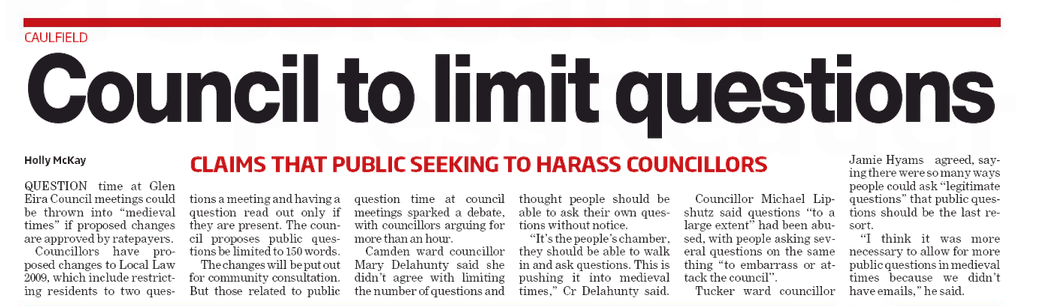
Once again the faction of Lipshutz, Hyams, Esakoff, Pilling and their newest recruit, Kelvin Ho, have successfully undermined open democratic processes in Glen Eira. In the following ‘debate’, we urge all readers to carefully consider the tenuousness, if not inanity of their arguments, the deliberate misleading and misrepresentation of the facts and what can only be seen as the self-serving motivation of their position. Years and years of appalling anti-community decisions are alive and well in Glen Eira!
ITEM 9.6 – LOCAL LAW AMENDMENT (MEETING PROCEDURES)
Lipshutz moved motion to accept recommendation. Seconded by Hyams.
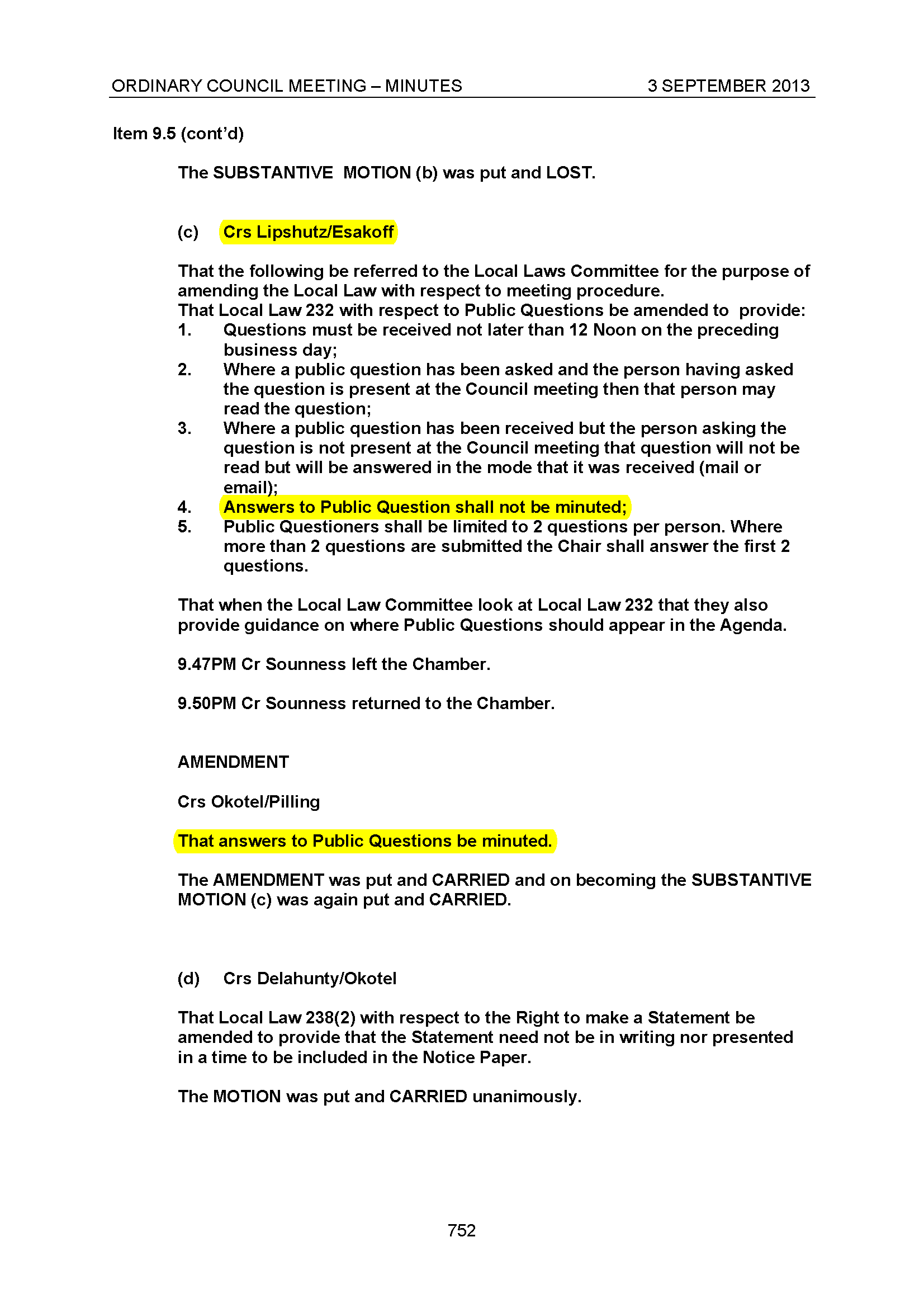
LIPSHUTZ: began by saying that he chaired the Local Laws Committee and that they had met several times over the past year. Said that the motion is only to go out to public consultation. Said that the proposed amendment on Urgent Business was to facilitate councillors raising an issue that occurred between meetings. Conceded that the ‘most controversial’ proposal concerned public questions. Claimed that public questions ‘had become anachronistic’ because technology (ie webpages, email). Said that he spends many hours answering emails and getting ‘numerous phonecalls’. So ‘if you want to ask a question’ people can via their councillors. In his view ‘public questions have been abused’. ‘We have seen question after question from the same sort of people’ who ask ‘multiple questions on the same things simply to embarrass the council’. Said that ‘the question could have been asked of a councillor’ and they would ‘have been given an answer’. So the amendment wants to move back the time for submission of public questions to 12 pm of the day preceding the council meeting. Also changing ‘should not exceed 150 words’ to ‘must not exceed 150 words’. He doesn’t want the situation ‘where one person dominates’ so they are limiting this to 2 questions. If people ask more then they won’t be read out. Further, ‘if you really want to know what the answer is, come to the council meeting’. ‘If you’re not here at the council meeting’ they will not be read out but will be answered but ‘will not be part of the minutes’. This is ‘important’ because people just want things in the minutes and ‘have no interest in coming to council meetings’. ‘If you want it in the minutes, come here and hear us’. On right of reply, the amendment proposes to remove the clause about it having to be in writing. ‘As long as councillors have notice’ a reply can be made. They don’t want to be ‘caught by surprise. We know when someone is going to say something’. Was sure that there would be ‘some people who do not agree’ with these changes but they can have their say and ‘we will consider’ the views.
HYAMS: said that he was ‘reasonably sure’ that in the past public questions were submitted under aliases. Currently questions come in on the day so can be taken on notice which means that people come to council meetings to hear the answers only to find that they have been taken on notice and no answer given on the night – ‘so having it a day earlier there is a better chance’ that the questions won’t be taken on notice. Also when questions come in on the day there are officers and councillors ‘running around trying to do the research’ to answer the questions.
DELAHUNTY: said she doesn’t agree with all the proposed amendments but will not oppose the motion because it is basically setting up the process for ‘further input’. Thought that the changes ‘limit the ability to participate’ for residents and it ‘almost distances’ council from ‘ratepayers’ by attempting to put in ‘more controls, less talking, less engagement, less interaction’. ‘Local government is about being the closest to the people’. Lipshutz talked about emails and phone calls from residents asking questions, so putting in these conditions is in fact ‘making it more inconsistent’ by making it harder for residents to communicate with council. When people write emails to councillors ‘we don’t say that’s enough’, you’ve asked your two questions, so why should this apply here? Wanted ‘consistent principles’ applied. Council ‘should embrace’ being more ‘interactive with the public’. Didn’t think that the proposed changes ‘embrace best practice’.
HO: said he was ‘happy to listen to any issues’ that residents raised and that he would be every second Tuesday of the month in the Carnegie shopping centre and people could talk to him between 10-12.
SOUNNESS: supported the motion to let people have their say on the amendments. Said that people had told him they were dissatisfied with the local law and one of the previous issues was about ‘frisbee’ was ‘an issue of the local law’ as well as how the ‘meeting procedure works’. He has had ‘strong conversations’ with people on this as well.
LOBO: said that ‘we need uniformity’ with other councils. There should be one law for all councils and ‘not let’ councillors ‘twist and turn what is good’. ‘The local law has to be spoken by the people’. They should be able to ‘speak in the gallery’ and not be restricted to 150 words. ‘Residents should get an opportunity to stand up and ask questions’.
MAGEE: said that councillors are available 365 days a year to the community and 24 hours on the phone, via email. They are ‘available at any stage’. Claimed that in his 8 years there have only been ‘a handful’ of questions that needed to ‘be asked at a council meeting’. He understood the part about 150 words, but he also gets emails of ‘3 to 4 pages’ and he answers. When letters come in to the mayor and councillors, then the mayor answers on ‘behalf of all councillors’. Said that you ‘can’t have one local law’ because they cover ‘everything from dogs to footpaths’ and every council is different. Also silly to say that people should come to council meetings to ‘voice their opinion’. People have ‘voiced their opinion for hundreds of years’ and if this was permitted with the skyrail issue then the meeting would have ‘gone to 2 or 3 or maybe 4 o’clock’ in the morning. It ‘is easier if questions are taken on notice because the answer’ is mostly the same. There is plenty of opportunity for residents to ‘speak’ with councillors ‘one on one’ or via email. Coming to a council meeting and asking a question so that it goes into the minutes you ‘have to wonder why those questions are being asked’. Said that ‘every question’ will be answered but ‘it is not up to council to sit here and have 3 or 4 hundred’ questions answered ‘one by one’. Like Hyams said, councillors are ‘chasing answers’ to sometimes 7 very ‘detailed’ questions. ‘Those questions could have come in 3 weeks earlier’ but ‘they come in at the last minute and expect an answer’. Said that ‘we would never ever try to stifle debate or the opportunity for questions’ but ‘it’s got to be reasonable’. Said that public questions ‘tend to be about a range of things’ and he believes that they should be ‘about the agenda’. Everything ‘else can come through as a question, a letter, as an email’ to councillors. He ‘never shirks’ his responsibility in answering questions.
ESAKOFF: agreed with speakers. Said that ‘public questions have been abused’ and that some years ago a question came in from an empty ‘block of land’ as the address, so ‘it does happen’. ‘We are available pretty much 24/7’. Said that on some days she gets lots of calls and on other days it might only be one. As for questions on the agenda, well people could have rung councillors ‘right up to 7.30 and asked us’ rather than waiting until the end of the meeting to get the answer.
DELAHUNTY: moved a very long amendment which included: NOTICE OF MOTION; PUBLIC PARTICIPATION; PUBLIC ADDRESSING COUNCIL; QUESTIONS FROM PUBLIC WITHOUT NOTICE. Lobo seconded.
DELAHUNTY: said that there had been a report prepared on ‘best practice’ in September 2013. Said that Glen Eira was ‘the only council in Victoria not to have the ability to raise a notice of motion’. Her motion isn’t about changing the local law ‘immediately’ but is seeking public input. A notice of motion doesn’t ‘take away the ability’ in any shape or form for a request for a report. It doesn’t stop councillors from researching whatever they want, but it does give ‘your elected representatives’ what other councillors have got. Said that ‘you may hear arguments’ about political motivations. She is ‘seeking standards’ and giving residents the opportunity to bring issues ‘to the fore’. ‘It gives us the ability to put something on the agenda without the faint ability to put something on the agenda’ where ‘we have to actually wait for 2 meeting cycles’. Now they have to call for a report, have a discussion, ‘use officers’ time’ when ‘we know what it is that we’ve researched anyway’. ‘we’re all adults, we’re all capable of getting a grasp on issues’. Officers’ time means ‘ratepayers’ money’. This doesn’t happen in other councils and ‘the sky has not fallen in’. Arguments about political purposes is totally wrong – ‘it has nothing to do with political purposes’. ‘It shows a complete disrespect for your elected representatives and disrespect for the public’. Wanted more public participation since ‘local government should be engaging, should be closest to the people’. Questions without notice from the public is like what Esakoff said about receiving phone calls and emails everyday, ‘so why shouldn’t this be another forum where those questions can be answered?’ Said that with questions without notice from the public this would ‘echo’ what other councils are doing and also what Glen Eira keeps saying to government about ‘wanting to be the closest to the community’. Said she remembered the resolution about skyrail where council said ‘it is not fair that residents do not get to voice their opinion to their elected representatives in a group forum’ and this is ‘the exact same thing that happens here’. ‘It is not fair that residents come into this chamber’ and can’t voice their opinion or ask questions in the same way that they can on the phone and via email. ‘It is inconsistent’ that you can do this via phone and not in chamber.
LOBO: said that ‘local laws can be created as a web’ by ‘spiders’ and when ‘the spider is the author of the local law it doesn’t apply to the people’. ‘our local law has been represented by the same councillors every year’. In a democracy there should be ‘sharing’ amongst councillors and to a ‘lay person’ so ‘we don’t have clauses that can be taken against someone who is not liked’. Was not sure if this is ‘democracy’ and people should check over the last ten years how voting has been taken in council. ‘The power should be with the gallery and not with us’. ‘we are here to represent the grassroots’ and if ‘we can’t do this then councils should be closed’.
LIPSHUTZ: said that Delahunty ‘sees the world through rose coloured glasses’. Asked the CEO if what Delahunty said about Glen Eira being the only council without a notice of motion whether this is ‘true or false’.
CEO: said that ‘I need to check for absolute accuracy’ but she understands that ‘there are other councils who do not have notice of motion’ or if they do have this, then ‘they have particular rules around how and when those particular notices of motion can be used’.
LIPSHUTZ: in ‘theory’ notice of motion is good and ‘in theory every councillor should be able to raise notice of motion’. ‘In practice it doesn’t work’. People do use it for ‘political purposes’. Councillors are Liberal, Labor and others and people have political views and that’s ‘all right’.
DELAHUNTY: point of order on relevance.
LIPSHUTZ: said it was ‘relevant’.
Delahunty again raised the point of order and asked Pilling to ‘rule on the point of order’ and that Lipshutz should be ‘silent’ until the point of order is ruled upon.
PILLING: asked Lipshutz ‘to stay on the subject’.
LIPSHUTZ: ‘it is a political issue and the fact is’ that ‘any councillor’ can use this for ‘personal reasons one after the other and hijack the meeting’. In Kingston and Monash there were notices of motion ‘one after the other’ and they ‘stayed up to 3am in the morning’. ‘It can be used to hijack meetings’ and even though ‘we might like to think’ it won’t happen, ‘it does happen’. Also when people raise the notice of motion there is ‘no background to it’ and ‘without real research’. He brought up the issue of a ‘councillor wanting to close the mulch heap’ and he ‘came along with his own data’. ‘It was false but he did convince the majority of councillors at the time that he was correct’ but only ‘later was it discovered that it was false’. If they had had ‘guidance and a report from the officers’ and ‘had the research we would have made the right decision’. Requests for a report are a ‘better way forward’ because ‘we then get the research’. Lobo talks about ‘democracy’ and ‘we have what’s called an election’ and ‘councillors are elected to make decisions’. ‘That doesn’t mean we make decisions without consulting’. What ‘we don’t want’ is for councillors to ‘sit around this table and the meeting is hijacked by questions from the public or by councillors’. Delahunty laughed and Lipshutz then said ‘I don’t think it is very funny and I ask’ the mayor to tell her to ‘behave herself’. More laughter from Delahunty and the gallery. Councillors make decisions on planning and other things that ‘affect people’s lives’ and they have to ‘make those decisions fairly and squarely’. They can’t do that because a ‘councillor or councillors decide they want to have a personal agenda’ and they want to ‘move something which is in their party political or personal interests’. On public questions the ‘same people invariably are asking the same questions’. You don’t see large numbers of people coming along to ask questions. Every councillor is available. ‘It is very easy to get a group of people to come together to hijack a meeting and make sure this council is not workable’.
HYAMS: accepted Delahunty saying that she wasn’t against the motion but that that was a ‘pre-emptive’ move for her motion.
DELAHUNTY: point of order that ‘that is improper’.
PILLING: asked Hyams to speak to the topic
HYAMS: public consultation is ‘reasonable’ but ‘when you think something is not going to definitely work’ then you shouldn’t put it out to public consultation and Delahunty’s amendment ‘is in that category’. ‘We don’t need notice of motion. We have better ways of doing things’ like requests for reports. It’s better that officer reports come to council even if we ‘don’t follow officer advice’ as with the example from Lipshutz’s mulch heap where ‘we didn’t follow officer advice and possibly we should have’. All very well for Delahunty to say that ‘we’re all adults’ but sometimes ‘we don’t know what we don’t know’ so officer reports are important. Repeated the example of Marrickville council who voted to boycott Israeli products and then had to rescind the motion when they realised their computer systems were reliant on Israeli products. There’s always room for improvement but ‘the way we have it now’ is better because other councils that have notice of motion don’t have requests for reports. In the past people had to write their public questions down before the meeting started and the vast majority were then taken on notice for answers. So this means ‘how do you unask a question’ or stop someone from asking a question if ‘they’ve got the microphone?’ People would get ‘frustrated’ because they’ve sat there throughout the meeting only to ask a question that wouldn’t be allowed or get it on notice of motion later. The amendments are ‘trying to make sure’ that unless there is a ‘massive deluge all questions get answered’. Said that this issue isn’t ‘anywhere near’ what skyrail is. Also all recommendations from the Local Laws advisory committee ‘had to come to a council meeting’.
SOUNNESS: ‘My name is Thomas and I’m here to represent you!!!!’. Said the motion is about ‘how you and us communicate’. On notice of motion he ‘hadn’t made up’ his mind as yet because that could be a case of making up his mind before due process. Couldn’t see why notice of motion couldn’t sit alongside request for a report. Strong opinion from community and this is what council should be ‘considering or not considering’ so this is an ‘opportunity’ to get feedback and ‘see what the community wants’ then council can ‘debate’ the issue. ‘Until we have the evidence in front of us’ he didn’t think that they can make the decision about whether something is right or wrong. Even if the motion fails people can ‘still write in’ and say they want notice of motion and the other things. And ‘councillors are encouraged not to have a closed mind on things that are put forward’. Originally he was ‘mildly against’ notice of motion and now ‘I am mildly for it’. Thought that the ‘community should be given the opportunity to consider another way of communicating’ with council.
HYAMS: asked the CEO for her understanding of Winky-pop and whether this applied to things like the local law
CEO: said that her ‘understanding’ is that the Winky-pop decisions ‘relates to actions in terms of administrative decisions’ and delegations and ‘powers of the council rather than the types of discussions we are contemplating this evening’.
DELAHUNTY: wanted clarification from Pilling as to whether or not Lipshutz said that a meeting is ‘hijacked’ if a councillor uses notice of motion
PILLING: said his ‘recollection’ was that ‘issues can be raised by councillors’ to ‘score points’.
DELAHUNTY: asked Hyams whether he ‘was aware’ that her amendment allows for notice of motion’ must be given 6 business days before the meeting’ so that discussion can take place in assemblies. Also asked asked Hyams if something goes out for consultation that he doesn’t think is a good idea and people say it is a good idea whether he would ‘reject that’?
HYAMS: said he didn’t think ‘I said’ that there wouldn’t be time to discuss the notice of motion. On Delahunty’s second question ‘I can’t answer that’ because it is ‘hypothetical’.
MAGEE: on public questions said that this isn’t something that he would ‘probably support’ because if there were 150 people wanting to ask questions then ‘that would make our council unworkable’. But he would support a ‘time frame before council meeting’ which was informal and direct questions from the gallery. Thought that ‘during a council meeting is very problematic’. He will ‘reserve’ judgement until he hears ‘from the public’ but he thinks that if the ‘majority ‘ want to ask questions at a council meeting ‘I may still vote against that’. ‘I can only do what I believe is right’. The ‘business of council is very important’. They run a $150 million dollar business and ‘operates 24 hours a day’ and the council meetings are to ‘conduct the business of council’. ‘Answering questions from the public, that happens 365 days a year’. However, ‘I would welcome that interaction before a council meeting’. On notice of motion that has ‘raised it head’ countless times and there are good reasons for it as well as ‘opposition’ and ‘it can be misused’. ‘If you think that’s a way of getting things through without all the information coming out, why wouldn’t you do that?’ With an officer’s report you ‘get all the pros and cons, the costs’.
AMENDMENT PUT TO VOTE AND LOST
VOTING FOR AMENDMENT – DELAHUNTY, LOBO, SOUNNESS, MAGEE
VOTING AGAINST – LIPSHUTZ, HYAMS, ESAKOFF, PILLING, HO