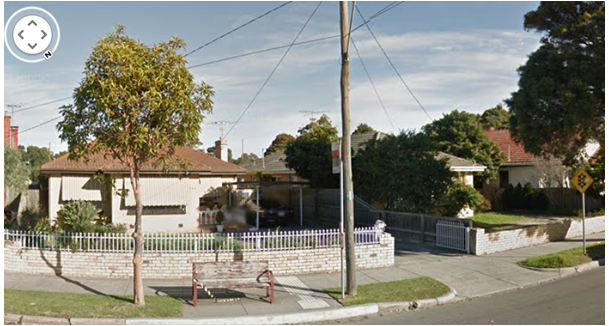
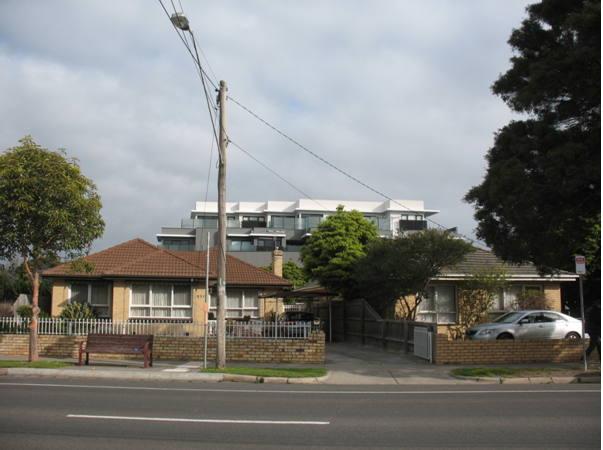
257 Neerim Road
August 24, 2015
257 Neerim Road
August 20, 2015
Several recent VCAT decisions reveal in full, glorious detail, the utter fumbling, Keystone Cops approach by our planners, elected representatives AND the countless drawbacks (failings) of the Planning Scheme. We also draw attention to the incestuous nature of the development industry. Former Glen Eira planners are now working for private companies and appearing in the very same role they had with council (ie Andrew Bromley was council’s officer at VCAT. He now appears at VCAT for the developer. Ms Bowden is also with the same company).
There is definitely a ‘cut and paste’ mentality in many of the decisions and conditions handed down by council. Entire slabs are transferred willy-nilly from one application to another, without it would appear, having any sound basis. Conditions imposed become the modus operandi of a council fighting its own planning scheme. Often, as in the following decisions, residents have to wonder whether common sense and competence have entirely deserted those involved.
Decision #1 – 14-16 Elliot Avenue, Carnegie. The application was for 4 storeys and 21 dwellings. Officers recommended a permit and councillors decided (as per their usual tactic) to lop off one storey and increase setbacks. Lobo was the only councillor to vote against the Esakoff and Okotel motion. (Zoned RGZ1) In her decision, the member rejected most of the conditions imposed by Council and modified countless others.
The top floor required to be deleted by the contested condition is recessed from the lower floors. The setback of this floor meets Standard B17 of Clause 55.04. As an interface with its neighbours, the proposal meets the test of side and rear setbacks. If Council is of the view that a four storey presentation to Elliott Avenue is not appropriate, there are ways of managing it, such as further setting it back from the street rather than deleting the whole floor altogether, with a loss of three dwellings. On policy and emerging character basis, this condition is not justified and will be deleted.
This condition requires the basement to be setback a minimum of 3 metres from the rear (eastern boundary) and 5 metres from the front (western) boundary. The reason for this condition is to provide adequate ground soil volume to achieve the landscaping required by Condition 9. ….. Council submitted that the extent of the basement footprint would significantly constrain the ability to provide canopy trees. It reasoned that the additional setback of 2 metres at the front and 1.2 metres at the rear, (currently proposed at 3 metres at the front and 1.8 metres at the rear) would provide additional in-ground landscaping opportunities to soften the building. …..In opposing this condition, Mr. Bromley cited a number of Tribunal decisions where Council has sought permit conditions to increase setbacks for the purpose of landscaping[4] and which were rejected by the Tribunal. In fact, the depth of setback from Elliott Avenue sought by Council at No. 2 Belsize Avenue is 3 metres[5] and 2.8 metre for 330 Neerim Road[6], and not the 5 metres sought in this matter…..If a 3 metre setback was considered by Council to be adequate for landscaping elsewhere in the area, requiring a 5 metre setback in this instance is excessive. I accept Mr. Bromley’s submission that it is not necessary to further increase the setback of 3 metres from the front and 1.8 metres from the rear. This condition will be deleted.
This condition requires part of the northern bedroom of Unit 102 that cantilevers into the front setback to be deleted. Council submitted that this part of the bedroom of the dwelling cantilevers over the ground floor into the front setback area, and that removal of this part of the bedroom would reduce the dominance of the building when viewed from the public realm. A careful reading of the design of this part of the building indicates otherwise. The cantilevering of this dwelling is not confined to the bedroom, but the living and dining area of that dwelling. Even if the wall of the bedroom is recessed according to this condition, the balance of the northern elevation of that dwelling still cantilevers over the ground floor. I cannot understand the purpose of this condition. It will be deleted.
The remaining contested condition is 1q) which requires written confirmation from a qualified traffic engineer demonstrating that the basement and ramp complies with Clause 52.06 of the Glen Eira Planning Scheme, and that vehicular access is acceptable. Condition 1d) already requires the basement access and layout to comply with Clause 52.06 and to the satisfaction of the responsible authority. If it does not and is not approved by Council, such a layout does not become part of the endorsed plan. This condition is superfluous. (and deleted).
Decision #2 – 64-66 Bent Street, McKinnon – application for part 3 and part 4 storey with 31 dwellings. Council officers recommended permit. Councillors refused permit but only after Sounness and Pilling lost a motion to grant a permit with conditions. Hyams and Esakoff then moved to reject. Final vote was 5 to 4 with Magee, Pilling, Sounness and Lipshutz opposing refusal.
It is important to note that this policy is not about respecting the existing neighbourhood character. There is no preferred neighbourhood character nominated for housing diversity areas. For residential development, it is about scale relative to the commercial centre, for it not to dominate the streetscape, and promotion of site consolidation to maximise development opportunities.
It also means that the scale and building mass of a development, if it is not at the edge against a lower intensity zone such as Neighbourhood Residential Zone (a minimal change area) would not be the same as the existing low scale single storey single dwelling character of an area, if that were the current character.
Decision #3 – 1A Orrong Crescent & 632 Inkerman Road, Caulfield. 4 storey mixed use; 18 dwellings, 3 shops. Zoned C1Z. Officers recommended permit with conditions. Councillors voted unanimously for 3 storeys and 16 dwellings.
Condition 1(a) requires deletion of the third floor (top level) and the roof replaced by a style that is consistent with the architectural style of the building, and which may include pitched forms. This condition was not a recommendation of Council officer’s, and has the most severe impact on the yield of the development. Condition (d) requires additional setback of the third floor. As this condition is to require further setback of the top floor which is required to be deleted, it contradicts Condition 1(a).
As for policies, there is common ground that the site is not specifically covered by a policy that relates to a site in a Commercial 1 Zone and which is not part of an activity centre. The commercial centre in Kooyong Road just south of Inkerman Road is not contiguous to the site. That centre contains single, double, and 3 storey commercial buildings. The site is in the Commercial 1 Zone, and the existing building has been a commercial building for many years, decades before planning controls. As for the notion that the site should be treated as if it is in a residential zone such as the Neighbourhood Residential Zone as its surrounding properties, it is not so in fact or law.
How many more times must council be knocked back on attempting to include the no parking permits as a condition of a permit instead of in the ‘notes’? Obviously very, very slow learners – or do they even bother to read, analyse and assess VCAT decisions?
This condition requires the permit holder to inform all purchasers about this planning permit with regard to Note C. Note C states that residents of the dwellings in this development will not be issued Residential parking Permit (including visitor parking permits). Council explained that it is its standard practice that residents of medium density development do not qualify for residential parking permits, and that this condition will ensure that all purchasers are informed of this position. A permit condition is a requirement. Once the development is complete, there is no further requirement to be met. A ‘Note’ is information and not a requirement of the permit. It is not appropriate to make a ‘Note’ as if it is a requirement of the permit.
Decision #4 – 482-4 North Road, Ormond. Application was for 4 storeys and 24 dwellings. Officers recommended deletion of 3 dwellings and other conditions. Councillor majority voted for 4 storeys and 19 dwellings. Zoned MUZ
My discretion regarding the appropriate setbacks to the south boundary is guided by the provisions of the zone and by the planning policy framework. The land is within the Mixed Use Zone. The purposes of the zone are to implement policy, to provide for housing at higher densities and to encourage development that responds to the existing or preferred neighbourhood character of the area. There are no specific design requirements in a schedule or overlays.
I consider the local policy framework strongly encourages robust built form in the Ormond NAC. It is one of the preferred locations in Glen Eira for higher density housing that can contribute to broad housing diversity objectives. This necessarily means buildings in these areas would be taller, with greater massing and bulk than the prevailing lower density single dwellings.
I have noted above that clause 32.04-6 specifically excludes standard B20 as one of the clause 55 amenity tests to be met. I accept it must be considered as part of the overall assessment. I consider this specific exclusion was intended to convey an expectation that the bulk and massing of a building in a Mixed Use Zone could be somewhat more robust and intensive than might be acceptable in the other residential zones. This is to facilitate more intensive buildings in this zone, including commercial and industrial buildings that typically have higher floor to ceiling heights relative to residential buildings.
Finally, there is no objective or statutory basis in the scheme for the 9 and 18 metre setbacks required by Council. These setbacks are not based on any standards of clause 55. They are not derived from local policy, a schedule to the zone, a design and development overlay or an adopted urban design framework or local policy. Furthermore I note that the rear of other nearby 3 and 4 storey apartment buildings have not been required to have setbacks similar to the ones proposed in this review. I consider the setbacks are arbitrary, subjective and excessive requirements.
August 19, 2015
Glen Eira has designated Bentleigh, Elsternwick, and Carnegie as Urban Villages where the majority of new development is supposed to go. All the rest are either Neighbourhood Centres or Local Centres. There are ten Neighbourhood Centres and 23 listed ‘local centres’ in the Planning Scheme. The Phoenix Precinct has its own category as a Priority Development Zone.
According to the Planning Scheme, residential development in Neighbourhood Centres, is meant to adhere to the following:
Apartments and shop top housing is encouraged within the commercial areas of these centres. Single dwellings and multi unit development are encouraged immediately adjoining the commercial areas of these centres.
AND
Encourage a decrease in the density of residential development as the proximity to the commercial area of the neighbourhood centre decreases.
Thus, according to this prescription, multi-unit development is only to go into those areas “IMMEDIATELY ADJOINING THE COMMERCIAL AREAS”. Then why oh why has so much of these neighbourhood centres been zoned as GRZ1 – ie three storeys?
It is obvious that the zones do not match what is stated in the Planning Scheme, with the result that huge swathes of McKinnon, East Bentleigh, Murrumbeena, Ormond, Caulfield South and others, have been all given the green light for 3 storey multi-unit development.
Local centres are even worse off since these are pockets of land zoned commercial that more often than not, directly abut neighbourhood residential zones. The Planning Scheme states:
Recognise the minor role that local centres will play in providing for housing diversity by encouraging development limited to low density shop top housing
AND
Ensure that residential development (except in Patterson and Gardenvale local centres) does not exceed two storeys in height
Since there is no height restriction on land zoned commercial, this is indeed pie in the sky – as recently proved with a three storey development at 251 Koornang Road (zoned commercial 1). Why such errant nonsense still remains in the planning scheme is beyond us. Nor has Council even attempted to introduce any restrictions on its small shopping strips as Boroondara has had success with. Nor have they introduced any Design & Development Overlays as this comprehensive document from Bayside demonstrates (uploaded here). Council has done nothing except slap Commercial zoning on a handful of businesses without due regard to the fact that many of these ‘local centres’ are surrounded by residential, low rise single dwellings – all zoned Neighbourhood Residential zone.
Once again it is inept planning and a bonus to developers.
So here is a quiz on the zones that readers might like to have a go in responding to. We would bet that councillors and even officers wouldn’t know the answers to most of these queries!
These are the questions we believe that residents need answers to since they go to the heart of sound strategic planning. If this council is so confident that its planning is ‘perfect’, then they need to be able to justify their planning decisions. Thus far, all residents have received are shonky figures, complete failure to fulfill the ‘promises’ of a decade ago, plus execrable statements that consulting with residents would result in worse outcomes. For any council to hold such a view is utterly abhorrent.
August 18, 2015
And more of the same?
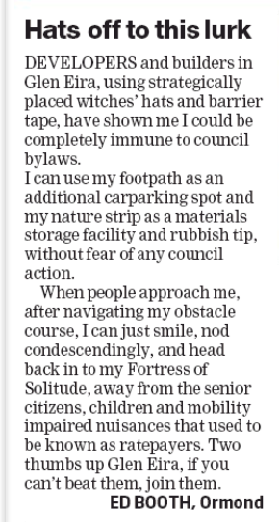
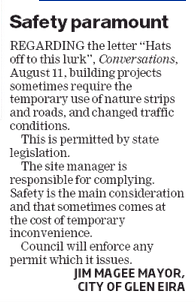
August 16, 2015
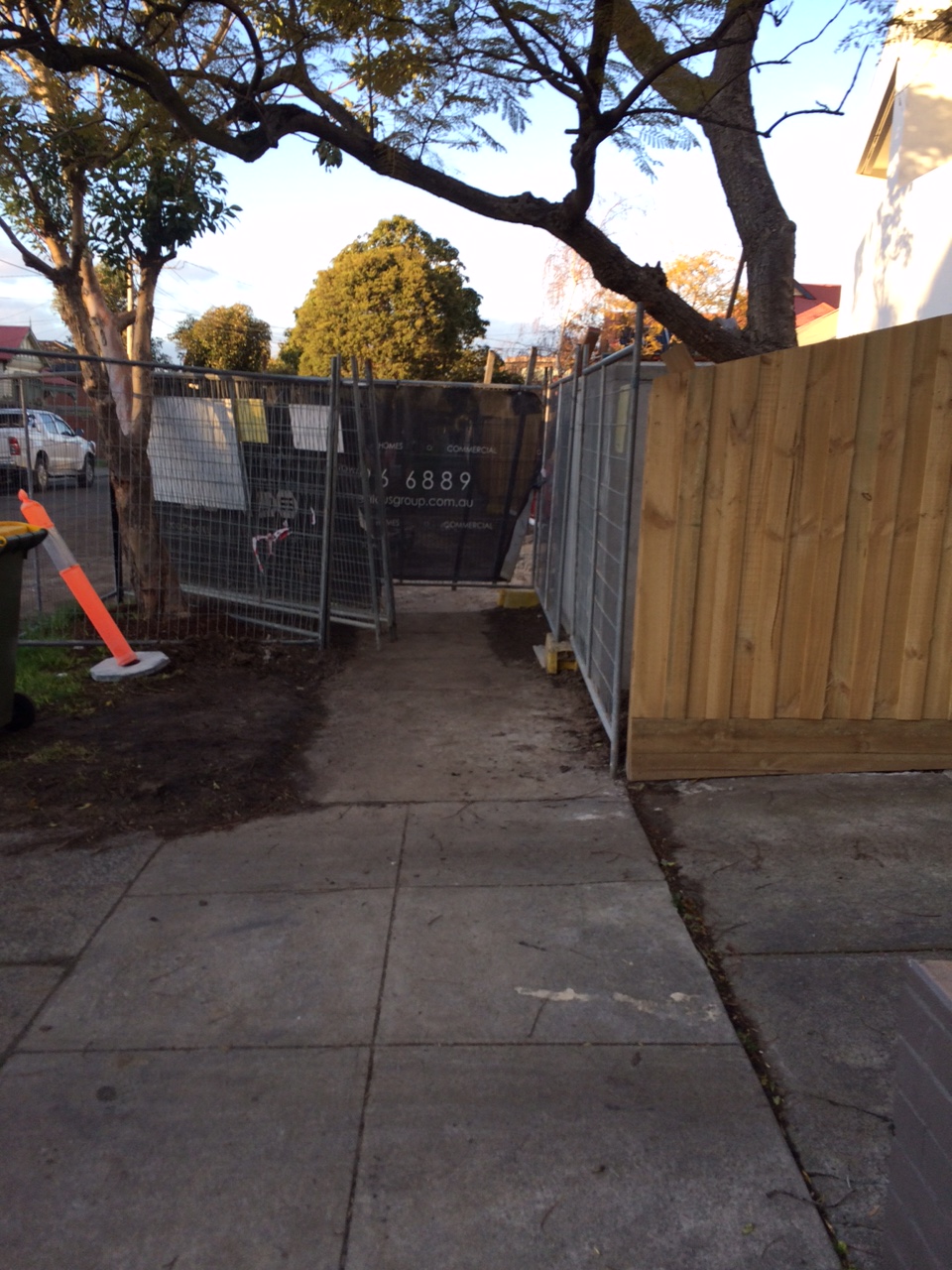
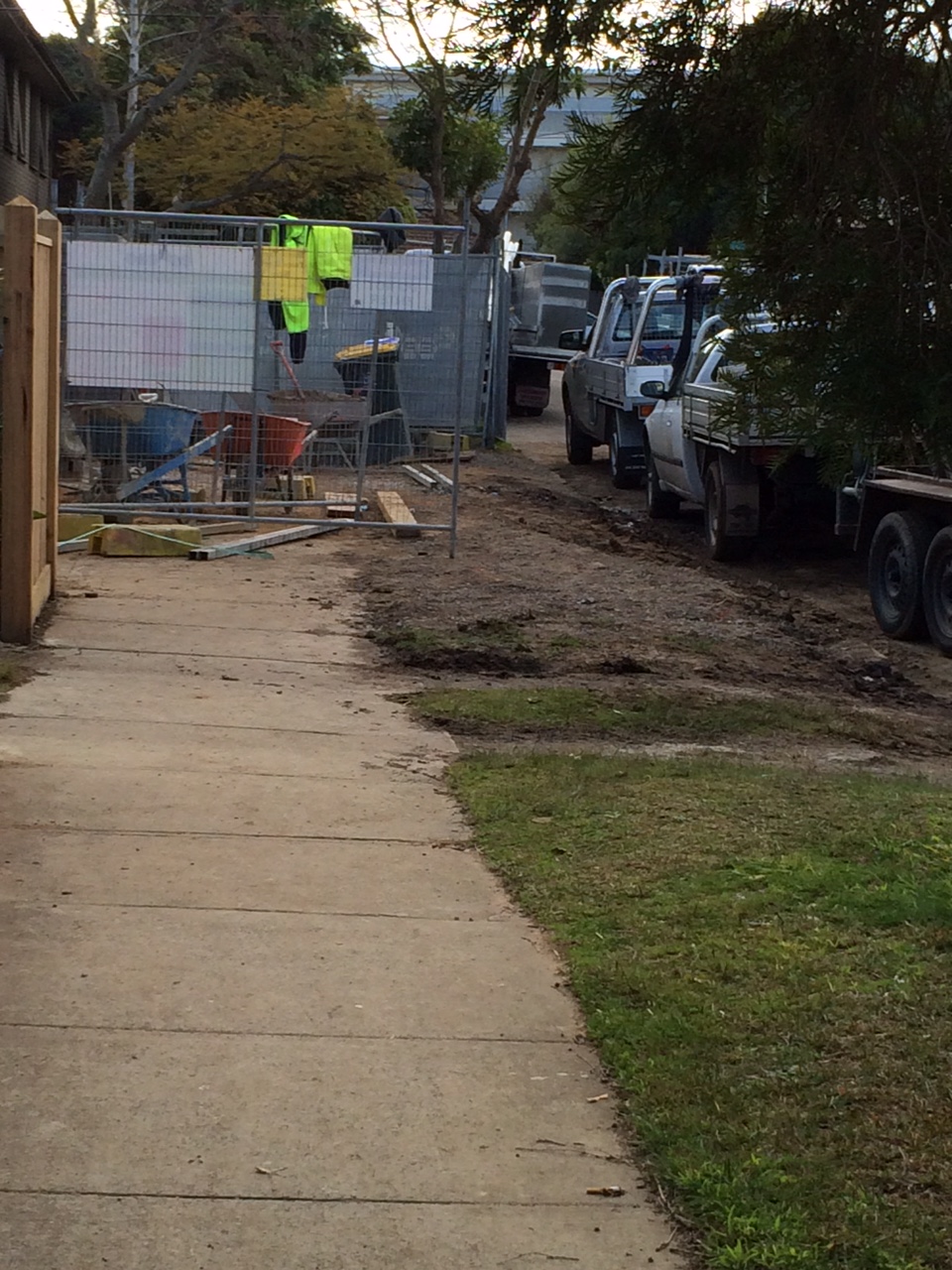
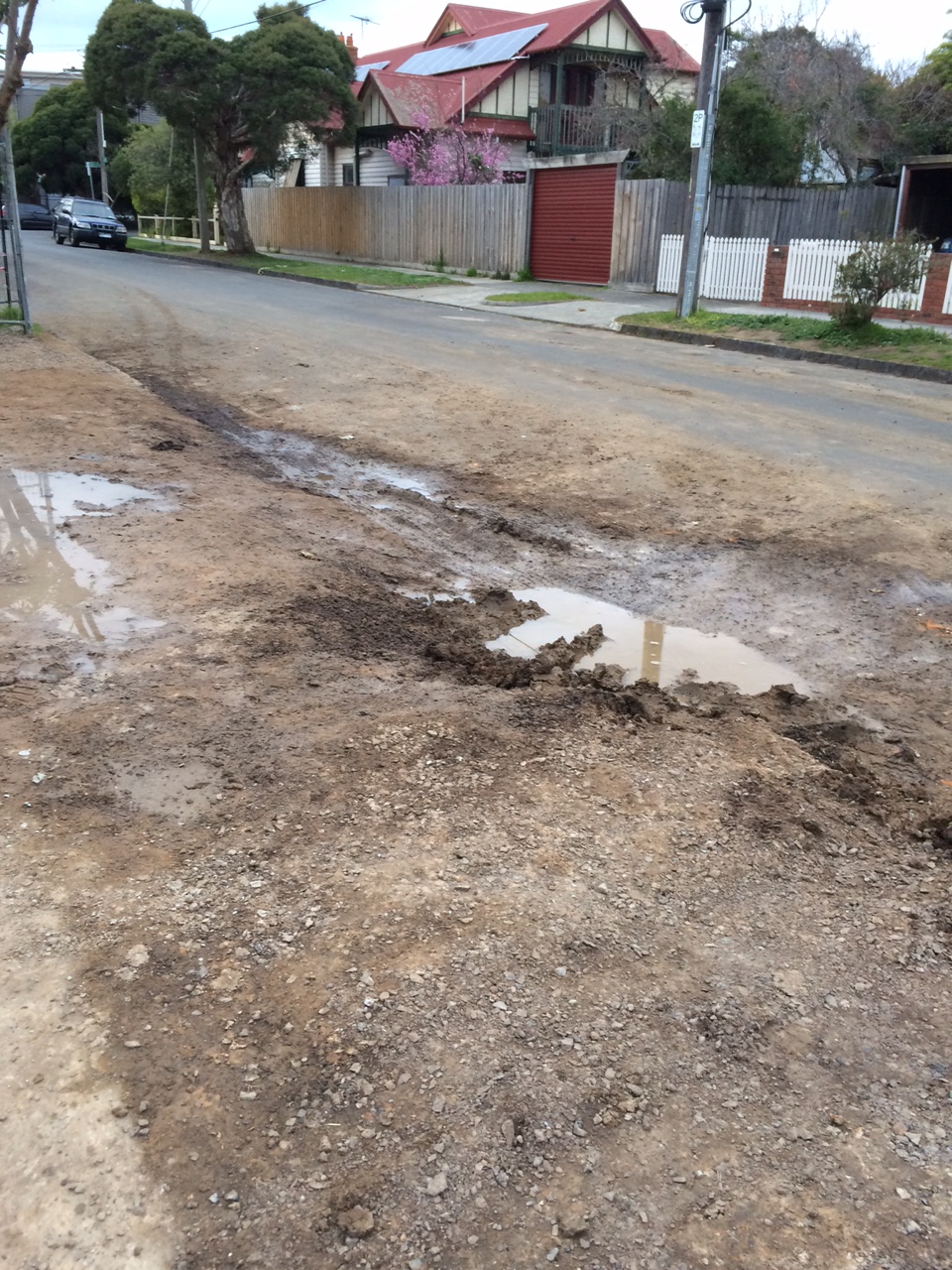
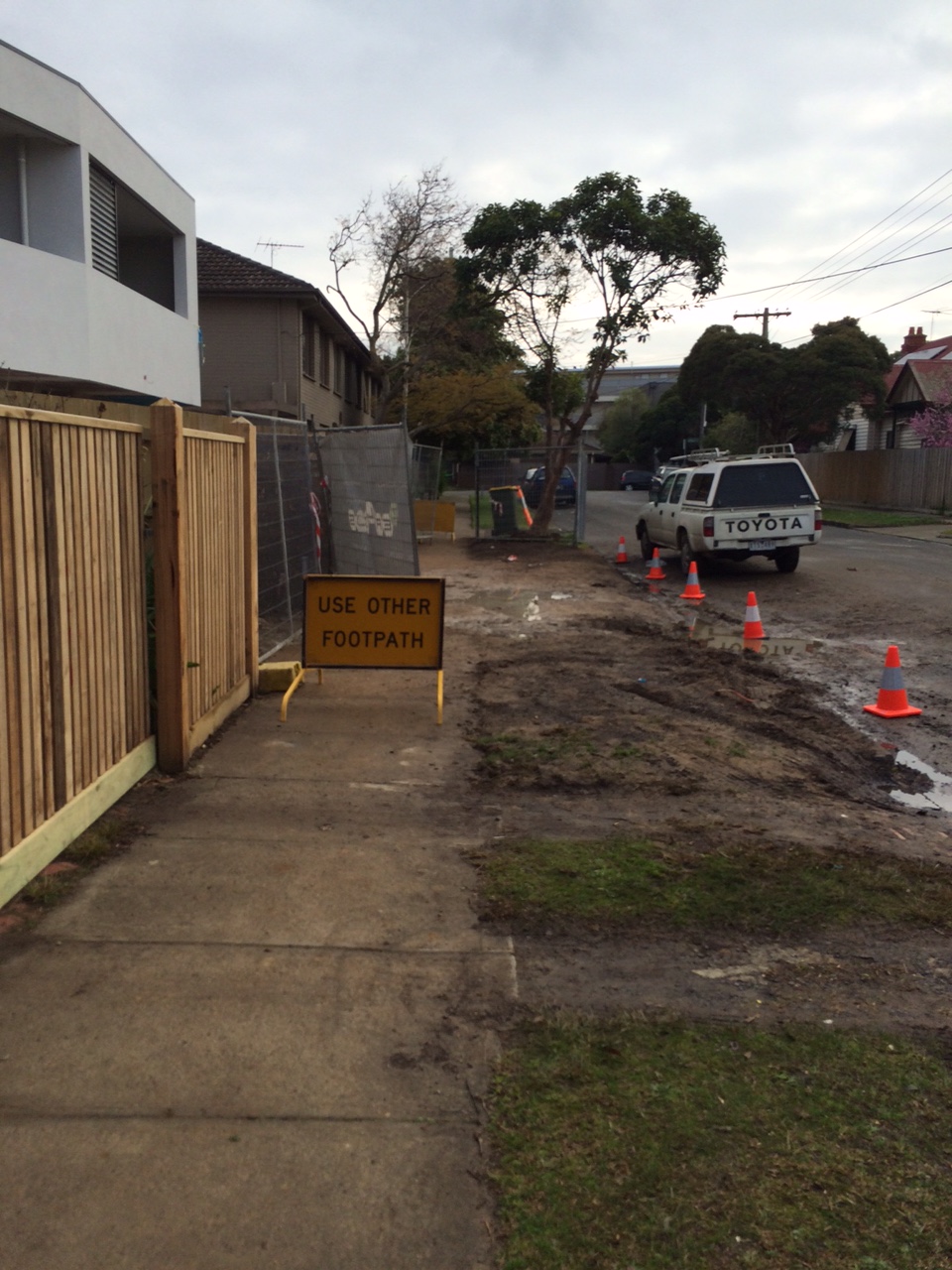
We’ve received the following email and series of photographs highlighting (once again) the chaos that residents have to put up with. Why this goes on and on and developers allowed to own our streets is incomprehensible. Even if fined, we’re told that either the fine is ignored, or it’s so miniscule that it is a drop in the ocean for most contractors working on multi-million dollar projects. It is our understanding however, that councils have the legal right to set their own penalties. A $200, or even $300 dollar fine is negligible. It is time that this council got off its backside and starting properly policing, fining and prosecuting each and every single developer that does not give a damn about those living next to his mess.
In order, here is:
What we do not have photos of is the claim that on Friday last, there were 16 trucks parked in the Carnegie Street – three with trailers attached. The street in its entirety is approximately 200 metres long. Residents were unable to get out of their drives.
Development has a major impact on us everyday and council just doesn’t care and doesn’t have the interest in doing anything about it!! Our neighbourhood has been impacted, like so many others, by a local single block development in Carnegie. The developers and construction company have had no regard for publicly owned property, no regard for public access, no regard for neighbours and have had a number safety breaches on site that I understand have resulted in fines and orders to rectify the site. This week council has been contacted everyday to complain about the impassable footpath that has been created by the construction company. The attached photographs show the problem. The daily calls have resulted in 3 notices being issued to the construction company (Wednesday) – but the result was no change at all – the footpaths remain impassable. Calls were made again on Thursday and Friday – again no change to the footpaths at all. This morning the solution seems to have been found! ‘Use other footpath’ signs erected. So the developers get away with completely ruining public infrastructure and are not made to immediately rectify the damage – no strong action from council, nothing that does anything to protect the health and safety of residents, nothing that makes a strong statement to developers about not damaging public property. This council is shameless and completely ineffective.
August 13, 2015
Item 9.COMMUNITY GRANTS
Magee moved to accept ‘as printed’. Hyams seconded.
MAGEE: said this was the ‘most gratifying part’ of being part of a council in handing out money to community groups who ‘provide services to our community’. Went through the report on numbers of applications and how many from non profit groups. Said that the committee included himself, Esakoff and Sounness. Community groups are largely volunteers and they work to ‘give a community benefit’. Some groups missed out because they didn’t fit in with the guidelines which council publishes and these are ‘extensive’.
HYAMS: called this a ‘good process’ and it helps the community and ‘everyone benefits’. There are still other applications to consider.
OKOTEL: is ‘happy and pleased’ that there is this program because it’s ‘important for our community’ in supporting groups. What she was unhappy about was the ‘final submissions’ on which clubs received the grants. Said that the process involves ‘assessment against community grants guidelines’ and this ‘is done in a very thorough way’ by the grants committee. This takes a day to go through them all and ‘I would certainly endorse the recommendations of the committee’. But she sees ‘a stretching of those guidelines to accommodate’ other applications and that ‘this goes one step too far’. Further, ‘if council were to act properly’ then they should amend the guidelines ‘to be more accommodating rather than stretching’ in her opinion, the guidelines to give grants to those groups that ‘weren’t recommended’ by the committee. She supports the recommendations of the committee but ‘what we see before us is a step too far’ beyond the guidelines.
PILLING: said that the ‘process’ had improved over the years and that the quality of applications had also improved. Said that ‘overwhelmingly’ the majority of the committee’s recommendations were ‘adopted’. Admitted that a ‘few’ had changed amounts but ‘that was a very small number’ and he was ‘confident that the process’ is good and that all applicants are aware of the guidelines. Purpose of the guidelines is to give residents the ‘confidence that we’re spending their money wisely’.
DELAHUNTY: thanked the committee for their work and appreciated that it was ‘very very difficult’ for decisions when there are so many ‘good causes’. Thought that ‘the process is robust’ and councillors have a big responsibility and also to ‘ensure’ that they follow the guidelines. Said she was ‘undecided’ on some and that they had to ‘get more information on’ like the one on making a ‘short video’ and the Jewish GLBT (IE gay, lesbian,bisexual, transgender) and ‘this will be a great project, one we haven’t seen before’. Sporting clubs ‘hang out for our decisions’.
LOBO: ‘any grant is always welcome’. Said that grants are ‘motivation’ for clubs and this is also apparent in the ‘community service awards’. One thing that ‘intrigued’ him was the clubs who said they were ‘running multi-cultural’ events and ‘I would like to have seen what kind of multi-cultural activities they perform’ plus whether ‘multi-cultural people can also join that club’.
MAGEE: endorsed all recommendations and everything is assessed against guidelines. Committee is important because they can delve and question and decide ‘what is the greatest community benefit’. and ‘sometimes the amounts can change slightly to what the officers recommend’. Thanked Jones and the officers for ‘putting this together’ and ‘it is an awesome amount of work’ that they put in and then bring it ‘to the assembly’. Also, there is often the need for ‘clarification’ from the applicants and this sometimes ‘comes from the committee and sometimes from Mr Jones’. Magee endorses ‘all of the’ grants and even when there is the wish to give a grant he can’t ‘because there is only so much money to give out’. Those groups that ‘miss out’ did so because their application wasn’t ‘worded properly’ or ‘explained’ things properly. Said there are some new things in the grants – Jewish Comedy Festival and he’s ‘looking forward to this’ and hopes it really ‘gets off the ground’.
MOTIONS PUT AND CARRIED. OKOTEL VOTED AGAINST
++++++++
Item 9.12 – Strategic Resource Plan
Hyams moved to accept as printed. Pilling seconded.
HYAMS: said that this was simply to ‘adjust some of the figures’ but that they are still ‘good figures’. Main one was ‘liquidity’ and ‘at first glance is not the greatest’ but the ‘reason we adjusted’ is that once you look at the ‘seasonally adjusted for aged care’ it is ‘very sustainable’. Stated that the adjustment was because ‘without that’ there would be the assumption that the aged care bonds would have to be ‘repaid all at once – and that’s never going to happen’. So now the ‘assumption is that only a small percentage’ will be paid out at a time. Claimed that the adjustments therefore equal ‘the real world’ and the previous figures were more ‘accounting fiction’. Council had to change because the Local Government requirements has changed and council had already sent their plan off to the minister. So there was the need ‘to change and bring into line with those assumptions’. Admitted that ‘there were also some mistakes that were made’ but these ‘have been corrected now’.
DELAHUNTY: said that the officer’s report mentioned two reasons for the adjustments – ‘formulaic inconsistencies’ and ‘definitions’. Said these errors should have ‘been picked up’ and that the ‘biggest one’ is the ‘last line’. Said that council ‘always’ knew about the ‘new definitions’ for the aged care bonds. This was ‘adjusted in our minds’ only. Said that she’s got ‘issues’ with the performance indicators as a system and acknowledged the time of council officers to ‘work out the definitions’. The report is ‘obviously sound’ but ‘subject’ to the need to be a ‘bit more careful’.
OKOTEL: said that they’ve ‘identified areas’ where the indicators ‘could be improved’ so that ‘what we’re reporting against is meaningful’.
MOTION PUT AND CARRIED UNANIMOUSLY
August 11, 2015
ITEM 9.7 – MRC
(ESAKOFF, LIPSHUTZ & SOUNNESS WERE APOLOGIES FOR THIS MEETING)
Delhunty moved an alternate motion that included: that the MRC has entered into a lease with the Alliance group involved with the level crossing removal project where “commuters’ will be allowed to ‘park for free’. This is a ‘sub lease arrangement’ and is ‘valued at approximately $90,000 -$100,000’ for 2 months. Motion also said that council write to the Trust to ensure that ‘they are aware’ of the arrangement. Also copies go to Minister for Environment & Climate Change, Lisa Neville, Auditor-General and members of parliament. Seconded by Magee.
DELAHUNTY: said that the report was first off about access arrangements for the public and what has been happening. Not a lot has been happening but there are ‘other current arrangments’ including a ‘commercial’ deal that has ‘been struck between the Alliance’ and the MRC ‘that values the Guineas car park, conservatively’ for $90,000 for 60 days. That’s just over $1,400 per day. In the ‘stalled’ lease negotiations between the Trust and the MRC ‘their offer and their apparent independent valuation’ is ‘offering the community 30 cents a day’. From this disparity, we ‘can see how absolutely outrageous’ the MRC’s offer on the lease is. ‘It shows what contempt they hold the community in’. ‘We won’t put up with it’ when the MRC itself values the land far more highly. Thus in the private arrangement the MRC ‘are making now what would cover’ their current lease. Even the 95,000 for the lease is a ‘poor outcome’ for the community when there is a valuation which says they should be paying closer to a million dollars for the lease of the land. Said that the starting point for any negotiations should be ‘what they have valued’ the car park land as. She is ‘hopeful’ that in passing this information on to ‘ those negotiating’ the lease that there will be ‘a better outcome for the community’.
MAGEE: started off by saying that the MRC ‘doesn’t seem able to put their hands on the agreement’ of 2011 and he suggests that ‘they look in the same filing cabinet’ where they can’t find the documents for the leases for the ‘northern stables’ and Aquinita Lodge. Ratepayers and taxpayers of Victoria are ‘paying in excess of a billion dollars’ for the grade separation but the MRC is ‘making a profit out of it’. They think that ‘you need us’ so we are ‘happy to sub-let Crown Land which you own’ and make you pay for the land that you own’. When the price they are paying for t’that small car park’ is ‘extrapolated’ across the 50 hectares of land then the ‘one million dollars is insignificant’ because it becomes more like ’40 or 50 million dollars’. Said that the MRC ‘are not what they portray’ themselves to be – they aren’t community minded nor a ‘friend of Glen Eira’. They have the ‘absolute need to profiteer’ and to ‘charge’ the taxpayers of Victoria to ‘park on their land’. ‘This is not only appalling. This is sickening’. Said that the ‘minister should be aware of this. The minister should be commenting on this’. If the MRC are ‘allowed to sublet’ the Guineas car park, then they can ‘sublet any part’ of the racecourse. Question is ‘what are they allowed to do’. Said there is ‘no lease in place’ and that it is an ‘ongoing, day by day’ process. Plus ‘anyone who sits back and accepts this’ is equally in contempt with the MRC.
OKOTEL: endorsed the motion and ‘queried how genuine’ the MRC are about ‘talking with council’. From the ‘invitation’ in the letter printed in the agenda, council has ‘sought’ a meeting with the MRC but it is ‘disappointing that they don’t seem to be able to make the time’. Said that there is no time set aside ‘as yet’. Thus, whilst the tone of the letter suggests they are ‘willing to have an open discussion’ that’s not happening but it’s important for council to ‘continue to advocate strongly’. ‘Despite’ the letters they get ‘very little progress is being made’.
HYAMS: asked for an amendment that when ‘further information’ is received that a report be tabled. This amendment was accepted by the mover of the motion and seconder.
DELAHUNTY: what needs to be finalised is the lease but negotiations ‘have broken down’ because there is ‘an incredible discrepancy between valuations’. The MRC has for the last 20 years paid about $90,000pa. They think it’s valued at $100 per year and the ‘council obviously thinks much higher’. The lease to the alliance shows that the MRC doesn’t value the land at $100 per year but much more and they are ‘trying to take the trust and the community for fools and we won’t stand for it here’. Their subletting will ‘help move the lease’ negotiations forward because it shows their own valuation of the land.
MOTION PUT and CARRIED UNANIMOUSLY
August 11, 2015
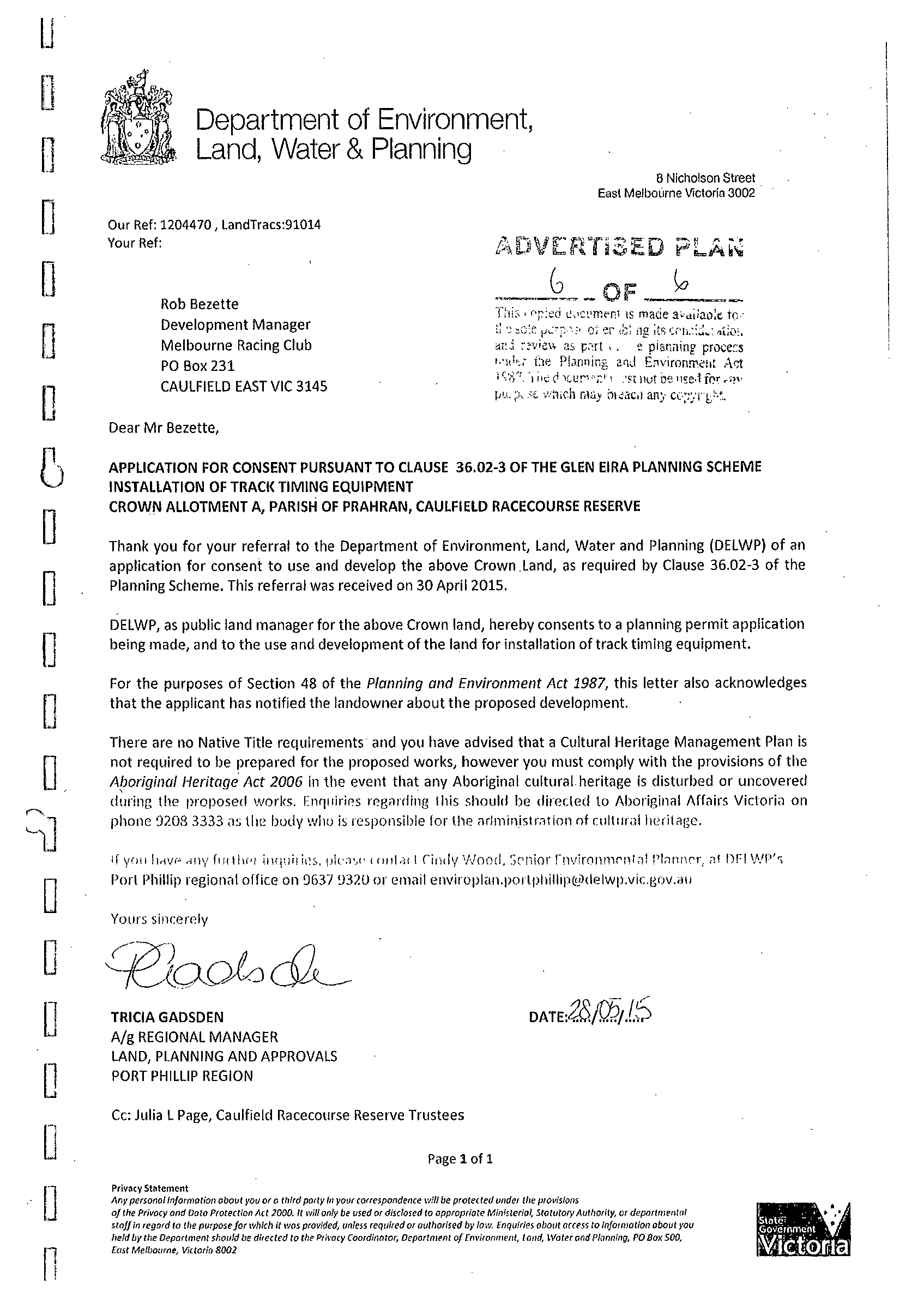
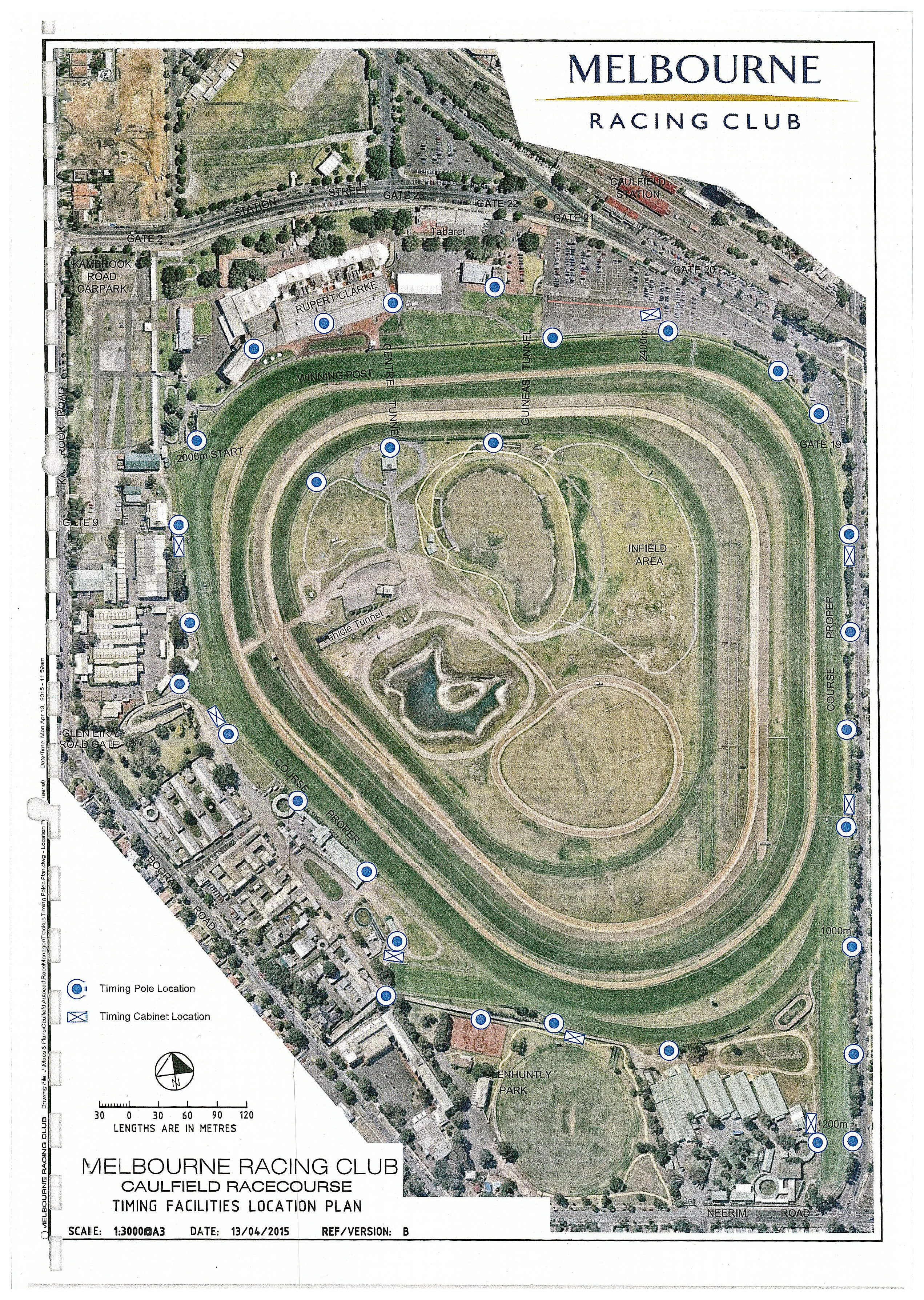
The Melbourne Racing Club is at it again – acting as if it is their god given right to do whatever they want on public land, whenever they want, and without any concern for nearby residents. This time they want a ‘timing system’ which involves the erection of 31 radio towers (height 13 metres) scattered across the racecourse and costing, they claim, $570,000. Naturally, the Department (as land manager) has given its approval (see uploaded letter here).
Throughout the application there is not a single word about environmental impacts nor potential safety concerns for residents – nor for that matter horses! Instead there is repetition upon repetition claiming ‘non-significant impact on the visual amenity of the area’. One paragraph in particular caught our attention –
3 antennas are proposed within the centre of the reserve and will be located directly adjacent to the track and existing infrastructure. The location of these antennas will ensure that the visual impact is minimal and the use of the public open space area remains unaffected.
Yes, 13 metre high poles of steel are certainly compatible with visual amenity and ball sports that council is advocating. Another nail in the coffin for more public open space if this goes ahead!
Here is what the poles will look like and where it is proposed they will go!
PS: please note that the heights will exceed 13 metres, since this calculation does not take into account the footings upon which the poles will rest.

August 9, 2015
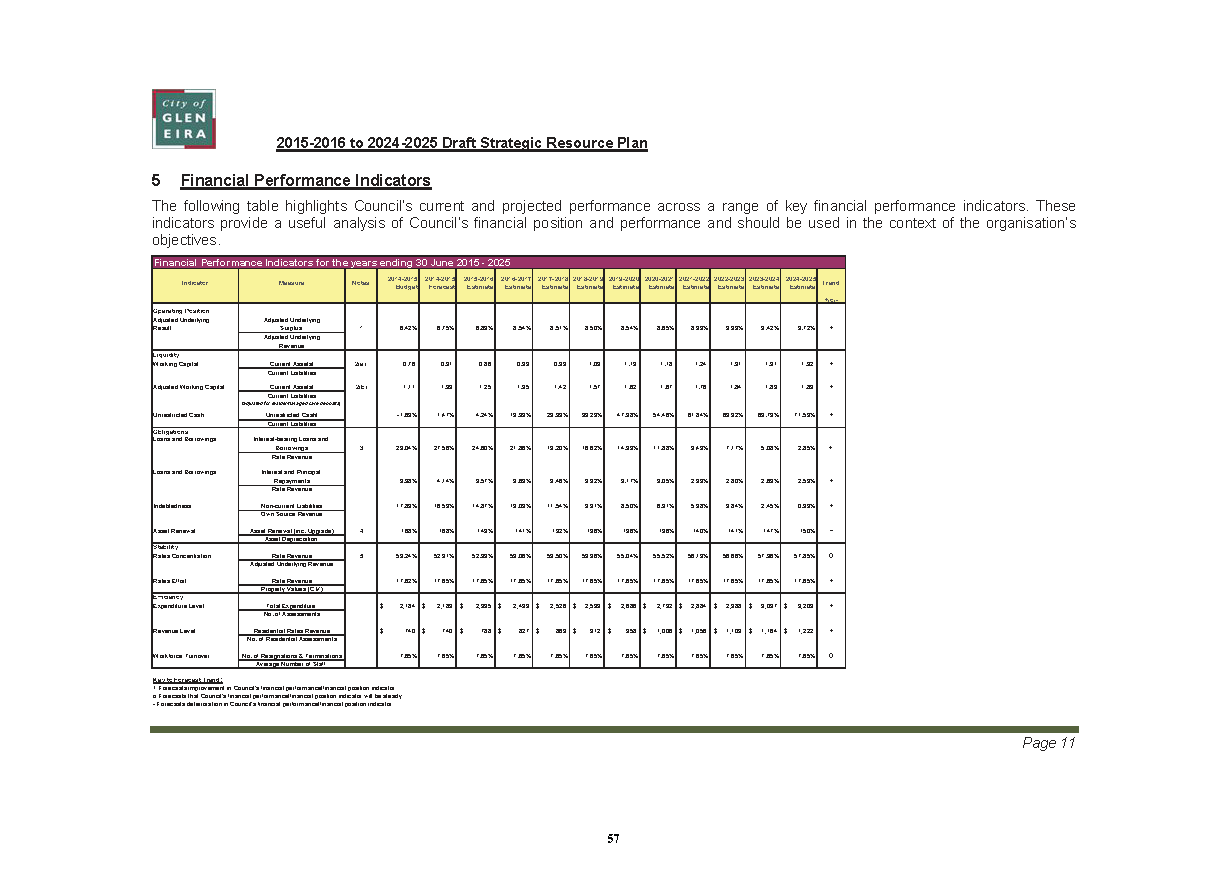
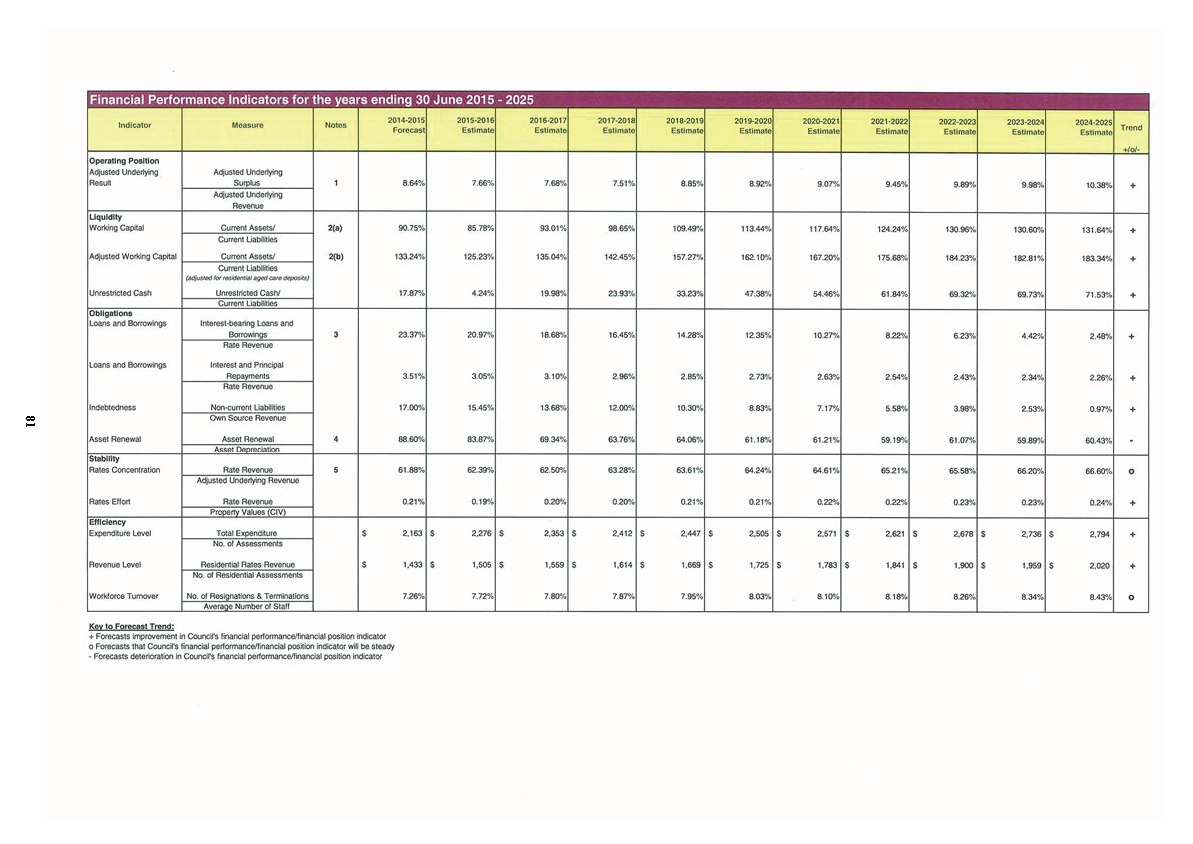
How on earth does a council stuff up so badly on financial reporting when:
This is all about Item 9.12 of the current agenda where we find the following unbelievable admission –
On assessing the financial indicators as part of the end-of-year accounts review, officers identified a number of formulaic inconsistencies and errors in the indicators listed in Council’s Strategic Resource Plan compared with the calculations in the LGPRF template.
To ensure consistency with the Local Government Performance Reporting calculations, officers have recalculated the financial indicators and have reproduced these (refer attached). They will be updated in Council’s Strategic Resource Plan.
So readers may judge for themselves the magnitude of these errors, we ask them to compare the ‘original’ SRP (passed and accepted without question by our wide awake councillors) and the current version. Simply click on each image to enlarge. We do apologise for the quality of the images – that of course is dependent on the formats that council chooses to publish its material. Otherwise readers should go directly to the minutes of these council meetings.
CIRCA MAY/JUNE 2015
 AUGUST VERSION
August 7, 2015
In the great scheme of things, Item 9.10 of the current agenda is trivial and far from earth shattering. Yet, it is a microcosm of the rot that distinguishes this council and its administration. The report is about fences on borders and whether Council should include information on its website that residents can access. Hardly revolutionary, hardly controversial and hardly likely to bring down the citadel. Yet the report (written once again by Mr Anonymous!) recommends the usual – do nothing!
Even with something so basic, the report is skewed and peppered with woeful logic, plus a disdain for residents that comes through strongly and clearly.
The arguments for doing nothing are quite literally appalling, childish and contradictory. There’s no need for council to do anything because residents can use ‘Google’ to get the required information, plus –It would be uncommon for members of the public to go, in the first instance, to the Glen Eira Council website to search for information on boundary fences. Really? Then why claim a few sentences later that council is frequently called by residents on such matters as gas, transport, centrelink, etc. If residents don’t know who is responsible for these latter areas and call council, then why should they have any more ‘legal’ knowledge about fences?
We’re then told that the job of council is to direct callers to the appropriate authorities. All well and good – but residents might not call – they might simply go to the website looking for information!
The final kick in the guts to residents comes with these gems of paragraphs –
The purpose of Council’s website is to provide residents with information about issues that Council can assist with. It is not to provide them with information on every issue that may affect them, such as dividing fence issues.
If residents were to see information on issues that Council has no control over, such as dividing fences, then it may lead to the question – “If Council can’t help me then why do they have information about it on their website?”
It follows that placing information on Council’s website about boundary fences warrants placing information on the website about other non-Council controlled matters. Taken further, it could be argued that Council’s website should include information about income tax returns, or passport applications; matters which are also important to the community.
Of course, nowhere in this mass of puerile logic will readers find one statement about fences that sit on the border of council and private land and council’s responsibility to pay for half, or to compensate owners when their trees damage private fences. That aspect of important information for residents does not rate a mention. Search the website and all that one can find relates to the mandatory fences around swimming pools.
How such drivel and disdain for the public can be allowed into the public domain is beyond belief. It is arrogance of the highest order that in our view even surpasses the arrogance of the Melbourne Racing Club. In Glen Eira, residents simply don’t matter except as the permanent cash cows to keep such anonymous authors in a job!
And what on earth is the problem with putting up a single webpage? Surely this could have been done much cheaper without a ‘request for a report’ and some bean counter spending an hour or two devising a way to say – get stuffed? How much did his time cost ratepayers?
Thankfully, not every council is so toxic and anti-community as Glen Eira. After a perfunctory search, here are the URLs for information on fence borders that all these other councils think is worthwhile to put up on their respective websites.
http://www.bayside.vic.gov.au/living_in_bayside/building_in_bayside.htm#Fences
www.kingston.vic.gov.au/…/Fences_Boundary_Rules_Info_Generic.pdf
http://www.frankston.vic.gov.au/Planning_and_Building/Building/Fences/Dividing_Fences
http://www.monash.vic.gov.au/Building-Planning/Building/Installations/Fences
http://www.whitehorse.vic.gov.au/Fence-Requirements.html
http://www.knox.vic.gov.au/Page/Page.aspx?Page_Id=931
http://www.hobsonsbay.vic.gov.au/Planning_Building/Building_services/Around_the_home/Fencing
http://www.maroondah.vic.gov.au/FencingRegulations.aspx
http://www.yarracity.vic.gov.au/Planning–Building/Building-services/Fences/
http://www.moreland.vic.gov.au/planning-building/building-renovations-and-extensions/fencing/
http://www.melton.vic.gov.au/Regulations/Rates_and_payments/Fencing_information
www.buloke.vic.gov.au/neighbours-the-law-and-you
http://www.manningham.vic.gov.au/fences
http://www.portphillip.vic.gov.au/fencing.htm
http://www.mrsc.vic.gov.au/Council_the_Region/Laws_Regulations/Fences
https://www.whittlesea.vic.gov.au/building-planning-and-transport/building/fences
http://www.corangamite.vic.gov.au/index.php/council-services/building-a-planning/building/fencing
http://www.latrobe.vic.gov.au/Search?keyword=fences
http://www.nillumbik.vic.gov.au/Building_and_Planning/Building/Fences
http://www.maribyrnong.vic.gov.au/Page/Page.aspx?Page_Id=8602
http://www.glenelg.vic.gov.au/Neighbouring_Fences
http://www.darebin.vic.gov.au/Your-Council/Property-owners/Owner-Responsibilities
http://www.alpineshire.vic.gov.au/Page/Page.aspx?Page_Id=1922
http://www.hrcc.vic.gov.au/building-services/fences
http://www.colacotway.vic.gov.au/Page/Page.asp?Page_Id=4762&h=1
 Glen Eira Debates