GE Governance


At council meeting on Tuesday night, under ‘Councillor Questions’ Penhalluriack asked Newton a question related to the Glenhuntly mulch storage facility. In a long preamble to the actual question Penhalluriack outlined the following:

  • Newton prides himself on correct ‘risk management’ procedures & policies.
  • Scientific Consultants were called in to evaluate the public health risk at the Glen Huntly depot
  • Part of their findings was that legionella ‘and fungi’ were presenting some risk to workers and the general public
  • Several recommendations were made to reduce the risk – ie sprinklers, training, protective gloves/clothing, the importance of washing hands and signage alerting the public

The question asked of Newton had several parts:

  • Why did Council ‘twice deny that there was any danger to the community’s health’ when he had twice asked about it
  • Why did he have to go to the Audit committee and raise the question for a third time before anything was done?
  • ‘why hasn’t (the report) been circulated to councillors?’
  • Were areas ‘adjacent to the mulch bin’ also analysed such as the school, playground, car park areas?
  • Penhalluriack also sought an explanation as to why it appears that none of the recommendations of the report have been carried out?

Newton took the question on Notice

COMMENTS:  Penhalluriack’s question makes it abundantly clear that information within this Council is ‘filtered’ and that only a select few are privy to information that could have major repercussions on the entire community and council’s liability. We remind readers of the composition of the audit committee (especially Lipshutz). If the audit committee did have this information, then why wasn’t it distributed to all councillors according to best practice and council’s audit committee charter? Why does it take a councillor 3 requests before any response is forthcoming? Why does it take months and months for any remediation of what might potentially be a public health risk? And the most important question: Why the cover up?

It is important that we first establish the credentials of the extract we are about to cite. It comes from Page 19 of a document entitled “Best Practice Guidelines Local Government Entity Audit Committees & Internal Audit” (June 2000). These guidelines were prepared by “the Auditing & Assurance Standards Board of the Australian Accounting Research Foundation, with the support of The Institute of Internal Auditors – Australia and the Australian Institute of Company Directors for the Department of Infrastructure (DoI) and endorsed by the Municipal Association of Victoria (MAV) and Local Government Professionals (LGPro).” 

The extract which primarily concerns us, is: 

“Appointments of external persons shall be made by Council by way of a public advertisement and be for a maximum term of three years. The terms of the appointment should be arranged to ensure an orderly rotation and continuity of membership despite changes to Council’s elected representatives.” (page 19) 

Of the 8 authors listed one name stands out – MR. DAVID GIBBS – the Chair of Glen Eira’s Audit Committee!

What we have here is a highly respected ‘authority’ producing guidelines for local government, yet NOT ADHERING TO HIS OWN GUIDELINES. Mr Gibbs and Mr. MacLean have both been with Glen Eira since at least 1998. Both their names are continually mentioned in the 2005 Whelan Report, as well as in the 1998 Walsh Report.  That means that for at least the past 13 years the external members of the Glen Eira audit committee have NOT CHANGED.

The ratepayers of Glen Eira need and demand answers to the following questions:

  1. Why have both Gibbs and McLean been given such lengthy and uninterrupted tenure on Council’s Audit Committee?
  2. Why has Mr. Gibbs failed to adhere to his own guidelines and not resigned from the Council Audit Committee?
  3. Why is Mr. Gibbs said to be consulting with Andrew Newton on a ‘staffing’ matter as outlined in the Whelan Report, when officer staffing is the exclusive domain of the administration?
  4. How does Council respond to the growing perception, and hence alarm, within the community that all is, and has not been, 100% “kosher” with its Audit Committee?

In late January this year, the Minister for Local Government, Jeanette Powell, gazetted a comprehensive 42 page blueprint for Audit Committee reform and accountability. Whilst only ‘guidelines’ the Minister also stated  that Local Governments are “strongly encouraged to adopt and use the Guide when establishing their audit committees”.  Much of what the 42 page document entails has a direct bearing on the Audit Committee as constituted in Glen Eira. It is timely to consider this issue now since the agenda items listed for discussion next Tuesday night clearly fly in the face of the Minister’s recommendations in several key areas.  

We discuss the central issues under several headings – 

  1. Composition and tenure of Audit Committee Membership 

The recommendation from the Minister is: 

“Periodic rotation of the members of the audit committee is encouraged as this will enhance the perception and reality of audit committee independence… To ensure continuity, ideally no more than one member should leave the audit committee pursuant to rotation in any one year. …..LGE members will be subject to council elections every four years and accordingly the tenure of LGE members on the audit committee needs to be set to allow for their rotation among the nominated LGE members….The period of tenure for independent members could be two to three years, again with options for reappointment after periodic performance reviews. The LGE might also consider setting a maximum number of terms of reappointment for independent members.” 

COMMENT: The latest agenda items contain committee nominations for 2010/11. Lipshutz and Tang again feature prominently. In fact, their tenure on the Audit Committee, as well as other important committees within Glen Eira (such as Local Laws; Racecourse Issues and previously Finance) has been extraordinary. The table below illustrates clearly how this council and its councillors have allowed two individuals to dominate the most important committees and which we argue is now in complete opposition to the position expressed by the Minister. 

Year Lipshutz Tang
2005/6 Audit; Finance; Local Laws Environment; Finance; Local Laws; racecourse
2006/7 Audit; Finance; Local Laws; Pools; Finance; Local Laws
2007/8 Audit; finance; Local Laws; Pools Environment; Financé; Local Laws; Roads; Caulfield Reserve
2008/9 Audit; Finance; Local Laws; Pools; Racecourse Reserve Racecourse Reserve; Trustee; Audit; Local Laws;
2009/10 Racecourse; Audit; Local Laws; Pools; Finance Racecourse; Audit; Local Laws;Recreation
PROPOSED 2010/11 Audit; Community Consultation; Local Laws; Pools; Racecourse Arts & Culture; Citizen of the Year; Environment; Local Laws; Racecourse; Sport & Recreation

 2.     Further Recommendations from the Minister

Some more extracts from the guidelines –

“To be effective, the audit committee must be independent from management and free from any undue influence”. 

COMMENT: In Glen Eira the ‘Finance Committee’ has suddenly become defunct –  no meetings of this committee were recorded in the Annual Report for the previous two years and it has now vanished from the upcoming committee delegations. Yet the table above reveals that Lipshutz was a member of this committee whilst he was also on the Audit Committee! A great example of ‘independence’ and perhaps ‘conflict of interest’ we ask? 

“Review internal audit’s mission, charter, and resources such that this charter maintains internal audit’s independence from management. This is achieved through its reporting structures and rights of access to all levels of management and relevant information…..Ensure that all work is reported through to the audit committee and is not censored or held up by management”. 

COMMENT: Not only Lipshutz but Gibbs and McLean have also been sitting on the audit committee for eons and have been extremely well reimbursed for their time and effort. We ask again why the Minister’s guidelines recommending rotation should not apply in the case of the latter two members? As the Minister states,  it is important to ‘also to provide a fresh perspective through succession planning and the selection process.” 

Finally, there are many comments throughout the document related to ethics, governance, and of particular emphases is the development of a charter that clearly enunciates all mechanisms, roles, expectations, and evaluations of the committee itself, and its individual members. The facts that readers should keep in mind are: 

  1. These guidelines were published on January 31st 2011 and gazetted on 8th February 2011
  2. Council has thus had ample time to read, absorb, and plan for their implementation. This has not been done!
  3. Instead, we have basically the same old members; the same old accounting firms; the same old protocols, and hence the same old questions about independence, good governance and perceptions of all too cosy relationships with external and internal members 
  4. Are Lipshutz and Tang in particular, so extraordinary in their skills, acumen, and vast accounting and/or expansive legal experience that they are indispensible on all these major committees? And is it mere coincidence, or the councillors’ own wishes, that Penhalluriack and Forge only manage to get on three committees, and Oscar Lobo is only on one? Should ratepayers conclude that no other councillor can fill the shoes of Lipshutz and Tang – that these individuals have the time to do a job properly when they are sitting on 6 committees each?  Or is there another agenda being played out here which has been ongoing for years?
Baillieu defends meetings with Urbis

Marika Dobbin

March 10, 2011

PREMIER Ted Baillieu has defended his government over its meetings with developers of a 140-metre skyscraper proposed for the parliamentary precinct that would eclipse the adjacent Windsor Hotel redevelopment.

He said it was appropriate for Planning Minister Matthew Guy and his department to have met representatives of the developers from consultancy Urbis recently, ahead of a formal permit application being lodged.

”We have never had a problem with pre-application meetings,” he said. ”I think it’s important in those situations that it is all documented and that will be a distinguishing feature of this government.”

An Ombudsman’s report into the Windsor Hotel fiasco criticised the former government for failing to keep accurate records of meetings. Mr Baillieu said he had not seen the proposal for the Palace Theatre site – but hinted he would be against it.

Questions:

  • How many pre-application meetings took place between government, MRC and/or council regarding the C60
  • How comprehensive is the record keeping of these meetings?
  • How well informed were councillors of the existence of these meetings?
  • How well informed were councillors of the progress of these meetings?
  • How comprehensive are the records of meetings post application?
  • Are councillors privy to these records? Should they be?

A previous post concentrated on the fact that numerous other Councils appear to have no qualms in making public their Staff Code of Conduct. In Glen Eira everything is under wraps. Why? What is there to be gained by such practices? Perhaps a better question is: What is there to hide? What could be so ‘private’ that ratepayers have no idea as to the protocols, values, and mechanisms that they are paying for. We’ve continually harped on the fact that in terms of transparency and accountability Glen Eira appears to fall well below the mark of its neighbouring and benchmark councils. Is this ‘ethical’; is this the kind of behaviour that residents are willing to put up with?

Here are some examples to illustrate our point. Please note how ETHICS is highlighted in the following councils’ Codes of Conduct.  We’ve linked some of these documents so that residents may read them for themselves.

KINGSTON

“Kingston is a major metropolitan Council for whom ethics and business conduct is a key requirement. We care about obtaining good results for our community and care equally about how those results are achieved. The CEO must also exercise delegated powers in ways consistent with previously established guidance or direction from the Council.  

The Guide recognises Council’s duties, responsibilities and community aims and values. It describes what is needed from us all to keep the good faith and trust of Council and its many stakeholders, and is based on what we value most:

Honesty and Integrity – Doing what we say we will do. 

The spirit and letter of the law and all relevant legislation will be obeyed. 

Unless you are authorised to do so, do not use Council resources or staff services for private purposes. 

BAYSIDE 

“The purpose of this guideline is to assist all Bayside staff in the maintenance of ethical standards of professional integrity and conduct….

Accountability at Bayside means we are mutually accountable and take responsibility for our actions, behaviours and results. It is: meeting promises/commitments; managing expectations; admitting mistakes; providing leadership.” 

Achievement at Bayside means that we are motivated to succeed through service by making a contribution to our community using our unique skills and abilities, and being recognised for what we achieved.” 

The way we work is to: always welcome the opinions of the community. Accept the differences in members of the team and the community and welcome their contributions 

No council materials should be used for non council purposes.”

______________________________________

So we ask – how similar or different is the Glen Eira policy? Does it highlight ethics? Community? Service? Overall values? If the Councillors’ Code of Conduct is freely available, then we maintain that the Staff Code of Conduct should be equally transparent and visible. How else can the community judge officers’ performance if they have no ratified gauge against which to evaluate such performance? 


Below are some extracts taken from a presentation by the NSW Ombudsman, Bruce Barbour on 9th September, 2010

 “….if standards of ethical conduct are so clear and well established – why do we need to continually raise and discuss them? Surely once they are set down that is enough? Well no, it is not enough. If they are not modelled by those in authority, not regularly discussed, if they are not re-enforced, if they are not made part of the day to day operational landscape, they can and will slip from the public sector consciousness.

When we are focussed only on the outcome, there is often less concern about the process. People find short cuts, and the ends are too often considered to justify the means.

This of course is not the only reason for ethical breaches. There are those in public service who, when given the opportunity, will choose to act unethically. Unfortunately, human nature means we will never be completely rid of all unethical conduct.

Firstly, there needs to be genuine and strong leadership. A clear and consistent message from the top. Prime Ministers, Premiers, Ministers, Chief Executive Officers, Directors General and senior managers need to commit to core principles. This involves not only saying the right thing – which is easy to do – but also doing the right thing, and leading by example.

This commitment is key, yet as several of the examples I gave earlier show it is not always present, indeed the initial source of resistance when my office has dealt with agencies has sometimes been at the Chief Executive or senior manager level. Once staff see this response, this example being set, it sets the tone for all our dealings with that organisation.”

We’ve published these selected highlights for several reasons:

  • Their relevance to the question of ‘legality’ versus ‘ethics’ at Glen Eira
  • The simple fact that Glen Eira has only a ‘Councillor Code of Conduct’ as opposed to a ‘Code of Governance’ as other councils have implemented
  • Other Councils have their Officer Code of Conduct, or their Business Code of Conduct freely available. Glen Eira’s requisite document is kept secret and locked away. This only makes us wonder what it contains that it should be regarded as ‘off limits’ to resident ratepayers. It also raises questions as to how different this document might be to the Councillor Code of Conduct?
  • After three Municipal Investigations we believe that ‘ethics’ and ethical conduct by councillors and administrators is far more important to ratepayers than mumbo jumbo legalese and whether or not there has been a ‘technical breach’ of the Local Government Act.

PS: As an afterthought, we’ve uploaded the Bayside Staff Conduct Guidelines (here). Please note the consistent use of the following terms in their policy – ‘community’; ‘trust’; ‘admitting mistakes’; ‘values’ and plenty more. Whilst these may also been seen as ‘motherhood statements’, they clearly indicate a philosophy which is geared to service to the community and collaboration with the community. We would be most surprised (but would welcome it) if this kind of emphasis exists in any Glen Eira policy. But of course, since this is not out in the public domain, we can only speculate and guess!!!!!

The problem with Lipshutz, Hyams and Tang, as we see it, is that they continually forget that they are first and foremost meant to represent their constituents (us) and not pretend they are in a courtroom mouthing weasel words after weasel words. For ‘legal’ issues we as ratepayers fork out over $300,000 per year for a Corporate Counsel and her department! That is not the job of councillors!

Nothing brings this home more clearly than the continuing fiasco over public questions by Mr. Varvodic and the answers supplied by Lipshutz and Hyams. Readers will remember that the last set of minutes from the Recreation and Advisory Committee was in reality nothing more than a list of topics discussed. These were not minutes as per normal from this committee. To prove our point readers should look up the Council minutes of 8th June, 2010. There we have two sets which are expansive, and give a clear indication of what individuals actually said. So why are these latest minutes so bereft of detail?

Mr. Varvodic has sent us his public question which accuses Hyams, as chair of that committee, in censoring the minutes. Technically, this is legal – minutes must be approved by committee members. But is it ethical? Is this good governance? And more to the point, what is he hiding? How come previous minutes are so different in style, tone, and content?

Even more hypocritical is the fact that since Mr. Varvodic’s name was undoubtedly included as a topic of conversation, (ie. Topics were public questions, local law, Frisbee group) then he has every (ethical) right to full disclosure as to what may have been said about him. Hyams’ response to Mr. Varvodic is outrageous in its misrepresentations and deliberate obfuscation. Hyams has stated that:

‘The real and full minutes of the meeting were published at the last Council Meeting…The minutes of Council’s Advisory Committee Meetings record discussion points, motions, outcomes and resolutions. The Inspectorate accepted this approach in responding to Complaint 14”.

Nothing could be further from the truth! The actual minutes of that committee give no inkling as to ‘discussion points’. They are in fact pseudo ‘record of assembly’ minutes. It does Hyams no credit to indulge in semantics and legalese. It does Esakoff no credit to sign whatever nonsense is placed under her nose, and it does this Council as a whole no credit to be continually perceived as abrogating their duty to ensure that legal loopholes do not over-ride basic principles of sound and open government.

AN AFTERTHOUGHT!  We have always been fascinated by the fact that ‘governance’ features as one of the objectives within the Council Plan. No other council that we know of includes such an item in their Community or Council Plan. The fact that Glen Eira does is extraodinary. It simple does not belong there. It is a ‘given’ – legally and by all principles of good government. Readers should carefully examine what this council includes under its categories of ‘governance’ in the Annual Report (Page 80) to see what a mockery the whole exercise becomes. Under the heading ‘Governance’ we find mumbo jumbo about health and safety and the ‘awards’ the council received. Then of course, there are the mandatory statistics about how many calls were answered by the service desk.

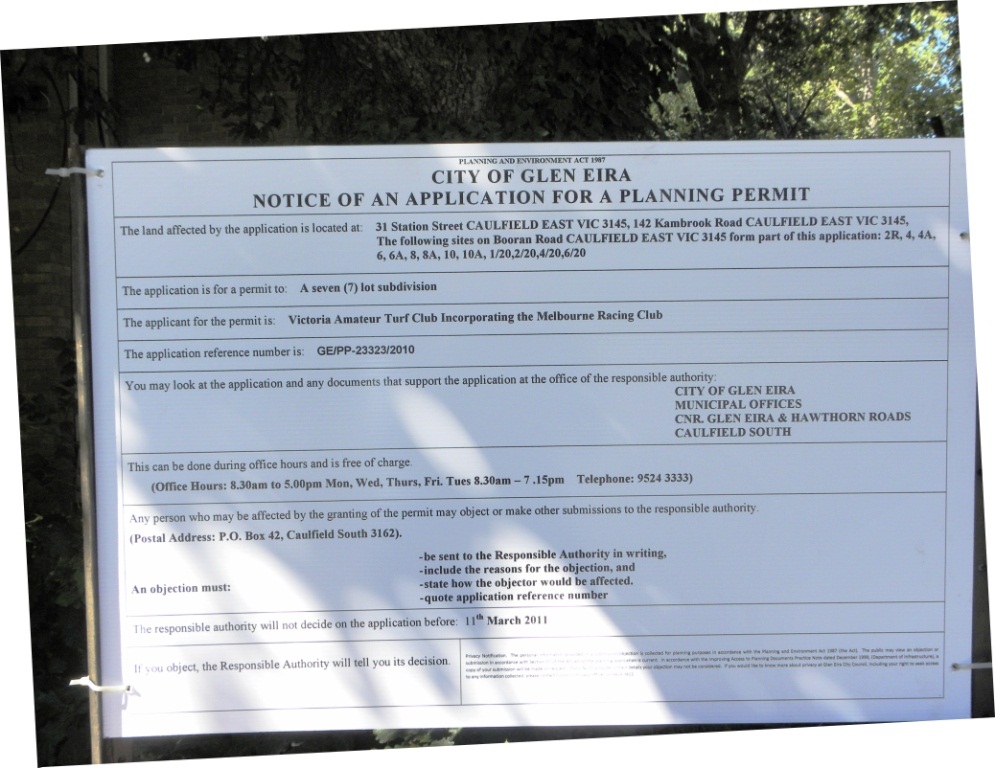
We’ve received several comments, emails and photos from local residents regarding the notice that has gone up on Station St for a 7 lot subdivision submitted by the VATC (MRC). This news is most disturbing for several reasons:

  • What has happened to the proposed land swap?
  • The sign (see photo) indicates that this application is several months old. There has been no publicity and we even wonder whether councillors are in the know about this. If they don’t, then why has the Planning Dept. of Glen Eira Council decided to keep this under wraps? On whose authority was this decision made and what is their agenda?
  • We’re also told that brand spanking new signage has gone up without stating that as well as the racecourse, this area is also a public park. Again, who knew about this and was council permission for the erection of these signs sought by the MRC and granted?

Once again, here is evidence of one of two things – the MRC thumbing its nose at Council and residents, or worse, that they have worked in collusion with Council and possibly without the full knowledge of all councillors. This is not simply a planning issue. Given the ongoing saga of the C60 and the centre of the racecourse issue anything that pertains to these matters deserves full transparency and accountability. This obviously has not occurred here.

When reporting on Glen Eira issues, the sad truth is that we’re often forced to rely on rumour and innuendo simply because the community is always the last to know what is really going on. What this means in reality is that the community has no say in anything. Decisions are inevitably made without transparency, without accountability, and without community input. The latest example concerns Booran Rd. Reservoir.

Here’s what we’ve been told –

  • It is currently being cleaned up
  • Workmen on the site claim that a kindergarten is on the cards
  • Neil Pilling is pushing for this

Terrific! Kindergartens are desperately needed in Glen Eira. But, and this is a big but, Glen Eira is only the MANAGER of the Booran Rd. Reserve. The terms of management designate the area for ‘recreation’. As ‘manager’ council does not have any say over use of the site – this must be determined by the State Government. Questions thus abound as to who is paying for what? What does this do to Magee’s plans for a kindergarten in his neck of the woods? Do all councillors know about such proposals? What about the desperate need for more open space? What’s happened to the promise for further ‘community consultation’ regarding use?

If these rumours prove correct, then it only reinforces the perception that backroom schemes and deals are the defining characteristic of Glen Eira administration and councillors.

The latest Ombudsman’s report into the Windsor Hotel scandal raises, in our opinion, some remarkable parallels with the goings on in Glen Eira under the reign of Andrew Newton. The Ombudsman has revealed how ‘public consultation’ on the Windsor development was nothing but a sham in order to provide the ‘evidence’ required for an already pre-determined decision. This echoes numerous public consultation issues in Glen Eira over the past decade where, we believe, decisions had already been determined prior to the obligatory ‘consultation’ . In short, ‘consultation’ shams. The examples are numerous – Caulfield Park Pavilion; Council Plan; Planning Scheme Review; DAMP plan; Councillor Code of Conduct and the 2009 Local Law ‘consultations’ . In each case, community views were largely ignored and certainly not incorporated in any significant way into the final policy/strategy. We are not alleging anything illegal here. Council only has to ‘consider’ public opinion. What we do believe is that ‘consultation’ in Glen Eira fails to implement the spirit of the law – council adheres only to the letter of the law. Hence, we feel that the ombudsman’s comments have real relevance for Glen Eira and its residents.

Some further evidence to support this view. The ombudsman found major faults with the record keeping processes and hence accountability of several key players. He concluded that: “I was also disappointed with the standard of record-keeping, especially that of the Department, Heritage Victoria, and the City of Melbourne. This included the failure of agencies to make and keep accurate records of key meetings and events relating to The Hotel Windsor planning and heritage applications. Poor file management practices were also evident.

In the absence of basic records detailing key meetings and discussions with agencies and individuals regarding the proposed redevelopment, it is difficult to have a complete appreciation of the processes followed.”

On November 3rd the administration’s response to a ‘Request for a Report’ was tabled at Council Meeting. The request was for ‘a report on each meeting during the past twelve months between Council’s officers acting in their official capacities and representatives of the Melbourne Racing Club and or of the Caulfield Racecourse Trustees (those who are not also Glen Eira Councillors) including the normal details explaining the subjects discussed and any decisions reached.”

The report was tabled without names as to author – the first black mark against all notions of accountability and transparency! Secondly, we find this extract in the report:

“Throughout this process, there have been numerous meetings to give effect to the Council’s decisions and to prepare material for future Council decision-making. Officers do not hold delegated power to decide on planning scheme amendments and accordingly none of the meetings made Council decisions – nor was there any possibility of them doing so.

If Council wants staff of the Planning Office to attempt to identify the dates of meetings, that would involve time which would otherwise be spent addressing planning applications, amendments or appeals and it would be appreciated if Council would specifically direct that activity if it wishes.” (So much for at least file management practices!)

 Then there is also the following: “The MRC CEO and manager dropped in on the Council’s CEO at the end of one day in September (date unrecorded) to “clarify” MRC criticism of comments by Council’s Director of Community Relations about C60 in the Leader Newspaper (approx 5 minutes).”

 We find it incredible that dates are left ‘unrecorded’ especially since this is mandatory practice for all recordkeeping regimes. Yet, the time was noted!” 

Given the information at hand, we can only conclude one of two things: 

  1. The report to council is inadequate and doesn’t fulfil the requirements of good recordkeeping
  2. The report to council is deliberately obtuse and again doesn’t fulfil the directives of council decisions.

Perhaps the ombudsman should also be carefully investigating the planning processes that have occurred between Glen Eira and the MRC and the recordkeeping policies of this council and how well they are adhered to?

« Previous Page — Next Page »