GE Governance


From feedback received thus far it appears that resident concerns over the ‘partnership’ between Council, developer and the Victorian Planning Authority, are either not being understood by some councillors, or these concerns are seen as unnecessarily ‘alarmist’.

When the largest ever development is about to occur in Glen Eira, we maintain that community input, from the very start is essential – and not when a draft structure plan has already been devised and to all intents and purposes, probably set in concrete. Any ‘visioning’ must include residents from the start and their involvement must be ongoing throughout the entire project.

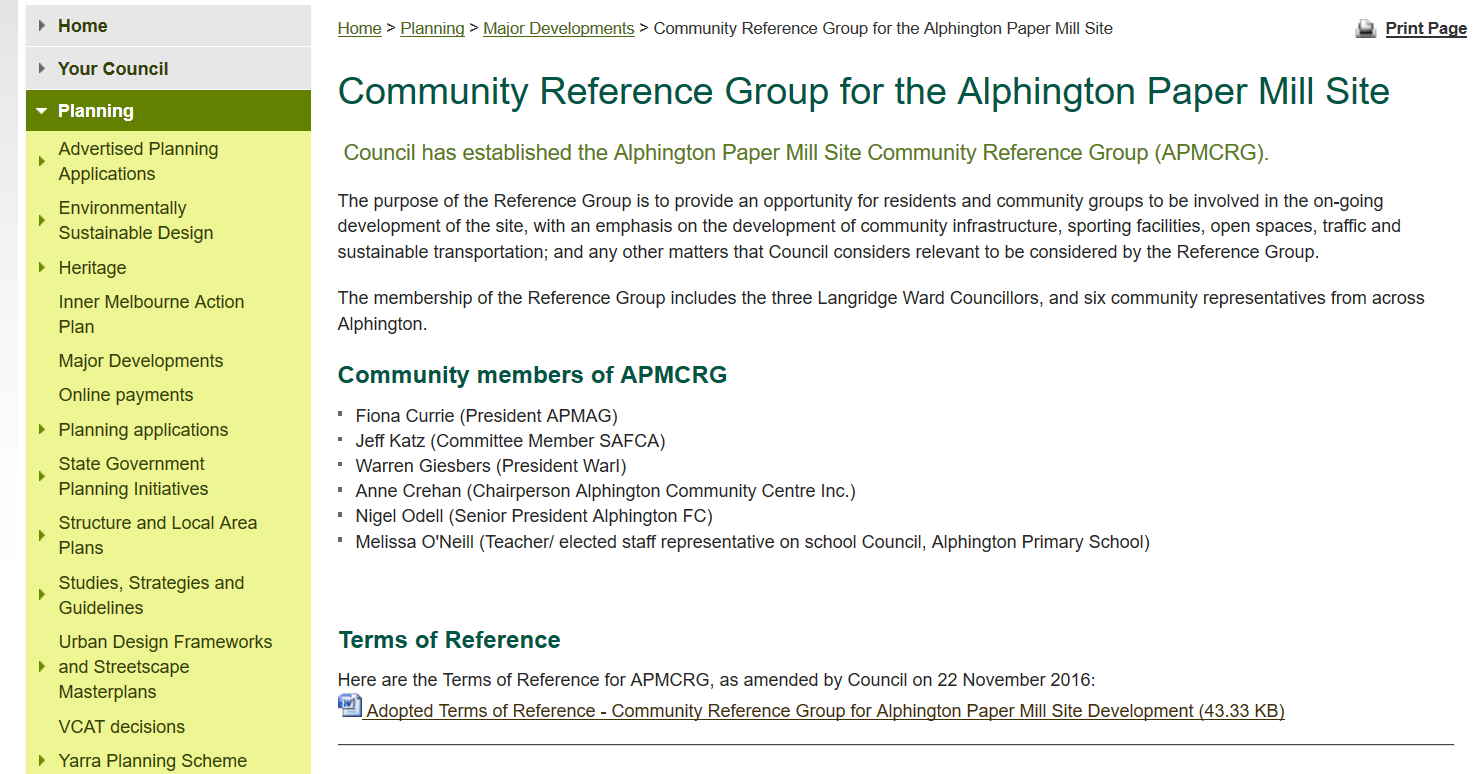
In the current agenda papers, one officer report notes the large development at the old Amcor site. Yarra City Council is one model that should be employed for the Virginia Estate development. Yarra had no problem in establishing a ‘reference’ committee right from the start that included 6 community reps. Yarra had no problem in holding regular meetings where residents through their representatives could bring up issues. This is not rocket science. It is the basis of an inclusive council that sees its residents as partners. If the current mantra of council is to be believed then the establishment of such a group is essential!

Here’s the Yarra Council blurb for this committee –

yarra

We’ve also uploaded HERE, the relevant Terms of Reference for the committee.

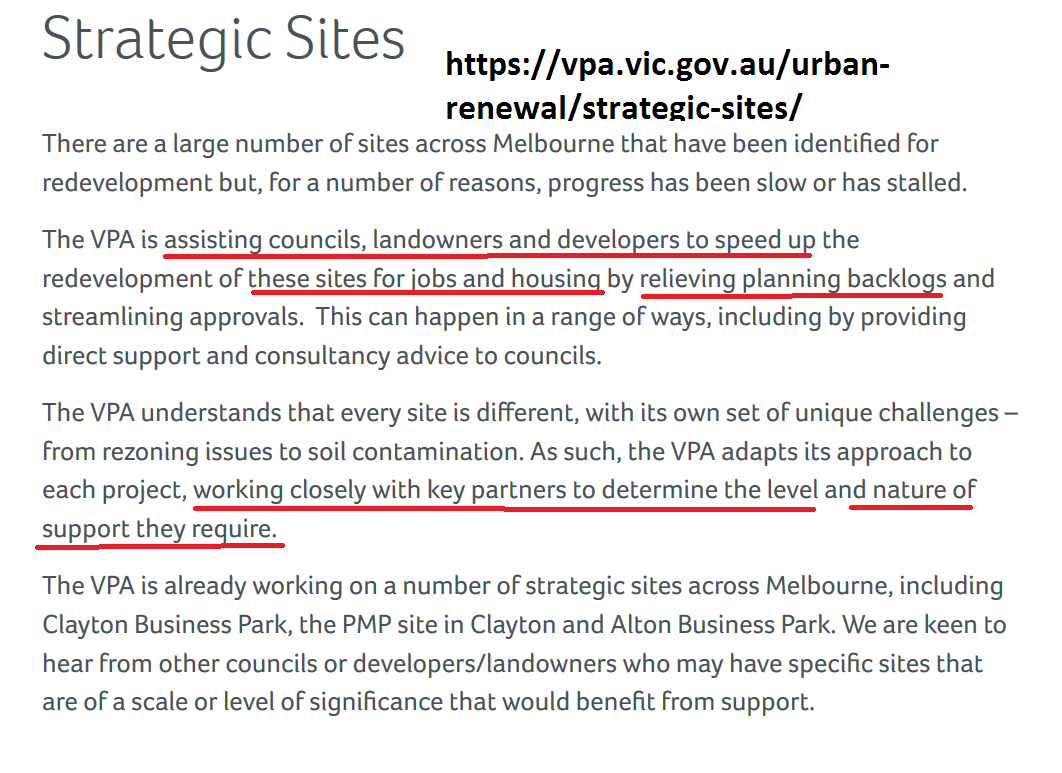
The plans for the development of Virginia Estate have taken a new turn with the proposed ‘partnership’ between council and the Victorian Planning Authority (VPA). This government body is primarily charged with the responsibility of overseeing ‘urban renewal’, especially in growth areas. They are also involved with large development sites within the metropolitan area such as the Monash/Clayton precinct and now East Village. Here is what their brief states –

redsites

All of the above would indicate that government, developer and council are keen to push through rezoning and amendments that will set the ball rolling for Virginia Estate. There is no doubt that at the latest stated figure of 24 hectares, Virginia Estate will be developed, and a very large component will feature residential accommodation. What concerns us is the role that the community will play in this development. The letter from the VPA, included in the agenda, outlines a brief timetable schedule. Please note carefully the following:

  • The time frame for the ‘delivery’ of a draft structure plan for the site is basically 3 months. Yet, the officer report keeps insisting that this will be part of council’s review of its ‘activity centre strategy’ – not due to be completed until 2018 at the earliest. Thus, what porkies are we being fed?
  • Why aren’t the community involved right from the start instead of having the draft structure plan thrust down their throat and then asked to comment? We all know what this means and how little is changed once the ‘draft’ of anything is completed.
  • Why does the officer report emphasise ‘business’ and ‘residential’ barely rates a mention?

We’ve uploaded the proposed schedule. Clearly discussions between government, developer and council have been ongoing for some time given this timeframe. We’ve also uploaded the full agenda item (HERE) so readers can see for themselves the lack of real detail provided.

vpa

In conclusion, VPA does have a role here and council is undoubtedly better off financially if much of the cost comes out of government and developer coffers. What we are concerned about is the level of genuine consultation with the community and whether development gets the go ahead well and truly before infrastructure, transport, etc. is completed.

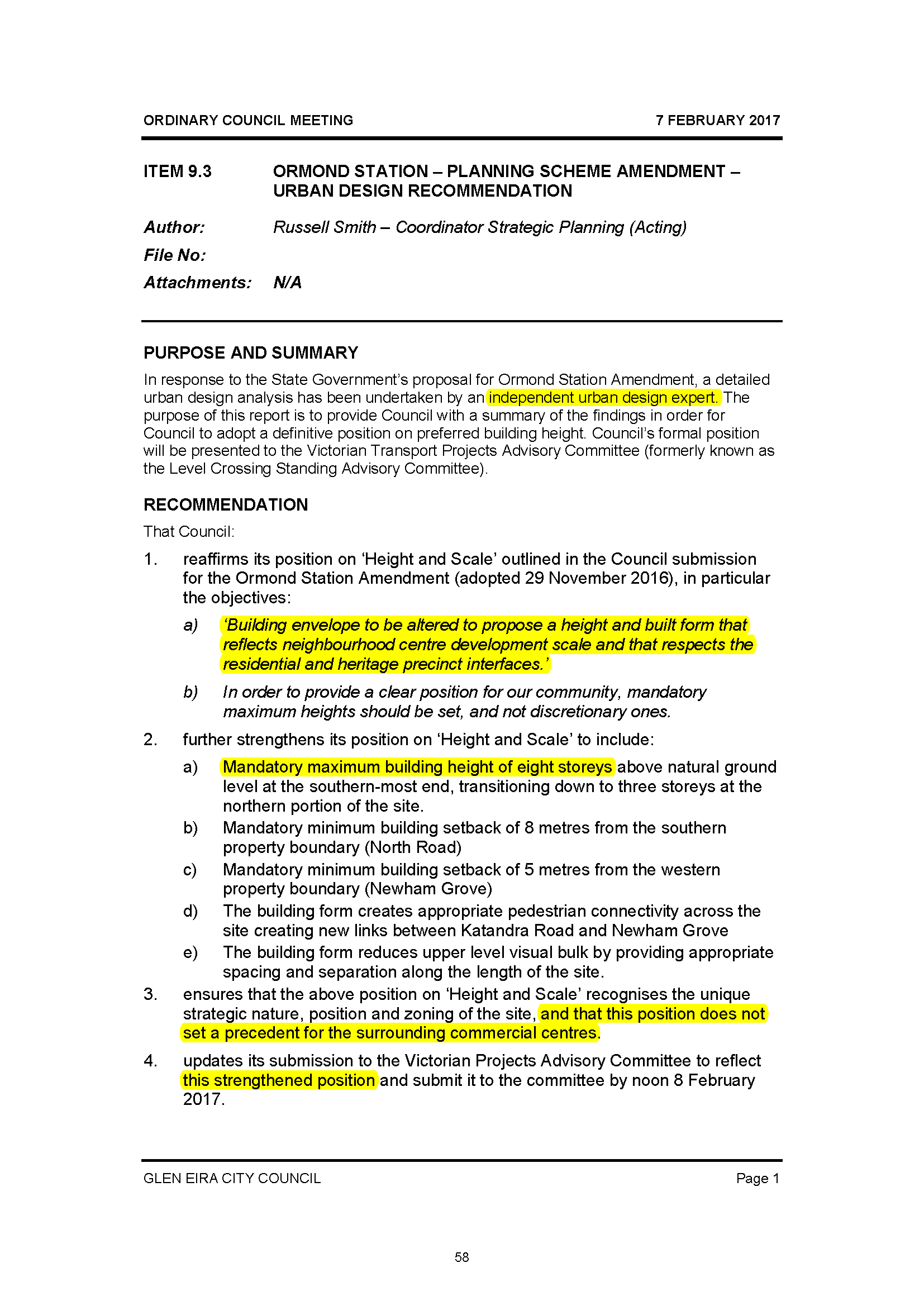
There are 3 agenda items down for decision this coming Tuesday which should set alarm bells ringing for residents. In this first post we concentrate on Item 9.3 – Council’s ‘position’ on the Ormond Railway development site.

What is absolutely staggering about this report and its recommendation is that councillors ENDORSE A MANDATORY HEIGHT LIMIT OF 8 STOREYS!

This is staggering for the simple reason that it exceeds the proposed heights of 7 storeys in Carnegie and 5 storeys in Bentleigh that were nominated in the proposed Amendments for these activity centres. Thus we now have the ludicrous situation where a so called ‘neighbourhood centre’ with less shopping areas and surrounded by residential development is okay for 8 storeys and Carnegie and Bentleigh are deemed suitable for lesser height. Unbelievable shonky planning !

What makes matters even worse is that this recommendation by the ‘experts’ is not even in the public domain. Hence we have the situation where residents are denied access to the rationale which would support a recommendation of 8 storeys. So much for transparency and accountability!

Further, we are told in the officer report  that: In order to form the strongest position possible, City Futures (ie Council) have sought an evidence-based approach to inform Council’s position for a preferred maximum building height. And what is this ‘evidence based’ data on? According to the report it consists of the following –

  • Status of centre
  • Precedents
  • Typology
  • Street wall ratio
  • Solar Access
  • Key View lines
  • Transition
  • Connectivity

We posit that none of the above is ‘evidence’ for an 8 storey apartment block. It might as well be 10 or 12 storeys! Nothing here would suggest that the following important issues have been considered – open space, infrastructure, parking/traffic, development in the area, retail business study, etc. etc. If this is the basis upon which such major decisions are being made, then God help us!

Even worse, is that once again there has not been a single round of ‘consultation’ between residents and council on how high anything should be in the municipality! The rhetoric is all about ‘consultation’. Pity that words never seem to match actions and decisions!

pages-from-02-07-2017-agenda

The image presented below derives from profile.id. It utilises census data from 2011 and provides a comparison of the development occurring in Glen Eira compared to the general metropolitan area from this time. We have absolutely no doubt that the situation has worsened considerably since the introduction of the zones and the rampant development that has been occurring in Glen Eira over the past 3 years.

Council has never published data which quantifies the number of single bedroom apartments compared to 2, 3, and even 4 bedroom apartments. Officer reports are inconsistent and frequently do not even mention the breakdown of what is on the application. As for delegated decisions, they never reach the wider public domain. Often those applications which do make it to council simply state ’40 dwellings’, ’28 dwellings’ etc. so residents have no idea as to how many are single, double or triple bedroom units. Whether or not this failure to be fully transparent, or consistent, is deliberate or not, we leave up to readers to decide.

What is absolutely clear is that Glen Eira is fast becoming the second most single bedroom municipality in the state – only behind the City of Melbourne (which does release statistics). Given the Caulfield Village Development with its near 50% single bedroom ratio for the first 2 precincts and likely to be more with the last precinct, plus what is likely on the cards for Virginia Estate, the groundwork for the slums of the future are well and truly set!

untitled

Delahunty moved a motion for a Request for a Report on the Caulfield Village. Her request was that the report include ‘planning options’ available to council on the social housing issue for the Village. Taylor seconded.

DELAHUNTY: said that the VCAT decision on Precinct 2 was that council was ‘unsuccessful’ in the attempt to ‘require’ the developer to include social housing. Called this a ‘surprising judgement’ and wondered whether the member had ‘actually seen or heard of’ social housing. Said the judgement was ‘so far removed from the way social housing operates’. Claimed that for the member to state that the ‘requirement to provide social housing’ is ‘financially prohibitive is rather surprising’. Said that ‘of course’ there’s a financial ‘imposte’ but ‘that’s what it is’. Called it an ‘incredibly disappointing result’ and when you have such a massive development almost like a ‘new suburb’ that there should be ‘some proper social housing provider attached to it’. Acknowledged that the developer ‘came up with their own scheme’ but this ‘doesn’t meet anyone’s definition of social housing’ and this looks like a pay later ‘lending scheme’. ‘It was an attempt to circumvent this requirement’ and all it would do would be to ‘help people access deposits’ or ‘get their hands on the deposit faster’.  Claimed that this doesn’t ‘address disability at all’ but helps the developer ‘sell their properties faster’. Said she ‘doesn’t understand at all’ how the judgement ‘was made’ and ‘won’t let this rest’. The report is asking for help to ‘understand what levers, what tools’ can be used. Said ‘noise’ is ‘available, appealing to the hearts of the developer is available’ but there ‘must be some planning levers that we can still pull’. ‘It’s unconscionable to let this go’.

TAYLOR: thought about the cost and ‘access to public land’ and ‘it’s not all about take, take, take’. The developer ‘can’t have it all one way’. On accessing a ‘social housing organisation’, ‘how difficult is this?’ Said there are ‘at least 39 social housing providers’ and it’s a ‘matter of liaising with them’. It’s ‘not onerous’ and a few meetings or emails can set this up. This ‘didn’t sit well with me’ so she ‘highly commends this report’.

ATHANASOPOULOS: started by saying that ‘we live in a society that is very inclusive’. Said he had visited a family member in London who lived in a property bought from the government and it was ‘very nice’ in an allotment of ‘maybe another 30’ units in a village that ‘probably had another 100’ units. Said it was ‘great’ that this ’90 year old lady’ could walk everywhere and there was a ‘sense of community’. If it can happen in a ‘massive city like London’ then ‘why can’t we create’ something similar here? They need more ‘than vcat on our side’ but also ‘local members’ and ‘ministers’ in order to ‘get something better than this’ because ‘people deserve it’.

SILVER: asked that the motion also include ‘examples’ of social housing from other municipalities and their major developments. Went on to say that the judgement was from a ‘legal member’ and ‘whether something is regarded as reasonable is a matter of policy’ ‘rather than planning scheme’ so it’s not necessarily ‘fair to the tribunal to say’ that it’s a bad decision because they have to ‘implement the law’ even though council mightn’t like the decision.

Delahunty then asked Torres whether this amendment would ‘slow down our efforts’ on advocacy? Torres said ‘no’ in that there ‘are other examples in other councils’. Delahunty accepted the amendment.

HYAMS: said ‘there is also a matter of principle here’ because VCAT was supposed to ‘apply the objectives’ of the Incorporated Plan and the ‘objective is social housing’. ‘They are now saying they are not going to have social housing’ and he ‘can’t see’ how this is in keeping with the plan. Claimed that another objective was ‘that there be no loss of on street parking’ and the VCAT decision means that they are losing car spaces to the ‘net loss of 45’. These are mostly metered parking spots, so ‘it will be a cost to the community’. Hoped that they would ‘also be looking’ to see ‘how we can reverse that’.

MOTION PUT AND CARRIED UNANIMOUSLY

COMMENTS


The history of Caulfield Village is literally the history of utter failure by Council to do its job of land management competently, transparently, and for the benefit of residents. Over the years, every single aspect of this project has been mired in controversy, lies, and repeated cave-ins. The machinations go back right to the beginning with the establishment of a Special Committee to decide on the C60 and which consisted of Hyams, Lipshutz, Esakoff and Pilling. These 4, together with Newton and this administration did everything in their power to accede to every MRC demand.

Not surprising that the developer keeps winning when the Incorporated Plan is literally such a joke and should never have been accepted by the 4 councillors involved. The municipality is now paying the price for this collusion and incompetence.

Admittedly, Delahunty was not part of these earlier decisions and to her credit she, Magee and Lobo have been consistent on their demands for social housing. The same cannot be said for Hyams and Esakoff. Here is what the former said when the first amended Development Plan for Precinct 1 came in – ie more dwellings and reduction in 3 bedroom apartments leading to more single bedroom apartments.(taken from our post of May 3rd, 2015)

HYAMS: said there will be more apartments, thus more people, but the ‘building still stays’ within the parameters of the incorporated plan. Said that objectors raised the issue of ‘lack of diversity’ but ‘I don’t know that there needs to be that diversity in every site – there needs to be diversity across Glen Eira’. So even though there will be many one and two bedroom places there are ‘family sites around the area’ so that’s the diversity. As for social housing ‘that is a requirement’ for the end of the development but ‘I don’t think there was a requirement’ for social housing in ‘every single part’ of the development. Didn’t think that it was ‘appropriate’ for council to ‘move the goal posts’ now in regard to social housing. He was ‘sure this would be enforced in due course’.

As for the role of the administration and its planning department, the following quote from the Camera report on the first Development Plan should be enough to convince readers of either how incompetent they are, or how committed they are to basically duping residents.

This document gives certainty to the local community by precisely stipulating building envelopes; their heights, setbacks, and siting. It can be said that the Caulfield Village development is one of the most planned development sites in the municipality. The future development of this land has been “locked in” following a rigorous community consultation and amendment process, the community now has a high level of certainty in what to expect at Caulfield Village

Finally, a word of warning to residents on the Virginia Estate proposals. Their draft ‘management plan’ is basically a duplicate of the MRC plan for social housing. They have undoubtedly witnessed the successes of the MRC and are employing identical tactics. We can only hope that with this new council, they will have learnt the lessons of the past when it comes to deciding on the Virginia Estate development – which we believe will dwarf what is occurring in the Caulfield Village.

Readers might also like to revisit one of our earlier posts – https://gleneira.wordpress.com/2016/06/21/are-we-about-to-be-screwed-again/

According to Item 9.11 of the current agenda, Council has been offered $350,000 and $25,000 per annum in order to become the Committee of Management for the land at the top of Glen Eira/Booran Roads.  This land featured in the notorious ‘land swap’ between the Government and the Melbourne Racing Club and was to be established as a ‘public park’. Council’s position has been that it will not accept the land because of its poor access, size, lack of adequate ‘surveillance’, etc. The land was returned to the government once council refused.

Now we find:

  • That clearly some secret deal has been made between the Department, the MRC, and council – to the exclusion of the public
  • Council is willing to renege on its previous position for the meagre sum of $350,000 – (far from the true value of the land)

The officer’s report contains these recommendations. That council –

authorises officers to meet with DELWP to negotiate favourable conditions for Council’s use of the land, including clarity on the type of recreation facilities that could be incorporated onto the site

Potential for the site to be rezoned in future for other uses, without a nett reduction in open space across the municipality;

Plus these paragraphs:

This reserve has previously been offered to, and refused by Council, with Council’s previous position on the land swap arrangement being that any land should be of equivalent value and made available for public use. In the original offer to Council, the (then) Department of Sustainability and Environment (DSE) had stipulated that the land had to be utilised as public open space.

The new offer from DELWP still states the condition that the reserve is to be used for public recreation purposes. However, officers understand that the current offer is potentially open for discussion on the restrictions, which enables other options for discussion on use of the land

Even more disconcerting is this paragraph –

A current offer has been made of the land of $350,000 to develop it and approximately $25,000 per annum to use to maintain it. This will be inadequate to deliver a quality open space. However, it will be enough to ensure that Council is notdisadvantaged by taking on the reserve in the short term, and will enable Council to implement some potential low cost temporary uses for the space.

Thus, we have the situation where ‘short term’ expediency trumps long term planning and the carrot of $350,000 is sufficient for council to sell its soul! Plus, we certainly do know that once council implements something, then it is almost impossible to change!

It is obvious that discussions have already occurred and will continue. This does not provide justification for a report that is so vague and so uninformative on an issue which has featured prominently for years and years.

City of Boroondara demolishes Kew townhouses after ‘gross’ permit breach

Dec 15, 2016 Denham Sadler

Two brand new townhouses in Kew have been demolished by the local council after the developer “grossly” exceeded the planning permit. The new development on Normanby Road was ruled to have breached the Boroondara Council’s planning permit by VCAT including by height and its boundaries and was demolished this month. The two townhouses were constructed at 11.5 metres and 12.15 metres high, well above the council’s nine metre height restriction, Boroondara Mayor Phillip Healey says.

“They weren’t missing by millimetres or centimetres, they were missing by a lot,” Cr Healey said. “This wasn’t marginal, this was grossly over where it should be.”

The original building permit to construct the two townhouses was obtained by Nicholas Pantas in September 2012. After a planning officer visited the construction site, an investigation found that Mr Pantas had made “numerous unauthorised changes” to the development.

This decision was then appealed at Victorian Civil and Administrative Tribunal in August 2015, where the developer was given until February this year to amend the developments or have them demolished. The City of Boroondara also took action against Mr Pantas in the Magistrates Court in December last year; he was fined $8000 in penalties and costs.

The National Australia Bank then took possession of the property but were unable to meet the permit and the townhouses were subsequently demolished this month.

“The builder’s action was downright illegal,” Cr Healey said. “This is a costly reminder that planning permits and approved plans must be complied with.”

Kosa Architects helped the developer to obtain the permits and designed the building, but principal Stephen Kosa says the drawings weren’t followed. “The builder didn’t follow the town planning permits or building planning permits,” Mr Kosa said. “Unfortunately the builder decided to try to maximise what he thought to be the end outcome and didn’t follow the approved drawings. We end no involvement in the end construction.”

Despite attempts, Mr Kosa said it was impossible to alter the buildings so they would meet the permits. “The buildings were virtually irretrievable and to bring them back into compliance would virtually be a demolition,” he said.

Cr Healey said the move had enjoyed strong support from the local community. “It’s very pleasing to get supported because we are given the task of managing this and enforcing it, but we don’t always get this level of support,” he said. “We have a responsibility.”

With the two townhouses now completely gone, a new permit will be submitted for the Kew property, and Cr Healey urged the developer to work with the council, not against it. “Work with us – don’t come to us after you’ve done it,” he says. “Work with the process and then these sort of things don’t happen.”

The City of Boroondara has had several recent wins against developers and landowners in court, with a Kew landowner fined $13,500 in May for attempting to remove native trees without a permit, and a builder in Balwyn North fined $6500 for failing to protect two trees during construction.

Source: http://www.domain.com.au/news/city-of-boroondara-demolishes-kew-townhouses-after-gross-permit-breach-20161214-gtas2a/

A long post, but an extremely important one.  We urge readers to note:

  • The new (ill applied) language of ‘evidence based’.
  • The political grandstanding
  • The possible influence that Wynne’s ‘rejection’ of amendments C147/8 has had where no strategic justification was submitted!
  • The implicit admission that council’s planning for the past decade is abysmal and actually non-existent
  • And much, much more!

Item 9.3 – Council submission on Ormond Tower proposal

Motion to accept submission moved by Athanasopoulos  and seconded by Davey.

ATHANASOPOULOS: said that council needs to ‘hold’ a ‘very strong position’ and the submission does that.

DAVEY: thanks officers for their submission on something as ‘vast’ as the proposal. Said this was an opportunity for council to represent what ‘the community wants’ on this site. Officers had ‘raised’ what they saw as issues – ie ‘height and scale’ and 13 storeys is ‘huge’ and ‘we need to consider something smaller’. The suggestion of a supermarket is ‘also quite significant for that area’ because of its impact on the shopping centre and also ‘traffic’. Impact on Katandra which is used by commuters and school is also significant. Said she was pleased that the officers recommended that the State Government also consider some form of ‘social housing’.

ESAKOFF: moved an amendment that a five storey mandatory height limit be proposed and then scaling back to no more than 2-3 storeys at the back. Said that council would provide justification for this when they appear at the hearings of the advisory committee in February. Seconded by Hyams. Said that there was much ‘concern’ in Ormond and surrounding areas about ‘this proposal’. She was asking for councillors’ support and said ‘I am taking a firm stand on what is appropriate in Ormond’ and she didn’t want to be ‘wishy-washy in our response’. Said the proposal was ‘completely out of sync’ with the planning scheme and ‘community expectations’. Quoted from the actual submission on height and ‘scale’ that is ‘beyond that of urban villages’. This is not in accord with council’s housing diversity policy that designates neighbourhood centres to be of less density than the urban villages. Since Ormond is a neighbourhood centre, she couldn’t see how council can accept anything above 5 storeys.

HYAMS: explained to the gallery the formalities of motions and amendments. Supported Esakoff’s amendment because council has to give the community some idea of where they stand and the submission is ‘very good’. His opinion is ‘that we need to be consistent across Glen Eira’ and council has asked for interim height restrictions and in Bentleigh which is an urban village they’ve asked for 5 storeys. Thought that if council is to be taken ‘seriously’ then 5 storeys ‘also applies to Ormond’. Stated that people might be asking why 5 storeys in Bentleigh and then being ‘less’ concerned when ‘it comes to Ormond’.

MAGEE: said that there already are 5 storeys in the area and that ‘one could argue’ that ‘this is the appropriate height’ but that means that the developer is saying 13 storeys and council is saying 5 storeys. The result would be that council would ‘lose a lot of credibility’. Council would be better of by saying ‘let’s look at parking, let’s look at traffic’ and ‘amenity’. ‘How many floors are going to be parking’ and how many accommodation and ‘start building the profile of how that affects’ the area. If council simply says 5 storeys then this makes it ‘hard for officers’ when they ‘go and do their presentation’. Once they’ve done the traffic and parking it immediately starts ‘putting the negative tone’ and through consensus ‘you reach a common ground’. This ‘could be 5 storeys’ and ‘it might even be 6’. To now say ‘we don’t want anything’ but 5, is a ‘very negative path’ and is ‘very hard to argue that ongoing’. Said this was only the ‘beginning’ of the process and they’ve got the opportunity to ‘sit down and present our submission’ and ‘we have to back that up with figures’. It’s very ‘hard’ to simply ‘go in’ with 5 storeys. It ‘has to be backed up’ with data. Didn’t want ‘them on the back foot’ and ‘saying they just want 5’ and there’s ‘no justification for it’. Magee would prefer that ‘they listen’. Said that council isn’t accepting 13 storeys. Council is merely saying here’s what ‘we think’ and this is based on ‘very sound logic’ and ‘every department’ involved with planning at council ‘will have input into this submission’. ‘It is dangerous to simply say 5 storeys maximum’. He can’t ‘support the motion’ because ‘it doesn’t give us the strongest argument’.

DELAHUNTY: said she thought that council had a better chance of a good outcome if ‘we used an evidence based’ approach. Said councillors know the area and ‘we kind of know what would be appropriate there’ but that ‘we would make a better argument when we do the strategic work’. Therefore ‘I would like not to have a height named in the submission’ because ‘it doesn’t use an evidence based method’. The proposed submission makes a ‘good argument about the height and the scale’ and its ‘relationship to what is currently in Ormond’. Said that council has made some suggestions for planning in Glen Eira over the past 6 months and this ‘suggests that we need time and space’ to do ‘strategic evidence based work’ to justify their recommendations so ‘I am worried about the inconsistency of now putting a height on it and what political mileage’ could be ‘gained out of that’. When they go to the panel in February, ‘we will have some evidence collected by then’ which they can present to the panel about ‘what our preferred height will be’. Said that it’s now council’s preferred height but ‘your preferred height because it is evidence based’. Thought that the ‘stronger position’ as a council is to ‘do the work first’. The community asked for feedback so if council is a ‘strong’ community voice they have to do better than propose something that is ‘not evidence based’. Thought they will get to a ‘height argument’ but only after they’ve done the ‘strategic work’. That will be done by February and because of that she thought ‘it will be stronger’.

TAYLOR: said that ‘we all want to take a position of strong advocacy’ and agreed with Esakoff that none of them ‘want to be equivocal’ and that through their campaigning they are aware of residents’ concerns about height. Agreed with those opposing the amendment that if they could ‘pack’ more ‘evidence’ behind their position they would be better off.

SILVER: thought that listening to the community and then ‘going bang’ in February is ‘the strongest way possible’ of achieving something.

AMENDMENT PUT AND LOST. VOTING FOR – Hyams and Esakoff.

Voting against – Magee, Taylor, Delahunty, Davey, Athanasopoulos

ABSTAINED – Silver

ESAKOFF: said she was ‘disappointed’ about the amendment being lost and that she was a ‘little confused about the arguments’ and that the ‘authority’ will decide ‘regardless of our submission’. Thought that on ‘behalf of the community’ that ‘we’ve made a stand’. As for ‘evidence’, she thought that council’s ‘heirarchy’ of urban villages and neighbourhood centres is ‘evidence’. Summed up by going through submission again – ie traffic, impact on local schools, shopping centre, etc. Wanted a more ‘transparent process’ that allowed for meaningful ‘community input’. Said she would ‘get over’ losing out on the amendment but ‘the community mighn’t’. If council suggested 5 or 6 storeys then ‘we wouldn’t have the multiple levels of car parking’ since ‘it would reduce the need for it’ so Magee’s earlier arguments would now be ‘all irrelevant’. ‘This is our submission. This is our chance’. Even though they will have a hearing ‘this is our submission’ in what ‘our community is going to see us standing up for them’.

SILVER: thought this was an ‘unfortunate situation’ in that before the level crossing works they had land ‘subject’ to the same conditions as elsewhere but the Minister changed the legislation and the government is now using this ‘opportunity’ to ‘make a bit more dough’. The ministerial amendment ‘wiped the slate, carte blanche and the government could do whatever it wants’. Ideally council should be the decision maker, but that’s not happening since all they are doing now is telling the government what they think ‘should be the standards’. Didn’t know ‘whether this is a genuine form of consultation’ but seemed like ‘just another way for the government to make more money’.  Council ‘has a standard’ and it’s up to the government to adhere to this standard ‘or ignore it’. That’s why he didn’t support the amendment because he is ‘uncomfortable with the entire sky tower’.

MAGEE: even though he agrees with ‘everything’ Esakoff said thought that they are ‘trying to get to the same position in a different way’. They don’t want 13 storeys but ‘there isn’t even an opportunity for an appeal to VCAT’. The Minister ‘will decide’ on the basis of the reports submitted to him. Council’s just is to put ‘forward a submission based on evidence’. ‘It can’t be an emotional response’. Said that local MPs are ‘on our side’ and they are saying ‘give us the tools, give us the reasoning’ so it’s not 13 storeys. So even though the ‘community may be disappointed that we didn’t put in a blanket 5 storey maximum’ the important ‘part’ is ‘where this will end up’. Didn’t want the ‘negative feel right from the start’. Thought that it had to be ‘evidence based’ and not emotion based.

HYAMS: even though he would have preferred the amendment to be passed, this is still a ‘very good submission’. Thought that it was ‘fair enough that the government does go for some value capture, but it has to be reasonable’. This will be a ‘stand alone building’ and so won’t ‘integrate with the shopping centre’.

DELAHUNTY: thought that what is likely to be ignored is ‘our role’. Planning isn’t simply about height or overshadowing, it is ‘more nuanced’ and how a ‘building might add to a place’ and council is ‘best placed to make those decisions’. Was ‘disappointed’ that council wasn’t the ‘decision maker’. Didn’t ‘want to see lazy planning from the state government’. Council needs to ‘keep up our efforts’  in terms of ‘more than just heights and more than just shadows’ and ‘talk more about Ormond’ and the people and ‘the way the village and the people interact’. Supported the ‘strong submission’ and didn’t think ‘it’s our only chance’ because they will ‘front up again’ in February.

ATHANOSOPOULOS: thought the submission was ‘very strong’ and important to have such debates. Thought that a comment from the gallery earlier about going to VCAT and ‘not having the right evidence’ was important. So this is setting the ‘bar’ and saying ‘we are no longer unprepared’.

ORIGINAL MOTION PUT AND CARRIED UNANIMOUSLY.
There is a salutary lesson for residents and council in the comparison of the Caulfield Village development process and what is fast approaching for the Virginia Estate project. Residents need to be fully aware of:

  • The impact of rezoning (ie Caulfield Village rezoned to Priority Development Zone, and Virginia Estate now mooted rezoning to MUZ and/or Commercial 1)
  • Council acceptance of an Incorporated Plan for Caulfield Village and the potential acceptance of a ‘Management Plan’ for Virginia Estate – both of which will allegedly provide the ‘conceptual framework’ for development but without real detail. No objection rights for residents – decision is made by council.
  • Development Plans (ie the details) which then follow for each precinct but which only have to be ‘generally in accordance’ with the Incorporated/Management Plan. These Development Plans can be amended time and time again, and have been for the Caulfield Village.

Readers will remember that the Precinct 2 application (just under another 400 dwellings) for the Caulfield Village was refused at ‘manager’ level by Council without Council displaying this until after the fact. The developer immediately went to VCAT, where the decision has now been handed down. Once again, the developer has basically won, and all previous promises (ie real social housing element, ‘housing diversity’ has gone).

The ‘problem’ with this entire process is that the Schedule for the Caulfield Village which Council accepted and which provides all the ‘musts’ is so vague, and basically useless,  that the developer has all the cards stacked to his advantage. Fundamentally,  council’s requirements were inadequate and our fear is that unless some real lessons are learnt the same will occur at Virginia Estate. For example, the Caulfield Village history is:

  • No on-site visitor parking required (at this stage 2063 dwellings – originally mooted at 1100 in the Incorporated Plan). Precinct 2 now has 45 on site car parking spots but this is dependent on the ‘largesse’ of the developer and not on council’s Schedule.
  • Amendment after amendment that allows balconies to encroach on setbacks
  • No definitive statements on social housing except this useless sentence in the Schedule – The provision of affordable housing in the form of social housing. No definitive statement on how many ‘social housing’ units, or how this is to be managed. Readers will remember that council wrung its hands in dismay when Precinct 1 was allowed without any social housing and the arguments of Hyams et al were that future precincts would meet this requirement. So much for promises!
  • No definitive statements on ‘housing diversity’ – thus Precinct 1 has over 40% as one bedroom dwellings and Precinct 2 will likely have 2.2% of three bedroom apartments according to the plans.

For the full VCAT decision, please see: http://www.austlii.edu.au/au/cases/vic/VCAT/2016/1965.html

As we’ve said above, unless the lessons from Caulfield Village are learnt, and learnt properly, then we fully expect that the Virginia Estate project will follow in the same manner . It is the job of this new council to ensure that every single potential gap in any Management Plan and accompanying Schedule is spelt out so that the developer has as little wriggle room as possible. If this is not done, then we can rest assured that the eventual Management Plan will not be worth the paper it is written on and the entire project will duplicate the abysmal planning that occurred and is still occurring with the Caulfield Village!

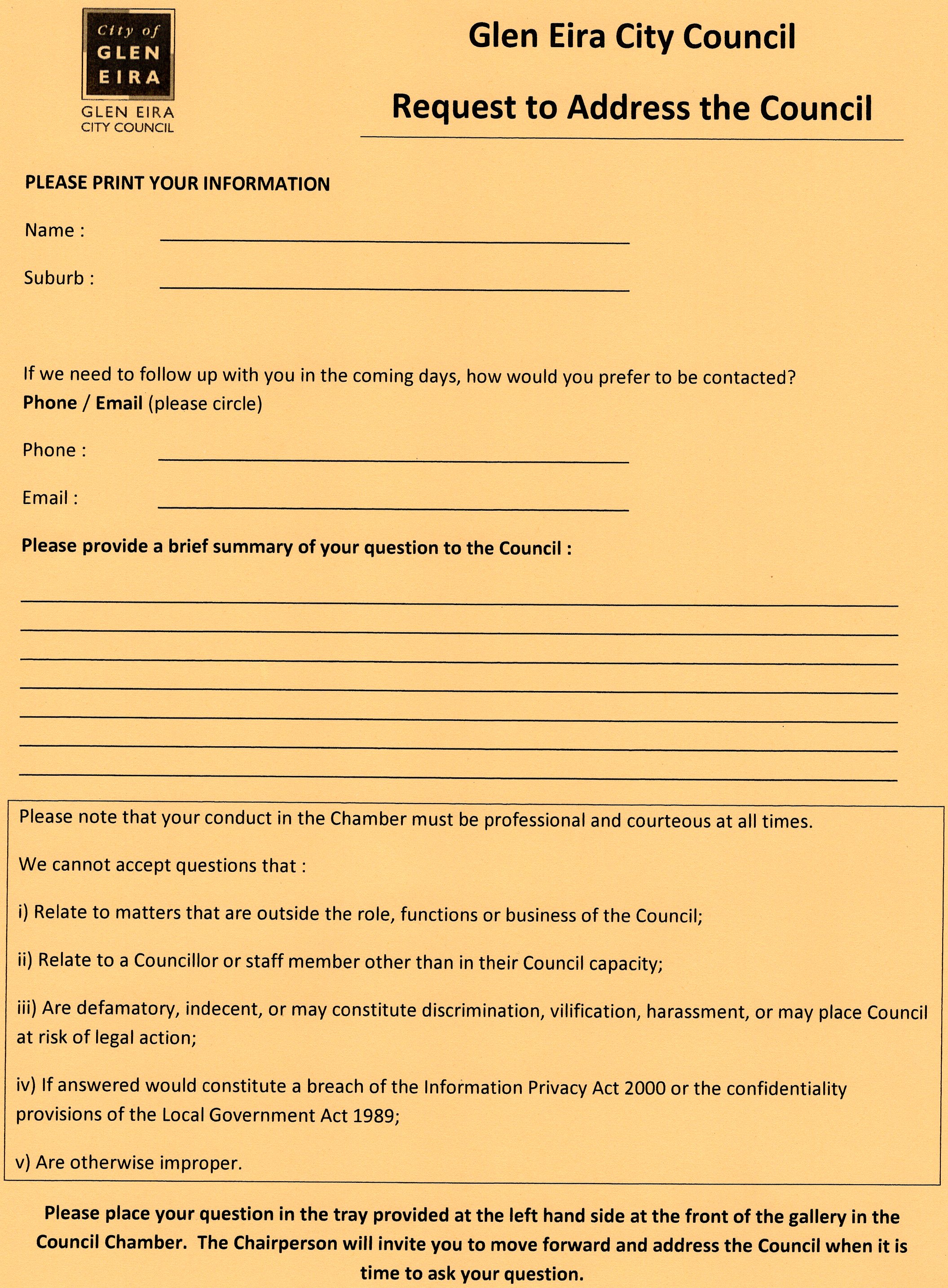
The following was provided for the gallery at tonight’s council meeting –

img007

Delahunty began the meeting with some explanatory comments regarding the above sheet outlining  ‘Request to Address the Council’.

DELAHUNTY: started by saying that at the appropriate time in the meeting she would call for the suspension of standing orders, so that people in the gallery who had filled out the sheet could address council either with a question or a statement. Said that either she would answer the question or direct the question to the ‘most appropriate person’. There will be a 15 minute time limit. This is ‘trialing one method’ and could change depending on ‘how this goes’ but the aim is ‘greater public consultation’.

Delahunty then proceeded with the traditional oath, accepting previous minutes, reading of petition, etc.

When reporting on the Community Consultation Committee minutes, Hyams made the comment that what Delahunty is proposing is that her motion is ‘fine but that local law is sacrosanct’ and that her proposal goes ‘outside’ the law so he won’t be supporting the motion to suspend standing orders.

Delahunty then explained that if her motion to suspend standing orders is successful, that the questions asked by the gallery is different to the public questions process in that the question and answers won’t be minuted. Public questions will continue at the assigned agenda item (ie at the end of the public meeting). Delahunty then moved the motion to suspend standing orders. Seconded by Magee.

MOTION PUT – VOTING IN FAVOUR – TAYLOR, STRAJT, SILVER, MAGEE, DELAHUNTY, ATHANOSOPOULOS, DAVEY

VOTING AGAINST: HYAMS, ESAKOFF.

MOTION CARRIED.

1st question – asked about the Ormond development proposal and the construction of the platform for the development whether this ‘breached’ any council planning laws. If it didn’t breach any planning laws then under what authority was this done?

ANSWER: Delahunty referred this on to Torres who reported that the Minister for Planning ‘changed the town planning controls’ to ‘facilitate the removal’ of the crossing and to ‘facilitate the development of the railway station’. This meant that ‘no planning permission was required’ from council for these two things. ‘We understand that the deck is an intrinsic part of the redevelopment’ and therefore council has no authority over this since ‘it is a structural requirement’ for the trench and ‘didn’t need planning permission’.

2nd question – asked how council is going to stop this development.

ANSWER: Delahunty said that ‘vision’ that council and the community has for the streets will involve strong lobbying. Council does want to see the area ‘enlivened’ but acknowledged there would be concern over ‘what precedent is set’. Residents should be ‘assured’ that ‘we are determined to do some strategic work’ that residents can ‘tell us’ what your vision is for the area. The CEO then spoke about council’s ‘shopping strip initiative’ which would ‘help form our activity’ as a result of the planning scheme review. Torres also said that they’ve started the process to ‘help inform’ our ‘future activity strategy’ such as questions like ‘what do you like about your shopping centre’. This might seen a ‘simple question’ but is important for ‘creating a vision for the centre’.

3rd Question – whether council would consider working together with other councils to ‘enable a more cost effective delivery of services’.

ANSWER: Delahunty said this was a good point about the need for ‘developing partnerships’ and she’s in favour of it as is the CEO. Because of ratecapping this becomes inevitable and they will have to think ‘more collaboratively with our neighbours’. Hyams also said it’s a ‘good idea’.

4th question – will council provide a date for live streaming of meetings?

ANSWER: Delahunty said that she couldn’t provide a date but that it is definitely on the agenda. They are waiting on a report to come back to council. Magee spoke that he’s in favour but the heritage of the building was a consideration but he didn’t like just one camera focused on the mayor. Privacy issues also needed to be addressed.

Question 5 – whether council would change the order of business so that public questions aren’t at the end of meetings and that the time for questions be extended to 30 minutes?

ANSWER: Delahunty said they would look at this but it’s ‘set out in the local law’ which council can change.

Other questioners were invited to speak to councillors at end of meeting since the 15 minutes was up.

« Previous PageNext Page »