April 13, 2016
April 8, 2016
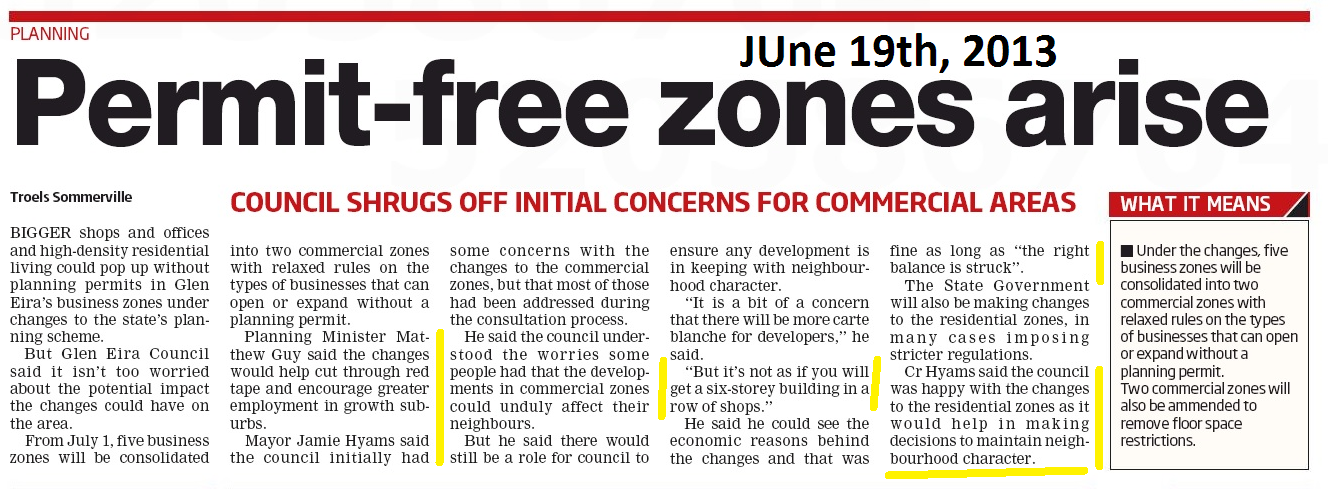
Given recent events, we thought it would be illuminating to revisit one of our earlier posts (June 19th, 2013) so that residents may gauge for themselves how much credibility to assign to anything our councillors say, and especially Hyams. Here is an article from the Leader of that date. The comments for that post are also worth re-reading since time has proven them to be very prescient.
April 7, 2016
VCAT has granted a permit for the Centre Road development. It will be 8 storeys and 33 dwellings, plus car parking waivers. The original application was for 9 storeys and 40+ dwellings, but amended plans were submitted following the compulsory conference. PS: correction. Here is the link to the full VCAT decision – http://www.austlii.edu.au/au/cases/vic/VCAT/2016/538.html
These extracts from the decision once again point out the deficiencies in the Glen Eira Planning Scheme. As per usual, any talk of introducing height limits for commercial allotments is far too little and far too late. The horse has bolted! Council had a decade and more to act. It has steadfastly refused to do a single thing! This is now the result!
Some quotes –
The acceptability of the height of this proposal is influenced by the planning scheme’s policy framework as it applies to this locality.
The policy identifies three urban villages in the municipality (Bentleigh, Carnegie and Elsternwick) and no distinction is drawn between them in terms of the role and scale of each centre.
Significantly, there are no height controls applying to the Bentleigh urban village, or to any of the other urban villages.
The policy framework outlined above provides a strong level of support for a building on this site that is higher than the prevailing one and storey scale of development in the centre. The achievement of the Council’s urban village and housing diversity objectives will almost inevitably involve the introduction of buildings into the urban village that have a greater height than the buildings that currently comprise the Bentleigh centre.
In the absence of more detailed built form controls or guidelines than those currently in the planning scheme, our finding that higher buildings can be contemplated where the Commercial 1 Zone abuts the RGZ, does not greatly assist us in forming a view about the acceptability of an eight storey building on a site that has an abuttal to the GRZ and the NRZ.
In these precincts, developments of three to four storeys are emerging on consolidated sites in both the RGZ and the GRZ. That analysis demonstrates that the urban village designation and the associated policies are having a profound impact in changing the built from character of the Bentleigh centre in a manner that is consistent with the objectives of those policies
We commented during the course of the hearing that Clause 55 does not apply to the consideration of a building of 5 or more storeys. Consequently, reliance on Standard B17 is limited to its use as a guide only. In this case compliance with B17 up to level 3 (including the width of the lane) is of some assistance because it is these levels that will have the greatest visual bulk impacts on the immediate neighbours. Above level 3, the additional setback is significant. Having regard to the nature of the interfaces we have described previously, and having regard to the strategic context of the review site, we are satisfied that the interface treatment is acceptable.
We acknowledge that the building will be viewed from the wider residential hinterland to the south. The visibility of the building is not however an impact that is beyond the reasonable expectations that emanate from the Council’s designation of this locality as an urban village and a housing diversity area.
April 6, 2016
Readers will remember the saga of Claire Street, McKinnon and Magee’s crocodile tears of woe on the steps of VCAT. The street featured again at Tuesday night’s meeting with Magee jumping on the same old bandwagon – everything is VCAT’s fault rather than council policy, planning and zoning.
The only reason that the VCAT member knocked back the first Stellar application for three storeys and thirty plus units was that the developer was exceedingly greedy. No decent setbacks, and internal amenity suitable for a mole – ie subterranean apartments! Another application has now gone in for 33 units and will end up at VCAT again.
But things have now got even worse. There is another application in by the same company Steller, for 1-9 Claire Street that will see: ‘six, three storey townhouse and two three storey apartment (44 dwellings)”. Stellar has basically bought out the entire street and the sole remaining resident has decided that enough is enough and has put his property (4 Claire St) up for sale.
We have no doubt that both Stellar applications will be passed by VCAT. Not because they ‘ignore’ council policy, but because it IS COUNCIL POLICY TO ENCOURAGE 3 STOREY DEVELOPMENT ON CONSOLIDATED LOTS and the zoning is GRZ. When the VCAT member rejected the first application for 6-10 Claire St., he made it absolutely clear in his judgement that zoning and lack of preferred character statements make Claire St.(and much of McKinnon) a candidate for this kind of rampant (over)development. It is Council policy. Please note the number of times the phrase ‘policy’ or ‘planning scheme’ feature in the extracts from this judgement (below).
Magee and the other councillors can continue with their nonsense and the spurious blame game, but residents need to appreciate the truth. Any Planning Scheme Review that fails to address zoning and the limitations of the schedules is not a review – it is a whitewash!
The judgement below says it all in our view.
Source: http://www.austlii.edu.au/au/cases/vic/VCAT/2015/1762.html
These local policies strongly support the development of apartment style buildings in Claire Street , McKinnon, in a manner that will result in significant levels of change. This is a deliberate and considered policy outcome sought by the Glen Eira City Council. It allows policies to also be implemented that reduce the ability for any meaningful level of medium density housing to be developed in the majority of other residential areas within the municipality. In other words, the Council has chosen to allow significant change in limited neighbourhoods, so as to preserve to a strong level the existing character of most of its other neighbourhoods.
While this individual proposal fails to address some important design matters, it is inevitable, in applying the local policies drafted by the Glen Eira City Council, that Claire Street, McKinnon will be subject to significant levels of change in the short to medium term.
Although townhouse developments of two and three double storey dwellings have started to appear in this area, the restrictions now in place over most of the municipality will act to focus more intensive development into areas such as this in McKinnon. It may not mean the whole street is filled with three storey apartment buildings but it almost certainly means that the existing single dwellings on a lot will be gradually replaced. It may take twenty or thirty years but, based on submissions and statements of grounds, I am not sure that existing residents appreciate the changes that will occur in response to development outcomes sought by the Glen Eira Planning Scheme.
In this proceeding, Mr & Mrs Menko lamented that most of the lots in Claire Street have now been purchased by developers, and are likely to be subject to forms of development like the one before me. They resist this level of change, and the likelihood that only two of the original single dwellings will remain. They also raise concerns about how this extent of development can be suitable for a dead-end street, with its only access point to McKinnon Road, and limited on-street car parking supply. They also question the ability of McKinnon Road to accommodate the additional traffic. I understand the frustrations and anger expressed by residents about the rate of change that might occur in Claire Street . However the extent of redevelopment that is likely to occur is a direct realisation of the very clear intent of the Glen Eira Planning Scheme, in particular the local policies created by the Glen Eira City Council.
That is, this form of development and rate of change, is consistent with the planning scheme that I am charged to apply. Further, it is not my role to review, on an ad-hoc basis, the suitability of this dead-end street to accommodate this level of change, nor the ability of McKinnon as a whole to accommodate additional population and traffic. The Glen Eira City Council has had the opportunity to carefully consider such matters, over an extended period of time, and has identified Claire Street McKinnon as an appropriate location for the placement of a housing diversity area, to take the additional housing demands of the municipality.
The Glen Eira Planning Scheme clearly supports substantial development in Claire Street McKinnon. This substantial development is not expected to imitate or reflect the style and form of the single dwellings that currently exist in this and other streets. Instead, a policy intent has been clearly been articulated for Claire Street by the Glen Eira City Council, that encourages more intense and more diverse housing forms. Invariably this means that apartment buildings are strongly encouraged in this neighbourhood.
It is clear, when taking into account the policy framework as whole, that apartment style development is the undeniable future for Claire Street , McKinnon, as clearly identified and articulated by the local policies contained in the Glen Eira Planning Scheme, as drafted by the Glen Eira City Council.
the apartment building is excavated below natural ground level to the rear boundary, such that the ground floor level will be around 1.3 metres below natural ground level, and the ceiling height of the ground floor apartments will be roughly matching the standard fence height on the boundary.
The residents urged upon me that a more appropriate development will consist of two storeys in scale. I agree with their submissions that the two storey apartment building at 13 Claire Street represents a more successful integration into the surrounding context. Further, for the reasons set out above I agree that this proposed three storey building is too big and bulky, with inappropriate setbacks, for the review site. However I have not been persuaded that the site is unsuitable for a three storey apartment building per se. Given the extent of policy support for a significant level of additional housing in this location, and the vast size of this consolidated site, I am not willing to conclude that it is not possible for a well designed three storey apartment building to be found to be an appropriate built form response to this context
Mr & Mrs Menko also raises a concern with the potential increase in traffic in Claire Street and their difficulties in accessing McKinnon Road. I acknowledge that this proposed development, if approved, would have increased such traffic levels, and the delays currently experienced in turning onto McKinnon Street. However the traffic impacts of the proposal were considered by Council’s traffic engineers, and in their independent and expert opinion, the surrounding road network can accommodate the expected increase in traffic.
The policy framework of the Glen Eira Planning Scheme clearly articulates a future for Claire Street McKinnon that anticipates significant change and more substantial housing developments. The Glen Eira City Council has adopted such a vision as a means of protecting much of its other residential areas from even a moderate amount of medium density housing. That is the policy framework that has been adopted and applied to this municipality for over 11 years, and is the vision that I must have regard to and implement in my decision making task.
April 1, 2016
We’ve uploaded the Planning Scheme Review Discussion Paper HERE.
Please peruse and we welcome your (initial) views.
March 31, 2016
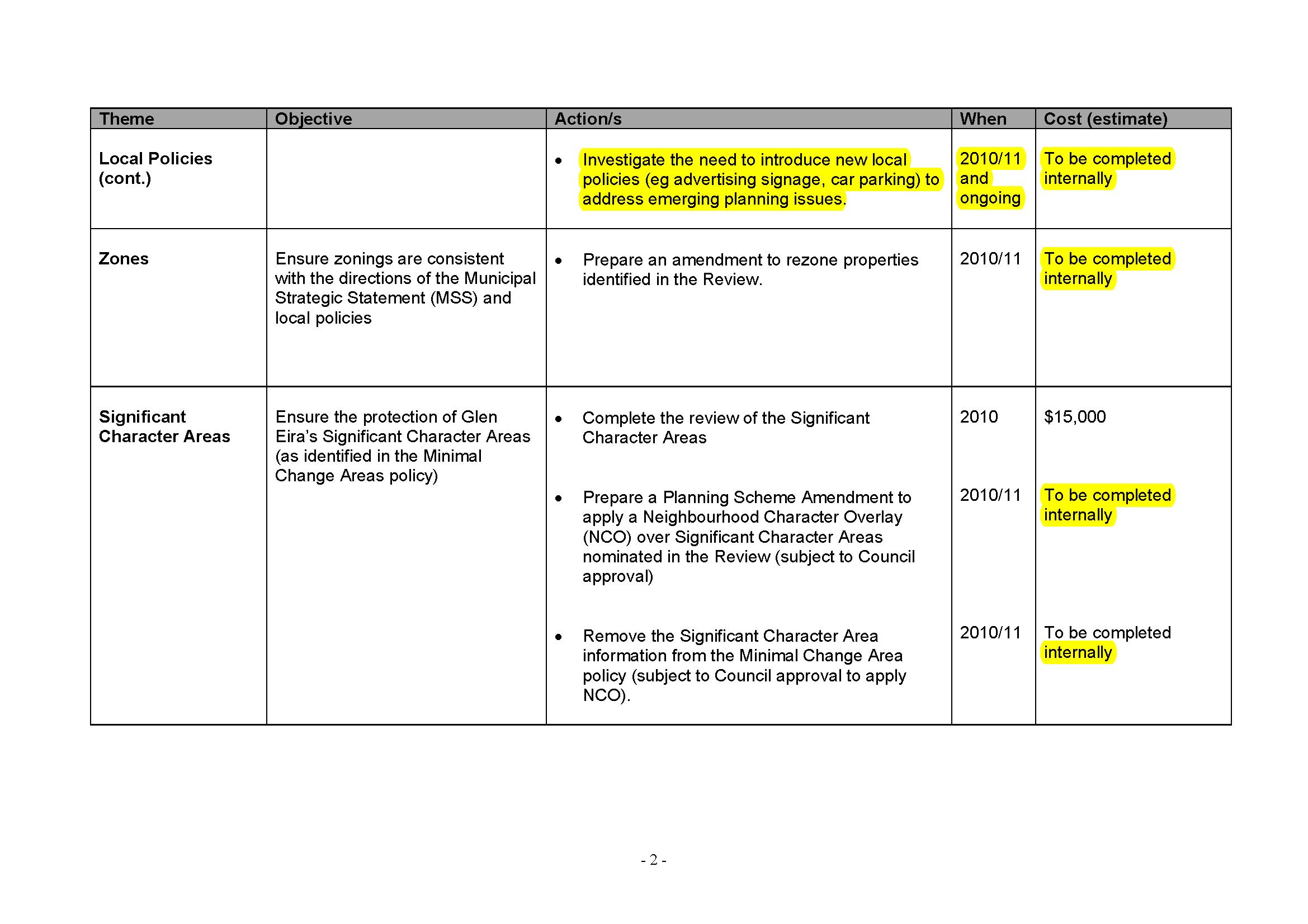
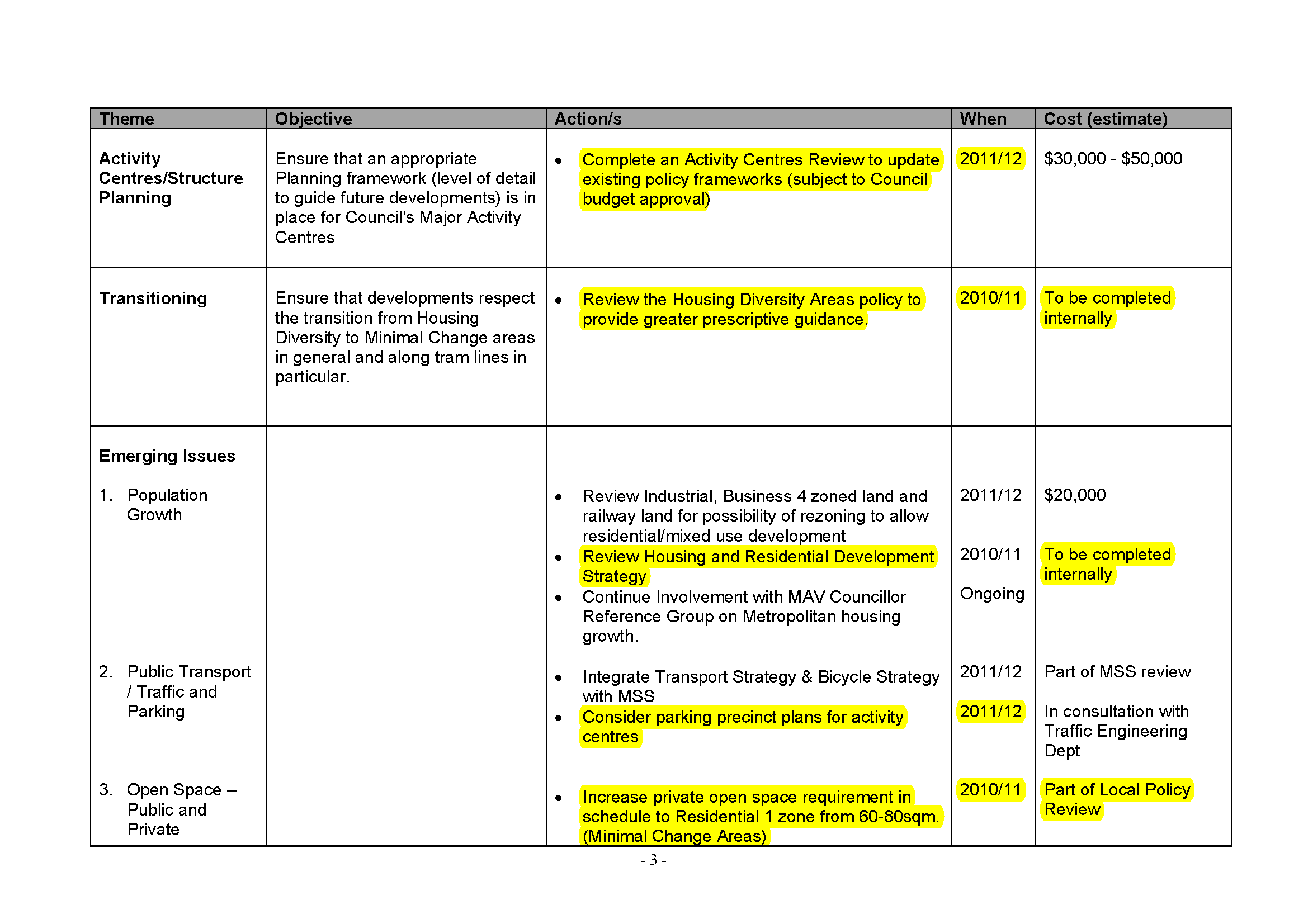
In 2010 Council went through the motions of a ‘review’ on its planning scheme. The councillors who partook in this ‘review’ and remain on council are: Lipshutz, Hyams, Esakoff, Pilling, Magee and Lobo. They resolved to pass the ‘action plan’ that is pictured below (from the minutes of August 2010).
We urge readers to note the following:
Thus, these images stand as a damning indictment of these councillors and administration. A repeat of this sham must not be allowed to happen with the current ‘review’.

March 30, 2016
It is our understanding that Minister Wynne has ordered Glen Eira to finally undertake a Planning Scheme Review. He has also rejected we believe council’s attempt for an extension to the deadline he set.

March 29, 2016
What stands out like a sore thumb in the Glen Eira submission is:
The ‘evidence’ for these claims is obvious once we compare Council’s stated position with some of its neighbours. Below is Glen Eira versus Bayside. Whilst these two councils do agree on numerous items, their differences are what is most telling. We focus in this post on the recommendations for the Residential Growth Zone only (RGZ). A quick summary –
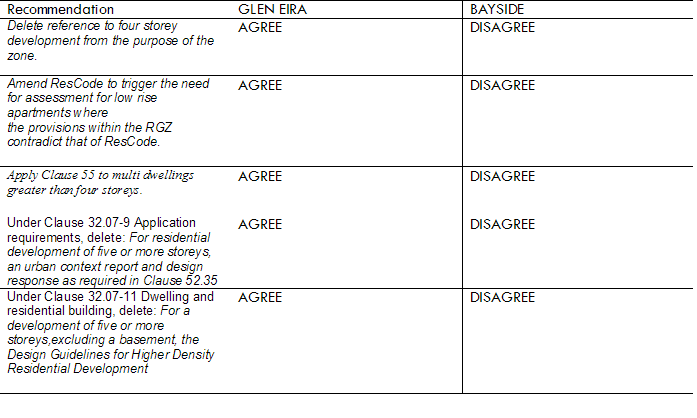
Recommendation #20 – Delete reference to four storey development from the purpose of the zone.
GLEN EIRA – AGREE (no comment provided to justify or explain this position)
BAYSIDE – DISAGREE – The purpose of the RGZ is to enable new housing growth and diversity in locations that offer good access to services, transport and other infrastructure. In developed areas, a transition between areas of more intensive use and development and areas of restricted housing growth is required. A four storey development outcome will be appropriate in these circumstances and therefore it is recommended that the current reference remains in the purpose of the zone.
RECOMMENDATION #21 – Amend ResCode to trigger the need for assessment for low rise apartments where the provisions within the RGZ contradict that of ResCode.
GLEN EIRA – AGREE – (no comment provided to justify or explain this position)
BAYSIDE – DISAGREE – ResCode was not intended to provide direction on apartment typology. It is recommended that the Better Apartments tool be implemented as the new assessment mechanism for apartment’s development of any scale.
RECOMMENDATION #30 – Apply Clause 55 to multi dwellings greater than four storeys.
GLEN EIRA – AGREE – ResCode should apply to all forms of multi-dwelling residential development. The lack of prescription in the State Government’s Higher Density Design Guidelines (6 storeys and above) creates uncertainty
BAYSIDE – DISAGREE – Rescode was not designed to assess multi storey building typology. A more appropriate tool such as the Better Apartments should apply for multi dwellings greater than four storeys
RECOMMENDATION #41 – Under Clause 32.07-9 Application requirements, delete: For residential development of five or more storeys, an urban context report and design response as required in Clause 52.35.
GLEN EIRA – AGREE – Agree subject to ResCode applying to multi-dwelling residential developments of five or more storeys
BAYSIDE – DISAGREE – An urban context report and design response are required to ensure that the purpose of the zone, the future vision of the area and any sensitive interfaces are taken into consideration
RECOMMENDATION #42 – Under Clause 32.07-11 Dwelling and residential building, delete: For a development of five or more storeys,excluding a basement, the Design Guidelines for Higher Density Residential Development
GLEN EIRA – AGREE (no comment or explanation provided)
BAYSIDE – DISAGREE – In the absence of a more current policy to guide Higher Density Residential Development it is considered that the Design Guidelines for Higher Density Residential should remain. It is recommended that it be replaced with the Better Apartments policy once it is implemented.
March 24, 2016
Glen Eira has finally published (without a formal council resolution and after the fact) its submission to the ‘review’ of the residential zones. This post is the first in a series where we will analyse this submission and highlight its incompetency, hypocrisy and once again council’s determination to insist that it got it right in August 2013.
Council’s incompetency and attempt to mislead is clearly shown in the following statement which comes from page 12 of its submission. (please note that the actual submission is really only a page or two since most of the 19 pages consist of regurgitating previous submissions and then tables from the committee’s recommendations).
Council writes –
Glen Eira will need to provide 800 dwellings (red line in Figure 1) each year to cater for the increase of 12000 households over the next 15 years.
Wrong on all counts!!! In the first place the figure of 12,000 households does not originate from 2016, as this sentence implies, but from 2011 as calculated by data from both Victoria in Future 2015, and profile.id. Thus what council has done is divide 12,000 by 15 years, instead of the 20 years specified by the government. That brings the average required addition of dwellings to 600 per year and NOT the claimed 800 per year.
Yet Glen Eira has over 2000 net new dwellings going up per year ever since the zones came in thus tripling its required net new dwellings in order to meet population growth. Nowhere in this submission will residents find any statement to this effect – unlike other councils’ submissions. In Glen Eira it is a case of the more the better, but without any thought given to ensuring that residential amenity, open space, infrastructure is capable of meeting this 300% over supply.
We urge all residents to read this council submission (uploaded here) and to ask themselves:
March 23, 2016
Source: http://www.gleneira.vic.gov.au/Resident-services/Rates/Rates-and-charges
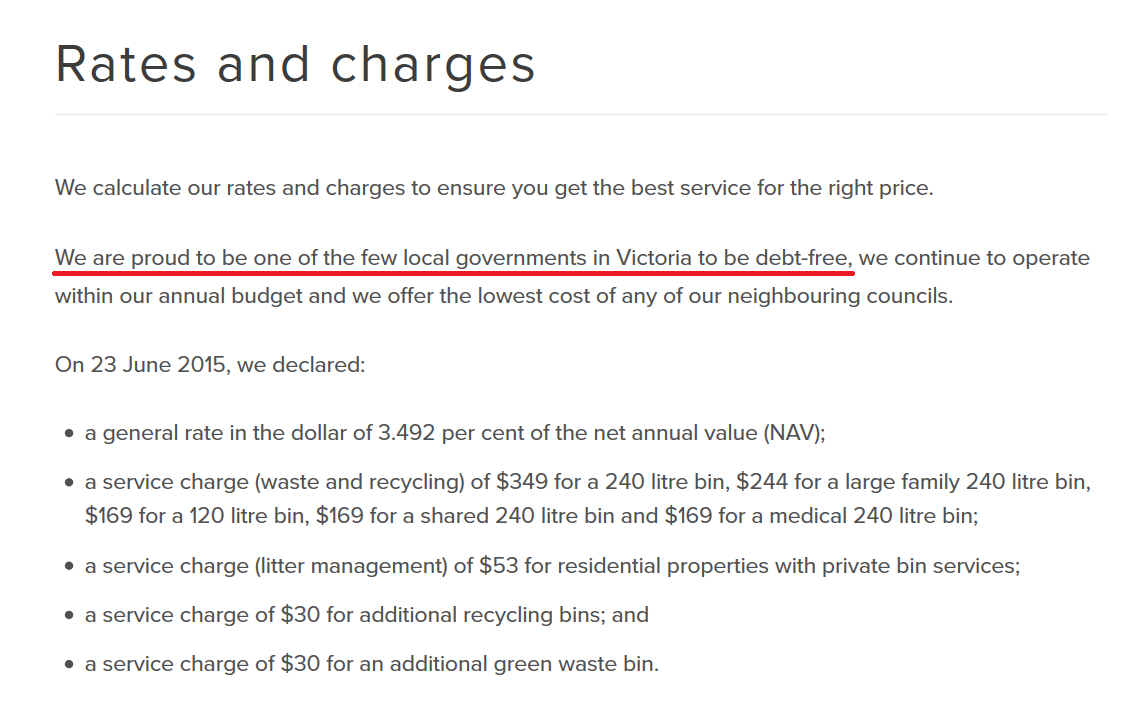 The ‘reality’? From the 2015/16 Strategic Resource Plan –
 We wonder how long it will take council to remove this latest webpage!!!!!!!!!!
 Glen Eira Debates