GE Transport


Tomorrow night, council is holding a ‘symposium’ on the proposed housing strategy. The speakers are:

Bernard Salt (demographer)

Lester Townsend (Planning Panels Victoria)

Kate Breen (Affordable Development Outcomes)

Maria Yanez (Nightingale Housing)

Whilst these four individuals are undoubtedly ‘experts’ in their respective fields, we need to consider why these people have been chosen by council and exactly how much they know about Glen Eira and its current housing needs, its zones, its development rate, its lack of strategic vision! It’s all very well to look at the ‘big picture’ across the state, but housing strategies are meant to be ‘individualised’ and pertain to unique municipalities.  We are therefore very sceptical as to the value of tomorrow night’s symposium and how well it will address the fundamental issues facing Glen Eira. Yes, what is happening statewide and nationally is important, but even more important is what is and what has been happening in Glen Eira.

Even more disconcerting are the following statements (cited verbatim) all taken from this link – (https://www.haveyoursaygleneira.com.au/our-housing-our-future/widgets/344509/faqs#80192)

The event is the opener for our early community engagement phase which will continue to the end of August.  A second phase of consultation will take place in early 2022 on the content of a draft housing strategy.

Council has stated that the Housing Strategy will be completed in April 2022. Does the above paragraph then imply that the ‘second phase of consultation’ will simply be on what council produces as its one and only draft strategy? Why the huge gap of 6 months before any further ‘consultation’ takes place?

This might have been kosher if the survey and the issues paper were up to scratch. They are not. Once again we find that detail is lacking, pertinent questions and options are lacking, and residents are asked nothing more than irrelevant Dorothy Dix Questions, that add nothing to a full understanding of Glen Eira’s future and the role council needs to play.

Finally, we have this other quote:

As the purpose of the event is to explore information about demographics and housing rather than specifically about the current housing strategy project, Councillors and Council officers will not be answering questions on the night.  Drop-in sessions on 22 and 26 July are planned and will be an opportunity for the community to discuss the themes of the housing strategy discussion paper and the housing stragegy (sic) project with Council officers.

 Why then hold such a forum if it does not relate specifically to our local housing strategy? Why deny residents the opportunity to ask questions of officers and councillors? How much has this public relations exercise cost?

In the coming days we will analyse the survey and reveal why it is nothing more than another bogus exercise in so-called ‘ consultation!

PS: In 2019 Stonnington Council also held a symposium for its revamped housing strategy. They did include speakers from Planning Panels and Nightingale just like Glen Eira is doing. However, they also had someone from Profile.id – a company that Glen Eira and most other councils in the state rely on for their ‘individualised’ information. This presentation focused exclusively on Stonnington – its population growth, its development rate, its age structure, etc. See the presentation via this link: https://drive.google.com/file/d/1odRg-PHd-pmfAGCJ_oN44sI5rJkJR5oN/view. In Glen Eira such information is deemed unnecessary it would appear!

Council will be voting on the draft budget this Tuesday night. The differences between the May version of the budget and what is now presented is remarkable. Whilst some areas have received increased funding, the issues that were highlighted in the submissions have been totally ignored. This once again raises the question of why bother to ask for community input, when the recommendations are so flagrantly ignored year after year? Residents are never given the opportunity to specify what their priorities are. Instead we continue with the top-down approach and the minimalist adherence to the legislation. God forbid that residents be given the opportunity to answer such questions as: where do you want your money to be spent and how much?

The submissions made it very clear that what was needed was:

  • Increased funding for the urban forest strategy. This still remains at the May version of $200,000!
  • More funding for the acquisition of new open space. Nothing has changed from the $7M proposed in May.
  • Residents wanted the bicycle strategy to receive a minimum of $500,000. We are still stuck on $250,000.

At this rate, we can be waiting well into the 22nd century before our tree canopy reaches any reasonable target, or there is sufficient open space to accommodate the increasing population.

Yet council has still managed to find and allocate huge increases to various projects that are not only questionable, but where we believe most residents would argue aren’t necessary and certainly not on the top of the priority list. Please note, we are not arguing that these things shouldn’t be done. What we are suggesting is that given all the other major issues that are currently confronting Glen Eira, that much of this money should have been directed into those areas that demand immediate action – such as open space, the urban forest strategy, structure planning, amendments for development contribution levies, etc.etc. Five years on from the ordered Planning Scheme Review, we have practically nothing in concrete outcomes.

Below is a table which depicts the monies allocated for the various projects according to the May and then the June draft budgets – and all with hardly any detail.

PROJECTMAY DRAFT BUDGETJUNE DRAFT BUDGET
Caulfield Park Masterplan$600,000$710,000
Duncan Mackinnon Netball$200,000$250,000
Pedestrian Safety$205,000$355,000
GREAT WALKS STREETNot listed$700,000
Outer Circle$40,000$700,000
Lord Reserve/Koornang Park master plan implementation$500,000$680,000
Hopetoun Gardens$40,000$220,000
Tennis Strategy$75,000$275,000
Caulfield Park master plan implementation$40,000$790,000
Princes Park Playground upgradeNot listed$1,250,000

Surely some of these projects, and their massive increases in funding, could be deferred until this council sorted out its other major concerns as we’ve listed above.

Finally, it is also remarkable that in the space of one month, we have gone from an estimated deficit of $45,000 to a suggested surplus of over $11M where the announced government grants somehow don’t add up to this amount!

Our final comment is that until this council is prepared to provide full and comprehensive explanations for its decision making and budget allocations, residents are once again left in the dark with no real say as to how their money is and should be spent.

Public submissions for the draft budget and Strategic Resource Plan, have one consistent theme running through nearly all of the presentations. This is best summed up with this sentence from one such submission –

It is one thing to have a strategy and action plan in place, it is quite another to implement them. As Councillors would well know, implementation requires funded projects. It is here that Council is lacking.

Time and again throughout all of these well documented and thoughtful submissions we find similar statements. Council has policies, plans, strategies but implementation is either non-existent, or years behind schedule, and simply underfunded and/or forgotten about. This applies across all departments – from Caulfield Park implementation of the Master Plan, to bike paths, open space, the Urban Forest Strategy or the Climate Emergency. Nothing seems to have been done or certainly not funded enough to ensure real progress on any of these issues.

Then we also have the penny pinching that is so common in Glen Eira. Child care fees go up another $3 per day. Council’s persistent claims about such repeated rises is that they are on a par with the private providers. Only now the differences are made clear thanks to these submissions – ie whilst the fee per day might be equitable, council does not provide lunches or nappies. As for the car share options, that has remained static, yet for all the talk about reducing the number of cars on our roads, very little has been done to expand this option for residents. Instead fees are through the roof! Glen Eira’s car share policy first came to notice in 2016. Its subsequent policy is dated 2017-20 – hence defunct and out of date. We currently have 12 car share spaces in comparison to: Yarra – aiming for 231 in the next 5 years; port Phillip in 2018 had 181; and as far back as 2015 Moreland had 40. The rhetoric and the reality are simply miles apart on so many issues.

Council can ratify as many policies/strategies as it likes, but until there is a genuine commitment to fund such projects adequately nothing will change. Policies become nothing more than another worthless piece of public relations providing the illusion that council does give a damn about the lack of open space, the destruction of our tree canopy, and the failure to progress the bicycle strategy or provide sufficient car share opportunities. Residents should really start asking themselves whether this council’s priorities are in line with ratepayers’ thinking. Of course, ratepayers have never been provided with the opportunity to have a say in what these priorities should be before they are presented with the draft budget. In Glen Eira it would be fair to say that residents are nothing more than cash cows!

At last night’s Zoom forum on the Built Form Frameworks for Caulfield South, we had Kate Jewell (Co-ordinator City Strategy) make the pronouncement that’s in the header to this post. This statement followed resident after resident complaining vigorously about council’s reluctance to impose mandatory heights.

Here is the audio of this interchange:

Jewell’s statement tosses the ball straight back into councillors’ court. They have the power to oversee policy direction. They also have the power to pass resolutions which officers are mandated to follow. We have already had some examples of this – namely the abandonment of Amendments for Glen Huntly and for Bentleigh & Carnegie. This is no different. The question thus becomes:

  • Will councillors have the courage to insist on mandatory heights for all neighbourhood centres?
  • Will councillors, as representatives of their constituents, act in accordance with the community’s wishes?
  • Will councillors finally see the folly of this planning department and insist that the foundation for all strategic planning must derive from a comprehensive Housing Strategy that should be prioritised immediately and certainly before any decisions are made on structure plans or built form frameworks.

We also have to wonder whether Mr Slavin’s quick intervention in the above audio, cutting off the Jewell response, was that he perceived she was heading into ‘dangerous waters’ for the bureaucrats?

Save Glen Eira has published the following media release that we believe is well worth a read and consideration. Professor Michael Buxton’s comments are spot on and call into question Council’s track record on planning.

Consultations are literally coming out of our ears over the past few years. Council’s repeated mantra is that they want to hear from residents. That residents should provide meaningful comments so that their views may be taken into account in any subsequent decision making. Sounds wonderful. But the reality is vastly different.

Time and again we are presented with surveys that deliberately avoid the central issues or are framed in such a way as to elicit the desired response(s). This approach is anything but genuine consultation!

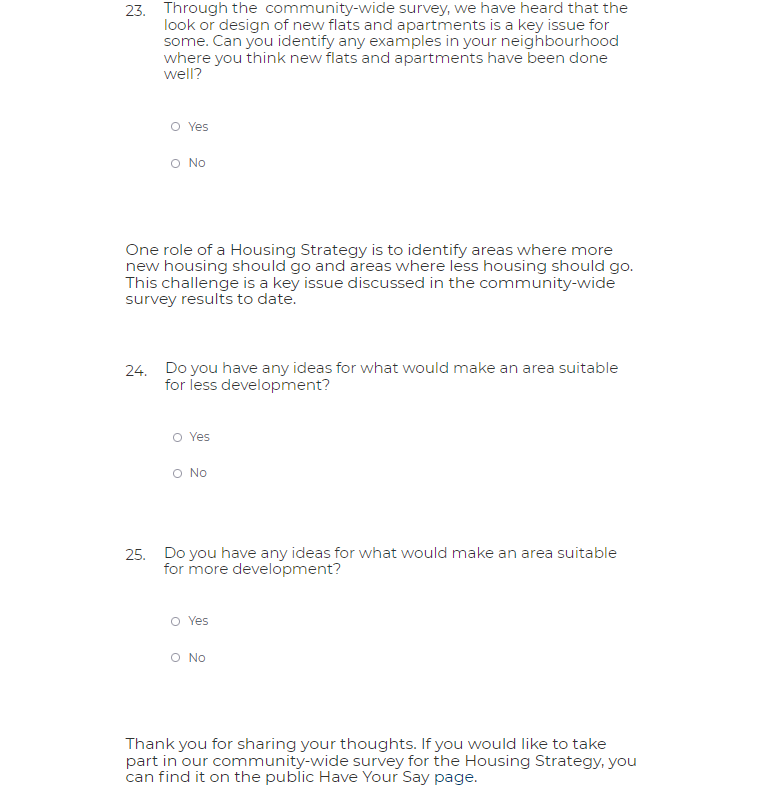
The latest example is the Have Your Say survey on the draft Built Form Frameworks for Bentleigh East, Caulfield South and Caulfield North. Each centre has its own survey, but the questions are identical.

Here are some examples of what is presented and why this cannot be viewed as a fair, unbiased, and revealing ‘consultation’ designed to elicit real community feedback.

EXAMPLE 1

The question asked was: Thinking about the Centre as a ‘vibrant’ place, how important are the following to you? Readers were then provided with the following:

We allege that not only are these options meaningless but that they have no relevance whatsoever to what is actually proposed in the draft document. Nor do any of these objectives come close to justifying what the actual recommendations are! For the above options, clearly 99% of respondents would say that buildings should be ‘visually interesting’ and ‘attractive’. And not too many people would object to catering to the wide range of housing needed for the elderly or the young. Nor would many be opposed to supporting local businesses.  Thus we get a series of questions that literally lead most respondents to answer  in the ‘very important’ to ‘important’ range.

But how are these questions related to what is recommended in the drafts, or even within council’s current planning scheme? Will the implementation of a 5 metre setback from the street be of great assistance in encouraging ‘attractive and visually interesting buildings’? Will a discretionary 6 storey height limit, also assist in this objective? Or is this nothing more than gobbledy-gook parading as if any of these objectives can be achieved with what is currently in the planning scheme and what is proposed.

More importantly there remains the question of how council will choose to ‘interpret’ the results of this survey. Will we get statements such as 95% of respondents answered ‘very important’ and thus they are endorsing the draft BFFs?

EXAMPLE 2

The focus then turns to ‘design objectives’ with the following options:

It should be pointed out that council’s definition of ‘mid-rise’ for Caulfield South is stated to be: A mid-rise character is about building height (between 4 and 7 storeys). This idea reflects the role of Caulfield South as a Neighbourhood Activity Centre, with a moderate role to play in meeting future housing needs as well as employment, transport and services. Unless readers have bothered to plough through all the verbage prior to this point, then they would have no idea of what is proposed for this centre. Furthermore, the language used here is questionable at best and at worst deliberately evasive. What does ‘cohesive’ really mean – especially since the order of the survey has not as yet clearly depicted the proposed height limits along the various streets. Do readers really have a grasp on the fact that according to the recommendations hundreds and hundreds of metres of buildings could all be at this maximum height – and that is called ‘cohesive’?   

Also amiss is that unless readers have gone through the full documents, they would have no idea that council is proposing that sunlight only matters on the most ‘active’ part of the day. This is then defined as 10-12pm for certain streets and 12-2pm for some other streets. The above image does not relay this information. Of course, residents would respond that sunlight is vital. But this certainly doesn’t mean that they are ‘happy’ with a meagre 2 hours of sunlight because of the proposed building heights!

EXAMPLE 3

The following example if the best of the lot –

Of course height, setbacks, street walls and public realm areas are ‘important’ and should be the most important element in any planning document of this nature. But does selecting ‘very important’ indicate that residents are accepting of the recommendations in the draft document? Do residents really believe that a 6 storey discretionary height limit is what they want? Or that 2 hours of sunlight is sufficient?

CONCLUSIONS

There is much more that could be said about this style of ‘consultation’ and in particular, this survey. Until council is prepared to ask the questions that must be asked; to provide succinct and accurate summaries; to justify every single planning recommendation, then we are engaging in another sham consultation. All that is happening is that council is fulfilling its legislative requirement to undertake ‘consultation’, but nothing more. Until such a time that genuine evaluation of such processes is undertaken and reported upon we will continue to waste tens of thousands of dollars on consultations that are reverse engineered and designed to achieve predetermined outcomes.

The published draft budget contains some very interesting proposals. Below is a summary of the main ones that residents should pay attention to:

  • Proposed borrowings go from last year’s figure of $60M to the current goal of $65M and that still leaves the GESAC loan of just under $8m to be paid off.
  • The Carnegie Pool redevelopment has miraculously jumped from $51M last year to $53M this coming financial year
  • Pensioner rebates continue to decline. We are now down to the underwhelming subsidy of $23
  • The Elsternwick community Hub and park has now been further delayed to 2030 instead of the previous estimate of 2017.
  • $7M is proposed for the acquisition of open space. That is out of the current reserve sitting at about $25M. Hence whilst this proposed expenditure is a step in the right direction, we have to ask – is this enough given the long standing deficit of open space in Glen Eira? Also how much land will $7M actually buy?
  • The Murrumbeena Community Hub is fast tracked ahead of the Elsternwick Community Hub when the latter is in a major activity centre and has population forecasts that far exceed that of Murrumbeena.

There is also plenty missing in this year’s proposed budget. No clear and easily identified detail is provided on which projects have been abandoned or deferred and where the resulting allocated money has gone. For example: what is the status of the proposed multi-storey car parks in Bentleigh and Elsternwick? Have they been put on the back burner or simply gone into the dustbin of history?

Other councils do not appear to have any problem in providing their residents with tables that are easy for any lay person to comprehend. Just one example comes from the current Kingston budget where carried forward works are depicted. Nothing like this is to be found in the Glen Eira budget papers.

The budget is also replete with jargon and statements that are misleading or totally uninformative. For example, on page 16 we find this paragraph:

The City is substantially developed and while it is experiencing an increase in property numbers, these mainly arise from higher density developments. The budget implications arise in Council having to cope with replacement of infrastructure such as drains which cannot cope with the higher density. These costs cannot be passed on to the developer and are paid for from rates. The rates received from new dwellings do not offset the significant infrastructure costs.

COMMENT: At the moment the costs ‘cannot be passed on to the developer’ because council does not have a CDP, or a community infrastructure levy. This income source was removed from the planning scheme years ago. The impression that the above creates is that it is not legally possible for councils to recoup some of the costs from developers and this is totally untrue. Also the 2016 planning scheme review highlighted council’s need for a CDP, So 5 years down the track we are still waiting for these amendments to surface! Developers can (and should) pay for infrastructure, but it all depends on a council that is willing to progress the necessary amendments to ensure this happens.

Next on page 16 we have two incredible sentences:

Continued investment of resources in the Council’s Transformation Program will enable further efficiencies and enhance customer outcomes.

When millions upon millions are spent each year on such programs and technology, surely residents deserve more than some glib pronouncements about ‘efficiencies’. What is the total required? What ‘efficiencies’ are achieved? And who are the ‘customers’ that will benefit and in what manner?  

Another sentence on this page also needs detail and explanation – Council declared a Climate Emergency on Tuesday 5 May 2020. Responding to this declaration through our work program will require a substantial increase in investment.

Again, we get no detail, no projections of required investment and no timelines.

We urge all readers to take the time to assess this budget and what is proposed. Do we really need these mega projects (and without any published business cases) that will put this council into hock for decades, and what services are not receiving the required funding. What are OUR PRIORITIES as opposed to those enumerated by bureaucrats?

A quick report on last night’s council meeting:

  • Many of the submitted public questions merely ‘responded’ to rather than ‘answered’
  • By a vote of 5 to 4 committing $300,000 to $350,000 to proceed with the ‘design’ for the Inkerman Road bike path – in spite of the massive community opposition.
  • No attempt to change the public question format – current status accepted unanimously
  • The ‘revised’ Built Form Frameworks to go out for a 6 week ‘consultation’ period. Voted in unanimously with not a single word from any councillor as to why version 2 included some changes. The officer’s report for this latest version is still to make an appearance. We doubt it ever will.

We will comment in greater detail in the days ahead.

The agenda for next Tuesday night’s council meeting is now up on council’s website. Readers will remember that at the last council meeting the decision regarding the proposed Built Form Frameworks for Bentleigh East, Caulfield South and Caulfield North, was deferred. The argument was that councillors needed more time to discuss and that further detail was required. Residents therefore have every right to expect that what is now published fulfills these requirements. So what have we got? Nothing more than a repeat of what was in the last agenda.

Even if this is the result of a simple ‘technological’ error and that an updated version was somehow not included in the agenda papers, it does not excuse what has occurred. Doesn’t someone double check what goes out to the public? Don’t we have spell checks that are employed? Who is responsible? How diligently did they proof read the documents?

In the end, incompetence reigns supreme!

PS: Council has now uploaded the correct Built Form Frameworks. What they have NOT as yet done is to include the latest officer report. Surely residents should have timely access to the rationale behind whatever changes have been made.

Whilst council plods on with its long awaited structure plans, urban design frameworks and god knows what else it hasn’t achieved as yet, the most crucial element in both council’s and we presume the state’s planning is what COVID has produced in terms of migration slow down, oversupply of apartments, businesses closing, and rising house prices for detached dwellings. In short, the boom period for many individuals is well and truly over.

Given these factors, it becomes even more important that council’s strategic planning is fully cognisant of what lies ahead and what has been happening in the past 3 to 5 years. The oversupply of apartments is not something new – it was already evident in 2017. The rising costs of houses means that less and less can afford them, despite mortgage rates being at an all time low. Renters are also leaving in droves – often returning to stay with parents. And given the absence of overseas students, and migration figures to rival our lowest numbers since 1946, any strategic planning simply has to factor all this in.

We have had Victoria in Future 2019 predicting population growth that is now in tatters. The impact on housing supply and demand therefore must be reassessed and planned for accordingly.  Council continues to argue that things will return to ‘normal’. But when? In 3 years time, in five years, or never? Besides, structure plans are not meant to be created and then left hanging in the wind for decades. They are supposed to be ‘live’ documents that are continuously reviewed and reworked. So given all the above negatives, why is council still demanding 12 storey apartment complexes in Carnegie? Or even higher along Nepean Highway? Do we really need all this high rise when apartments are what is suffering the most?

All of the above makes it absolutely crucial that any Housing Strategy does not ignore these events. Simply looking at ‘capacity’ as we were told with the first version of the Built Form Frameworks for Bentleigh East, Caulfield North and Caulfield South, is in our view a meaningless exercise. Capacity does not equate with need. It simply says, ‘yes, a 20 storey building can go here’. It doesn’t answer the crucial question of whether or not we need 20 storey buildings to cater for population growth over the next 15 years. Nor does it tell us whether existing infrastructure can cope, nor how much it will cost to introduce the required infrastructure.

We have extracted two pages from a 2020 report from the National Housing Finance & Investment Company  which is worth a read. The full document is found at: https://www.nhfic.gov.au/media/1621/nhfic_state-of-the-nations-housing-report_accessible-updated.pdf

Please take a close look at their projections and the arguments upon which these are built.

« Previous PageNext Page »