GE Planning


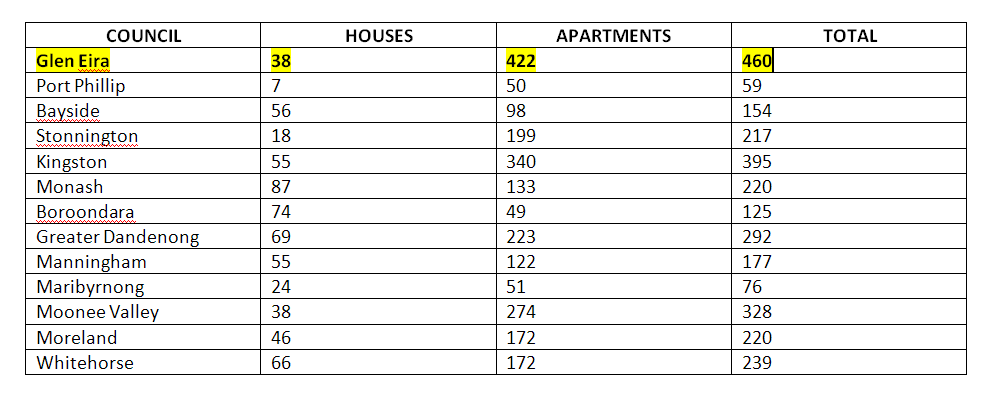
The ABS has today released its figures for building approvals for the months of July and August, 2017. They have also updated their data for the 2016/17 financial year. Glen Eira’s numbers for the past financial year were upgraded to 2021 building permits granted.

Please consider the table below. Glen Eira is now not only the biggest development municipality in the south east, but is winning hands down for the Northern suburbs alone. If the current rate continues, then Glen Eira will well and truly surpass another 2000 net new dwellings per year!

We have uploaded the full Excel spread sheet HERE

Readers may also find the suburb analysis of interest as well (uploaded HERE). Please note that Bentleigh-McKinnon is now far ahead of Carnegie. Quite incredible considering that McKinnon is merely a poor old neighbourhood centre in council’s heirarchy and Bentleigh is supposed to have only ‘minimal’ growth according to the structure planning documentation. The bottom line remains, we believe, that land zoned GRZ provides easier and cheaper pickings for developers – and McKinnon, Ormond have plenty of land zoned GRZ. Our prediction, unless zoning changes dramatically, is that these figures only represent the tip of the ice-berg and more and more development will be focused in our neighbourhood centres – especially since council has not provided any timelines for addressing this crucial issue or providing any information as to its intentions for these suburbs!

Source: http://www.dtf.vic.gov.au/Infrastructure-Delivery/Victorian-Government-land-sales/Recent-sales-history

The above image details recent government sales.  In this instance, we highlight crown land that has been zoned under ‘education’. The site at 100 Queens Avenue is a single storey building (primarily computer labs) plus an adjacent car park that has been there for eons.  Questions abound:

  • Why was the land sold?
  • Who bought the land? and
  • If it is Monash, then why on earth spend $8m for a quarter of a hectare?
  • Or is the buyer a private developer?
  • And if a private developer, does this mean high, high rise residential?
  • How much does council know?
  • Why the total lack of transparency, discussion?
  • What will this now be rezoned to?
  • What role has the vpa played in all of this?
  • Exactly how much do our elected representatives know?
  • What are the implications for the adjoining open space? Will this be flogged off too?
  • How many storeys are required to recoup a reasonable profit on $8m?
  • Finally, as a worst case scenario, is the MRC involved in any way?

Until facts are forthcoming then residents have every right to be concerned about the lack of transparency at all levels of government!

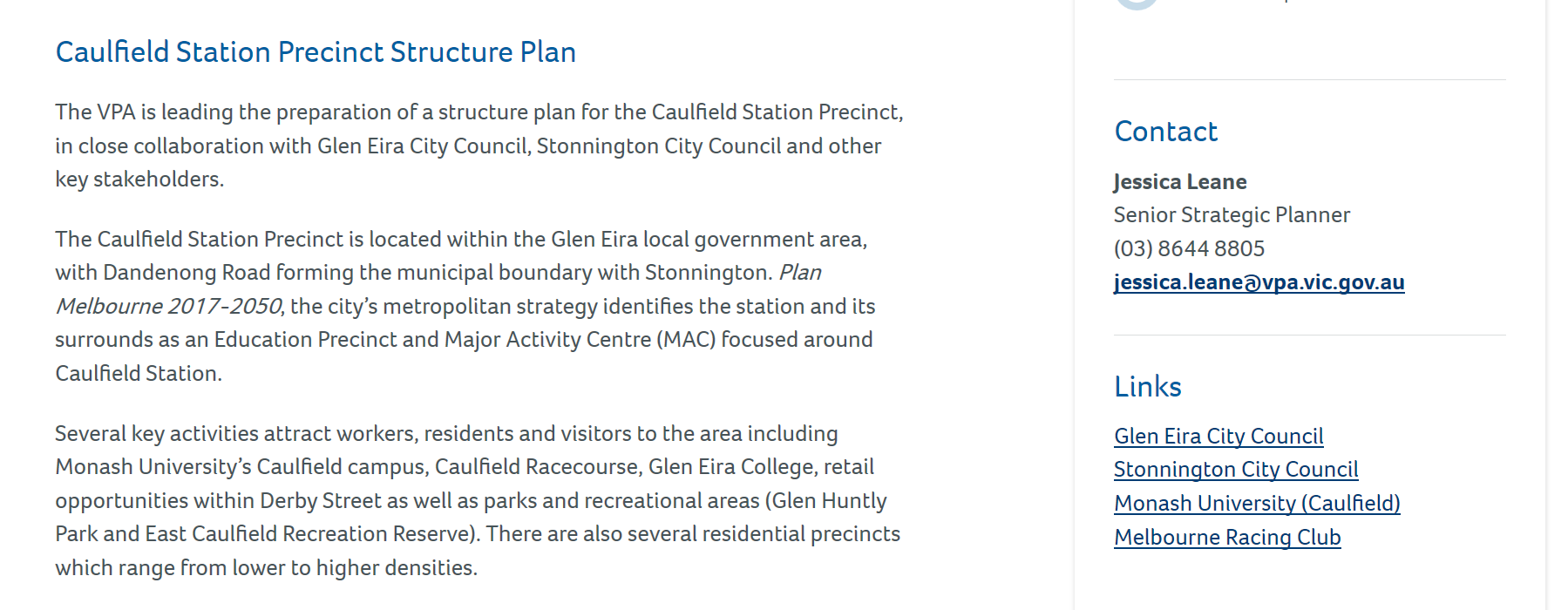
Source: https://vpa.vic.gov.au/project/caulfield-station-precinct/

For the second week in a row, we find the following Age advertisement. This time on page 2.

Why is it that practically every stat published by council is highly questionable? The latest example concerns their statement that for the financial years of 2015/16 and 2016/17 planning permit approvals were granted for the following numbers of net new dwellings –

  • 2604 net (additional) dwellings approved in in 2015/2016.
  • 2728 net (additional) dwellings approved in in 2016/2017.

Councils are required to forward their data to the State Government’s DWELP. The numbers are then put onto the Planning Permit Activity website. This section of the department basically serves as a repository for data that has been supplied by councils. Thus we are left with the question of the accuracy of the supplied data. Which figures are residents to believe? Council can’t have it both ways. Either the figures quoted above are a fiction, or those supplied to the government are a fiction.

Here is what the Planning Permit Activity reports as the results for 2015/15 and 2016/17 based on their quarterly reports (See: https://www.planning.vic.gov.au/publications/planning-permit-activity-in-victoria/planning-permit-activity-quarterly-report ) Readers can then backtrack to the various three quarterly reports and add up the figures for themselves.

2015/16 – 2133

2016/17 – 1806

The discrepancies are not minor – equalling roughly 500 net new dwelling approvals in 2015/16 and 900 in 2016/17. How can this happen and if deliberate, then what is the purpose?

Perhaps the answer might lie in these figures (which are correct) provided by council –

Within the past two years we have seen the following Building Permit net dwelling approvals:
·         1681 net (additional) dwellings approved in in 2015/2016.
·         1993 net (additional) dwellings approved in in 2016/2017.
According to council, the correlation per year between building permits and planning permits approaches the 1000 discrepancy mark. But if we look at the Permit Activity numbers from the government website, the discrepancy halves and makes the following council statement that much harder to swallow –
However, planning permits and even building permits are not always acted upon, and so they do not paint an accurate picture of what will be constructed. In fact, ID consulting advice show that historically in Glen Eira, only just over half of dwellings approved through a building permit will go on to be constructed.
Does this paragraph mean it will never be built, or just for the respective year? What about ten years down the track? Are we still maintaining that only 50% is built? We admit that there is land banking, or some developers may go bust, but we certainly dispute the figure of 50%. Obtaining land, planning permits, building permits, constitutes a huge investment. Then there are undoubtedly finance costs, interest, land tax, etc. etc. Money is in building and selling and since property prices are already at an all time high, and forecast to drop, why would any developer sit back with his planning and building permits and not act on these? And finally, is such a statement by council intended to cast doubt on the fact that Glen Eira is without a shadow of a doubt the development capitol of the South East?

The issue of density has received very little attention from our planners and from councillors as a whole. Yet it is crucial to an understanding of what is happening and what is forecast. Remember that Glen Eira is already one of the densest municipalities in the state and it would seem that council is gearing up for even more!

According to Victoria in Future, 2016 Glen Eira’s density (persons per square km) was 3,544 based on 2011 Census figures. If we look at the 2016 Census data this figure has now risen to 3,621 per square km across the entire municipality. What these figures don’t tell us is ‘residential density’ – that is, the number of persons per square km of residentially zoned land. This measure provides a far more realistic reflection of liveability and ‘capacity’ for that matter. It also reveals those areas that are probably under extreme pressure in terms of infrastructure, traffic, etc.

Our figures are based on the State Government’s spatial mapping facility and date from soon after the introduction of the residential zones in August 2013. Since this time there have been plenty of changes to industrial zoned land to either Mixed Use or Commercial. These latter zonings allow residential development as opposed to the former ‘industrial’ zoning. Hence, our figures are in all likelihood an underestimation of what is the current situation.

Our calculation of ‘residentially zoned land’ includes the following – Commercial 1; Mixed Use; Neighbourhood Residential (NRZ); GRZ ; RGZ. Parks, roads, public utilities, etc. have been excluded. We concentrate exclusively on land that is deemed suitable for ‘residential’.

Our analysis reveals several fascinating results that are a major cause for concern.

  • Many of our ‘neighbourhood centres’ are the densest in the municipality – some exceeding the so called major activity centres (ie McKinnon, Ormond, Caulfield North, Murrumbeena).
  • If this is indeed the case, then it reveals again the disaster of the 2013 zoning where developers exploited the zoning in these smaller centres rather than the major activity centres (apart from Carnegie that is).
  • Yet, when work on these neighbourhood centres will be completed is anyone’s guess. In the meantime the zoning remains and that means more development if current trends continue.
  • There is absolutely no excuse for council not to address the zoning in these neighbourhood centres – especially if the plan is to increase the potential for more development in the major activity centres.

BENTLEIGH

In 2013 Bentleigh had 4,123,990 square metres of residentially zoned land. Converted to square km, this equals 4.123 square km or 412.39 hectares. The 2016 census tells us that Bentleigh’s current population stands at 16,153. That means that Bentleigh has a residential density of –3,917 per sq.km

The same process has been used for the following neighbourhood centes –

ORMOND

1,793,474 sq.m of residentially zoned land converts to 1.793 SQ.KM. Population is 8417 = 4,694 PERSONS PER SQUARE KM

MCKINNON

1,392, 499 = 13.92 square km – 6064 POPULATION = 4,356 PERSONS PER SQUARE KM

MURRUMBEENA

2,237,382  – 22.27 sq.km – 9926 POPULATION = 4457 PERSONS PER SQUARE KM

CAULFIELD NORTH

3,798,341 = 3.798 SQ.KM = 15269 POPULATION = 4,020 PERSONS PER SQUARE KM

This data flies in the face of council’s past strategic planning. And it should have been obvious 12 months into the new zones. When huge swathes of our neighbourhood centres are zoned for 3 storeys, why wouldn’t developers go for these areas instead of the more expensive and problematic commercial zoning in the major activity centres? Leaving neighbourhood centre planning to the end is not a solution – not whilst more and more development is occurring in these centres.

Despite the ‘tactfulness’ of the missive presented below, it is very clear that Staikos (and Wynne) are far from happy with our wonderful council. The reasons are obvious:

  • Wynne grants interim height guidelines of 5 and 4 storeys for Bentleigh and 7 and 6 storeys for Carnegie and council literally thumbs its nose at this with its proposed 8 and 12 storeys respectfully.
  • Community outcry is growing and state elections are not that far off
  • Repeated questions to council remain unanswered, and concept plans lack all strategic justification – especially the ‘upgrading’ of East Bentleigh.

Since the issue of heritage in Glen Eira is now firmly on the agenda, readers may be interested in a recent VCAT decision. The following extracts are cited verbatim. Please note that once again it appears as if the right hand (ie council’s heritage advisor) and the planning department are poles apart! Even more strange is the fact that council’s delegate is arguing against its proposed Amendment C149!

Source: http://www.austlii.edu.au/cgi-bin/viewdoc/au/cases/vic/VCAT/2017/1492.html

  • There is nothing in the Heritage local planning policy or the reference documents that provide any real guidance as to what is an acceptable degree of visibility for a first floor addition in this heritage precinct. Mr Raworth (for applicant) has considered the proposed new Heritage local planning policy in Amendment C149. I agree with the Council that this new policy cannot be considered as a seriously entertained planning proposal because it still has a way to go in its consideration through the planning scheme amendment process. This draft new Heritage policy is nevertheless useful in providing insight into the approach that the Council is anticipating that it will take in assessing the impact of visibility of new first floor additions.
  • The draft new Heritage policy encourages additions that are visually recessive and read as a secondary element to the heritage place. The policy states first floor additions should be centrally sited and massed behind the principal visible roof forms, with its visibility minimised from the street. The policy contains a series of sightline drawings from the opposite side of a street for differing building types. The Council and Mr Raworth agree none of these are reflective of the situation in this heritage precinct where the houses have a low pitched roof. Hence, as Mr Raworth points out, a subjective decision needs to be made about whether the design has gone far enough to achieve the first floor appearing as a secondary element. This decision is particularly important in this case as there are limited examples of first floor additions in the precinct at present.
  • The two dimensional and eyeline streetscape views contained in Sheet 6 of the planning application drawings demonstrate the visibility of the first floor from the street. As the roof form is hipped and low pitched, each side of the first floor will have greater visibility than the central section. Given this, it is understandable that Council’s Heritage Advisor was seeking a narrowing of the first floor footprint. However, that is not what Council granted planning permission for, so the width of the first floor is not an aspect of the design that is before me for consideration. It is the proximity of the southwest corner of the front of the first floor addition to the pitch of the roof and visibility of it in the streetscape that I must consider.

The Ormond Tower Amendment (c170) was finally published today. It is frankly an abomination! Here is a rundown of the lowlights –

  • The area is now zoned as a Comprehensive Development Zone with its own schedule
  • Parking allocations are minimalist and well below what is required
  • Height limits are NOT mandatory
  • The Minister retains control over everything – no third party objection rights
  • The ‘development plan’ is nothing more than politspeak and in our view hardly qualifies as a decent planning document that residents can have faith in. (Uploaded HERE)
  • New clauses introduced into the planning scheme reinforce all of the above nonsense – ie Clause 21.04 now includes – Recognise the opportunity for landmark built form, on strategic redevelopment sites made available through the removal of a level crossing, to establish a new character whilst maintaining neighbourhood amenity
  • It should also be noted that the Minister has not released the report upon which his decision is supposedly based!

The following screen dumps summarise the amendment –

PARKING

BUILT FORM, SETBACKS & HEIGHT

What this augurs for Bentleigh & McKinnon is anyone’s guess!

« Previous PageNext Page »