GE Planning


Why on earth does council even bother to put in submissions to state government reviews when they are invariably of such poor quality? Most are a few pages of self congratulation with a total lack of analysis, detail, and real contribution to the debate. And lest we forget, without endorsement via a council resolution and made public only ‘after the fact’. Frankly, council ought to be highly embarrassed in comparison to what other councils are capable of producing.

The latest effort concerns the State Government’s Plan Melbourne Refresh – a very, very important document that will have a major impact on strategic planning for Melbourne for the next 30 years. There is much in this document that should concern residents:

  • The ‘suggestion’ that middle ring suburbs should contain a 70/30 split of future housing growth
  • Notions of a 20 minute neighbourhood centre
  • Environmental sustainability
  • Changes to planning legislation, and much, much more.

So what is Glen Eira’s response to all these vital issues? Readers should note what our council, unlike countless others, fails to even mention –development contribution levies, tree protection on private and public land. We’ve uploaded the full submission HERE. Below are a few extracts and then a comparison with the views of other councils.

This is a very, very long post, but we urge readers to carefully consider the views presented below.

ON HOUSING AND THE 70/30 SPLIT

The Glen Eira Council view – It is proposed to accommodate the majority of new housing in Melbourne’s established areas, rather than in the growth areas. Glen Eira adequately accommodates population growth through its longstanding housing policies and suite of residential zones. These serve to co-locate higher densities of housing with public transport. A balance has been achieved in maintaining low scale residential areas and channelling housing into locations that can best support change. We have obtained government approval for maximum heights over all residentially zoned land where there were no limits before. Any move through Plan Melbourne 2016 to dilute the protection that Glen Eira has over its residentially zoned land will not be supported.

COMMENT

There is much in the above paragraph that needs to be challenged. For example:

  • How many residents would concur with council’s interpretation of ‘adequately accommodates population growth’ when all the complaints are about traffic mayhem, lack of public open space, lack of well designed buildings, and lack of infrastructure support.
  • What exactly does ‘higher density’ mean when neighbourhood centres such as McKinnon, Ormond, Murrumbeena, and East Bentleigh have the highest proportion of GRZ in their suburbs. Further, if public transport is the ‘key’ to locating ‘higher density’ then East Bentleigh certainly does not fit into this category.
  • What exactly does ‘locations that can best support change’ mean when council has not lifted a finger to introduce any parking precinct plans, urban design frameworks, etc. And how can certain ‘locations’ ‘support change’ when there is absolutely no preferred character statements in the planning scheme for any of the housing diversity areas?
  • Another major furphy is the claim that ‘maximum heights’ are the be all and end all of good strategic planning. And of course there is also the blatant unfounded mantra that ‘all residentially zoned’ land in Glen Eira is now better off. No mention of course of Mixed Use Zones which give a lie to the claim that all residentially zoned land now has height limits.

Thankfully other councils have taken the trouble to analyse and provide some data to support their assertions. They also oppose the introduction of the 70/30 split but at least their arguments have far greater validity, or raise concerns that are never mentioned by Glen Eira – ie neighbourhood character, heritage, employment, etc. Some examples:

BOROONDARA – Council is particularly concerned with the point around ‘low suburban density’ and “to encourage high urban densities and foster more diversity and choice in the housing sector, in closer proximity to public transport and jobs.” Many areas in Boroondara which adjoin public transport corridors consist of high quality residential streets which should be protected from intensive development, particularly apartment buildings. This includes some areas in the vicinity of train stations.

, accommodating the majority of new dwellings in established areas within walking distance of the public transport network can lead to a loss of trees and canopy cover in those areas. Therefore, any regulatory framework needs to take account of the local context and competing objectives and allow a level of discretion in managing these requirements. Further, Council questions the notion of protecting environmental and liveability assets on the urban fringe at the expense of another area’s environmental assets. This includes protecting valued tree canopy cover that reduces urban heat island effect and other valued aspects of Boroondara’s liveability.

The proposed housing target ignores the expectations which Boroondara has around the quality of new development. Importantly though, it makes broad based assumptions around the capacity of existing infrastructure in established areas such as Boroondara to support such intensification. In many instances, local development and social infrastructure already operates at or above capacity. Further, increasing development within these areas will only exacerbate the situation. Established area councils therefore require better infrastructure funding mechanisms to meet  increasing demand and renewal of infrastructure assets.

Council also refutes the claim being made in the Discussion Paper that Melbourne’s middle ring suburbs are accommodating a steadily increasing share of Melbourne’s housing growth – from 25% of building approvals in 2002 to 40% in 2014. This is on the basis of Footnote 6 in the Discussion Paper which states “This is an indicative measure of change in middle suburbs as building approvals include knock down and rebuild developments and therefore not necessarily net additional dwellings.

While knock down rebuilds distort the data, overall, new supply has increased in middle suburbs.” In other words, the Discussion Paper cannot readily point to any data which suggests that new dwelling supply in the middle suburbs has increased to a level which can justify a 70/30 target or sub-regional or municipal wide housing targets more generally. Further, the Discussion Paper notes that Melbourne 2030 aspired to a (roughly) 70/30 housing target, but (at best) Melbourne is being planned on the basis of 61% of new dwellings being located in established areas to 2051 under Victoria in Future 2015……Council does not believe the MAC or the Minister for Planning has strategically justified the imposition of a 70/30 housing target.


MONASH

The issues with existing infrastructure and service levels within the established suburbs of Melbourne is significant and is the major impediment to achieving the 70/30 split and ensuring the Melbourne continues to be a liveable and functional city. If the strategy is to encourage increased density within established suburbs (including parts of Monash), the need to upgrade and provide additional physical and community infrastructure needs to be given a much higher priority and be more clearly acknowledged and planned for in Plan Melbourne.

The Refresh paper identifies ‘low suburban density’ as a problem that needs to be addressed. However, it does not explain why this is a problem. In stating that this ‘problem’ will be overcome, it does not explain whether it still proposes to enable the retention of existing elements of suburban development that many within the community value – such as key elements of the existing neighbourhood character – and how the aspiration to increase the density rather than continue to expand the urban growth boundary will work with the ‘green our city’ elements of the Plan Melbourne strategy.

The Refresh Paper criticises the current aspiration in Plan Melbourne for 50% of metropolitan Melbourne being within the Neighbourhood Residential Zone because ‘applying a zone according to a percentage is an unconventional approach’., however it appears to be taking a similar approach to setting a 70/30 split for new development. Further justification should be provided to support this proposed split, which, if achieved, will lead to a significant change throughout suburban Melbourne. It is not appropriate, for instance to completely remove from any decisions around housing scale, consideration of the character of the area (built or natural / landscape character.

WHITEHORSE

Transport infrastructure has the potential to shape the built form and land use activities of our city. Many investment decisions are made based on the proximity to transport infrastructure regardless of whether it is included in a metropolitan or local planning strategy. However, simply being adjacent to a bus route should not automatically mean that development intensity can be increased. For example, the bus service may be infrequent, or there may be a sensitive environmental or neighbourhood character area nearby that warrants protection. One option is to rank bus or transport routes by frequency and quality before allowing more intensive development across the board. Council notes that it considered this sort of information when it introduced the new residential zones suite into its planning scheme, with this information balanced against environmental and neighbourhood character considerations.

Council would also like to emphasise the importance of integrating planning and building systems and a recommendation along these lines could be included in Plan Melbourne 2016 here. For example, single dwellings on a lot over 300 square metres in most instances do not require planning permission, which often results in a dwelling which is out of character with the surrounding neighbourhood. By being in the building system, Council cannot control the built form outcome on these sites. More consideration to neighbourhood character in the building system, or alternatively, consideration of single dwellings in the planning system, is needed.

MORELAND

Council does not consider increased density should occur at the expense of adversely affecting valued urban character by excessive building height, allowing sub-standard accommodation (as is occurring with some apartment developments) and on the assumption that there is adequate infrastructure in established areas to accommodate increased growth in established areas.

COMMENT

What stands out clearly from the above quotes is that Glen Eira continues with its myth about the new zones being in the ‘right locations’. Every other council comments on the fact that being close to a transport node is not necessarily the best or sole criterion for increased density – especially not if it means the destruction of heritage, neighbourhood character, and environment. But in Glen Eira we have heritage overlays smack in the middle of Residential Growth Zones because they are allegedly ‘close’ to railway stations; we have street after street of beautiful Californian bungalows and Edwardian cottages gone – ie Bent St., Bentleigh and Elliott St., Carnegie, plus countless others. And of course we have moonscaping that is allowed to go on unabated. And even with this unprecedented growth in Glen Eira, there is no attempt to re-introduce development contributions levies or a decent open space levy.

Our final post for 2015 is very apposite. It sums up:

  • The disaster that is the zones
  • The failure of council to undertake any measures to ameliorate the damage
  • The continued and unabated destruction of huge swathes of Glen Eira
  • The creation of a ‘second class citizenry’ that does not deserve open space, landscaping and on site parking
  • How out of date the current planning scheme is since it states that Glen Eira can meet its housing requirements with an average of 600 new dwellings PER YEAR!
  • The utter failure to provide quality strategic planning, and
  •  Councillors who have failed in their duty to insist on open and transparent government

What we present below are the applications that have come in from October to the end of December 2015. That is two months worth! All have yet to be decided but we anticipate that 95% at least will eventually be granted a permit. Please remember that this is only the ‘snap shot’ of one suburb! Thus in two months one small suburb of 3.8 square km is to contain the entire new housing that was mapped out in the planning scheme for an entire municipality!

Here are the applications in no particular order –

PS: we have ignored the scores and scores of applications for 2 double storeys which would bring the total up far more.

285-287 Neerim Road CARNEGIE VIC 3163 – 6 storey, 61 dwellings,

315-317 Neerim Road CARNEGIE VIC 3163 – 7 storey 26 dwellings

363R Neerim Road CARNEGIE VIC 3163 – 3 storey, 4 dwellings

14-22 Woorayl Street CARNEGIE VIC 3163 – 12 storey, 134 dwellings, amended plans put in

116-118 Grange Road CARNEGIE VIC 3163 – 31 dwellings

1 Beena Avenue CARNEGIE VIC 3163 – 5 three storey attached dwellings

10-12 Anzac Street CARNEGIE VIC 3163 – 6 double storeys

1240-1248 Glen Huntly Road CARNEGIE VIC 3163 – 6 storeys, 117 dwellings

30-32 Ames Avenue CARNEGIE VIC 3163 – 3 storey 28 dwellings

26 Ames Avenue CARNEGIE VIC 3163 – 4 double storeys

8-12 Elliott Avenue CARNEGIE VIC 3163 – 4 storeys 41 dwellings

1 Tranmere Avenue CARNEGIE VIC 3163 – 4 storey, 15 dwellings

5 Tranmere Avenue CARNEGIE VIC 3163 – 4 dwellings of three storeys each

22-28 Jersey Parade CARNEGIE VIC 3163 – 4 storey, 39 dwellings

TOTAL – 515 DWELLINGS!

seasons-greetings2

2015 has definitely been a very mixed bag. Here is our summation –

The Positives

  • The resignation of Andrew Newton and another senior bureaucrat.
  • The fallout from the residential zones is now obvious to all and councillors are feeling the pressure
  • A far more enlightened and knowledgeable electorate on planning
  • 2016 is an election year.
  • Rate capping imposed

The Negatives

  • Further evidence in recent days of a dysfunctional and divided council
  • Major travesties of justice and continued ignoring of community – Frogmore, the MRC and C60 developments, Caulfield Park conservatory, destruction of street after street as a result of the new zones
  • Ratepayer funds spent on disseminating lies and propaganda as damage control – ie the 11 cents flyer
  • Voting cliques
  • No tree register
  • No amendments to curb overdevelopment & no review of planning scheme
  • No consistency in councillors’ arguments
  • Deplorable governance continues
  • Sub standard officer reports
  • Pavilions that continue to come in well over budget – Duncan MacKinnon for one.

We have undoubtedly ignored plenty of other events/issues that could have been included in the above. Please feel free to add your own.

Finally, thank you to all our readers and contributors and thank you again to our council for it is they who provide the multitude of fodder for our analyses. We are pretty optimistic about the future and the potential for major change and improvement. As the following says – it has started but still a long way to go before we get a fully transparent and accountable council. That in the end will depend on voters and candidates who do give a damn about residents.

2016

Here are some questions to ponder –

  • Why is so much in Glen Eira ‘secret’? – when other councils see no need for such limitations?
  • Why do councillors continually allow such ‘perversions’ to continue unabated?
  • Why does Glen Eira continually resort to bluff, bluster and frankly intimidation when it is dealing with residents?
  • Why does this council’s culture display such arrogance and disdain for its residents?

Here are some prime examples of very recent times.

  • The online planning register has suddenly been updated to include this load of deliberate, intimidating hogwash.

Availability of planning documents
The planning applications and associated plans and documents available on this website are provided solely for the purpose of the planning process as set out in the Planning and Environment Act 1987. The information must not be used for any other purpose. By entering this website you acknowledge and agree that you will only use information accessible here for the purpose of the planning process under that Act and any use or distribution of this information beyond that purpose is strictly prohibited.

Not only is there nothing in the Planning and Environment Act to substantiate these bogus ‘threats’, but the Government Spear program itself includes far more than the pathetic council register – ie name of applicant. Further, Planning Alerts is a free service that publishes applications for wider distribution.

  • Last Tuesday night’s council meeting included this public question –

“Will Council publish its submissions on Plan Melbourne Refresh and the Local Government Act Review? I also ask why council does not seek a formal resolution endorsing all submissions made to Government reviews or inquiries?” and the ‘answer’ was –

“When finalised, the submissions will be posted on Council’s website. Resolutions are sought as required.”

There is plenty amiss here. Firstly, residents will not have any idea of council’s position on these important issues until AFTER THE FACT. There is no open public discussion in chamber; no formal council resolution endorsing the submission written by officers, and hence another example of decision making behind closed doors – and we are of course assuming that councillors even get to read the draft submission! Yet, as always, such practices are allowed to continue unchallenged by councillors. No comments are required as to the ‘tone’ of the response and the arrogance implicit in it!

In stark contrast, we’ve done a very quick search of other councils who did seek formal resolutions and discussions on their submissions. Here is the list we’ve found after only a 5 minute search. All speak volumes of the culture of Glen Eira!

Plan Melbourne Refresh

Banyule

Boroondara

Brimbank

Darebin

Hobsons Bay

Maribyrnong

Melbourne

Moonee Valley

Moreland

Mornington Peninsula

Nillumbik

Stonnington

Whitehorse

Yarra

Yarra Ranges


Local Government Act Review

Bayside

Boroondara

Brimbank

Frankston

Monash

Moreland

Nillumbik

Northern Grampians

Port Phillip

Surf Coast

Yarra

Just a very brief report on tonight’s council meeting. Full details in the days ahead. However, tonight’s events distinguished themselves by disclosing to a good sized gallery how governance and unity do not exist in Glen Eira. The animosity in chamber was palpable.

The lowlights –

  • insult after insult hurled across the chamber between various councillors – Lobo, Magee, Lipshutz, Hyams the main culprits
  • open government again the loser to the gang of six (Magee an enthusiastic joiner)
  • inconsistency in argument on vivid display once more
  • public questions basically fobbed off with non answers

On planning applications the results were –

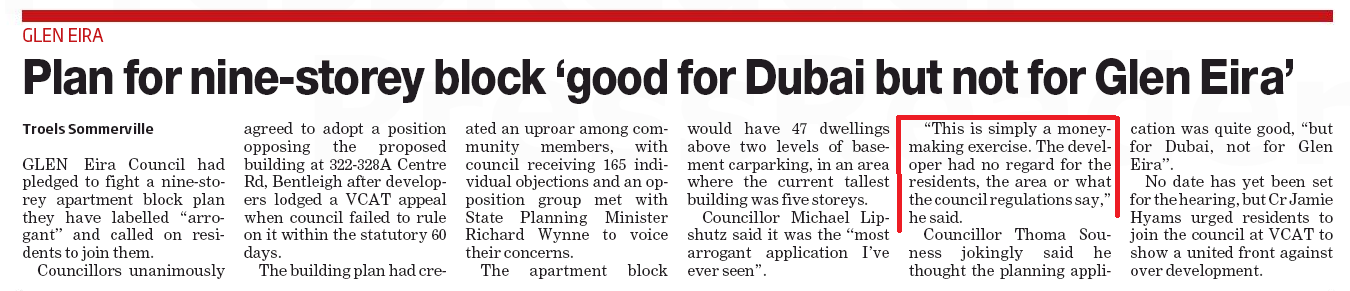
  • 9 storey for Centre Road – unanimous refusal
  • Bent Street – permit (Lobo voting against)
  • Centre Road 5 storey and 63 units – permit
  • Murrumbeena 4 double storeys – permit
  • Nicholson Street Bentleigh – permit

Watch this space for our reports on what happened!

Item 9.2 – Centre Road/Browns Road, Bentleigh East.

Application is for a part 3 and part 5 storeys building and 67 dwellings. Officer recommendation is ‘up to 63 dwellings’. Of the 67 proposed dwellings 60 are to be single bedroom apartments, 6 double bedroom apartments and one 3 bedroom apartment. Officer recommendation is to ‘amalgamate’ some of these so that another 3 two bedroom apartments are created and one additional 3 bedroom apartment in the revised dwelling numbers of 63 units.

Whilst this represents an interesting new position in that this is the first time we remember an officer’s report commenting specifically on the issue of ‘diversity’ and imposing conditions that will only marginally increase the number of 2 and 3 bedroom apartments, we remind readers of the following comments made by our wonderful councillors in previous decisions. Once again the question of consistency and arguably integrity (depending on who the applicant is) raises its ugly head.

HYAMS on the MRC Amended Plan for Caulfield Village where 3 bedroom apartments were gutted to create more single bedroom units so that just on 61% of the proposed 463 dwellings got the nod to be single bedroom dog boxes – “I don’t know that there needs to be that diversity in every site – there needs to be diversity across Glen Eira’. . So even though there will be many one and two bedroom places there are ‘family sites around the area’ so that’s the diversity.

PILLING (on same item) – On profit council has to look at the ‘planning process’. 26 3 bedroom places ‘are a plus’ but’ not for us to determine’. Said that council ‘can encourage but we can’t actually have that law’. And this also applies to ‘social housing’. This will ‘happen’ at some point and ‘it’s up to the developer to provide it’ even though council might like it in ‘every part of the development’. Just because council doesn’t ‘like’ it isn’t enough reason to vote against. Council has to make its decisions on ‘good planning’ processes such as the planning scheme, incorporated plan and development plan.

OKOTEL (same item) – was ‘concerned’ about the reduction of three bedroom apartments but she accepts that these could ‘be difficult to sell’ and ‘nobody wants to see vacant dwellings’ especially when ‘there is such a need for housing’. ‘It’s better that apartments are built and purchased’.

The above quotes speak for themselves!


When it comes to the MRC, Council turns a blind eye again and again.

Two days ago the CMFEU had their annual picnic day at the racecourse. Contrary to the so called ‘agreement’ –

  • Cars were parked in the centre of the racecourse – a definite ‘no-no’
  • No traffic wardens to manage the mayhem – although radio reports kept warning motorists to stay clear of the area
  • No warning to residents
  • No clarity as to whether this constitutes a ‘major’ event or not?
  • In short, council simply lets the MRC do whatever it wants, whenever it wants.

029

The Caulfield Village is now really taking shape along Station St and residents should not be surprised to find that what was supposed to be a 5 storey building (according to the Incorporated Plan of 2011) became a 6 storey building with the Development Plan. Please also note how balconies are now allowed to intrude as far as they like into the setbacks – courtesy of another Amendment that was gleefully promoted by council. We can hardly wait for all the other cave-ins to occur when the next set of Development plans come in for the remaining two precincts. Well done council for selling out residents completely!

005

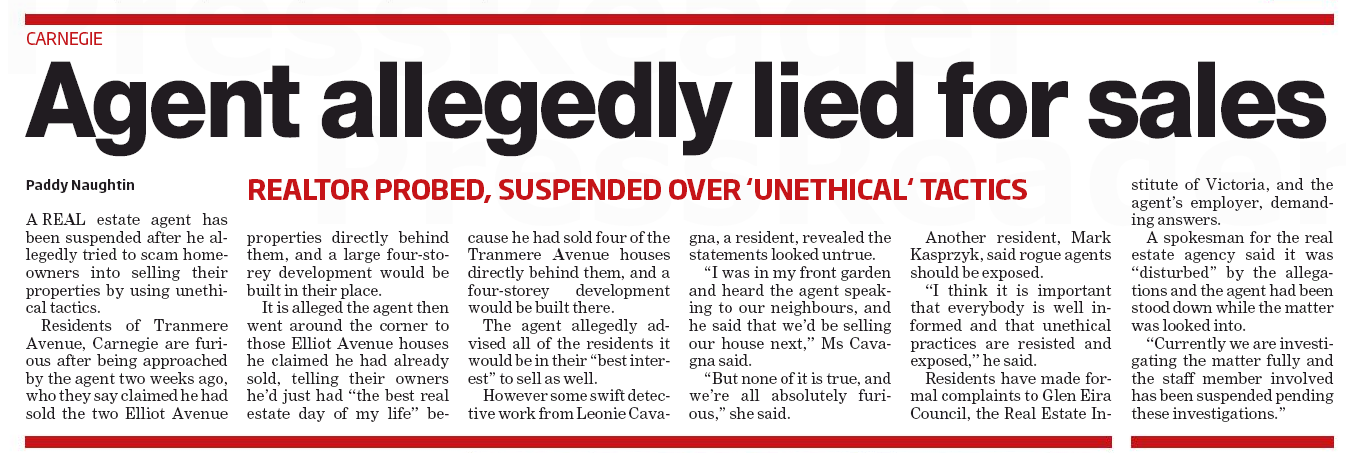
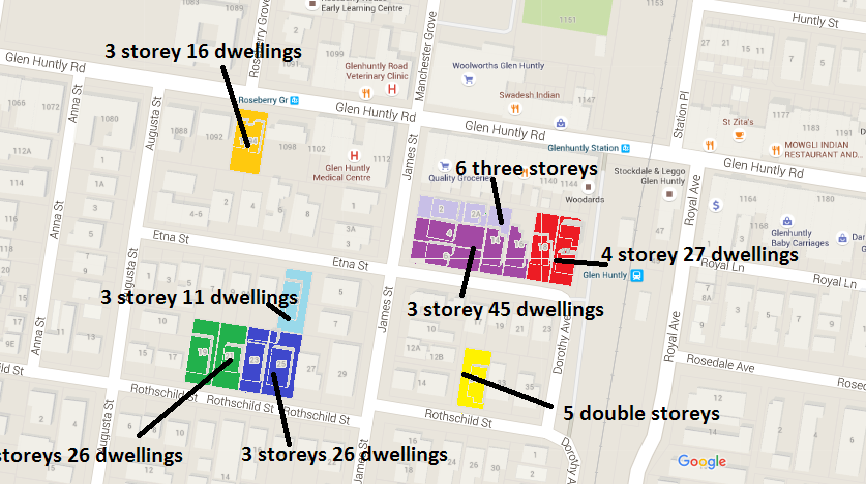
We are revisiting the carnage that is taking place in Carnegie because a definite trend is developing throughout the municipality. Once a particular street is gone, then developers move onto the next street – knocking on doors and attempting to entice residents to sell. Now that Bent Street in Bentleigh is gone, the vultures are moving into Vickery. In Carnegie, Elliott Avenue is lost, so now the next profit making venture is Tranmere. Within two months of purchasing properties there, applications have gone in. The box below indicates those properties which have been sold but an application has yet to be submitted. The same for the next street along – Hewitts Road.

We have already depicted what is happening along Neerim Road. The image below reveals in all its gory detail what is happening in the surrounding local streets. This is not planning. This is incompetence and indifference and one might even argue utter negligence. When just under 500 dwellings are crammed into 4 blocks with no consideration of traffic, open space, drainage, water tables, and general mayhem for residents as a result of all this cumulative building, and all done in secret and by stealth and collusion, then all these councillors must be held to account. What is even more unforgivable, is knowing that this is happening and refusing to do anything to ameliorate the damage – except of course to blame VCAT and the State Government for their own incompetence and unwillingness to do what should have been done ten years ago – structure planning, design and development overlays, parking precinct plans, development contributions levy, and a fair dinkum review of the planning scheme.

CLICK TO ENLARGE IMAGE

latest carnegie

Untitled

adad2

PS: we’ve revisited Amendment C106 which rezoned part of the heritage overlay to Public Utility Zone (Education). There were several objectors to this rezoning, so a Planning Panel was held. The amendment was basically to facilitate the proposed Monash redevelopment which includes the Caulfield Plaza (supermarket) and the construction of 800+ student accommodation residences.

The Planning Panel endorsed the proposed amendment. However some extracts from this panel report are important. They reveal once again how this council can promise the earth (ie reviewing its archaic policies) and years later nothing has happened. We also note that under this zoning of PUZ, buildings DO NOT REQUIRE A PERMIT! This of course was never mentioned in council chamber!

Here are some extracts from the Panel Report. Please note the various dates, and the continued litany of broken promises –

Derby Road shopping centre, noted in the Glen Eira Heritage Management Plan 1996 as being ‘significant at the metropolitan level as a predominantly post‐Federation shopping street….’;

The Amendment does not propose any change to properties affected by the Heritage Overlay. Council will continue to apply existing heritage planning controls and guidance as per the current Heritage Overlay, Heritage Policy and ‘Derby Road Draft Heritage Guidelines June 2003’ as part of the consideration of future proposals for buildings and works at 16‐28 Derby Road.

Council noted that this Policy is based on an urban design framework approved in 1998. Council is looking to review this policy in 2014, together with a number of other local policies.

If approved, the Public Use Zone will allow the development of buildings for educational purposes without the need for a planning permit. The exception to this is the properties at 16‐28 Derby Road, which will require permits for buildings and works due to their location within the Heritage Overlay

Sundry issues raised by objectors include the loss of Council revenue that would result from the rezoning to Public Use (Education); perceived loss of the heritage overlay for some Derby Road properties; urban design issues associated with development of the University campus; and a lack of planned streetscape improvements to Derby Road.

In their written submission, the Council noted that the relevant Clause 22.01 – Phoenix Precinct Policy of the Glen Eira Planning Scheme is based on an urban design framework and that preferred uses for sites facing Derby Road are in accordance with the Derby Road Action Plan 1998 but that the Council is looking to review this policy in 2014

Lastly, the issue of streetscape improvements in Derby Road is beyond the scope of this Amendment but the Panel notes the Council’s intention to review the urban design framework and assumes that the streetscape will form part of that review.


True to form, the MRC continues with its money making ventures to the detriment of local residents – ably supported by council, by government, and by the pen pushers in the department. The latest outrages are:

  • Another rock concert in early December
  • This in combination with the month long circus
  • Another appeal by the MRC to VCAT over council’s refusal on the 30 plus radio towers
  • The department’s (and government’s) collusion in more compliance with MRC wishes
  • The failure to publish agenda items and minutes for the last Trustee meeting – despite the Auditor General’s report
  • The failure of council reps to utter a single word about what is going on
  • More than a year down the track since the Auditor General’s report and no visible signs of improvement in governance, access to the course, and the MRC giving a damn about the local community
  • Years down the track and not a whisper about the removal of training and the removal of fences as per original ‘agreement’.
  • And now we have Chanukah in the park with the prospect of fireworks. So much for the argument that ‘noise’ and horses don’t mix, therefore we have to keep the fences up to avoid horses bolting.

Thankfully divine providence may have intervened in blowing down the ramshackle fences along Queen’s Avenue – those very fences that were supposed to be removed ages ago and with council sharing the cost! See photos below.

Of far greater significance is this response to a complaint to the Minister in relation to the department’s removing all previous conditions it imposed on the granting of a permit for the outdoor cinema – namely – (a) trustee approval (b) land used to be under lease agreements and (c) current lease agreement in place. At the subsequent VCAT hearing which was appealed by a resident, the MRC magically pulled a new and undated letter from the department out of its bag of tricks. This new letter simply removed all of the earlier imposed conditions, making the granting of the permit a certainty. How convenient! How timely and how disgusting!

A complaint was then sent off to Minister Neville asking:

  • Why earlier conditions had been removed
  • Why an official letter was undated
  • Whether this was granted with ministerial approval
  • What was government doing in relation to the Auditor General’s report which was now over a year old

The full response is published here plus the pdf version

minletter_Page_1minletter_Page_2minletter_Page_3

Readers might also like to envisage what their land could look like once the decrepit, never maintained fences are permanently removed.

IMG_4984d

IMG_4985d

IMG_4988d

« Previous PageNext Page »